Fra Angelico.jpg)
 by Tom Gurney
Tom Gurney BSc (Hons) is an art history expert with over 20 years experience
Published on June 19, 2020 / Updated on November 29, 2026
Email: tomgurney1@gmail.com / Phone: +44 7429 011000
Introduction
Gabriel lifts a hand towards Mary, who bows with her arms crossed. Between them, an open doorway draws the eye into a walled garden. The encounter occupies a panel less than forty centimetres high, yet it contains two voices across centuries. Isaiah’s words run along the top and Gabriel’s announcement from Luke along the bottom. This is the Annunciation from the Armadio degli Argenti, the painted cabinet made to protect precious offerings at the Florentine church of Santissima Annunziata. [1] [2] [3]
At a Glance
- ArtistFra Angelico and assistants, as catalogued by the Italian Ministry of Culture. [1]
- DateAbout 1450–53, according to the Italian national catalogue. [1]
- MediumTempera and gilding on wood. [1]
- Dimensions38.5 × 37.5 cm (height × width), according to the Italian national catalogue. [1]
- CollectionMuseo di San Marco, Florence, inv. 1890, no. 8489. [1] [4]
- PositionThe second compartment from the left in the top row of the first surviving board, national catalogue no. 0900191187A-2. [1] [2]
- Original settingThe cabinet for precious votive offerings at Santissima Annunziata, Florence, commissioned by Piero di Cosimo de’ Medici. [2] [5]
Where the Annunciation sits on the cabinet
The Annunciation is the middle scene of the top row on the first surviving board, now in the Museo di San Marco in Florence. The board has nine compartments in three rows. The Vision of Ezekiel sits to the left, and the Nativity follows on the right. The Italian national catalogue dates the scene to about 1450–53 and credits Fra Angelico and assistants. It lists the compartment at 38.5 × 37.5 cm, while the Fondazione Federico Zeri gives a width of 37 cm and a date range of 1448–52. The Zeri archive also traces the panel from the Santissima Annunziata to the Accademia and then to San Marco. [1] [2] [3] [4]
Piero di Cosimo de’ Medici commissioned the painted covering for a cabinet in the Servite church. It held valuable votive gifts, including silver objects offered at the church’s venerated fresco of the Annunciation. The small scene thus repeated a subject that already had a particular significance for the people who had given the objects inside. A document cited in the national catalogue records a window to be fitted above the cabinet in 1453, placing it in the chapel by that year. In a poem dedicated to Piero in 1468, the Dominican friar Domenico da Corella describes the painted covering concealing the silver vessels, a detail that captures how the paintings were seen in use. [2] [3] [5]
The square board seen today belongs to a work that was altered and dismantled. Andrea De Marchi’s reconstruction, discussed by Gerardo de Simone, proposes two tall original doors, each two compartments wide. The doors were later adapted into a covering that could be lifted, and the paintings were subsequently cut into smaller groups. The nine scenes now seen together preserve the opening sequence, while the reconstruction gives a sense of what has been lost: the relation of the painted episodes to the action of opening and closing the cabinet. [2] [3]
Gabriel and Mary on either side of the doorway
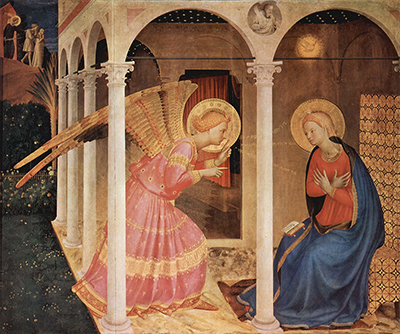
Gabriel kneels at the left in a pink robe edged with gold. The fabric gathers at his raised knee and trails across the paving. His wings sweep out behind him in red, blue and yellow bands, and one hand rises clear of his body against the grey wall. Mary inclines her head on the right, her hands folded against her chest. Her blue mantle falls over her pink dress and spreads towards the edge of the panel. A low wooden stool stands nearby. The two figures face one another across a broad stretch of floor, so the angel’s raised fingers and Mary’s crossed hands register clearly even at this small scale. [1] [3] [4]
The side arcades frame the figures and lead the eye away from them. The nearest columns rise from low parapets, and the arches diminish towards the wall across the back. At its centre the open doorway reveals a path leading to a further opening. The dark passage is flanked by the lighter stonework of the two arcades. Above the wall, slender trees and terracotta pots are silhouetted against the sky, where the small dove of the Holy Spirit is easy to miss. On the ground the gestures carry the exchange from left to right. The building and the dove draw attention into the depth and height of the scene. [1] [3] [4]
De Simone sees a resemblance between the painted arcades and the architecture beside the cabinet’s original chapel, especially the curled capitals of the nearby Chiostrino dei Voti. He also reads the enclosing wall and doorway in light of Ezekiel’s vision of the Temple, whose eastern gate admits the glory of the Lord and is then to remain closed (Ezekiel 43–44). In his account, the glimpse beyond the doorway evokes the enclosed garden and sealed fountain of the Song of Songs (4:12), traditionally associated in Christian interpretation with Mary’s virginity. The garden’s partial visibility matters to this reading. Its trees rise into view, but the path leading to it is available only through the narrow central opening. [3]
A comparison brings out the unusual openness of Angelico’s doorway. In Domenico Veneziano’s Annunciation from the predella of the St Lucy Altarpiece, now at the Fitzwilliam Museum, the receding lines converge on a bolted garden door. De Simone draws attention to the resemblance between the two courtyards. The Fitzwilliam panel makes the garden’s closure emphatic. In the cabinet scene the opening is ajar, and the eye can travel beyond the wall at the moment the angel speaks. [3] [6]
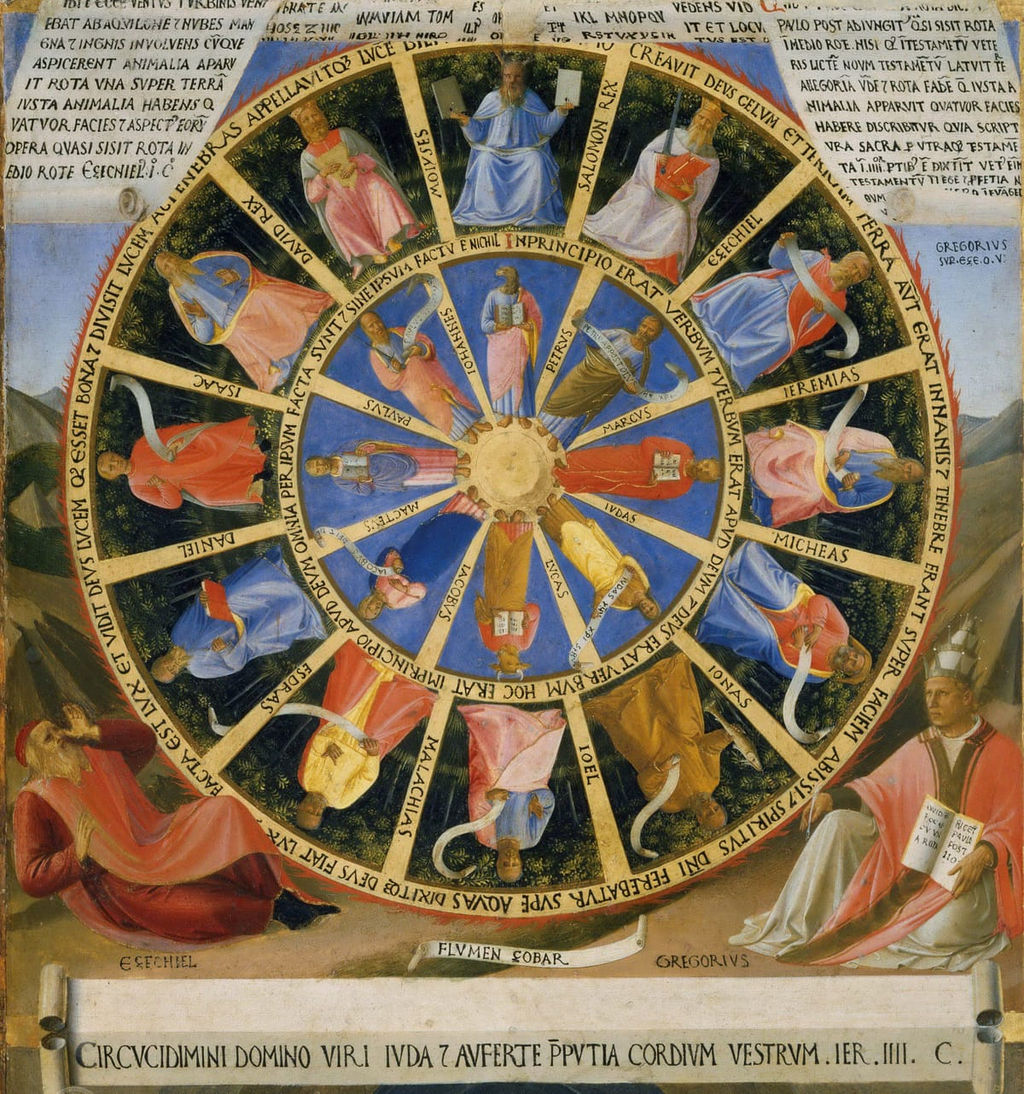
The Mystic Wheel, 0900191187A-1. The painted spokes connect differently positioned witnesses and writers. Image source. Public domain. Proportional web resize.
Isaiah above, Luke below
The Latin inscription across the top is from Isaiah 7:14. It foretells that a virgin will conceive and bear a son named Emmanuel. Below, Luke 1:31 gives Gabriel’s words directly to Mary, telling her that she will conceive, bear a son and name him Jesus. Both bands begin with Ecce, an invitation to behold what follows. The likeness extends to conception, birth and naming. Isaiah speaks of the woman in the third person. Luke changes the address to the second person, making the same sequence immediate in Gabriel’s words to Mary. Her reply comes later in Luke’s account, and the painter lets her bowed head and crossed arms carry her response within the scene. [3] [7] [8]
The bands resemble scrolls, with their ends curling back at the corners. The eye can read them in succession or pause on the picture between them. The upper text names a promise, the lower one supplies the words of the encounter, and the gestures give those words a human exchange. Cyril Gerbron relates the cabinet’s arrangement of writing and pictures to Christian typology, a way of reading earlier scriptures in relation to the Gospel. He points to an illustrated manuscript in Venice that pairs the announcement of Samson’s birth with Gabriel’s visit to Mary and gives the same verses of Isaiah and Luke. On the cabinet the two verses are brought together around a single picture, so the viewer makes the comparison through the written lines. At the upper left of the board, Ezekiel’s two concentric wheels set out that relationship as a diagram. The Annunciation asks the viewer to make the connection through one event, before the Nativity brings the promised child into view. [3] [9]
Looking closely at the painted surface
Scientific examination of the nine-scene board has used imaging and spectroscopy to distinguish pigments that can appear similar to the eye. The exhibition Art from Inside published a map of the board’s principal pigments, including lead white, vermilion, red lake and ultramarine from lapis lazuli. These are findings for the board as a whole. On the Annunciation itself, the colour is most conspicuous in the striped wings and the two figures’ drapery. Their saturated passages stand out against the comparatively quiet stone and leave the centre visually clear for Gabriel’s hand and the view through the doorway. [1] [4] [10]
The small scale also shaped the work of conservator Silvia Verdianelli. In an account for Palazzo Strozzi and the Museo di San Marco, she describes cleaning the cabinet panels under high magnification, working through yellowed varnish, overpaint and later retouching. That account concerns the group of panels. The minute lettering and the narrow bands of colour on Gabriel’s wings give some idea of the scale at which the conservator had to distinguish later material from original paint. [11]
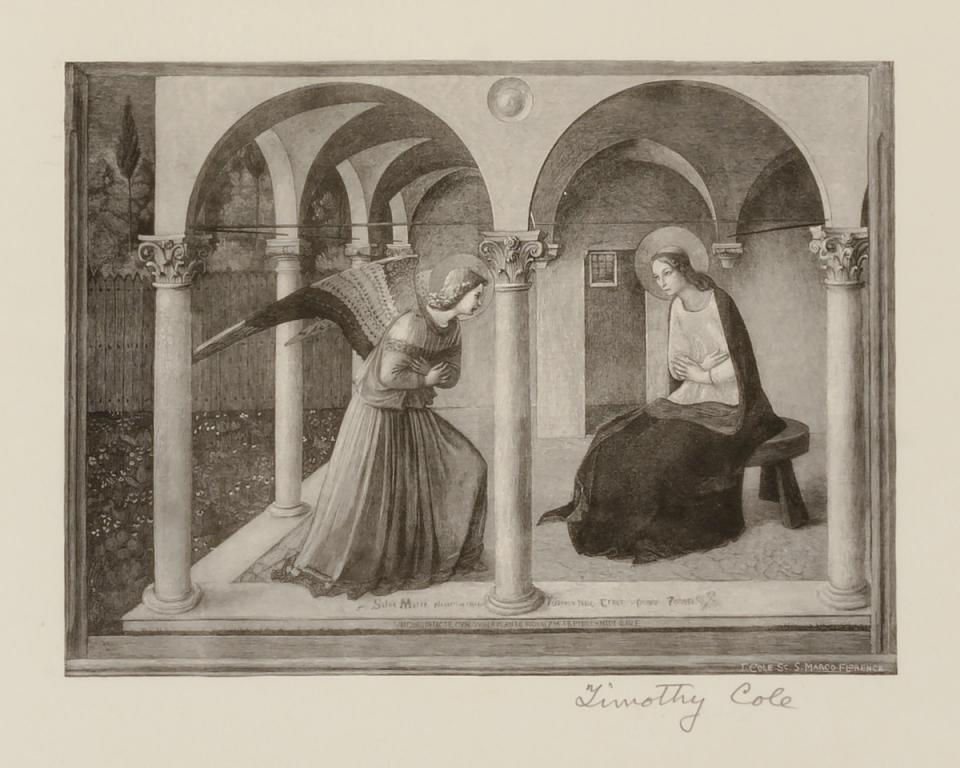
Timothy Cole’s wood engraving after the San Marco corridor Annunciation. Smithsonian American Art Museum 1974.39.24. Smithsonian American Art Museum. Image source. CC0 / Public domain. Proportional web resize.
How Angelico changed the setting in other Annunciations
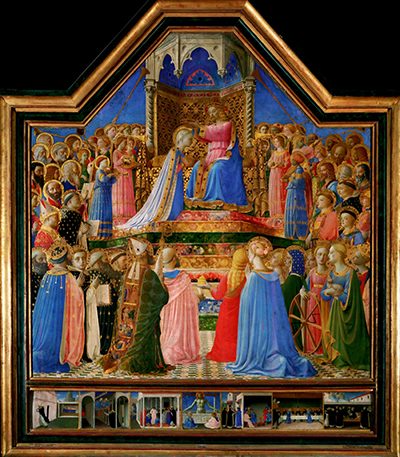
In the Prado altarpiece, painted for San Domenico in Fiesole, Adam and Eve are expelled from Eden at the left while Gabriel approaches Mary under a portico at the right. The two episodes share the painted world, placing the Fall and the Christian promise of redemption within one view. The cabinet scene keeps the courtyard for Gabriel and Mary. Its connection across the Testaments runs vertically through the two written bands. At Cortona, gold words pass through the painted space between the figures, including Mary’s reply. On the cabinet the two bands begin and end at the margins of the scene, so the reader can return to them independently of the figures’ gestures. [3] [12] [13] [14]
The corridor fresco at San Marco uses a different kind of address. Its painted loggia meets the friar rounding the stair at the entrance to the dormitory, and the lettering below asks the passer-by to say an Ave. The Cell 3 fresco places Saint Peter Martyr to the side as a witness to the exchange in a room intended for a single friar. All three are now encountered at San Marco, but the cabinet scene was made for the Servite shrine across Florence. Its nearest companions are the pictures on either side, one teaching the viewer how to read the sequence and the other carrying the story forward. [3] [15] [16]
Fra Angelico artworks directory
Explore documented works and surviving parts of larger ensembles. Catalogue links identify individual records. Attribution and dating can vary across collections and publications. Search the Federico Zeri Photo Archive by artist.
| Name | Date | Medium and sources |
|---|---|---|
| Adoration of the Magi | About 1440–60, NGA catalogue | Painting Catalogue. |
| Adoration of the Magi (Armadio degli Argenti) | About 1450–53 | Tempera and gold on wood. Catalogue. |
| Agony in the Garden (Armadio degli Argenti) | About 1450–53 | Tempera and gilding on wood Catalogue. |
| Annalena Altarpiece / Pala di Annalena | commonly c. 1435 | Tempera on panel Catalogue. |
| Annunciation (Armadio degli Argenti) | About 1450–53 | Tempera and gilding on wood. Catalogue. |
| Annunciation (Cortona) | generally placed in the 1430s; exact dating remains debated | Tempera on panel Catalogue. |
| Annunciation (Prado) | 1425–26 | Tempera on poplar panel Catalogue. |
| Annunciation (San Marco upper corridor) | commonly c. 1442 | Fresco Catalogue. |
| Annunciation with Saint Peter Martyr | About 1439–43 | Fresco on plaster. Catalogue. |
| Annunciatory Angel | 1450–55, Detroit catalogue | Gold leaf and tempera on wood panel. Catalogue. |
| Armadio degli Argenti (Silver Treasury) | principally c. 1450–52 | Tempera on panel Catalogue. |
| Arrest of Christ (Armadio degli Argenti) | About 1450–53 | Tempera and gilding on wood Catalogue. |
| Ascension (Armadio degli Argenti) | About 1450–53 | Tempera and gilding on wood Catalogue. |
| Baptism of Christ (Armadio, Alesso Baldovinetti) | About 1452–53 | Tempera and gilding on wood Catalogue. |
| Beheading of Saints Cosmas and Damian (San Marco Altarpiece) | About 1438–42 | Painted panel Catalogue. |
| Betrayal of Christ (Armadio degli Argenti) | About 1450–53 | Tempera and gilding on wood Catalogue. |
| Blessed Dominican, Possibly Jordan of Saxony (San Marco Altarpiece) | About 1438–42 | Painted panel Catalogue. |
| Blessed Vincent Ferrer (San Marco Altarpiece) | About 1438–42 | Painted panel Catalogue. |
| Burial of Saints Cosmas and Damian (San Marco Altarpiece) | About 1438–42 | Painted panel Catalogue. |
| Bust of a Cleric and a Group of Figures (recto and verso) | 15th century | Pen and ink on paper Catalogue. |
| Christ among the Doctors (Armadio degli Argenti) | About 1450–53 | Tempera and gilding on wood Catalogue. |
| Christ before Caiaphas (Armadio degli Argenti) | About 1450–53 | Tempera and gilding on wood Catalogue. |
| Christ Glorified in the Court of Heaven | About 1423–24 | Egg tempera on wood, probably poplar, with gold and silver leaf Catalogue. |
| Christ Seated in Judgment | 1447 | Fresco and gilding on plaster. Catalogue. |
| Christ Stripped of His Garments (Armadio degli Argenti) | About 1450–53 | Tempera and gilding on wood Catalogue. |
| Christ Washes the Apostles’ Feet (Armadio degli Argenti) | About 1450–53 | Tempera and gilding on wood Catalogue. |
| Circumcision of Christ (Armadio degli Argenti) | About 1450–53 | Tempera and gilding on wood. Catalogue. |
| Communion of the Apostles (Armadio degli Argenti) | About 1450–53 | Tempera and gilding on wood Catalogue. |
| Coronation of the Virgin (Armadio degli Argenti) | About 1450–53 | Tempera and gilding on wood Catalogue. |
| Coronation of the Virgin (Louvre) | Louvre: second quarter of the fifteenth century, 1425–50; often dated more narrowly c. 1434–35 | Tempera and gold on panel Catalogue. |
| Coronation of the Virgin (Uffizi) | 1431–35 | Tempera on wood, gold ground Catalogue. |
| Cortona Triptych | About 1437 | Tempera and gold on panel. Catalogue. |
| Crucifixion (Armadio degli Argenti) | About 1450–53 | Tempera and gilding on wood Catalogue. |
| Crucifixion and Saints | 1441–42 | Fresco Catalogue. |
| Deposition from the Cross / Santa Trinita Deposition | commissioned 1429–32; completed by Angelico within this period | Tempera on panel Catalogue. |
| Descent into Limbo (Armadio degli Argenti) | About 1450–53 | Tempera and gilding on wood Catalogue. |
| Entombment of Christ (San Marco Altarpiece) | About 1438–42 | Painted panel Catalogue. |
| Entry into Jerusalem (Armadio degli Argenti) | About 1450–53 | Tempera and gilding on wood Catalogue. |
| Expulsion and the Stoning of Saint Stephen | 1448–49, Vatican Museums | Fresco. Catalogue. |
| Fiesole San Domenico Altarpiece | early 1420s; predella about 1423–24 | Tempera on panel Catalogue. |
| Flagellation (Armadio degli Argenti) | About 1450–53 | Tempera and gilding on wood Catalogue. |
| Flight into Egypt | About 1450–53 | Tempera and gilding on wood. Catalogue. |
| Guidalotti Polyptych | c. 1447–49 | Tempera and oil on panel Catalogue. |
| Healing of Palladia and Saint Damian Accepting Her Gift (San Marco Altarpiece) | About 1438–42 | Painted panel Catalogue. |
| Holy Pilgrim, Possibly Saint Roch (San Marco Altarpiece) | About 1438–42 | Painted panel Catalogue. |
| Holy Women at the Tomb (Armadio degli Argenti) | About 1450–53 | Tempera and gilding on wood Catalogue. |
| Judas Receives Payment (Armadio degli Argenti) | About 1450–53 | Tempera and gilding on wood Catalogue. |
| Lamentation over Christ (Armadio degli Argenti) | About 1450–53 | Tempera and gilding on wood Catalogue. |
| Lamentation over the Dead Christ (Croce al Tempio Lamentation) | 1436–41, Zeri catalogue | Tempera and gilding on wood panel. Catalogue. |
| Last Judgement (Armadio degli Argenti) | About 1450–53 | Tempera and gilding on wood Catalogue. |
| Last Judgement (San Marco) | c. 1425–28 | Tempera and gold on panel Catalogue. |
| Last Supper (Armadio degli Argenti) | About 1450–53 | Tempera and gilding on wood Catalogue. |
| Lex Amoris (Armadio degli Argenti) | About 1450–53 | Tempera and gilding on wood Catalogue. |
| Madonna and Child with Saint Dominic and Saint Thomas Aquinas | About 1430, Hermitage catalogue | Detached fresco. Catalogue. |
| Madonna and Child with Saints | About 1411–13 | Tempera on wood panel, with a gold ground. Catalogue. |
| Madonna of Humility | About 1425, Thyssen catalogue | Tempera and gold on wood. Catalogue. |
| Madonna of the Star | 1431–34, Zeri catalogue | Tempera with oil glazes and gold on wood panel, as catalogued by the Gardner for the 2018 exhibition. Catalogue. |
| Marriage at Cana (Armadio, Alesso Baldovinetti) | About 1452–53 | Tempera and gilding on wood Catalogue. |
| Massacre of the Innocents (Armadio degli Argenti) | About 1450–53 | Tempera and gilding on wood Catalogue. |
| Miracle of the Black Leg (San Marco Altarpiece) | About 1438–42 | Painted panel Catalogue. |
| Mocking of Christ (Armadio degli Argenti) | About 1450–53 | Tempera and gilding on wood Catalogue. |
| Mystic Wheel (The Vision of Ezekiel) | About 1450–52 | Tempera and gilding on wood. Catalogue. |
| Nativity (Armadio degli Argenti) | About 1450–53 | Tempera and gilding on wood. Catalogue. |
| Niccoline Chapel frescoes | principally 1448–50 | Fresco Catalogue. |
| Noli me Tangere | broadly within Angelico’s San Marco campaign, late 1430s–1440s | Fresco Catalogue. |
| Ordination of Saint Lawrence | 1448 | Fresco. Catalogue. |
| Pentecost (Armadio degli Argenti) | About 1450–53 | Tempera and gilding on wood Catalogue. |
| Presentation of Christ at the Temple (Armadio degli Argenti) | About 1450–53 | Tempera and gilding on wood. Catalogue. |
| Presentation of Jesus at the Temple | Early 1440s | Fresco on plaster. Catalogue. |
| Raising of Lazarus (Armadio degli Argenti) | About 1450–53 | Tempera and gilding on wood Catalogue. |
| Rescue of Saints Cosmas and Damian and Exorcism of Lysias (San Marco Altarpiece) | About 1438–42 | Painted panel Catalogue. |
| Road to Calvary (Armadio degli Argenti) | About 1450–53 | Tempera and gilding on wood Catalogue. |
| Saint Anthony Abbot (San Marco Altarpiece) | About 1438–42 | Painted panel Catalogue. |
| Saint Bernard of Clairvaux or Saint Benedict (San Marco Altarpiece) | About 1438–42 | Painted panel Catalogue. |
| Saint Damian Receives Money from Palladia | About 1425–49 | Tempera and gilding on wood. Catalogue. |
| Saint Francis and a Bishop Saint, Saint John the Baptist and Saint Dominic | Late 1420s, Getty catalogue | Tempera and gold leaf on panel. Catalogue. |
| Saint James the Greater Freeing the Magician Hermogenes | About 1426–29 | Tempera and gold on panel Catalogue. |
| Saint Jerome (San Marco Altarpiece) | About 1438–42 | Painted panel Catalogue. |
| Saint Lawrence Giving Alms | About 1448 | Wall fresco. Catalogue. |
| Saint Lawrence Receiving the Treasures of the Church from Pope Sixtus II | About 1448–49 | Fresco on plaster. Catalogue. |
| Saint Romuald (San Marco Altarpiece) | About 1438–42 | Painted panel Catalogue. |
| Saint Stephen Addressing the Council | 1448–49, Vatican Museums | Fresco. Catalogue. |
| Saint Stephen Preaching | 1448–49, Vatican Museums | Wall fresco. Catalogue. |
| Saint Thomas Aquinas (San Marco Altarpiece) | About 1438–42 | Painted panel Catalogue. |
| Saints Cosmas and Damian and Their Brothers Survive the Stake | Second quarter of the 15th century | Tempera and gilding on wood. Catalogue. |
| Saints Cosmas and Damian at the Stake (San Marco Altarpiece) | About 1438–42 | Painted panel Catalogue. |
| Saints Cosmas and Damian before Lysias (San Marco Altarpiece) | About 1438–42 | Painted panel Catalogue. |
| Saints Cosmas and Damian Rescued by an Angel | Second quarter of the 15th century | Tempera and gilding on wood. Catalogue. |
| Saints Cosmas and Damian with Their Brothers before Proconsul Lysias | Second quarter of the 15th century | Tempera and gilding on wood. Catalogue. |
| San Marco Altarpiece / Pala di San Marco | 1438–43 | Tempera on panel Catalogue. |
| San Pietro Martire Triptych | About 1422–23, Strozzi exhibition | Tempera and gold on panel. Catalogue. |
| Scenes from the Lives of the Desert Fathers (Thebaid) | About 1420, Uffizi catalogue | Tempera on wood. Catalogue. |
| Sixteen Prophets | 1447 | Fresco and gilding on plaster Catalogue. |
| Stoning and Shooting of the Brothers (San Marco Altarpiece) | About 1438–42 | Painted panel Catalogue. |
| Tabernacle of the Linaioli | 1433–35 | Tempera on panel Catalogue. |
| The Attempted Crucifixion and Stoning of Saints Cosmas and Damian | Second quarter of the 15th century | Tempera and gilding on wood. Catalogue. |
| The Crucifixion | About 1420–23, Met catalogue | Tempera on wood, gold ground. Catalogue. |
| The Death and the Assumption of the Virgin | 1424–34 | Tempera with oil glazes and gold on panel Catalogue. |
| The Dominican Blessed (left end) (Fiesole predella) | About 1423–24 | Egg tempera and gold on wood Catalogue. |
| The Dominican Blessed (right end) (Fiesole predella) | About 1423–24 | Egg tempera and gold on wood Catalogue. |
| The Entombment of Christ | About 1450 | Tempera on poplar panel. Catalogue. |
| The Forerunners of Christ with Saints and Martyrs | About 1423–24 | Egg tempera on wood (probably poplar), with gold and silver leaf. Catalogue. |
| The Funeral of Saint Anthony Abbot | About 1426–30 | Tempera on poplar panel. Catalogue. |
| The Martyrdom of Saints Cosmas and Damian | About 1425–49 | Tempera and gilding on wood. Catalogue. |
| The Mocking of Christ / Christ Mocked | within the San Marco dormitory campaign, broadly late 1430s–1440s | Fresco Catalogue. |
| The Nativity | About 1425, Minneapolis catalogue | Tempera on poplar panel. Catalogue. |
| The Nativity in Cell 5 at San Marco | About 1439–43 | Fresco on plaster. Catalogue. |
| The Penitent Saint Jerome | 1419–20 | Tempera on wood panel Catalogue. |
| The Virgin and Child by Fra Angelico (Fogg Museum) | About 1430, Harvard catalogue | Tempera originally on panel, subsequently transferred to Masonite. Catalogue. |
| The Virgin Mary with the Apostles and Other Saints (Fiesole predella) | About 1423–24 | Egg tempera and gold on wood Catalogue. |
| Transfiguration (Armadio, Alesso Baldovinetti) | About 1452–53 | Tempera and gilding on wood Catalogue. |
| Transfiguration (San Marco Cell 6) | within the San Marco dormitory campaign, broadly late 1430s–1440s | Fresco Catalogue. |
| Virgin Mary Annunciate | 1450–55, Detroit catalogue | Gold leaf and tempera on wood panel. Catalogue. |
| Virgin of the Pomegranate | About 1426 | Tempera on panel with gilding Catalogue. |
Frequently Asked Questions
Discussion
Use these prompts to look again or share an observation.
Reader Insights
Look through the painted doorway before returning to Gabriel and Mary. What does the view beyond it add to the encounter?
Read Isaiah above and Luke below. How does the change of speaker affect your reading of the figures between them?
Join the Conversation
Share a detail or question about Annunciation (Armadio degli Argenti).
References
- Ministero della Cultura, Annunciazione, national catalogue no. 0900191187A-2 and linked measurement and technical records (in Italian),. View source.
- Ministero della Cultura, Episodi del Nuovo Testamento, first Armadio board, national catalogue no. 0900191187A-0 (in Italian),. View source.
- Gerardo de Simone, “Un’iconostasi di ‘figure piccole’ del Beato Angelico. L’Armadio degli Argenti per la Santissima Annunziata”, in Beato Angelico. Storie dell’infanzia di Cristo, 2023, pp. 35–64, especially pp. 35–39, 50–51 and Appendix I, scene 2 (in Italian),. View source.
- Fondazione Federico Zeri, Guido di Pietro, Annunciazione, artwork record 11610 (in Italian),. View source.
- Museo di San Marco, “Beato Angelico ‘eccellente pittore e miniatore’”, section on the Armadio degli Argenti (in Italian),. View source.
- The Fitzwilliam Museum, Domenico Veneziano, The Annunciation, no. 1106,. View source.
- Holy See, Nova Vulgata, Isaiah 7:14 (in Latin),. View source.
- Holy See, Nova Vulgata, Luke 1:26–38 (in Latin),. View source.
- Cyril Gerbron, “Le Christ est une page. Exégèse et mémoire dans l’armadio degli argenti de Fra Angelico”, Histoire de l’art 71, 2012, pp. 51–62 (in French),. View source.
- Fondazione Bracco, Art from Inside, dossier, “Beato Angelico. Un arcobaleno sull’armadio del tesoro” and the principal pigment map (in Italian),. View source.
- Silvia Verdianelli and Fondazione Palazzo Strozzi, Racconti di restauro: Armadio degli Argenti, 2026, published account of the intervention (in Italian),. View source.
- Museo Nacional del Prado, “The Museo del Prado presents The Annunciation by Fra Angelico after its restoration”, 2019, press dossier, pp. 1–3 and 7,. View source.
- Comune di Cortona, Museo Diocesano di Cortona, collection overview (in Italian),. View source.
- Lasse Hodne, “Reading and Viewing Words in Fra Angelico’s Typological Paintings”, Acta ad archaeologiam et artium historiam pertinentia 24, 2011, “Speech and Writing in Fra Angelico’s Cortona altar-piece”,. View source.
- Museo di San Marco, “L’Angelico a San Marco raccontato da Padre Marchese. Quinta puntata: l’Annunciazione e gli affreschi del dormitorio”, including the corridor inscription (in Italian),. View source.
- Ministero della Cultura, Annunciazione, San Pietro Martire, national catalogue no. 0900283055 (in Italian),. View source.
.jpg)
 Fra Angelico.jpg)