


 by Tom Gurney
Tom Gurney BSc (Hons) is an art history expert with over 20 years experience
Published on June 19, 2020 / Updated on November 29, 2026
Email: tomgurney1@gmail.com / Phone: +44 7429 011000
Introduction
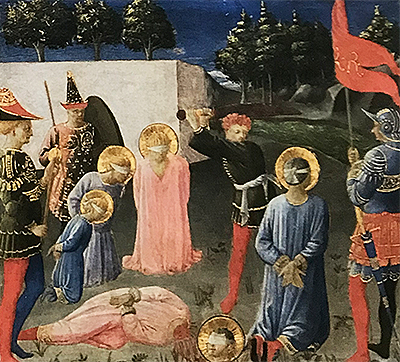
A man in pink lies across the foreground, his severed head still ringed with gold. To the right, a kneeling figure in blue waits beneath the executioner’s raised blade. The painter brings the aftermath of one blow and the moment before the next into a single scene barely wider than a handspan. This tempera and gold painting, attributed to Fra Angelico’s workshop, is the sixth of the surviving Florentine scenes associated with the Annalena Altarpiece. It is held by the Museo di San Marco in Florence. [1] [2]
At a Glance
- ArtistWorkshop of Fra Angelico, with the individual painter disputed. [1] [2] [3]
- DateSecond quarter of the 15th century, catalogued by the Italian state record as about 1425–49. [1]
- MediumTempera and gilding on wood. [1]
- DimensionsAbout 20 × 22 cm. [2]
- CollectionMuseo di San Marco, Florence, inventory 1890, no. 8486 for the Florentine group. [1]
- Catalogue numberItalian national catalogue 0900191243-7. [1]
- PositionSixth from the left on the surviving Annalena predella boards in Florence. [1]
Four figures still waiting
The body in pink is the first sign that the sentence has already been carried out on one of the brothers. Its weight runs along the bottom edge, with the hands drawn together behind the back and the haloed head resting apart. The blue figure at the right fills much the same depth of foreground but remains upright on his knees. His garment falls in long folds and gathers on the ground. The difference between the two postures makes the next moment easy to imagine. Between them, the executioner is caught mid-turn, his red-stockinged legs apart and his raised arms bringing the blade into the space above the kneeling man. [2]
Three more haloed figures form a group further back on the left. The smallest bends at the knees, while the grey-clad figure behind him inclines his head and the taller man in rose remains upright. Look from their halos to the blue figure’s and then down to the head on the ground. The same gold disc accompanies several states of the body, from waiting to kneeling to death. Pale bands over several pairs of eyes further distinguish the prisoners from the men who watch and carry out the sentence. The national catalogue names Cosmas, Damian and their brothers Anthimus, Leontius and Euprepius as the five figures. The painting gives each a place in the group without making every individual identification equally clear. [1] [2]
The scenery leaves room for these differences to register. A pale wall and dark opening sit behind the figures on the left. The wall ends near the executioner, giving way to trees, sloping ground and a strip of blue sky. The open intervals around his arms and between the kneeling figures keep the gestures legible. Even in a scene with several people crowded to the edges, the central figure has room to move and the man before him has space in which to wait. The wall suggests a boundary, but its painted fragment gives little basis for identifying a particular city or execution site. [1] [2]
The Roman standard
The soldier at the right holds a red banner above the kneeling man. The Italian catalogue records the painted letters as S.P.Q.R., the initials of Senatus Populusque Romanus, the Senate and People of Rome. Their placement matters. The soldier carries the authority for the sentence into the picture, while the executioner, dressed largely in black, performs it. The two men are close enough to belong to the same action but occupy distinct roles within it. The banner’s red also answers the red on the soldiers’ and executioner’s legs, carrying the eye between the edges and centre of the scene. [1] [2]
The standard rises at the edge of the painting, where its fabric bends and the letters cross a fold. The halos make their own sequence lower down, leading to the gold around the severed head. The painter gives the official emblem height and the saints’ marks a more persistent presence. The opposition between the two can be read through the story itself. Roman authority finally succeeds in killing the men, but the same halo that marks a living brother still surrounds the one who has died. [1] [2] [4]
Where the surviving strip ends
In Jacobus de Voragine’s Golden Legend, Cosmas and Damian practise medicine without taking payment. Their healing of Palladia and Damian’s acceptance of her gift set in motion a family quarrel that resurfaces after their deaths. Lysias, the judge in the legend, attempts to kill them and their brothers. When their ordeals fail, he orders all five beheaded under the emperor Diocletian. The account then tells how a voice instructs the Christians to bury the brothers together despite Cosmas’s earlier objection to sharing Damian’s grave. The beheading ends the brothers’ earthly lives, while the fate of their bodies brings the earlier dispute to its resolution. [4]
A predella is the strip of smaller paintings beneath an altarpiece’s main image. The six compartments now joined on two boards in Florence move from Damian accepting Palladia’s gift through the hearing before Lysias, the rescue from drowning, the failed burning, the failed crucifixion and stoning and finally the beheading. The penultimate compartment still shows a punishment that fails. The body at the foot of the sixth makes that familiar expectation of rescue impossible to sustain. The recurrent brothers link the compartments across the strip, and the four still waiting in this picture extend the story a few moments beyond its already visible outcome. [1] [4] [5]
Sixth from the left is the scene’s position on the surviving Florentine boards. The full arrangement remains open. Kunsthaus Zürich holds a small panel of the saints healing the deacon Justinian after their deaths and associates it with the same altarpiece. A separate burial scene has been proposed among the missing elements. The figure of the healer thereby gives way to the martyr in the Florence sequence, while the related Zürich picture shows how the story could resume with the saints healing after death. Above the surviving scenes, the Annalena main panel shows Cosmas and Damian standing beside the enthroned Virgin and Child. The same saints whom the small paintings place at the mercy of Lysias appear there in honour. [1] [5] [6]
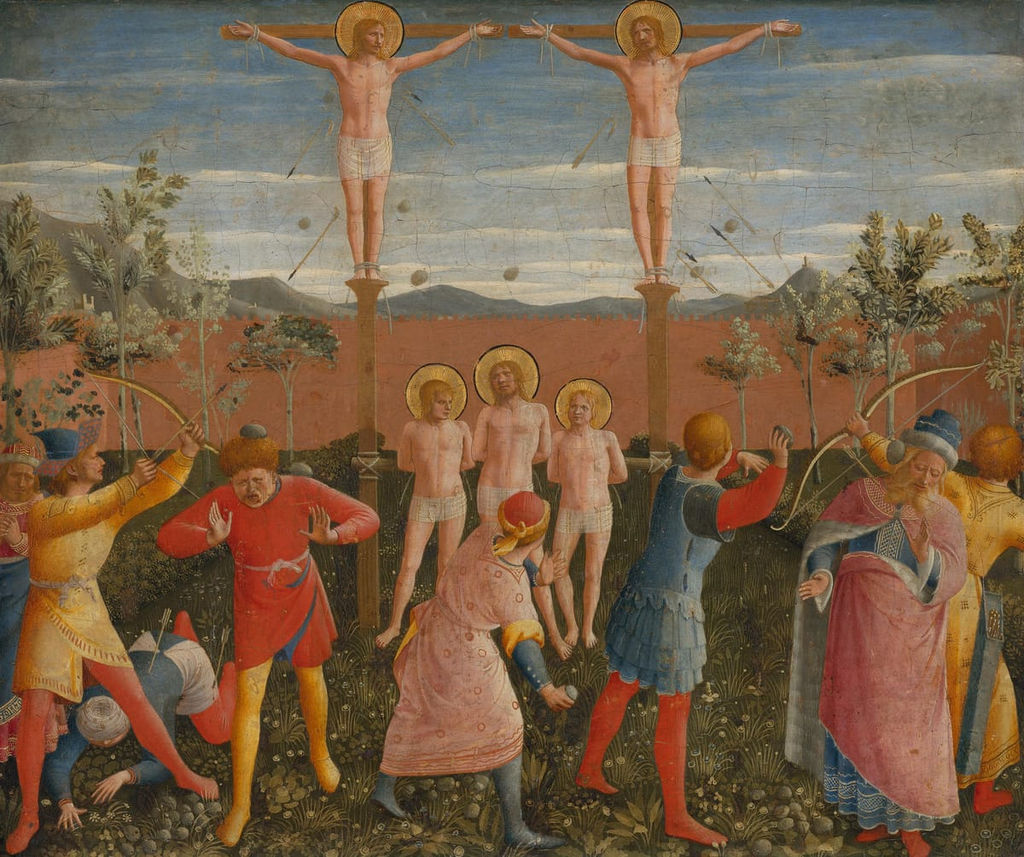
The separate San Marco high-altarpiece panel in Munich, WAF 38. The three standing men are flanked by the attackers. Image source. Public domain. Proportional web resize.
The Annalena name and the workshop
The name comes from the altarpiece’s association with the Florentine convent of San Vincenzo d’Annalena. The 2025 exhibition organised by Palazzo Strozzi and the Museo di San Marco identified Medici patronage and kept the original location open. The family chapel dedicated to Cosmas and Damian at San Lorenzo is a longstanding proposal. The prominence of the two saints in the main painting and the space given to their story below suit such a destination. The physical fit has also been questioned. The state catalogue credits Stephan Beissel with proposing the pairing of the six scenes and the main panel and records Frida Schottmüller’s objection that the small compartments were out of proportion to it. [1] [5] [7] [8]
The Fondazione Federico Zeri catalogues the beheading as workshop production and lists Zanobi Strozzi among the alternative attributions. In a 2021 study Carl Brandon Strehlke argued for Strozzi’s involvement in the predella and placed the altarpiece around 1442. The curator Angelo Tartuferi has argued for Battista di Biagio Sanguigni, comparing the drawing of curly heads in the predella with miniatures in an antiphonary for which Sanguigni was paid in 1432. The payment concerns the manuscript. The connection to the paintings depends on the resemblance Tartuferi sees across the two media. The competing readings make a workshop attribution more precise than a named hand for this compartment. [1] [2] [8] [3]
The six small scenes were recorded in the chapel of Saint Luke at Santissima Annunziata in the early nineteenth century. They entered Florence’s Accademia in 1854 and later went to the Museo di San Marco. At the museum, a storm in September 2014 damaged the main painting and predella. A diagnostic campaign preceded work by Silvia Verdianelli on the painted surfaces and Roberto Buda on the wooden supports. The museum presented the restoration in 2017. [9] [10]
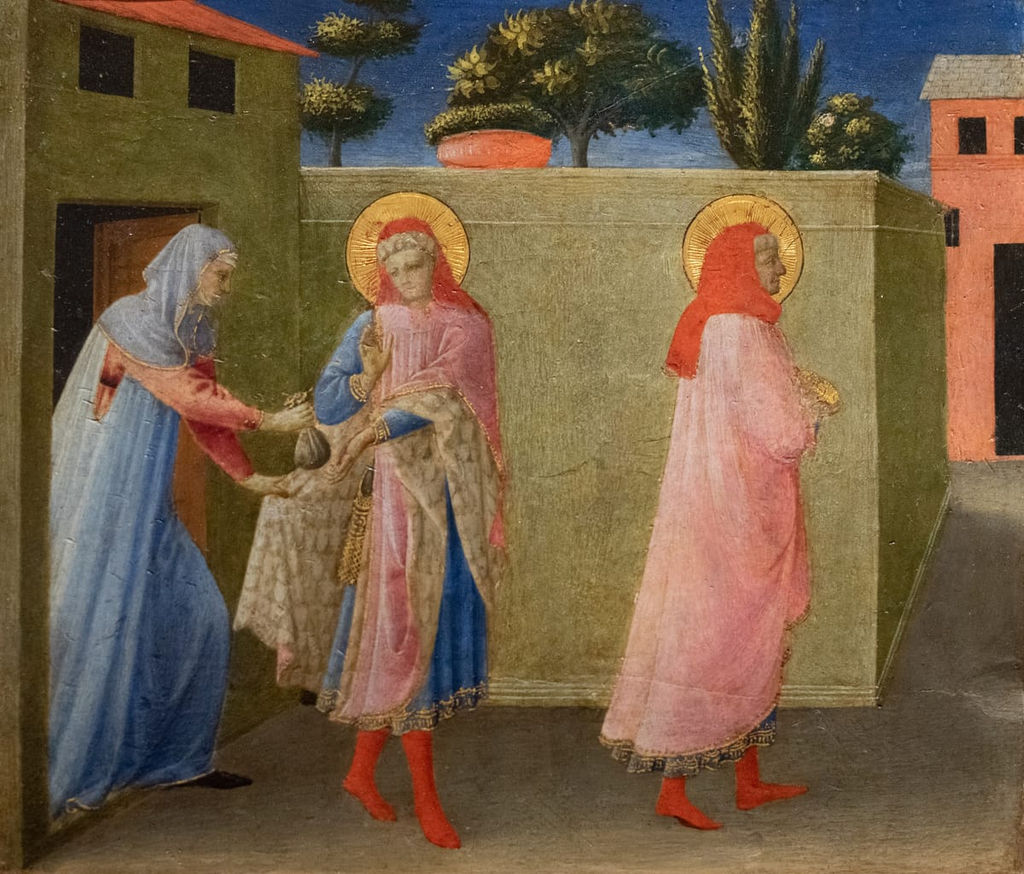
The smaller Florentine gift scene from the Annalena predella. At the right a second saint turns away from the exchange. Image source. Public domain. Proportional web resize.
A different beheading in the Louvre
Fra Angelico’s San Marco Altarpiece for the high altar of the Florentine church had a separate predella with its own beheading. That panel, now Louvre RF 340, measures 37.3 × 46.1 cm in the 2025 exhibition checklist. The Florentine compartment measures about 20 × 22 cm. In the Louvre image, tall cypresses divide a broad stretch of sky, the fortified town recedes at the left and several bodies already occupy the foreground. Here, a single fallen body leaves more of the picture to those still waiting, and the bright banner presses close to the kneeling figure. The two paintings pause at different points in the same execution. [2] [7] [11]
Fra Angelico artworks directory
Explore documented works and surviving parts of larger ensembles. Catalogue links identify individual records. Attribution and dating can vary across collections and publications. Search the Federico Zeri Photo Archive by artist.
| Name | Date | Medium and sources |
|---|---|---|
| Adoration of the Magi | About 1440–60, NGA catalogue | Painting Catalogue. |
| Adoration of the Magi (Armadio degli Argenti) | About 1450–53 | Tempera and gold on wood. Catalogue. |
| Agony in the Garden (Armadio degli Argenti) | About 1450–53 | Tempera and gilding on wood Catalogue. |
| Annalena Altarpiece / Pala di Annalena | commonly c. 1435 | Tempera on panel Catalogue. |
| Annunciation (Armadio degli Argenti) | About 1450–53 | Tempera and gilding on wood. Catalogue. |
| Annunciation (Cortona) | generally placed in the 1430s; exact dating remains debated | Tempera on panel Catalogue. |
| Annunciation (Prado) | 1425–26 | Tempera on poplar panel Catalogue. |
| Annunciation (San Marco upper corridor) | commonly c. 1442 | Fresco Catalogue. |
| Annunciation with Saint Peter Martyr | About 1439–43 | Fresco on plaster. Catalogue. |
| Annunciatory Angel | 1450–55, Detroit catalogue | Gold leaf and tempera on wood panel. Catalogue. |
| Armadio degli Argenti (Silver Treasury) | principally c. 1450–52 | Tempera on panel Catalogue. |
| Arrest of Christ (Armadio degli Argenti) | About 1450–53 | Tempera and gilding on wood Catalogue. |
| Ascension (Armadio degli Argenti) | About 1450–53 | Tempera and gilding on wood Catalogue. |
| Baptism of Christ (Armadio, Alesso Baldovinetti) | About 1452–53 | Tempera and gilding on wood Catalogue. |
| Beheading of Saints Cosmas and Damian (San Marco Altarpiece) | About 1438–42 | Painted panel Catalogue. |
| Betrayal of Christ (Armadio degli Argenti) | About 1450–53 | Tempera and gilding on wood Catalogue. |
| Blessed Dominican, Possibly Jordan of Saxony (San Marco Altarpiece) | About 1438–42 | Painted panel Catalogue. |
| Blessed Vincent Ferrer (San Marco Altarpiece) | About 1438–42 | Painted panel Catalogue. |
| Burial of Saints Cosmas and Damian (San Marco Altarpiece) | About 1438–42 | Painted panel Catalogue. |
| Bust of a Cleric and a Group of Figures (recto and verso) | 15th century | Pen and ink on paper Catalogue. |
| Christ among the Doctors (Armadio degli Argenti) | About 1450–53 | Tempera and gilding on wood Catalogue. |
| Christ before Caiaphas (Armadio degli Argenti) | About 1450–53 | Tempera and gilding on wood Catalogue. |
| Christ Glorified in the Court of Heaven | About 1423–24 | Egg tempera on wood, probably poplar, with gold and silver leaf Catalogue. |
| Christ Seated in Judgment | 1447 | Fresco and gilding on plaster. Catalogue. |
| Christ Stripped of His Garments (Armadio degli Argenti) | About 1450–53 | Tempera and gilding on wood Catalogue. |
| Christ Washes the Apostles’ Feet (Armadio degli Argenti) | About 1450–53 | Tempera and gilding on wood Catalogue. |
| Circumcision of Christ (Armadio degli Argenti) | About 1450–53 | Tempera and gilding on wood. Catalogue. |
| Communion of the Apostles (Armadio degli Argenti) | About 1450–53 | Tempera and gilding on wood Catalogue. |
| Coronation of the Virgin (Armadio degli Argenti) | About 1450–53 | Tempera and gilding on wood Catalogue. |
| Coronation of the Virgin (Louvre) | Louvre: second quarter of the fifteenth century, 1425–50; often dated more narrowly c. 1434–35 | Tempera and gold on panel Catalogue. |
| Coronation of the Virgin (Uffizi) | 1431–35 | Tempera on wood, gold ground Catalogue. |
| Cortona Triptych | About 1437 | Tempera and gold on panel. Catalogue. |
| Crucifixion (Armadio degli Argenti) | About 1450–53 | Tempera and gilding on wood Catalogue. |
| Crucifixion and Saints | 1441–42 | Fresco Catalogue. |
| Deposition from the Cross / Santa Trinita Deposition | commissioned 1429–32; completed by Angelico within this period | Tempera on panel Catalogue. |
| Descent into Limbo (Armadio degli Argenti) | About 1450–53 | Tempera and gilding on wood Catalogue. |
| Entombment of Christ (San Marco Altarpiece) | About 1438–42 | Painted panel Catalogue. |
| Entry into Jerusalem (Armadio degli Argenti) | About 1450–53 | Tempera and gilding on wood Catalogue. |
| Expulsion and the Stoning of Saint Stephen | 1448–49, Vatican Museums | Fresco. Catalogue. |
| Fiesole San Domenico Altarpiece | early 1420s; predella about 1423–24 | Tempera on panel Catalogue. |
| Flagellation (Armadio degli Argenti) | About 1450–53 | Tempera and gilding on wood Catalogue. |
| Flight into Egypt | About 1450–53 | Tempera and gilding on wood. Catalogue. |
| Guidalotti Polyptych | c. 1447–49 | Tempera and oil on panel Catalogue. |
| Healing of Palladia and Saint Damian Accepting Her Gift (San Marco Altarpiece) | About 1438–42 | Painted panel Catalogue. |
| Holy Pilgrim, Possibly Saint Roch (San Marco Altarpiece) | About 1438–42 | Painted panel Catalogue. |
| Holy Women at the Tomb (Armadio degli Argenti) | About 1450–53 | Tempera and gilding on wood Catalogue. |
| Judas Receives Payment (Armadio degli Argenti) | About 1450–53 | Tempera and gilding on wood Catalogue. |
| Lamentation over Christ (Armadio degli Argenti) | About 1450–53 | Tempera and gilding on wood Catalogue. |
| Lamentation over the Dead Christ (Croce al Tempio Lamentation) | 1436–41, Zeri catalogue | Tempera and gilding on wood panel. Catalogue. |
| Last Judgement (Armadio degli Argenti) | About 1450–53 | Tempera and gilding on wood Catalogue. |
| Last Judgement (San Marco) | c. 1425–28 | Tempera and gold on panel Catalogue. |
| Last Supper (Armadio degli Argenti) | About 1450–53 | Tempera and gilding on wood Catalogue. |
| Lex Amoris (Armadio degli Argenti) | About 1450–53 | Tempera and gilding on wood Catalogue. |
| Madonna and Child with Saint Dominic and Saint Thomas Aquinas | About 1430, Hermitage catalogue | Detached fresco. Catalogue. |
| Madonna and Child with Saints | About 1411–13 | Tempera on wood panel, with a gold ground. Catalogue. |
| Madonna of Humility | About 1425, Thyssen catalogue | Tempera and gold on wood. Catalogue. |
| Madonna of the Star | 1431–34, Zeri catalogue | Tempera with oil glazes and gold on wood panel, as catalogued by the Gardner for the 2018 exhibition. Catalogue. |
| Marriage at Cana (Armadio, Alesso Baldovinetti) | About 1452–53 | Tempera and gilding on wood Catalogue. |
| Massacre of the Innocents (Armadio degli Argenti) | About 1450–53 | Tempera and gilding on wood Catalogue. |
| Miracle of the Black Leg (San Marco Altarpiece) | About 1438–42 | Painted panel Catalogue. |
| Mocking of Christ (Armadio degli Argenti) | About 1450–53 | Tempera and gilding on wood Catalogue. |
| Mystic Wheel (The Vision of Ezekiel) | About 1450–52 | Tempera and gilding on wood. Catalogue. |
| Nativity (Armadio degli Argenti) | About 1450–53 | Tempera and gilding on wood. Catalogue. |
| Niccoline Chapel frescoes | principally 1448–50 | Fresco Catalogue. |
| Noli me Tangere | broadly within Angelico’s San Marco campaign, late 1430s–1440s | Fresco Catalogue. |
| Ordination of Saint Lawrence | 1448 | Fresco. Catalogue. |
| Pentecost (Armadio degli Argenti) | About 1450–53 | Tempera and gilding on wood Catalogue. |
| Presentation of Christ at the Temple (Armadio degli Argenti) | About 1450–53 | Tempera and gilding on wood. Catalogue. |
| Presentation of Jesus at the Temple | Early 1440s | Fresco on plaster. Catalogue. |
| Raising of Lazarus (Armadio degli Argenti) | About 1450–53 | Tempera and gilding on wood Catalogue. |
| Rescue of Saints Cosmas and Damian and Exorcism of Lysias (San Marco Altarpiece) | About 1438–42 | Painted panel Catalogue. |
| Road to Calvary (Armadio degli Argenti) | About 1450–53 | Tempera and gilding on wood Catalogue. |
| Saint Anthony Abbot (San Marco Altarpiece) | About 1438–42 | Painted panel Catalogue. |
| Saint Bernard of Clairvaux or Saint Benedict (San Marco Altarpiece) | About 1438–42 | Painted panel Catalogue. |
| Saint Damian Receives Money from Palladia | About 1425–49 | Tempera and gilding on wood. Catalogue. |
| Saint Francis and a Bishop Saint, Saint John the Baptist and Saint Dominic | Late 1420s, Getty catalogue | Tempera and gold leaf on panel. Catalogue. |
| Saint James the Greater Freeing the Magician Hermogenes | About 1426–29 | Tempera and gold on panel Catalogue. |
| Saint Jerome (San Marco Altarpiece) | About 1438–42 | Painted panel Catalogue. |
| Saint Lawrence Giving Alms | About 1448 | Wall fresco. Catalogue. |
| Saint Lawrence Receiving the Treasures of the Church from Pope Sixtus II | About 1448–49 | Fresco on plaster. Catalogue. |
| Saint Romuald (San Marco Altarpiece) | About 1438–42 | Painted panel Catalogue. |
| Saint Stephen Addressing the Council | 1448–49, Vatican Museums | Fresco. Catalogue. |
| Saint Stephen Preaching | 1448–49, Vatican Museums | Wall fresco. Catalogue. |
| Saint Thomas Aquinas (San Marco Altarpiece) | About 1438–42 | Painted panel Catalogue. |
| Saints Cosmas and Damian and Their Brothers Survive the Stake | Second quarter of the 15th century | Tempera and gilding on wood. Catalogue. |
| Saints Cosmas and Damian at the Stake (San Marco Altarpiece) | About 1438–42 | Painted panel Catalogue. |
| Saints Cosmas and Damian before Lysias (San Marco Altarpiece) | About 1438–42 | Painted panel Catalogue. |
| Saints Cosmas and Damian Rescued by an Angel | Second quarter of the 15th century | Tempera and gilding on wood. Catalogue. |
| Saints Cosmas and Damian with Their Brothers before Proconsul Lysias | Second quarter of the 15th century | Tempera and gilding on wood. Catalogue. |
| San Marco Altarpiece / Pala di San Marco | 1438–43 | Tempera on panel Catalogue. |
| San Pietro Martire Triptych | About 1422–23, Strozzi exhibition | Tempera and gold on panel. Catalogue. |
| Scenes from the Lives of the Desert Fathers (Thebaid) | About 1420, Uffizi catalogue | Tempera on wood. Catalogue. |
| Sixteen Prophets | 1447 | Fresco and gilding on plaster Catalogue. |
| Stoning and Shooting of the Brothers (San Marco Altarpiece) | About 1438–42 | Painted panel Catalogue. |
| Tabernacle of the Linaioli | 1433–35 | Tempera on panel Catalogue. |
| The Attempted Crucifixion and Stoning of Saints Cosmas and Damian | Second quarter of the 15th century | Tempera and gilding on wood. Catalogue. |
| The Crucifixion | About 1420–23, Met catalogue | Tempera on wood, gold ground. Catalogue. |
| The Death and the Assumption of the Virgin | 1424–34 | Tempera with oil glazes and gold on panel Catalogue. |
| The Dominican Blessed (left end) (Fiesole predella) | About 1423–24 | Egg tempera and gold on wood Catalogue. |
| The Dominican Blessed (right end) (Fiesole predella) | About 1423–24 | Egg tempera and gold on wood Catalogue. |
| The Entombment of Christ | About 1450 | Tempera on poplar panel. Catalogue. |
| The Forerunners of Christ with Saints and Martyrs | About 1423–24 | Egg tempera on wood (probably poplar), with gold and silver leaf. Catalogue. |
| The Funeral of Saint Anthony Abbot | About 1426–30 | Tempera on poplar panel. Catalogue. |
| The Martyrdom of Saints Cosmas and Damian | About 1425–49 | Tempera and gilding on wood. Catalogue. |
| The Mocking of Christ / Christ Mocked | within the San Marco dormitory campaign, broadly late 1430s–1440s | Fresco Catalogue. |
| The Nativity | About 1425, Minneapolis catalogue | Tempera on poplar panel. Catalogue. |
| The Nativity in Cell 5 at San Marco | About 1439–43 | Fresco on plaster. Catalogue. |
| The Penitent Saint Jerome | 1419–20 | Tempera on wood panel Catalogue. |
| The Virgin and Child by Fra Angelico (Fogg Museum) | About 1430, Harvard catalogue | Tempera originally on panel, subsequently transferred to Masonite. Catalogue. |
| The Virgin Mary with the Apostles and Other Saints (Fiesole predella) | About 1423–24 | Egg tempera and gold on wood Catalogue. |
| Transfiguration (Armadio, Alesso Baldovinetti) | About 1452–53 | Tempera and gilding on wood Catalogue. |
| Transfiguration (San Marco Cell 6) | within the San Marco dormitory campaign, broadly late 1430s–1440s | Fresco Catalogue. |
| Virgin Mary Annunciate | 1450–55, Detroit catalogue | Gold leaf and tempera on wood panel. Catalogue. |
| Virgin of the Pomegranate | About 1426 | Tempera on panel with gilding Catalogue. |
Frequently Asked Questions
Discussion
Use these prompts to look again or share an observation.
Reader Insights
Find the sword and the kneeling figure first. What does that pairing reveal about the moment the painter chose?
How do the arrangement of witnesses and the ground beneath them separate this last episode from the earlier attempts?
Join the Conversation
Share a detail or question about The Martyrdom of Saints Cosmas and Damian.
References
- Italian Ministry of Culture, Martirio di San Cosma e San Damiano, national catalogue component 0900191243-7. Catalogue record and ArCo component and position record. View source 1. View source 2.
- Fondazione Federico Zeri, Decapitazione di san Cosma e san Damiano, work 13474, with Alinari and Anderson photographs. View source.
- Museo di San Marco, “Gli ‘esordi’ di Beato Angelico al Museo di San Marco”, interview with Angelo Tartuferi, 26 October 2025. View source.
- Jacobus de Voragine, The Golden Legend, William Caxton’s translation, Temple Classics vol. 5, “Cosmo and Damian”, Fordham University Medieval Sourcebook. View source.
- Jillian Harrold, Saintly Doctors: The Early Iconography of SS. Cosmas and Damian in Italy, University of Warwick doctoral thesis, 2007, pp. 182–198, especially pp. 194–195. View source.
- Kunsthaus Zürich, Cosmas and Damian Heal the Deacon Justinian, KS 41. View source.
- Fondazione Palazzo Strozzi and Museo di San Marco, Fra Angelico, 2025 exhibition press kit, Room 3 and San Marco Altarpiece checklist. View source.
- Carl Brandon Strehlke, “Fra Angelico: Dominican Painter or Medici Painter?”, in La Pala di San Marco del Beato Angelico: Restauro e ricerche, 2021, pp. 25–26, fig. 9. View source.
- National Gallery of Art, Washington, The Healing of Palladia by Saint Cosmas and Saint Damian, provenance note 4 on the six Annalena scenes. View source.
- Museo di San Marco, “Angelico ritrovato. Il restauro della Pala di Annalena”, 10 February 2017. View source.
- Musée du Louvre, Le Martyre des saints Cosme et Damien, RF 340. View source.
.jpg)



 Fra Angelico.jpg)


