


 by Tom Gurney
Tom Gurney BSc (Hons) is an art history expert with over 20 years experience
Published on June 19, 2020 / Updated on November 29, 2026
Email: tomgurney1@gmail.com / Phone: +44 7429 011000
Introduction
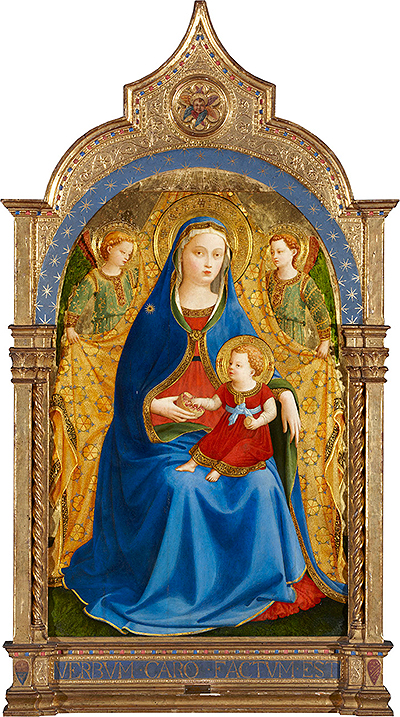
The Christ Child has both feet on his mother's blue mantle, but the rest of him is turning towards the open pomegranate in her hand. His fingers are already among the seeds. Mary holds the fruit steady while looking out towards the viewer, giving us time to notice what her son is doing. In this panel, painted around 1426 and now in the Museo del Prado in Madrid, Fra Angelico gives the child a gesture any parent might recognise. In the Prado's reading, it also foreshadows Christ's death and resurrection. [1]
At a Glance
- ArtistFra Angelico
- DateAround 1426
- MediumTempera on panel with gilding
- Dimensions87 × 59 cm, as recorded by the Prado
- CollectionMuseo Nacional del Prado, Madrid, P8233. [1]
The fruit changes hands
Start with Mary's right hand, which enters the red opening in her mantle from the left of the picture. The fingers lie under the split rind and lift it towards the child's reaching hand. He leans across his body to touch the seeds, with his red sleeve giving way to a soft white undersleeve that gathers at the wrist. His attention has moved to the left, while his bare feet still point in slightly different directions across the slope of her lap. Angelico gives that small movement enough weight that you can tell where the child is sitting and how far he has to reach. [1]
Mary's other hand hangs beside him, with a few fingers following the fall of the green lining. The arm bends around the space he occupies. It is a loose, protective gesture, and the painter has left enough room between her fingers for them to seem at rest. Her head, nearly upright, lends the group a formality the child's turning head and reaching arm keep breaking. The two faces could almost belong to different moments in a conversation. The child is absorbed in something within the picture. His mother leaves the viewer a way into it. [1]
The Prado reads the fruit in Mary's hand as an allusion to her chastity and the child's touch as a foreshadowing of Christ's death and resurrection. The red seeds exposed by the broken skin make it easy to see how the fruit could evoke the blood of the Passion. Its scale matters. From across the room you might first see the brilliant red of the child's clothes and the gold of his halo. Only on approaching do you see the red repeated in the small cluster of seeds and the fingers that are parting them. A viewer can recognise a religious emblem through an action, at the pace of looking closely at a child. [1]
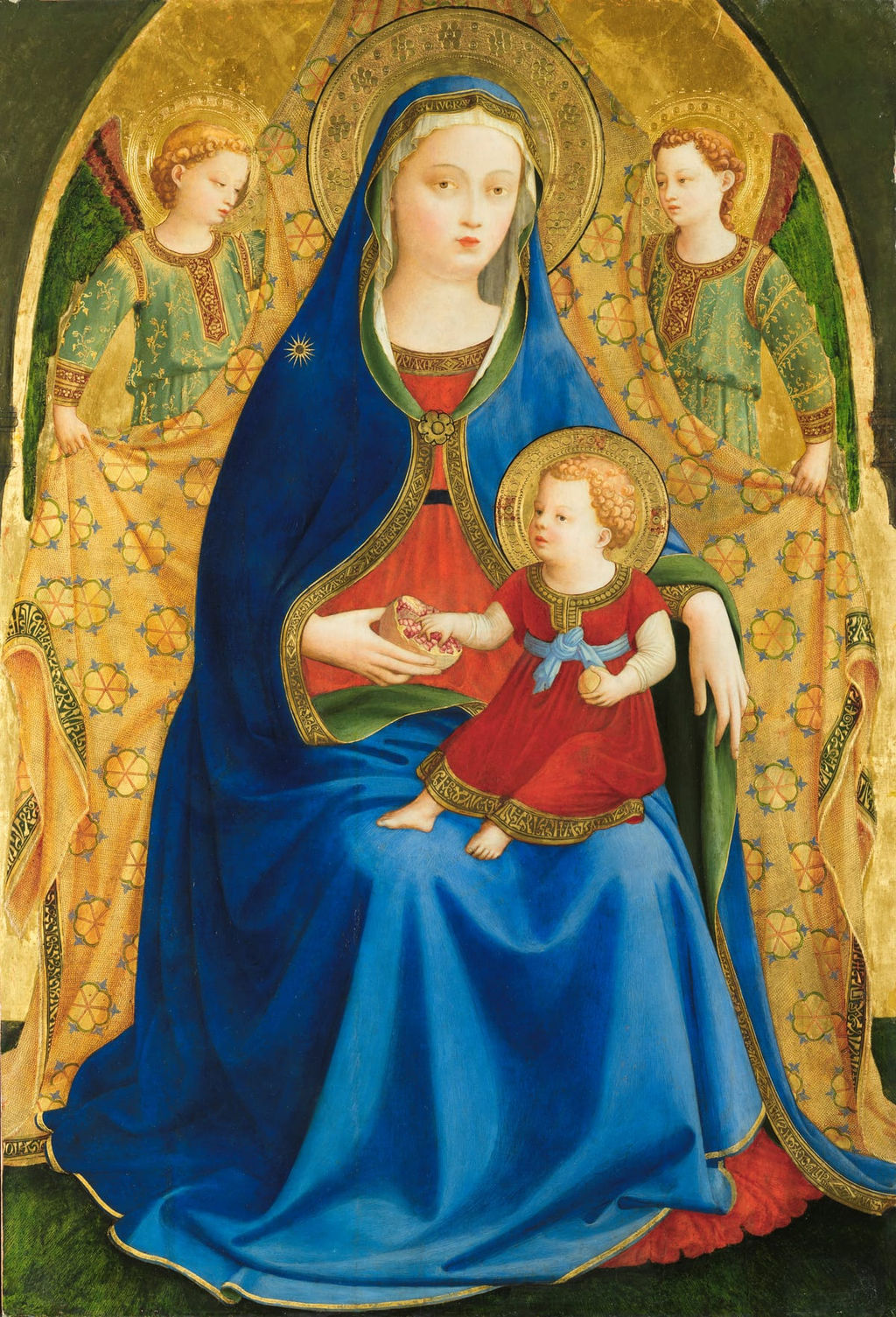
The Prado’s Virgin of the Pomegranate. The fruit, brought forward by two small gestures, sits against the red of the Virgin’s dress. Image source. Public domain. Proportional web resize.
Blue cloth, gold and a strip of grass
The blue mantle gives the painting its largest continuous shape. Near Mary's shoulder it forms an almost unbroken slope. Beneath the child it catches the light across her knees and falls into deep folds before pooling on the grass. The thin gold border makes those changes of direction especially clear. Follow it from the clasp at her chest around the open mantle. Then pick up the much longer line where the hem spreads across the ground. Between those edges the paint describes the volume of the seated figure, with cloth stretched above the knee and loose fabric folding into hollows below it. [1]
The two angels hold up a patterned cloth of honour. Their outer hands grip it beside Mary's shoulders and lift the corners, while the folds hang down beside her like a second set of borders inside the panel. Look at the small flowers on the fabric. Their spacing seems fairly regular across the broad areas, then the motifs bunch, turn or disappear where the fabric curls back on itself. The cloth forms a brilliant surface behind Mary's silhouette and gives the angels something physical to do. Their bodies sit back from her hands and the child's feet, even though there is very little distance between the figures and the edge of the picture. [1]
The depth of the scene can be read from the curved upper boundary to the bottom of the panel. At the top, the two angels fit closely into the diminishing space on either side of Mary's halo. Below, the downturned edges of their cloth leave a thin foreground where her blue hem and a piece of the red dress touch the grass. The Prado's acquisition account points out that Angelico used gold beneath that grassy area as well as in parts of the picture where it is easy to see. The gold the eye follows through halos, borders and fabric therefore continues into an area we tend to read simply as ground. [1]
It is worth looking at the three kinds of surface in succession. The halo around Mary's head is a broad, finely patterned disc. The cloth of honour is patterned in its own right, yet its ornament has to bend convincingly through each fold. The blue mantle reads through subtle differences between lit cloth and shadow, with gold tracing its longest edges. The Prado's 2019 exhibition placed Angelico's painted textiles in the context of Florence's trade in luxury fabrics. That comparison helps explain the care with which he describes both the gleam of the cloth and how it behaves when somebody takes hold of it. The painted fabric has a place in the religious scene and would have looked recognisable to a viewer familiar with costly Florentine cloth. [1] [2]
The panel in 1420s Florence
The date around 1426 is a proposal based on the painting's relationship to other works, and the name of the person who commissioned it remains unknown. The Prado's account places it near the museum's Annunciation, an altarpiece made for the Dominican convent of San Domenico in Fiesole. There, Angelico lets the eye travel along columns and through a portico. Here, space is measured in overlaps, from the nearest part of the blue mantle to the child, Mary's torso, and the angel-held cloth. Both paintings make the bodies feel as though they occupy a definite place. The differences are what one might expect between an altarpiece that tells a story across a wide field and a panel used for sustained attention to two figures. The 2025 Florence exhibition's curatorial account discusses the Pomegranate among Angelico's pictures for private devotion. [1] [2] [3]
The Prado also draws a comparison with the Saint Anne with the Virgin and Child by Masolino and Masaccio, painted for Sant'Ambrogio in Florence around 1424–25 according to the Uffizi. The Uffizi assigns Mary and the child in that altarpiece to Masaccio. His child sits securely across Mary's knees, and her hands help describe the weight of the small body. In Angelico's panel the child's feet and the blue folds beneath them give a similarly clear sense of contact, while a smaller and more hesitant movement across the lap carries the subject. The comparison shows why Angelico's early work belongs in the same conversation as Masaccio's. A gold ground and a close observation of the body could be part of the same picture. [1] [4]
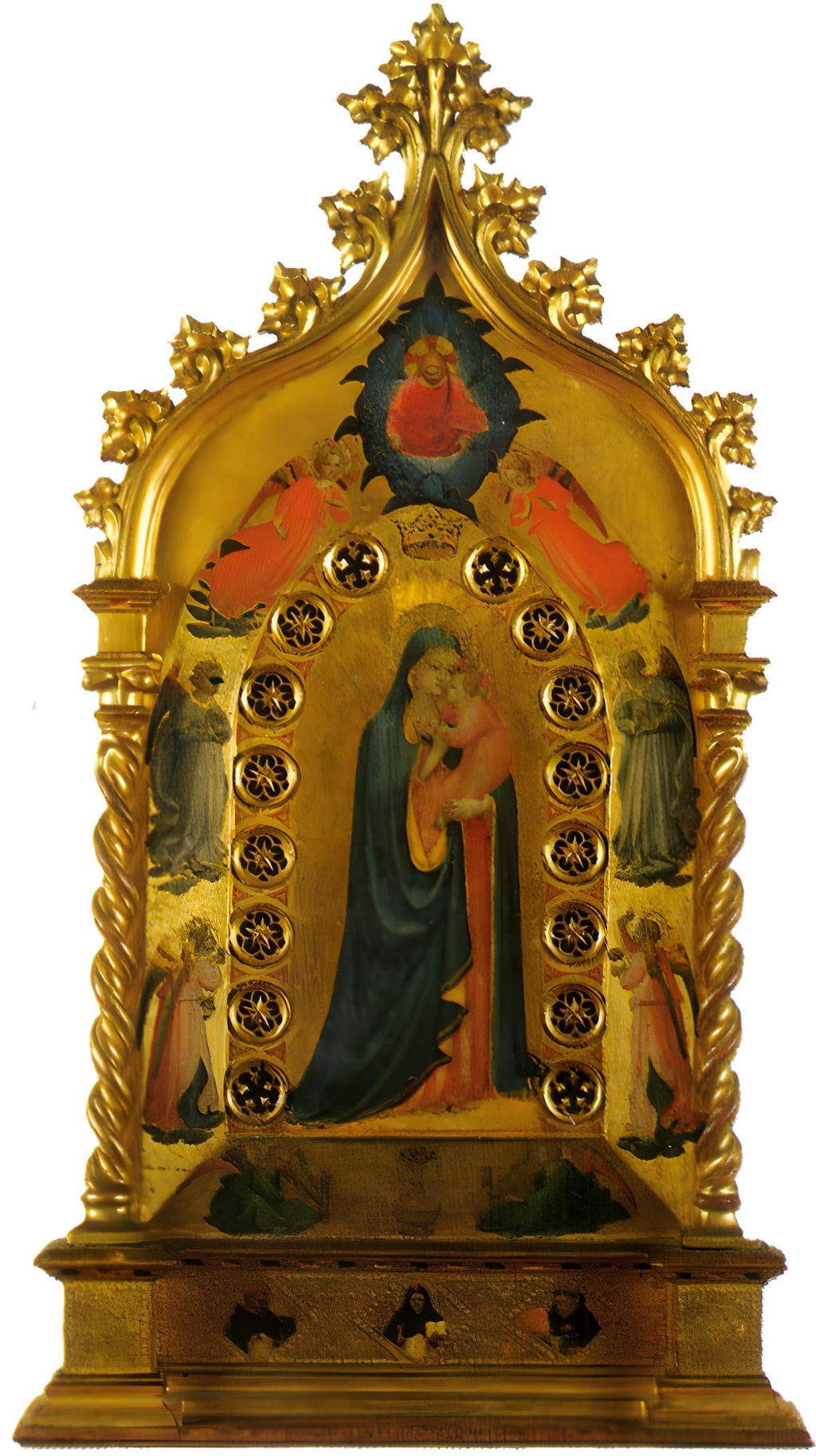
The Madonna of the Star on display with its architectural surround. Compare the central figures with the small images encircling them. Image source. Public domain. Proportional web resize.
Other Madonnas with angels and fruit
Angelico returned to the arrangement of a mother and child before a textile held by angels. The Thyssen-Bornemisza Collection's Virgin of Humility, on deposit at the Museu Nacional d'Art de Catalunya in Barcelona, is especially close in date according to the collection's current account, which places it around 1425. There Mary sits low on a cushion. Three angels hold up the cloth and two more sit at the foot of the picture. Mary's vase and the lily that the child offers her give the two figures something to share, just as the open fruit does in the Prado panel. In the Thyssen picture the tall stems draw your eye up, towards the infant's face. In Madrid the action is concentrated low, between two hands that meet on red cloth. [5]
Laurence Kanter put the Alba panel and the Thyssen painting close together in the Metropolitan Museum's 2005 catalogue, proposing around 1426–27 for the Thyssen picture partly because of the resemblance between the figures. The Thyssen now gives its own panel a slightly earlier date. The closeness is easy to see when the panels are side by side. In both works Mary faces out almost squarely, the angels press in at the sides, and a child's small movement gives direction to the whole group. These repeating solutions help scholars place the paintings in the same period, even when their order is open to debate. [5] [6]
The fruit also appears in another famous Florentine Madonna, painted some six decades later. Sandro Botticelli's Madonna of the Pomegranate in the Uffizi is a circular panel about 143.5 centimetres across. There, angels are arranged in a symmetrical group around Mary and Christ, and the fruit is held on the central axis of the circle. Angelico places the child well to one side, drawing the eye across his mother's lap to where he touches the seeds. Seen together, the two paintings show how differently a painter can direct attention to the same fruit. [7]
From the House of Alba to the Prado
Carlos Miguel Fitz-James Stuart y Silva, the 14th Duke of Alba, bought the painting in Florence in 1817. Falomir sees the purchase as an early example of the European taste for fifteenth-century Italian painting and links the duke's collecting interests with his contact with artists such as Ingres. After it travelled to Spain the picture was comparatively hard for scholars to see in the private Alba collection. It reached a wider audience at the exhibition marking five hundred years since Angelico's death in 1955. The panel did not travel to the Metropolitan Museum's 2005 exhibition, but the catalogue used it as a reference point for placing other works. Falomir also notes the exceptional condition of the painted surface after cleaning, a good reason why the close details still reward comparison. The painting appeared in the 2012 exhibition on the Alba collection in Madrid and travelled to the Meadows Museum in Dallas in 2015, its first visit to the United States. [1] [6] [8]
The Prado bought the panel from the House of Alba in 2016 with support from Spain's Ministry of Culture and the Friends of the Museo del Prado Foundation. The Spanish government put the price at €18 million, spread over four annual payments. The museum presented the panel in January 2016 alongside another Angelico from the same collection, The Funeral of Saint Anthony Abbot, which the Duke of Alba donated. The two works share a documented stretch of their history from 1817. The Funeral, catalogue P8234, is a small scene from the lower section of an altarpiece. The much larger devotional Madonna is P8233, with an original patron and destination still to be identified. [1] [9] [10]
In 2019 the Prado exhibited both Alba paintings alongside the newly restored Annunciation, in a survey of Fra Angelico and the rise of the Florentine Renaissance. Among the loans were Florentine velvets with gold and silver thread and a marble bust of the 14th Duke of Alba by Lorenzo Bartolini. The textiles gave visitors a comparison for the patterns and sheen Angelico painted behind the Virgin. The bust gave a face to the collector who had bought her two centuries before. The exhibition brought together two different parts of the panel's story, from the city that made its painted cloth familiar to the collector who brought the painting to Spain. [2] [11] [12]
Further reading
Explore a catalogue or scholarly study related to this article.
Fra Angelico and the Rise of the Florentine Renaissance. Edited by Carl Brandon Strehlke. Museo Nacional del Prado and Thames & Hudson, 2019.
The Prado exhibition catalogue places the painting among the innovations of early Renaissance Florence. See the publisher’s catalogue.
Fra Angelico at the Prado
The museum introduces the exhibition that placed the panel in its early Florentine context.
Exposición: Fra Angelico y los inicios del Renacimiento en Florencia
The Prado introduces its exhibition on Angelico and the development of painting in early Renaissance Florence.
Watch on YouTubeFra Angelico artworks directory
Explore documented works and surviving parts of larger ensembles. Catalogue links identify individual records. Attribution and dating can vary across collections and publications. Search the Federico Zeri Photo Archive by artist.
| Name | Date | Medium and sources |
|---|---|---|
| Adoration of the Magi | About 1440–60, NGA catalogue | Painting Catalogue. |
| Adoration of the Magi (Armadio degli Argenti) | About 1450–53 | Tempera and gold on wood. Catalogue. |
| Agony in the Garden (Armadio degli Argenti) | About 1450–53 | Tempera and gilding on wood Catalogue. |
| Annalena Altarpiece / Pala di Annalena | commonly c. 1435 | Tempera on panel Catalogue. |
| Annunciation (Armadio degli Argenti) | About 1450–53 | Tempera and gilding on wood. Catalogue. |
| Annunciation (Cortona) | generally placed in the 1430s; exact dating remains debated | Tempera on panel Catalogue. |
| Annunciation (Prado) | 1425–26 | Tempera on poplar panel Catalogue. |
| Annunciation (San Marco upper corridor) | commonly c. 1442 | Fresco Catalogue. |
| Annunciation with Saint Peter Martyr | About 1439–43 | Fresco on plaster. Catalogue. |
| Annunciatory Angel | 1450–55, Detroit catalogue | Gold leaf and tempera on wood panel. Catalogue. |
| Armadio degli Argenti (Silver Treasury) | principally c. 1450–52 | Tempera on panel Catalogue. |
| Arrest of Christ (Armadio degli Argenti) | About 1450–53 | Tempera and gilding on wood Catalogue. |
| Ascension (Armadio degli Argenti) | About 1450–53 | Tempera and gilding on wood Catalogue. |
| Baptism of Christ (Armadio, Alesso Baldovinetti) | About 1452–53 | Tempera and gilding on wood Catalogue. |
| Beheading of Saints Cosmas and Damian (San Marco Altarpiece) | About 1438–42 | Painted panel Catalogue. |
| Betrayal of Christ (Armadio degli Argenti) | About 1450–53 | Tempera and gilding on wood Catalogue. |
| Blessed Dominican, Possibly Jordan of Saxony (San Marco Altarpiece) | About 1438–42 | Painted panel Catalogue. |
| Blessed Vincent Ferrer (San Marco Altarpiece) | About 1438–42 | Painted panel Catalogue. |
| Burial of Saints Cosmas and Damian (San Marco Altarpiece) | About 1438–42 | Painted panel Catalogue. |
| Bust of a Cleric and a Group of Figures (recto and verso) | 15th century | Pen and ink on paper Catalogue. |
| Christ among the Doctors (Armadio degli Argenti) | About 1450–53 | Tempera and gilding on wood Catalogue. |
| Christ before Caiaphas (Armadio degli Argenti) | About 1450–53 | Tempera and gilding on wood Catalogue. |
| Christ Glorified in the Court of Heaven | About 1423–24 | Egg tempera on wood, probably poplar, with gold and silver leaf Catalogue. |
| Christ Seated in Judgment | 1447 | Fresco and gilding on plaster. Catalogue. |
| Christ Stripped of His Garments (Armadio degli Argenti) | About 1450–53 | Tempera and gilding on wood Catalogue. |
| Christ Washes the Apostles’ Feet (Armadio degli Argenti) | About 1450–53 | Tempera and gilding on wood Catalogue. |
| Circumcision of Christ (Armadio degli Argenti) | About 1450–53 | Tempera and gilding on wood. Catalogue. |
| Communion of the Apostles (Armadio degli Argenti) | About 1450–53 | Tempera and gilding on wood Catalogue. |
| Coronation of the Virgin (Armadio degli Argenti) | About 1450–53 | Tempera and gilding on wood Catalogue. |
| Coronation of the Virgin (Louvre) | Louvre: second quarter of the fifteenth century, 1425–50; often dated more narrowly c. 1434–35 | Tempera and gold on panel Catalogue. |
| Coronation of the Virgin (Uffizi) | 1431–35 | Tempera on wood, gold ground Catalogue. |
| Cortona Triptych | About 1437 | Tempera and gold on panel. Catalogue. |
| Crucifixion (Armadio degli Argenti) | About 1450–53 | Tempera and gilding on wood Catalogue. |
| Crucifixion and Saints | 1441–42 | Fresco Catalogue. |
| Deposition from the Cross / Santa Trinita Deposition | commissioned 1429–32; completed by Angelico within this period | Tempera on panel Catalogue. |
| Descent into Limbo (Armadio degli Argenti) | About 1450–53 | Tempera and gilding on wood Catalogue. |
| Entombment of Christ (San Marco Altarpiece) | About 1438–42 | Painted panel Catalogue. |
| Entry into Jerusalem (Armadio degli Argenti) | About 1450–53 | Tempera and gilding on wood Catalogue. |
| Expulsion and the Stoning of Saint Stephen | 1448–49, Vatican Museums | Fresco. Catalogue. |
| Fiesole San Domenico Altarpiece | early 1420s; predella about 1423–24 | Tempera on panel Catalogue. |
| Flagellation (Armadio degli Argenti) | About 1450–53 | Tempera and gilding on wood Catalogue. |
| Flight into Egypt | About 1450–53 | Tempera and gilding on wood. Catalogue. |
| Guidalotti Polyptych | c. 1447–49 | Tempera and oil on panel Catalogue. |
| Healing of Palladia and Saint Damian Accepting Her Gift (San Marco Altarpiece) | About 1438–42 | Painted panel Catalogue. |
| Holy Pilgrim, Possibly Saint Roch (San Marco Altarpiece) | About 1438–42 | Painted panel Catalogue. |
| Holy Women at the Tomb (Armadio degli Argenti) | About 1450–53 | Tempera and gilding on wood Catalogue. |
| Judas Receives Payment (Armadio degli Argenti) | About 1450–53 | Tempera and gilding on wood Catalogue. |
| Lamentation over Christ (Armadio degli Argenti) | About 1450–53 | Tempera and gilding on wood Catalogue. |
| Lamentation over the Dead Christ (Croce al Tempio Lamentation) | 1436–41, Zeri catalogue | Tempera and gilding on wood panel. Catalogue. |
| Last Judgement (Armadio degli Argenti) | About 1450–53 | Tempera and gilding on wood Catalogue. |
| Last Judgement (San Marco) | c. 1425–28 | Tempera and gold on panel Catalogue. |
| Last Supper (Armadio degli Argenti) | About 1450–53 | Tempera and gilding on wood Catalogue. |
| Lex Amoris (Armadio degli Argenti) | About 1450–53 | Tempera and gilding on wood Catalogue. |
| Madonna and Child with Saint Dominic and Saint Thomas Aquinas | About 1430, Hermitage catalogue | Detached fresco. Catalogue. |
| Madonna and Child with Saints | About 1411–13 | Tempera on wood panel, with a gold ground. Catalogue. |
| Madonna of Humility | About 1425, Thyssen catalogue | Tempera and gold on wood. Catalogue. |
| Madonna of the Star | 1431–34, Zeri catalogue | Tempera with oil glazes and gold on wood panel, as catalogued by the Gardner for the 2018 exhibition. Catalogue. |
| Marriage at Cana (Armadio, Alesso Baldovinetti) | About 1452–53 | Tempera and gilding on wood Catalogue. |
| Massacre of the Innocents (Armadio degli Argenti) | About 1450–53 | Tempera and gilding on wood Catalogue. |
| Miracle of the Black Leg (San Marco Altarpiece) | About 1438–42 | Painted panel Catalogue. |
| Mocking of Christ (Armadio degli Argenti) | About 1450–53 | Tempera and gilding on wood Catalogue. |
| Mystic Wheel (The Vision of Ezekiel) | About 1450–52 | Tempera and gilding on wood. Catalogue. |
| Nativity (Armadio degli Argenti) | About 1450–53 | Tempera and gilding on wood. Catalogue. |
| Niccoline Chapel frescoes | principally 1448–50 | Fresco Catalogue. |
| Noli me Tangere | broadly within Angelico’s San Marco campaign, late 1430s–1440s | Fresco Catalogue. |
| Ordination of Saint Lawrence | 1448 | Fresco. Catalogue. |
| Pentecost (Armadio degli Argenti) | About 1450–53 | Tempera and gilding on wood Catalogue. |
| Presentation of Christ at the Temple (Armadio degli Argenti) | About 1450–53 | Tempera and gilding on wood. Catalogue. |
| Presentation of Jesus at the Temple | Early 1440s | Fresco on plaster. Catalogue. |
| Raising of Lazarus (Armadio degli Argenti) | About 1450–53 | Tempera and gilding on wood Catalogue. |
| Rescue of Saints Cosmas and Damian and Exorcism of Lysias (San Marco Altarpiece) | About 1438–42 | Painted panel Catalogue. |
| Road to Calvary (Armadio degli Argenti) | About 1450–53 | Tempera and gilding on wood Catalogue. |
| Saint Anthony Abbot (San Marco Altarpiece) | About 1438–42 | Painted panel Catalogue. |
| Saint Bernard of Clairvaux or Saint Benedict (San Marco Altarpiece) | About 1438–42 | Painted panel Catalogue. |
| Saint Damian Receives Money from Palladia | About 1425–49 | Tempera and gilding on wood. Catalogue. |
| Saint Francis and a Bishop Saint, Saint John the Baptist and Saint Dominic | Late 1420s, Getty catalogue | Tempera and gold leaf on panel. Catalogue. |
| Saint James the Greater Freeing the Magician Hermogenes | About 1426–29 | Tempera and gold on panel Catalogue. |
| Saint Jerome (San Marco Altarpiece) | About 1438–42 | Painted panel Catalogue. |
| Saint Lawrence Giving Alms | About 1448 | Wall fresco. Catalogue. |
| Saint Lawrence Receiving the Treasures of the Church from Pope Sixtus II | About 1448–49 | Fresco on plaster. Catalogue. |
| Saint Romuald (San Marco Altarpiece) | About 1438–42 | Painted panel Catalogue. |
| Saint Stephen Addressing the Council | 1448–49, Vatican Museums | Fresco. Catalogue. |
| Saint Stephen Preaching | 1448–49, Vatican Museums | Wall fresco. Catalogue. |
| Saint Thomas Aquinas (San Marco Altarpiece) | About 1438–42 | Painted panel Catalogue. |
| Saints Cosmas and Damian and Their Brothers Survive the Stake | Second quarter of the 15th century | Tempera and gilding on wood. Catalogue. |
| Saints Cosmas and Damian at the Stake (San Marco Altarpiece) | About 1438–42 | Painted panel Catalogue. |
| Saints Cosmas and Damian before Lysias (San Marco Altarpiece) | About 1438–42 | Painted panel Catalogue. |
| Saints Cosmas and Damian Rescued by an Angel | Second quarter of the 15th century | Tempera and gilding on wood. Catalogue. |
| Saints Cosmas and Damian with Their Brothers before Proconsul Lysias | Second quarter of the 15th century | Tempera and gilding on wood. Catalogue. |
| San Marco Altarpiece / Pala di San Marco | 1438–43 | Tempera on panel Catalogue. |
| San Pietro Martire Triptych | About 1422–23, Strozzi exhibition | Tempera and gold on panel. Catalogue. |
| Scenes from the Lives of the Desert Fathers (Thebaid) | About 1420, Uffizi catalogue | Tempera on wood. Catalogue. |
| Sixteen Prophets | 1447 | Fresco and gilding on plaster Catalogue. |
| Stoning and Shooting of the Brothers (San Marco Altarpiece) | About 1438–42 | Painted panel Catalogue. |
| Tabernacle of the Linaioli | 1433–35 | Tempera on panel Catalogue. |
| The Attempted Crucifixion and Stoning of Saints Cosmas and Damian | Second quarter of the 15th century | Tempera and gilding on wood. Catalogue. |
| The Crucifixion | About 1420–23, Met catalogue | Tempera on wood, gold ground. Catalogue. |
| The Death and the Assumption of the Virgin | 1424–34 | Tempera with oil glazes and gold on panel Catalogue. |
| The Dominican Blessed (left end) (Fiesole predella) | About 1423–24 | Egg tempera and gold on wood Catalogue. |
| The Dominican Blessed (right end) (Fiesole predella) | About 1423–24 | Egg tempera and gold on wood Catalogue. |
| The Entombment of Christ | About 1450 | Tempera on poplar panel. Catalogue. |
| The Forerunners of Christ with Saints and Martyrs | About 1423–24 | Egg tempera on wood (probably poplar), with gold and silver leaf. Catalogue. |
| The Funeral of Saint Anthony Abbot | About 1426–30 | Tempera on poplar panel. Catalogue. |
| The Martyrdom of Saints Cosmas and Damian | About 1425–49 | Tempera and gilding on wood. Catalogue. |
| The Mocking of Christ / Christ Mocked | within the San Marco dormitory campaign, broadly late 1430s–1440s | Fresco Catalogue. |
| The Nativity | About 1425, Minneapolis catalogue | Tempera on poplar panel. Catalogue. |
| The Nativity in Cell 5 at San Marco | About 1439–43 | Fresco on plaster. Catalogue. |
| The Penitent Saint Jerome | 1419–20 | Tempera on wood panel Catalogue. |
| The Virgin and Child by Fra Angelico (Fogg Museum) | About 1430, Harvard catalogue | Tempera originally on panel, subsequently transferred to Masonite. Catalogue. |
| The Virgin Mary with the Apostles and Other Saints (Fiesole predella) | About 1423–24 | Egg tempera and gold on wood Catalogue. |
| Transfiguration (Armadio, Alesso Baldovinetti) | About 1452–53 | Tempera and gilding on wood Catalogue. |
| Transfiguration (San Marco Cell 6) | within the San Marco dormitory campaign, broadly late 1430s–1440s | Fresco Catalogue. |
| Virgin Mary Annunciate | 1450–55, Detroit catalogue | Gold leaf and tempera on wood panel. Catalogue. |
| Virgin of the Pomegranate | About 1426 | Tempera on panel with gilding Catalogue. |
Frequently Asked Questions
Discussion
Use these prompts to look again or share an observation.
Reader Insights
Look for the point where the two hands meet around the fruit. What makes that small exchange readable?
What happens to the balance of the painting when you move your gaze from the broad gold field to the grass at the feet?
Join the Conversation
Share a detail or question about Virgin of the Pomegranate.
References
- Miguel Falomir, entries for La Virgen de la granada and Funeral de san Antonio abad, Museo Nacional del Prado, 2016 annual report, pp. 28–30 and 82–83 (in Spanish). View source.
- Museo Nacional del Prado, Fra Angelico y los inicios del Renacimiento en Florencia, 2019 annual report (in Spanish). View source.
- Fondazione Palazzo Strozzi and Museo di San Marco, Fra Angelico, 2025 exhibition press kit and curatorial essays. View source.
- Gallerie degli Uffizi, Masolino and Masaccio, Sant'Anna Metterza (in Italian). View source.
- Museo Nacional Thyssen-Bornemisza, Fra Angelico, The Virgin of Humility. View source.
- Laurence Kanter, catalogue entry 18, in Laurence Kanter and Pia Palladino, Fra Angelico, Metropolitan Museum of Art, 2005, pp. 101–103. View source.
- Daniela Parenti, Gallerie degli Uffizi, Botticelli, Madonna della melagrana (in Italian). View source.
- Meadows Museum, Fra Angelico Masterpiece Added to Alba Collection Exhibition at Meadows Museum, 8 June 2015. View source.
- Spanish Council of Ministers, authorisation to purchase La Virgen de la granada, 22 January 2016 (in Spanish). View source.
- Spanish Ministry of Culture, presentation of La Virgen de la granada and Funeral de San Antonio abad, 26 January 2016 (in Spanish). View source.
- Spanish Ministry of Culture and Sport, CUD/392/2019, state guarantee and loan list for the 2019 Prado exhibition (in Spanish). View source.
- Council of Ministers, Spanish Government, Prado exhibition guarantee and exhibition overview, 8 March 2019 (in Spanish). View source.
.jpg)



 Fra Angelico.jpg)


