


 Fra Angelico.jpg)
 by Tom Gurney
Tom Gurney BSc (Hons) is an art history expert with over 20 years experience
Published on June 19, 2020 / Updated on November 29, 2026
Email: tomgurney1@gmail.com / Phone: +44 7429 011000
Introduction
A visitor in a sweeping rose-coloured cloak kneels at the feet of the Christ Child. Behind him, men and horses crowd towards a humble shelter. Mary and the child sit directly in front of its dark doorway, so that the smallest figure in the scene is also the easiest to find. This Adoration of the Magi, now in the Museo di San Marco in Florence, formed part of the painted doors of the Armadio degli Argenti, a cabinet for precious offerings. Two lines of Latin turn the arrival at Bethlehem into a meeting between a psalm about royal tribute and Matthew’s account of the gifts. [1] [2]
At a Glance
- ArtistFra Angelico and assistants, as catalogued by the Italian Ministry of Culture. [1]
- DateAbout 1450–53 in the state catalogue. [1]
- MediumTempera and gold on wood. [1] [2]
- Dimensions38.5 × 37.5 cm, height by width, in the state component record. [1]
- CollectionMuseo di San Marco, Florence, inv. 1890, no. 8490. [1] [2]
- Catalogue identifier0900191187A-5. [1]
- PositionCentre of the middle row of the surviving infancy group. [1]
The procession at the doorway
The shelter takes up much of the upper half of the picture. Its pale front, striped with horizontal bands, faces us almost squarely, while the right side falls into shadow beneath a sloping roof. The doorway makes a dark rectangle immediately behind Mary’s halo and bowed head. Two small openings higher in the façade break up its broad surface without competing for attention. The building gives the eye somewhere to rest after the close-packed faces and elaborate clothes. It also gives Mary a central position without the need for a throne. [1]
On the left, horses’ heads emerge between the men, while overlapping hats and shoulders suggest more people arriving than the narrow panel can comfortably show. The figures nearest Mary have room to turn, bend or wait. In the foreground the kneeling visitor’s cloak spreads behind him in long folds, almost touching the lower inscription. His body slopes towards the child, whom Mary supports on her lap. The size of the cloak gives weight to the movement of lowering himself. At the far right, a blue-clad figure holds up a gold-coloured vessel with a pointed lid. The standing figures between him and the doorway partly screen him from the child. A single glance takes in different stages of the visit, from the press of arrivals at the edge to the pause of someone still holding a gift and the intimacy of the man already kneeling. [1]
The landscape makes room for the journey even though the figures fill most of the foreground. Small buildings appear on either side of the shelter, set among brown hills. A tall, slender tree rises behind the roof on the right. The light façade hides much of the view, so the eye pieces together the country beyond from narrow glimpses. That alternation between open country and a crowded stopping place helps convey the distance the party has travelled. The painting gives most of its space to what happens when the journey ends. [1]
Matthew tells of Magi from the east who come to Jerusalem, ask for the newborn king of the Jews and follow the star to the child. In the house they find Mary and Jesus, bow down and open their treasures. The Gospel names gold, frankincense and myrrh. It leaves the number of visitors unstated and calls them Magi. The familiar group of three kings belongs to Western Christian tradition. The three gifts probably helped fix that number, and the royal language of the psalm painted above the scene helps explain why that reading fits the picture. The vessels show the act of offering, while the words below name their contents. [3] [4]
Two inscriptions about giving
The upper band draws on Psalm 72:10, numbered 71 in the Latin Psalter. In the painted version, the kings of Tarshish and the islands will bring tribute, and the kings of Arabia and Saba will bring gifts. The psalm as a whole asks for a just king who protects the poor and receives homage from far away. The cabinet singles out the verse about the offerings. Below the scene, the words from Matthew 2:11 describe the visitors opening their treasures and presenting gold, frankincense and myrrh. Both inscriptions are painted in capitals on narrow bands that resemble strips of parchment. [5] [6] [7]
The pairing changes the way we see the kneeling figure. Read from above, his lowered head gives bodily form to the homage described in the psalm. Read from below, his place at the child’s feet belongs to a particular visit with three named gifts. The composition leaves enough clear ground around the two figures for the gesture to register at this small scale. The contrast between their surroundings and the royal language is especially sharp. Richly dressed guests have crossed the hills to reach a child seated outside a modest building. The psalm gives that encounter a reach beyond the few people we see. [3] [5] [6] [7]
The same way of reading recurs throughout the cabinet. The Mystic Wheel opens the cycle with a diagram that brings older scripture and New Testament authors together. Gerardo de Simone discusses a close parallel for the sequence of scenes and verses in a manuscript of the Rota in medio rotae at the Biblioteca Marciana in Venice. The parallels are close enough to show a shared tradition, while differences in the wording leave direct copying uncertain. De Simone also connects the central doorway here with the opening in the Annunciation immediately above it in the present arrangement. Mary occupies the threshold in the Adoration, where the visitors meet the child. The doorway in the Massacre of the Innocents, below, is displaced to one side and belongs to a scene of violence. Seen down the middle of the board, the three openings give the same architectural feature very different roles. [8]
A scene on a cabinet for offerings
The Adoration sits between the Circumcision and the Presentation of Christ at the Temple in the middle row of the surviving infancy group. The group contains eight episodes and the opening Mystic Wheel. The sequence moves from Luke’s account of the naming of Jesus to Matthew’s visitors and back to Luke for the Presentation. The Flight into Egypt then picks up Matthew’s story after the Magi depart. [3] [8]
The group alternates settings as well as subjects. Here the roof and landscape leave the gathering open to the air, whereas the neighbouring scenes set ritual actions within built interiors. The museum’s square arrangement makes these differences easy to see. Andrea De Marchi’s reconstruction, discussed by De Simone, proposes two tall original doors, each two scenes wide. In that reconstruction the nine fields of the infancy group belong beside Alesso Baldovinetti’s strip of three scenes in the upper part of the cabinet. [1] [2] [8]
Piero di Cosimo de’ Medici commissioned the decoration for the Servite church of Santissima Annunziata around 1450. The Armadio degli Argenti held valuable votive offerings made to the church’s revered image of the Annunciation. De Simone places the installation in 1453, with a payment for fitting the jambs recorded in December of that year. In the early 1460s the hinged doors gave way to a single panel that could be raised by a pulley. The painted panels eventually went on display at the Accademia in 1812 and moved to San Marco in 1922. The original setting gives the choice of words in this particular scene an added resonance. A cabinet made to protect the treasures that worshippers had given bore an image of visitors opening their own treasures in homage. [8] [9]
The Italian state catalogue dates the individual scene to about 1450–53 and records Fra Angelico and assistants. The 2025–26 Palazzo Strozzi and San Marco exhibition checklist dates the ensemble to about 1450–52 and lists the infancy group under Fra Angelico, with Baldovinetti’s three scenes separately identified. The scene measures 38.5 × 37.5 cm in the state catalogue, while the exhibition checklist gives 38.5 × 37 cm for each scene in the group. These are measurements of the small painted field. The three-by-three infancy group is much larger. [1] [2]
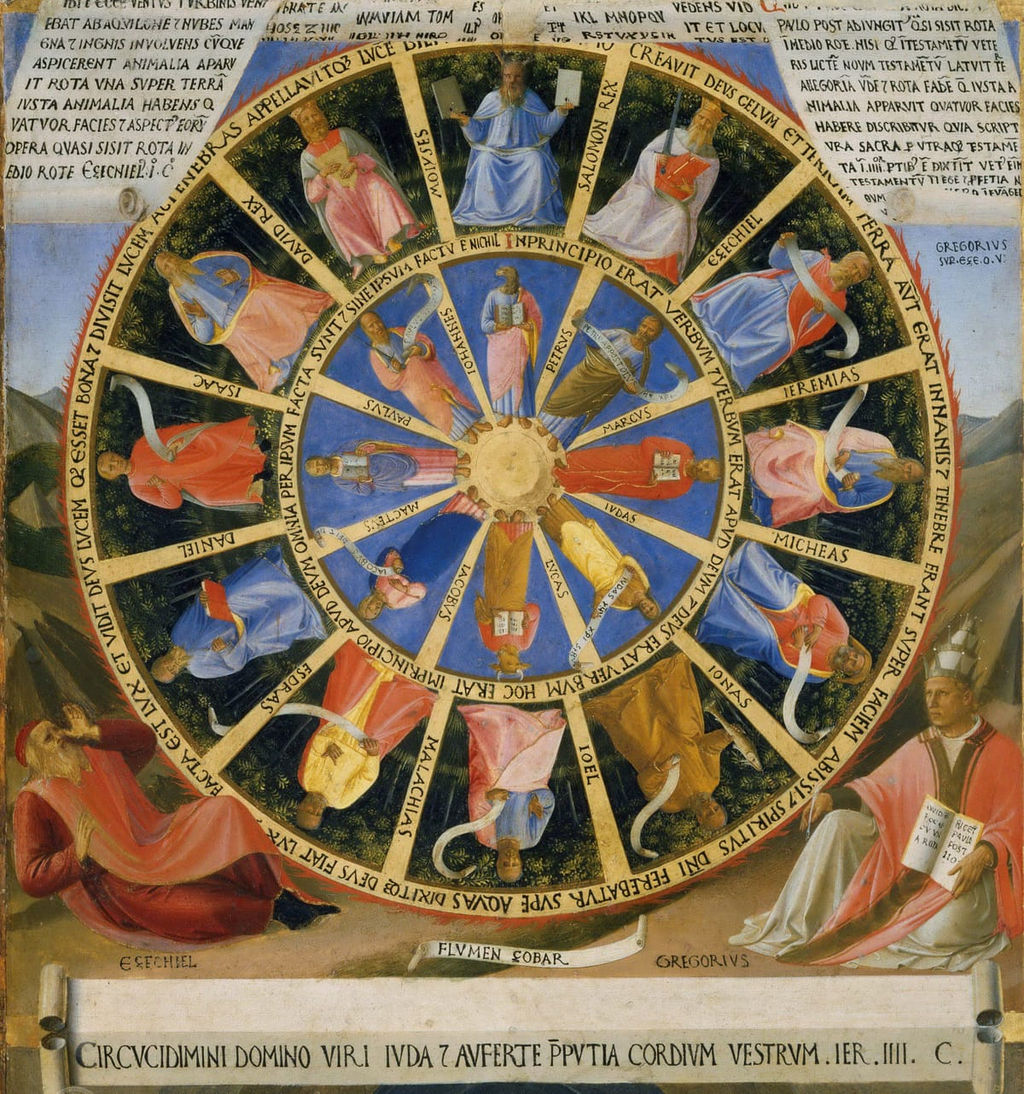
The Mystic Wheel, 0900191187A-1. The painted spokes connect differently positioned witnesses and writers. Image source. Public domain. Proportional web resize.
Looking at the painted surface
The painting’s small scale rewards a close look. The narrow lines above and below leave almost the entire height to the shelter and its visitors, yet the lettering can carry as much of the story as the figures. Technical examination of the infancy group for its 2023 exhibition in Milan used non-invasive imaging and spectroscopy. A published pigment map distinguishes materials across the group, with lapis lazuli among the blues and both vermilion and red lake among the reds. The published examples that identify reds in particular garments come from the Flight into Egypt. In the Adoration the rose of the kneeling figure’s cloak draws the eye down towards the child, while red stockings at the right edge mark the standing figure who still has his vessel in hand. San Marco’s 2026 reinstallation presents the cabinet paintings without their early twentieth-century frame. [10] [11] [12]
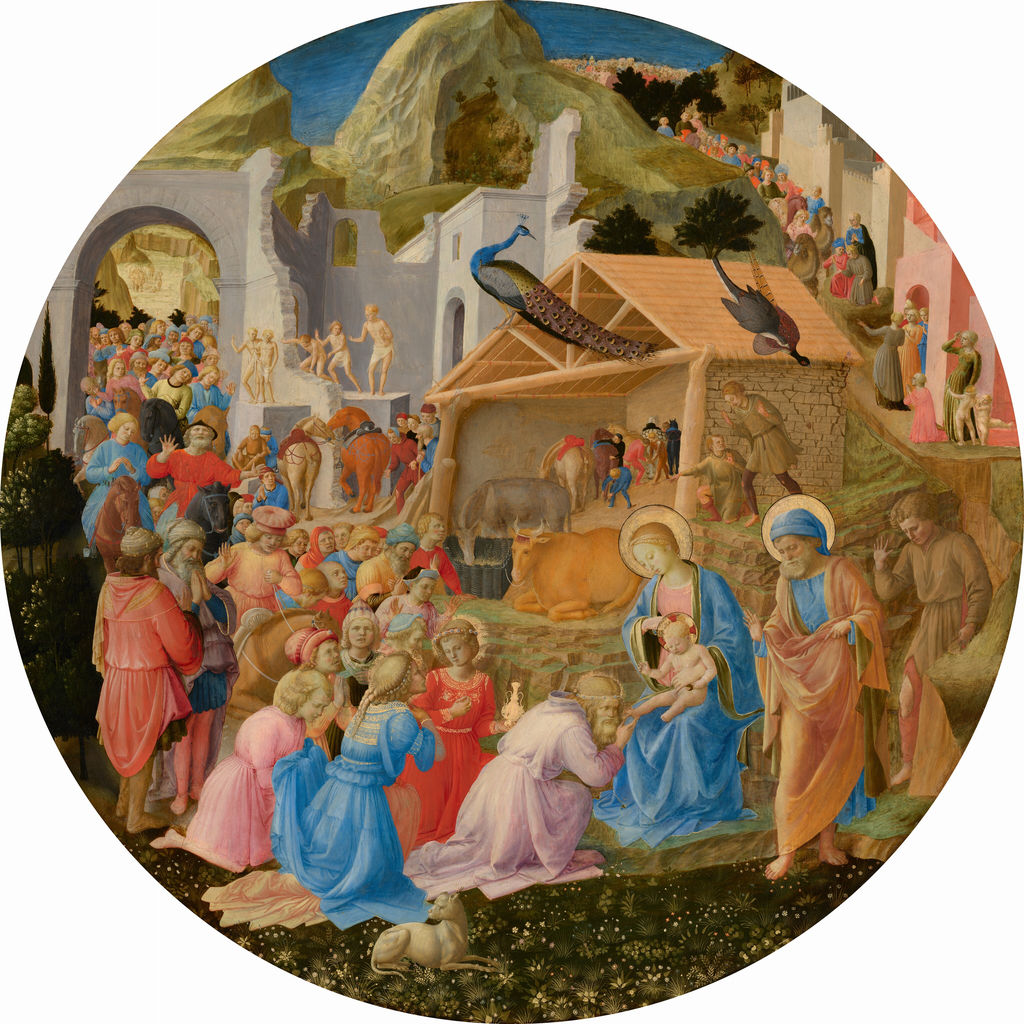
The complete Washington tondo, Fra Angelico and Fra Filippo Lippi, National Gallery of Art accession 1952.2.2. National Gallery of Art, Washington. Image source. CC0 / Public domain. Proportional web resize.
Fra Angelico artworks directory
Explore documented works and surviving parts of larger ensembles. Catalogue links identify individual records. Attribution and dating can vary across collections and publications. Search the Federico Zeri Photo Archive by artist.
| Name | Date | Medium and sources |
|---|---|---|
| Adoration of the Magi | About 1440–60, NGA catalogue | Painting Catalogue. |
| Adoration of the Magi (Armadio degli Argenti) | About 1450–53 | Tempera and gold on wood. Catalogue. |
| Agony in the Garden (Armadio degli Argenti) | About 1450–53 | Tempera and gilding on wood Catalogue. |
| Annalena Altarpiece / Pala di Annalena | commonly c. 1435 | Tempera on panel Catalogue. |
| Annunciation (Armadio degli Argenti) | About 1450–53 | Tempera and gilding on wood. Catalogue. |
| Annunciation (Cortona) | generally placed in the 1430s; exact dating remains debated | Tempera on panel Catalogue. |
| Annunciation (Prado) | 1425–26 | Tempera on poplar panel Catalogue. |
| Annunciation (San Marco upper corridor) | commonly c. 1442 | Fresco Catalogue. |
| Annunciation with Saint Peter Martyr | About 1439–43 | Fresco on plaster. Catalogue. |
| Annunciatory Angel | 1450–55, Detroit catalogue | Gold leaf and tempera on wood panel. Catalogue. |
| Armadio degli Argenti (Silver Treasury) | principally c. 1450–52 | Tempera on panel Catalogue. |
| Arrest of Christ (Armadio degli Argenti) | About 1450–53 | Tempera and gilding on wood Catalogue. |
| Ascension (Armadio degli Argenti) | About 1450–53 | Tempera and gilding on wood Catalogue. |
| Baptism of Christ (Armadio, Alesso Baldovinetti) | About 1452–53 | Tempera and gilding on wood Catalogue. |
| Beheading of Saints Cosmas and Damian (San Marco Altarpiece) | About 1438–42 | Painted panel Catalogue. |
| Betrayal of Christ (Armadio degli Argenti) | About 1450–53 | Tempera and gilding on wood Catalogue. |
| Blessed Dominican, Possibly Jordan of Saxony (San Marco Altarpiece) | About 1438–42 | Painted panel Catalogue. |
| Blessed Vincent Ferrer (San Marco Altarpiece) | About 1438–42 | Painted panel Catalogue. |
| Burial of Saints Cosmas and Damian (San Marco Altarpiece) | About 1438–42 | Painted panel Catalogue. |
| Bust of a Cleric and a Group of Figures (recto and verso) | 15th century | Pen and ink on paper Catalogue. |
| Christ among the Doctors (Armadio degli Argenti) | About 1450–53 | Tempera and gilding on wood Catalogue. |
| Christ before Caiaphas (Armadio degli Argenti) | About 1450–53 | Tempera and gilding on wood Catalogue. |
| Christ Glorified in the Court of Heaven | About 1423–24 | Egg tempera on wood, probably poplar, with gold and silver leaf Catalogue. |
| Christ Seated in Judgment | 1447 | Fresco and gilding on plaster. Catalogue. |
| Christ Stripped of His Garments (Armadio degli Argenti) | About 1450–53 | Tempera and gilding on wood Catalogue. |
| Christ Washes the Apostles’ Feet (Armadio degli Argenti) | About 1450–53 | Tempera and gilding on wood Catalogue. |
| Circumcision of Christ (Armadio degli Argenti) | About 1450–53 | Tempera and gilding on wood. Catalogue. |
| Communion of the Apostles (Armadio degli Argenti) | About 1450–53 | Tempera and gilding on wood Catalogue. |
| Coronation of the Virgin (Armadio degli Argenti) | About 1450–53 | Tempera and gilding on wood Catalogue. |
| Coronation of the Virgin (Louvre) | Louvre: second quarter of the fifteenth century, 1425–50; often dated more narrowly c. 1434–35 | Tempera and gold on panel Catalogue. |
| Coronation of the Virgin (Uffizi) | 1431–35 | Tempera on wood, gold ground Catalogue. |
| Cortona Triptych | About 1437 | Tempera and gold on panel. Catalogue. |
| Crucifixion (Armadio degli Argenti) | About 1450–53 | Tempera and gilding on wood Catalogue. |
| Crucifixion and Saints | 1441–42 | Fresco Catalogue. |
| Deposition from the Cross / Santa Trinita Deposition | commissioned 1429–32; completed by Angelico within this period | Tempera on panel Catalogue. |
| Descent into Limbo (Armadio degli Argenti) | About 1450–53 | Tempera and gilding on wood Catalogue. |
| Entombment of Christ (San Marco Altarpiece) | About 1438–42 | Painted panel Catalogue. |
| Entry into Jerusalem (Armadio degli Argenti) | About 1450–53 | Tempera and gilding on wood Catalogue. |
| Expulsion and the Stoning of Saint Stephen | 1448–49, Vatican Museums | Fresco. Catalogue. |
| Fiesole San Domenico Altarpiece | early 1420s; predella about 1423–24 | Tempera on panel Catalogue. |
| Flagellation (Armadio degli Argenti) | About 1450–53 | Tempera and gilding on wood Catalogue. |
| Flight into Egypt | About 1450–53 | Tempera and gilding on wood. Catalogue. |
| Guidalotti Polyptych | c. 1447–49 | Tempera and oil on panel Catalogue. |
| Healing of Palladia and Saint Damian Accepting Her Gift (San Marco Altarpiece) | About 1438–42 | Painted panel Catalogue. |
| Holy Pilgrim, Possibly Saint Roch (San Marco Altarpiece) | About 1438–42 | Painted panel Catalogue. |
| Holy Women at the Tomb (Armadio degli Argenti) | About 1450–53 | Tempera and gilding on wood Catalogue. |
| Judas Receives Payment (Armadio degli Argenti) | About 1450–53 | Tempera and gilding on wood Catalogue. |
| Lamentation over Christ (Armadio degli Argenti) | About 1450–53 | Tempera and gilding on wood Catalogue. |
| Lamentation over the Dead Christ (Croce al Tempio Lamentation) | 1436–41, Zeri catalogue | Tempera and gilding on wood panel. Catalogue. |
| Last Judgement (Armadio degli Argenti) | About 1450–53 | Tempera and gilding on wood Catalogue. |
| Last Judgement (San Marco) | c. 1425–28 | Tempera and gold on panel Catalogue. |
| Last Supper (Armadio degli Argenti) | About 1450–53 | Tempera and gilding on wood Catalogue. |
| Lex Amoris (Armadio degli Argenti) | About 1450–53 | Tempera and gilding on wood Catalogue. |
| Madonna and Child with Saint Dominic and Saint Thomas Aquinas | About 1430, Hermitage catalogue | Detached fresco. Catalogue. |
| Madonna and Child with Saints | About 1411–13 | Tempera on wood panel, with a gold ground. Catalogue. |
| Madonna of Humility | About 1425, Thyssen catalogue | Tempera and gold on wood. Catalogue. |
| Madonna of the Star | 1431–34, Zeri catalogue | Tempera with oil glazes and gold on wood panel, as catalogued by the Gardner for the 2018 exhibition. Catalogue. |
| Marriage at Cana (Armadio, Alesso Baldovinetti) | About 1452–53 | Tempera and gilding on wood Catalogue. |
| Massacre of the Innocents (Armadio degli Argenti) | About 1450–53 | Tempera and gilding on wood Catalogue. |
| Miracle of the Black Leg (San Marco Altarpiece) | About 1438–42 | Painted panel Catalogue. |
| Mocking of Christ (Armadio degli Argenti) | About 1450–53 | Tempera and gilding on wood Catalogue. |
| Mystic Wheel (The Vision of Ezekiel) | About 1450–52 | Tempera and gilding on wood. Catalogue. |
| Nativity (Armadio degli Argenti) | About 1450–53 | Tempera and gilding on wood. Catalogue. |
| Niccoline Chapel frescoes | principally 1448–50 | Fresco Catalogue. |
| Noli me Tangere | broadly within Angelico’s San Marco campaign, late 1430s–1440s | Fresco Catalogue. |
| Ordination of Saint Lawrence | 1448 | Fresco. Catalogue. |
| Pentecost (Armadio degli Argenti) | About 1450–53 | Tempera and gilding on wood Catalogue. |
| Presentation of Christ at the Temple (Armadio degli Argenti) | About 1450–53 | Tempera and gilding on wood. Catalogue. |
| Presentation of Jesus at the Temple | Early 1440s | Fresco on plaster. Catalogue. |
| Raising of Lazarus (Armadio degli Argenti) | About 1450–53 | Tempera and gilding on wood Catalogue. |
| Rescue of Saints Cosmas and Damian and Exorcism of Lysias (San Marco Altarpiece) | About 1438–42 | Painted panel Catalogue. |
| Road to Calvary (Armadio degli Argenti) | About 1450–53 | Tempera and gilding on wood Catalogue. |
| Saint Anthony Abbot (San Marco Altarpiece) | About 1438–42 | Painted panel Catalogue. |
| Saint Bernard of Clairvaux or Saint Benedict (San Marco Altarpiece) | About 1438–42 | Painted panel Catalogue. |
| Saint Damian Receives Money from Palladia | About 1425–49 | Tempera and gilding on wood. Catalogue. |
| Saint Francis and a Bishop Saint, Saint John the Baptist and Saint Dominic | Late 1420s, Getty catalogue | Tempera and gold leaf on panel. Catalogue. |
| Saint James the Greater Freeing the Magician Hermogenes | About 1426–29 | Tempera and gold on panel Catalogue. |
| Saint Jerome (San Marco Altarpiece) | About 1438–42 | Painted panel Catalogue. |
| Saint Lawrence Giving Alms | About 1448 | Wall fresco. Catalogue. |
| Saint Lawrence Receiving the Treasures of the Church from Pope Sixtus II | About 1448–49 | Fresco on plaster. Catalogue. |
| Saint Romuald (San Marco Altarpiece) | About 1438–42 | Painted panel Catalogue. |
| Saint Stephen Addressing the Council | 1448–49, Vatican Museums | Fresco. Catalogue. |
| Saint Stephen Preaching | 1448–49, Vatican Museums | Wall fresco. Catalogue. |
| Saint Thomas Aquinas (San Marco Altarpiece) | About 1438–42 | Painted panel Catalogue. |
| Saints Cosmas and Damian and Their Brothers Survive the Stake | Second quarter of the 15th century | Tempera and gilding on wood. Catalogue. |
| Saints Cosmas and Damian at the Stake (San Marco Altarpiece) | About 1438–42 | Painted panel Catalogue. |
| Saints Cosmas and Damian before Lysias (San Marco Altarpiece) | About 1438–42 | Painted panel Catalogue. |
| Saints Cosmas and Damian Rescued by an Angel | Second quarter of the 15th century | Tempera and gilding on wood. Catalogue. |
| Saints Cosmas and Damian with Their Brothers before Proconsul Lysias | Second quarter of the 15th century | Tempera and gilding on wood. Catalogue. |
| San Marco Altarpiece / Pala di San Marco | 1438–43 | Tempera on panel Catalogue. |
| San Pietro Martire Triptych | About 1422–23, Strozzi exhibition | Tempera and gold on panel. Catalogue. |
| Scenes from the Lives of the Desert Fathers (Thebaid) | About 1420, Uffizi catalogue | Tempera on wood. Catalogue. |
| Sixteen Prophets | 1447 | Fresco and gilding on plaster Catalogue. |
| Stoning and Shooting of the Brothers (San Marco Altarpiece) | About 1438–42 | Painted panel Catalogue. |
| Tabernacle of the Linaioli | 1433–35 | Tempera on panel Catalogue. |
| The Attempted Crucifixion and Stoning of Saints Cosmas and Damian | Second quarter of the 15th century | Tempera and gilding on wood. Catalogue. |
| The Crucifixion | About 1420–23, Met catalogue | Tempera on wood, gold ground. Catalogue. |
| The Death and the Assumption of the Virgin | 1424–34 | Tempera with oil glazes and gold on panel Catalogue. |
| The Dominican Blessed (left end) (Fiesole predella) | About 1423–24 | Egg tempera and gold on wood Catalogue. |
| The Dominican Blessed (right end) (Fiesole predella) | About 1423–24 | Egg tempera and gold on wood Catalogue. |
| The Entombment of Christ | About 1450 | Tempera on poplar panel. Catalogue. |
| The Forerunners of Christ with Saints and Martyrs | About 1423–24 | Egg tempera on wood (probably poplar), with gold and silver leaf. Catalogue. |
| The Funeral of Saint Anthony Abbot | About 1426–30 | Tempera on poplar panel. Catalogue. |
| The Martyrdom of Saints Cosmas and Damian | About 1425–49 | Tempera and gilding on wood. Catalogue. |
| The Mocking of Christ / Christ Mocked | within the San Marco dormitory campaign, broadly late 1430s–1440s | Fresco Catalogue. |
| The Nativity | About 1425, Minneapolis catalogue | Tempera on poplar panel. Catalogue. |
| The Nativity in Cell 5 at San Marco | About 1439–43 | Fresco on plaster. Catalogue. |
| The Penitent Saint Jerome | 1419–20 | Tempera on wood panel Catalogue. |
| The Virgin and Child by Fra Angelico (Fogg Museum) | About 1430, Harvard catalogue | Tempera originally on panel, subsequently transferred to Masonite. Catalogue. |
| The Virgin Mary with the Apostles and Other Saints (Fiesole predella) | About 1423–24 | Egg tempera and gold on wood Catalogue. |
| Transfiguration (Armadio, Alesso Baldovinetti) | About 1452–53 | Tempera and gilding on wood Catalogue. |
| Transfiguration (San Marco Cell 6) | within the San Marco dormitory campaign, broadly late 1430s–1440s | Fresco Catalogue. |
| Virgin Mary Annunciate | 1450–55, Detroit catalogue | Gold leaf and tempera on wood panel. Catalogue. |
| Virgin of the Pomegranate | About 1426 | Tempera on panel with gilding Catalogue. |
Frequently Asked Questions
The Washington Adoration of the Magi is a separate painting, a round panel or tondo measuring 137.3 cm across. The National Gallery of Art catalogues it under Fra Angelico and Fra Filippo Lippi. The Florence painting is a nearly square scene, about 38 cm across, with text above and below linking it to the rest of the cabinet. [1] [13]
Discussion
Use these prompts to look again or share an observation.
Reader Insights
Follow the horses and faces at the left towards the low folds of the kneeling visitor’s cloak. Where does the scene slow down?
How does it change your reading of the gifts to know where worshippers’ offerings were originally kept?
Join the Conversation
Share a detail or question about Adoration of the Magi (Armadio degli Argenti).
References
- Italian Ministry of Culture, Adorazione dei Re Magi, component record 0900191187A-5. View source.
- Fondazione Palazzo Strozzi and Museo di San Marco, Fra Angelico exhibition checklist, nos. 9.5a–b. View source.
- United States Conference of Catholic Bishops, Matthew 2:1–12. View source.
- Getty Research Institute, Iconography Authority, Magi (Christian characters). View source.
- Italian Ministry of Culture, upper inscription of component 0900191187A-5. View source.
- United States Conference of Catholic Bishops, Psalm 72. View source.
- Italian Ministry of Culture, lower inscription of component 0900191187A-5. View source.
- Gerardo de Simone, Un’iconostasi di “figure piccole” del Beato Angelico, in Beato Angelico. Storie dell’infanzia di Cristo, 2023, pp. 35–64. View source.
- Ada Labriola, Museo di San Marco, Beato Angelico “eccellente pittore e miniatore”. View source.
- Fondazione Bracco, A Masterpiece for Milan: Stories of the Infancy of Christ by Fra Angelico, 2023. View source.
- Fondazione Bracco, Art from Inside, exhibition materials and diagram of the principal pigments. View source.
- Direzione regionale Musei nazionali Toscana, reinstallation of the Sala dell’Angelico, 2026. View source.
- National Gallery of Art, Washington, The Adoration of the Magi, 1952.2.2. View source.
.jpg)



 Fra Angelico.jpg)


