


 by Tom Gurney
Tom Gurney BSc (Hons) is an art history expert with over 20 years experience
Published on June 19, 2020 / Updated on November 29, 2026
Email: tomgurney1@gmail.com / Phone: +44 7429 011000
Introduction
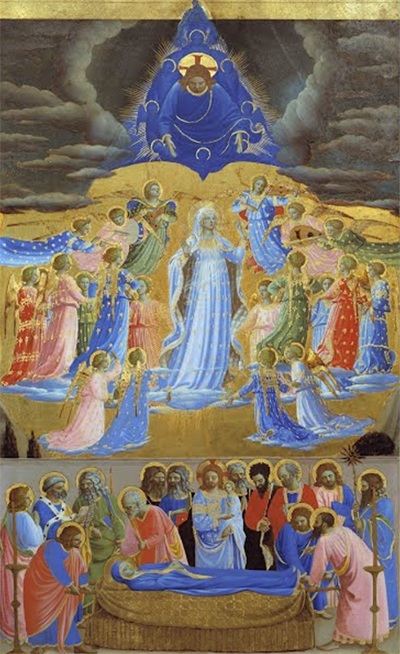
At the foot of Fra Angelico’s panel, four men bend to take the weight of a bier. Mary’s blue mantle lies almost flat against the cloth of gold. Look directly above her and the blue rises into an upright figure, her hands lifted among angels. Higher still, Christ leans towards her with his arms apart. The panel brings Mary’s funeral and her reception into heaven into a single field of view. The Isabella Stewart Gardner Museum, where it is kept, calls it The Dormition and Assumption of the Virgin. [1]
The painting is only about 62 centimetres high, yet the distance between the bier and Christ seems considerable. Fra Angelico makes it felt in the way people and angels gather, in the changing direction of their gestures and in the passage from a grey wall to gold and then to deep blue. This was also a reliquary panel, one of four associated with the Dominican church of Santa Maria Novella in Florence. Its scale invited the kind of looking that brings a palm frond or an angel’s hand into focus. The Gardner dates the panel to 1424–34. The catalogue checklist for the 2025–26 Florence exhibition places the same work in the early 1430s and calls the lower scene a funeral. [1] [2]
At a Glance
- ArtistFra Angelico
- TitleThe Dormition and Assumption of the Virgin, also known as The Death and the Assumption of the Virgin
- Date1424–34, according to the Isabella Stewart Gardner Museum
- MediumTempera with oil glazes and gold on panel
- Panel dimensions61.8 × 38.3 cm
- CollectionIsabella Stewart Gardner Museum, Boston, Early Italian Room, P15w34
A funeral about to move
The lower scene gives the eye a firm horizontal line. Mary’s head rests towards the left, her hands lie together and the blue mantle narrows towards her feet. Follow the top edge of the bier and then the drooping curve of the patterned cloth beneath it. The fabric describes the weight of what it covers. The men at the ends of the bier tell us what is about to happen. Two bend in from the left and two from the right to lift it for burial. Their reaching hands bring the viewer close to the practical work of the funeral. Behind them some of the disciples look down at Mary while others turn towards one another. The row of haloes stays relatively level, but each change of posture interrupts its rhythm. [1]
The palm frond at the far right has a fine spray of leaves that breaks the level line of the wall. The story was familiar from medieval accounts of Mary’s death. In Jacobus de Voragine’s Golden Legend, an angel brings Mary a branch from Paradise and tells her that it is to be carried before her bier. She entrusts it to John the Evangelist. A detail that could almost disappear among the candles and haloes thus points both backwards to the angel’s visit and forwards to the procession. Fra Angelico used the palm in a different, horizontal Dormition now in Philadelphia, where the museum likewise identifies the bearer on the right as John. [3] [4]
In the middle of the group, the standing Christ holds a small figure. The museum’s description calls attention to its resemblance to an infant, and the art historian Malena Rotter identifies it as Mary’s soul, following a convention found in Byzantine icons. Christ’s gesture recalls a familiar image of Mary holding her son. Here he carries her. With the still body below and the tiny figure above it, the same stretch of blue and gold contains both a scene of mourning and a promise that Mary has been received. The group stands before a quiet grey wall. Its plainness gives definition to the tightly packed faces and shoulders, and its upper edge marks a clean break before the open gold field. [1] [5]
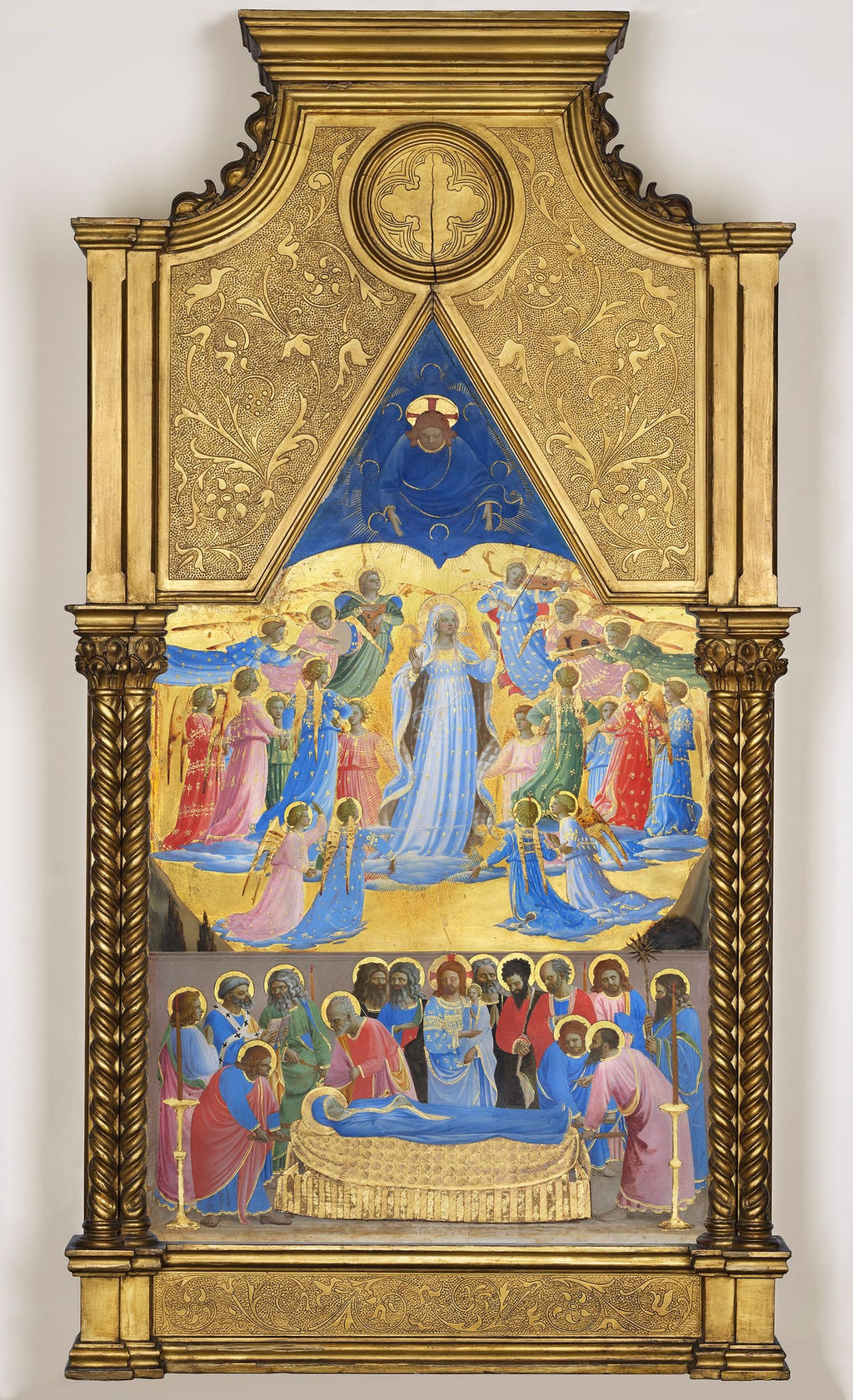
The Gardner reliquary in its architectural surround. The lower funeral and the upright Virgin above share the painted field. Image source. Public domain. Proportional web resize.
How the angels mark the ascent
The first angels you meet on looking up have their backs towards you. Four kneel low in the upper scene, two at either side, and the direction of their bodies draws attention inwards to Mary. Beyond them, angels on clouds link hands. Follow the curve they make around her and the side wings of the gathering feel further away than those four foreground figures. The clouds give the circle a footing. The kneeling figures give it depth. There is space to see the length of Mary’s mantle down the middle while the coloured robes of her companions gather around her in smaller patches. [5]
The musicians occupy a different level. They approach from the sides above the encircling angels. Some draw bows across strings, others blow into instruments, and an angel with a tambourine adds another kind of movement. A lifted bow or the angle of a wind instrument makes it possible to imagine the parts sounding together. Below, the candles and the bearers suggest the measured action of a funeral. Above, bodies seem to move to music. Both scenes concern a ceremony, and in each Fra Angelico makes its pace visible through the actions of the people taking part. [1] [5]
Christ fills the small blue area at the summit. Look at the face first, where the cross in the halo catches the light, then at the darker blue around his arms. Rotter describes an aureole of blue cherubim. Their outlines emerge through slight shifts of colour, pale accents and rims of gold. The figure’s lean makes the downward movement as evident as Mary’s upward one. The arms that cradle her soul in the funeral open to receive her at the summit. Once you have followed that exchange of gestures, the two scenes read as closely connected even though the wall, gold and blue give each part of the story its own setting. [1] [5]
Four reliquaries for Santa Maria Novella
The Gardner names Fra Giovanni di Zanobi Masi, sacristan of Santa Maria Novella, as the possible commissioner. The Florence exhibition’s guide identifies him as the patron of the group and places the commission before his death in 1434. A sacristy is where a church keeps the objects it needs for worship, including vessels, vestments and sacred treasures. These painted tabernacles belong to a tradition in which a small devotional image could share the same object with relics. Beth Williamson, writing for the Gardner’s 2018 exhibition catalogue, points to examples in which relics were displayed around the image, so that a person looking closely could move between the painted subject and the material remains of saints. Williamson leaves open the possibility that Angelico’s reliquaries were carried in procession, but the surviving objects offer no attachment point for a carrying pole. The intimate scale makes sense for display on an altar as well. [1] [6] [7]
The three other panels are in the Museo di San Marco in Florence. The Annunciation and Adoration of the Magi brings together two moments from the beginning of Mary’s story as Christ’s mother. The small Coronation of the Virgin pursues the story beyond her reception into heaven. The Madonna of the Star offers a standing Virgin and Child for contemplation. Openings around its central image give some idea of how relics could have accompanied a painted scene. The Boston panel once had a pointed top with horizontal shoulders, and Williamson compares its outline with a Sienese reliquary by Andrea di Bartolo in Washington. X-rays of the Washington work revealed chambers near its gable. This comparison suggests a possible arrangement, while the precise form of the Boston frame and the presence and placement of relics in it remain open questions. [7] [8] [9]
The group also helps put Fra Angelico’s larger works in perspective. The small Florentine reliquary of the Coronation shares its subject with two independent altarpieces. In the Louvre Coronation, made for San Domenico in Fiesole, steps lead up through the gathering to the act of crowning. The Uffizi Coronation, from Sant’Egidio in Florence, was paired with a predella that includes a funeral of the Virgin. There, the funeral belongs beneath the crowning. In the Gardner panel, the movement stops just as Mary reaches the company of heaven, leaving the coronation to another object in the group. [8] [10] [11]
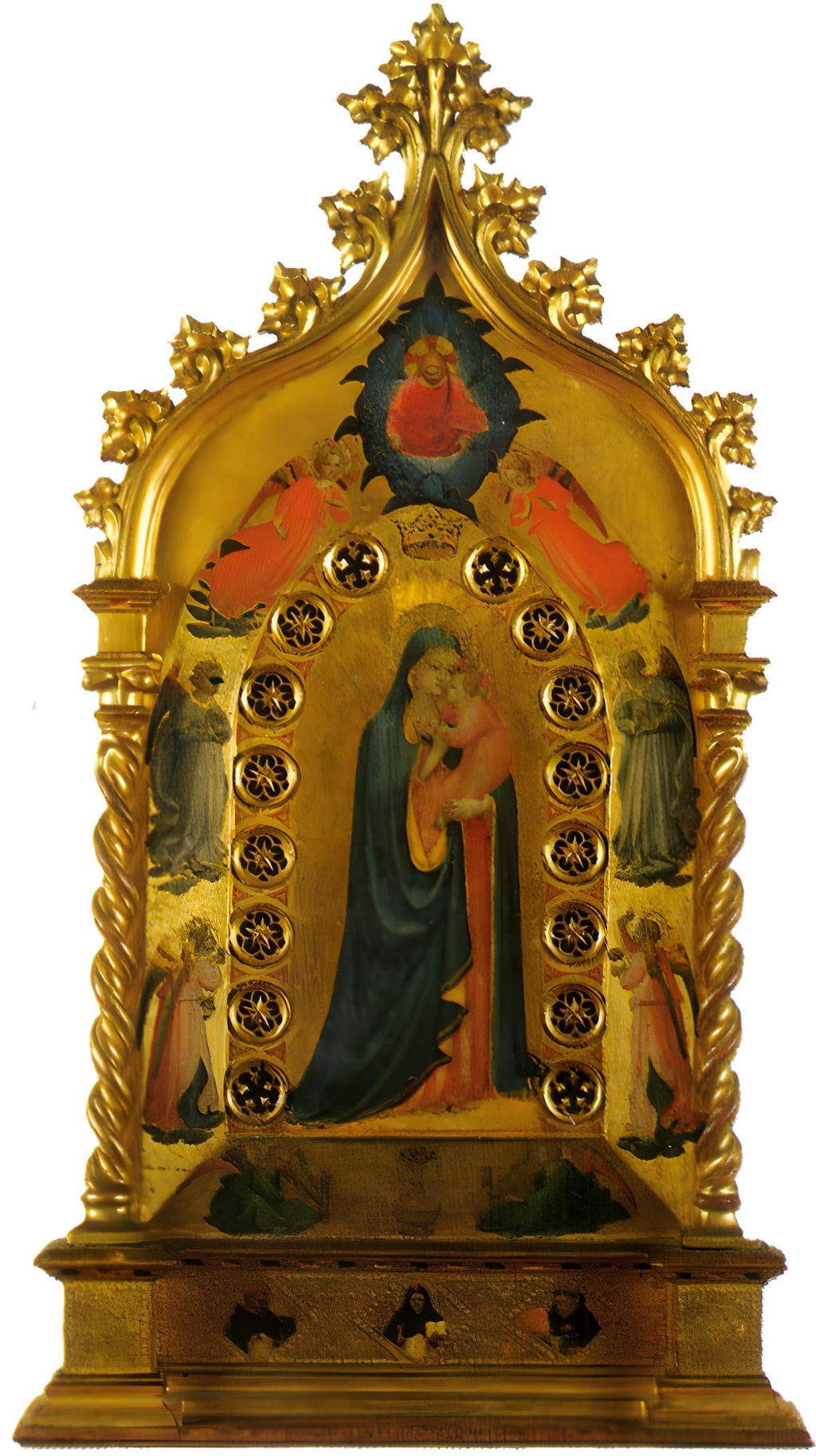
The Madonna of the Star on display with its architectural surround. Compare the central figures with the small images encircling them. Image source. Public domain. Proportional web resize.
The painted surface and the changing frame
Although the image is well preserved, the wood and the framing have a complicated history. The conservators Gianfranco Pocobene and Alexa Beller concluded that the original gabled format was squared off in the late eighteenth or early nineteenth century. The gilded Gothic-style frame dates from the nineteenth century and was fitted shortly before Gardner bought the painting. Its small columns and carved ornament give the object the appearance of a shrine. The carved surround a visitor sees today therefore belongs to a later phase of the object’s history, even though it encloses Angelico’s fifteenth-century work. [1] [9]
Research around the Gardner’s 2018 exhibition involved structural work and the removal of later alterations, bringing the panel closer to its earlier outline. When the conservators lifted nineteenth-century overpaint on the back, they found traces of older decoration. Those layers helped them work out more about how the tabernacle’s shape and size had changed. They also found surprisingly little wear to the painted image. Much of the gold leaf survives, the ultramarine remains intense and the researchers found no evidence of an old natural-resin varnish. The survival of the blue matters to the composition. In the uppermost triangle, dark-on-dark details have enough definition to emerge when you stop looking for a simple outline of Christ’s body. [5] [9]
From Florence to Boston
The Gardner’s provenance places the panel at Santa Maria Novella until at least 1754. By 1816 it belonged to the Reverend John Sanford in Somerset and was exhibited that year at the British Institution in London. It subsequently passed to the Methuen family at Corsham Court. Isabella Stewart Gardner bought it from the London dealers Colnaghi & Co. on 23 February 1899, through Bernard Berenson, for £4,000. The museum identifies it as the first painting by Fra Angelico to reach the United States. It is displayed in the Early Italian Room, beside a window. That proximity to daylight suits a painting whose gold surface shifts in appearance with the angle of the light. [1] [8] [9]
In 1909 the Dutch art historian Willem Martin discussed the collection in an illustrated review. He singled out the Fra Angelico for praise and described it hanging below a Mantegna. The pairing gives a glimpse of the panel’s new life among Italian paintings at Fenway Court, far from the three small objects with which it had once shared a place. [12]
In 2018 the Gardner’s Heaven on Earth exhibition brought the Boston painting together with the three counterparts from the Museo di San Marco. The four were shown together again at Palazzo Strozzi in the 2025–26 Florence exhibition. The reunions made it possible to compare, at the scale of the actual objects, how the painted settings and remnants of the reliquaries served different subjects. In the Boston panel, the story begins with the small task of lifting a body. The other works give that moment its place in Mary’s life. Look at the bier again after tracing her ascent and the hands doing the lifting have a counterpart in the open hands waiting for her at the very top. [2] [6] [8]
Fra Angelico artworks directory
Explore documented works and surviving parts of larger ensembles. Catalogue links identify individual records. Attribution and dating can vary across collections and publications. Search the Federico Zeri Photo Archive by artist.
| Name | Date | Medium and sources |
|---|---|---|
| Adoration of the Magi | About 1440–60, NGA catalogue | Painting Catalogue. |
| Adoration of the Magi (Armadio degli Argenti) | About 1450–53 | Tempera and gold on wood. Catalogue. |
| Agony in the Garden (Armadio degli Argenti) | About 1450–53 | Tempera and gilding on wood Catalogue. |
| Annalena Altarpiece / Pala di Annalena | commonly c. 1435 | Tempera on panel Catalogue. |
| Annunciation (Armadio degli Argenti) | About 1450–53 | Tempera and gilding on wood. Catalogue. |
| Annunciation (Cortona) | generally placed in the 1430s; exact dating remains debated | Tempera on panel Catalogue. |
| Annunciation (Prado) | 1425–26 | Tempera on poplar panel Catalogue. |
| Annunciation (San Marco upper corridor) | commonly c. 1442 | Fresco Catalogue. |
| Annunciation with Saint Peter Martyr | About 1439–43 | Fresco on plaster. Catalogue. |
| Annunciatory Angel | 1450–55, Detroit catalogue | Gold leaf and tempera on wood panel. Catalogue. |
| Armadio degli Argenti (Silver Treasury) | principally c. 1450–52 | Tempera on panel Catalogue. |
| Arrest of Christ (Armadio degli Argenti) | About 1450–53 | Tempera and gilding on wood Catalogue. |
| Ascension (Armadio degli Argenti) | About 1450–53 | Tempera and gilding on wood Catalogue. |
| Baptism of Christ (Armadio, Alesso Baldovinetti) | About 1452–53 | Tempera and gilding on wood Catalogue. |
| Beheading of Saints Cosmas and Damian (San Marco Altarpiece) | About 1438–42 | Painted panel Catalogue. |
| Betrayal of Christ (Armadio degli Argenti) | About 1450–53 | Tempera and gilding on wood Catalogue. |
| Blessed Dominican, Possibly Jordan of Saxony (San Marco Altarpiece) | About 1438–42 | Painted panel Catalogue. |
| Blessed Vincent Ferrer (San Marco Altarpiece) | About 1438–42 | Painted panel Catalogue. |
| Burial of Saints Cosmas and Damian (San Marco Altarpiece) | About 1438–42 | Painted panel Catalogue. |
| Bust of a Cleric and a Group of Figures (recto and verso) | 15th century | Pen and ink on paper Catalogue. |
| Christ among the Doctors (Armadio degli Argenti) | About 1450–53 | Tempera and gilding on wood Catalogue. |
| Christ before Caiaphas (Armadio degli Argenti) | About 1450–53 | Tempera and gilding on wood Catalogue. |
| Christ Glorified in the Court of Heaven | About 1423–24 | Egg tempera on wood, probably poplar, with gold and silver leaf Catalogue. |
| Christ Seated in Judgment | 1447 | Fresco and gilding on plaster. Catalogue. |
| Christ Stripped of His Garments (Armadio degli Argenti) | About 1450–53 | Tempera and gilding on wood Catalogue. |
| Christ Washes the Apostles’ Feet (Armadio degli Argenti) | About 1450–53 | Tempera and gilding on wood Catalogue. |
| Circumcision of Christ (Armadio degli Argenti) | About 1450–53 | Tempera and gilding on wood. Catalogue. |
| Communion of the Apostles (Armadio degli Argenti) | About 1450–53 | Tempera and gilding on wood Catalogue. |
| Coronation of the Virgin (Armadio degli Argenti) | About 1450–53 | Tempera and gilding on wood Catalogue. |
| Coronation of the Virgin (Louvre) | Louvre: second quarter of the fifteenth century, 1425–50; often dated more narrowly c. 1434–35 | Tempera and gold on panel Catalogue. |
| Coronation of the Virgin (Uffizi) | 1431–35 | Tempera on wood, gold ground Catalogue. |
| Cortona Triptych | About 1437 | Tempera and gold on panel. Catalogue. |
| Crucifixion (Armadio degli Argenti) | About 1450–53 | Tempera and gilding on wood Catalogue. |
| Crucifixion and Saints | 1441–42 | Fresco Catalogue. |
| Deposition from the Cross / Santa Trinita Deposition | commissioned 1429–32; completed by Angelico within this period | Tempera on panel Catalogue. |
| Descent into Limbo (Armadio degli Argenti) | About 1450–53 | Tempera and gilding on wood Catalogue. |
| Entombment of Christ (San Marco Altarpiece) | About 1438–42 | Painted panel Catalogue. |
| Entry into Jerusalem (Armadio degli Argenti) | About 1450–53 | Tempera and gilding on wood Catalogue. |
| Expulsion and the Stoning of Saint Stephen | 1448–49, Vatican Museums | Fresco. Catalogue. |
| Fiesole San Domenico Altarpiece | early 1420s; predella about 1423–24 | Tempera on panel Catalogue. |
| Flagellation (Armadio degli Argenti) | About 1450–53 | Tempera and gilding on wood Catalogue. |
| Flight into Egypt | About 1450–53 | Tempera and gilding on wood. Catalogue. |
| Guidalotti Polyptych | c. 1447–49 | Tempera and oil on panel Catalogue. |
| Healing of Palladia and Saint Damian Accepting Her Gift (San Marco Altarpiece) | About 1438–42 | Painted panel Catalogue. |
| Holy Pilgrim, Possibly Saint Roch (San Marco Altarpiece) | About 1438–42 | Painted panel Catalogue. |
| Holy Women at the Tomb (Armadio degli Argenti) | About 1450–53 | Tempera and gilding on wood Catalogue. |
| Judas Receives Payment (Armadio degli Argenti) | About 1450–53 | Tempera and gilding on wood Catalogue. |
| Lamentation over Christ (Armadio degli Argenti) | About 1450–53 | Tempera and gilding on wood Catalogue. |
| Lamentation over the Dead Christ (Croce al Tempio Lamentation) | 1436–41, Zeri catalogue | Tempera and gilding on wood panel. Catalogue. |
| Last Judgement (Armadio degli Argenti) | About 1450–53 | Tempera and gilding on wood Catalogue. |
| Last Judgement (San Marco) | c. 1425–28 | Tempera and gold on panel Catalogue. |
| Last Supper (Armadio degli Argenti) | About 1450–53 | Tempera and gilding on wood Catalogue. |
| Lex Amoris (Armadio degli Argenti) | About 1450–53 | Tempera and gilding on wood Catalogue. |
| Madonna and Child with Saint Dominic and Saint Thomas Aquinas | About 1430, Hermitage catalogue | Detached fresco. Catalogue. |
| Madonna and Child with Saints | About 1411–13 | Tempera on wood panel, with a gold ground. Catalogue. |
| Madonna of Humility | About 1425, Thyssen catalogue | Tempera and gold on wood. Catalogue. |
| Madonna of the Star | 1431–34, Zeri catalogue | Tempera with oil glazes and gold on wood panel, as catalogued by the Gardner for the 2018 exhibition. Catalogue. |
| Marriage at Cana (Armadio, Alesso Baldovinetti) | About 1452–53 | Tempera and gilding on wood Catalogue. |
| Massacre of the Innocents (Armadio degli Argenti) | About 1450–53 | Tempera and gilding on wood Catalogue. |
| Miracle of the Black Leg (San Marco Altarpiece) | About 1438–42 | Painted panel Catalogue. |
| Mocking of Christ (Armadio degli Argenti) | About 1450–53 | Tempera and gilding on wood Catalogue. |
| Mystic Wheel (The Vision of Ezekiel) | About 1450–52 | Tempera and gilding on wood. Catalogue. |
| Nativity (Armadio degli Argenti) | About 1450–53 | Tempera and gilding on wood. Catalogue. |
| Niccoline Chapel frescoes | principally 1448–50 | Fresco Catalogue. |
| Noli me Tangere | broadly within Angelico’s San Marco campaign, late 1430s–1440s | Fresco Catalogue. |
| Ordination of Saint Lawrence | 1448 | Fresco. Catalogue. |
| Pentecost (Armadio degli Argenti) | About 1450–53 | Tempera and gilding on wood Catalogue. |
| Presentation of Christ at the Temple (Armadio degli Argenti) | About 1450–53 | Tempera and gilding on wood. Catalogue. |
| Presentation of Jesus at the Temple | Early 1440s | Fresco on plaster. Catalogue. |
| Raising of Lazarus (Armadio degli Argenti) | About 1450–53 | Tempera and gilding on wood Catalogue. |
| Rescue of Saints Cosmas and Damian and Exorcism of Lysias (San Marco Altarpiece) | About 1438–42 | Painted panel Catalogue. |
| Road to Calvary (Armadio degli Argenti) | About 1450–53 | Tempera and gilding on wood Catalogue. |
| Saint Anthony Abbot (San Marco Altarpiece) | About 1438–42 | Painted panel Catalogue. |
| Saint Bernard of Clairvaux or Saint Benedict (San Marco Altarpiece) | About 1438–42 | Painted panel Catalogue. |
| Saint Damian Receives Money from Palladia | About 1425–49 | Tempera and gilding on wood. Catalogue. |
| Saint Francis and a Bishop Saint, Saint John the Baptist and Saint Dominic | Late 1420s, Getty catalogue | Tempera and gold leaf on panel. Catalogue. |
| Saint James the Greater Freeing the Magician Hermogenes | About 1426–29 | Tempera and gold on panel Catalogue. |
| Saint Jerome (San Marco Altarpiece) | About 1438–42 | Painted panel Catalogue. |
| Saint Lawrence Giving Alms | About 1448 | Wall fresco. Catalogue. |
| Saint Lawrence Receiving the Treasures of the Church from Pope Sixtus II | About 1448–49 | Fresco on plaster. Catalogue. |
| Saint Romuald (San Marco Altarpiece) | About 1438–42 | Painted panel Catalogue. |
| Saint Stephen Addressing the Council | 1448–49, Vatican Museums | Fresco. Catalogue. |
| Saint Stephen Preaching | 1448–49, Vatican Museums | Wall fresco. Catalogue. |
| Saint Thomas Aquinas (San Marco Altarpiece) | About 1438–42 | Painted panel Catalogue. |
| Saints Cosmas and Damian and Their Brothers Survive the Stake | Second quarter of the 15th century | Tempera and gilding on wood. Catalogue. |
| Saints Cosmas and Damian at the Stake (San Marco Altarpiece) | About 1438–42 | Painted panel Catalogue. |
| Saints Cosmas and Damian before Lysias (San Marco Altarpiece) | About 1438–42 | Painted panel Catalogue. |
| Saints Cosmas and Damian Rescued by an Angel | Second quarter of the 15th century | Tempera and gilding on wood. Catalogue. |
| Saints Cosmas and Damian with Their Brothers before Proconsul Lysias | Second quarter of the 15th century | Tempera and gilding on wood. Catalogue. |
| San Marco Altarpiece / Pala di San Marco | 1438–43 | Tempera on panel Catalogue. |
| San Pietro Martire Triptych | About 1422–23, Strozzi exhibition | Tempera and gold on panel. Catalogue. |
| Scenes from the Lives of the Desert Fathers (Thebaid) | About 1420, Uffizi catalogue | Tempera on wood. Catalogue. |
| Sixteen Prophets | 1447 | Fresco and gilding on plaster Catalogue. |
| Stoning and Shooting of the Brothers (San Marco Altarpiece) | About 1438–42 | Painted panel Catalogue. |
| Tabernacle of the Linaioli | 1433–35 | Tempera on panel Catalogue. |
| The Attempted Crucifixion and Stoning of Saints Cosmas and Damian | Second quarter of the 15th century | Tempera and gilding on wood. Catalogue. |
| The Crucifixion | About 1420–23, Met catalogue | Tempera on wood, gold ground. Catalogue. |
| The Death and the Assumption of the Virgin | 1424–34 | Tempera with oil glazes and gold on panel Catalogue. |
| The Dominican Blessed (left end) (Fiesole predella) | About 1423–24 | Egg tempera and gold on wood Catalogue. |
| The Dominican Blessed (right end) (Fiesole predella) | About 1423–24 | Egg tempera and gold on wood Catalogue. |
| The Entombment of Christ | About 1450 | Tempera on poplar panel. Catalogue. |
| The Forerunners of Christ with Saints and Martyrs | About 1423–24 | Egg tempera on wood (probably poplar), with gold and silver leaf. Catalogue. |
| The Funeral of Saint Anthony Abbot | About 1426–30 | Tempera on poplar panel. Catalogue. |
| The Martyrdom of Saints Cosmas and Damian | About 1425–49 | Tempera and gilding on wood. Catalogue. |
| The Mocking of Christ / Christ Mocked | within the San Marco dormitory campaign, broadly late 1430s–1440s | Fresco Catalogue. |
| The Nativity | About 1425, Minneapolis catalogue | Tempera on poplar panel. Catalogue. |
| The Nativity in Cell 5 at San Marco | About 1439–43 | Fresco on plaster. Catalogue. |
| The Penitent Saint Jerome | 1419–20 | Tempera on wood panel Catalogue. |
| The Virgin and Child by Fra Angelico (Fogg Museum) | About 1430, Harvard catalogue | Tempera originally on panel, subsequently transferred to Masonite. Catalogue. |
| The Virgin Mary with the Apostles and Other Saints (Fiesole predella) | About 1423–24 | Egg tempera and gold on wood Catalogue. |
| Transfiguration (Armadio, Alesso Baldovinetti) | About 1452–53 | Tempera and gilding on wood Catalogue. |
| Transfiguration (San Marco Cell 6) | within the San Marco dormitory campaign, broadly late 1430s–1440s | Fresco Catalogue. |
| Virgin Mary Annunciate | 1450–55, Detroit catalogue | Gold leaf and tempera on wood panel. Catalogue. |
| Virgin of the Pomegranate | About 1426 | Tempera on panel with gilding Catalogue. |
Frequently Asked Questions
The figure represents Mary’s soul. Fra Angelico depicts it in the form of a child, echoing a long-standing way of showing the Dormition. [5]
The gilded Gothic-style frame is nineteenth-century. Study of the painted panel established that its original shape included a pointed gable. The exact design of the original frame is still uncertain. [9]
They belong to the Museo di San Marco in Florence. They depict the Annunciation and Adoration of the Magi, the Coronation of the Virgin and the Madonna of the Star. [8]
Discussion
Use these prompts to look again or share an observation.
Reader Insights
Follow the apostles’ eyes in the lower group, then look above. Where does the painting first invite your eye to change direction?
How does the small cluster of angels near the Virgin distinguish the upper event from the bedside scene?
Join the Conversation
Share a detail or question about The Death and the Assumption of the Virgin.
References
- Isabella Stewart Gardner Museum, The Dormition and Assumption of the Virgin, P15w34, collection record. View source.
- Fondazione Palazzo Strozzi and Museo di San Marco, Fra Angelico, exhibition press kit, checklist no. 8, 2025. View source.
- Jacobus de Voragine, “The Assumption of Mary,” The Golden Legend, in William Caxton’s English translation, Temple Classics edition edited by F. S. Ellis, with lacunae supplied from W. G. Ryan’s translation. View source.
- Philadelphia Museum of Art, Fra Angelico, Dormition of the Virgin, collection record. View source.
- Malena Rotter, Unsichtbares sichtbar machen. Strategien zur Darstellung des überirdischen Raumes in der italienischen Malerei im 14. und 15. Jahrhundert, pp. 235–238, German. View source.
- Fondazione Palazzo Strozzi and Museo di San Marco, Fra Angelico guide to sites outside the exhibition, “Basilica di Santa Maria Novella”, 2025, Italian and English. View source.
- Beth Williamson, “Fra Angelico and Siena: Contextualizing the Painted Reliquary”, in Nathaniel Silver, ed., Fra Angelico: Heaven on Earth, Isabella Stewart Gardner Museum and Paul Holberton Publishing, 2018. View source.
- Isabella Stewart Gardner Museum, Fra Angelico: Heaven on Earth, exhibition overview, 2018. View source.
- Gianfranco Pocobene and Alexa Beller, “Fra Angelico’s Dormition and Assumption of the Virgin: Transformations Old and New”, Canadian Association for Conservation, 44th annual conference abstracts, p. 33, 2018. View source.
- Musée du Louvre, Le Couronnement de la Vierge, INV 314, collection record, French. View source.
- Uffizi Galleries, “The Coronation of the Virgin by Fra Angelico rejoins its predella”. View source.
- Willem Martin, “Iets over Amerikaansche schilderijverzamelingen,” Elseviers Geïllustreerd Maandschrift, vol. 19, p. 83, 1909, Dutch. View source.
.jpg)



 Fra Angelico.jpg)


