 by Tom Gurney
Tom Gurney BSc (Hons) is an art history expert with over 20 years experience
Published on June 19, 2020 / Updated on November 29, 2026
Email: tomgurney1@gmail.com / Phone: +44 7429 011000
Introduction
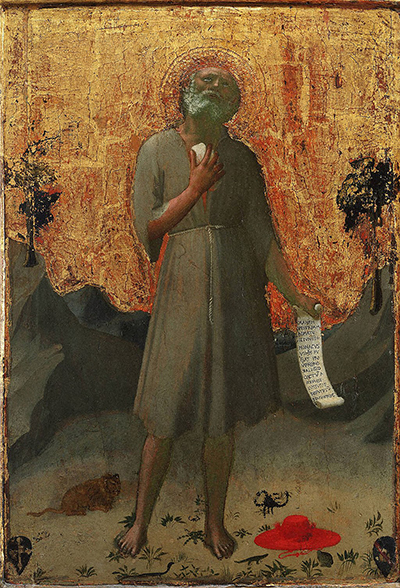
Saint Jerome holds a stone to his chest and lifts his face into a field of gold. His other hand lets a written scroll unfurl almost to his knee. Fra Angelico gives the saint’s two hands different tasks, one performing penance and the other displaying the rules of an ascetic life. Princeton University Art Museum dates this tempera panel to 1419–20. The most striking detail in it today, the brightness of the arm that raises the stone, owes part of its effect to paint added after the picture was first made. [1] [2]
At a Glance
- ArtistFra Angelico
- Date1419–20, as catalogued by Princeton
- MediumTempera on wood panel
- Dimensions56.5 × 41.2 cm
- CollectionPrinceton University Art Museum, y1963-1. [1]
The stone, the scroll and the gold
Jerome stands barefoot in the middle of the panel, in a plain robe gathered by a cord. Seen from the front, the body is almost as upright as the trunks of the trees at either edge. The head breaks that alignment. The lift of the chin exposes the throat, and the eyes look above anything visible in the picture. The bent right arm crosses the broad front of the robe, bringing the pale stone close to the centre of the chest. To the viewer’s right, the left arm slopes down and away from the body. The pale scroll hangs from that hand and lifts at the tip, its curl as finely drawn as the stone is blunt. [1]
The ground under Jerome’s feet is broad enough to stand on. Behind him, dark planes of rock rise sharply at the edges and dip towards the centre. The trees make the outcrops feel higher, but the eye has little room to travel beyond them. Gold rises directly from the irregular line of the rocks. Massey reads the worked gold as sunlight falling across the desert. Against it, the halo is legible through its worked rings, which keep the turn of the head clear even where gold meets gold. The picture uses surprisingly little depth to establish the solitary figure’s position. The space in front of him is where the ground is easiest to see and where the painter places the smallest things. [1] [2]
A tawny lion crouches low on the left. On the right, a black scorpion stands out near the scarlet hat, and a lizard and a snake break up the ground around Jerome’s feet. The lion recalls the legend in which Jerome pulls a thorn from its paw. The scorpion has an echo in Jerome’s own letter to Eustochium, where he remembers sharing the desert with scorpions and wild beasts. He writes of fasting and tears, and of desires that followed him into solitude. The animals put the viewer in the terrain of that account, even though the picture gathers several different traditions about the saint into one place. The red hat lying on the ground is a later emblem of Jerome’s supposed rank as a cardinal. [2] [3]
The writing in the scroll’s narrow lines makes a different claim on the eye. Art historian Lyle Massey identifies the text as rules associated with a Tuscan order dedicated to Jerome. They counsel fasting, warn against wine and treat cooked food as an indulgence. These are practical instructions for going without, set beside a gesture that a viewer can understand from across a room. The scroll recalls the biblical translator responsible for much of the Latin Vulgate. Here its words concern the discipline of the body. The earlier panel and the slightly later Crucifixion at the Metropolitan Museum of Art show two ways Angelico could use gold. In New York the ground sets off a crowd gathered around the cross. In Princeton it surrounds one upturned face and leaves the object of the saint’s gaze beyond the top of the picture. The Met dates its panel to about 1420–23, close to Princeton’s dating of the Jerome. [1] [2] [4]
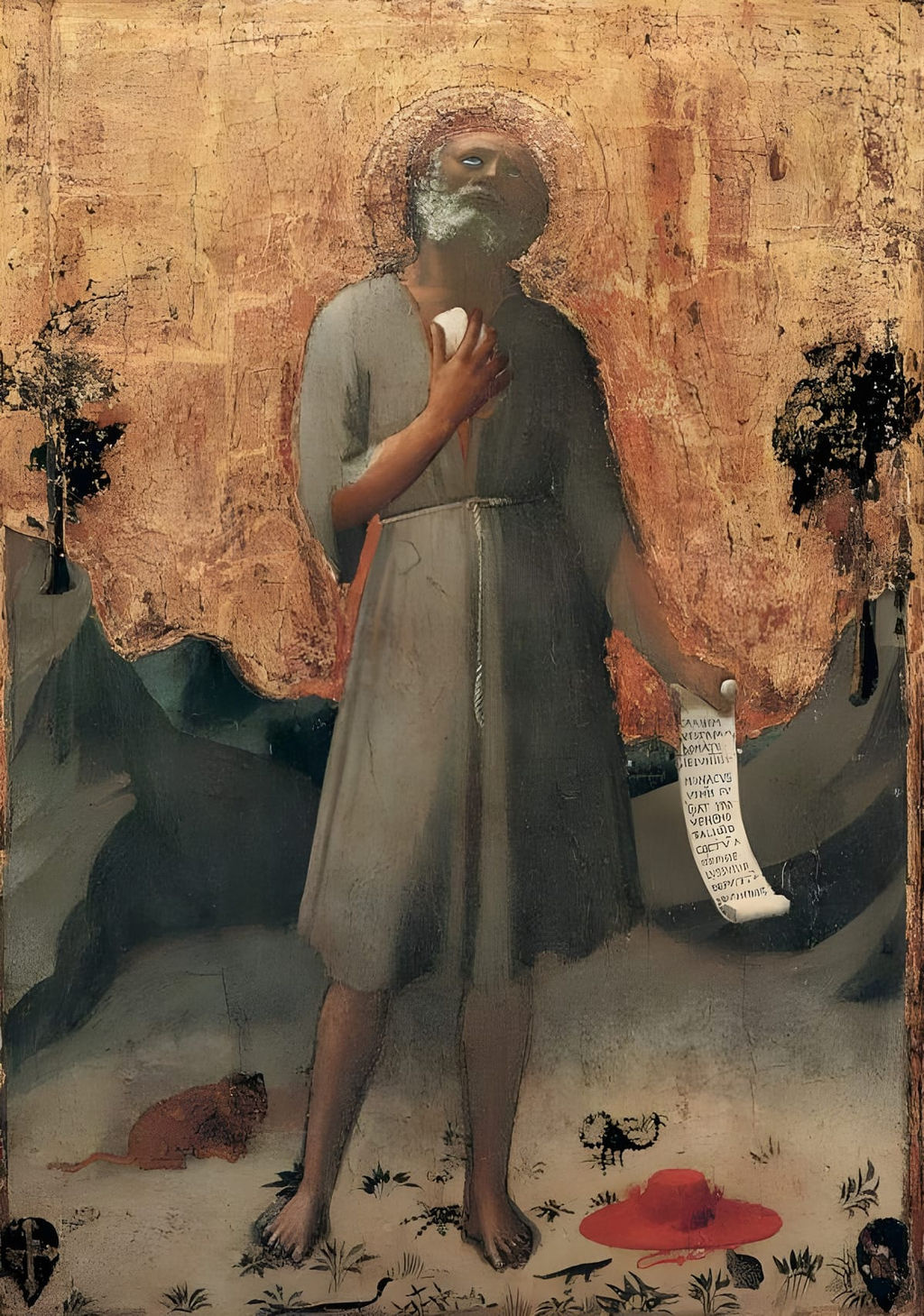
The Princeton Penitent Saint Jerome, y1963-1. The saint's stone and long scroll are legible within the rocky setting. Image source. Public domain. Proportional web resize.
What the surface can tell us
When the panel underwent restoration in 1984, examination revealed that earlier work had substantially changed the painted figure. Jerome’s face, left arm and both legs had been repainted. Princeton identifies the right forearm as the sole unrestored part of his anatomy. The light green earth underpaint there, known as terra verde, is consistent with Angelico’s practice in works accepted as his own. That small area gives the attribution a material point of comparison. It also explains why comparisons based on the modelling of the present face need particular care. [1]
The paintings conservator Annika Svendsen Finne reads the brighter, rosier right arm as an effect of the cooler, darker paint added to the surrounding flesh. She places that intervention probably within fifty years of the panel’s making. The arm would make sense as the place for a painter to concentrate light. It performs the central action, and the light makes the stone and the hand unusually easy to pick out. Finne’s reading asks us to distinguish how convincingly the arm works in the picture today from how that emphasis came about. Scholars have proposed that Angelico revised the painting himself. The hand and purpose of the intervention remain open. [1]
The attribution has changed as the evidence available to scholars has changed. In 1920 Richard Offner published the panel as Masolino, comparing the saint’s body with Masolino’s Adam in the Brancacci Chapel in Florence and weighing a possible attribution to Masaccio. His argument also paid close attention to the way the trees and rocks raise the viewer’s eye. The visual observation still holds even though the museum now gives the work to Fra Angelico. The Fondazione Zeri’s photographic catalogue preserves the Masolino attribution and records a proposal for Sassetta. The panel was also associated with Giovanni di Francesco Toscani through a group of early Florentine paintings including the Met’s Crucifixion. The Met’s 2005–06 Fra Angelico exhibition catalogue presented the panel under both Angelico’s name and that of an unknown Florentine master. Princeton’s current attribution names Angelico, and Finne leaves the authorship of the early repainting open. [1] [5] [6] [7]
The Gaddi family and the hermits of Fiesole
There are two small heraldic shields at the bottom, one in each corner. They have been identified with the Gaddi and Ridolfi families. The marriage of Angelo Gaddi and Maddalena Ridolfi in 1424 is one reason the arms have been read as marks of a family occasion. Offner considered a marriage or a birth and favoured the latter. Carl Brandon Strehlke identifies Angelo, a grandson of the painter Taddeo Gaddi, as an early owner. His family is also associated with the patronage of Angelico’s Annunciation now in the Prado, made for the Dominican house of San Domenico at Fiesole. The occasion for the Jerome remains uncertain. Princeton’s date for the painting precedes the marriage by several years. [1] [5] [8] [9]
The painting also has an early connection with a second religious house in Fiesole, the hermit community of San Girolamo. The historian Laura Fenelli distinguishes it on those grounds from another Saint Jerome with Ferranti arms mentioned in Florentine records. The scroll makes the Fiesole connection particularly intelligible. Jerome’s example could inform what a religious community ate and drank as well as how its members prayed. A later altarpiece by Francesco Botticini, still traceable to the church at Fiesole and now at the National Gallery in London, surrounds its own penitent Jerome with saints and kneeling donors. The Princeton panel has most of its original frame moulding and an iron hanging ring. Its compact size and hardware suit a picture hung for close viewing, although its first place of display remains uncertain. [1] [2] [10] [11]
From Casa Guidi to Princeton
Princeton places the picture at Casa Guidi, the Florence home of Robert and Elizabeth Barrett Browning, probably by 1850. In Old Pictures in Florence, published in Men and Women in 1855, Robert Browning imagines appealing to the old painters for surviving examples of their work. Princeton associates the panel with his line “Some Jerome that seeks the heaven with a sad eye”. In the poem, the speaker has just addressed Taddeo Gaddi and asks for a taste of his intonaco, the plaster on which a fresco is painted. Fra Angelico is named separately a few lines earlier. The upward eyes make the museum’s association persuasive as a recollection, even though Browning’s imaginary request is for a fresco. [1] [12]
The picture came up at Sotheby’s in London in May 1913 at the sale of the collection of the Brownings’ son, Robert Barrett Browning. The museum lists Dowdeswell as a probable purchaser. By 1920 it was demonstrably in Frank Jewett Mather Jr.’s collection: Offner thanked Mather for permission to publish it and printed his name under the illustration. Mather, a Princeton professor and museum director, bequeathed the panel to the university’s art museum, where it is catalogued as y1963-1. The painting thus passes through several ways of looking at the saint. Browning’s verse recalls the sadness in his upward gaze, Offner makes that pose part of an argument about authorship, and the conservation examination gives the stone-bearing forearm a new importance. [1] [5] [13]
Fra Angelico artworks directory
Explore documented works and surviving parts of larger ensembles. Catalogue links identify individual records. Attribution and dating can vary across collections and publications. Search the Federico Zeri Photo Archive by artist.
| Name | Date | Medium and sources |
|---|---|---|
| Adoration of the Magi | About 1440–60, NGA catalogue | Painting Catalogue. |
| Adoration of the Magi (Armadio degli Argenti) | About 1450–53 | Tempera and gold on wood. Catalogue. |
| Agony in the Garden (Armadio degli Argenti) | About 1450–53 | Tempera and gilding on wood Catalogue. |
| Annalena Altarpiece / Pala di Annalena | commonly c. 1435 | Tempera on panel Catalogue. |
| Annunciation (Armadio degli Argenti) | About 1450–53 | Tempera and gilding on wood. Catalogue. |
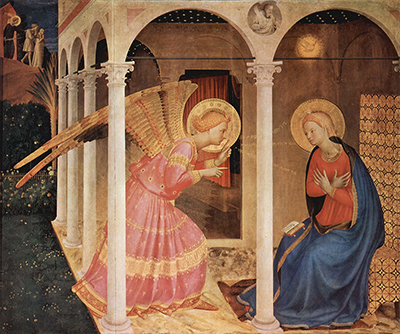
| Annunciation (Cortona) | generally placed in the 1430s; exact dating remains debated | Tempera on panel Catalogue. |
| Annunciation (Prado) | 1425–26 | Tempera on poplar panel Catalogue. |
| Annunciation (San Marco upper corridor) | commonly c. 1442 | Fresco Catalogue. |
| Annunciation with Saint Peter Martyr | About 1439–43 | Fresco on plaster. Catalogue. |
| Annunciatory Angel | 1450–55, Detroit catalogue | Gold leaf and tempera on wood panel. Catalogue. |
| Armadio degli Argenti (Silver Treasury) | principally c. 1450–52 | Tempera on panel Catalogue. |
| Arrest of Christ (Armadio degli Argenti) | About 1450–53 | Tempera and gilding on wood Catalogue. |
| Ascension (Armadio degli Argenti) | About 1450–53 | Tempera and gilding on wood Catalogue. |
| Baptism of Christ (Armadio, Alesso Baldovinetti) | About 1452–53 | Tempera and gilding on wood Catalogue. |
| Beheading of Saints Cosmas and Damian (San Marco Altarpiece) | About 1438–42 | Painted panel Catalogue. |
| Betrayal of Christ (Armadio degli Argenti) | About 1450–53 | Tempera and gilding on wood Catalogue. |
| Blessed Dominican, Possibly Jordan of Saxony (San Marco Altarpiece) | About 1438–42 | Painted panel Catalogue. |
| Blessed Vincent Ferrer (San Marco Altarpiece) | About 1438–42 | Painted panel Catalogue. |
| Burial of Saints Cosmas and Damian (San Marco Altarpiece) | About 1438–42 | Painted panel Catalogue. |
| Bust of a Cleric and a Group of Figures (recto and verso) | 15th century | Pen and ink on paper Catalogue. |
| Christ among the Doctors (Armadio degli Argenti) | About 1450–53 | Tempera and gilding on wood Catalogue. |
| Christ before Caiaphas (Armadio degli Argenti) | About 1450–53 | Tempera and gilding on wood Catalogue. |
| Christ Glorified in the Court of Heaven | About 1423–24 | Egg tempera on wood, probably poplar, with gold and silver leaf Catalogue. |
| Christ Seated in Judgment | 1447 | Fresco and gilding on plaster. Catalogue. |
| Christ Stripped of His Garments (Armadio degli Argenti) | About 1450–53 | Tempera and gilding on wood Catalogue. |
| Christ Washes the Apostles’ Feet (Armadio degli Argenti) | About 1450–53 | Tempera and gilding on wood Catalogue. |
| Circumcision of Christ (Armadio degli Argenti) | About 1450–53 | Tempera and gilding on wood. Catalogue. |
| Communion of the Apostles (Armadio degli Argenti) | About 1450–53 | Tempera and gilding on wood Catalogue. |
| Coronation of the Virgin (Armadio degli Argenti) | About 1450–53 | Tempera and gilding on wood Catalogue. |
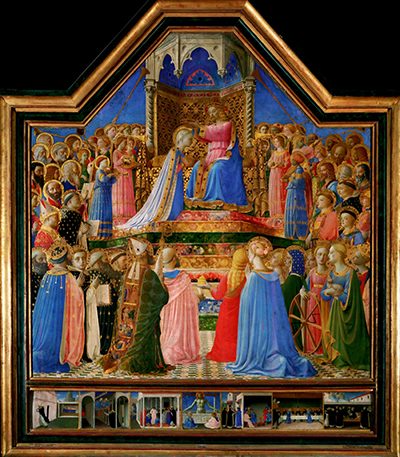
| Coronation of the Virgin (Louvre) | Louvre: second quarter of the fifteenth century, 1425–50; often dated more narrowly c. 1434–35 | Tempera and gold on panel Catalogue. |
| Coronation of the Virgin (Uffizi) | 1431–35 | Tempera on wood, gold ground Catalogue. |
| Cortona Triptych | About 1437 | Tempera and gold on panel. Catalogue. |
| Crucifixion (Armadio degli Argenti) | About 1450–53 | Tempera and gilding on wood Catalogue. |
| Crucifixion and Saints | 1441–42 | Fresco Catalogue. |
| Deposition from the Cross / Santa Trinita Deposition | commissioned 1429–32; completed by Angelico within this period | Tempera on panel Catalogue. |
| Descent into Limbo (Armadio degli Argenti) | About 1450–53 | Tempera and gilding on wood Catalogue. |
| Entombment of Christ (San Marco Altarpiece) | About 1438–42 | Painted panel Catalogue. |
| Entry into Jerusalem (Armadio degli Argenti) | About 1450–53 | Tempera and gilding on wood Catalogue. |
| Expulsion and the Stoning of Saint Stephen | 1448–49, Vatican Museums | Fresco. Catalogue. |
| Fiesole San Domenico Altarpiece | early 1420s; predella about 1423–24 | Tempera on panel Catalogue. |
| Flagellation (Armadio degli Argenti) | About 1450–53 | Tempera and gilding on wood Catalogue. |
| Flight into Egypt | About 1450–53 | Tempera and gilding on wood. Catalogue. |
| Guidalotti Polyptych | c. 1447–49 | Tempera and oil on panel Catalogue. |
| Healing of Palladia and Saint Damian Accepting Her Gift (San Marco Altarpiece) | About 1438–42 | Painted panel Catalogue. |
| Holy Pilgrim, Possibly Saint Roch (San Marco Altarpiece) | About 1438–42 | Painted panel Catalogue. |
| Holy Women at the Tomb (Armadio degli Argenti) | About 1450–53 | Tempera and gilding on wood Catalogue. |
| Judas Receives Payment (Armadio degli Argenti) | About 1450–53 | Tempera and gilding on wood Catalogue. |
| Lamentation over Christ (Armadio degli Argenti) | About 1450–53 | Tempera and gilding on wood Catalogue. |
| Lamentation over the Dead Christ (Croce al Tempio Lamentation) | 1436–41, Zeri catalogue | Tempera and gilding on wood panel. Catalogue. |
| Last Judgement (Armadio degli Argenti) | About 1450–53 | Tempera and gilding on wood Catalogue. |
| Last Judgement (San Marco) | c. 1425–28 | Tempera and gold on panel Catalogue. |
| Last Supper (Armadio degli Argenti) | About 1450–53 | Tempera and gilding on wood Catalogue. |
| Lex Amoris (Armadio degli Argenti) | About 1450–53 | Tempera and gilding on wood Catalogue. |
| Madonna and Child with Saint Dominic and Saint Thomas Aquinas | About 1430, Hermitage catalogue | Detached fresco. Catalogue. |
| Madonna and Child with Saints | About 1411–13 | Tempera on wood panel, with a gold ground. Catalogue. |
| Madonna of Humility | About 1425, Thyssen catalogue | Tempera and gold on wood. Catalogue. |
| Madonna of the Star | 1431–34, Zeri catalogue | Tempera with oil glazes and gold on wood panel, as catalogued by the Gardner for the 2018 exhibition. Catalogue. |
| Marriage at Cana (Armadio, Alesso Baldovinetti) | About 1452–53 | Tempera and gilding on wood Catalogue. |
| Massacre of the Innocents (Armadio degli Argenti) | About 1450–53 | Tempera and gilding on wood Catalogue. |
| Miracle of the Black Leg (San Marco Altarpiece) | About 1438–42 | Painted panel Catalogue. |
| Mocking of Christ (Armadio degli Argenti) | About 1450–53 | Tempera and gilding on wood Catalogue. |
| Mystic Wheel (The Vision of Ezekiel) | About 1450–52 | Tempera and gilding on wood. Catalogue. |
| Nativity (Armadio degli Argenti) | About 1450–53 | Tempera and gilding on wood. Catalogue. |
| Niccoline Chapel frescoes | principally 1448–50 | Fresco Catalogue. |
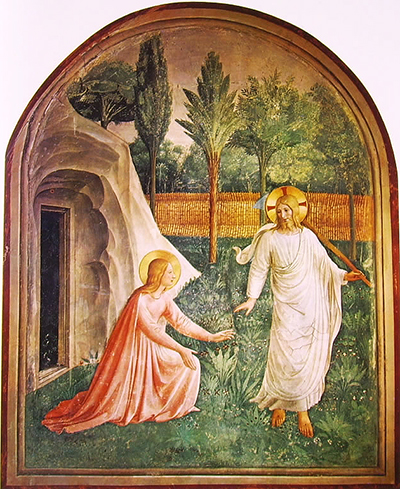
| Noli me Tangere | broadly within Angelico’s San Marco campaign, late 1430s–1440s | Fresco Catalogue. |
| Ordination of Saint Lawrence | 1448 | Fresco. Catalogue. |
| Pentecost (Armadio degli Argenti) | About 1450–53 | Tempera and gilding on wood Catalogue. |
| Presentation of Christ at the Temple (Armadio degli Argenti) | About 1450–53 | Tempera and gilding on wood. Catalogue. |
| Presentation of Jesus at the Temple | Early 1440s | Fresco on plaster. Catalogue. |
| Raising of Lazarus (Armadio degli Argenti) | About 1450–53 | Tempera and gilding on wood Catalogue. |
| Rescue of Saints Cosmas and Damian and Exorcism of Lysias (San Marco Altarpiece) | About 1438–42 | Painted panel Catalogue. |
| Road to Calvary (Armadio degli Argenti) | About 1450–53 | Tempera and gilding on wood Catalogue. |
| Saint Anthony Abbot (San Marco Altarpiece) | About 1438–42 | Painted panel Catalogue. |
| Saint Bernard of Clairvaux or Saint Benedict (San Marco Altarpiece) | About 1438–42 | Painted panel Catalogue. |
| Saint Damian Receives Money from Palladia | About 1425–49 | Tempera and gilding on wood. Catalogue. |
| Saint Francis and a Bishop Saint, Saint John the Baptist and Saint Dominic | Late 1420s, Getty catalogue | Tempera and gold leaf on panel. Catalogue. |
| Saint James the Greater Freeing the Magician Hermogenes | About 1426–29 | Tempera and gold on panel Catalogue. |
| Saint Jerome (San Marco Altarpiece) | About 1438–42 | Painted panel Catalogue. |
| Saint Lawrence Giving Alms | About 1448 | Wall fresco. Catalogue. |
| Saint Lawrence Receiving the Treasures of the Church from Pope Sixtus II | About 1448–49 | Fresco on plaster. Catalogue. |
| Saint Romuald (San Marco Altarpiece) | About 1438–42 | Painted panel Catalogue. |
| Saint Stephen Addressing the Council | 1448–49, Vatican Museums | Fresco. Catalogue. |
| Saint Stephen Preaching | 1448–49, Vatican Museums | Wall fresco. Catalogue. |
| Saint Thomas Aquinas (San Marco Altarpiece) | About 1438–42 | Painted panel Catalogue. |
| Saints Cosmas and Damian and Their Brothers Survive the Stake | Second quarter of the 15th century | Tempera and gilding on wood. Catalogue. |
| Saints Cosmas and Damian at the Stake (San Marco Altarpiece) | About 1438–42 | Painted panel Catalogue. |
| Saints Cosmas and Damian before Lysias (San Marco Altarpiece) | About 1438–42 | Painted panel Catalogue. |
| Saints Cosmas and Damian Rescued by an Angel | Second quarter of the 15th century | Tempera and gilding on wood. Catalogue. |
| Saints Cosmas and Damian with Their Brothers before Proconsul Lysias | Second quarter of the 15th century | Tempera and gilding on wood. Catalogue. |
| San Marco Altarpiece / Pala di San Marco | 1438–43 | Tempera on panel Catalogue. |
| San Pietro Martire Triptych | About 1422–23, Strozzi exhibition | Tempera and gold on panel. Catalogue. |
| Scenes from the Lives of the Desert Fathers (Thebaid) | About 1420, Uffizi catalogue | Tempera on wood. Catalogue. |
| Sixteen Prophets | 1447 | Fresco and gilding on plaster Catalogue. |
| Stoning and Shooting of the Brothers (San Marco Altarpiece) | About 1438–42 | Painted panel Catalogue. |
| Tabernacle of the Linaioli | 1433–35 | Tempera on panel Catalogue. |
| The Attempted Crucifixion and Stoning of Saints Cosmas and Damian | Second quarter of the 15th century | Tempera and gilding on wood. Catalogue. |
| The Crucifixion | About 1420–23, Met catalogue | Tempera on wood, gold ground. Catalogue. |
| The Death and the Assumption of the Virgin | 1424–34 | Tempera with oil glazes and gold on panel Catalogue. |
| The Dominican Blessed (left end) (Fiesole predella) | About 1423–24 | Egg tempera and gold on wood Catalogue. |
| The Dominican Blessed (right end) (Fiesole predella) | About 1423–24 | Egg tempera and gold on wood Catalogue. |
| The Entombment of Christ | About 1450 | Tempera on poplar panel. Catalogue. |
| The Forerunners of Christ with Saints and Martyrs | About 1423–24 | Egg tempera on wood (probably poplar), with gold and silver leaf. Catalogue. |
| The Funeral of Saint Anthony Abbot | About 1426–30 | Tempera on poplar panel. Catalogue. |
| The Martyrdom of Saints Cosmas and Damian | About 1425–49 | Tempera and gilding on wood. Catalogue. |
| The Mocking of Christ / Christ Mocked | within the San Marco dormitory campaign, broadly late 1430s–1440s | Fresco Catalogue. |
| The Nativity | About 1425, Minneapolis catalogue | Tempera on poplar panel. Catalogue. |
| The Nativity in Cell 5 at San Marco | About 1439–43 | Fresco on plaster. Catalogue. |
| The Penitent Saint Jerome | 1419–20 | Tempera on wood panel Catalogue. |
| The Virgin and Child by Fra Angelico (Fogg Museum) | About 1430, Harvard catalogue | Tempera originally on panel, subsequently transferred to Masonite. Catalogue. |
| The Virgin Mary with the Apostles and Other Saints (Fiesole predella) | About 1423–24 | Egg tempera and gold on wood Catalogue. |
| Transfiguration (Armadio, Alesso Baldovinetti) | About 1452–53 | Tempera and gilding on wood Catalogue. |
| Transfiguration (San Marco Cell 6) | within the San Marco dormitory campaign, broadly late 1430s–1440s | Fresco Catalogue. |
| Virgin Mary Annunciate | 1450–55, Detroit catalogue | Gold leaf and tempera on wood panel. Catalogue. |
| Virgin of the Pomegranate | About 1426 | Tempera on panel with gilding Catalogue. |
Frequently Asked Questions
The 1984 examination revealed old repainting on the face, left arm and both legs. The right forearm is the only unrestored part of Jerome’s anatomy and retains light green earth underpaint consistent with Fra Angelico’s practice. The author of the older intervention remains uncertain. [1]
Princeton’s panel is by Fra Angelico. In Leonardo’s Saint Jerome in the Wilderness, the saint crouches beside a large lion and extends his stone-bearing arm. The Vatican Museums hold Leonardo’s unfinished panel. [1] [14] [15]
Discussion
Use these prompts to look again or share an observation.
Reader Insights
What clues help you find Jerome when you first see the whole rocky landscape?
Follow the saint’s raised hand towards the cross. How much empty space does the painter leave between them?
Join the Conversation
Share a detail or question about The Penitent Saint Jerome.
References
- Princeton University Art Museum, The Penitent Saint Jerome, y1963-1, including “More Context”, provenance and Annika Svendsen Finne’s signed conservation commentary. View source.
- Lyle Massey, “Ascetic Ecology: Landscape of a Desert Saint”, in Making Worlds: Global Invention in the Early Modern Period, University of Toronto Press, pp. 305–309 and fig. 11.1. View source.
- Jerome, Letter 22 to Eustochium, §7, translated by W. H. Fremantle. View source.
- The Metropolitan Museum of Art, Fra Angelico, The Crucifixion, 43.98.5. View source.
- Richard Offner, “A Saint Jerome by Masolino”, Art in America, 1920, pp. 68–76. View source.
- Fondazione Federico Zeri, San Girolamo penitente nel deserto, photographic catalogue, Princeton inv. 63-1. View source.
- The Metropolitan Museum of Art, Fra Angelico, 2005 exhibition catalogue, nos. 8–9, pp. 52 and 55. View source.
- Ada Labriola, “Da Padova a Firenze: l’illustrazione dei Trionfi”, in Francesco Petrarca, I Trionfi. Commentario, 2012, pp. 75–76, n. 27. View source.
- Carl Brandon Strehlke, “Florencia vista por Fra Angelico, 1400–39”, in Fra Angelico y los inicios del Renacimiento en Florencia, Museo Nacional del Prado, 2019, pp. 34–36, “La familia Gaddi”. View source.
- Laura Fenelli, “Il convento scomparso. Note per una ricostruzione del complesso fiorentino di Santa Maria al Sepolcro (Le Campora)”, p. 178 and n. 145. View source.
- The National Gallery, Francesco Botticini, Saint Jerome in Penitence with Saints and Donors, NG227.1. View source.
- Robert Browning, “Old Pictures in Florence”, Men and Women, vol. 2, stanza 26. View source.
- Sotheby, Wilkinson & Hodge, The Browning Collections: Catalogue of the Pictures, Drawings & Engravings, 1 May 1913, Fondazione Federico Zeri bibliographic record. View source.
- Barbara Jatta, Vatican Museums, The St Jerome of Leonardo da Vinci in the Vatican Museums, “The painting – Iconography”. View source.
- Vatican Museums, Leonardo da Vinci, St Jerome, Pinacoteca, Room IX. View source.
.jpg)
 Fra Angelico.jpg)