


 by Tom Gurney
Tom Gurney BSc (Hons) is an art history expert with over 20 years experience
Published on June 19, 2020 / Updated on November 29, 2026
Email: tomgurney1@gmail.com / Phone: +44 7429 011000
Introduction
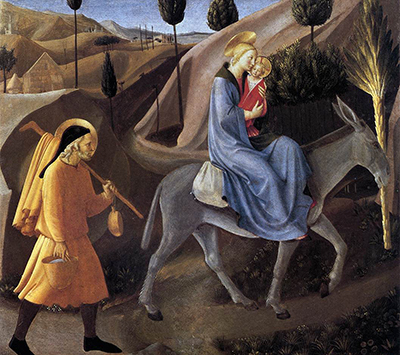
A grey donkey picks its way uphill, carrying Mary and the infant Jesus towards the right edge of the painting. Joseph follows on foot with a staff and a small flask. The three travellers take up most of the foreground, but behind them a pale road winds away into the hills. The Flight into Egypt is the seventh compartment of the infancy board from the Armadio degli Argenti, now at the Museo di San Marco in Florence. Two painted inscriptions give this quiet journey its urgency. One is the angel’s warning to Joseph. The other gives voice to someone who has already fled. [1] [2] [3]
At a Glance
- ArtistFra Angelico and assistants, according to the Italian national catalogue, which also records an alternative attribution to Zanobi Strozzi. [1]
- DateAbout 1450–1453, according to the Italian national catalogue. [1]
- MediumTempera and gilding on wood. [1]
- Dimensions38.5 cm high × 37.5 cm wide in the national catalogue’s scene record. The Fondazione Zeri gives a width of 37 cm. [1] [4]
- CollectionMuseo di San Marco, Florence. [1]
- InventoryInventario 1890, no. 8490. National catalogue record 0900191187A-7. [1]
- PositionLower left of the nine-field infancy board, national catalogue record 0900191187A-0. [2] [3]
From the Temple to the road
Piero di Cosimo de’ Medici commissioned the Armadio degli Argenti for the Servite church of Santissima Annunziata in Florence. The cabinet held precious offerings dedicated to the church’s revered image of the Annunciation. The surviving painted sections once formed its closure. In Andrea De Marchi’s reconstruction, the scenes belonged to a pair of tall doors, each two compartments wide. Work on the jambs is documented in December 1453, while the often repeated date of 1448 for the commission lacks documentary confirmation. The individual field has no documented year of execution. In the 1460s the doors were made into a single sliding closure. The familiar square infancy board is a later grouping. [5] [2] [3]
The preceding scene, the Presentation in the Temple, ends the middle row. Mary and Joseph bring Jesus into a building where figures wait to receive him. The Flight begins the next row in open country, with no one waiting for the family. The change takes the viewer from Luke’s account back to Matthew’s. Immediately to the right is the Massacre of the Innocents, a crowded scene in which Herod’s violence falls on the families left in Bethlehem. The cupboard gives the escape and the massacre separate fields. A viewer standing in front of the board sees the road out and the violence behind almost in a single glance. [2] [3] [6]
How the picture makes the family move
The donkey’s body forms a long diagonal beneath the folds of Mary’s mantle, and its lifted foreleg follows the rise of the ground. Its ears point up against the dark growth behind its head. Mary inclines her head towards Jesus and holds him against her chest. Her hand is picked out against his red cloak. The blue mantle spreads over her knees and drops towards the animal’s legs, gathering the mother and child into one shape. Their haloes overlap as their heads draw close. The movement of the animal lets the two figures remain almost still while the landscape passes behind them. [1] [2]
Joseph’s stride gives the group a second pace. The ochre folds of his coat open above the boot at the lower edge, and his tilted staff carries the eye up to the flask. That little container makes the practical demands of travel visible. The gap between him and the donkey also leaves a clear view of the land falling away behind them. In the foreground the route runs across the painting. Farther back it narrows and bends between the slopes. Small buildings and slender trees establish the scale of the distant country. At the right, a lit trunk marks the point the donkey is about to pass, and the road continues beyond the frame. The place of refuge lies somewhere beyond what the viewer can see. [1] [2]
In Matthew 2, an angel appears to Joseph in a dream after the Magi depart, warning him that Herod intends to kill the child. Joseph leaves with Mary and Jesus by night and stays in Egypt until Herod dies. Matthew names the destination without describing the route or mentioning a donkey. The painter gives the journey a visible form through the animal, the sloping road and the few things Joseph can carry. The sky above the distant hills is blue, so the scene leaves the hour of the journey open. Later traditions supplied incidents such as the miraculous bending of a palm tree. Here the family is still travelling, and no angel or miracle interrupts its progress. [6] [1] [7]
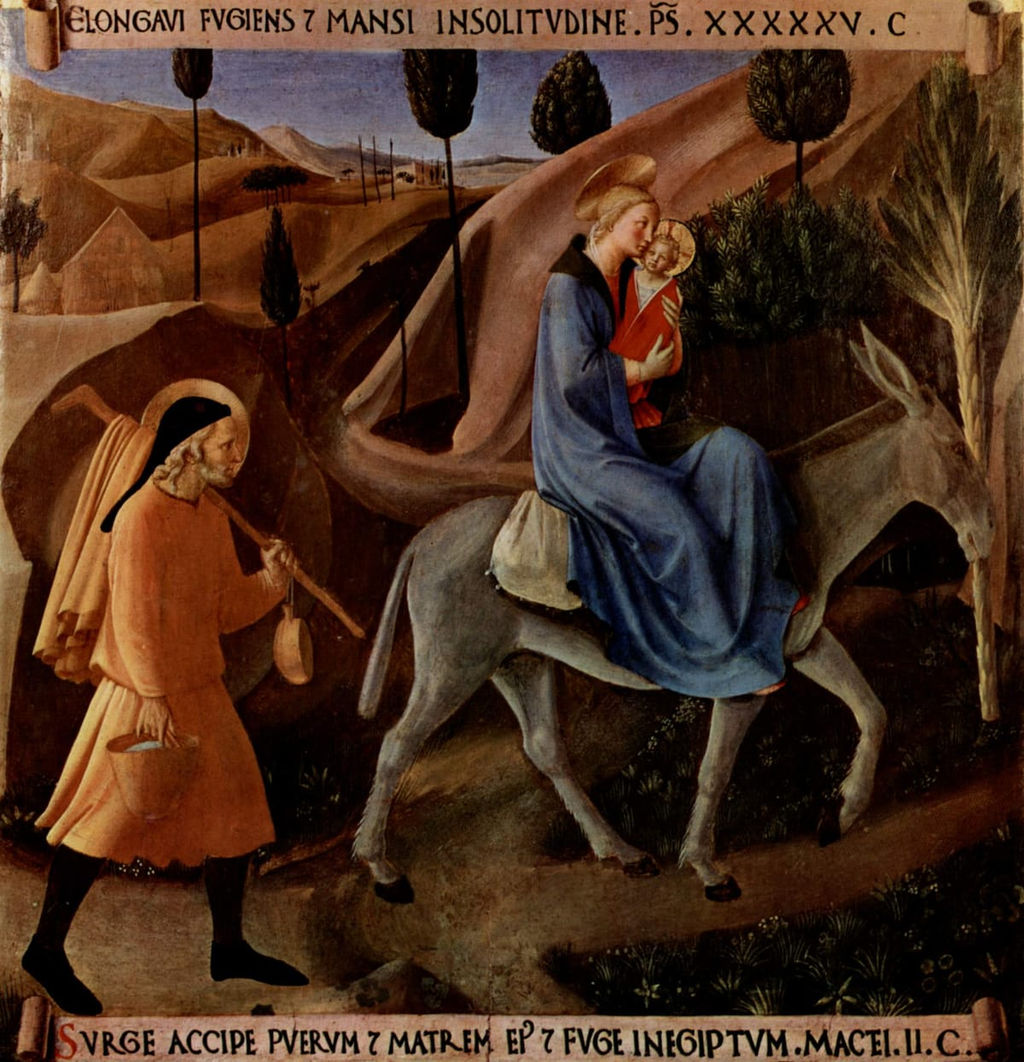
The Flight into Egypt in the Armadio, 0900191187A-7. The inscriptions sit directly above and below the road and its travellers. Image source. Public domain. Proportional web resize.
A warning below, a voice above
The lower inscription takes the opening command from Matthew 2:13. The angel tells Joseph to get up, take the child and his mother, and flee to Egypt. The rest of the verse gives the reason for their departure. The painting leaves those words off the strip, but anyone looking across to the next scene can see what Herod’s threat meant. Matthew also connects the stay in Egypt to Hosea’s words about calling a son out of Egypt. The cupboard gives this moment a different accompaniment. [1] [3] [6]
The upper inscription draws on Psalm 55:8, Psalm 54 in traditional Vulgate numbering. In the psalm a person beset by enemies longs for wings and imagines escaping into the wilderness. The painted Latin puts the flight and the stay in the past, a departure from the future tenses of the Vulgate text noted by Gerardo de Simone. Laid above the landscape, it reads as the voice of someone who has made the escape that the angel commands below. The older text has its own setting as a lament, and the cabinet invites a Christian viewer to hear it again in the circumstances of the travelling family. Even the sweeping view acquires a particular force after those words. From a distance, the hills can look inviting. For the figures on the road, their most valuable quality may be the space they put between the family and its pursuers. [1] [3] [8]
The same arrangement changes the emphasis in the neighbouring Massacre of the Innocents. There the upper strip draws on Joel’s condemnation of the shedding of innocent blood, and the lower one names Herod and the killing at Bethlehem. The Flight uses a voice in the first person and a command addressed to one man. The Massacre widens the view to the people who had no such warning. [3] [6]
This way of reading begins with the board’s opening Vision of Ezekiel, which sets prophets and New Testament writers in concentric wheels. The design makes their relationship visible before the story starts. In the Flight, the scrolls above and below the figures evoke strips of parchment, giving a wooden cabinet something of the character of an illustrated book. An early manuscript in Venice’s Biblioteca Marciana pairs the Flight and other infancy scenes with many of the same passages. The close resemblance places the painting in a tradition of reading the Testaments together. Differences in the texts leave open which version of that tradition reached the painter. [3] [9]
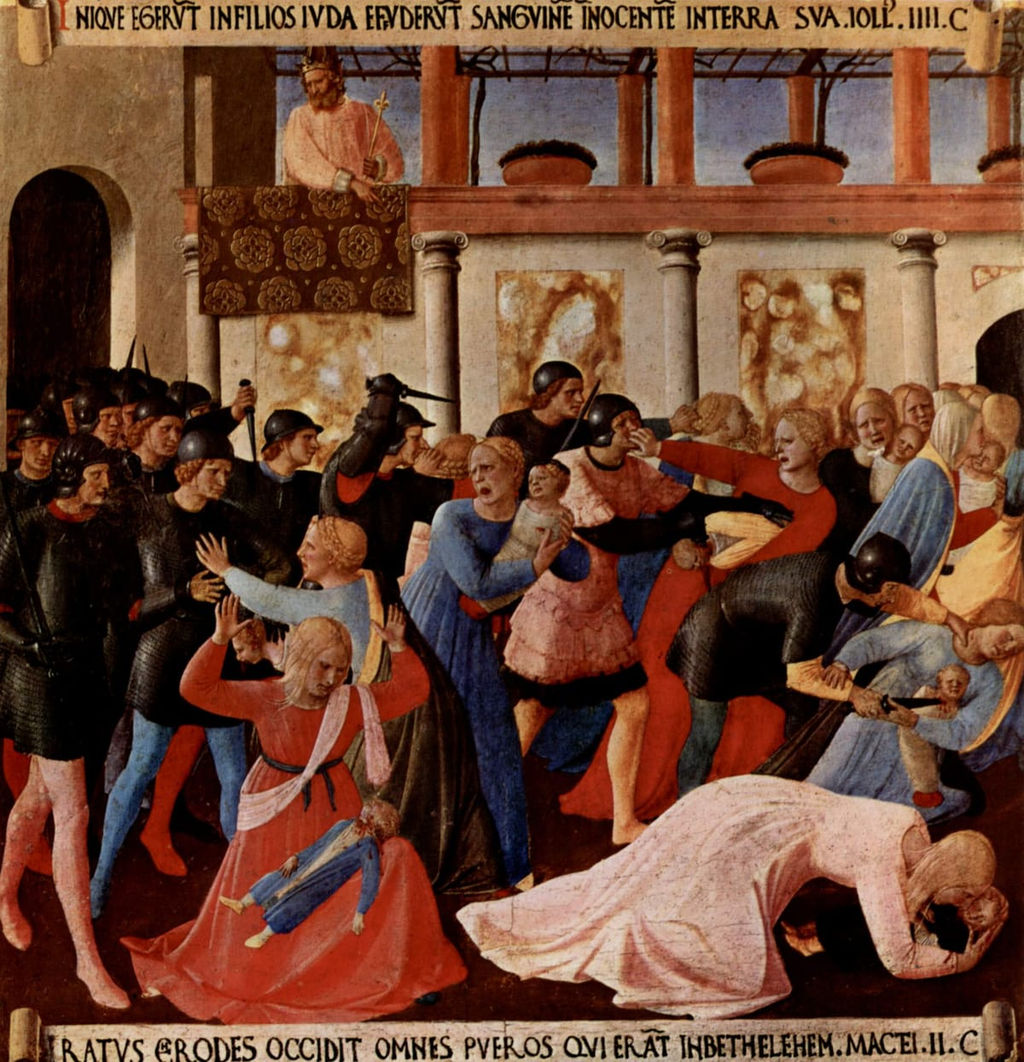
The Massacre of the Innocents, 0900191187A-8. It occupies the field immediately after the Flight into Egypt. Image source. Public domain. Proportional web resize.
Two reds and a tiny green collar
The infancy board was examined for its loan to the Museo Diocesano in Milan in 2023–24. Its painted surface was studied with non-invasive imaging and spectroscopy. The published results for the Flight distinguish two red materials very close together. The child’s cloak contains vermilion, while the red of Mary’s dress beneath the blue mantle is red lake. The small green collar at her neck contains a mixture of copper-based green, blue from lapis lazuli, lead white and lead-tin yellow. The collar occupies little more than a narrow break between the pale flesh and the darker mantle. Even at that scale, the painters used a carefully mixed colour where the garments and faces meet. [10] [11]
The state catalogue dates the acquisition from Santissima Annunziata to 1808, when the religious house was suppressed. The paintings were exhibited at Florence’s Accademia in 1812 and came to San Marco from 1922. In 2026 the museum presented the Armadio without the frame added in the early twentieth century. The board brings the two aspects of the Flight back into view together. Up close, a hand, a flask and a handful of brushstrokes at the collar make the journey tangible. Step back and the travelling group comes into line with the warning to Joseph and the scene of Herod’s violence alongside it. [1] [4] [3] [12]
Fra Angelico artworks directory
Explore documented works and surviving parts of larger ensembles. Catalogue links identify individual records. Attribution and dating can vary across collections and publications. Search the Federico Zeri Photo Archive by artist.
| Name | Date | Medium and sources |
|---|---|---|
| Adoration of the Magi | About 1440–60, NGA catalogue | Painting Catalogue. |
| Adoration of the Magi (Armadio degli Argenti) | About 1450–53 | Tempera and gold on wood. Catalogue. |
| Agony in the Garden (Armadio degli Argenti) | About 1450–53 | Tempera and gilding on wood Catalogue. |
| Annalena Altarpiece / Pala di Annalena | commonly c. 1435 | Tempera on panel Catalogue. |
| Annunciation (Armadio degli Argenti) | About 1450–53 | Tempera and gilding on wood. Catalogue. |
| Annunciation (Cortona) | generally placed in the 1430s; exact dating remains debated | Tempera on panel Catalogue. |
| Annunciation (Prado) | 1425–26 | Tempera on poplar panel Catalogue. |
| Annunciation (San Marco upper corridor) | commonly c. 1442 | Fresco Catalogue. |
| Annunciation with Saint Peter Martyr | About 1439–43 | Fresco on plaster. Catalogue. |
| Annunciatory Angel | 1450–55, Detroit catalogue | Gold leaf and tempera on wood panel. Catalogue. |
| Armadio degli Argenti (Silver Treasury) | principally c. 1450–52 | Tempera on panel Catalogue. |
| Arrest of Christ (Armadio degli Argenti) | About 1450–53 | Tempera and gilding on wood Catalogue. |
| Ascension (Armadio degli Argenti) | About 1450–53 | Tempera and gilding on wood Catalogue. |
| Baptism of Christ (Armadio, Alesso Baldovinetti) | About 1452–53 | Tempera and gilding on wood Catalogue. |
| Beheading of Saints Cosmas and Damian (San Marco Altarpiece) | About 1438–42 | Painted panel Catalogue. |
| Betrayal of Christ (Armadio degli Argenti) | About 1450–53 | Tempera and gilding on wood Catalogue. |
| Blessed Dominican, Possibly Jordan of Saxony (San Marco Altarpiece) | About 1438–42 | Painted panel Catalogue. |
| Blessed Vincent Ferrer (San Marco Altarpiece) | About 1438–42 | Painted panel Catalogue. |
| Burial of Saints Cosmas and Damian (San Marco Altarpiece) | About 1438–42 | Painted panel Catalogue. |
| Bust of a Cleric and a Group of Figures (recto and verso) | 15th century | Pen and ink on paper Catalogue. |
| Christ among the Doctors (Armadio degli Argenti) | About 1450–53 | Tempera and gilding on wood Catalogue. |
| Christ before Caiaphas (Armadio degli Argenti) | About 1450–53 | Tempera and gilding on wood Catalogue. |
| Christ Glorified in the Court of Heaven | About 1423–24 | Egg tempera on wood, probably poplar, with gold and silver leaf Catalogue. |
| Christ Seated in Judgment | 1447 | Fresco and gilding on plaster. Catalogue. |
| Christ Stripped of His Garments (Armadio degli Argenti) | About 1450–53 | Tempera and gilding on wood Catalogue. |
| Christ Washes the Apostles’ Feet (Armadio degli Argenti) | About 1450–53 | Tempera and gilding on wood Catalogue. |
| Circumcision of Christ (Armadio degli Argenti) | About 1450–53 | Tempera and gilding on wood. Catalogue. |
| Communion of the Apostles (Armadio degli Argenti) | About 1450–53 | Tempera and gilding on wood Catalogue. |
| Coronation of the Virgin (Armadio degli Argenti) | About 1450–53 | Tempera and gilding on wood Catalogue. |
| Coronation of the Virgin (Louvre) | Louvre: second quarter of the fifteenth century, 1425–50; often dated more narrowly c. 1434–35 | Tempera and gold on panel Catalogue. |
| Coronation of the Virgin (Uffizi) | 1431–35 | Tempera on wood, gold ground Catalogue. |
| Cortona Triptych | About 1437 | Tempera and gold on panel. Catalogue. |
| Crucifixion (Armadio degli Argenti) | About 1450–53 | Tempera and gilding on wood Catalogue. |
| Crucifixion and Saints | 1441–42 | Fresco Catalogue. |
| Deposition from the Cross / Santa Trinita Deposition | commissioned 1429–32; completed by Angelico within this period | Tempera on panel Catalogue. |
| Descent into Limbo (Armadio degli Argenti) | About 1450–53 | Tempera and gilding on wood Catalogue. |
| Entombment of Christ (San Marco Altarpiece) | About 1438–42 | Painted panel Catalogue. |
| Entry into Jerusalem (Armadio degli Argenti) | About 1450–53 | Tempera and gilding on wood Catalogue. |
| Expulsion and the Stoning of Saint Stephen | 1448–49, Vatican Museums | Fresco. Catalogue. |
| Fiesole San Domenico Altarpiece | early 1420s; predella about 1423–24 | Tempera on panel Catalogue. |
| Flagellation (Armadio degli Argenti) | About 1450–53 | Tempera and gilding on wood Catalogue. |
| Flight into Egypt | About 1450–53 | Tempera and gilding on wood. Catalogue. |
| Guidalotti Polyptych | c. 1447–49 | Tempera and oil on panel Catalogue. |
| Healing of Palladia and Saint Damian Accepting Her Gift (San Marco Altarpiece) | About 1438–42 | Painted panel Catalogue. |
| Holy Pilgrim, Possibly Saint Roch (San Marco Altarpiece) | About 1438–42 | Painted panel Catalogue. |
| Holy Women at the Tomb (Armadio degli Argenti) | About 1450–53 | Tempera and gilding on wood Catalogue. |
| Judas Receives Payment (Armadio degli Argenti) | About 1450–53 | Tempera and gilding on wood Catalogue. |
| Lamentation over Christ (Armadio degli Argenti) | About 1450–53 | Tempera and gilding on wood Catalogue. |
| Lamentation over the Dead Christ (Croce al Tempio Lamentation) | 1436–41, Zeri catalogue | Tempera and gilding on wood panel. Catalogue. |
| Last Judgement (Armadio degli Argenti) | About 1450–53 | Tempera and gilding on wood Catalogue. |
| Last Judgement (San Marco) | c. 1425–28 | Tempera and gold on panel Catalogue. |
| Last Supper (Armadio degli Argenti) | About 1450–53 | Tempera and gilding on wood Catalogue. |
| Lex Amoris (Armadio degli Argenti) | About 1450–53 | Tempera and gilding on wood Catalogue. |
| Madonna and Child with Saint Dominic and Saint Thomas Aquinas | About 1430, Hermitage catalogue | Detached fresco. Catalogue. |
| Madonna and Child with Saints | About 1411–13 | Tempera on wood panel, with a gold ground. Catalogue. |
| Madonna of Humility | About 1425, Thyssen catalogue | Tempera and gold on wood. Catalogue. |
| Madonna of the Star | 1431–34, Zeri catalogue | Tempera with oil glazes and gold on wood panel, as catalogued by the Gardner for the 2018 exhibition. Catalogue. |
| Marriage at Cana (Armadio, Alesso Baldovinetti) | About 1452–53 | Tempera and gilding on wood Catalogue. |
| Massacre of the Innocents (Armadio degli Argenti) | About 1450–53 | Tempera and gilding on wood Catalogue. |
| Miracle of the Black Leg (San Marco Altarpiece) | About 1438–42 | Painted panel Catalogue. |
| Mocking of Christ (Armadio degli Argenti) | About 1450–53 | Tempera and gilding on wood Catalogue. |
| Mystic Wheel (The Vision of Ezekiel) | About 1450–52 | Tempera and gilding on wood. Catalogue. |
| Nativity (Armadio degli Argenti) | About 1450–53 | Tempera and gilding on wood. Catalogue. |
| Niccoline Chapel frescoes | principally 1448–50 | Fresco Catalogue. |
| Noli me Tangere | broadly within Angelico’s San Marco campaign, late 1430s–1440s | Fresco Catalogue. |
| Ordination of Saint Lawrence | 1448 | Fresco. Catalogue. |
| Pentecost (Armadio degli Argenti) | About 1450–53 | Tempera and gilding on wood Catalogue. |
| Presentation of Christ at the Temple (Armadio degli Argenti) | About 1450–53 | Tempera and gilding on wood. Catalogue. |
| Presentation of Jesus at the Temple | Early 1440s | Fresco on plaster. Catalogue. |
| Raising of Lazarus (Armadio degli Argenti) | About 1450–53 | Tempera and gilding on wood Catalogue. |
| Rescue of Saints Cosmas and Damian and Exorcism of Lysias (San Marco Altarpiece) | About 1438–42 | Painted panel Catalogue. |
| Road to Calvary (Armadio degli Argenti) | About 1450–53 | Tempera and gilding on wood Catalogue. |
| Saint Anthony Abbot (San Marco Altarpiece) | About 1438–42 | Painted panel Catalogue. |
| Saint Bernard of Clairvaux or Saint Benedict (San Marco Altarpiece) | About 1438–42 | Painted panel Catalogue. |
| Saint Damian Receives Money from Palladia | About 1425–49 | Tempera and gilding on wood. Catalogue. |
| Saint Francis and a Bishop Saint, Saint John the Baptist and Saint Dominic | Late 1420s, Getty catalogue | Tempera and gold leaf on panel. Catalogue. |
| Saint James the Greater Freeing the Magician Hermogenes | About 1426–29 | Tempera and gold on panel Catalogue. |
| Saint Jerome (San Marco Altarpiece) | About 1438–42 | Painted panel Catalogue. |
| Saint Lawrence Giving Alms | About 1448 | Wall fresco. Catalogue. |
| Saint Lawrence Receiving the Treasures of the Church from Pope Sixtus II | About 1448–49 | Fresco on plaster. Catalogue. |
| Saint Romuald (San Marco Altarpiece) | About 1438–42 | Painted panel Catalogue. |
| Saint Stephen Addressing the Council | 1448–49, Vatican Museums | Fresco. Catalogue. |
| Saint Stephen Preaching | 1448–49, Vatican Museums | Wall fresco. Catalogue. |
| Saint Thomas Aquinas (San Marco Altarpiece) | About 1438–42 | Painted panel Catalogue. |
| Saints Cosmas and Damian and Their Brothers Survive the Stake | Second quarter of the 15th century | Tempera and gilding on wood. Catalogue. |
| Saints Cosmas and Damian at the Stake (San Marco Altarpiece) | About 1438–42 | Painted panel Catalogue. |
| Saints Cosmas and Damian before Lysias (San Marco Altarpiece) | About 1438–42 | Painted panel Catalogue. |
| Saints Cosmas and Damian Rescued by an Angel | Second quarter of the 15th century | Tempera and gilding on wood. Catalogue. |
| Saints Cosmas and Damian with Their Brothers before Proconsul Lysias | Second quarter of the 15th century | Tempera and gilding on wood. Catalogue. |
| San Marco Altarpiece / Pala di San Marco | 1438–43 | Tempera on panel Catalogue. |
| San Pietro Martire Triptych | About 1422–23, Strozzi exhibition | Tempera and gold on panel. Catalogue. |
| Scenes from the Lives of the Desert Fathers (Thebaid) | About 1420, Uffizi catalogue | Tempera on wood. Catalogue. |
| Sixteen Prophets | 1447 | Fresco and gilding on plaster Catalogue. |
| Stoning and Shooting of the Brothers (San Marco Altarpiece) | About 1438–42 | Painted panel Catalogue. |
| Tabernacle of the Linaioli | 1433–35 | Tempera on panel Catalogue. |
| The Attempted Crucifixion and Stoning of Saints Cosmas and Damian | Second quarter of the 15th century | Tempera and gilding on wood. Catalogue. |
| The Crucifixion | About 1420–23, Met catalogue | Tempera on wood, gold ground. Catalogue. |
| The Death and the Assumption of the Virgin | 1424–34 | Tempera with oil glazes and gold on panel Catalogue. |
| The Dominican Blessed (left end) (Fiesole predella) | About 1423–24 | Egg tempera and gold on wood Catalogue. |
| The Dominican Blessed (right end) (Fiesole predella) | About 1423–24 | Egg tempera and gold on wood Catalogue. |
| The Entombment of Christ | About 1450 | Tempera on poplar panel. Catalogue. |
| The Forerunners of Christ with Saints and Martyrs | About 1423–24 | Egg tempera on wood (probably poplar), with gold and silver leaf. Catalogue. |
| The Funeral of Saint Anthony Abbot | About 1426–30 | Tempera on poplar panel. Catalogue. |
| The Martyrdom of Saints Cosmas and Damian | About 1425–49 | Tempera and gilding on wood. Catalogue. |
| The Mocking of Christ / Christ Mocked | within the San Marco dormitory campaign, broadly late 1430s–1440s | Fresco Catalogue. |
| The Nativity | About 1425, Minneapolis catalogue | Tempera on poplar panel. Catalogue. |
| The Nativity in Cell 5 at San Marco | About 1439–43 | Fresco on plaster. Catalogue. |
| The Penitent Saint Jerome | 1419–20 | Tempera on wood panel Catalogue. |
| The Virgin and Child by Fra Angelico (Fogg Museum) | About 1430, Harvard catalogue | Tempera originally on panel, subsequently transferred to Masonite. Catalogue. |
| The Virgin Mary with the Apostles and Other Saints (Fiesole predella) | About 1423–24 | Egg tempera and gold on wood Catalogue. |
| Transfiguration (Armadio, Alesso Baldovinetti) | About 1452–53 | Tempera and gilding on wood Catalogue. |
| Transfiguration (San Marco Cell 6) | within the San Marco dormitory campaign, broadly late 1430s–1440s | Fresco Catalogue. |
| Virgin Mary Annunciate | 1450–55, Detroit catalogue | Gold leaf and tempera on wood panel. Catalogue. |
| Virgin of the Pomegranate | About 1426 | Tempera on panel with gilding Catalogue. |
Frequently Asked Questions
Discussion
Use these prompts to look again or share an observation.
Reader Insights
Follow the pale road from the figures into the distance. What does the landscape add to the way you read the family’s departure?
Look at the reds beside Mary’s blue mantle. What can you see by eye, and which distinction does the technical study establish?
Join the Conversation
Share a detail or question about Flight into Egypt.
References
- Ministero della Cultura, ICCD, Fuga in Egitto, full national catalogue record 0900191187A-7, especially pp. 2–3 (in Italian). View source.
- Ministero della Cultura, ArCo, Armadio degli Argenti, episodi del Nuovo Testamento, first board 0900191187A-0 and linked components (in Italian). View source.
- Gerardo de Simone, “Un’iconostasi di ‘figure piccole’ del Beato Angelico”, in Beato Angelico. Storie dell’infanzia di Cristo. Anta dell’Armadio degli Argenti, 2023, pp. 35–64, especially figs. 7 and 13 and appendix I, scenes 6–8 (in Italian). View source.
- Fondazione Federico Zeri, Guido di Pietro, Fuga in Egitto, work record 12823 (in Italian). View source.
- Ada Labriola, Museo di San Marco, “Beato Angelico ‘eccellente pittore e miniatore’”, 2024, section on the Armadio degli Argenti (in Italian). View source.
- New American Bible, Revised Edition, Matthew 2:13–23 and notes, United States Conference of Catholic Bishops. View source.
- Musée des Beaux-Arts de Lyon, La Fuite en Égypte de Nicolas Poussin, exhibition dossier, sections on the Gospel account and later infancy traditions (in French). View source.
- New American Bible, Revised Edition, Psalm 55:2–9 and notes, United States Conference of Catholic Bishops. View source.
- Cyril Gerbron, “Le Christ est une page. Exégèse et mémoire dans l’armadio degli argenti de Fra Angelico”, Histoire de l’art 71, 2012, pp. 51–62, especially p. 52 (in French). View source.
- Fondazione Bracco, “A Masterpiece for Milan 2023”, section on the loan and scientific examination of the infancy board. View source.
- Fondazione Bracco, Art from Inside, exhibition press kit, “Primo scomparto dell’Armadio degli Argenti”, PDF pp. 14–15 (in Italian). View source.
- Direzione regionale Musei nazionali Toscana, announcement of the new display in the Sala dell’Angelico, March 2026 (in Italian). View source.
.jpg)



 Fra Angelico.jpg)


