 by Tom Gurney
Tom Gurney BSc (Hons) is an art history expert with over 20 years experience
Published on June 19, 2020 / Updated on November 29, 2026
Email: tomgurney1@gmail.com / Phone: +44 7429 011000
Introduction
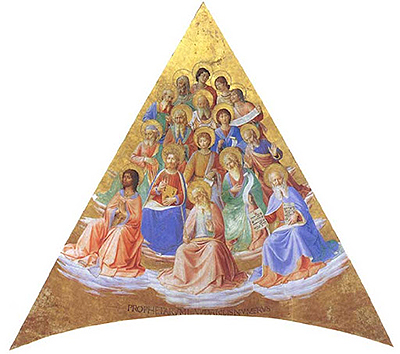
Sixteen figures gather on clouds above the altar end of Orvieto Cathedral’s Chapel of San Brizio. The men in front have room to spread their robes and turn their bodies. Higher up, heads and haloes gather ever more tightly as the vault narrows to a point. Fra Angelico and his assistants painted the Sixteen Prophets in 1447, in a compartment beside Christ Seated in Judgment. The two frescoes occupy separate sections of the same vault, and the prophets form one company in the heavenly assembly around Christ. [1] [2]
At a Glance
- ArtistFra Angelico and assistants, including Benozzo Gozzoli
- Date1447
- MediumFresco and gilding on plaster
- LocationIn situ, altar-bay vault, Chapel of San Brizio, Orvieto Cathedral, Italy
- CommissionOpera del Duomo di Orvieto
- CatalogueItalian national catalogue 1000150542. [1] [2] [3] [4]
A company built to fit the vault
The curving triangular compartment, or web, sets the terms of the composition. The Italian state catalogue describes alternating ranks of two and three, staggered as they climb. The heads above fit into the intervals between those below, so that a face often emerges between two shoulders. At the base, three more fully visible figures have the sweep of pale clouds beneath their knees and feet. The middle figure bows his head, gathering the folds of a rose-coloured mantle around his legs. The figures at the edges sit obliquely, their robes opening towards the sides. Even these broad folds leave a margin of gold. The group has the compact outline of a pyramid, with room around it to register as a single shape. [1]
From the chapel floor, the figure group is likely to register first as a succession of faces, blocks of colour and patches of gold. The broad blue drapery near the lower right balances the salmon-pink on the left, and both colours reappear in smaller patches among the heads above. Blue recedes into shadow in the folds of the foreground robe, which gives the seated body weight even as the clouds lift it clear of the lower edge. The solid figures and the continuous gilded ground together create a sense of depth without a distant landscape. The painted borders along the ribs keep the company distinct from its neighbours, even as their floral panels and small portraits in hexagons carry the eye across the vault. [1] [2]
Up close, the assembly is less uniform than it appears from below. One man concentrates on the object in his lap, another turns his head to the side, and a younger face looks out between the bowed or bearded heads. The crowned figure just left of centre holds a stringed instrument, the attribute of David. Jack Wasserman also identifies Moses by the tablets of the Law. Books and scrolls vary the gestures of the other figures. Some are held close to the chest, while others break across the robes as pale diagonals. They suggest different ways of receiving, pondering and passing on sacred words, even where a face or object supplies too little evidence to give the figure a name. [1] [5]
The words beneath the clouds
The inscription along the bottom reads “Prophetarum laudabilis numerus”, meaning “the praiseworthy company of prophets”. The words come from the Latin hymn Te Deum, where the prophets join the apostles and martyrs in praising God. Numerus here means a company or host. The inscription gives the figures a collective identity, and the number sixteen comes from the painted assembly. Sara Nair James notes that phrases from the same hymn also appear with the Apostles and Martyrs completed in the later campaign. The inscriptions tie groups painted decades apart into a common act of praise. [6] [7]
James identifies John the Baptist as the prophet placed nearest Christ. Across the bay, the Virgin occupies the corresponding place among the Apostles painted by Signorelli. James reads their positions as a Deësis, the grouping of Christ with Mary and John as intercessors. That relationship is easier to grasp in the chapel than in a photograph of the Prophets alone. She also connects the placement of the Prophets and Patriarchs on one side and the Apostles and Doctors of the Church on the other with the sides from which the Old Testament and Gospel were read. In that reading, looking across the vault follows divisions familiar from worship below. [6]
What the plaster reveals
The Opera del Duomo contracted Fra Angelico on 14 June 1447 to decorate the chapel. Benozzo Gozzoli was among the assistants, and the Museo Benozzo Gozzoli notes that his pay was considerably higher than theirs. The fresco itself offers a different kind of evidence about the work they shared. Conservator Carla Bertorello found preparatory lines brushed in yellow to reddish ochre beneath less opaque passages in the Prophets. In the neighbouring compartment the painters transferred the large figure of Christ by dusting pigment through holes pricked in a full-size drawing. Over a few metres of the same vault, the workshop used different means to put its designs onto plaster. [2] [3] [4]
Bertorello’s team mapped 39 giornate in the Prophets scene itself. Each was an area of fresh plaster laid for a work session. The joins preserve a sequence. The heads in the upper part were painted first in a diamond-like arrangement, then work continued down through the busts towards the large foreground figures, each of which was divided into three sections. A join in one detail follows the very edge of a beard, where it would be less conspicuous. The areas of plaster and the way they meet suggest that two painters could work on the figures at the same time. By comparison, the Patriarchs web of the later campaign covers a similar area in just 21 sections. Its full-size designs were transferred through pricked outlines, and the plaster divisions were less closely tied to the separation of faces and clothing. [2]
Work could continue after the plaster dried. Bertorello notes that some of the expensive colours bought for the 1447 campaign, which included ultramarine and red lead, would generally have needed to be applied to dry plaster with a binder. Alongside the evidence of wet plaster and preparatory drawing, these finishing layers help explain how the painters could combine the broad masses of colour visible from below with fine modelling and ornament. [2]
Scholars have reached different conclusions about who painted the individual prophets. The state catalogue records a view that Angelico painted most of the figures, with a possible contribution by Gozzoli to three youthful figures. It also records a minority view assigning Gozzoli most of the group. The contracts name participants and the plaster shows how the work could be shared, but the surviving evidence leaves those competing assignments open. The gilded ground gives the figures a common setting. Its expanse recalls an older tradition of sacred painting, while the distinct faces and the way the bodies sit, turn and overlap give the company a physical presence suited to the vault’s scale. [1] [2]
The fresco in the finished chapel
By the end of September 1447, Angelico’s team had painted the Prophets and Christ the Judge. Angelico returned to Rome and took up work for Nicholas V, including the frescoes of the Niccoline Chapel. At Orvieto, some of the framing decoration continued under the local painter Pietro di Nicola Baroni, and the next major phase began with Luca Signorelli in 1499. Signorelli used designs left by Angelico for the Apostles and the angels with the instruments of the Passion in the altar bay. He finished the vault by 1500 and carried the Last Judgement cycle down onto the walls. The chapel received its present name after the Madonna di San Brizio was moved there in 1622. [2] [3] [8]
Look from the prophets to the company of patriarchs in the neighbouring bay, then down to the scenes on the walls. In the vault each company keeps its own place and can be taken in as a group at a distance. Below, the larger bodies of the resurrected and the damned fill whole expanses of wall. That change in scale and movement sets off the quiet gestures in the Prophets. In the earliest work on the chapel, the bend of a head over a book and the hands poised at David’s instrument were already giving the heavenly assembly its own character, decades before the painted bodies below it rose from their graves. [2] [6] [3]
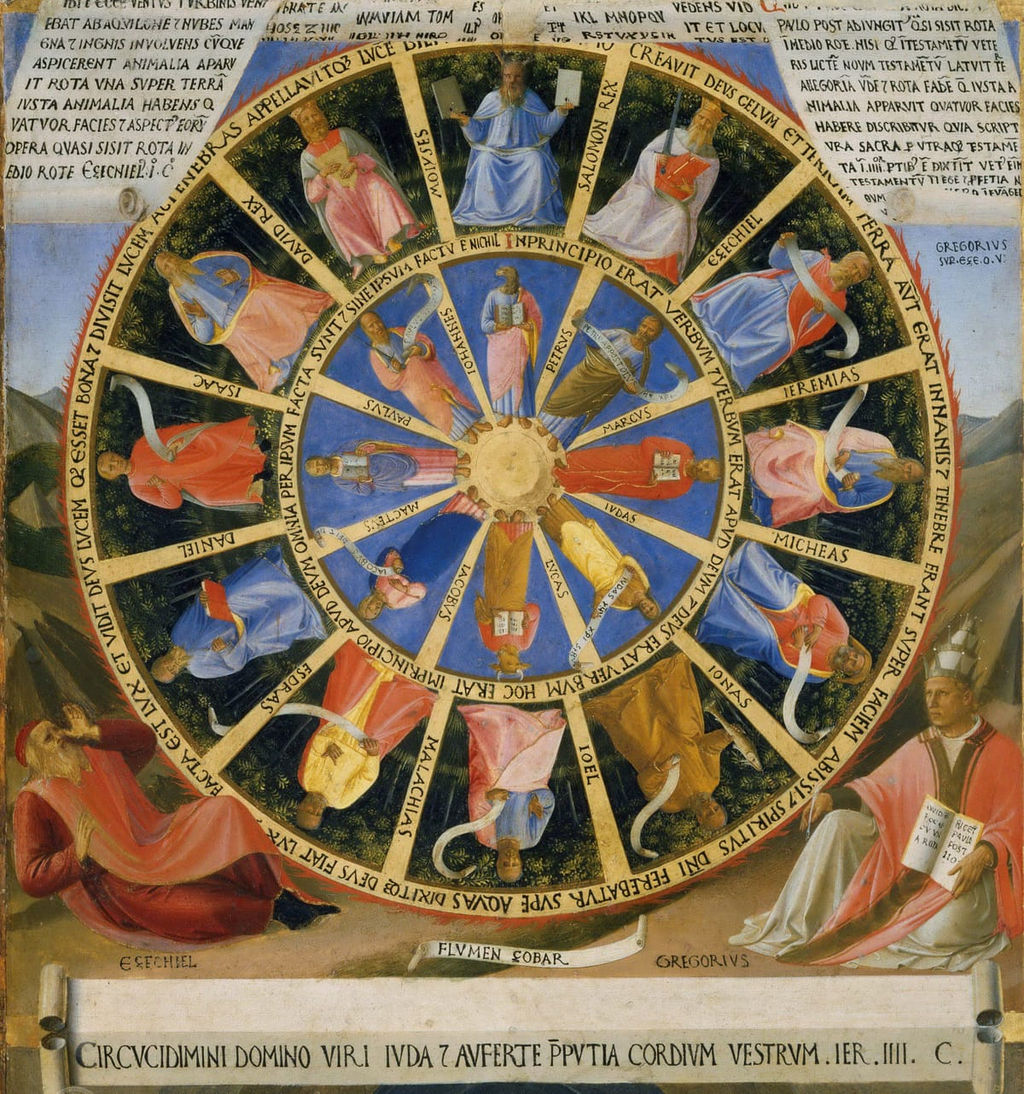
The Mystic Wheel, 0900191187A-1. The painted spokes connect differently positioned witnesses and writers. Image source. Public domain. Proportional web resize.
Fra Angelico artworks directory
Explore documented works and surviving parts of larger ensembles. Catalogue links identify individual records. Attribution and dating can vary across collections and publications. Search the Federico Zeri Photo Archive by artist.
| Name | Date | Medium and sources |
|---|---|---|
| Adoration of the Magi | About 1440–60, NGA catalogue | Painting Catalogue. |
| Adoration of the Magi (Armadio degli Argenti) | About 1450–53 | Tempera and gold on wood. Catalogue. |
| Agony in the Garden (Armadio degli Argenti) | About 1450–53 | Tempera and gilding on wood Catalogue. |
| Annalena Altarpiece / Pala di Annalena | commonly c. 1435 | Tempera on panel Catalogue. |
| Annunciation (Armadio degli Argenti) | About 1450–53 | Tempera and gilding on wood. Catalogue. |
| Annunciation (Cortona) | generally placed in the 1430s; exact dating remains debated | Tempera on panel Catalogue. |
| Annunciation (Prado) | 1425–26 | Tempera on poplar panel Catalogue. |
| Annunciation (San Marco upper corridor) | commonly c. 1442 | Fresco Catalogue. |
| Annunciation with Saint Peter Martyr | About 1439–43 | Fresco on plaster. Catalogue. |
| Annunciatory Angel | 1450–55, Detroit catalogue | Gold leaf and tempera on wood panel. Catalogue. |
| Armadio degli Argenti (Silver Treasury) | principally c. 1450–52 | Tempera on panel Catalogue. |
| Arrest of Christ (Armadio degli Argenti) | About 1450–53 | Tempera and gilding on wood Catalogue. |
| Ascension (Armadio degli Argenti) | About 1450–53 | Tempera and gilding on wood Catalogue. |
| Baptism of Christ (Armadio, Alesso Baldovinetti) | About 1452–53 | Tempera and gilding on wood Catalogue. |
| Beheading of Saints Cosmas and Damian (San Marco Altarpiece) | About 1438–42 | Painted panel Catalogue. |
| Betrayal of Christ (Armadio degli Argenti) | About 1450–53 | Tempera and gilding on wood Catalogue. |
| Blessed Dominican, Possibly Jordan of Saxony (San Marco Altarpiece) | About 1438–42 | Painted panel Catalogue. |
| Blessed Vincent Ferrer (San Marco Altarpiece) | About 1438–42 | Painted panel Catalogue. |
| Burial of Saints Cosmas and Damian (San Marco Altarpiece) | About 1438–42 | Painted panel Catalogue. |
| Bust of a Cleric and a Group of Figures (recto and verso) | 15th century | Pen and ink on paper Catalogue. |
| Christ among the Doctors (Armadio degli Argenti) | About 1450–53 | Tempera and gilding on wood Catalogue. |
| Christ before Caiaphas (Armadio degli Argenti) | About 1450–53 | Tempera and gilding on wood Catalogue. |
| Christ Glorified in the Court of Heaven | About 1423–24 | Egg tempera on wood, probably poplar, with gold and silver leaf Catalogue. |
| Christ Seated in Judgment | 1447 | Fresco and gilding on plaster. Catalogue. |
| Christ Stripped of His Garments (Armadio degli Argenti) | About 1450–53 | Tempera and gilding on wood Catalogue. |
| Christ Washes the Apostles’ Feet (Armadio degli Argenti) | About 1450–53 | Tempera and gilding on wood Catalogue. |
| Circumcision of Christ (Armadio degli Argenti) | About 1450–53 | Tempera and gilding on wood. Catalogue. |
| Communion of the Apostles (Armadio degli Argenti) | About 1450–53 | Tempera and gilding on wood Catalogue. |
| Coronation of the Virgin (Armadio degli Argenti) | About 1450–53 | Tempera and gilding on wood Catalogue. |
| Coronation of the Virgin (Louvre) | Louvre: second quarter of the fifteenth century, 1425–50; often dated more narrowly c. 1434–35 | Tempera and gold on panel Catalogue. |
| Coronation of the Virgin (Uffizi) | 1431–35 | Tempera on wood, gold ground Catalogue. |
| Cortona Triptych | About 1437 | Tempera and gold on panel. Catalogue. |
| Crucifixion (Armadio degli Argenti) | About 1450–53 | Tempera and gilding on wood Catalogue. |
| Crucifixion and Saints | 1441–42 | Fresco Catalogue. |
| Deposition from the Cross / Santa Trinita Deposition | commissioned 1429–32; completed by Angelico within this period | Tempera on panel Catalogue. |
| Descent into Limbo (Armadio degli Argenti) | About 1450–53 | Tempera and gilding on wood Catalogue. |
| Entombment of Christ (San Marco Altarpiece) | About 1438–42 | Painted panel Catalogue. |
| Entry into Jerusalem (Armadio degli Argenti) | About 1450–53 | Tempera and gilding on wood Catalogue. |
| Expulsion and the Stoning of Saint Stephen | 1448–49, Vatican Museums | Fresco. Catalogue. |
| Fiesole San Domenico Altarpiece | early 1420s; predella about 1423–24 | Tempera on panel Catalogue. |
| Flagellation (Armadio degli Argenti) | About 1450–53 | Tempera and gilding on wood Catalogue. |
| Flight into Egypt | About 1450–53 | Tempera and gilding on wood. Catalogue. |
| Guidalotti Polyptych | c. 1447–49 | Tempera and oil on panel Catalogue. |
| Healing of Palladia and Saint Damian Accepting Her Gift (San Marco Altarpiece) | About 1438–42 | Painted panel Catalogue. |
| Holy Pilgrim, Possibly Saint Roch (San Marco Altarpiece) | About 1438–42 | Painted panel Catalogue. |
| Holy Women at the Tomb (Armadio degli Argenti) | About 1450–53 | Tempera and gilding on wood Catalogue. |
| Judas Receives Payment (Armadio degli Argenti) | About 1450–53 | Tempera and gilding on wood Catalogue. |
| Lamentation over Christ (Armadio degli Argenti) | About 1450–53 | Tempera and gilding on wood Catalogue. |
| Lamentation over the Dead Christ (Croce al Tempio Lamentation) | 1436–41, Zeri catalogue | Tempera and gilding on wood panel. Catalogue. |
| Last Judgement (Armadio degli Argenti) | About 1450–53 | Tempera and gilding on wood Catalogue. |
| Last Judgement (San Marco) | c. 1425–28 | Tempera and gold on panel Catalogue. |
| Last Supper (Armadio degli Argenti) | About 1450–53 | Tempera and gilding on wood Catalogue. |
| Lex Amoris (Armadio degli Argenti) | About 1450–53 | Tempera and gilding on wood Catalogue. |
| Madonna and Child with Saint Dominic and Saint Thomas Aquinas | About 1430, Hermitage catalogue | Detached fresco. Catalogue. |
| Madonna and Child with Saints | About 1411–13 | Tempera on wood panel, with a gold ground. Catalogue. |
| Madonna of Humility | About 1425, Thyssen catalogue | Tempera and gold on wood. Catalogue. |
| Madonna of the Star | 1431–34, Zeri catalogue | Tempera with oil glazes and gold on wood panel, as catalogued by the Gardner for the 2018 exhibition. Catalogue. |
| Marriage at Cana (Armadio, Alesso Baldovinetti) | About 1452–53 | Tempera and gilding on wood Catalogue. |
| Massacre of the Innocents (Armadio degli Argenti) | About 1450–53 | Tempera and gilding on wood Catalogue. |
| Miracle of the Black Leg (San Marco Altarpiece) | About 1438–42 | Painted panel Catalogue. |
| Mocking of Christ (Armadio degli Argenti) | About 1450–53 | Tempera and gilding on wood Catalogue. |
| Mystic Wheel (The Vision of Ezekiel) | About 1450–52 | Tempera and gilding on wood. Catalogue. |
| Nativity (Armadio degli Argenti) | About 1450–53 | Tempera and gilding on wood. Catalogue. |
| Niccoline Chapel frescoes | principally 1448–50 | Fresco Catalogue. |
| Noli me Tangere | broadly within Angelico’s San Marco campaign, late 1430s–1440s | Fresco Catalogue. |
| Ordination of Saint Lawrence | 1448 | Fresco. Catalogue. |
| Pentecost (Armadio degli Argenti) | About 1450–53 | Tempera and gilding on wood Catalogue. |
| Presentation of Christ at the Temple (Armadio degli Argenti) | About 1450–53 | Tempera and gilding on wood. Catalogue. |
| Presentation of Jesus at the Temple | Early 1440s | Fresco on plaster. Catalogue. |
| Raising of Lazarus (Armadio degli Argenti) | About 1450–53 | Tempera and gilding on wood Catalogue. |
| Rescue of Saints Cosmas and Damian and Exorcism of Lysias (San Marco Altarpiece) | About 1438–42 | Painted panel Catalogue. |
| Road to Calvary (Armadio degli Argenti) | About 1450–53 | Tempera and gilding on wood Catalogue. |
| Saint Anthony Abbot (San Marco Altarpiece) | About 1438–42 | Painted panel Catalogue. |
| Saint Bernard of Clairvaux or Saint Benedict (San Marco Altarpiece) | About 1438–42 | Painted panel Catalogue. |
| Saint Damian Receives Money from Palladia | About 1425–49 | Tempera and gilding on wood. Catalogue. |
| Saint Francis and a Bishop Saint, Saint John the Baptist and Saint Dominic | Late 1420s, Getty catalogue | Tempera and gold leaf on panel. Catalogue. |
| Saint James the Greater Freeing the Magician Hermogenes | About 1426–29 | Tempera and gold on panel Catalogue. |
| Saint Jerome (San Marco Altarpiece) | About 1438–42 | Painted panel Catalogue. |
| Saint Lawrence Giving Alms | About 1448 | Wall fresco. Catalogue. |
| Saint Lawrence Receiving the Treasures of the Church from Pope Sixtus II | About 1448–49 | Fresco on plaster. Catalogue. |
| Saint Romuald (San Marco Altarpiece) | About 1438–42 | Painted panel Catalogue. |
| Saint Stephen Addressing the Council | 1448–49, Vatican Museums | Fresco. Catalogue. |
| Saint Stephen Preaching | 1448–49, Vatican Museums | Wall fresco. Catalogue. |
| Saint Thomas Aquinas (San Marco Altarpiece) | About 1438–42 | Painted panel Catalogue. |
| Saints Cosmas and Damian and Their Brothers Survive the Stake | Second quarter of the 15th century | Tempera and gilding on wood. Catalogue. |
| Saints Cosmas and Damian at the Stake (San Marco Altarpiece) | About 1438–42 | Painted panel Catalogue. |
| Saints Cosmas and Damian before Lysias (San Marco Altarpiece) | About 1438–42 | Painted panel Catalogue. |
| Saints Cosmas and Damian Rescued by an Angel | Second quarter of the 15th century | Tempera and gilding on wood. Catalogue. |
| Saints Cosmas and Damian with Their Brothers before Proconsul Lysias | Second quarter of the 15th century | Tempera and gilding on wood. Catalogue. |
| San Marco Altarpiece / Pala di San Marco | 1438–43 | Tempera on panel Catalogue. |
| San Pietro Martire Triptych | About 1422–23, Strozzi exhibition | Tempera and gold on panel. Catalogue. |
| Scenes from the Lives of the Desert Fathers (Thebaid) | About 1420, Uffizi catalogue | Tempera on wood. Catalogue. |
| Sixteen Prophets | 1447 | Fresco and gilding on plaster Catalogue. |
| Stoning and Shooting of the Brothers (San Marco Altarpiece) | About 1438–42 | Painted panel Catalogue. |
| Tabernacle of the Linaioli | 1433–35 | Tempera on panel Catalogue. |
| The Attempted Crucifixion and Stoning of Saints Cosmas and Damian | Second quarter of the 15th century | Tempera and gilding on wood. Catalogue. |
| The Crucifixion | About 1420–23, Met catalogue | Tempera on wood, gold ground. Catalogue. |
| The Death and the Assumption of the Virgin | 1424–34 | Tempera with oil glazes and gold on panel Catalogue. |
| The Dominican Blessed (left end) (Fiesole predella) | About 1423–24 | Egg tempera and gold on wood Catalogue. |
| The Dominican Blessed (right end) (Fiesole predella) | About 1423–24 | Egg tempera and gold on wood Catalogue. |
| The Entombment of Christ | About 1450 | Tempera on poplar panel. Catalogue. |
| The Forerunners of Christ with Saints and Martyrs | About 1423–24 | Egg tempera on wood (probably poplar), with gold and silver leaf. Catalogue. |
| The Funeral of Saint Anthony Abbot | About 1426–30 | Tempera on poplar panel. Catalogue. |
| The Martyrdom of Saints Cosmas and Damian | About 1425–49 | Tempera and gilding on wood. Catalogue. |
| The Mocking of Christ / Christ Mocked | within the San Marco dormitory campaign, broadly late 1430s–1440s | Fresco Catalogue. |
| The Nativity | About 1425, Minneapolis catalogue | Tempera on poplar panel. Catalogue. |
| The Nativity in Cell 5 at San Marco | About 1439–43 | Fresco on plaster. Catalogue. |
| The Penitent Saint Jerome | 1419–20 | Tempera on wood panel Catalogue. |
| The Virgin and Child by Fra Angelico (Fogg Museum) | About 1430, Harvard catalogue | Tempera originally on panel, subsequently transferred to Masonite. Catalogue. |
| The Virgin Mary with the Apostles and Other Saints (Fiesole predella) | About 1423–24 | Egg tempera and gold on wood Catalogue. |
| Transfiguration (Armadio, Alesso Baldovinetti) | About 1452–53 | Tempera and gilding on wood Catalogue. |
| Transfiguration (San Marco Cell 6) | within the San Marco dormitory campaign, broadly late 1430s–1440s | Fresco Catalogue. |
| Virgin Mary Annunciate | 1450–55, Detroit catalogue | Gold leaf and tempera on wood panel. Catalogue. |
| Virgin of the Pomegranate | About 1426 | Tempera on panel with gilding Catalogue. |
Frequently Asked Questions
Look up in the bay at the altar end of the Chapel of San Brizio. The Prophets occupy the wedge-shaped compartment next to Christ the Judge and his angels. [2]
David has his crown and stringed instrument, Moses carries the tablets of the Law, and Sara Nair James identifies John the Baptist by his position at the head of the group beside Christ. The inscription names the company as a whole, and many of the remaining figures have attributes shared by several prophets. [1] [5] [6]
Discussion
Use these prompts to look again or share an observation.
Reader Insights
Try following the rows of seated prophets across the painted vault. What helps you keep track of individual figures?
Look for books, scrolls and changes in direction. How do these small differences affect the sense of a single ordered group?
Join the Conversation
Share a detail or question about Sixteen Prophets.
References
- Catalogo generale dei Beni Culturali, Profeti, national catalogue 1000150542 (in Italian). View source.
- Carla Bertorello, Struttura e funzionamento di un cantiere pittorico. Beato Angelico e Luca Signorelli nel Duomo di Orvieto, in Materiali e tecniche nella pittura murale del Quattrocento, ENEA, 2010, vol. 1, pp. 95–101, and vol. 2, pp. 23–31 (in Italian). View volumes View source.
- Opera del Duomo di Orvieto, The Chapel of San Brizio. View source.
- Museo Benozzo Gozzoli, Benozzo Gozzoli in Rome and Orvieto (1447–1449). View source.
- Jack Wasserman, Pontormo in the Capponi Chapel in Santa Felicita in Florence, Mitteilungen des Kunsthistorischen Institutes in Florenz 53, 2009, note 36. View source.
- Sara Nair James, Penance and Redemption: The Role of the Roman Liturgy in Luca Signorelli’s Frescoes at Orvieto, Artibus et Historiae 22, no. 44, 2001, pp. 119–147, especially figs. 7–9 and the discussion of the vault inscriptions. View source.
- Office for the Liturgical Celebrations of the Supreme Pontiff, Te Deum, in the liturgy for the Dedication of the Altar, Sydney, 19 July 2008, pp. 102–103 (hymn in Latin). View source.
- Magnolia Scudieri, Guido di Pietro, detto il Beato Angelico, Dizionario Biografico degli Italiani (in Italian). View source.
.jpg)
 Fra Angelico.jpg)