 by Tom Gurney
Tom Gurney BSc (Hons) is an art history expert with over 20 years experience
Published on June 19, 2020 / Updated on November 29, 2026
Email: tomgurney1@gmail.com / Phone: +44 7429 011000
Introduction
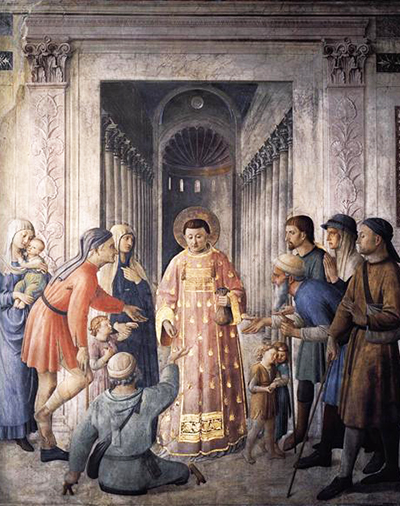
A man seated on the pavement reaches up towards Saint Lawrence, who lowers his right hand to meet him. Behind the saint, two ranks of columns lead deep into a church, yet the most consequential distance in the picture is the few inches between those hands. In Saint Lawrence Giving Alms, Fra Angelico makes that small exchange the centre of a fresco in the Niccoline Chapel of the Apostolic Palace. It is the right-hand episode in a pair that shows what Lawrence did with the wealth entrusted to him by Pope Sixtus II. [1] [2]
At a Glance
- ArtistFra Angelico and workshop. [1] [3]
- DateAround 1448. Two payments for the chapel decoration are documented in February and March 1448. [1]
- MediumWall fresco. [1] [3]
- LocationLower register, right-hand episode on the north entrance wall, above the doorway of the Niccoline Chapel, Apostolic Palace, Vatican City. [2] [4]
- PatronPope Nicholas V. [1]
- SubjectThe Roman deacon Lawrence distributes the Church's wealth to people in need. [2] [5]
The people at the door
Lawrence stands beneath the great opening in a rose-coloured dalmatic, the vestment of a deacon. Gold-coloured edging and repeated motifs distinguish his clothing from the blues, browns and greys around him. The halo and the long, nearly unbroken fall of the robe give him a stillness the surrounding figures lack. His lowered eyes follow his giving hand. At his other side he holds a pouch close to his body. The pouch and the outstretched fingers give the distribution a practical rhythm. There is money to be held, a person to attend to and another waiting. [2]
The seated man is nearest to us. One hand braces him on the ground while the other reaches up, and the turn of his shoulders makes the effort of that reach visible. At left, the man in a short red tunic bends towards Lawrence with an open palm. A child below him also lifts a hand. At the outer edge a woman holds an infant, while another woman, closer to the saint, keeps a hand at her breast. On the right a grey-bearded man leans forward and extends a hand. Behind and beside him, some watch and others wait. The staff angled down to the pavement near the right edge and the seated man's supporting arm give two very different indications of how people hold themselves in this space. [2]
The crowd closes in at shoulder height, but there is room near the centre for us to see Lawrence's sleeve and the hand below it. The reaching figures seem close enough to interrupt one another. Angelico keeps their gestures legible by giving each a different angle or height, from the child's small upturned hand to the older man's almost horizontal arm. The grand setting gives the exchange visibility, and the people at the door give it urgency. [2]
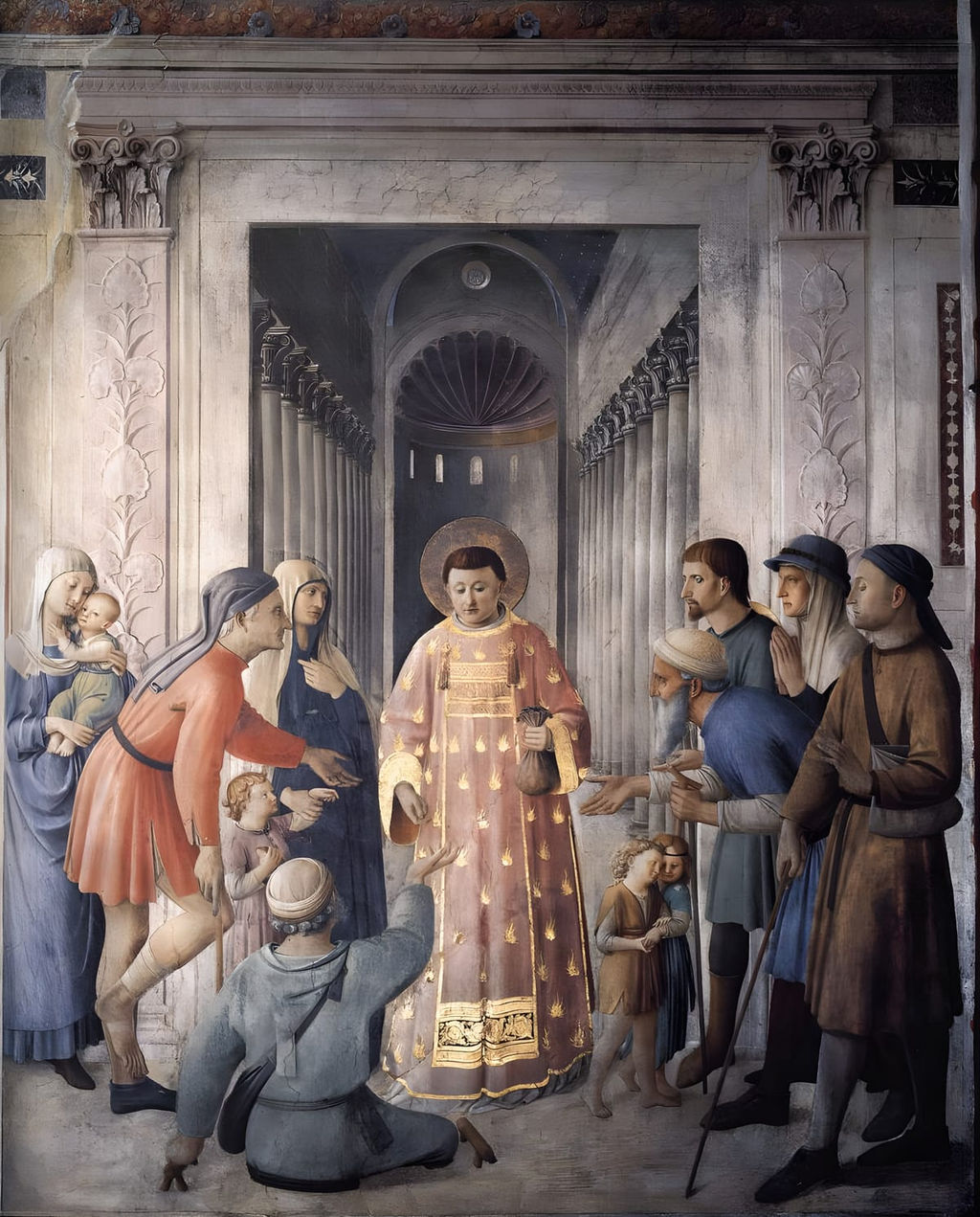
Lawrence distributes alms outside the entrance. His position gives the figures on each side a common point of attention. Image source. Public domain. Proportional web resize.
The church behind Lawrence
The pale façade is richly worked. Look at the curling foliage on the flat uprights on either side of the opening and at their carved-looking capitals. The high rectangular portal gives way to the round forms of the interior. Light picks out the columns in succession as they recede, and the curved end of the nave comes into view beneath a shell-like vault. Livia Lupi draws attention to the small windows at the far end and the round opening above, which give the eye something to follow into the shadow. The depth also sets off the saint's head. His halo sits against the dark interior, and the upright lines around him direct attention back down towards the group at the threshold. [2] [4]
The building has prompted comparisons with both Florence and Rome. Lupi finds a close parallel for the portal's Corinthian capitals in Brunelleschi's architecture at the Ospedale degli Innocenti and San Lorenzo in Florence, while noting how the painted uprights differ in colour and ornament. Suzanne M. Scanlan reads the doorway as that of St Peter's. Lupi is more cautious about tying the chapel's basilican settings to a specific phase of Nicholas V's rebuilding plans for St Peter's, since the documented work she discusses followed the frescoes. The architecture makes the historical connection imaginable even where an exact model is elusive. An early Christian story takes place before a church composed in a language a fifteenth-century viewer could recognise. [4] [6]
From the Church treasury to the street
The full wall shows how much an isolated view leaves outside the frame. To the left of the almsgiving, Lawrence kneels as Sixtus II entrusts him with the treasures of the Church. A narrow painted strip separates the episodes. Lupi notes that it cuts across parts of figures at the join, including the woman with the infant on the almsgiving side. Within that sharp division, there are quieter links. The columns and ornamental capitals in the two settings answer one another, while Lawrence's position changes from kneeling at the pope’s feet to standing among people who reach towards him. The paired scenes give the passage of wealth a visible direction. [2] [4]
The medieval Golden Legend tells how Sixtus charged Lawrence with distributing the treasure. It has the deacon seek people out by night and by day, giving each what they needed. Later, questioned about the wealth, he gathers poor people together and presents them as the enduring treasure. The fresco draws out the earlier distribution, when the money is still changing hands. That distinction matters. Angelico gives a whole scene to an action that could have been passed over on the way to the more dramatic encounter with the authorities. [2] [3] [5]
Ambrose of Milan gives an earlier account in On the Duties of the Clergy. He invokes Lawrence while defending the use of the Church's gold to help people in need, including the redemption of captives. In his telling, Lawrence points to the poor when asked to produce the treasure, because Christ lives in them. Read alongside the painting, Ambrose's account gives weight to the brief exchange in the foreground. The money can pass out of sight almost at once. The people who receive it remain before us, each with a place in the composition. [7]
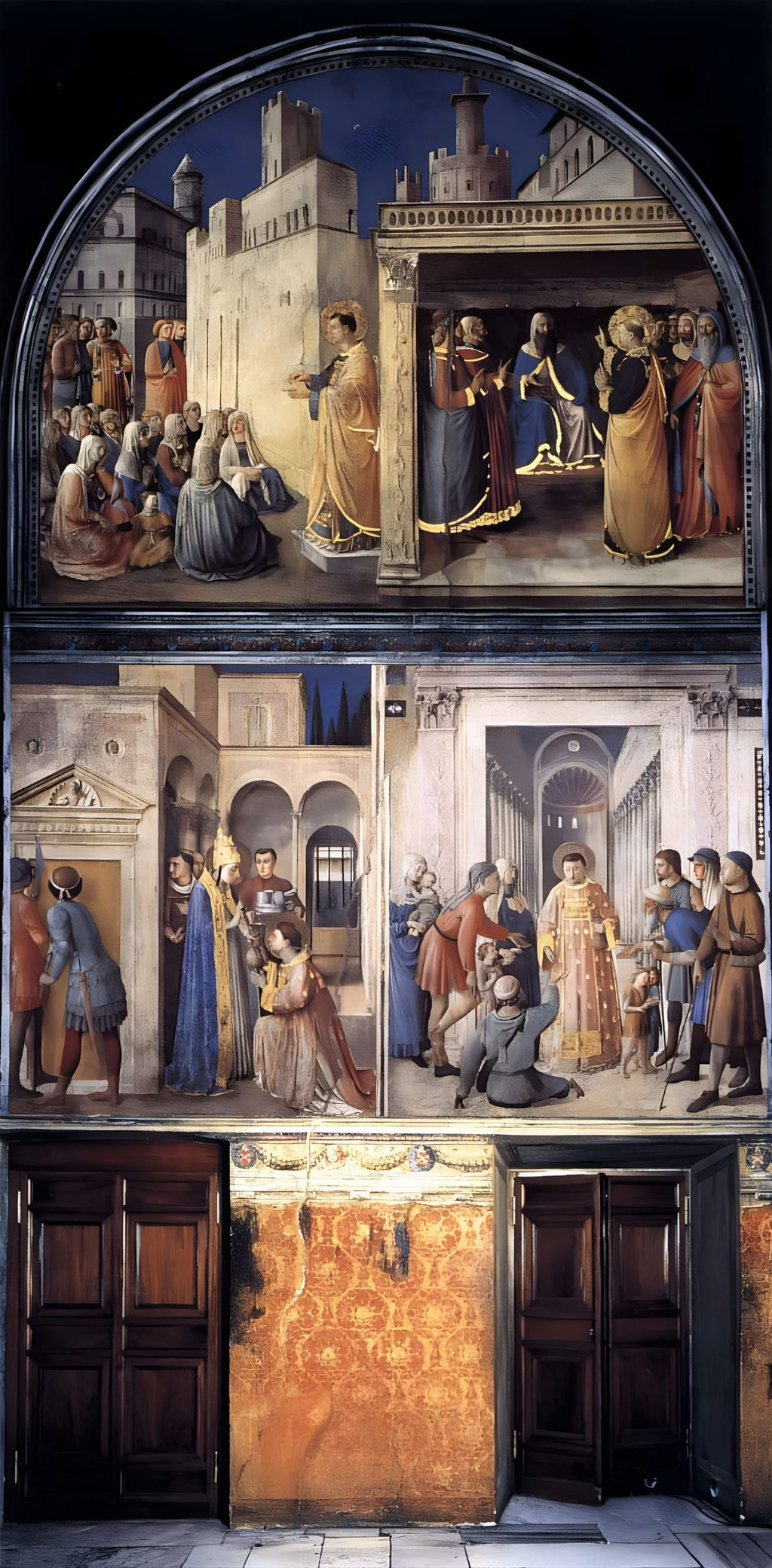
One wall of the Niccoline Chapel. The paired Stephen scenes above and the Lawrence scenes below occupy separate registers. Image source. Public domain. Proportional web resize.
Charity in the pope's chapel
Nicholas V commissioned the decoration of the Niccoline Chapel, his private chapel in the Apostolic Palace. The Vatican Museums record two payments to Fra Angelico in February and March 1448 for the decoration. Lawrence's story runs in the lower register, beneath scenes from the life of Stephen. The two accounts of giving are on different walls. Stephen distributes alms beside his own ordination, above the Ordination of Saint Lawrence, while Lawrence distributes them on the entrance wall beneath Stephen's preaching and dispute. Acts places Stephen among the seven chosen after a complaint that widows were being overlooked in the daily distribution. The frescoes give that Jerusalem story and the Roman tradition about Lawrence a common subject in the duties of a deacon. [1] [2] [4] [3] [8]
Gerardo de Simone reads the two cycles as a balance between papal authority, expressed in the men who confer office, and the service of the deacons, expressed in preaching, charity and martyrdom. He identifies Nicholas V's likeness with Sixtus in the ordination and entrustment scenes. That reading locates the patron's role beside the almsgiving and gives it a concrete form. The pope who controls the treasury is also responsible for what happens when it leaves his hands. Scanlan proposes another contemporary association, identifying the woman beside Lawrence who holds a child's wrist as Francesca Romana, a recent Roman exemplar of charity. The identification remains a proposal, but it draws attention to a figure whose care for a child is easy to miss beside the saint's act of giving. [6] [9]
The fresco and its reproductions
The fresco survives above the doorway, where the shallow stretch of pavement seems to continue the wall's ledge. The Vatican Museums date the chapel's modern restoration campaign to 1995–96. Much earlier, people could study the scene at a distance through reproductions. In 1849–50 Ludwig Gruner engraved it for the Arundel Society from a drawing by Josef Ernst Tunner. Later in the nineteenth century Fratelli Alinari photographed it, and an albumen print is now in the Rijksmuseum. Those records describe two distinct objects made after the fresco. Both reproduce the distribution as a subject in its own right, separate from the scene of Sixtus handing over the treasure. In the chapel, the real doorway below and the painted door behind Lawrence make the threshold a feature of both the room and the story. [2] [10] [11] [12]
Inside the Niccoline Chapel
See the frescoes in the rooms where their painted stories meet.
Cappella Niccolina – Niccoline Chapel
See how the painted lives of Stephen and Lawrence occupy the two registers of the chapel.
Watch on YouTubeFra Angelico artworks directory
Explore documented works and surviving parts of larger ensembles. Catalogue links identify individual records. Attribution and dating can vary across collections and publications. Search the Federico Zeri Photo Archive by artist.
| Name | Date | Medium and sources |
|---|---|---|
| Adoration of the Magi | About 1440–60, NGA catalogue | Painting Catalogue. |
| Adoration of the Magi (Armadio degli Argenti) | About 1450–53 | Tempera and gold on wood. Catalogue. |
| Agony in the Garden (Armadio degli Argenti) | About 1450–53 | Tempera and gilding on wood Catalogue. |
| Annalena Altarpiece / Pala di Annalena | commonly c. 1435 | Tempera on panel Catalogue. |
| Annunciation (Armadio degli Argenti) | About 1450–53 | Tempera and gilding on wood. Catalogue. |
| Annunciation (Cortona) | generally placed in the 1430s; exact dating remains debated | Tempera on panel Catalogue. |
| Annunciation (Prado) | 1425–26 | Tempera on poplar panel Catalogue. |
| Annunciation (San Marco upper corridor) | commonly c. 1442 | Fresco Catalogue. |
| Annunciation with Saint Peter Martyr | About 1439–43 | Fresco on plaster. Catalogue. |
| Annunciatory Angel | 1450–55, Detroit catalogue | Gold leaf and tempera on wood panel. Catalogue. |
| Armadio degli Argenti (Silver Treasury) | principally c. 1450–52 | Tempera on panel Catalogue. |
| Arrest of Christ (Armadio degli Argenti) | About 1450–53 | Tempera and gilding on wood Catalogue. |
| Ascension (Armadio degli Argenti) | About 1450–53 | Tempera and gilding on wood Catalogue. |
| Baptism of Christ (Armadio, Alesso Baldovinetti) | About 1452–53 | Tempera and gilding on wood Catalogue. |
| Beheading of Saints Cosmas and Damian (San Marco Altarpiece) | About 1438–42 | Painted panel Catalogue. |
| Betrayal of Christ (Armadio degli Argenti) | About 1450–53 | Tempera and gilding on wood Catalogue. |
| Blessed Dominican, Possibly Jordan of Saxony (San Marco Altarpiece) | About 1438–42 | Painted panel Catalogue. |
| Blessed Vincent Ferrer (San Marco Altarpiece) | About 1438–42 | Painted panel Catalogue. |
| Burial of Saints Cosmas and Damian (San Marco Altarpiece) | About 1438–42 | Painted panel Catalogue. |
| Bust of a Cleric and a Group of Figures (recto and verso) | 15th century | Pen and ink on paper Catalogue. |
| Christ among the Doctors (Armadio degli Argenti) | About 1450–53 | Tempera and gilding on wood Catalogue. |
| Christ before Caiaphas (Armadio degli Argenti) | About 1450–53 | Tempera and gilding on wood Catalogue. |
| Christ Glorified in the Court of Heaven | About 1423–24 | Egg tempera on wood, probably poplar, with gold and silver leaf Catalogue. |
| Christ Seated in Judgment | 1447 | Fresco and gilding on plaster. Catalogue. |
| Christ Stripped of His Garments (Armadio degli Argenti) | About 1450–53 | Tempera and gilding on wood Catalogue. |
| Christ Washes the Apostles’ Feet (Armadio degli Argenti) | About 1450–53 | Tempera and gilding on wood Catalogue. |
| Circumcision of Christ (Armadio degli Argenti) | About 1450–53 | Tempera and gilding on wood. Catalogue. |
| Communion of the Apostles (Armadio degli Argenti) | About 1450–53 | Tempera and gilding on wood Catalogue. |
| Coronation of the Virgin (Armadio degli Argenti) | About 1450–53 | Tempera and gilding on wood Catalogue. |
| Coronation of the Virgin (Louvre) | Louvre: second quarter of the fifteenth century, 1425–50; often dated more narrowly c. 1434–35 | Tempera and gold on panel Catalogue. |
| Coronation of the Virgin (Uffizi) | 1431–35 | Tempera on wood, gold ground Catalogue. |
| Cortona Triptych | About 1437 | Tempera and gold on panel. Catalogue. |
| Crucifixion (Armadio degli Argenti) | About 1450–53 | Tempera and gilding on wood Catalogue. |
| Crucifixion and Saints | 1441–42 | Fresco Catalogue. |
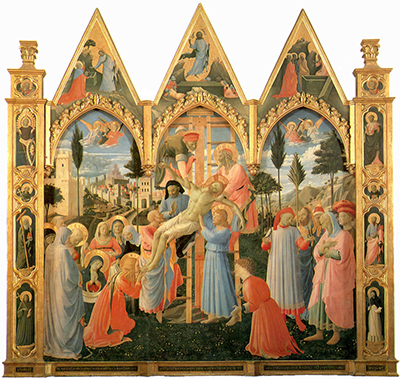
| Deposition from the Cross / Santa Trinita Deposition | commissioned 1429–32; completed by Angelico within this period | Tempera on panel Catalogue. |
| Descent into Limbo (Armadio degli Argenti) | About 1450–53 | Tempera and gilding on wood Catalogue. |
| Entombment of Christ (San Marco Altarpiece) | About 1438–42 | Painted panel Catalogue. |
| Entry into Jerusalem (Armadio degli Argenti) | About 1450–53 | Tempera and gilding on wood Catalogue. |
| Expulsion and the Stoning of Saint Stephen | 1448–49, Vatican Museums | Fresco. Catalogue. |
| Fiesole San Domenico Altarpiece | early 1420s; predella about 1423–24 | Tempera on panel Catalogue. |
| Flagellation (Armadio degli Argenti) | About 1450–53 | Tempera and gilding on wood Catalogue. |
| Flight into Egypt | About 1450–53 | Tempera and gilding on wood. Catalogue. |
| Guidalotti Polyptych | c. 1447–49 | Tempera and oil on panel Catalogue. |
| Healing of Palladia and Saint Damian Accepting Her Gift (San Marco Altarpiece) | About 1438–42 | Painted panel Catalogue. |
| Holy Pilgrim, Possibly Saint Roch (San Marco Altarpiece) | About 1438–42 | Painted panel Catalogue. |
| Holy Women at the Tomb (Armadio degli Argenti) | About 1450–53 | Tempera and gilding on wood Catalogue. |
| Judas Receives Payment (Armadio degli Argenti) | About 1450–53 | Tempera and gilding on wood Catalogue. |
| Lamentation over Christ (Armadio degli Argenti) | About 1450–53 | Tempera and gilding on wood Catalogue. |
| Lamentation over the Dead Christ (Croce al Tempio Lamentation) | 1436–41, Zeri catalogue | Tempera and gilding on wood panel. Catalogue. |
| Last Judgement (Armadio degli Argenti) | About 1450–53 | Tempera and gilding on wood Catalogue. |
| Last Judgement (San Marco) | c. 1425–28 | Tempera and gold on panel Catalogue. |
| Last Supper (Armadio degli Argenti) | About 1450–53 | Tempera and gilding on wood Catalogue. |
| Lex Amoris (Armadio degli Argenti) | About 1450–53 | Tempera and gilding on wood Catalogue. |
| Madonna and Child with Saint Dominic and Saint Thomas Aquinas | About 1430, Hermitage catalogue | Detached fresco. Catalogue. |
| Madonna and Child with Saints | About 1411–13 | Tempera on wood panel, with a gold ground. Catalogue. |
| Madonna of Humility | About 1425, Thyssen catalogue | Tempera and gold on wood. Catalogue. |
| Madonna of the Star | 1431–34, Zeri catalogue | Tempera with oil glazes and gold on wood panel, as catalogued by the Gardner for the 2018 exhibition. Catalogue. |
| Marriage at Cana (Armadio, Alesso Baldovinetti) | About 1452–53 | Tempera and gilding on wood Catalogue. |
| Massacre of the Innocents (Armadio degli Argenti) | About 1450–53 | Tempera and gilding on wood Catalogue. |
| Miracle of the Black Leg (San Marco Altarpiece) | About 1438–42 | Painted panel Catalogue. |
| Mocking of Christ (Armadio degli Argenti) | About 1450–53 | Tempera and gilding on wood Catalogue. |
| Mystic Wheel (The Vision of Ezekiel) | About 1450–52 | Tempera and gilding on wood. Catalogue. |
| Nativity (Armadio degli Argenti) | About 1450–53 | Tempera and gilding on wood. Catalogue. |
| Niccoline Chapel frescoes | principally 1448–50 | Fresco Catalogue. |
| Noli me Tangere | broadly within Angelico’s San Marco campaign, late 1430s–1440s | Fresco Catalogue. |
| Ordination of Saint Lawrence | 1448 | Fresco. Catalogue. |
| Pentecost (Armadio degli Argenti) | About 1450–53 | Tempera and gilding on wood Catalogue. |
| Presentation of Christ at the Temple (Armadio degli Argenti) | About 1450–53 | Tempera and gilding on wood. Catalogue. |
| Presentation of Jesus at the Temple | Early 1440s | Fresco on plaster. Catalogue. |
| Raising of Lazarus (Armadio degli Argenti) | About 1450–53 | Tempera and gilding on wood Catalogue. |
| Rescue of Saints Cosmas and Damian and Exorcism of Lysias (San Marco Altarpiece) | About 1438–42 | Painted panel Catalogue. |
| Road to Calvary (Armadio degli Argenti) | About 1450–53 | Tempera and gilding on wood Catalogue. |
| Saint Anthony Abbot (San Marco Altarpiece) | About 1438–42 | Painted panel Catalogue. |
| Saint Bernard of Clairvaux or Saint Benedict (San Marco Altarpiece) | About 1438–42 | Painted panel Catalogue. |
| Saint Damian Receives Money from Palladia | About 1425–49 | Tempera and gilding on wood. Catalogue. |
| Saint Francis and a Bishop Saint, Saint John the Baptist and Saint Dominic | Late 1420s, Getty catalogue | Tempera and gold leaf on panel. Catalogue. |
| Saint James the Greater Freeing the Magician Hermogenes | About 1426–29 | Tempera and gold on panel Catalogue. |
| Saint Jerome (San Marco Altarpiece) | About 1438–42 | Painted panel Catalogue. |
| Saint Lawrence Giving Alms | About 1448 | Wall fresco. Catalogue. |
| Saint Lawrence Receiving the Treasures of the Church from Pope Sixtus II | About 1448–49 | Fresco on plaster. Catalogue. |
| Saint Romuald (San Marco Altarpiece) | About 1438–42 | Painted panel Catalogue. |
| Saint Stephen Addressing the Council | 1448–49, Vatican Museums | Fresco. Catalogue. |
| Saint Stephen Preaching | 1448–49, Vatican Museums | Wall fresco. Catalogue. |
| Saint Thomas Aquinas (San Marco Altarpiece) | About 1438–42 | Painted panel Catalogue. |
| Saints Cosmas and Damian and Their Brothers Survive the Stake | Second quarter of the 15th century | Tempera and gilding on wood. Catalogue. |
| Saints Cosmas and Damian at the Stake (San Marco Altarpiece) | About 1438–42 | Painted panel Catalogue. |
| Saints Cosmas and Damian before Lysias (San Marco Altarpiece) | About 1438–42 | Painted panel Catalogue. |
| Saints Cosmas and Damian Rescued by an Angel | Second quarter of the 15th century | Tempera and gilding on wood. Catalogue. |
| Saints Cosmas and Damian with Their Brothers before Proconsul Lysias | Second quarter of the 15th century | Tempera and gilding on wood. Catalogue. |
| San Marco Altarpiece / Pala di San Marco | 1438–43 | Tempera on panel Catalogue. |
| San Pietro Martire Triptych | About 1422–23, Strozzi exhibition | Tempera and gold on panel. Catalogue. |
| Scenes from the Lives of the Desert Fathers (Thebaid) | About 1420, Uffizi catalogue | Tempera on wood. Catalogue. |
| Sixteen Prophets | 1447 | Fresco and gilding on plaster Catalogue. |
| Stoning and Shooting of the Brothers (San Marco Altarpiece) | About 1438–42 | Painted panel Catalogue. |
| Tabernacle of the Linaioli | 1433–35 | Tempera on panel Catalogue. |
| The Attempted Crucifixion and Stoning of Saints Cosmas and Damian | Second quarter of the 15th century | Tempera and gilding on wood. Catalogue. |
| The Crucifixion | About 1420–23, Met catalogue | Tempera on wood, gold ground. Catalogue. |
| The Death and the Assumption of the Virgin | 1424–34 | Tempera with oil glazes and gold on panel Catalogue. |
| The Dominican Blessed (left end) (Fiesole predella) | About 1423–24 | Egg tempera and gold on wood Catalogue. |
| The Dominican Blessed (right end) (Fiesole predella) | About 1423–24 | Egg tempera and gold on wood Catalogue. |
| The Entombment of Christ | About 1450 | Tempera on poplar panel. Catalogue. |
| The Forerunners of Christ with Saints and Martyrs | About 1423–24 | Egg tempera on wood (probably poplar), with gold and silver leaf. Catalogue. |
| The Funeral of Saint Anthony Abbot | About 1426–30 | Tempera on poplar panel. Catalogue. |
| The Martyrdom of Saints Cosmas and Damian | About 1425–49 | Tempera and gilding on wood. Catalogue. |
| The Mocking of Christ / Christ Mocked | within the San Marco dormitory campaign, broadly late 1430s–1440s | Fresco Catalogue. |
| The Nativity | About 1425, Minneapolis catalogue | Tempera on poplar panel. Catalogue. |
| The Nativity in Cell 5 at San Marco | About 1439–43 | Fresco on plaster. Catalogue. |
| The Penitent Saint Jerome | 1419–20 | Tempera on wood panel Catalogue. |
| The Virgin and Child by Fra Angelico (Fogg Museum) | About 1430, Harvard catalogue | Tempera originally on panel, subsequently transferred to Masonite. Catalogue. |
| The Virgin Mary with the Apostles and Other Saints (Fiesole predella) | About 1423–24 | Egg tempera and gold on wood Catalogue. |
| Transfiguration (Armadio, Alesso Baldovinetti) | About 1452–53 | Tempera and gilding on wood Catalogue. |
| Transfiguration (San Marco Cell 6) | within the San Marco dormitory campaign, broadly late 1430s–1440s | Fresco Catalogue. |
| Virgin Mary Annunciate | 1450–55, Detroit catalogue | Gold leaf and tempera on wood panel. Catalogue. |
| Virgin of the Pomegranate | About 1426 | Tempera on panel with gilding Catalogue. |
Frequently Asked Questions
Discussion
Use these prompts to look again or share an observation.
Reader Insights
Follow the recipients’ hands and bodies. How does the painter make several needs legible during one distribution?
Compare the architectural setting with the previous transfer. What changes about where Lawrence stands and who can approach him?
Join the Conversation
Share a detail or question about Saint Lawrence Giving Alms.
References
- Vatican Museums. Cappella Niccolina, the commission, documented payments and arrangement of the chapel (in Italian). View source.
- Vatican Museums. Virtual tour of the Niccoline Chapel, the entrance wall and adjacent registers. View source.
- Museo Benozzo Gozzoli. Stories of Saint Stephen and Saint Lawrence, the narrative traditions and the workshop's contribution. View source.
- Livia Lupi. Rhetoric of Pictorial Place, University of York, 2016, vol. I, pp. 174–177, 182–183, 189–196. View source.
- Jacobus de Voragine. The Golden Legend, vol. IV, ‘The Life of S. Laurence’, William Caxton translation edited by F. S. Ellis. View source.
- Suzanne M. Scanlan. ‘Sanctity on the Threshold’, chapter 1 of Divine and Demonic Imagery at Tor de’Specchi, 1400–1500, chapter summary. View source.
- Ambrose of Milan. On the Duties of the Clergy, book II, chapter 28, §§136–141, translated by H. de Romestin, E. de Romestin and H. T. F. Duckworth. View source.
- Acts of the Apostles. Acts 6:1–6, the selection of Stephen and the other six, New American Bible. View source.
- Gerardo de Simone. ‘L’immagine del pontefice: Niccolò V e la propaganda attraverso le arti’, pp. 198–201 and 208–210 (in Italian). View source.
- Vatican Museums. Department of 15th- and 16th-Century Art, research and restoration activities. View source.
- Wellcome Collection. Saint Laurence of Rome distributing alms, engraving by Ludwig Gruner after Josef Ernst Tunner, 6269i. View source.
- Rijksmuseum. Fratelli Alinari, photographic reproduction of Saint Lawrence Giving Alms, RP-F-1993-6-7 (in Dutch and English). View source.
.jpg)
 Fra Angelico.jpg)