 by Tom Gurney
Tom Gurney BSc (Hons) is an art history expert with over 20 years experience
Published on June 19, 2020 / Updated on November 29, 2026
Email: tomgurney1@gmail.com / Phone: +44 7429 011000
Introduction
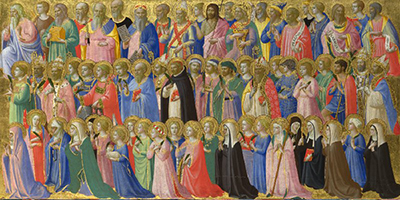
In Fra Angelico’s The Forerunners of Christ with Saints and Martyrs, three ranks of figures turn towards the left, where the risen Christ stood in the adjoining panel. Near the middle of the upper rank, John the Baptist looks straight out and points towards him. His glance draws us into an assembly whose attention is largely directed beyond the edge of the painting. Made about 1423–24 for the high altar of San Domenico in Fiesole, the panel is now in the National Gallery, London. [1]
At a Glance
- ArtistFra Angelico (Guido di Pietro). [1] [2]
- DateAbout 1423–24, according to the National Gallery. [1]
- MediumEgg tempera on wood (probably poplar), with gold and silver leaf. [1] [2]
- Dimensions31.9 × 63.5 cm (height × width of the painted surface, as listed by the National Gallery). [1] [2]
- Original positionInner-right panel of the predella of the high altarpiece at San Domenico, Fiesole. [1]
- CollectionNational Gallery, London, NG663.3, bought in 1860. [1]
Three ranks turned towards Christ
The panel was part of the predella, the painted tier at the base of the San Domenico Altarpiece. Towards the left edge, the grey-bearded Adam leads the patriarchs and prophets in the top rank. Stephen heads the male martyrs below, and Anne kneels at the front of the women’s rank. The figures overlap so closely that a shoulder or the sweep of a sleeve often marks the boundary between one person and the next. The succession of half-hidden haloes gives the crowd depth against the gold, while narrow passages of red, pink, blue and green let the eye pick out individuals. The three lines carry the eye across the panel from right to left. [1] [2]
That movement continues across the interval to Christ Glorified in the Court of Heaven, where angels encircle the risen Christ with his Resurrection banner. Across from Adam and Anne, the Virgin leads the assembly on the other side, with Peter and Paul immediately behind her. Dillian Gordon notes that the group nearest Mary is set apart from the rest on the inner-left panel. On the right, the ranks run without that break. The two flanking panels converge on Christ while keeping their own patterns of spacing and emphasis. [2]
The patriarchs, prophets and John the Baptist
Noah’s Ark is small enough to carry in his hands, yet Fra Angelico gives it an opening in the roof for the dove. Abraham’s blade recalls the sacrifice of Isaac, and Moses holds two tablets with lettering drawn from the Commandments. Farther along, the crowned David carries a psaltery with his name on it. The names can sit where a viewer might least expect them. Ezekiel’s is written across his blue cap, while Jeremiah’s appears on the scroll he holds. The procession moves through scriptural time in broad terms, gathering people into a single act of worship. Adam’s place at its head takes on particular force beside the risen Christ, whom Christian tradition understood as a new Adam renewing humanity’s relationship with God. [1] [2]
John is the only New Testament figure in the upper rank. He holds a cross in his left hand and points with his right, towards the Christ of the neighbouring panel. The outward glance and sideways gesture work together. He catches the viewer’s eye in the midst of people absorbed in looking left, then gives that attention a direction. His position among the prophets makes sense of his place in the title. In the Gospels he announces the arrival of the person to whom he now points. [1] [2]
Palms, instruments and names
The palms held by the men in the middle rank mark them as martyrs. Their other emblems tell more particular stories. A stone rests at Stephen’s collar, and Lawrence has the gridiron associated with his death. Sebastian, clothed like his neighbours, carries an arrow. Thomas Becket’s name is picked out on his mitre, while the blood on Peter Martyr’s head and habit marks the wound that identifies the Dominican saint. In the middle of the rank, the physician saints Cosmas and Damian wear distinctive hats and are identified with a box of ointments. Among so many similarly sized faces, a headpiece or a small object can do the work of a whole episode. [2]
Below them, Anne inclines her head in prayer. The woman just behind her has been identified as Thecla, traditionally the first female martyr, though Gordon leaves the name open. On that reading she takes her place immediately below Stephen, the first male martyr. Agnes holds a tiny lamb whose halo and wounded side identify it as the Lamb of God. Catherine has a crown and a wheel, while Helena, farther to the right, carries the True Cross and has her name on her crown. Among the women towards the end of the rank, Bridget of Sweden has a book and a lighted candle. The succession of courtly dresses, mantles and religious habits makes the changes in costume especially clear along this lower edge. [1] [2]
Some clues are stronger than others. The figure beside Adam wears animal skin and holds ears of grain. Gordon allows either Eve or Abel. A garland of red and white roses leaves open the choice between Cecilia and Dorothy, and the identification of the armoured martyr as George is tentative. Some figures remain unnamed. The panel rewards looking for these clues even where the evidence permits only a description. [2]
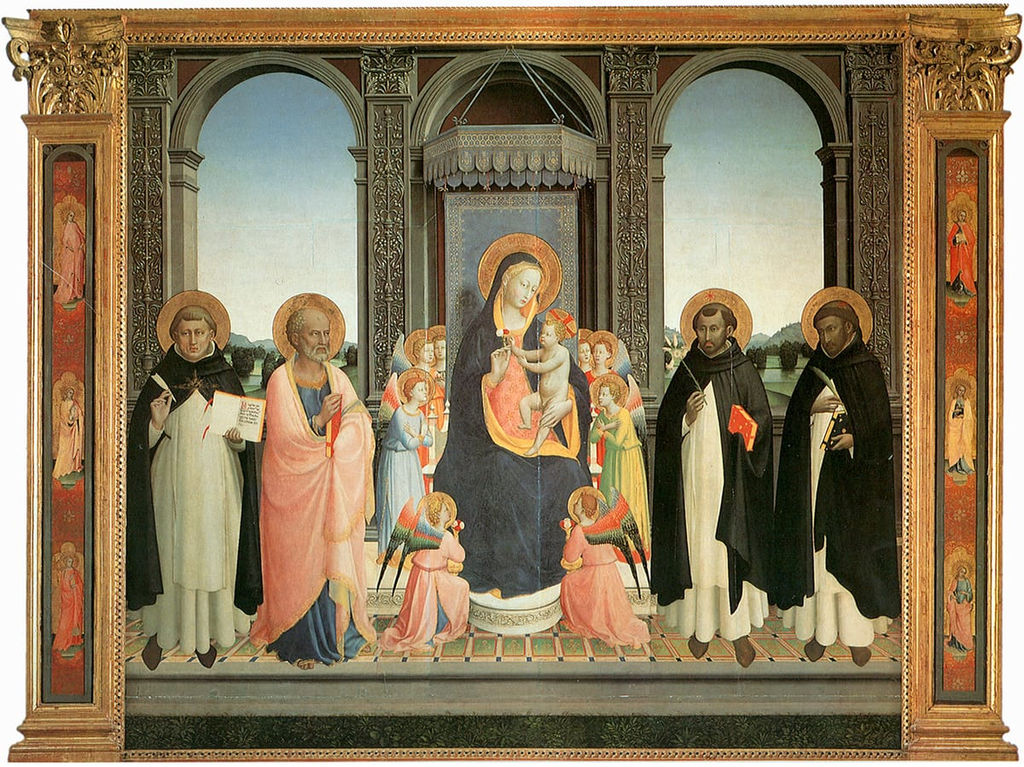
The main Fiesole altarpiece as it survives after Lorenzo di Credi’s alterations. Its detached predella is in London. Image source. Public domain. Proportional web resize.
Gold that still catches the light and silver that has darkened
The armoured martyr’s helmet in the middle rank appears dark today. It was picked out in silver leaf, as were such small details as Abraham’s knife, Sebastian’s arrowhead, the spikes of Catherine’s wheel and Lawrence’s gridiron. Tarnish has muted the glint that once distinguished these objects. Other details have altered through fading. Conservators found traces of red lake glaze on the darker green robes, where it once modelled the folds and introduced a shift from green towards red. Some passages that now read as flat expanses of green originally had more variation. [1] [2] [3]
The gold was worked in several ways. The broad background was laid over a reddish preparation and burnished. The ring of small impressions around the halo of the woman identified as Cecilia or Dorothy catches the light differently from the smooth field around it. For fine decorations on top of paint, an oil-based adhesive held the metal leaf. The brocaded vestment of Ignatius of Antioch in the middle rank shows how much ornament could be carried on a small area of cloth. There is a difference in scale between the gleam that ties the assembly together and the thin gold marks that distinguish a single garment. [2] [3]
What survives of the Fiesole altarpiece
The horizontal grain continues from one main predella panel to the next, showing that all three were painted on a single plank. Each retains a raised lip of ground at its edges where the original mouldings met the painted surface. The conservation team estimated that roughly eight centimetres are missing on either side of the centre panel. The two narrower panels of Dominican Blessed have vertical grain and probably occupied the bases of the pilasters, slightly forward of the main strip. The exact design of the lost framing is unknown. The surviving evidence explains how the right-hand crowd could belong to a continuous assembly and still have been seen through a separate opening. [2] [3]
Fra Angelico was himself a friar at San Domenico. In the central gathering, Gordon sees the Dominicans taking their place within the wider Church, with the two panels of Blessed giving the order’s own holy men and women a place at the margins. She also points to a possible parallel in a letter by Giovanni Dominici, the founder of the convent, which guides its reader through the ranks of heaven during Lenten meditation. The resemblance suggests a way to understand the orderly gathering around Christ at a Dominican altar. The source for Angelico’s precise choice of figures remains unknown. [2]
The convent’s chronicle puts the three altarpieces in place by the church’s consecration in 1435. The 2025 Florence exhibition dated the surviving main tier of the high altarpiece to about 1420–23. Lorenzo di Credi remodelled that tier in 1501, bringing the enthroned Virgin and Child and attendant saints into a single architectural setting. It remains at San Domenico. In the early nineteenth century the original predella passed through the Metzger brothers and the Valentini collection before the National Gallery bought it in October 1860. The Gallery’s date of about 1423–24 belongs to the London panel and remains an estimate. [1] [2] [4]
The predella was retouched after it arrived in London. Conservators later found that some of the repair paint had darkened and that an old varnish had turned grey. Examination also revealed damage from an earlier cleaning in the bottom rank of the right-hand panel, including around Agnes’s face. The Gallery cleaned and restored the ensemble in 2000–01. [2] [3]
Fra Angelico artworks directory
Explore documented works and surviving parts of larger ensembles. Catalogue links identify individual records. Attribution and dating can vary across collections and publications. Search the Federico Zeri Photo Archive by artist.
| Name | Date | Medium and sources |
|---|---|---|
| Adoration of the Magi | About 1440–60, NGA catalogue | Painting Catalogue. |
| Adoration of the Magi (Armadio degli Argenti) | About 1450–53 | Tempera and gold on wood. Catalogue. |
| Agony in the Garden (Armadio degli Argenti) | About 1450–53 | Tempera and gilding on wood Catalogue. |
| Annalena Altarpiece / Pala di Annalena | commonly c. 1435 | Tempera on panel Catalogue. |
| Annunciation (Armadio degli Argenti) | About 1450–53 | Tempera and gilding on wood. Catalogue. |
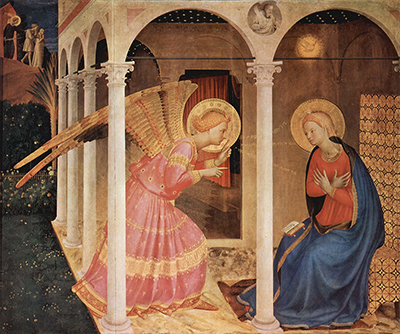
| Annunciation (Cortona) | generally placed in the 1430s; exact dating remains debated | Tempera on panel Catalogue. |
| Annunciation (Prado) | 1425–26 | Tempera on poplar panel Catalogue. |
| Annunciation (San Marco upper corridor) | commonly c. 1442 | Fresco Catalogue. |
| Annunciation with Saint Peter Martyr | About 1439–43 | Fresco on plaster. Catalogue. |
| Annunciatory Angel | 1450–55, Detroit catalogue | Gold leaf and tempera on wood panel. Catalogue. |
| Armadio degli Argenti (Silver Treasury) | principally c. 1450–52 | Tempera on panel Catalogue. |
| Arrest of Christ (Armadio degli Argenti) | About 1450–53 | Tempera and gilding on wood Catalogue. |
| Ascension (Armadio degli Argenti) | About 1450–53 | Tempera and gilding on wood Catalogue. |
| Baptism of Christ (Armadio, Alesso Baldovinetti) | About 1452–53 | Tempera and gilding on wood Catalogue. |
| Beheading of Saints Cosmas and Damian (San Marco Altarpiece) | About 1438–42 | Painted panel Catalogue. |
| Betrayal of Christ (Armadio degli Argenti) | About 1450–53 | Tempera and gilding on wood Catalogue. |
| Blessed Dominican, Possibly Jordan of Saxony (San Marco Altarpiece) | About 1438–42 | Painted panel Catalogue. |
| Blessed Vincent Ferrer (San Marco Altarpiece) | About 1438–42 | Painted panel Catalogue. |
| Burial of Saints Cosmas and Damian (San Marco Altarpiece) | About 1438–42 | Painted panel Catalogue. |
| Bust of a Cleric and a Group of Figures (recto and verso) | 15th century | Pen and ink on paper Catalogue. |
| Christ among the Doctors (Armadio degli Argenti) | About 1450–53 | Tempera and gilding on wood Catalogue. |
| Christ before Caiaphas (Armadio degli Argenti) | About 1450–53 | Tempera and gilding on wood Catalogue. |
| Christ Glorified in the Court of Heaven | About 1423–24 | Egg tempera on wood, probably poplar, with gold and silver leaf Catalogue. |
| Christ Seated in Judgment | 1447 | Fresco and gilding on plaster. Catalogue. |
| Christ Stripped of His Garments (Armadio degli Argenti) | About 1450–53 | Tempera and gilding on wood Catalogue. |
| Christ Washes the Apostles’ Feet (Armadio degli Argenti) | About 1450–53 | Tempera and gilding on wood Catalogue. |
| Circumcision of Christ (Armadio degli Argenti) | About 1450–53 | Tempera and gilding on wood. Catalogue. |
| Communion of the Apostles (Armadio degli Argenti) | About 1450–53 | Tempera and gilding on wood Catalogue. |
| Coronation of the Virgin (Armadio degli Argenti) | About 1450–53 | Tempera and gilding on wood Catalogue. |
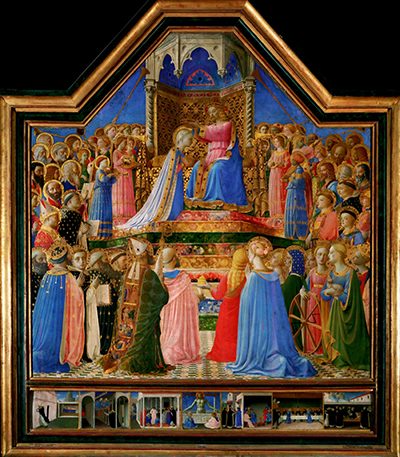
| Coronation of the Virgin (Louvre) | Louvre: second quarter of the fifteenth century, 1425–50; often dated more narrowly c. 1434–35 | Tempera and gold on panel Catalogue. |
| Coronation of the Virgin (Uffizi) | 1431–35 | Tempera on wood, gold ground Catalogue. |
| Cortona Triptych | About 1437 | Tempera and gold on panel. Catalogue. |
| Crucifixion (Armadio degli Argenti) | About 1450–53 | Tempera and gilding on wood Catalogue. |
| Crucifixion and Saints | 1441–42 | Fresco Catalogue. |
| Deposition from the Cross / Santa Trinita Deposition | commissioned 1429–32; completed by Angelico within this period | Tempera on panel Catalogue. |
| Descent into Limbo (Armadio degli Argenti) | About 1450–53 | Tempera and gilding on wood Catalogue. |
| Entombment of Christ (San Marco Altarpiece) | About 1438–42 | Painted panel Catalogue. |
| Entry into Jerusalem (Armadio degli Argenti) | About 1450–53 | Tempera and gilding on wood Catalogue. |
| Expulsion and the Stoning of Saint Stephen | 1448–49, Vatican Museums | Fresco. Catalogue. |
| Fiesole San Domenico Altarpiece | early 1420s; predella about 1423–24 | Tempera on panel Catalogue. |
| Flagellation (Armadio degli Argenti) | About 1450–53 | Tempera and gilding on wood Catalogue. |
| Flight into Egypt | About 1450–53 | Tempera and gilding on wood. Catalogue. |
| Guidalotti Polyptych | c. 1447–49 | Tempera and oil on panel Catalogue. |
| Healing of Palladia and Saint Damian Accepting Her Gift (San Marco Altarpiece) | About 1438–42 | Painted panel Catalogue. |
| Holy Pilgrim, Possibly Saint Roch (San Marco Altarpiece) | About 1438–42 | Painted panel Catalogue. |
| Holy Women at the Tomb (Armadio degli Argenti) | About 1450–53 | Tempera and gilding on wood Catalogue. |
| Judas Receives Payment (Armadio degli Argenti) | About 1450–53 | Tempera and gilding on wood Catalogue. |
| Lamentation over Christ (Armadio degli Argenti) | About 1450–53 | Tempera and gilding on wood Catalogue. |
| Lamentation over the Dead Christ (Croce al Tempio Lamentation) | 1436–41, Zeri catalogue | Tempera and gilding on wood panel. Catalogue. |
| Last Judgement (Armadio degli Argenti) | About 1450–53 | Tempera and gilding on wood Catalogue. |
| Last Judgement (San Marco) | c. 1425–28 | Tempera and gold on panel Catalogue. |
| Last Supper (Armadio degli Argenti) | About 1450–53 | Tempera and gilding on wood Catalogue. |
| Lex Amoris (Armadio degli Argenti) | About 1450–53 | Tempera and gilding on wood Catalogue. |
| Madonna and Child with Saint Dominic and Saint Thomas Aquinas | About 1430, Hermitage catalogue | Detached fresco. Catalogue. |
| Madonna and Child with Saints | About 1411–13 | Tempera on wood panel, with a gold ground. Catalogue. |
| Madonna of Humility | About 1425, Thyssen catalogue | Tempera and gold on wood. Catalogue. |
| Madonna of the Star | 1431–34, Zeri catalogue | Tempera with oil glazes and gold on wood panel, as catalogued by the Gardner for the 2018 exhibition. Catalogue. |
| Marriage at Cana (Armadio, Alesso Baldovinetti) | About 1452–53 | Tempera and gilding on wood Catalogue. |
| Massacre of the Innocents (Armadio degli Argenti) | About 1450–53 | Tempera and gilding on wood Catalogue. |
| Miracle of the Black Leg (San Marco Altarpiece) | About 1438–42 | Painted panel Catalogue. |
| Mocking of Christ (Armadio degli Argenti) | About 1450–53 | Tempera and gilding on wood Catalogue. |
| Mystic Wheel (The Vision of Ezekiel) | About 1450–52 | Tempera and gilding on wood. Catalogue. |
| Nativity (Armadio degli Argenti) | About 1450–53 | Tempera and gilding on wood. Catalogue. |
| Niccoline Chapel frescoes | principally 1448–50 | Fresco Catalogue. |
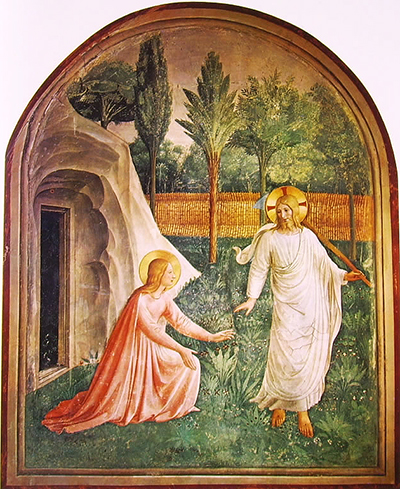
| Noli me Tangere | broadly within Angelico’s San Marco campaign, late 1430s–1440s | Fresco Catalogue. |
| Ordination of Saint Lawrence | 1448 | Fresco. Catalogue. |
| Pentecost (Armadio degli Argenti) | About 1450–53 | Tempera and gilding on wood Catalogue. |
| Presentation of Christ at the Temple (Armadio degli Argenti) | About 1450–53 | Tempera and gilding on wood. Catalogue. |
| Presentation of Jesus at the Temple | Early 1440s | Fresco on plaster. Catalogue. |
| Raising of Lazarus (Armadio degli Argenti) | About 1450–53 | Tempera and gilding on wood Catalogue. |
| Rescue of Saints Cosmas and Damian and Exorcism of Lysias (San Marco Altarpiece) | About 1438–42 | Painted panel Catalogue. |
| Road to Calvary (Armadio degli Argenti) | About 1450–53 | Tempera and gilding on wood Catalogue. |
| Saint Anthony Abbot (San Marco Altarpiece) | About 1438–42 | Painted panel Catalogue. |
| Saint Bernard of Clairvaux or Saint Benedict (San Marco Altarpiece) | About 1438–42 | Painted panel Catalogue. |
| Saint Damian Receives Money from Palladia | About 1425–49 | Tempera and gilding on wood. Catalogue. |
| Saint Francis and a Bishop Saint, Saint John the Baptist and Saint Dominic | Late 1420s, Getty catalogue | Tempera and gold leaf on panel. Catalogue. |
| Saint James the Greater Freeing the Magician Hermogenes | About 1426–29 | Tempera and gold on panel Catalogue. |
| Saint Jerome (San Marco Altarpiece) | About 1438–42 | Painted panel Catalogue. |
| Saint Lawrence Giving Alms | About 1448 | Wall fresco. Catalogue. |
| Saint Lawrence Receiving the Treasures of the Church from Pope Sixtus II | About 1448–49 | Fresco on plaster. Catalogue. |
| Saint Romuald (San Marco Altarpiece) | About 1438–42 | Painted panel Catalogue. |
| Saint Stephen Addressing the Council | 1448–49, Vatican Museums | Fresco. Catalogue. |
| Saint Stephen Preaching | 1448–49, Vatican Museums | Wall fresco. Catalogue. |
| Saint Thomas Aquinas (San Marco Altarpiece) | About 1438–42 | Painted panel Catalogue. |
| Saints Cosmas and Damian and Their Brothers Survive the Stake | Second quarter of the 15th century | Tempera and gilding on wood. Catalogue. |
| Saints Cosmas and Damian at the Stake (San Marco Altarpiece) | About 1438–42 | Painted panel Catalogue. |
| Saints Cosmas and Damian before Lysias (San Marco Altarpiece) | About 1438–42 | Painted panel Catalogue. |
| Saints Cosmas and Damian Rescued by an Angel | Second quarter of the 15th century | Tempera and gilding on wood. Catalogue. |
| Saints Cosmas and Damian with Their Brothers before Proconsul Lysias | Second quarter of the 15th century | Tempera and gilding on wood. Catalogue. |
| San Marco Altarpiece / Pala di San Marco | 1438–43 | Tempera on panel Catalogue. |
| San Pietro Martire Triptych | About 1422–23, Strozzi exhibition | Tempera and gold on panel. Catalogue. |
| Scenes from the Lives of the Desert Fathers (Thebaid) | About 1420, Uffizi catalogue | Tempera on wood. Catalogue. |
| Sixteen Prophets | 1447 | Fresco and gilding on plaster Catalogue. |
| Stoning and Shooting of the Brothers (San Marco Altarpiece) | About 1438–42 | Painted panel Catalogue. |
| Tabernacle of the Linaioli | 1433–35 | Tempera on panel Catalogue. |
| The Attempted Crucifixion and Stoning of Saints Cosmas and Damian | Second quarter of the 15th century | Tempera and gilding on wood. Catalogue. |
| The Crucifixion | About 1420–23, Met catalogue | Tempera on wood, gold ground. Catalogue. |
| The Death and the Assumption of the Virgin | 1424–34 | Tempera with oil glazes and gold on panel Catalogue. |
| The Dominican Blessed (left end) (Fiesole predella) | About 1423–24 | Egg tempera and gold on wood Catalogue. |
| The Dominican Blessed (right end) (Fiesole predella) | About 1423–24 | Egg tempera and gold on wood Catalogue. |
| The Entombment of Christ | About 1450 | Tempera on poplar panel. Catalogue. |
| The Forerunners of Christ with Saints and Martyrs | About 1423–24 | Egg tempera on wood (probably poplar), with gold and silver leaf. Catalogue. |
| The Funeral of Saint Anthony Abbot | About 1426–30 | Tempera on poplar panel. Catalogue. |
| The Martyrdom of Saints Cosmas and Damian | About 1425–49 | Tempera and gilding on wood. Catalogue. |
| The Mocking of Christ / Christ Mocked | within the San Marco dormitory campaign, broadly late 1430s–1440s | Fresco Catalogue. |
| The Nativity | About 1425, Minneapolis catalogue | Tempera on poplar panel. Catalogue. |
| The Nativity in Cell 5 at San Marco | About 1439–43 | Fresco on plaster. Catalogue. |
| The Penitent Saint Jerome | 1419–20 | Tempera on wood panel Catalogue. |
| The Virgin and Child by Fra Angelico (Fogg Museum) | About 1430, Harvard catalogue | Tempera originally on panel, subsequently transferred to Masonite. Catalogue. |
| The Virgin Mary with the Apostles and Other Saints (Fiesole predella) | About 1423–24 | Egg tempera and gold on wood Catalogue. |
| Transfiguration (Armadio, Alesso Baldovinetti) | About 1452–53 | Tempera and gilding on wood Catalogue. |
| Transfiguration (San Marco Cell 6) | within the San Marco dormitory campaign, broadly late 1430s–1440s | Fresco Catalogue. |
| Virgin Mary Annunciate | 1450–55, Detroit catalogue | Gold leaf and tempera on wood panel. Catalogue. |
| Virgin of the Pomegranate | About 1426 | Tempera on panel with gilding Catalogue. |
Frequently Asked Questions
Discussion
Use these prompts to look again or share an observation.
Reader Insights
Pick one identifying attribute and follow the pattern of glances or poses around its owner. How does the row stay varied?
How does the crowd’s direction change when you view this panel beside the centre of the Fiesole predella?
Join the Conversation
Share a detail or question about The Forerunners of Christ with Saints and Martyrs.
References
- National Gallery, The Forerunners of Christ with Saints and Martyrs, NG663.3 View source.
- Dillian Gordon, “Fiesole San Domenico Altarpiece”, The Fifteenth Century Italian Paintings, vol. I, National Gallery (2003) View source.
- Dillian Gordon, Martin Wyld and Ashok Roy, “Fra Angelico’s Predella for the High Altarpiece of San Domenico, Fiesole”, National Gallery Technical Bulletin 23 (2002), pp. 4–19 View source.
- Fondazione Palazzo Strozzi and Museo di San Marco, Beato Angelico (2025 exhibition dossier), no. 23, “Gli esordi” and “Il convento di Fiesole” (Italian). View source.
.jpg)
 Fra Angelico.jpg)