 by Tom Gurney
Tom Gurney BSc (Hons) is an art history expert with over 20 years experience
Published on June 19, 2020 / Updated on November 29, 2026
Email: tomgurney1@gmail.com / Phone: +44 7429 011000
Introduction
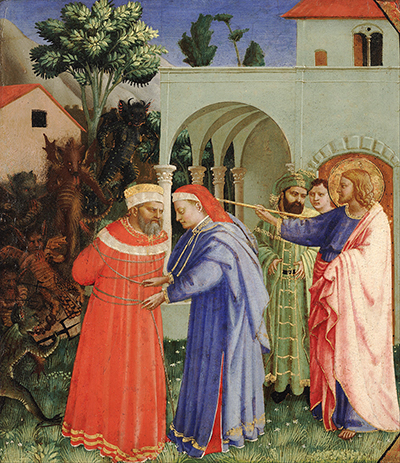
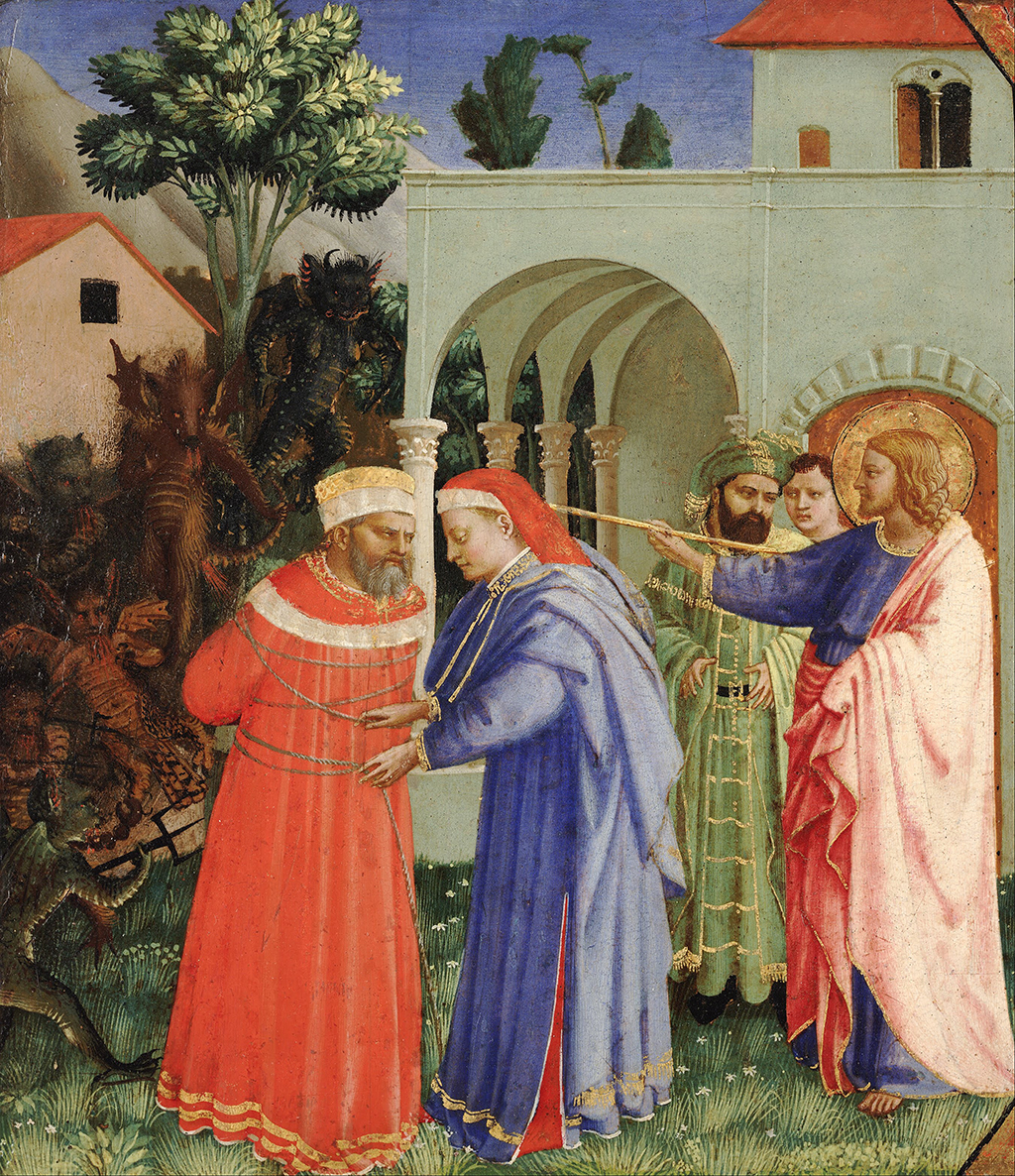
A man in blue bends over the cords binding a magician in red. At the right, a haloed apostle reaches across the space between them with a slender staff. The devils who seized the prisoner lurk close by, but it is the quiet work of the man at the ropes that holds the centre of Fra Angelico’s painting. Made around 1426–29, this small tempera-and-gold panel in the Kimbell Art Museum once formed part of the lowest tier of an altarpiece. [1]
At a Glance
- ArtistFra Angelico (Fra Giovanni da Fiesole)
- TitleThe Apostle Saint James the Greater Freeing the Magician Hermogenes
- Datec. 1426–29
- MediumTempera and gold on panel
- Dimensions26.8 × 23.8 cm (height × width)
- CollectionKimbell Art Museum, Fort Worth, AP 1986.03
- Original functionA scene from a dismantled altarpiece predella
Why Philetus unties the magician
In Jacobus de Voragine’s thirteenth-century Golden Legend, Hermogenes sends his disciple Philetus to discredit James’s preaching. Philetus returns persuaded by James and urges his master to follow him. Hermogenes immobilises his pupil by magic, and James sends a cloth that breaks the spell. The magician then summons devils to bring back both men as prisoners. An angel binds the devils with fiery chains. James has them released on the condition that they bring Hermogenes to him bound and unharmed. [2]
The story could end with the magician suffering the punishment he intended for someone else. James instead tells Philetus to do good in return for evil and untie the man who had bound him. He gives Hermogenes leave to go wherever he wishes, since conversion must be freely chosen. In the ensuing exchange, the magician fears what the devils may do to him once he is on his own. James gives him his staff for protection. Hermogenes then brings his books of magic to the apostle, who directs him to cast them into the sea. In the legend, his decision to return as a penitent comes after these events. [2]
The picture brings the staff and the untying into the same moment. James holds the staff himself and touches Philetus with it, a gesture the Kimbell interprets as empowering him to release the prisoner. The tip comes to the back of Philetus’s red head covering as his hands work below. Hermogenes stands upright, his arms pulled behind him, with several loops of cord running over his clothing. Angelico has chosen a point at which the magician has yet to move freely. Philetus’s care for his former teacher is already visible, while the change of heart promised by the story still lies ahead. [1] [2]
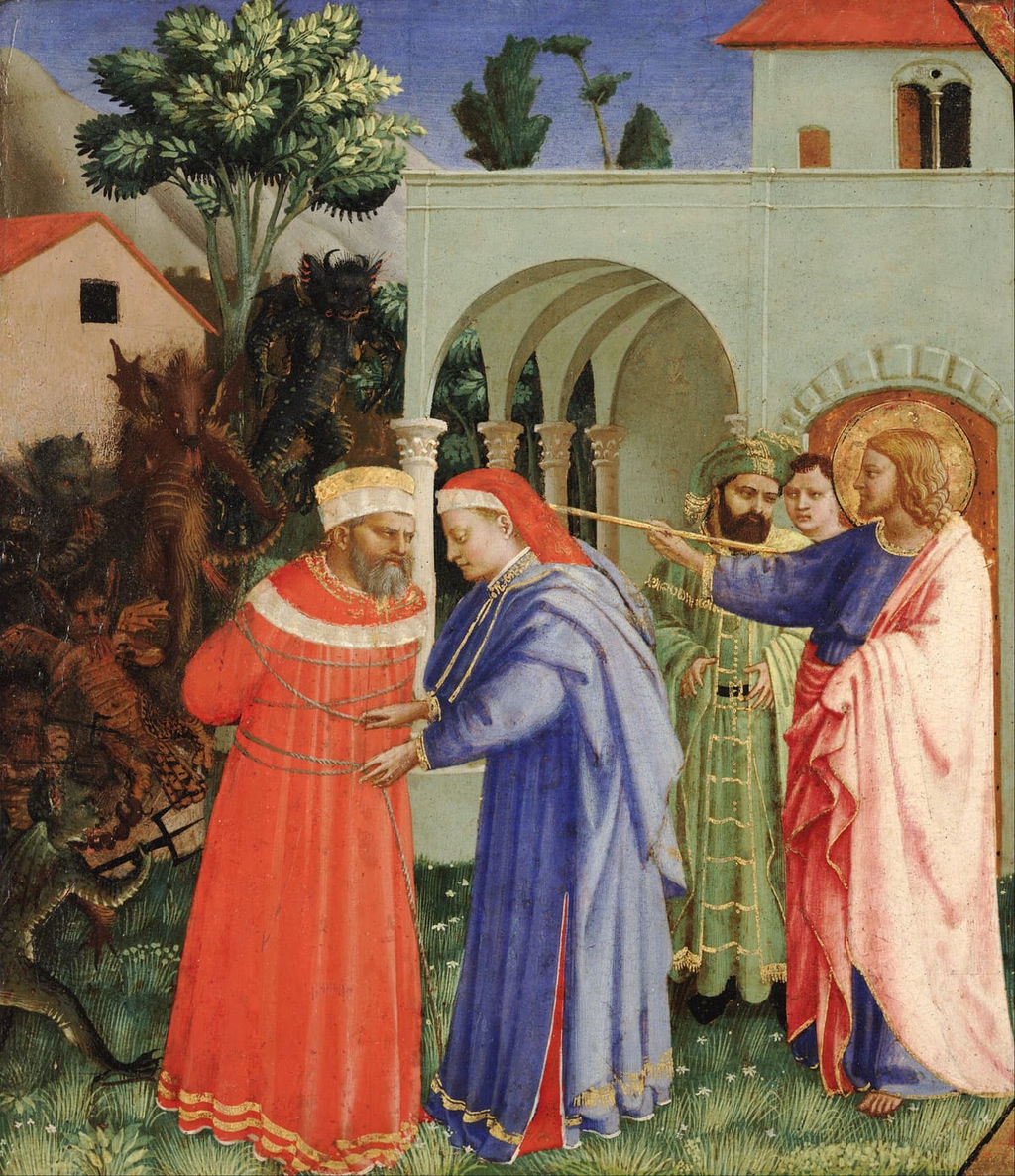
The Kimbell panel of James and Hermogenes, AP 1986.03. The bell-shaped opening of the arcade stands close to the turning figures. Image source. Public domain. Proportional web resize.
How the courtyard tells the story
The action runs through three readily distinguishable groups. At the left, horns, claws and dark wings emerge among the trees. Hermogenes, in the brightest red in the picture, stands just in front of them. Near the middle, Philetus leans in and works with both hands, catching one strand and reaching for another. At the right, James’s outstretched arm and staff carry the eye back towards the central pair. The two men behind his arm have little room to move. Their faces remain visible between the saint’s profile and the folds of Philetus’s hood, where they can look on without interrupting the line from James’s hand to the cords. [1]
The architecture gives those movements a setting. Pale arches recede behind the figures in diminishing bays, and the nearer column rises beside Hermogenes’s shoulder. Its shaft divides the magician from his helper just where the rope and Philetus’s hands bridge the gap. Farther right, a doorway frames James’s profile and halo. The garden continues beneath their feet, its fine blades of grass and small flowers reaching from the foot of the wall to the edge of the painted field. The shared foreground lets James act across a space that the columns and doorways divide into legible parts. [1]
At the left, the setting is just as carefully controlled. A roofline and dark square window sit behind the devils, and the branching tree makes some creatures hard to distinguish from the leaves and shadows. A horned face near the trunk and a claw nearer the ground become clearer after the main action has registered. Angelico makes that part of the painting slower to read. The vivid clothes, open grass and staff let the viewer grasp the release first and then discover how near the threat remains. The devils belong to the same garden as the apostle, a proximity that gives his composure its force. The Kimbell relates the coherent recession and lighting to Masaccio’s innovations in Florence. Here the depth of the arcade also gives the supernatural disturbance an everyday measure. The distance from the tree to the doorway can be judged by the size of the people and the intervals between the columns. [1]
Egg tempera and two kinds of gilding
The Kimbell identifies vermilion and lapis lazuli among the panel’s pigments and describes the fine hatching of Angelico’s egg tempera. Philetus’s cloak shows how much the modelling matters. Light catches the broad fold over his shoulder, while the deeper blues describe the cloth turning under his arm and hanging towards the ground. Along the edge, the gold trim follows the bends of the cloth. Hermogenes’s ornamental hem, by comparison, gathers into scallops near the grass. Bright colour makes the two men easy to find at a glance. The shifting folds and tiny strokes reward the much closer attention that the untying itself requires. [1]
James’s halo uses water gilding. The gold leaf was laid over a reddish clay preparation and burnished, giving the disk a smooth reflective surface. For the ornamental lines on the clothing, Angelico used mordant gilding, applying leaf to fine lines of adhesive. Those lines sit slightly above the paint and were left unburnished. In a painting with a blue sky, greenery and solidly modelled figures, gold still does several jobs. It sets off James’s head against the doorway and picks out the borders of clothes whose weight and volume the tempera has already established. [1]
The museum describes the painted surface as exceptionally well preserved, but the small X marks scratched into the devils’ faces are later damage. They belong to the history of people looking at or handling the painting. Their placement is strikingly selective. The marks cross particular faces in a crowded patch of shadows whose forms are easy to miss in a quick look. Whoever made the scratches had located the creatures Angelico made hardest to see. [1]
What survives of the altarpiece?
The scene once belonged to a predella, the low horizontal tier beneath an altarpiece’s main images. A figure in the main tier might stand alone as an object of devotion. Below it, several small scenes could show the actions for which the saints were remembered. Here Angelico made a whole encounter intelligible in a space less than 27 centimetres high. When the altarpiece was dismantled, the lower tier was cut into separate pictures. The Kimbell regards the slight trimming of the panel’s left side as probably a consequence of that separation. A modern gilded strip makes up the loss. The right edge retains an original incised and gilded border. [1]
Roberto Longhi saw a connection with the Naming of Saint John the Baptist, now in the Museo di San Marco in Florence. Keith Christiansen and Everett Fahy linked the pair to the Dormition of the Virgin in Philadelphia and the Meeting of Saint Dominic and Saint Francis in San Francisco. Laurence Kanter added The Appearance of Saint Agatha to Saint Lucy, recorded as a private loan for the Prado exhibition in 2019. The five scenes were brought together at the Metropolitan Museum of Art in 2005. In the proposed order, Hermogenes stands at the far left, followed by the Naming. The wider Dormition occupies the centre, with the Meeting and the Appearance to the right. The stories concern different saints and events, so the case for joining them depends on how the pictures were made and arranged as well as what they depict. [3] [4] [5]
The Naming offers two kinds of evidence. Restoration brought to light small remnants of a decorative border at its corners. The Italian state catalogue allows that such decoration might have edged the scene or divided it from an adjacent one. The composition also appears in Andrea di Giusto’s altarpiece completed in 1435, now in Prato. That borrowing gives the Florence picture a latest possible date. If the Naming and the Kimbell picture belonged to the same commission, it helps to bound the date of the group. [6] [7]
How far can the reconstruction go?
Kanter’s 2005 catalogue dated the group to about 1429–30, at the later end of the dating proposed for the Kimbell panel. He considered the solid modelling and treatment of the setting more developed than in Angelico’s closely related Franciscan predella of about 1428–29. He also proposed that a Blessing Redeemer from the Royal Collection and two angels in Turin might have occupied the central pinnacle. X-radiographs of the Redeemer revealed traces of removed mouldings that supported its original function as the crowning element of an altarpiece. The pointed frame of the Cortona Triptych offered a precedent for the arrangement. The X-rays show how the Redeemer was framed at the top. Its association with the Kimbell predella depends on other evidence, including scale and style. [3]
Kanter proposed the Uffizi’s Pontassieve Madonna for the missing centre of the main tier. Alessandro Cecchi challenged the connection, and subsequent research recovered the date 1435 and a fuller list of da Filicaia patrons from a nineteenth-century transcription of the inscription. The Uffizi identifies the Madonna as the centre of an altarpiece for San Michele Arcangelo at Pontassieve. The Italian catalogue for one of the Turin angels also records that Kanter revised his reconstruction in his 2008 study of the Kimbell panel while keeping open the association of the angels with the Redeemer. The National Gallery in London presents Fra Angelico’s San Domenico high altarpiece at Fiesole as a possible setting for that group of crowning figures. [3] [4] [8] [9] [10]
Kanter also considered two small Detroit panels of the Annunciation for the side pinnacles. The Detroit Institute of Arts agrees that they were made to sit above the main painting of a large altarpiece, but now dates them to 1450–55. That date puts them roughly a generation after the Fort Worth panel. Evidence for the original function of a fragment can survive even when its association with a particular altarpiece remains unsettled. [3] [11] [12]
The predella’s combination of saints nevertheless offers clues to its destination. One of Kanter’s proposals was San Jacopo in Campo Corbolini in Florence, where the Compagnia di Santa Maria del Giglio, which cared for blind people and honoured Saint Lucy, was based. James’s presence would suit the church’s dedication. Another possibility was the Dominican church at San Miniato al Tedesco, originally dedicated to Saints James and Lucy. Both suggestions account for an unusual conjunction of saints. The panel’s provenance leaves the original commission open. [1] [3] [4]
From a London sale room to Fort Worth
The Kimbell lists the eighteenth-century Florentine collector Ignazio Enrico Hugford as a probable early owner. The panel later belonged to Lucien Bonaparte, Prince of Canino, and appeared as lot 61 at William Buchanan’s London sale in February 1815, where it went unsold. A note by the antiquary Francis Douce uses that very lot number to compare the style of four other pictures with a work ascribed to Angelico. The remark survives among his annotated sale catalogues. The small panel was already serving as a point of reference for somebody trying to recognise Angelico’s hand. [1] [13]
At the 1865 Pourtalès-Gorgier sale in Paris, the comte Lafond bought it for 7,000 francs. It descended through the des Cars family. A photograph catalogued by the Fondazione Federico Zeri still carries an old title identifying the action as Christ giving Peter the power to bind and loose. The old name shows how much of the story a viewer could miss once the little picture was separated from its companions. In 1986 the Kimbell Art Foundation bought the panel, and it entered the museum’s collection in Fort Worth. [1] [14]
Fra Angelico artworks directory
Explore documented works and surviving parts of larger ensembles. Catalogue links identify individual records. Attribution and dating can vary across collections and publications. Search the Federico Zeri Photo Archive by artist.
| Name | Date | Medium and sources |
|---|---|---|
| Adoration of the Magi | About 1440–60, NGA catalogue | Painting Catalogue. |
| Adoration of the Magi (Armadio degli Argenti) | About 1450–53 | Tempera and gold on wood. Catalogue. |
| Agony in the Garden (Armadio degli Argenti) | About 1450–53 | Tempera and gilding on wood Catalogue. |
| Annalena Altarpiece / Pala di Annalena | commonly c. 1435 | Tempera on panel Catalogue. |
| Annunciation (Armadio degli Argenti) | About 1450–53 | Tempera and gilding on wood. Catalogue. |
| Annunciation (Cortona) | generally placed in the 1430s; exact dating remains debated | Tempera on panel Catalogue. |
| Annunciation (Prado) | 1425–26 | Tempera on poplar panel Catalogue. |
| Annunciation (San Marco upper corridor) | commonly c. 1442 | Fresco Catalogue. |
| Annunciation with Saint Peter Martyr | About 1439–43 | Fresco on plaster. Catalogue. |
| Annunciatory Angel | 1450–55, Detroit catalogue | Gold leaf and tempera on wood panel. Catalogue. |
| Armadio degli Argenti (Silver Treasury) | principally c. 1450–52 | Tempera on panel Catalogue. |
| Arrest of Christ (Armadio degli Argenti) | About 1450–53 | Tempera and gilding on wood Catalogue. |
| Ascension (Armadio degli Argenti) | About 1450–53 | Tempera and gilding on wood Catalogue. |
| Baptism of Christ (Armadio, Alesso Baldovinetti) | About 1452–53 | Tempera and gilding on wood Catalogue. |
| Beheading of Saints Cosmas and Damian (San Marco Altarpiece) | About 1438–42 | Painted panel Catalogue. |
| Betrayal of Christ (Armadio degli Argenti) | About 1450–53 | Tempera and gilding on wood Catalogue. |
| Blessed Dominican, Possibly Jordan of Saxony (San Marco Altarpiece) | About 1438–42 | Painted panel Catalogue. |
| Blessed Vincent Ferrer (San Marco Altarpiece) | About 1438–42 | Painted panel Catalogue. |
| Burial of Saints Cosmas and Damian (San Marco Altarpiece) | About 1438–42 | Painted panel Catalogue. |
| Bust of a Cleric and a Group of Figures (recto and verso) | 15th century | Pen and ink on paper Catalogue. |
| Christ among the Doctors (Armadio degli Argenti) | About 1450–53 | Tempera and gilding on wood Catalogue. |
| Christ before Caiaphas (Armadio degli Argenti) | About 1450–53 | Tempera and gilding on wood Catalogue. |
| Christ Glorified in the Court of Heaven | About 1423–24 | Egg tempera on wood, probably poplar, with gold and silver leaf Catalogue. |
| Christ Seated in Judgment | 1447 | Fresco and gilding on plaster. Catalogue. |
| Christ Stripped of His Garments (Armadio degli Argenti) | About 1450–53 | Tempera and gilding on wood Catalogue. |
| Christ Washes the Apostles’ Feet (Armadio degli Argenti) | About 1450–53 | Tempera and gilding on wood Catalogue. |
| Circumcision of Christ (Armadio degli Argenti) | About 1450–53 | Tempera and gilding on wood. Catalogue. |
| Communion of the Apostles (Armadio degli Argenti) | About 1450–53 | Tempera and gilding on wood Catalogue. |
| Coronation of the Virgin (Armadio degli Argenti) | About 1450–53 | Tempera and gilding on wood Catalogue. |
| Coronation of the Virgin (Louvre) | Louvre: second quarter of the fifteenth century, 1425–50; often dated more narrowly c. 1434–35 | Tempera and gold on panel Catalogue. |
| Coronation of the Virgin (Uffizi) | 1431–35 | Tempera on wood, gold ground Catalogue. |
| Cortona Triptych | About 1437 | Tempera and gold on panel. Catalogue. |
| Crucifixion (Armadio degli Argenti) | About 1450–53 | Tempera and gilding on wood Catalogue. |
| Crucifixion and Saints | 1441–42 | Fresco Catalogue. |
| Deposition from the Cross / Santa Trinita Deposition | commissioned 1429–32; completed by Angelico within this period | Tempera on panel Catalogue. |
| Descent into Limbo (Armadio degli Argenti) | About 1450–53 | Tempera and gilding on wood Catalogue. |
| Entombment of Christ (San Marco Altarpiece) | About 1438–42 | Painted panel Catalogue. |
| Entry into Jerusalem (Armadio degli Argenti) | About 1450–53 | Tempera and gilding on wood Catalogue. |
| Expulsion and the Stoning of Saint Stephen | 1448–49, Vatican Museums | Fresco. Catalogue. |
| Fiesole San Domenico Altarpiece | early 1420s; predella about 1423–24 | Tempera on panel Catalogue. |
| Flagellation (Armadio degli Argenti) | About 1450–53 | Tempera and gilding on wood Catalogue. |
| Flight into Egypt | About 1450–53 | Tempera and gilding on wood. Catalogue. |
| Guidalotti Polyptych | c. 1447–49 | Tempera and oil on panel Catalogue. |
| Healing of Palladia and Saint Damian Accepting Her Gift (San Marco Altarpiece) | About 1438–42 | Painted panel Catalogue. |
| Holy Pilgrim, Possibly Saint Roch (San Marco Altarpiece) | About 1438–42 | Painted panel Catalogue. |
| Holy Women at the Tomb (Armadio degli Argenti) | About 1450–53 | Tempera and gilding on wood Catalogue. |
| Judas Receives Payment (Armadio degli Argenti) | About 1450–53 | Tempera and gilding on wood Catalogue. |
| Lamentation over Christ (Armadio degli Argenti) | About 1450–53 | Tempera and gilding on wood Catalogue. |
| Lamentation over the Dead Christ (Croce al Tempio Lamentation) | 1436–41, Zeri catalogue | Tempera and gilding on wood panel. Catalogue. |
| Last Judgement (Armadio degli Argenti) | About 1450–53 | Tempera and gilding on wood Catalogue. |
| Last Judgement (San Marco) | c. 1425–28 | Tempera and gold on panel Catalogue. |
| Last Supper (Armadio degli Argenti) | About 1450–53 | Tempera and gilding on wood Catalogue. |
| Lex Amoris (Armadio degli Argenti) | About 1450–53 | Tempera and gilding on wood Catalogue. |
| Madonna and Child with Saint Dominic and Saint Thomas Aquinas | About 1430, Hermitage catalogue | Detached fresco. Catalogue. |
| Madonna and Child with Saints | About 1411–13 | Tempera on wood panel, with a gold ground. Catalogue. |
| Madonna of Humility | About 1425, Thyssen catalogue | Tempera and gold on wood. Catalogue. |
| Madonna of the Star | 1431–34, Zeri catalogue | Tempera with oil glazes and gold on wood panel, as catalogued by the Gardner for the 2018 exhibition. Catalogue. |
| Marriage at Cana (Armadio, Alesso Baldovinetti) | About 1452–53 | Tempera and gilding on wood Catalogue. |
| Massacre of the Innocents (Armadio degli Argenti) | About 1450–53 | Tempera and gilding on wood Catalogue. |
| Miracle of the Black Leg (San Marco Altarpiece) | About 1438–42 | Painted panel Catalogue. |
| Mocking of Christ (Armadio degli Argenti) | About 1450–53 | Tempera and gilding on wood Catalogue. |
| Mystic Wheel (The Vision of Ezekiel) | About 1450–52 | Tempera and gilding on wood. Catalogue. |
| Nativity (Armadio degli Argenti) | About 1450–53 | Tempera and gilding on wood. Catalogue. |
| Niccoline Chapel frescoes | principally 1448–50 | Fresco Catalogue. |
| Noli me Tangere | broadly within Angelico’s San Marco campaign, late 1430s–1440s | Fresco Catalogue. |
| Ordination of Saint Lawrence | 1448 | Fresco. Catalogue. |
| Pentecost (Armadio degli Argenti) | About 1450–53 | Tempera and gilding on wood Catalogue. |
| Presentation of Christ at the Temple (Armadio degli Argenti) | About 1450–53 | Tempera and gilding on wood. Catalogue. |
| Presentation of Jesus at the Temple | Early 1440s | Fresco on plaster. Catalogue. |
| Raising of Lazarus (Armadio degli Argenti) | About 1450–53 | Tempera and gilding on wood Catalogue. |
| Rescue of Saints Cosmas and Damian and Exorcism of Lysias (San Marco Altarpiece) | About 1438–42 | Painted panel Catalogue. |
| Road to Calvary (Armadio degli Argenti) | About 1450–53 | Tempera and gilding on wood Catalogue. |
| Saint Anthony Abbot (San Marco Altarpiece) | About 1438–42 | Painted panel Catalogue. |
| Saint Bernard of Clairvaux or Saint Benedict (San Marco Altarpiece) | About 1438–42 | Painted panel Catalogue. |
| Saint Damian Receives Money from Palladia | About 1425–49 | Tempera and gilding on wood. Catalogue. |
| Saint Francis and a Bishop Saint, Saint John the Baptist and Saint Dominic | Late 1420s, Getty catalogue | Tempera and gold leaf on panel. Catalogue. |
| Saint James the Greater Freeing the Magician Hermogenes | About 1426–29 | Tempera and gold on panel Catalogue. |
| Saint Jerome (San Marco Altarpiece) | About 1438–42 | Painted panel Catalogue. |
| Saint Lawrence Giving Alms | About 1448 | Wall fresco. Catalogue. |
| Saint Lawrence Receiving the Treasures of the Church from Pope Sixtus II | About 1448–49 | Fresco on plaster. Catalogue. |
| Saint Romuald (San Marco Altarpiece) | About 1438–42 | Painted panel Catalogue. |
| Saint Stephen Addressing the Council | 1448–49, Vatican Museums | Fresco. Catalogue. |
| Saint Stephen Preaching | 1448–49, Vatican Museums | Wall fresco. Catalogue. |
| Saint Thomas Aquinas (San Marco Altarpiece) | About 1438–42 | Painted panel Catalogue. |
| Saints Cosmas and Damian and Their Brothers Survive the Stake | Second quarter of the 15th century | Tempera and gilding on wood. Catalogue. |
| Saints Cosmas and Damian at the Stake (San Marco Altarpiece) | About 1438–42 | Painted panel Catalogue. |
| Saints Cosmas and Damian before Lysias (San Marco Altarpiece) | About 1438–42 | Painted panel Catalogue. |
| Saints Cosmas and Damian Rescued by an Angel | Second quarter of the 15th century | Tempera and gilding on wood. Catalogue. |
| Saints Cosmas and Damian with Their Brothers before Proconsul Lysias | Second quarter of the 15th century | Tempera and gilding on wood. Catalogue. |
| San Marco Altarpiece / Pala di San Marco | 1438–43 | Tempera on panel Catalogue. |
| San Pietro Martire Triptych | About 1422–23, Strozzi exhibition | Tempera and gold on panel. Catalogue. |
| Scenes from the Lives of the Desert Fathers (Thebaid) | About 1420, Uffizi catalogue | Tempera on wood. Catalogue. |
| Sixteen Prophets | 1447 | Fresco and gilding on plaster Catalogue. |
| Stoning and Shooting of the Brothers (San Marco Altarpiece) | About 1438–42 | Painted panel Catalogue. |
| Tabernacle of the Linaioli | 1433–35 | Tempera on panel Catalogue. |
| The Attempted Crucifixion and Stoning of Saints Cosmas and Damian | Second quarter of the 15th century | Tempera and gilding on wood. Catalogue. |
| The Crucifixion | About 1420–23, Met catalogue | Tempera on wood, gold ground. Catalogue. |
| The Death and the Assumption of the Virgin | 1424–34 | Tempera with oil glazes and gold on panel Catalogue. |
| The Dominican Blessed (left end) (Fiesole predella) | About 1423–24 | Egg tempera and gold on wood Catalogue. |
| The Dominican Blessed (right end) (Fiesole predella) | About 1423–24 | Egg tempera and gold on wood Catalogue. |
| The Entombment of Christ | About 1450 | Tempera on poplar panel. Catalogue. |
| The Forerunners of Christ with Saints and Martyrs | About 1423–24 | Egg tempera on wood (probably poplar), with gold and silver leaf. Catalogue. |
| The Funeral of Saint Anthony Abbot | About 1426–30 | Tempera on poplar panel. Catalogue. |
| The Martyrdom of Saints Cosmas and Damian | About 1425–49 | Tempera and gilding on wood. Catalogue. |
| The Mocking of Christ / Christ Mocked | within the San Marco dormitory campaign, broadly late 1430s–1440s | Fresco Catalogue. |
| The Nativity | About 1425, Minneapolis catalogue | Tempera on poplar panel. Catalogue. |
| The Nativity in Cell 5 at San Marco | About 1439–43 | Fresco on plaster. Catalogue. |
| The Penitent Saint Jerome | 1419–20 | Tempera on wood panel Catalogue. |
| The Virgin and Child by Fra Angelico (Fogg Museum) | About 1430, Harvard catalogue | Tempera originally on panel, subsequently transferred to Masonite. Catalogue. |
| The Virgin Mary with the Apostles and Other Saints (Fiesole predella) | About 1423–24 | Egg tempera and gold on wood Catalogue. |
| Transfiguration (Armadio, Alesso Baldovinetti) | About 1452–53 | Tempera and gilding on wood Catalogue. |
| Transfiguration (San Marco Cell 6) | within the San Marco dormitory campaign, broadly late 1430s–1440s | Fresco Catalogue. |
| Virgin Mary Annunciate | 1450–55, Detroit catalogue | Gold leaf and tempera on wood panel. Catalogue. |
| Virgin of the Pomegranate | About 1426 | Tempera on panel with gilding Catalogue. |
Frequently Asked Questions
The Kimbell Art Museum in Fort Worth records the panel as 26.8 cm high and 23.8 cm wide. Its accession number is AP 1986.03. [1]
Discussion
Use these prompts to look again or share an observation.
Reader Insights
Find James, Hermogenes and the airborne figures. How does the room make it possible to follow their actions in one view?
What does the architecture tell you about where the saint’s authority is being exercised in the story?
Join the Conversation
Share a detail or question about Saint James the Greater Freeing the Magician Hermogenes.
References
- Kimbell Art Museum, The Apostle Saint James the Greater Freeing the Magician Hermogenes, AP 1986.03. Object record, conservation and provenance. View source.
- Jacobus de Voragine, The Golden Legend, ‘The Life of Saint James the Greater’. William Caxton’s English translation, hosted by Fordham University. View source.
- Laurence Kanter and Pia Palladino, Fra Angelico, Metropolitan Museum of Art, 2005. Catalogue no. 25, pp. 121–132. View source.
- Gerardo de Simone, ‘Fra Angelico: perspectives de recherche, passées et futures’, Perspective, 2013, pp. 30–32 (in French). View source.
- Boletín Oficial del Estado, order CUD/392/2019 on loans to the Prado exhibition, annex, entries 12 and 16 (in Spanish). View source.
- Catalogo generale dei Beni Culturali, Imposizione del nome a San Giovanni Battista, 0900196288 (in Italian). View source.
- Catalogo generale dei Beni Culturali, Andrea di Giusto’s Martirio di San Bartolomeo e Imposizione del nome del Battista, 0901390676-7 (in Italian). View source.
- Uffizi Galleries, Madonna and Child Enthroned with Angels (the Pontassieve Madonna). View source.
- Catalogo generale dei Beni Culturali, Angelo adorante volto verso destra, 0100350895 (in Italian). View source.
- National Gallery, London, Blessing Redeemer, L10. View source.
- Detroit Institute of Arts, Annunciatory Angel, 77.1.1. View source.
- Detroit Institute of Arts, Virgin Annunciate, 77.1.2. View source.
- Lucy Joy West, ‘A great commerce in curious pictures’: the roles and practices of art dealers and agents in the reception and re-evaluation of pre-1500 European paintings in Britain, c. 1800–53, University of Leeds, 2023, p. 80 and notes 285–286. View source.
- Fondazione Federico Zeri, San Giacomo e il mago Ermogene, object record 107349 (in Italian). View source.
.jpg)
 Fra Angelico.jpg)