 by Tom Gurney
Tom Gurney BSc (Hons) is an art history expert with over 20 years experience
Published on June 19, 2020 / Updated on November 29, 2026
Email: tomgurney1@gmail.com / Phone: +44 7429 011000
Introduction
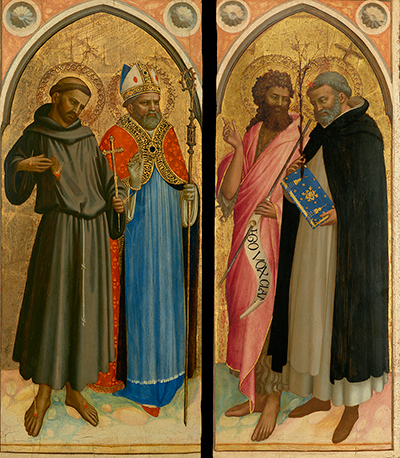
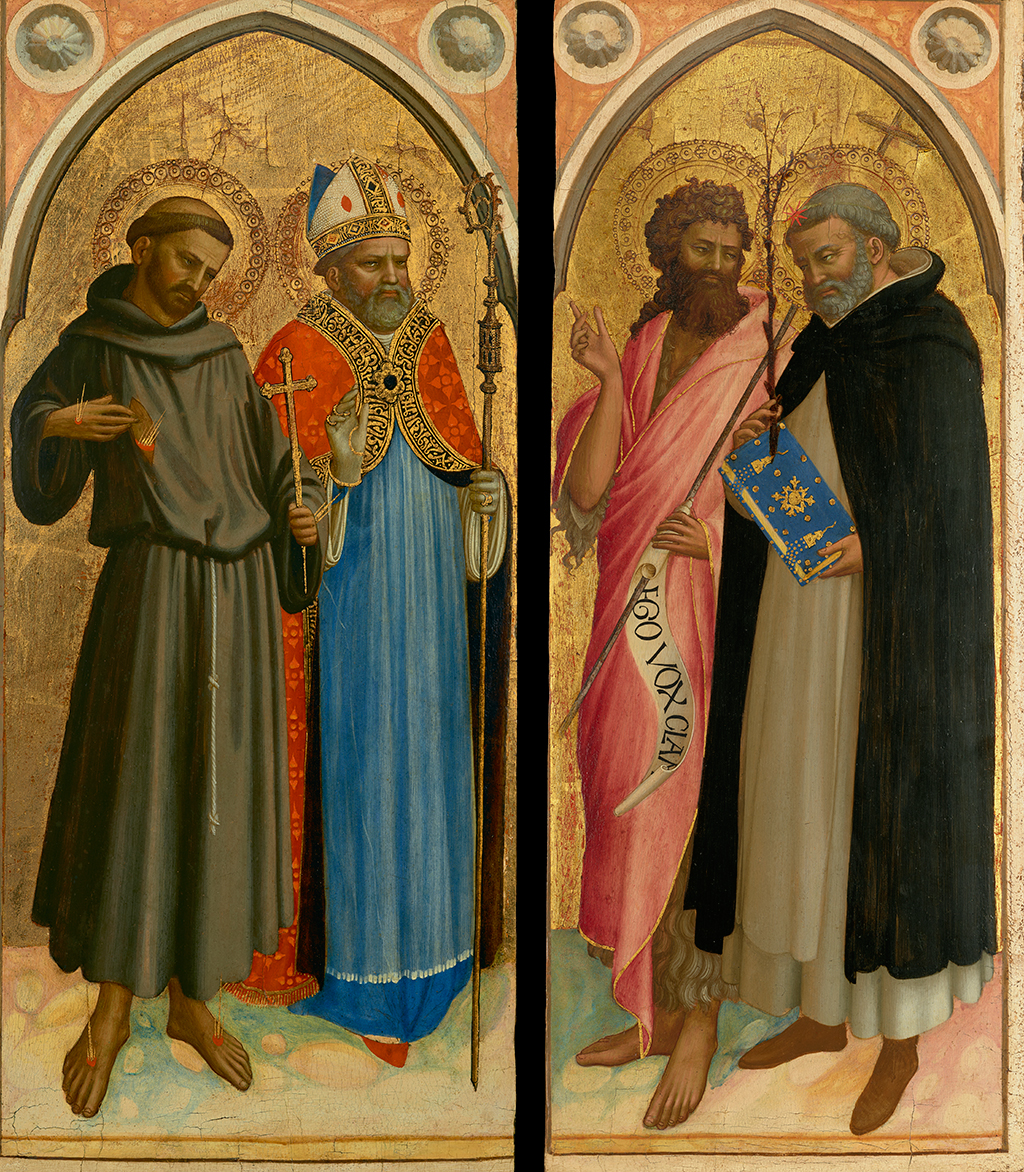
Francis pulls back his habit to show the wound in his side. Across the gap, John the Baptist lifts two fingers as the scroll on his reed cross curls towards his feet. Fra Angelico painted these figures and their companions on two folding wings for a portable altarpiece used in private devotion. The J. Paul Getty Museum dates the panels to the late 1420s. Their painted backs helped establish that two fragments of an Annunciation in New Haven once stood above them. [1] [2]
At a Glance
- ArtistFra Angelico (Guido di Pietro). [1]
- DateLate 1420s in the Getty collection record. [1]
- MediumTempera and gold leaf on panel. [1]
- DimensionsLeft panel 52.7 × 23.2 cm and right panel 52.7 × 21 cm, as recorded in the Metropolitan Museum’s 2005 exhibition catalogue. Yale’s later catalogue gives the right panel’s height as 53.7 cm. [3] [2]
- CollectionJ. Paul Getty Museum, Los Angeles, 92.PB.111. [1]
Francis and the bishop saint
Francis stands at the left of the left panel, barefoot, with his head lowered and one hand drawing the cloth aside. Fine strokes mark wounds on his hand, his feet and the exposed skin at his ribs. These are the stigmata, the marks of Christ’s Crucifixion borne by Francis. The narrow cord against the dark habit carries three knots, which the Getty interprets as signs of the Franciscan vows of poverty, chastity and obedience. The small cross Francis holds rises straight out of his closed fist, about level with the bishop’s raised hand. A few details at the scale of a fingernail distinguish the friar as clearly as the broad folds of his habit. [1]
The bishop’s red cope opens over a long blue garment. Bands of gold ornament follow the curved edges of the cope to a dark clasp, and the pattern reappears on his mitre. His crozier runs down the inner edge of the wing. Its elaborate head sits beside the painted arch, and its narrow shaft descends almost to his red shoe. A gloved hand rises in blessing. These signs identify his office, and the halo identifies him as a saint. His name remains uncertain. The richness of his dress makes the difference in rank and vocation immediately visible, even as he and Francis stand shoulder to shoulder on the same patch of ground. [1] [3]
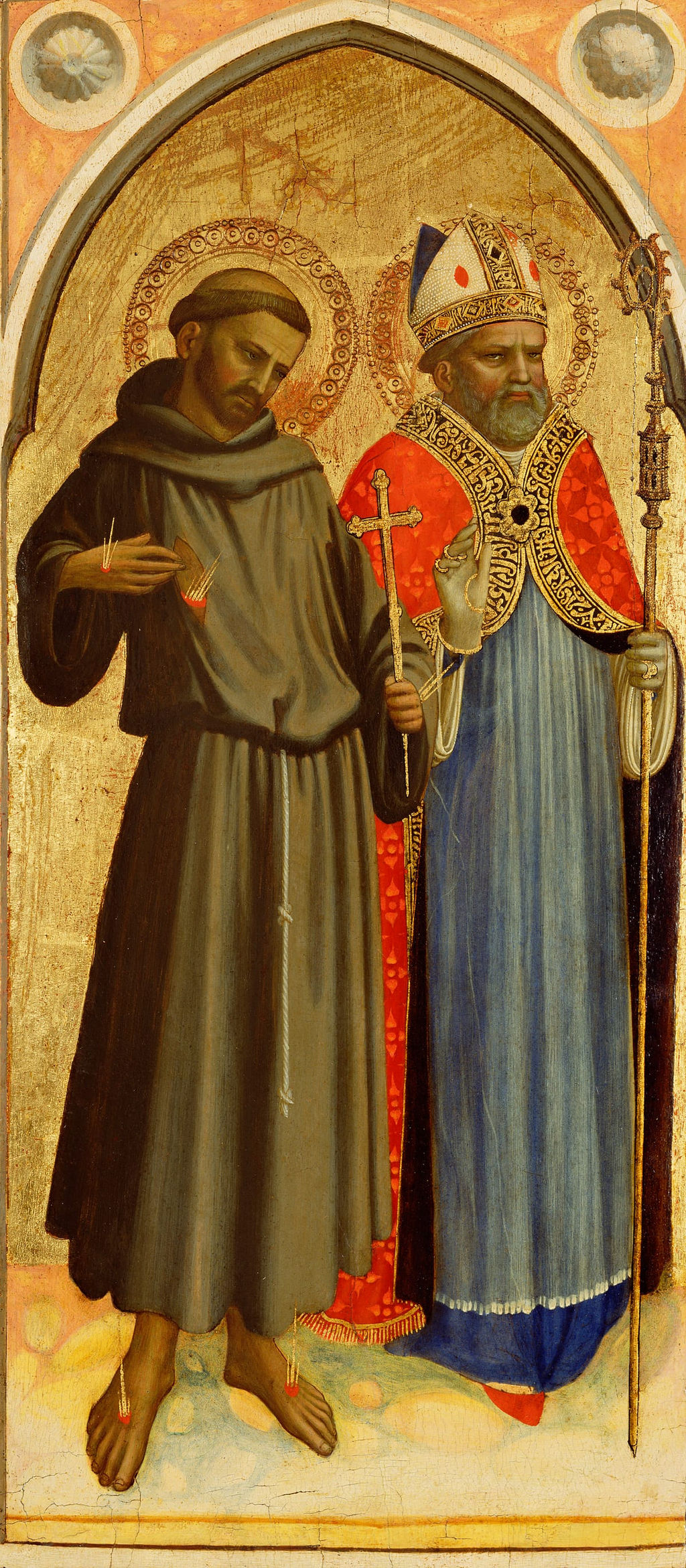
St Francis and a Bishop Saint, Getty Museum 92.PB.111.1. Image source. Public domain. Proportional web resize.
John the Baptist and Dominic
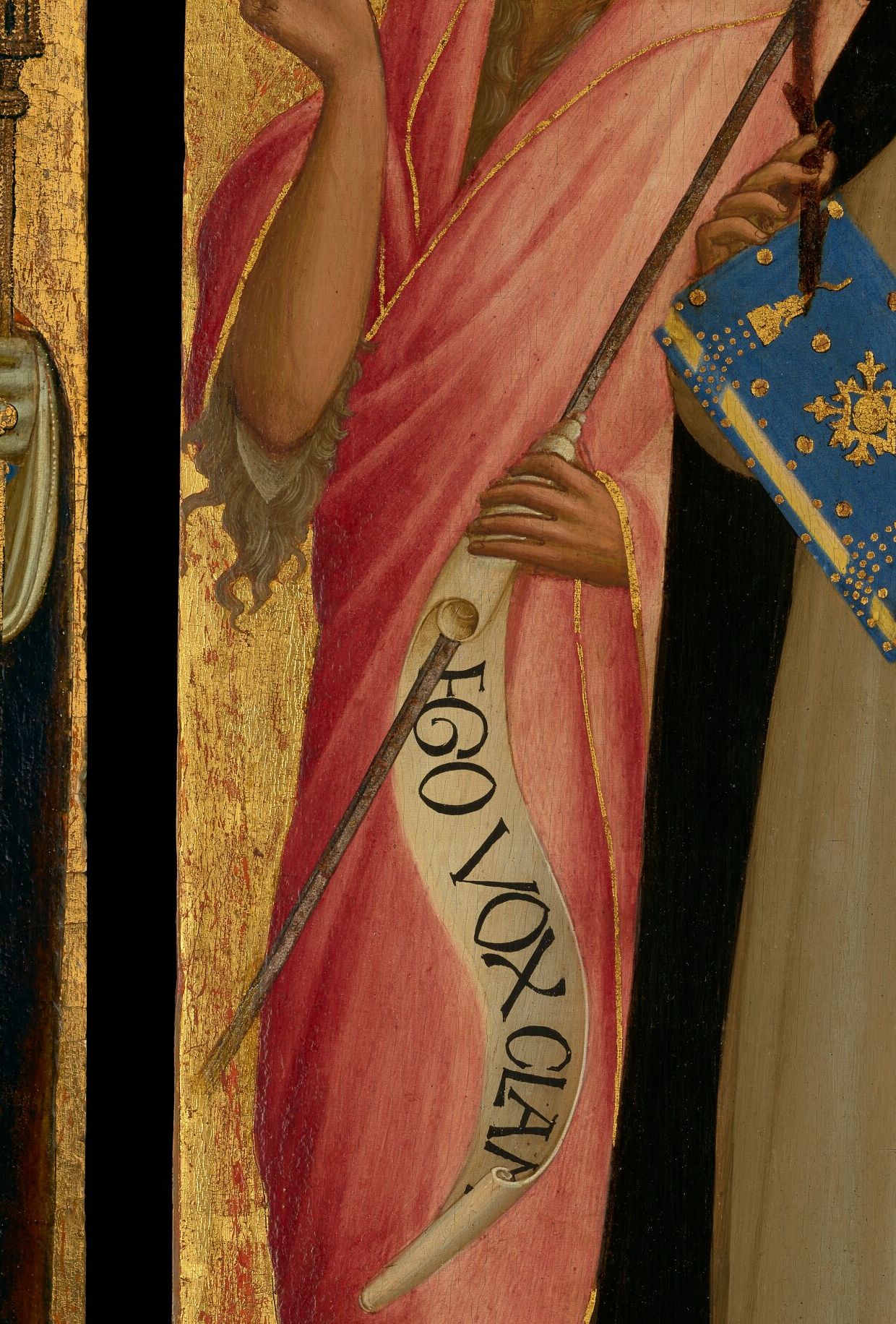
John’s rose-coloured mantle leaves a strip of animal skin visible at his chest and a shaggy edge near his ankles. His reed cross cuts diagonally across the panel, carrying a scroll that opens over the mantle. The first words identify John as the voice crying out, an allusion to his testimony in the Gospel of John. His pointing hand is close to the panel’s inner edge, where the eye can follow it back towards the space the two wings once framed. His bare feet spread across the painted ground, with one projecting towards its lower border. [1] [3]
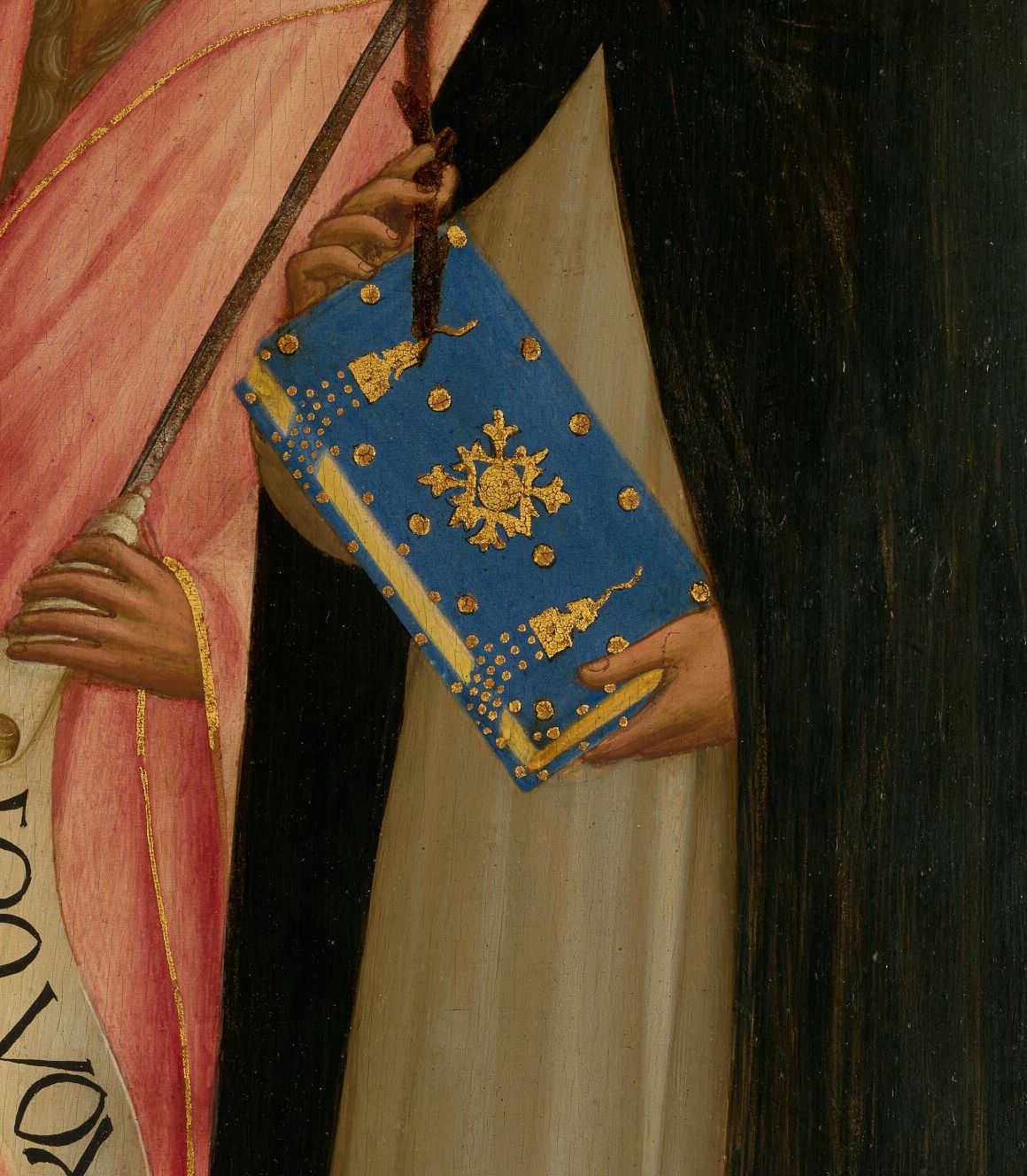
Dominic’s light tunic appears between the falls of his black cloak. He holds a lily, a sign of chastity, and a Gospel book. The book is closed, and its blue cover tilts towards the viewer, showing gold fittings and a central ornament. The stems rise through the narrow interval between the two faces. John’s scroll and Dominic’s book give the figures different ways of presenting words: the scroll lets the viewer catch part of a declaration, while the book’s cover marks the volume as an object worth attending to. [1]
Each pair stands under a single painted arch, with small rosettes set into the corners above it. The halos nearly touch within each arch, and the bodies overlap. Soft shading gives shape to the bishop’s cheek and weight to the cloth around Francis’s bent arm. There is less certainty in the way the feet meet the mottled floor, especially at the bottom of the Baptist’s panel, where the nearest foot drops steeply towards the edge. Laurence Kanter drew attention to this unevenness in the rendering of space alongside the close observation of fabrics. The narrow panels make both qualities easy to see. [1] [3]
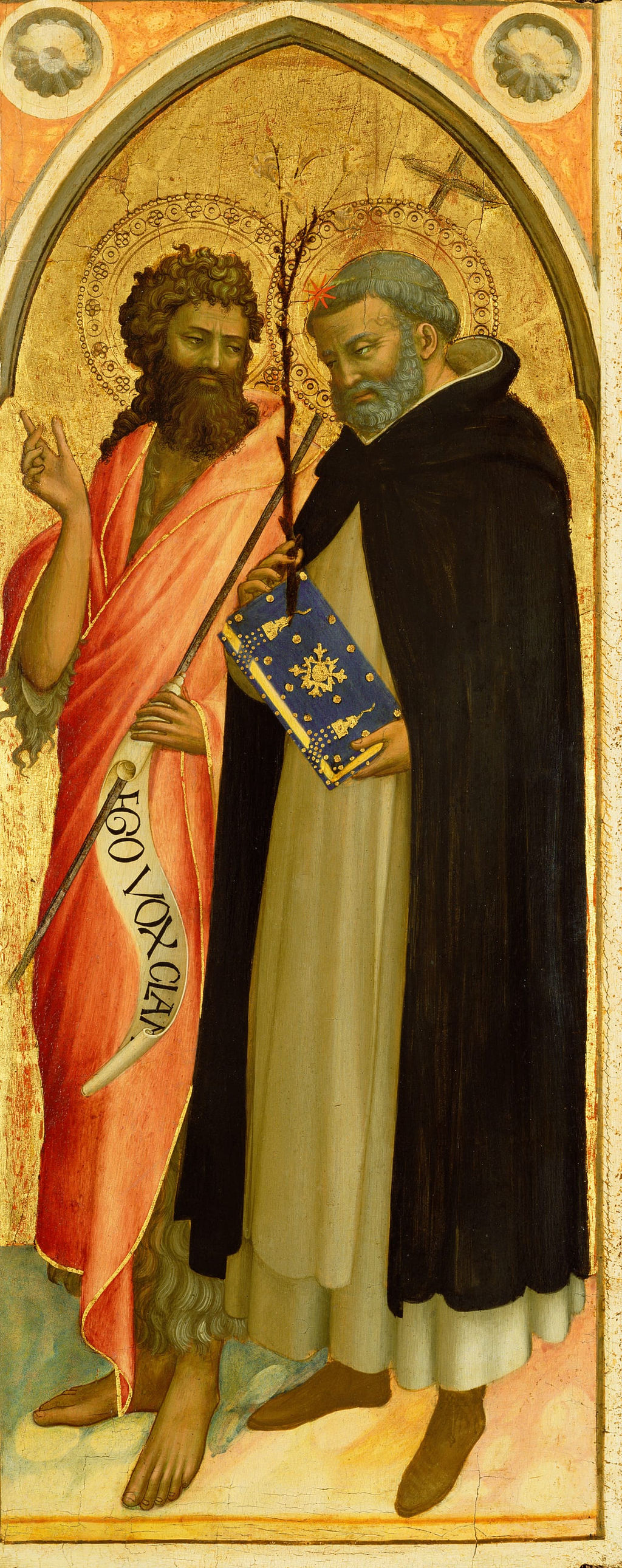
St John the Baptist and St Dominic, Getty Museum 92.PB.111.2. Image source. Public domain. Proportional web resize.
Annotated Details from The Getty altarpiece wings
The numbered points identify visible features discussed in this article. Return from each detail to the numbered overview. Both surviving Getty wings, 92.PB.111.1 and 92.PB.111.2. This view presents the two panels together so their scale, framing and attributes can be compared. Digital image courtesy of the Getty Open Content Program. Image source. CC0 / Public domain. Proportional web resize.
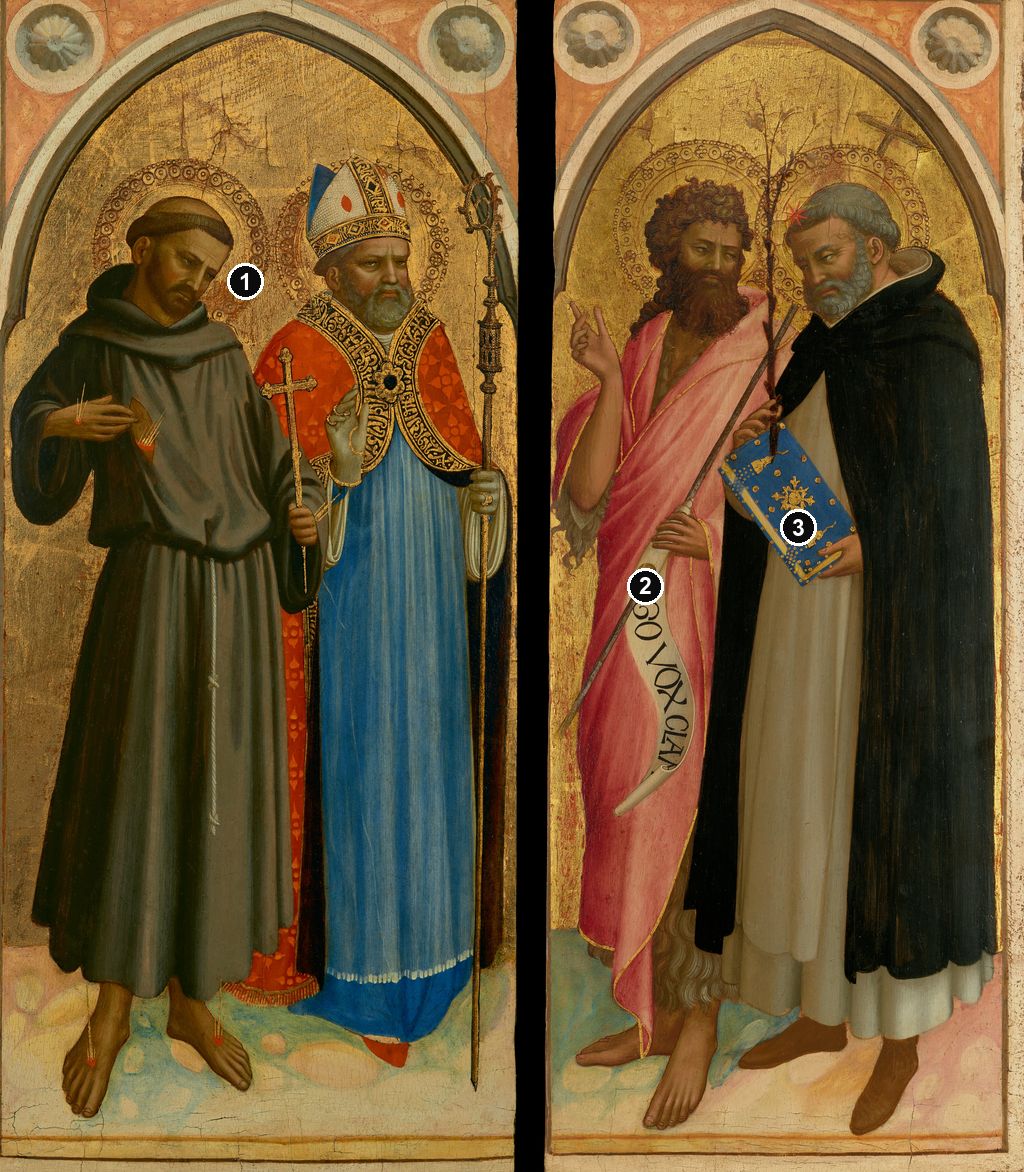
Details from THE GETTY ALTARPIECE WINGS
Compare the cropped details with the source images above. Notice how their colours, shapes and positions contribute to the larger compositions.
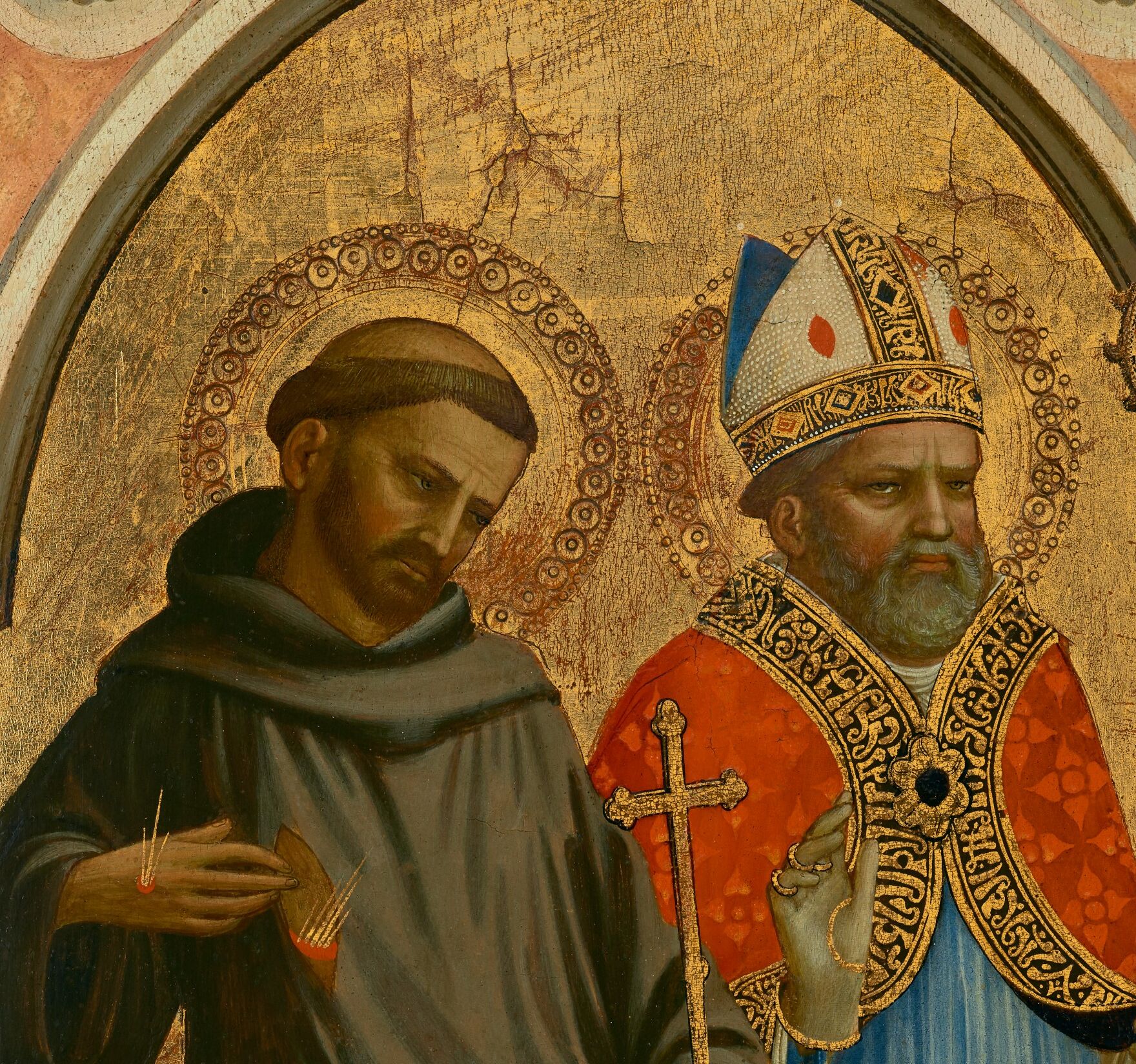
Francis and the bishop
The outline of Francis’s plain hood and the bishop’s bright mitre distinguish the two companions. The gold pattern continues behind both of them.
A cross and a scroll
John the Baptist holds a slender cross and a scroll. Follow the line of the scroll down the red fabric.
Dominic’s book
Dominic’s blue and gold book stands out against his dark cloak. The bright cover and the pale edges of the pages identify the object before you come close.
How the wings were put back together
The pointed arches over the saints look like the tops of the compositions today. The boards once extended higher. Kanter identified the upper pieces in Yale University Art Gallery’s Annunciation, which had entered the collection as a single rectangular scene. The rectangular arrangement was itself a reconstruction made after the pieces had been cut down. It had even been exhibited in 1955 as the work of Filippo Lippi. A wedge of gilded wood belongs with Gabriel, who stood above Francis and the bishop. The Virgin occupied the corresponding position over John and Dominic. The four figures at the Getty would have been seen below an exchange that crossed the open altarpiece. [2] [3]
The strongest evidence for the reconstruction is on the backs and inside the boards. The reverses carry paint imitating porphyry, a decorative stone, with white margins that continue from the lower panels onto the upper ones. The supports have the same thickness, and X-radiographs show continuous vertical wood grain across each proposed join. That evidence settles a difficulty visible from the front. The lower figures are lit from the right, while the Annunciation above them is lit from the left. [2] [3] [4]
The hinges left V-shaped channels where their wire ends were spread and pressed flat against the backs. The lower marks come within a centimetre of the surviving bottoms, close enough to suggest that a strip of wood was trimmed from each wing. Kanter has proposed that the lost strips might have carried the saints’ names. In his more recent reconstruction he estimates a closed width of about 46 centimetres and a full height of about 80 centimetres or slightly more. [4] [2]
The Getty bought the saints in 1992 from the Stevens Trust through Thomas Agnew & Sons in London. The panels were brought together with the Yale fragments for Rediscovering Fra Angelico, which opened in New Haven in 2001. The Metropolitan Museum published the reconstructed wings in 2005. In their open position, the saints would have faced the worshipper. Closing the wings would have concealed the figures and exposed the painted stone pattern. The reverses that helped settle the modern reconstruction were part of the object’s appearance in use. [1] [2] [3] [4]
The centre remains unidentified. In 2001 Kanter considered a Madonna of Humility in Washington because its width roughly matches the span of the closed wings. Its condition makes the comparison difficult, and the physical evidence needed to join it to the wings is missing. In his more recent Yale catalogue entry, Kanter considers the Städel Museum’s Madonna and Child Enthroned and Twelve Angels. That panel now measures 37.5 × 29.7 centimetres. Its horizontal grain suggests a board originally wider than it was tall. The proposal depends on how much wood was lost and on a frame substantial enough to account for the difference between the width of the painted image and the span of the wings. Kanter suggests that such a frame could have held relics. [4] [2] [5]
When were the panels painted?
The Getty originally published a date of about 1430–33, citing similarities to the standing saints on the outer wings of Angelico’s Tabernacle of the Linaioli, commissioned in 1433. The museum now dates the pair to the late 1420s. Kanter argues for about 1421–22, relating the figures to the predella of the high altarpiece at San Domenico in Fiesole. In a section of that predella, Christ Glorified in the Court of Heaven, Angelico uses overlap and slight turns of the head to pick out individual figures in a tightly packed gathering. The physical match with Yale establishes where the fragments fitted, while the date still depends on how the related works are ordered. [6] [1] [2] [3]
The Fondazione Federico Zeri’s photographic archive preserves a further distinction. It catalogues both wings under Angelico’s workshop, reflecting Zeri’s classification, and records the direct attribution to Angelico in the bibliography. The Getty and the Metropolitan Museum catalogue give the wings to Angelico, an attribution that Kanter traces to the scholar Miklós Boskovits. [7] [1] [3]
What the gold reveals
In 2019 Douglas MacLennan and colleagues scanned the gilding of both wings using macro X-ray fluorescence. The instrument records the signal from gold across the surface. Where two sheets overlap, the thicker band of metal gives a stronger signal, allowing the researchers to trace seams, including where paint covers the leaf. Figure 3 of their study pairs a photograph of the Baptist and Dominic wing with its gold map. The map makes it possible to distinguish individual sheets within a field that registers to the eye as a continuous background. [8]
In the corrected table, five measurable leaves from each wing give a mean leaf length of about 6.9 centimetres. The Baptist and Dominic panel has mean overlaps of about 3 millimetres in both directions. The Francis and bishop panel averages about 3 millimetres horizontally and 2 vertically. Masaccio’s Saint Andrew, measured in the same study, uses leaf of much the same size, about 6.8 centimetres, with wider average overlaps of about 5 and 4 millimetres. The researchers relate the sheet sizes to the dimensions prescribed by a Florentine guild statute of 1403. The seams show how each set of sheets was laid, but the sample sizes are small and similar overlaps occur in works by different artists. A gold map can inform a comparison of gilding practice. It cannot settle the date, identify the gilder or supply the altarpiece’s centre on its own. [8] [9]
Fra Angelico artworks directory
Explore documented works and surviving parts of larger ensembles. Catalogue links identify individual records. Attribution and dating can vary across collections and publications. Search the Federico Zeri Photo Archive by artist.
| Name | Date | Medium and sources |
|---|---|---|
| Adoration of the Magi | About 1440–60, NGA catalogue | Painting Catalogue. |
| Adoration of the Magi (Armadio degli Argenti) | About 1450–53 | Tempera and gold on wood. Catalogue. |
| Agony in the Garden (Armadio degli Argenti) | About 1450–53 | Tempera and gilding on wood Catalogue. |
| Annalena Altarpiece / Pala di Annalena | commonly c. 1435 | Tempera on panel Catalogue. |
| Annunciation (Armadio degli Argenti) | About 1450–53 | Tempera and gilding on wood. Catalogue. |
| Annunciation (Cortona) | generally placed in the 1430s; exact dating remains debated | Tempera on panel Catalogue. |
| Annunciation (Prado) | 1425–26 | Tempera on poplar panel Catalogue. |
| Annunciation (San Marco upper corridor) | commonly c. 1442 | Fresco Catalogue. |
| Annunciation with Saint Peter Martyr | About 1439–43 | Fresco on plaster. Catalogue. |
| Annunciatory Angel | 1450–55, Detroit catalogue | Gold leaf and tempera on wood panel. Catalogue. |
| Armadio degli Argenti (Silver Treasury) | principally c. 1450–52 | Tempera on panel Catalogue. |
| Arrest of Christ (Armadio degli Argenti) | About 1450–53 | Tempera and gilding on wood Catalogue. |
| Ascension (Armadio degli Argenti) | About 1450–53 | Tempera and gilding on wood Catalogue. |
| Baptism of Christ (Armadio, Alesso Baldovinetti) | About 1452–53 | Tempera and gilding on wood Catalogue. |
| Beheading of Saints Cosmas and Damian (San Marco Altarpiece) | About 1438–42 | Painted panel Catalogue. |
| Betrayal of Christ (Armadio degli Argenti) | About 1450–53 | Tempera and gilding on wood Catalogue. |
| Blessed Dominican, Possibly Jordan of Saxony (San Marco Altarpiece) | About 1438–42 | Painted panel Catalogue. |
| Blessed Vincent Ferrer (San Marco Altarpiece) | About 1438–42 | Painted panel Catalogue. |
| Burial of Saints Cosmas and Damian (San Marco Altarpiece) | About 1438–42 | Painted panel Catalogue. |
| Bust of a Cleric and a Group of Figures (recto and verso) | 15th century | Pen and ink on paper Catalogue. |
| Christ among the Doctors (Armadio degli Argenti) | About 1450–53 | Tempera and gilding on wood Catalogue. |
| Christ before Caiaphas (Armadio degli Argenti) | About 1450–53 | Tempera and gilding on wood Catalogue. |
| Christ Glorified in the Court of Heaven | About 1423–24 | Egg tempera on wood, probably poplar, with gold and silver leaf Catalogue. |
| Christ Seated in Judgment | 1447 | Fresco and gilding on plaster. Catalogue. |
| Christ Stripped of His Garments (Armadio degli Argenti) | About 1450–53 | Tempera and gilding on wood Catalogue. |
| Christ Washes the Apostles’ Feet (Armadio degli Argenti) | About 1450–53 | Tempera and gilding on wood Catalogue. |
| Circumcision of Christ (Armadio degli Argenti) | About 1450–53 | Tempera and gilding on wood. Catalogue. |
| Communion of the Apostles (Armadio degli Argenti) | About 1450–53 | Tempera and gilding on wood Catalogue. |
| Coronation of the Virgin (Armadio degli Argenti) | About 1450–53 | Tempera and gilding on wood Catalogue. |
| Coronation of the Virgin (Louvre) | Louvre: second quarter of the fifteenth century, 1425–50; often dated more narrowly c. 1434–35 | Tempera and gold on panel Catalogue. |
| Coronation of the Virgin (Uffizi) | 1431–35 | Tempera on wood, gold ground Catalogue. |
| Cortona Triptych | About 1437 | Tempera and gold on panel. Catalogue. |
| Crucifixion (Armadio degli Argenti) | About 1450–53 | Tempera and gilding on wood Catalogue. |
| Crucifixion and Saints | 1441–42 | Fresco Catalogue. |
| Deposition from the Cross / Santa Trinita Deposition | commissioned 1429–32; completed by Angelico within this period | Tempera on panel Catalogue. |
| Descent into Limbo (Armadio degli Argenti) | About 1450–53 | Tempera and gilding on wood Catalogue. |
| Entombment of Christ (San Marco Altarpiece) | About 1438–42 | Painted panel Catalogue. |
| Entry into Jerusalem (Armadio degli Argenti) | About 1450–53 | Tempera and gilding on wood Catalogue. |
| Expulsion and the Stoning of Saint Stephen | 1448–49, Vatican Museums | Fresco. Catalogue. |
| Fiesole San Domenico Altarpiece | early 1420s; predella about 1423–24 | Tempera on panel Catalogue. |
| Flagellation (Armadio degli Argenti) | About 1450–53 | Tempera and gilding on wood Catalogue. |
| Flight into Egypt | About 1450–53 | Tempera and gilding on wood. Catalogue. |
| Guidalotti Polyptych | c. 1447–49 | Tempera and oil on panel Catalogue. |
| Healing of Palladia and Saint Damian Accepting Her Gift (San Marco Altarpiece) | About 1438–42 | Painted panel Catalogue. |
| Holy Pilgrim, Possibly Saint Roch (San Marco Altarpiece) | About 1438–42 | Painted panel Catalogue. |
| Holy Women at the Tomb (Armadio degli Argenti) | About 1450–53 | Tempera and gilding on wood Catalogue. |
| Judas Receives Payment (Armadio degli Argenti) | About 1450–53 | Tempera and gilding on wood Catalogue. |
| Lamentation over Christ (Armadio degli Argenti) | About 1450–53 | Tempera and gilding on wood Catalogue. |
| Lamentation over the Dead Christ (Croce al Tempio Lamentation) | 1436–41, Zeri catalogue | Tempera and gilding on wood panel. Catalogue. |
| Last Judgement (Armadio degli Argenti) | About 1450–53 | Tempera and gilding on wood Catalogue. |
| Last Judgement (San Marco) | c. 1425–28 | Tempera and gold on panel Catalogue. |
| Last Supper (Armadio degli Argenti) | About 1450–53 | Tempera and gilding on wood Catalogue. |
| Lex Amoris (Armadio degli Argenti) | About 1450–53 | Tempera and gilding on wood Catalogue. |
| Madonna and Child with Saint Dominic and Saint Thomas Aquinas | About 1430, Hermitage catalogue | Detached fresco. Catalogue. |
| Madonna and Child with Saints | About 1411–13 | Tempera on wood panel, with a gold ground. Catalogue. |
| Madonna of Humility | About 1425, Thyssen catalogue | Tempera and gold on wood. Catalogue. |
| Madonna of the Star | 1431–34, Zeri catalogue | Tempera with oil glazes and gold on wood panel, as catalogued by the Gardner for the 2018 exhibition. Catalogue. |
| Marriage at Cana (Armadio, Alesso Baldovinetti) | About 1452–53 | Tempera and gilding on wood Catalogue. |
| Massacre of the Innocents (Armadio degli Argenti) | About 1450–53 | Tempera and gilding on wood Catalogue. |
| Miracle of the Black Leg (San Marco Altarpiece) | About 1438–42 | Painted panel Catalogue. |
| Mocking of Christ (Armadio degli Argenti) | About 1450–53 | Tempera and gilding on wood Catalogue. |
| Mystic Wheel (The Vision of Ezekiel) | About 1450–52 | Tempera and gilding on wood. Catalogue. |
| Nativity (Armadio degli Argenti) | About 1450–53 | Tempera and gilding on wood. Catalogue. |
| Niccoline Chapel frescoes | principally 1448–50 | Fresco Catalogue. |
| Noli me Tangere | broadly within Angelico’s San Marco campaign, late 1430s–1440s | Fresco Catalogue. |
| Ordination of Saint Lawrence | 1448 | Fresco. Catalogue. |
| Pentecost (Armadio degli Argenti) | About 1450–53 | Tempera and gilding on wood Catalogue. |
| Presentation of Christ at the Temple (Armadio degli Argenti) | About 1450–53 | Tempera and gilding on wood. Catalogue. |
| Presentation of Jesus at the Temple | Early 1440s | Fresco on plaster. Catalogue. |
| Raising of Lazarus (Armadio degli Argenti) | About 1450–53 | Tempera and gilding on wood Catalogue. |
| Rescue of Saints Cosmas and Damian and Exorcism of Lysias (San Marco Altarpiece) | About 1438–42 | Painted panel Catalogue. |
| Road to Calvary (Armadio degli Argenti) | About 1450–53 | Tempera and gilding on wood Catalogue. |
| Saint Anthony Abbot (San Marco Altarpiece) | About 1438–42 | Painted panel Catalogue. |
| Saint Bernard of Clairvaux or Saint Benedict (San Marco Altarpiece) | About 1438–42 | Painted panel Catalogue. |
| Saint Damian Receives Money from Palladia | About 1425–49 | Tempera and gilding on wood. Catalogue. |
| Saint Francis and a Bishop Saint, Saint John the Baptist and Saint Dominic | Late 1420s, Getty catalogue | Tempera and gold leaf on panel. Catalogue. |
| Saint James the Greater Freeing the Magician Hermogenes | About 1426–29 | Tempera and gold on panel Catalogue. |
| Saint Jerome (San Marco Altarpiece) | About 1438–42 | Painted panel Catalogue. |
| Saint Lawrence Giving Alms | About 1448 | Wall fresco. Catalogue. |
| Saint Lawrence Receiving the Treasures of the Church from Pope Sixtus II | About 1448–49 | Fresco on plaster. Catalogue. |
| Saint Romuald (San Marco Altarpiece) | About 1438–42 | Painted panel Catalogue. |
| Saint Stephen Addressing the Council | 1448–49, Vatican Museums | Fresco. Catalogue. |
| Saint Stephen Preaching | 1448–49, Vatican Museums | Wall fresco. Catalogue. |
| Saint Thomas Aquinas (San Marco Altarpiece) | About 1438–42 | Painted panel Catalogue. |
| Saints Cosmas and Damian and Their Brothers Survive the Stake | Second quarter of the 15th century | Tempera and gilding on wood. Catalogue. |
| Saints Cosmas and Damian at the Stake (San Marco Altarpiece) | About 1438–42 | Painted panel Catalogue. |
| Saints Cosmas and Damian before Lysias (San Marco Altarpiece) | About 1438–42 | Painted panel Catalogue. |
| Saints Cosmas and Damian Rescued by an Angel | Second quarter of the 15th century | Tempera and gilding on wood. Catalogue. |
| Saints Cosmas and Damian with Their Brothers before Proconsul Lysias | Second quarter of the 15th century | Tempera and gilding on wood. Catalogue. |
| San Marco Altarpiece / Pala di San Marco | 1438–43 | Tempera on panel Catalogue. |
| San Pietro Martire Triptych | About 1422–23, Strozzi exhibition | Tempera and gold on panel. Catalogue. |
| Scenes from the Lives of the Desert Fathers (Thebaid) | About 1420, Uffizi catalogue | Tempera on wood. Catalogue. |
| Sixteen Prophets | 1447 | Fresco and gilding on plaster Catalogue. |
| Stoning and Shooting of the Brothers (San Marco Altarpiece) | About 1438–42 | Painted panel Catalogue. |
| Tabernacle of the Linaioli | 1433–35 | Tempera on panel Catalogue. |
| The Attempted Crucifixion and Stoning of Saints Cosmas and Damian | Second quarter of the 15th century | Tempera and gilding on wood. Catalogue. |
| The Crucifixion | About 1420–23, Met catalogue | Tempera on wood, gold ground. Catalogue. |
| The Death and the Assumption of the Virgin | 1424–34 | Tempera with oil glazes and gold on panel Catalogue. |
| The Dominican Blessed (left end) (Fiesole predella) | About 1423–24 | Egg tempera and gold on wood Catalogue. |
| The Dominican Blessed (right end) (Fiesole predella) | About 1423–24 | Egg tempera and gold on wood Catalogue. |
| The Entombment of Christ | About 1450 | Tempera on poplar panel. Catalogue. |
| The Forerunners of Christ with Saints and Martyrs | About 1423–24 | Egg tempera on wood (probably poplar), with gold and silver leaf. Catalogue. |
| The Funeral of Saint Anthony Abbot | About 1426–30 | Tempera on poplar panel. Catalogue. |
| The Martyrdom of Saints Cosmas and Damian | About 1425–49 | Tempera and gilding on wood. Catalogue. |
| The Mocking of Christ / Christ Mocked | within the San Marco dormitory campaign, broadly late 1430s–1440s | Fresco Catalogue. |
| The Nativity | About 1425, Minneapolis catalogue | Tempera on poplar panel. Catalogue. |
| The Nativity in Cell 5 at San Marco | About 1439–43 | Fresco on plaster. Catalogue. |
| The Penitent Saint Jerome | 1419–20 | Tempera on wood panel Catalogue. |
| The Virgin and Child by Fra Angelico (Fogg Museum) | About 1430, Harvard catalogue | Tempera originally on panel, subsequently transferred to Masonite. Catalogue. |
| The Virgin Mary with the Apostles and Other Saints (Fiesole predella) | About 1423–24 | Egg tempera and gold on wood Catalogue. |
| Transfiguration (Armadio, Alesso Baldovinetti) | About 1452–53 | Tempera and gilding on wood Catalogue. |
| Transfiguration (San Marco Cell 6) | within the San Marco dormitory campaign, broadly late 1430s–1440s | Fresco Catalogue. |
| Virgin Mary Annunciate | 1450–55, Detroit catalogue | Gold leaf and tempera on wood panel. Catalogue. |
| Virgin of the Pomegranate | About 1426 | Tempera on panel with gilding Catalogue. |
Frequently Asked Questions
Discussion
Use these prompts to look again or share an observation.
Reader Insights
Compare the folds and small attributes of the four standing saints. Which identify a subject beyond any inscription?
What could the wood grain and decorated backs tell you about the relationship between the two panels even with the original framework missing?
Join the Conversation
Share a detail or question about Saint Francis and a Bishop Saint, Saint John the Baptist and Saint Dominic.
References
- J. Paul Getty Museum, Saint Francis and a Bishop Saint, Saint John the Baptist and Saint Dominic, 92.PB.111, collection record. View source.
- Laurence Kanter, The Annunciation, in Italian Paintings at the Yale University Art Gallery, vol. 2, no. 84, especially figs. 3–6. View source.
- Laurence Kanter and Pia Palladino, Fra Angelico, Metropolitan Museum of Art, 2005, no. 16a–d, pp. 95–97 and fig. 57. View source.
- Clay Dean and Laurence Kanter, introduction and “An Annunciation by Fra Angelico”, in Rediscovering Fra Angelico: A Fragmentary History, Yale University Art Gallery, 2001, pp. 7–9, 17–39, pls. 1–3 and figs. 4–5, 14. View source.
- Städel Museum, Madonna and Child Enthroned and Twelve Angels, inv. 838, collection record. View source.
- J. Paul Getty Museum, “Acquisitions/1992”, The J. Paul Getty Museum Journal 21, 1993, p. 115, no. 20. View source.
- Fondazione Federico Zeri, photographic archive records for San Francesco d’Assisi e un santo vescovo and San Giovanni Battista e san Domenico. · Right wing. View source 1. View source 2.
- Douglas MacLennan et al., “Visualizing and measuring gold leaf in fourteenth- and fifteenth-century Italian gold ground paintings using scanning macro X-ray fluorescence spectroscopy”, Heritage Science 7, 25, 2019, especially figs. 1 and 3 and pp. 6–8. View source.
- Douglas MacLennan et al., published correction, Heritage Science 7, 65, 2019, Table 1. View source.
.jpg)
 Fra Angelico.jpg)