 by Tom Gurney
Tom Gurney BSc (Hons) is an art history expert with over 20 years experience
Published on June 19, 2020 / Updated on November 29, 2026
Email: tomgurney1@gmail.com / Phone: +44 7429 011000
Introduction
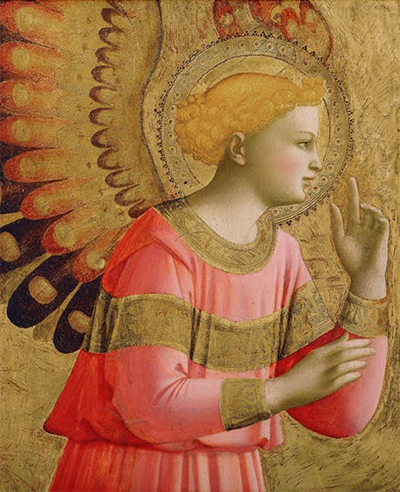
Gabriel raises a finger almost to the level of his lips. His wings spread behind him, but his attention is fixed beyond the right edge of the panel. There, in a separate painting, Mary lowers her head over a book. Fra Angelico’s Annunciatory Angel is the left-hand half of this encounter. The two panels are now in the Detroit Institute of Arts, which places them above the main tier of a dismantled altarpiece. Even on its own, Gabriel’s small gilt panel makes you look for the person he has come to address. [1] [2]
At a Glance
- ArtistFra Angelico. [1]
- Date1450–55 in the Detroit Institute of Arts catalogue. Laurence Kanter proposes about 1429–30. [1] [3]
- MediumGold leaf and tempera on wood panel. [1]
- Dimensions33 × 27 cm unframed (13 × 10⅝ in.), as recorded by the museum. [1]
- CollectionDetroit Institute of Arts, Bequest of Eleanor Clay Ford, 77.1.1. [1]
- CompanionVirgin Annunciate, Detroit Institute of Arts, 77.1.2. [2]
Gabriel’s wings and hands
The largest sweep in the painting belongs to the wing on the left. Its long feathers fan down behind Gabriel’s shoulder, with gold ovals standing out against the darkest tips. Higher up, a row of short, hooked markings follows the inside curve of the wing. Part of the far wing rises above the halo. Both shapes run into the panel’s edges. The raised finger, by comparison, has just enough gold around it to keep its outline clear. Follow the span of the feathers inwards and the smallest movement in the painting turns out to be the one that carries the greeting. [1] [3]
Gabriel’s other hand reaches across the rose-coloured sleeve, its fingertips coming to rest against the raised forearm. Shading under the cheek and along the neck gives the head volume, and the folds gathered at the elbow show where the arm bends. Look at the broad gold band across the chest and sleeves. It dips at the chest and bunches at the sleeves. Gold also picks out the collar and cuffs, while small circles and beaded lines mark the halo off from the surrounding field. Carl Brandon Strehlke identifies the ornament on the clothing as imitation Kufic lettering. At the cuff the letter-like forms bend around the wrist. The plain stretch of gold in front of Gabriel gives his face and hand room to register. [1] [3] [4]
A greeting across two panels
In Luke’s Gospel, Gabriel visits Mary in Nazareth and tells her that she will bear a son named Jesus. She asks how this can happen, and Gabriel speaks of the Holy Spirit before Mary gives her assent. Detroit reads the pair as the moment immediately after the announcement. Gabriel’s hand can still carry the emphasis of speech, while the Virgin Annunciate inclines her head and draws an arm inwards. The two gestures belong to different movements. One directs attention outward and the other gathers it back towards the figure. [1] [2] [5]
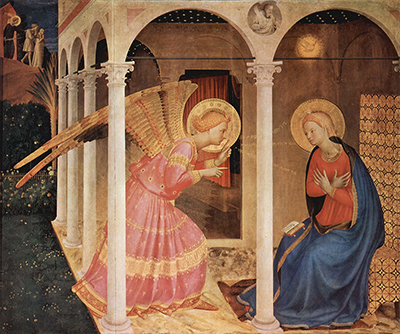
In the Prado Annunciation, the angel and Mary occupy a continuous painted portico. Its columns, floor and vault give the eye a route from one figure to the other. The Detroit panels leave the connection to the figures’ directions, their gestures and whatever stood between them. A viewer in front of an altarpiece would have looked across actual woodwork and other painted subjects to follow the exchange. Gabriel’s firm profile helps sustain it at a distance. Up close, the slight turn of his wrist becomes as legible as the raised finger. [1] [2] [3] [6]
Clues beneath the gold
The plain gold to the right of the face has a history of its own. In 1994, Kanter examined both panels and their X-radiographs. As Strehlke reports, the top right corner of Gabriel’s panel is an insert, about 7.4 × 6.1 cm. The X-ray shows an area of lead white to the right of the brow, beneath repaired gilding and cut off by the insert. Strehlke suggests it may be the trace of a corbel, a projecting architectural support. A painted arc detected in Mary’s panel gave him a further clue that the top of its original compartment may have had a lobed outline. [4]
The examination also found that the gilding was original, with patches and repairs. That finding matters because Paul Joannides had proposed that the gold was a later addition over a painted setting. The surviving traces suggest that small architectural elements may once have defined the space even as gold filled most of it. Gabriel may originally have been seen kneeling, with room for the full spread of his wings. In 1994, Strehlke left room for several kinds of structure, including the wings of a triptych or a piece of church furnishing. The two inserts and the traces under the gold give a clearer idea of what has been lost than of where the panels once stood. [4]
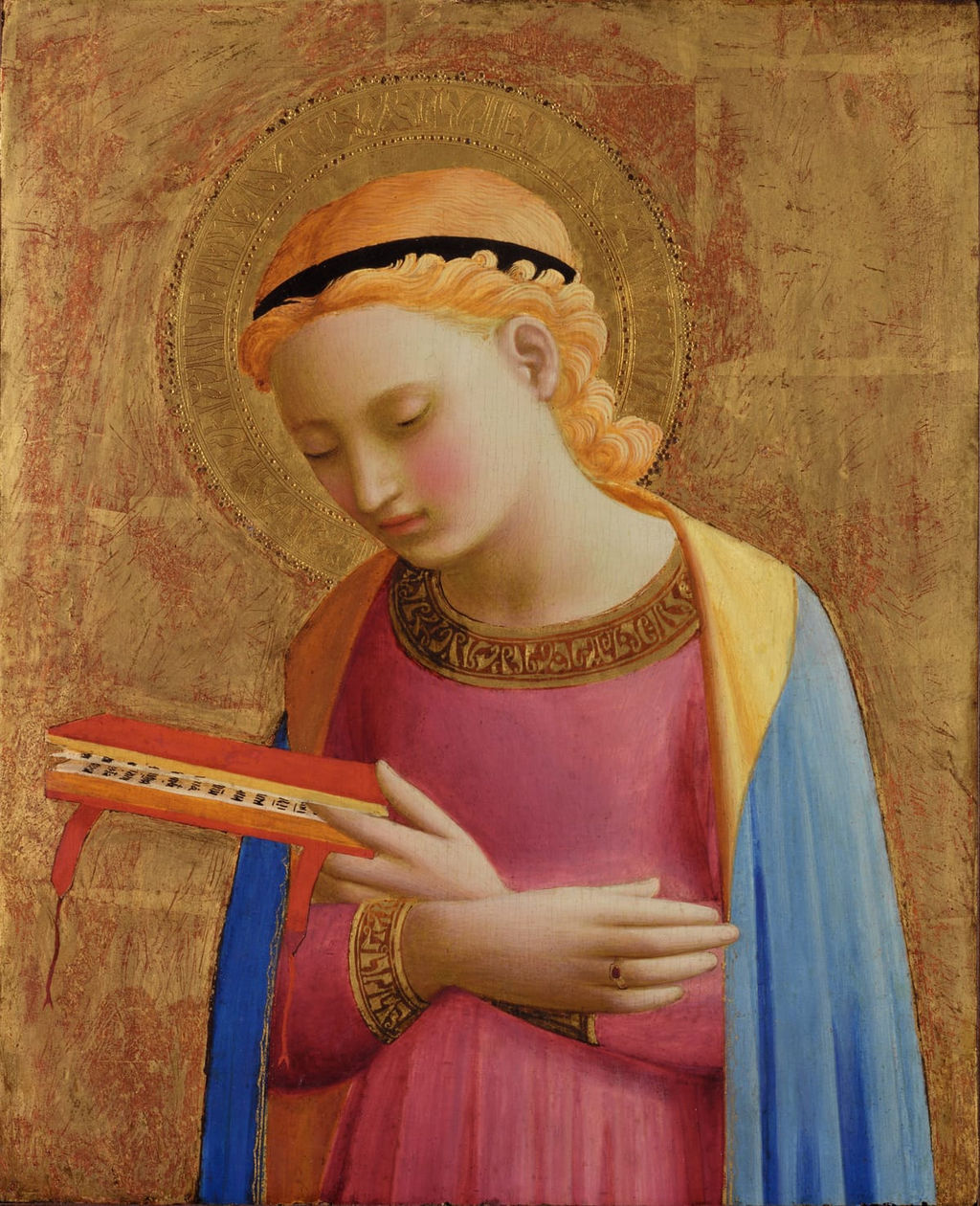
The Detroit Virgin Annunciate, 77.1.2. Her book and hands occupy the space just beneath her lowered head. Image source. Public domain. Proportional web resize.
Where the angel may have stood
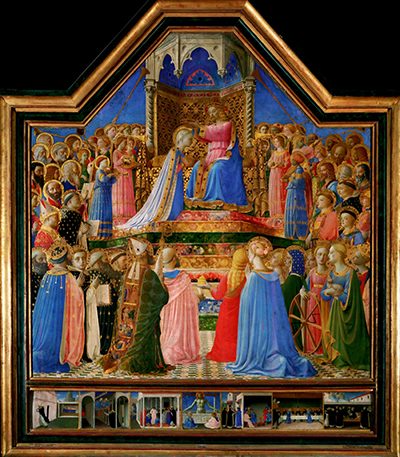
John Pope-Hennessy proposed that the panels were pinnacles, or raised compartments at the top of an altarpiece, and associated them with Angelico’s Coronation of the Virgin now in the Louvre. Laurence Kanter’s reconstruction in the 2005 Metropolitan Museum of Art catalogue puts Gabriel above the saints on the left and Mary in a corresponding position on the right. Between them he places the Royal Collection’s Christ Blessing, flanked by two adoring angels now in Turin. Farther down, a predella, or lower register of small narrative scenes, would have included Saint James Freeing the Magician Hermogenes and an episode from the life of Saint Lucy. The scale and style of the Detroit pair help make the case for placing them in this ensemble. [1] [3] [4]
A further physical clue for Kanter’s reconstruction comes from its proposed central pinnacle. X-radiographs of Christ Blessing showed its construction and traces left by mouldings removed from its upper edges. Those traces helped him infer the type of frame the picture once occupied. The Royal Collection also places the work at the top of an altarpiece. It catalogues the painting as workshop of Fra Angelico and dates it to about 1423. The X-rays concern the Royal Collection panel. The connection to Detroit rests on how the surviving pieces might fit together in size, style and subject. [3] [7]
Kanter tentatively placed the ensemble in the da Filicaia family’s chapel of Saint Lucy at Santa Croce in Florence. His reconstruction uses the Uffizi’s Pontassieve Madonna in the middle and leaves the main side panels blank. The Uffizi associates its painting with a 1435 commission for San Michele Arcangelo at Pontassieve, using a nineteenth-century transcription to fill out what survives of the inscription. In Kanter’s arrangement, looking from Gabriel to Mary would take the eye past the Christ Child below them. That gives a sense of how the Annunciation could have worked within a larger devotional image. The identity of the central painting and the original church for the Detroit panels remain open. [3] [8]
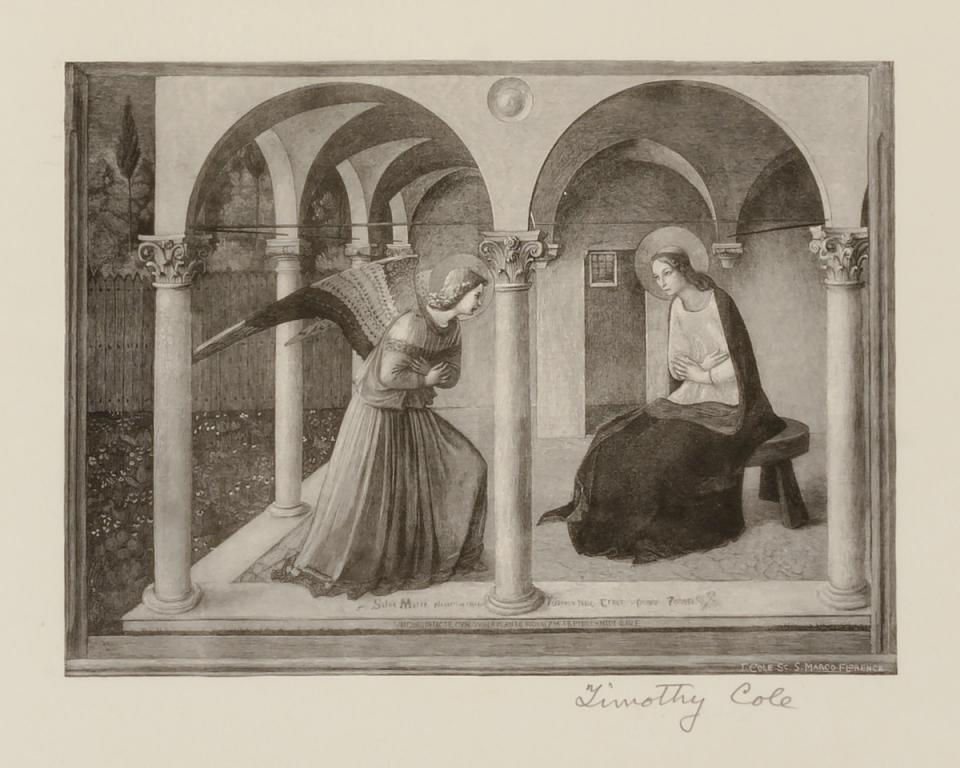
Timothy Cole’s wood engraving after the San Marco corridor Annunciation. Smithsonian American Art Museum 1974.39.24. Smithsonian American Art Museum. Image source. CC0 / Public domain. Proportional web resize.
Why the dates differ
Detroit dates Gabriel and Mary to 1450–55. Kanter arrived at about 1429–30 through his reconstruction and comparisons with other paintings. He placed the proposed ensemble after Angelico’s Saint Francis predella, whose figures he found less solidly modelled, and before slightly later works, in which the bodies tend to be more elongated. Strehlke, who also favoured an early date, put the pair in the early 1430s. He drew attention to the sculptural modelling of the figures and to a close parallel between Mary’s tooled halo and the halo in the Louvre Coronation. That resemblance can help place a painting in an artist’s career without placing it in the same altarpiece. [1] [2] [3] [4]
The face also has a counterpart on a much smaller scale. Anna Welch compared Gabriel’s tight curls and gentle profile with those of King David Playing a Psaltery, a drawing on vellum attributed to Angelico in the British Museum. Welch identifies the Detroit Gabriel by accession number and follows Kanter’s earlier chronology. In both heads the line from brow to nose and the finely drawn mouth give the profile its character. The resemblance shows how easily such details could work across vellum and panel, and offers one more comparison for the earlier dating. [3] [9]
From a Paris collection to Detroit
The Detroit records tentatively connect the pair with two Annunciation panels reportedly offered to Cardinal Desiderio Scaglia by the Dominican convent at Fiesole in 1621. Strehlke suggested that, if the identification holds, the pair might have belonged to sacristy furnishings. The church already had the large Annunciation now in the Prado. The gift provides a possible early owner, while the original commission remains uncertain. The two are securely identifiable in the collection of Dominique-Vivant Denon in Paris, where they appeared together as lot 41 at his sale in 1826. A lithograph after the angel appeared in Denon’s posthumous Monuments des arts du dessin in 1829, carrying Gabriel’s image beyond the collections that housed the panel. [1] [2] [4] [10]
The next step is less straightforward than the sale itself. Detroit traces the panels through William Beckford to Hamilton Palace. Marie-Anne Dupuy-Vachey, working from an annotated sale catalogue and the correspondence of the art agent Gregorio Franchi, argues that they went straight to the Duke of Hamilton, Beckford’s son-in-law. Franchi advised both men, which helps explain why the pictures figure in Beckford’s correspondence. The paintings reappeared as lot 356 in the Hamilton Palace sale in 1882. They subsequently passed through the Taylor collection in London, Galerie Sedelmeyer in Paris and Carl W. Hamilton’s collection in New York. Edsel Ford acquired the pair in 1925, and Eleanor Clay Ford’s bequest brought them to the museum in 1977. [1] [2] [10] [11]
Fra Angelico artworks directory
Explore documented works and surviving parts of larger ensembles. Catalogue links identify individual records. Attribution and dating can vary across collections and publications. Search the Federico Zeri Photo Archive by artist.
| Name | Date | Medium and sources |
|---|---|---|
| Adoration of the Magi | About 1440–60, NGA catalogue | Painting Catalogue. |
| Adoration of the Magi (Armadio degli Argenti) | About 1450–53 | Tempera and gold on wood. Catalogue. |
| Agony in the Garden (Armadio degli Argenti) | About 1450–53 | Tempera and gilding on wood Catalogue. |
| Annalena Altarpiece / Pala di Annalena | commonly c. 1435 | Tempera on panel Catalogue. |
| Annunciation (Armadio degli Argenti) | About 1450–53 | Tempera and gilding on wood. Catalogue. |
| Annunciation (Cortona) | generally placed in the 1430s; exact dating remains debated | Tempera on panel Catalogue. |
| Annunciation (Prado) | 1425–26 | Tempera on poplar panel Catalogue. |
| Annunciation (San Marco upper corridor) | commonly c. 1442 | Fresco Catalogue. |
| Annunciation with Saint Peter Martyr | About 1439–43 | Fresco on plaster. Catalogue. |
| Annunciatory Angel | 1450–55, Detroit catalogue | Gold leaf and tempera on wood panel. Catalogue. |
| Armadio degli Argenti (Silver Treasury) | principally c. 1450–52 | Tempera on panel Catalogue. |
| Arrest of Christ (Armadio degli Argenti) | About 1450–53 | Tempera and gilding on wood Catalogue. |
| Ascension (Armadio degli Argenti) | About 1450–53 | Tempera and gilding on wood Catalogue. |
| Baptism of Christ (Armadio, Alesso Baldovinetti) | About 1452–53 | Tempera and gilding on wood Catalogue. |
| Beheading of Saints Cosmas and Damian (San Marco Altarpiece) | About 1438–42 | Painted panel Catalogue. |
| Betrayal of Christ (Armadio degli Argenti) | About 1450–53 | Tempera and gilding on wood Catalogue. |
| Blessed Dominican, Possibly Jordan of Saxony (San Marco Altarpiece) | About 1438–42 | Painted panel Catalogue. |
| Blessed Vincent Ferrer (San Marco Altarpiece) | About 1438–42 | Painted panel Catalogue. |
| Burial of Saints Cosmas and Damian (San Marco Altarpiece) | About 1438–42 | Painted panel Catalogue. |
| Bust of a Cleric and a Group of Figures (recto and verso) | 15th century | Pen and ink on paper Catalogue. |
| Christ among the Doctors (Armadio degli Argenti) | About 1450–53 | Tempera and gilding on wood Catalogue. |
| Christ before Caiaphas (Armadio degli Argenti) | About 1450–53 | Tempera and gilding on wood Catalogue. |
| Christ Glorified in the Court of Heaven | About 1423–24 | Egg tempera on wood, probably poplar, with gold and silver leaf Catalogue. |
| Christ Seated in Judgment | 1447 | Fresco and gilding on plaster. Catalogue. |
| Christ Stripped of His Garments (Armadio degli Argenti) | About 1450–53 | Tempera and gilding on wood Catalogue. |
| Christ Washes the Apostles’ Feet (Armadio degli Argenti) | About 1450–53 | Tempera and gilding on wood Catalogue. |
| Circumcision of Christ (Armadio degli Argenti) | About 1450–53 | Tempera and gilding on wood. Catalogue. |
| Communion of the Apostles (Armadio degli Argenti) | About 1450–53 | Tempera and gilding on wood Catalogue. |
| Coronation of the Virgin (Armadio degli Argenti) | About 1450–53 | Tempera and gilding on wood Catalogue. |
| Coronation of the Virgin (Louvre) | Louvre: second quarter of the fifteenth century, 1425–50; often dated more narrowly c. 1434–35 | Tempera and gold on panel Catalogue. |
| Coronation of the Virgin (Uffizi) | 1431–35 | Tempera on wood, gold ground Catalogue. |
| Cortona Triptych | About 1437 | Tempera and gold on panel. Catalogue. |
| Crucifixion (Armadio degli Argenti) | About 1450–53 | Tempera and gilding on wood Catalogue. |
| Crucifixion and Saints | 1441–42 | Fresco Catalogue. |
| Deposition from the Cross / Santa Trinita Deposition | commissioned 1429–32; completed by Angelico within this period | Tempera on panel Catalogue. |
| Descent into Limbo (Armadio degli Argenti) | About 1450–53 | Tempera and gilding on wood Catalogue. |
| Entombment of Christ (San Marco Altarpiece) | About 1438–42 | Painted panel Catalogue. |
| Entry into Jerusalem (Armadio degli Argenti) | About 1450–53 | Tempera and gilding on wood Catalogue. |
| Expulsion and the Stoning of Saint Stephen | 1448–49, Vatican Museums | Fresco. Catalogue. |
| Fiesole San Domenico Altarpiece | early 1420s; predella about 1423–24 | Tempera on panel Catalogue. |
| Flagellation (Armadio degli Argenti) | About 1450–53 | Tempera and gilding on wood Catalogue. |
| Flight into Egypt | About 1450–53 | Tempera and gilding on wood. Catalogue. |
| Guidalotti Polyptych | c. 1447–49 | Tempera and oil on panel Catalogue. |
| Healing of Palladia and Saint Damian Accepting Her Gift (San Marco Altarpiece) | About 1438–42 | Painted panel Catalogue. |
| Holy Pilgrim, Possibly Saint Roch (San Marco Altarpiece) | About 1438–42 | Painted panel Catalogue. |
| Holy Women at the Tomb (Armadio degli Argenti) | About 1450–53 | Tempera and gilding on wood Catalogue. |
| Judas Receives Payment (Armadio degli Argenti) | About 1450–53 | Tempera and gilding on wood Catalogue. |
| Lamentation over Christ (Armadio degli Argenti) | About 1450–53 | Tempera and gilding on wood Catalogue. |
| Lamentation over the Dead Christ (Croce al Tempio Lamentation) | 1436–41, Zeri catalogue | Tempera and gilding on wood panel. Catalogue. |
| Last Judgement (Armadio degli Argenti) | About 1450–53 | Tempera and gilding on wood Catalogue. |
| Last Judgement (San Marco) | c. 1425–28 | Tempera and gold on panel Catalogue. |
| Last Supper (Armadio degli Argenti) | About 1450–53 | Tempera and gilding on wood Catalogue. |
| Lex Amoris (Armadio degli Argenti) | About 1450–53 | Tempera and gilding on wood Catalogue. |
| Madonna and Child with Saint Dominic and Saint Thomas Aquinas | About 1430, Hermitage catalogue | Detached fresco. Catalogue. |
| Madonna and Child with Saints | About 1411–13 | Tempera on wood panel, with a gold ground. Catalogue. |
| Madonna of Humility | About 1425, Thyssen catalogue | Tempera and gold on wood. Catalogue. |
| Madonna of the Star | 1431–34, Zeri catalogue | Tempera with oil glazes and gold on wood panel, as catalogued by the Gardner for the 2018 exhibition. Catalogue. |
| Marriage at Cana (Armadio, Alesso Baldovinetti) | About 1452–53 | Tempera and gilding on wood Catalogue. |
| Massacre of the Innocents (Armadio degli Argenti) | About 1450–53 | Tempera and gilding on wood Catalogue. |
| Miracle of the Black Leg (San Marco Altarpiece) | About 1438–42 | Painted panel Catalogue. |
| Mocking of Christ (Armadio degli Argenti) | About 1450–53 | Tempera and gilding on wood Catalogue. |
| Mystic Wheel (The Vision of Ezekiel) | About 1450–52 | Tempera and gilding on wood. Catalogue. |
| Nativity (Armadio degli Argenti) | About 1450–53 | Tempera and gilding on wood. Catalogue. |
| Niccoline Chapel frescoes | principally 1448–50 | Fresco Catalogue. |
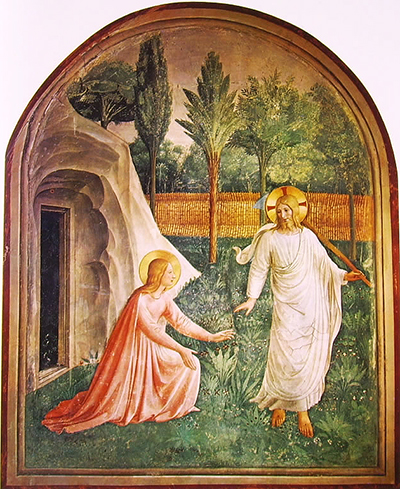
| Noli me Tangere | broadly within Angelico’s San Marco campaign, late 1430s–1440s | Fresco Catalogue. |
| Ordination of Saint Lawrence | 1448 | Fresco. Catalogue. |
| Pentecost (Armadio degli Argenti) | About 1450–53 | Tempera and gilding on wood Catalogue. |
| Presentation of Christ at the Temple (Armadio degli Argenti) | About 1450–53 | Tempera and gilding on wood. Catalogue. |
| Presentation of Jesus at the Temple | Early 1440s | Fresco on plaster. Catalogue. |
| Raising of Lazarus (Armadio degli Argenti) | About 1450–53 | Tempera and gilding on wood Catalogue. |
| Rescue of Saints Cosmas and Damian and Exorcism of Lysias (San Marco Altarpiece) | About 1438–42 | Painted panel Catalogue. |
| Road to Calvary (Armadio degli Argenti) | About 1450–53 | Tempera and gilding on wood Catalogue. |
| Saint Anthony Abbot (San Marco Altarpiece) | About 1438–42 | Painted panel Catalogue. |
| Saint Bernard of Clairvaux or Saint Benedict (San Marco Altarpiece) | About 1438–42 | Painted panel Catalogue. |
| Saint Damian Receives Money from Palladia | About 1425–49 | Tempera and gilding on wood. Catalogue. |
| Saint Francis and a Bishop Saint, Saint John the Baptist and Saint Dominic | Late 1420s, Getty catalogue | Tempera and gold leaf on panel. Catalogue. |
| Saint James the Greater Freeing the Magician Hermogenes | About 1426–29 | Tempera and gold on panel Catalogue. |
| Saint Jerome (San Marco Altarpiece) | About 1438–42 | Painted panel Catalogue. |
| Saint Lawrence Giving Alms | About 1448 | Wall fresco. Catalogue. |
| Saint Lawrence Receiving the Treasures of the Church from Pope Sixtus II | About 1448–49 | Fresco on plaster. Catalogue. |
| Saint Romuald (San Marco Altarpiece) | About 1438–42 | Painted panel Catalogue. |
| Saint Stephen Addressing the Council | 1448–49, Vatican Museums | Fresco. Catalogue. |
| Saint Stephen Preaching | 1448–49, Vatican Museums | Wall fresco. Catalogue. |
| Saint Thomas Aquinas (San Marco Altarpiece) | About 1438–42 | Painted panel Catalogue. |
| Saints Cosmas and Damian and Their Brothers Survive the Stake | Second quarter of the 15th century | Tempera and gilding on wood. Catalogue. |
| Saints Cosmas and Damian at the Stake (San Marco Altarpiece) | About 1438–42 | Painted panel Catalogue. |
| Saints Cosmas and Damian before Lysias (San Marco Altarpiece) | About 1438–42 | Painted panel Catalogue. |
| Saints Cosmas and Damian Rescued by an Angel | Second quarter of the 15th century | Tempera and gilding on wood. Catalogue. |
| Saints Cosmas and Damian with Their Brothers before Proconsul Lysias | Second quarter of the 15th century | Tempera and gilding on wood. Catalogue. |
| San Marco Altarpiece / Pala di San Marco | 1438–43 | Tempera on panel Catalogue. |
| San Pietro Martire Triptych | About 1422–23, Strozzi exhibition | Tempera and gold on panel. Catalogue. |
| Scenes from the Lives of the Desert Fathers (Thebaid) | About 1420, Uffizi catalogue | Tempera on wood. Catalogue. |
| Sixteen Prophets | 1447 | Fresco and gilding on plaster Catalogue. |
| Stoning and Shooting of the Brothers (San Marco Altarpiece) | About 1438–42 | Painted panel Catalogue. |
| Tabernacle of the Linaioli | 1433–35 | Tempera on panel Catalogue. |
| The Attempted Crucifixion and Stoning of Saints Cosmas and Damian | Second quarter of the 15th century | Tempera and gilding on wood. Catalogue. |
| The Crucifixion | About 1420–23, Met catalogue | Tempera on wood, gold ground. Catalogue. |
| The Death and the Assumption of the Virgin | 1424–34 | Tempera with oil glazes and gold on panel Catalogue. |
| The Dominican Blessed (left end) (Fiesole predella) | About 1423–24 | Egg tempera and gold on wood Catalogue. |
| The Dominican Blessed (right end) (Fiesole predella) | About 1423–24 | Egg tempera and gold on wood Catalogue. |
| The Entombment of Christ | About 1450 | Tempera on poplar panel. Catalogue. |
| The Forerunners of Christ with Saints and Martyrs | About 1423–24 | Egg tempera on wood (probably poplar), with gold and silver leaf. Catalogue. |
| The Funeral of Saint Anthony Abbot | About 1426–30 | Tempera on poplar panel. Catalogue. |
| The Martyrdom of Saints Cosmas and Damian | About 1425–49 | Tempera and gilding on wood. Catalogue. |
| The Mocking of Christ / Christ Mocked | within the San Marco dormitory campaign, broadly late 1430s–1440s | Fresco Catalogue. |
| The Nativity | About 1425, Minneapolis catalogue | Tempera on poplar panel. Catalogue. |
| The Nativity in Cell 5 at San Marco | About 1439–43 | Fresco on plaster. Catalogue. |
| The Penitent Saint Jerome | 1419–20 | Tempera on wood panel Catalogue. |
| The Virgin and Child by Fra Angelico (Fogg Museum) | About 1430, Harvard catalogue | Tempera originally on panel, subsequently transferred to Masonite. Catalogue. |
| The Virgin Mary with the Apostles and Other Saints (Fiesole predella) | About 1423–24 | Egg tempera and gold on wood Catalogue. |
| Transfiguration (Armadio, Alesso Baldovinetti) | About 1452–53 | Tempera and gilding on wood Catalogue. |
| Transfiguration (San Marco Cell 6) | within the San Marco dormitory campaign, broadly late 1430s–1440s | Fresco Catalogue. |
| Virgin Mary Annunciate | 1450–55, Detroit catalogue | Gold leaf and tempera on wood panel. Catalogue. |
| Virgin of the Pomegranate | About 1426 | Tempera on panel with gilding Catalogue. |
Frequently Asked Questions
Discussion
Use these prompts to look again or share an observation.
Reader Insights
How do the raised hand and angled wing direct attention beyond the surviving edge of the panel?
Imagine the Detroit Virgin on the other side of an altarpiece. What changes about the apparent direction of Gabriel’s greeting?
Join the Conversation
Share a detail or question about Annunciatory Angel.
References
- Detroit Institute of Arts, Annunciatory Angel, accession 77.1.1, object record, collection image, provenance and bibliography. View source.
- Detroit Institute of Arts, Virgin Annunciate, accession 77.1.2, object record, collection image, provenance and bibliography. View source.
- Laurence Kanter, entry 25 in Laurence Kanter and Pia Palladino, Fra Angelico, Metropolitan Museum of Art exhibition catalogue (2005), pp. 121–32, especially nos. 25F–G and fig. 71. View source.
- Carl Brandon Strehlke, “The Archangel Gabriel Annunciate” and “The Virgin Mary Annunciate”, entry 51 in Painting and Illumination in Early Renaissance Florence, 1300–1450, Metropolitan Museum of Art exhibition catalogue (1994), pp. 345–48. View source.
- Gospel of Luke, 1:26–38, New American Bible, Revised Edition. View source.
- Museo Nacional del Prado, The Museo del Prado Presents The Annunciation by Fra Angelico after Its Restoration (2019), pp. 1–3. View source.
- Royal Collection Trust, Christ Blessing, RCIN 407616, in Italian Altarpieces in the Royal Collection: 1300–1500. View source.
- Gallerie degli Uffizi, Madonna col Bambino in trono, Pontassieve panel, Depositi 143 (in Italian). View source.
- Anna Welch, “The Renaissance of a Twelfth-Century Papal Manuscript Fragment in Medici Florence: A New Reading of Fra Angelico’s David”, Word & Image 39, no. 4 (2023), pp. 384–401, especially fig. 1 and note 49. View source.
- Marie-Anne Dupuy-Vachey, “De Maria Cosway à William Beckford: Regards d’outre-Manche sur la collection de Vivant Denon”, especially p. 349 and note 72 (in French). View source.
- Sara Camporeale, “Dalle case ai musei: Primitivi italiani negli Stati Uniti tra Otto e Novecento”, Imagines 5 (2021), p. 164 and figs. 11–12 (in Italian). View source.
- Bayerische Staatsgemäldesammlungen, Engel der Verkündigung, Alte Pinakothek, Munich, inventory 1019 (in German). View source.
.jpg)
 Fra Angelico.jpg)