 by Tom Gurney
Tom Gurney BSc (Hons) is an art history expert with over 20 years experience
Published on June 19, 2020 / Updated on November 29, 2026
Email: tomgurney1@gmail.com / Phone: +44 7429 011000
Introduction
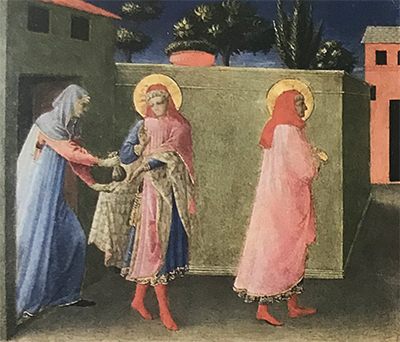
Palladia leans out from a doorway to offer Saint Damian a small pouch. He reaches towards it as his brother Cosmas walks away, still close enough for the two men’s gold haloes to catch the eye together. The gift is thanks for a cure, but accepting it will put the brothers at odds. This small painting in Florence opens the surviving sequence of six scenes traditionally associated with the Annalena Altarpiece. The Italian state catalogue records it under Fra Angelico’s name, with alternative attributions to two painters associated with his workshop. [1] [2]
At a Glance
- ArtistFra Angelico’s workshop. The Italian state catalogue names Fra Angelico and lists Zanobi Strozzi and Battista Sanguigni as alternative attributions. [1] [2]
- DateSecond quarter of the fifteenth century, catalogued as about 1425–49. [1]
- MediumTempera and gilding on wood. [1]
- Dimensions20 × 23.5 cm (height × width). [1]
- CollectionMuseo di San Marco, Florence. Inventory 1890, no. 8486, for the predella. Italian state catalogue component 0900191243-2. [1]
The exchange at the doorway
At the left edge of the picture, the dark doorway behind Palladia sets off her pale veil. She pitches forward, the pink of her sleeves carrying the eye away from the dark folds of her blue dress and towards the handover. The little rounded shape that hangs between her and Damian would be easy to miss on its own. The meeting of their hands draws attention to it. Damian’s head follows the exchange while the folds of his robe and the angle of his red shoes still suggest a man on his way past. [1] [2]
Cosmas is already a few steps ahead. His red cap, pink mantle and gold halo echo Damian’s, but his turned body gives the two figures very different outlines. The sweep of Cosmas’s cloak follows the direction of his stride, while Damian’s blue sleeve and gathered outer garment break up his silhouette at the point where he stops. The saints are plainly companions. The growing space between them makes it equally plain that only one has stayed to hear Palladia out. Cosmas’s departure also gives a visual reason for the difference in what each brother knows. [1] [2]
The buildings make this division possible in a space only a little wider than it is high. The doorway contains the dark from which Palladia emerges. A broad, pale green wall keeps the ground behind the saints quiet enough for both figures to stand out. Only at the far right does the route seem to open again, beside a warm pink building. Above the long horizontal of the wall are dark treetops and the rim of a terracotta-coloured vessel. That glimpse over the wall gives the little street depth without interrupting the gestures below. A viewer can move across the picture in the same direction as the brothers and still linger over the exchange they are about to leave behind. [1]
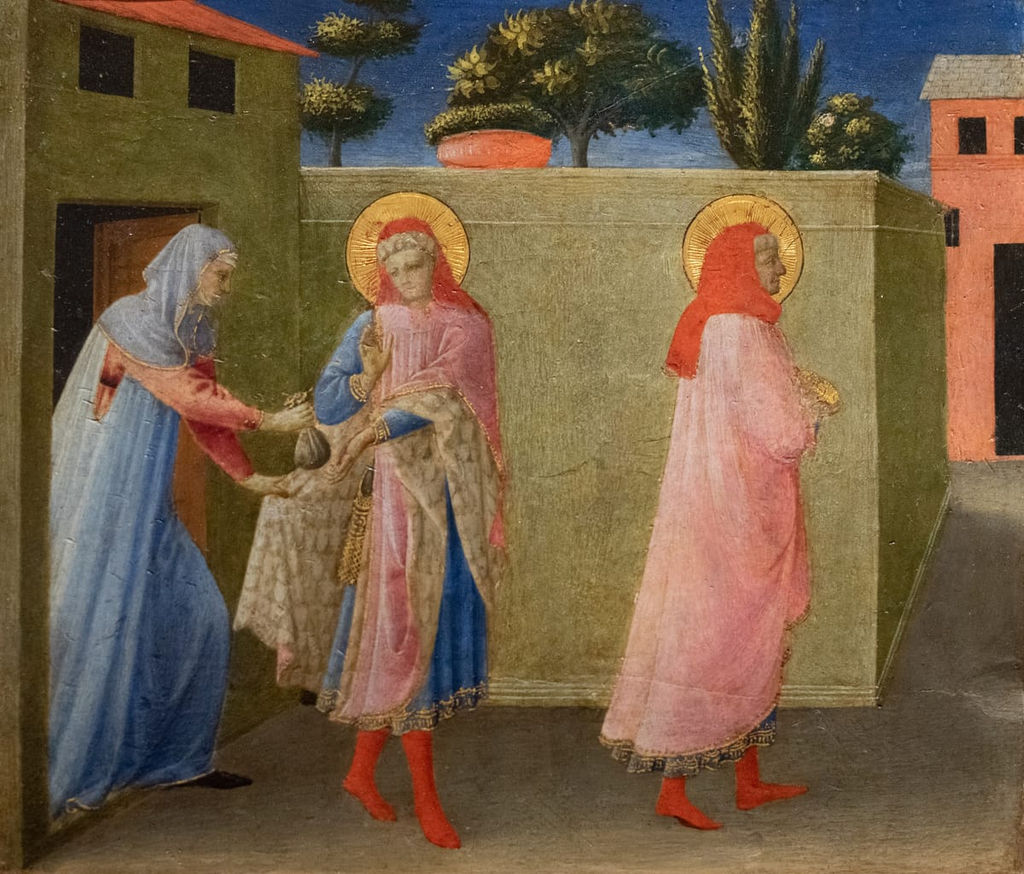
The smaller Florentine gift scene from the Annalena predella. At the right a second saint turns away from the exchange. Image source. Public domain. Proportional web resize.
What Palladia gives Damian
In Jacobus de Voragine’s Golden Legend, the brothers practise medicine without taking a reward. Palladia has exhausted her means seeking treatment when they cure her. Damian initially refuses her gift. She then appeals to him in God’s name, and he accepts out of respect for that appeal. When Cosmas learns what has happened, he declares that he and Damian should be buried apart. Christ appears to him in a dream to explain his brother’s conduct. [3]
The Italian catalogue calls the gift money. The Museo di San Marco’s telling describes a bag of eggs, and the art historian Jillian Harrold traces the egg detail to a fifteenth-century Florentine version of the saints’ life. The English translation of the Golden Legend in the Temple Classics edition describes a small gift and leaves its nature open. The painted pouch gives the exchange a visible centre and keeps its contents out of sight. Palladia has already received the cure. Her insistence, and what Damian owes her once she has invoked God’s name, are what make the encounter difficult. [1] [2] [3] [4]
The story gives each figure an intelligible motive. Palladia wants to thank the people who helped her after other treatments had consumed her resources. Cosmas has reason to take their commitment seriously. Damian has heard the appeal that makes this particular gift an exception. The painting distributes those positions across three bodies, from Palladia’s forward lean to Damian’s turn and Cosmas’s onward step. The dream that vindicates Damian lies beyond the picture. For the moment, the viewer knows more than the brother who is walking away. [2] [3]
The same story in Washington
In the larger Healing of Palladia by Saint Cosmas and Saint Damian at the National Gallery of Art in Washington, dated about 1438–40 by the museum, the cure and the gift appear together. Through the opening on the left, both saints attend Palladia in bed. On the right, a second opening frames the recovered woman offering a gift to Damian. The two doorways let the viewer compare Palladia’s condition before and after the cure and follow Damian from one encounter to the other. Florence gives the moment after the cure the entire compartment. Where Washington uses a building to separate successive events, Florence uses its wall to hold together three people whose attention is already divided. [1] [2] [5]
The Washington painting came from the high altarpiece of the church of San Marco, a distinct commission. Its support measures 38.1 × 47.5 cm, roughly twice the height and width recorded for the Florence scene. The two series were confused as early as the nineteenth century, when writers took six pictures then in the chapel of Saint Luke at Santissima Annunziata to be pieces of the San Marco high altarpiece. Those six were the Annalena scenes. They entered Florence’s Accademia in 1854 and later moved to the Museo di San Marco. Their present home and the original home of the Washington painting share a name, which helps explain why the distinction still matters. [1] [5]
The predella and the painters
A predella is the low painted band beneath the principal image of an altarpiece. The payment scene comes first on the two joined boards in Florence. Next the saints and their brothers appear before the proconsul Lysias. The change is abrupt. In the street, the saints’ calling is shown through a patient’s gratitude. In the next scene it has brought them to the attention of a judge. The sequence makes the gift the first consequence of a cure that has happened outside the painted story. [1] [2] [3]
The six Florentine scenes give us a surviving order. Reconstructing the whole predella involves further choices. The Kunsthaus Zürich holds a related compartment showing the healing of the deacon Justinian, and scholars have proposed different places for separated or missing scenes. The Medici commission also leaves a question of location. The family chapel dedicated to Cosmas and Damian at San Lorenzo is a plausible original destination for the altarpiece. The organisers of the 2025 Fra Angelico exhibition describe the original site as still debated. [1] [2] [6] [7] [8]
The hand that painted this compartment is also open to question. In the workshop attribution, the idea that Angelico supplied designs and other painters executed them is a scholarly reconstruction. Angelo Tartuferi has argued for Battista di Biagio Sanguigni on the strength of a comparison between the drawing of curly heads in the predella and miniatures in a choir book for which Sanguigni was paid in 1432. The document establishes his work as an illuminator. The resemblance is what links him to the painted series. Zanobi Strozzi remains the other named candidate in the Italian catalogue, and the Kunsthaus identifies features of his style in its own related panel. [1] [2] [6] [9]
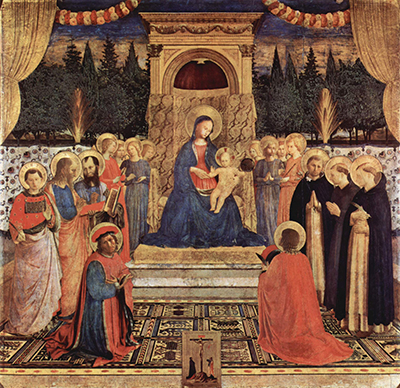
The altarpiece and its predella were damaged in the storm that struck the museum in September 2014. A diagnostic campaign preceded treatment of the painted surfaces and wooden supports, and the restored ensemble returned to display before the museum presented the work in February 2017. On the main panel, the two physician saints stand together near the Virgin and Child. The predella shifts the emphasis from their shared standing as saints to the moment when the same act of gratitude draws a different response from each brother. [2] [8]
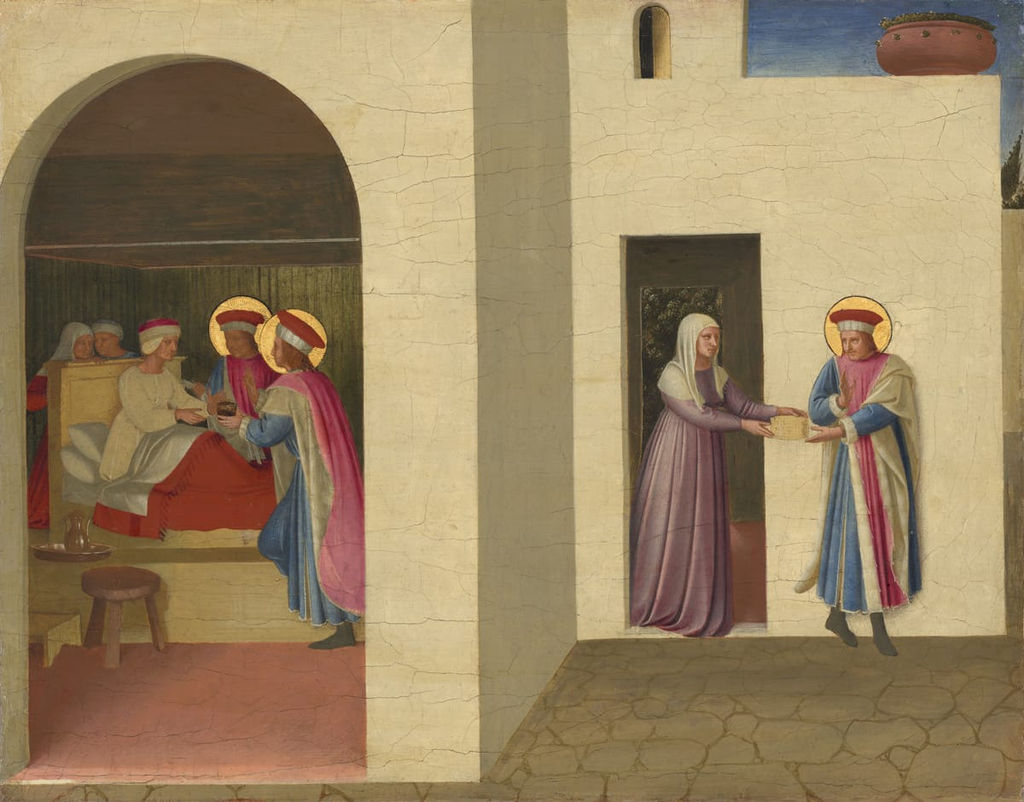
San Marco high-altarpiece comparison, National Gallery of Art accession 1952.5.3. The architecture separates the healing from the gift. Image source. Public domain. Proportional web resize.
Fra Angelico artworks directory
Explore documented works and surviving parts of larger ensembles. Catalogue links identify individual records. Attribution and dating can vary across collections and publications. Search the Federico Zeri Photo Archive by artist.
| Name | Date | Medium and sources |
|---|---|---|
| Adoration of the Magi | About 1440–60, NGA catalogue | Painting Catalogue. |
| Adoration of the Magi (Armadio degli Argenti) | About 1450–53 | Tempera and gold on wood. Catalogue. |
| Agony in the Garden (Armadio degli Argenti) | About 1450–53 | Tempera and gilding on wood Catalogue. |
| Annalena Altarpiece / Pala di Annalena | commonly c. 1435 | Tempera on panel Catalogue. |
| Annunciation (Armadio degli Argenti) | About 1450–53 | Tempera and gilding on wood. Catalogue. |
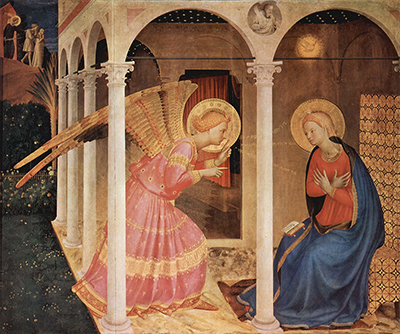
| Annunciation (Cortona) | generally placed in the 1430s; exact dating remains debated | Tempera on panel Catalogue. |
| Annunciation (Prado) | 1425–26 | Tempera on poplar panel Catalogue. |
| Annunciation (San Marco upper corridor) | commonly c. 1442 | Fresco Catalogue. |
| Annunciation with Saint Peter Martyr | About 1439–43 | Fresco on plaster. Catalogue. |
| Annunciatory Angel | 1450–55, Detroit catalogue | Gold leaf and tempera on wood panel. Catalogue. |
| Armadio degli Argenti (Silver Treasury) | principally c. 1450–52 | Tempera on panel Catalogue. |
| Arrest of Christ (Armadio degli Argenti) | About 1450–53 | Tempera and gilding on wood Catalogue. |
| Ascension (Armadio degli Argenti) | About 1450–53 | Tempera and gilding on wood Catalogue. |
| Baptism of Christ (Armadio, Alesso Baldovinetti) | About 1452–53 | Tempera and gilding on wood Catalogue. |
| Beheading of Saints Cosmas and Damian (San Marco Altarpiece) | About 1438–42 | Painted panel Catalogue. |
| Betrayal of Christ (Armadio degli Argenti) | About 1450–53 | Tempera and gilding on wood Catalogue. |
| Blessed Dominican, Possibly Jordan of Saxony (San Marco Altarpiece) | About 1438–42 | Painted panel Catalogue. |
| Blessed Vincent Ferrer (San Marco Altarpiece) | About 1438–42 | Painted panel Catalogue. |
| Burial of Saints Cosmas and Damian (San Marco Altarpiece) | About 1438–42 | Painted panel Catalogue. |
| Bust of a Cleric and a Group of Figures (recto and verso) | 15th century | Pen and ink on paper Catalogue. |
| Christ among the Doctors (Armadio degli Argenti) | About 1450–53 | Tempera and gilding on wood Catalogue. |
| Christ before Caiaphas (Armadio degli Argenti) | About 1450–53 | Tempera and gilding on wood Catalogue. |
| Christ Glorified in the Court of Heaven | About 1423–24 | Egg tempera on wood, probably poplar, with gold and silver leaf Catalogue. |
| Christ Seated in Judgment | 1447 | Fresco and gilding on plaster. Catalogue. |
| Christ Stripped of His Garments (Armadio degli Argenti) | About 1450–53 | Tempera and gilding on wood Catalogue. |
| Christ Washes the Apostles’ Feet (Armadio degli Argenti) | About 1450–53 | Tempera and gilding on wood Catalogue. |
| Circumcision of Christ (Armadio degli Argenti) | About 1450–53 | Tempera and gilding on wood. Catalogue. |
| Communion of the Apostles (Armadio degli Argenti) | About 1450–53 | Tempera and gilding on wood Catalogue. |
| Coronation of the Virgin (Armadio degli Argenti) | About 1450–53 | Tempera and gilding on wood Catalogue. |
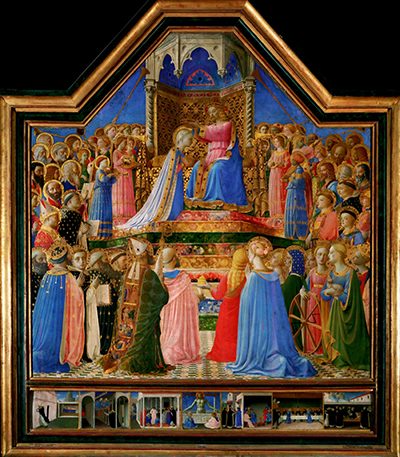
| Coronation of the Virgin (Louvre) | Louvre: second quarter of the fifteenth century, 1425–50; often dated more narrowly c. 1434–35 | Tempera and gold on panel Catalogue. |
| Coronation of the Virgin (Uffizi) | 1431–35 | Tempera on wood, gold ground Catalogue. |
| Cortona Triptych | About 1437 | Tempera and gold on panel. Catalogue. |
| Crucifixion (Armadio degli Argenti) | About 1450–53 | Tempera and gilding on wood Catalogue. |
| Crucifixion and Saints | 1441–42 | Fresco Catalogue. |
| Deposition from the Cross / Santa Trinita Deposition | commissioned 1429–32; completed by Angelico within this period | Tempera on panel Catalogue. |
| Descent into Limbo (Armadio degli Argenti) | About 1450–53 | Tempera and gilding on wood Catalogue. |
| Entombment of Christ (San Marco Altarpiece) | About 1438–42 | Painted panel Catalogue. |
| Entry into Jerusalem (Armadio degli Argenti) | About 1450–53 | Tempera and gilding on wood Catalogue. |
| Expulsion and the Stoning of Saint Stephen | 1448–49, Vatican Museums | Fresco. Catalogue. |
| Fiesole San Domenico Altarpiece | early 1420s; predella about 1423–24 | Tempera on panel Catalogue. |
| Flagellation (Armadio degli Argenti) | About 1450–53 | Tempera and gilding on wood Catalogue. |
| Flight into Egypt | About 1450–53 | Tempera and gilding on wood. Catalogue. |
| Guidalotti Polyptych | c. 1447–49 | Tempera and oil on panel Catalogue. |
| Healing of Palladia and Saint Damian Accepting Her Gift (San Marco Altarpiece) | About 1438–42 | Painted panel Catalogue. |
| Holy Pilgrim, Possibly Saint Roch (San Marco Altarpiece) | About 1438–42 | Painted panel Catalogue. |
| Holy Women at the Tomb (Armadio degli Argenti) | About 1450–53 | Tempera and gilding on wood Catalogue. |
| Judas Receives Payment (Armadio degli Argenti) | About 1450–53 | Tempera and gilding on wood Catalogue. |
| Lamentation over Christ (Armadio degli Argenti) | About 1450–53 | Tempera and gilding on wood Catalogue. |
| Lamentation over the Dead Christ (Croce al Tempio Lamentation) | 1436–41, Zeri catalogue | Tempera and gilding on wood panel. Catalogue. |
| Last Judgement (Armadio degli Argenti) | About 1450–53 | Tempera and gilding on wood Catalogue. |
| Last Judgement (San Marco) | c. 1425–28 | Tempera and gold on panel Catalogue. |
| Last Supper (Armadio degli Argenti) | About 1450–53 | Tempera and gilding on wood Catalogue. |
| Lex Amoris (Armadio degli Argenti) | About 1450–53 | Tempera and gilding on wood Catalogue. |
| Madonna and Child with Saint Dominic and Saint Thomas Aquinas | About 1430, Hermitage catalogue | Detached fresco. Catalogue. |
| Madonna and Child with Saints | About 1411–13 | Tempera on wood panel, with a gold ground. Catalogue. |
| Madonna of Humility | About 1425, Thyssen catalogue | Tempera and gold on wood. Catalogue. |
| Madonna of the Star | 1431–34, Zeri catalogue | Tempera with oil glazes and gold on wood panel, as catalogued by the Gardner for the 2018 exhibition. Catalogue. |
| Marriage at Cana (Armadio, Alesso Baldovinetti) | About 1452–53 | Tempera and gilding on wood Catalogue. |
| Massacre of the Innocents (Armadio degli Argenti) | About 1450–53 | Tempera and gilding on wood Catalogue. |
| Miracle of the Black Leg (San Marco Altarpiece) | About 1438–42 | Painted panel Catalogue. |
| Mocking of Christ (Armadio degli Argenti) | About 1450–53 | Tempera and gilding on wood Catalogue. |
| Mystic Wheel (The Vision of Ezekiel) | About 1450–52 | Tempera and gilding on wood. Catalogue. |
| Nativity (Armadio degli Argenti) | About 1450–53 | Tempera and gilding on wood. Catalogue. |
| Niccoline Chapel frescoes | principally 1448–50 | Fresco Catalogue. |
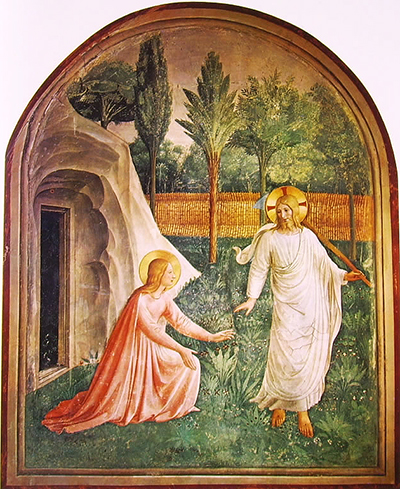
| Noli me Tangere | broadly within Angelico’s San Marco campaign, late 1430s–1440s | Fresco Catalogue. |
| Ordination of Saint Lawrence | 1448 | Fresco. Catalogue. |
| Pentecost (Armadio degli Argenti) | About 1450–53 | Tempera and gilding on wood Catalogue. |
| Presentation of Christ at the Temple (Armadio degli Argenti) | About 1450–53 | Tempera and gilding on wood. Catalogue. |
| Presentation of Jesus at the Temple | Early 1440s | Fresco on plaster. Catalogue. |
| Raising of Lazarus (Armadio degli Argenti) | About 1450–53 | Tempera and gilding on wood Catalogue. |
| Rescue of Saints Cosmas and Damian and Exorcism of Lysias (San Marco Altarpiece) | About 1438–42 | Painted panel Catalogue. |
| Road to Calvary (Armadio degli Argenti) | About 1450–53 | Tempera and gilding on wood Catalogue. |
| Saint Anthony Abbot (San Marco Altarpiece) | About 1438–42 | Painted panel Catalogue. |
| Saint Bernard of Clairvaux or Saint Benedict (San Marco Altarpiece) | About 1438–42 | Painted panel Catalogue. |
| Saint Damian Receives Money from Palladia | About 1425–49 | Tempera and gilding on wood. Catalogue. |
| Saint Francis and a Bishop Saint, Saint John the Baptist and Saint Dominic | Late 1420s, Getty catalogue | Tempera and gold leaf on panel. Catalogue. |
| Saint James the Greater Freeing the Magician Hermogenes | About 1426–29 | Tempera and gold on panel Catalogue. |
| Saint Jerome (San Marco Altarpiece) | About 1438–42 | Painted panel Catalogue. |
| Saint Lawrence Giving Alms | About 1448 | Wall fresco. Catalogue. |
| Saint Lawrence Receiving the Treasures of the Church from Pope Sixtus II | About 1448–49 | Fresco on plaster. Catalogue. |
| Saint Romuald (San Marco Altarpiece) | About 1438–42 | Painted panel Catalogue. |
| Saint Stephen Addressing the Council | 1448–49, Vatican Museums | Fresco. Catalogue. |
| Saint Stephen Preaching | 1448–49, Vatican Museums | Wall fresco. Catalogue. |
| Saint Thomas Aquinas (San Marco Altarpiece) | About 1438–42 | Painted panel Catalogue. |
| Saints Cosmas and Damian and Their Brothers Survive the Stake | Second quarter of the 15th century | Tempera and gilding on wood. Catalogue. |
| Saints Cosmas and Damian at the Stake (San Marco Altarpiece) | About 1438–42 | Painted panel Catalogue. |
| Saints Cosmas and Damian before Lysias (San Marco Altarpiece) | About 1438–42 | Painted panel Catalogue. |
| Saints Cosmas and Damian Rescued by an Angel | Second quarter of the 15th century | Tempera and gilding on wood. Catalogue. |
| Saints Cosmas and Damian with Their Brothers before Proconsul Lysias | Second quarter of the 15th century | Tempera and gilding on wood. Catalogue. |
| San Marco Altarpiece / Pala di San Marco | 1438–43 | Tempera on panel Catalogue. |
| San Pietro Martire Triptych | About 1422–23, Strozzi exhibition | Tempera and gold on panel. Catalogue. |
| Scenes from the Lives of the Desert Fathers (Thebaid) | About 1420, Uffizi catalogue | Tempera on wood. Catalogue. |
| Sixteen Prophets | 1447 | Fresco and gilding on plaster Catalogue. |
| Stoning and Shooting of the Brothers (San Marco Altarpiece) | About 1438–42 | Painted panel Catalogue. |
| Tabernacle of the Linaioli | 1433–35 | Tempera on panel Catalogue. |
| The Attempted Crucifixion and Stoning of Saints Cosmas and Damian | Second quarter of the 15th century | Tempera and gilding on wood. Catalogue. |
| The Crucifixion | About 1420–23, Met catalogue | Tempera on wood, gold ground. Catalogue. |
| The Death and the Assumption of the Virgin | 1424–34 | Tempera with oil glazes and gold on panel Catalogue. |
| The Dominican Blessed (left end) (Fiesole predella) | About 1423–24 | Egg tempera and gold on wood Catalogue. |
| The Dominican Blessed (right end) (Fiesole predella) | About 1423–24 | Egg tempera and gold on wood Catalogue. |
| The Entombment of Christ | About 1450 | Tempera on poplar panel. Catalogue. |
| The Forerunners of Christ with Saints and Martyrs | About 1423–24 | Egg tempera on wood (probably poplar), with gold and silver leaf. Catalogue. |
| The Funeral of Saint Anthony Abbot | About 1426–30 | Tempera on poplar panel. Catalogue. |
| The Martyrdom of Saints Cosmas and Damian | About 1425–49 | Tempera and gilding on wood. Catalogue. |
| The Mocking of Christ / Christ Mocked | within the San Marco dormitory campaign, broadly late 1430s–1440s | Fresco Catalogue. |
| The Nativity | About 1425, Minneapolis catalogue | Tempera on poplar panel. Catalogue. |
| The Nativity in Cell 5 at San Marco | About 1439–43 | Fresco on plaster. Catalogue. |
| The Penitent Saint Jerome | 1419–20 | Tempera on wood panel Catalogue. |
| The Virgin and Child by Fra Angelico (Fogg Museum) | About 1430, Harvard catalogue | Tempera originally on panel, subsequently transferred to Masonite. Catalogue. |
| The Virgin Mary with the Apostles and Other Saints (Fiesole predella) | About 1423–24 | Egg tempera and gold on wood Catalogue. |
| Transfiguration (Armadio, Alesso Baldovinetti) | About 1452–53 | Tempera and gilding on wood Catalogue. |
| Transfiguration (San Marco Cell 6) | within the San Marco dormitory campaign, broadly late 1430s–1440s | Fresco Catalogue. |
| Virgin Mary Annunciate | 1450–55, Detroit catalogue | Gold leaf and tempera on wood panel. Catalogue. |
| Virgin of the Pomegranate | About 1426 | Tempera on panel with gilding Catalogue. |
Frequently Asked Questions
The painting is in the Museo di San Marco in Florence, on the joined boards of the Annalena predella. Its component number in the Italian state catalogue is 0900191243-2. [1]
Discussion
Use these prompts to look again or share an observation.
Reader Insights
Look at the small gap between Palladia’s hand and Damian. What can you actually identify in the painted gesture?
Where does the composition place the brothers in relation to the exchange, and how does it give the gift significance?
Join the Conversation
Share a detail or question about Saint Damian Receives Money from Palladia.
References
- Catalogo generale dei Beni Culturali, San Damiano riceve denaro da Palladia, component 0900191243-2. View source.
- Jillian Harrold, Saintly Doctors: The Early Iconography of SS. Cosmas and Damian in Italy, University of Warwick, 2007, pp. 182–198. View source.
- Jacobus de Voragine, The Golden Legend, William Caxton’s translation, Temple Classics, vol. 5, ‘Of the Saints Cosmo and Damian’, Fordham University Internet History Sourcebooks. View source.
- Museo di San Marco, Alla ricerca degli animali nascosti nel Museo di San Marco, 2021, commentary on the gift in the Annalena predella. View source.
- National Gallery of Art, The Healing of Palladia by Saint Cosmas and Saint Damian, accession 1952.5.3, object description and provenance notes. View source.
- Kunsthaus Zürich, Cosmas and Damian Heal the Deacon Justinian, collection record KS 41. View source.
- Fondazione Palazzo Strozzi and Museo di San Marco, Fra Angelico, 2025 exhibition press kit, room 3 and San Marco altarpiece checklist. View source.
- Museo di San Marco, Angelico ritrovato. Il restauro della Pala di Annalena, 2017. View source.
- Angelo Tartuferi, interview with the Museo di San Marco, Gli “esordi” di Beato Angelico al Museo di San Marco, 2025. View source.
.jpg)
 Fra Angelico.jpg)