


 by Tom Gurney
Tom Gurney BSc (Hons) is an art history expert with over 20 years experience
Published on June 19, 2020 / Updated on November 29, 2026
Email: tomgurney1@gmail.com / Phone: +44 7429 011000
Introduction
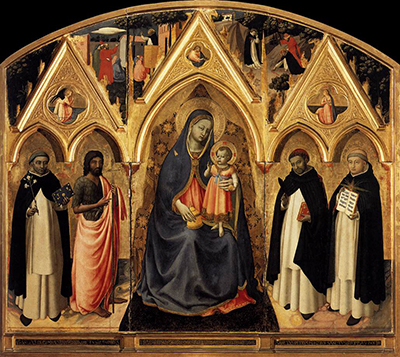
Fra Angelico’s San Pietro Martire Triptych gives the Virgin and Child a tall central arch and places four saints under smaller ones. Follow their feet and the divisions give way to a floor that runs across the painting. Look higher and the gold framework divides again, this time around an Annunciation and two episodes from the life of the Dominican saint Peter Martyr. The altarpiece was made for the community of Dominican nuns dedicated to him near Florence’s Porta Romana. Its main section is now in the Museo di San Marco in Florence. [1] [2]
At a Glance
- ArtistFra Angelico (Guido di Pietro). [1]
- DateAbout 1422–23 in the 2025 Palazzo Strozzi exhibition. A debt for the work is recorded in March 1429. [1] [2]
- MediumTempera and gold on panel. [1]
- Dimensions152 × 172 cm for the main section, as listed by Palazzo Strozzi. [1]
- CollectionMuseo di San Marco, Florence, inventory 1890, no. 8769. Three associated predella panels are in the Courtauld Gallery, London. [1] [2]
The Virgin, the Child and four saints
Mary’s blue mantle sweeps from her bowed head to the dark rug at the front of the throne. Her left hand steadies the Child, whose raised hand is poised in blessing. One of his bare feet emerges from a pink robe with a broad patterned hem. The drape behind them is gold like the field behind the saints, but its small clusters of dark ornament follow a regular repeat, making it read as fabric. Magnolia Scudieri compared the attention to textiles with that of Gentile da Fabriano. Carl Brandon Strehlke has pointed out that the repeating design looks as if it could have been woven, while the motif itself has no known match in contemporary Italian textiles. Its richness is visible without identifying a particular fabric or workshop. [1] [3] [4]
At the far left Saint Dominic carries a flowering lily and a blue book decorated with gold. The colours of his habit, a white tunic under a dark cloak, recur on both Dominican saints across the throne. John the Baptist stands next to Dominic in a rough garment partly covered by a pink mantle. His narrow cross and bare feet distinguish him from the friars, and his pointing hand takes the eye towards the centre. Peter Martyr stands to the Child’s right with a closed red book and a palm. Thomas Aquinas, at the far right, holds his book open towards us. The four saints differ in how they hold things and where they look. The open book makes a light rectangle in the field of Thomas’s cloak, while the Baptist’s arm carries the eye sideways. [1] [3]
The title saint is Peter of Verona, a Dominican preacher and inquisitor killed in 1252 and canonised the following year. Angelico makes room for him twice over. In the main tier the wound on Peter’s head and the palm identify him among the standing saints. Higher up he preaches and is attacked. In a single view the nuns could see their patron as a figure among the saints and look to smaller images that showed what he had done and how he had died. [1] [3] [5]
An Annunciation in three circles
The Annunciation is spread across the three pinnacles. Gabriel is in the left roundel, turned towards Mary. She appears in the right one, her head turned back towards him. In the centre God the Father sends the Holy Spirit to Mary. The figures occupy separate circles, and the central image gives their exchange a direction across the altarpiece. It also sits directly above the enthroned Virgin and Child. The viewer can follow the announcement across the top and look straight down to the Child against Mary’s knee. [1]
Look between the three points of the gilded frame for the two other scenes. On the left Peter preaches from a raised pulpit. A listener in red lifts an arm below him, and pink and ochre buildings give the gathering the shape of a street. On the right the story moves to rocky ground among trees. A red-clad assailant raises his arm over the fallen Peter, and a second friar appears farther back. Across the two scenes the scale of the people is small enough to take in the crowd and the attack at a glance, even though the space for each story narrows as it drops between the arches. Scudieri drew attention to the unusual choice to place these episodes at the top, in the spaces beside the pointed gables. A viewer accustomed to finding such stories in a strip below the main picture would have to look up to find Peter’s life here. [1] [3]
How the painting holds together
Look for the boundary beneath the inner spring of each side arch. A strip of gold marks the change in bay above, but the marbled floor below it runs across the joins. The pattern changes colour as it moves from left to right, and the dark rug interrupts it in the centre. The rug widens towards the front, giving the throne a foothold and bringing it closer to the painted edge. The Baptist turns into the gathering and is seen partly from the side. Peter stands at an angle on the other side of the throne. The four saints appear to have room to stand around the central group even where their footing is hard to reconcile with a single view into depth. [1] [3]
The Florentine exhibition of 2025 placed the altarpiece beside Masaccio’s San Giovenale Triptych, which carries the date 23 April 1422. Both are gold-ground altarpieces with Mary and the Child in the middle and saints at either side. In Masaccio’s work you can follow the lines in the green floor towards a point at Mary’s neck, and two angels kneel before the substantial throne. Angelico’s carpet and streaks of colour lead the eye through a shallower foreground. Above it the enclosed gold circles and the small outdoor episodes create depth on several different scales. The comparison also explains why the dating of Angelico’s work matters. An early date puts the two approaches to arranging figures in depth close together in time. [1] [2] [6]
Conservation helped explain how Angelico’s painted space was made. The 2012 report describes three wooden panels united at the front by cloth laid down under the gesso, the smooth ground that received the design. Infrared reflectography distinguished broad, heavily shaded marks beneath the painted Dominican saints from finer drawing and lighter shading in the Virgin and Child. The author raised the possibility of another hand while leaving the finding open. The frame had also changed over time. An old photograph shows spiral columns and an outer rectangular frame since removed, and X-radiography revealed traces of an earlier profile under the surviving rim. The report leaves the original framing arrangement uncertain. [3]
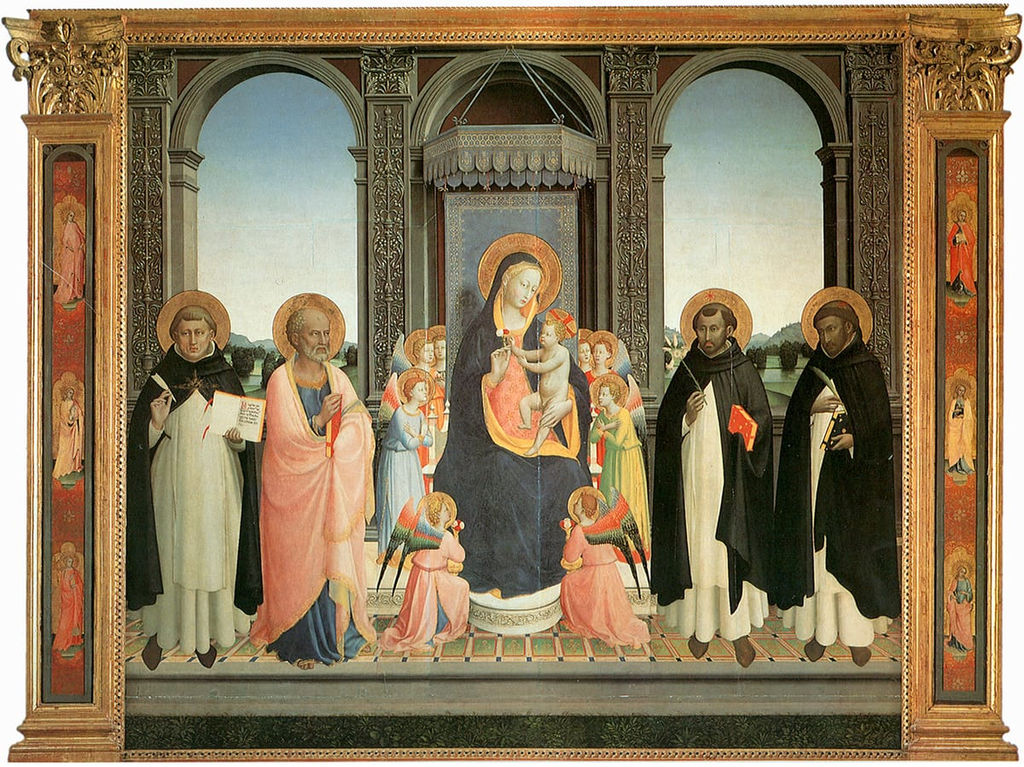
The main Fiesole altarpiece as it survives after Lorenzo di Credi’s alterations. Its detached predella is in London. Image source. Public domain. Proportional web resize.
What the 1429 record tells us
On 30 March 1429, as the date is given in Alessandro Santini’s account, the nuns still owed money for the altarpiece to San Domenico at Fiesole, the community to which Angelico belonged. The record establishes that the work existed by that point. Scudieri’s 2012 catalogue entry placed the painting in the middle to later 1420s. The Florence exhibition’s checklist dates it about 1422–23, and Strehlke has proposed about 1421–22 in light of the convent’s early history and comparisons with Masaccio. He has drawn attention to two substantial donations to the new convent in 1421 as a possible clue to when the commission became feasible. Angelico was already recorded as a painter in 1417. [1] [2] [3] [4] [7]
The nuns at San Pietro Martire belonged to a community closely tied to the Dominican reform of religious life. Sisters from the convent of San Domenico in Pisa came to instruct the new Florentine community. Local support included the backing of the Spini and da Uzzano families. Margherita Spini, who helped fund the founding of the convent, later entered it herself. The altarpiece reflects those ties to the order directly. Three of its four standing saints wear the Dominican habit. The name of the convent’s own patron is also the name by which we know the painting today. [2] [4]
The archived state catalogue dates the altarpiece between 1425 and 1428 and gives a height of 152.5 cm, close to the 152 cm in the 2025 exhibition checklist. It also confirms that the support of the two small scenes continues into that of the main painting. [1] [8]
The community moved to San Felice in Piazza in 1557. The nuns took it with them after their earlier site was affected by work on the city’s fortifications. The altarpiece stood at the new church’s high altar. By 1818 the main section was recorded in the institution attached to the convent and was probably already separate from its lower tier. The Florentine royal galleries bought the painting in 1828. It moved from the Uffizi to the Galleria Palatina in 1844 and reached San Marco in 1924. [3]
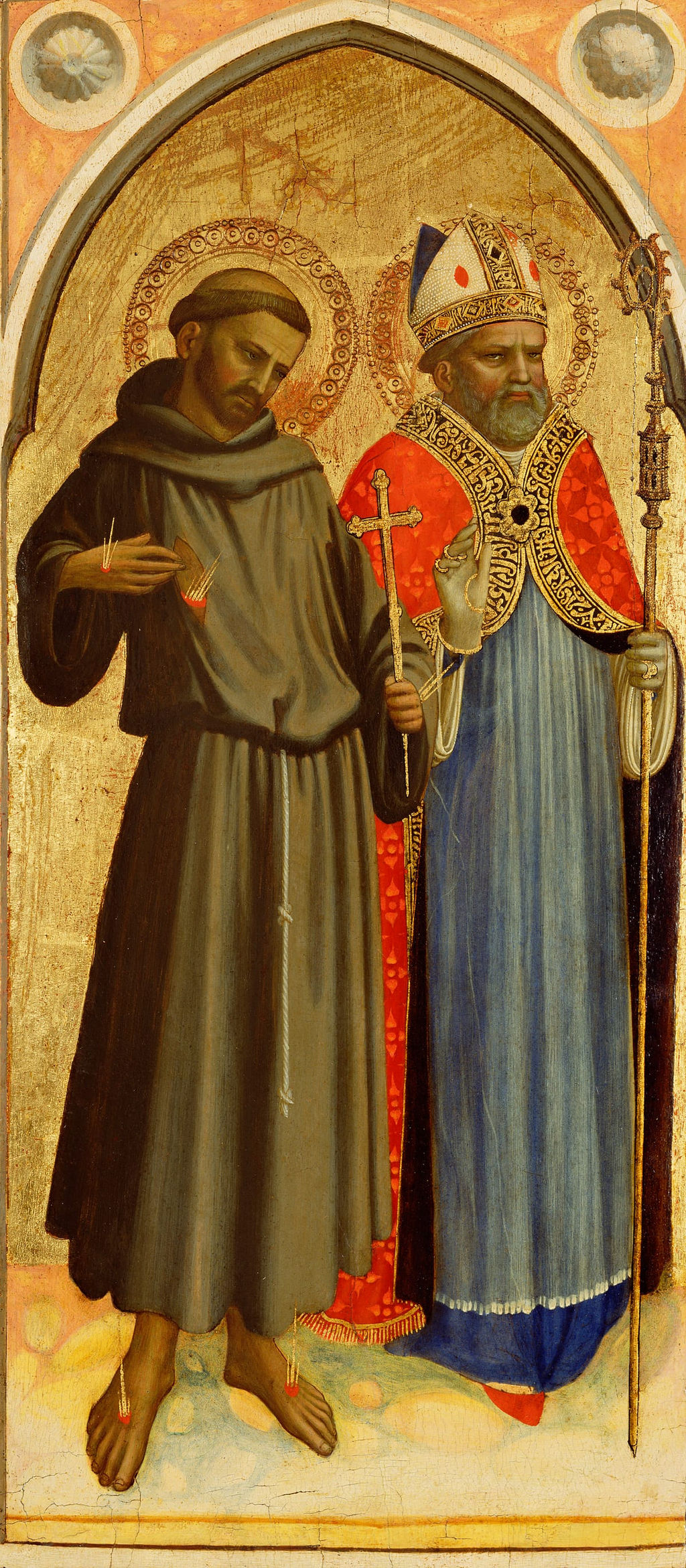
St Francis and a Bishop Saint, Getty Museum 92.PB.111.1. Image source. Public domain. Proportional web resize.
The three panels in London
The Courtauld Gallery holds three panels associated with the Florence altarpiece. Together they make up a proposed predella, the low band of paintings beneath the principal image. In the middle Christ appears above the rim of his tomb with the lance and the sponge of the Passion. Mary Magdalene and John the Evangelist flank him in their own small circles. To the right are Catherine of Alexandria and Agnes of Rome. The left-hand panel pairs a woman in a Dominican habit with Cecilia. This arrangement would have put the wounded adult Christ below the Child and the Annunciation above him. The London panels were displayed with the main section in Florence for the 2025 exhibition. The organisers also showed a reconstruction of the altarpiece alongside the original works. [1] [2] [9]
The Courtauld identifies the nun in the leftmost circle as Blessed Margaret of Hungary. Santini has proposed Agnes of Montepulciano. He points out that Angelico’s Margaret in the Fiesole altarpiece’s predella shows the marks of the stigmata on her raised hands. The nun in the Courtauld panel lacks those marks. The disagreement changes how the lower tier might have spoken to its original audience. Margaret’s name could recall Margherita Spini, a benefactor who joined the convent. Agnes of Montepulciano would bring another figure of Dominican women’s religious life into the company of Agnes of Rome and the other martyrs. The small figure’s black veil makes the Dominican identity evident and leaves her individual name open. [2] [9]
Cecilia, Catherine of Alexandria and Agnes of Rome also appear together in later stories about Peter Martyr. In one tradition they visit him in his cell and the other friars mistake them for ordinary visitors. The version naming all three belongs to a later phase in the legend’s development. Santini suggests that people who saw the altarpiece in San Felice in Piazza might have made the connection as the tale spread. The evidence leaves open which stories Angelico or the first generation of nuns knew. [10]
Fra Angelico artworks directory
Explore documented works and surviving parts of larger ensembles. Catalogue links identify individual records. Attribution and dating can vary across collections and publications. Search the Federico Zeri Photo Archive by artist.
| Name | Date | Medium and sources |
|---|---|---|
| Adoration of the Magi | About 1440–60, NGA catalogue | Painting Catalogue. |
| Adoration of the Magi (Armadio degli Argenti) | About 1450–53 | Tempera and gold on wood. Catalogue. |
| Agony in the Garden (Armadio degli Argenti) | About 1450–53 | Tempera and gilding on wood Catalogue. |
| Annalena Altarpiece / Pala di Annalena | commonly c. 1435 | Tempera on panel Catalogue. |
| Annunciation (Armadio degli Argenti) | About 1450–53 | Tempera and gilding on wood. Catalogue. |
| Annunciation (Cortona) | generally placed in the 1430s; exact dating remains debated | Tempera on panel Catalogue. |
| Annunciation (Prado) | 1425–26 | Tempera on poplar panel Catalogue. |
| Annunciation (San Marco upper corridor) | commonly c. 1442 | Fresco Catalogue. |
| Annunciation with Saint Peter Martyr | About 1439–43 | Fresco on plaster. Catalogue. |
| Annunciatory Angel | 1450–55, Detroit catalogue | Gold leaf and tempera on wood panel. Catalogue. |
| Armadio degli Argenti (Silver Treasury) | principally c. 1450–52 | Tempera on panel Catalogue. |
| Arrest of Christ (Armadio degli Argenti) | About 1450–53 | Tempera and gilding on wood Catalogue. |
| Ascension (Armadio degli Argenti) | About 1450–53 | Tempera and gilding on wood Catalogue. |
| Baptism of Christ (Armadio, Alesso Baldovinetti) | About 1452–53 | Tempera and gilding on wood Catalogue. |
| Beheading of Saints Cosmas and Damian (San Marco Altarpiece) | About 1438–42 | Painted panel Catalogue. |
| Betrayal of Christ (Armadio degli Argenti) | About 1450–53 | Tempera and gilding on wood Catalogue. |
| Blessed Dominican, Possibly Jordan of Saxony (San Marco Altarpiece) | About 1438–42 | Painted panel Catalogue. |
| Blessed Vincent Ferrer (San Marco Altarpiece) | About 1438–42 | Painted panel Catalogue. |
| Burial of Saints Cosmas and Damian (San Marco Altarpiece) | About 1438–42 | Painted panel Catalogue. |
| Bust of a Cleric and a Group of Figures (recto and verso) | 15th century | Pen and ink on paper Catalogue. |
| Christ among the Doctors (Armadio degli Argenti) | About 1450–53 | Tempera and gilding on wood Catalogue. |
| Christ before Caiaphas (Armadio degli Argenti) | About 1450–53 | Tempera and gilding on wood Catalogue. |
| Christ Glorified in the Court of Heaven | About 1423–24 | Egg tempera on wood, probably poplar, with gold and silver leaf Catalogue. |
| Christ Seated in Judgment | 1447 | Fresco and gilding on plaster. Catalogue. |
| Christ Stripped of His Garments (Armadio degli Argenti) | About 1450–53 | Tempera and gilding on wood Catalogue. |
| Christ Washes the Apostles’ Feet (Armadio degli Argenti) | About 1450–53 | Tempera and gilding on wood Catalogue. |
| Circumcision of Christ (Armadio degli Argenti) | About 1450–53 | Tempera and gilding on wood. Catalogue. |
| Communion of the Apostles (Armadio degli Argenti) | About 1450–53 | Tempera and gilding on wood Catalogue. |
| Coronation of the Virgin (Armadio degli Argenti) | About 1450–53 | Tempera and gilding on wood Catalogue. |
| Coronation of the Virgin (Louvre) | Louvre: second quarter of the fifteenth century, 1425–50; often dated more narrowly c. 1434–35 | Tempera and gold on panel Catalogue. |
| Coronation of the Virgin (Uffizi) | 1431–35 | Tempera on wood, gold ground Catalogue. |
| Cortona Triptych | About 1437 | Tempera and gold on panel. Catalogue. |
| Crucifixion (Armadio degli Argenti) | About 1450–53 | Tempera and gilding on wood Catalogue. |
| Crucifixion and Saints | 1441–42 | Fresco Catalogue. |
| Deposition from the Cross / Santa Trinita Deposition | commissioned 1429–32; completed by Angelico within this period | Tempera on panel Catalogue. |
| Descent into Limbo (Armadio degli Argenti) | About 1450–53 | Tempera and gilding on wood Catalogue. |
| Entombment of Christ (San Marco Altarpiece) | About 1438–42 | Painted panel Catalogue. |
| Entry into Jerusalem (Armadio degli Argenti) | About 1450–53 | Tempera and gilding on wood Catalogue. |
| Expulsion and the Stoning of Saint Stephen | 1448–49, Vatican Museums | Fresco. Catalogue. |
| Fiesole San Domenico Altarpiece | early 1420s; predella about 1423–24 | Tempera on panel Catalogue. |
| Flagellation (Armadio degli Argenti) | About 1450–53 | Tempera and gilding on wood Catalogue. |
| Flight into Egypt | About 1450–53 | Tempera and gilding on wood. Catalogue. |
| Guidalotti Polyptych | c. 1447–49 | Tempera and oil on panel Catalogue. |
| Healing of Palladia and Saint Damian Accepting Her Gift (San Marco Altarpiece) | About 1438–42 | Painted panel Catalogue. |
| Holy Pilgrim, Possibly Saint Roch (San Marco Altarpiece) | About 1438–42 | Painted panel Catalogue. |
| Holy Women at the Tomb (Armadio degli Argenti) | About 1450–53 | Tempera and gilding on wood Catalogue. |
| Judas Receives Payment (Armadio degli Argenti) | About 1450–53 | Tempera and gilding on wood Catalogue. |
| Lamentation over Christ (Armadio degli Argenti) | About 1450–53 | Tempera and gilding on wood Catalogue. |
| Lamentation over the Dead Christ (Croce al Tempio Lamentation) | 1436–41, Zeri catalogue | Tempera and gilding on wood panel. Catalogue. |
| Last Judgement (Armadio degli Argenti) | About 1450–53 | Tempera and gilding on wood Catalogue. |
| Last Judgement (San Marco) | c. 1425–28 | Tempera and gold on panel Catalogue. |
| Last Supper (Armadio degli Argenti) | About 1450–53 | Tempera and gilding on wood Catalogue. |
| Lex Amoris (Armadio degli Argenti) | About 1450–53 | Tempera and gilding on wood Catalogue. |
| Madonna and Child with Saint Dominic and Saint Thomas Aquinas | About 1430, Hermitage catalogue | Detached fresco. Catalogue. |
| Madonna and Child with Saints | About 1411–13 | Tempera on wood panel, with a gold ground. Catalogue. |
| Madonna of Humility | About 1425, Thyssen catalogue | Tempera and gold on wood. Catalogue. |
| Madonna of the Star | 1431–34, Zeri catalogue | Tempera with oil glazes and gold on wood panel, as catalogued by the Gardner for the 2018 exhibition. Catalogue. |
| Marriage at Cana (Armadio, Alesso Baldovinetti) | About 1452–53 | Tempera and gilding on wood Catalogue. |
| Massacre of the Innocents (Armadio degli Argenti) | About 1450–53 | Tempera and gilding on wood Catalogue. |
| Miracle of the Black Leg (San Marco Altarpiece) | About 1438–42 | Painted panel Catalogue. |
| Mocking of Christ (Armadio degli Argenti) | About 1450–53 | Tempera and gilding on wood Catalogue. |
| Mystic Wheel (The Vision of Ezekiel) | About 1450–52 | Tempera and gilding on wood. Catalogue. |
| Nativity (Armadio degli Argenti) | About 1450–53 | Tempera and gilding on wood. Catalogue. |
| Niccoline Chapel frescoes | principally 1448–50 | Fresco Catalogue. |
| Noli me Tangere | broadly within Angelico’s San Marco campaign, late 1430s–1440s | Fresco Catalogue. |
| Ordination of Saint Lawrence | 1448 | Fresco. Catalogue. |
| Pentecost (Armadio degli Argenti) | About 1450–53 | Tempera and gilding on wood Catalogue. |
| Presentation of Christ at the Temple (Armadio degli Argenti) | About 1450–53 | Tempera and gilding on wood. Catalogue. |
| Presentation of Jesus at the Temple | Early 1440s | Fresco on plaster. Catalogue. |
| Raising of Lazarus (Armadio degli Argenti) | About 1450–53 | Tempera and gilding on wood Catalogue. |
| Rescue of Saints Cosmas and Damian and Exorcism of Lysias (San Marco Altarpiece) | About 1438–42 | Painted panel Catalogue. |
| Road to Calvary (Armadio degli Argenti) | About 1450–53 | Tempera and gilding on wood Catalogue. |
| Saint Anthony Abbot (San Marco Altarpiece) | About 1438–42 | Painted panel Catalogue. |
| Saint Bernard of Clairvaux or Saint Benedict (San Marco Altarpiece) | About 1438–42 | Painted panel Catalogue. |
| Saint Damian Receives Money from Palladia | About 1425–49 | Tempera and gilding on wood. Catalogue. |
| Saint Francis and a Bishop Saint, Saint John the Baptist and Saint Dominic | Late 1420s, Getty catalogue | Tempera and gold leaf on panel. Catalogue. |
| Saint James the Greater Freeing the Magician Hermogenes | About 1426–29 | Tempera and gold on panel Catalogue. |
| Saint Jerome (San Marco Altarpiece) | About 1438–42 | Painted panel Catalogue. |
| Saint Lawrence Giving Alms | About 1448 | Wall fresco. Catalogue. |
| Saint Lawrence Receiving the Treasures of the Church from Pope Sixtus II | About 1448–49 | Fresco on plaster. Catalogue. |
| Saint Romuald (San Marco Altarpiece) | About 1438–42 | Painted panel Catalogue. |
| Saint Stephen Addressing the Council | 1448–49, Vatican Museums | Fresco. Catalogue. |
| Saint Stephen Preaching | 1448–49, Vatican Museums | Wall fresco. Catalogue. |
| Saint Thomas Aquinas (San Marco Altarpiece) | About 1438–42 | Painted panel Catalogue. |
| Saints Cosmas and Damian and Their Brothers Survive the Stake | Second quarter of the 15th century | Tempera and gilding on wood. Catalogue. |
| Saints Cosmas and Damian at the Stake (San Marco Altarpiece) | About 1438–42 | Painted panel Catalogue. |
| Saints Cosmas and Damian before Lysias (San Marco Altarpiece) | About 1438–42 | Painted panel Catalogue. |
| Saints Cosmas and Damian Rescued by an Angel | Second quarter of the 15th century | Tempera and gilding on wood. Catalogue. |
| Saints Cosmas and Damian with Their Brothers before Proconsul Lysias | Second quarter of the 15th century | Tempera and gilding on wood. Catalogue. |
| San Marco Altarpiece / Pala di San Marco | 1438–43 | Tempera on panel Catalogue. |
| San Pietro Martire Triptych | About 1422–23, Strozzi exhibition | Tempera and gold on panel. Catalogue. |
| Scenes from the Lives of the Desert Fathers (Thebaid) | About 1420, Uffizi catalogue | Tempera on wood. Catalogue. |
| Sixteen Prophets | 1447 | Fresco and gilding on plaster Catalogue. |
| Stoning and Shooting of the Brothers (San Marco Altarpiece) | About 1438–42 | Painted panel Catalogue. |
| Tabernacle of the Linaioli | 1433–35 | Tempera on panel Catalogue. |
| The Attempted Crucifixion and Stoning of Saints Cosmas and Damian | Second quarter of the 15th century | Tempera and gilding on wood. Catalogue. |
| The Crucifixion | About 1420–23, Met catalogue | Tempera on wood, gold ground. Catalogue. |
| The Death and the Assumption of the Virgin | 1424–34 | Tempera with oil glazes and gold on panel Catalogue. |
| The Dominican Blessed (left end) (Fiesole predella) | About 1423–24 | Egg tempera and gold on wood Catalogue. |
| The Dominican Blessed (right end) (Fiesole predella) | About 1423–24 | Egg tempera and gold on wood Catalogue. |
| The Entombment of Christ | About 1450 | Tempera on poplar panel. Catalogue. |
| The Forerunners of Christ with Saints and Martyrs | About 1423–24 | Egg tempera on wood (probably poplar), with gold and silver leaf. Catalogue. |
| The Funeral of Saint Anthony Abbot | About 1426–30 | Tempera on poplar panel. Catalogue. |
| The Martyrdom of Saints Cosmas and Damian | About 1425–49 | Tempera and gilding on wood. Catalogue. |
| The Mocking of Christ / Christ Mocked | within the San Marco dormitory campaign, broadly late 1430s–1440s | Fresco Catalogue. |
| The Nativity | About 1425, Minneapolis catalogue | Tempera on poplar panel. Catalogue. |
| The Nativity in Cell 5 at San Marco | About 1439–43 | Fresco on plaster. Catalogue. |
| The Penitent Saint Jerome | 1419–20 | Tempera on wood panel Catalogue. |
| The Virgin and Child by Fra Angelico (Fogg Museum) | About 1430, Harvard catalogue | Tempera originally on panel, subsequently transferred to Masonite. Catalogue. |
| The Virgin Mary with the Apostles and Other Saints (Fiesole predella) | About 1423–24 | Egg tempera and gold on wood Catalogue. |
| Transfiguration (Armadio, Alesso Baldovinetti) | About 1452–53 | Tempera and gilding on wood Catalogue. |
| Transfiguration (San Marco Cell 6) | within the San Marco dormitory campaign, broadly late 1430s–1440s | Fresco Catalogue. |
| Virgin Mary Annunciate | 1450–55, Detroit catalogue | Gold leaf and tempera on wood panel. Catalogue. |
| Virgin of the Pomegranate | About 1426 | Tempera on panel with gilding Catalogue. |
Frequently Asked Questions
Three pointed gables organise the principal image. Conservation also found three wooden panels assembled beneath a continuous preparation. The familiar name describes the three-part form, while the shared floor and uninterrupted gathering of saints show how Angelico used that form to present a single scene. [1] [3]
The triptych is a panel altarpiece made for the nuns of San Pietro Martire. The Annunciation with Saint Peter Martyr is a fresco in cell 3 of the former convent at San Marco. In the altarpiece the Annunciation is in the upper roundels, and Peter appears below with the other saints and above in two scenes of his life. [1] [11]
Discussion
Use these prompts to look again or share an observation.
Reader Insights
Follow the saints’ line of sight around the Madonna. Which objects or gestures make each figure individually recognisable?
Look for Gabriel and Mary in the upper parts. How do the panels keep their exchange clear across a gap?
Join the Conversation
Share a detail or question about San Pietro Martire Triptych.
References
- Palazzo Strozzi and Museo di San Marco, Fra Angelico (2025 exhibition dossier), photo sheet no. 25, San Marco walkthrough and altarpiece reconstructions View source.
- Alessandro Santini, “La predella ‘delle due Agnesi’ di Beato Angelico”, Museo di San Marco e Cenacoli (2025) (Italian). View source.
- Magnolia Scudieri, “Trittico di san Pietro martire” and “Note di restauro”, Bagliori dorati, Uffizi exhibition catalogue (2012), no. 34, pp. 164–167 (Italian). View source.
- Museo di San Marco e Cenacoli, “Masolino e la lunga giovinezza di Beato Angelico” (2024), report of Carl Brandon Strehlke’s lecture in Empoli (Italian). View source.
- Diana Lucía Gómez-Chacón, “San Pedro Mártir de Verona”, Revista Digital de Iconografía Medieval 6, no. 11 (2014), pp. 79–96 (Spanish). View source.
- Museo Masaccio d’Arte Sacra, The Triptych of San Giovenale View source.
- Magnolia Scudieri, “Guido di Pietro, detto il Beato Angelico”, Dizionario Biografico degli Italiani, Treccani (Italian). View source.
- Uffizi catalogue archive, Trittico di San Pietro Martire, state record 0900196284 (Italian). View source.
- The Courtauld Gallery, Three predella panels, P.1966.GP.10 View source.
- Alessandro Santini, “Divagazioni attorno a Beato Angelico e San Pietro Martire”, Museo di San Marco e Cenacoli (2026) (Italian). View source.
- Museo di San Marco e Cenacoli, “Beato Angelico fa TESTO” (2023), Annunciazione, cell 3 (Italian). View source.
.jpg)



 Fra Angelico.jpg)


