


 by Tom Gurney
Tom Gurney BSc (Hons) is an art history expert with over 20 years experience
Published on June 19, 2020 / Updated on November 29, 2026
Email: tomgurney1@gmail.com / Phone: +44 7429 011000
Introduction
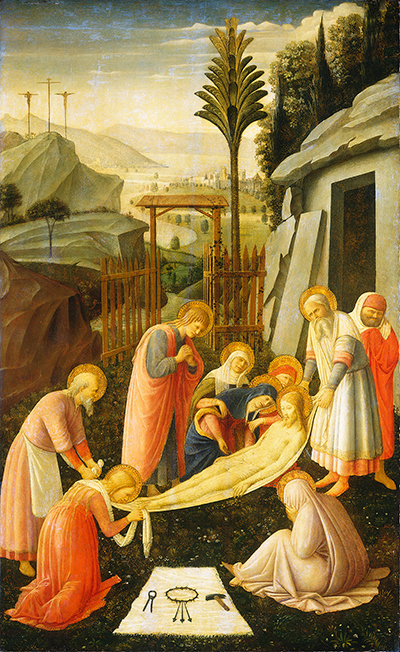
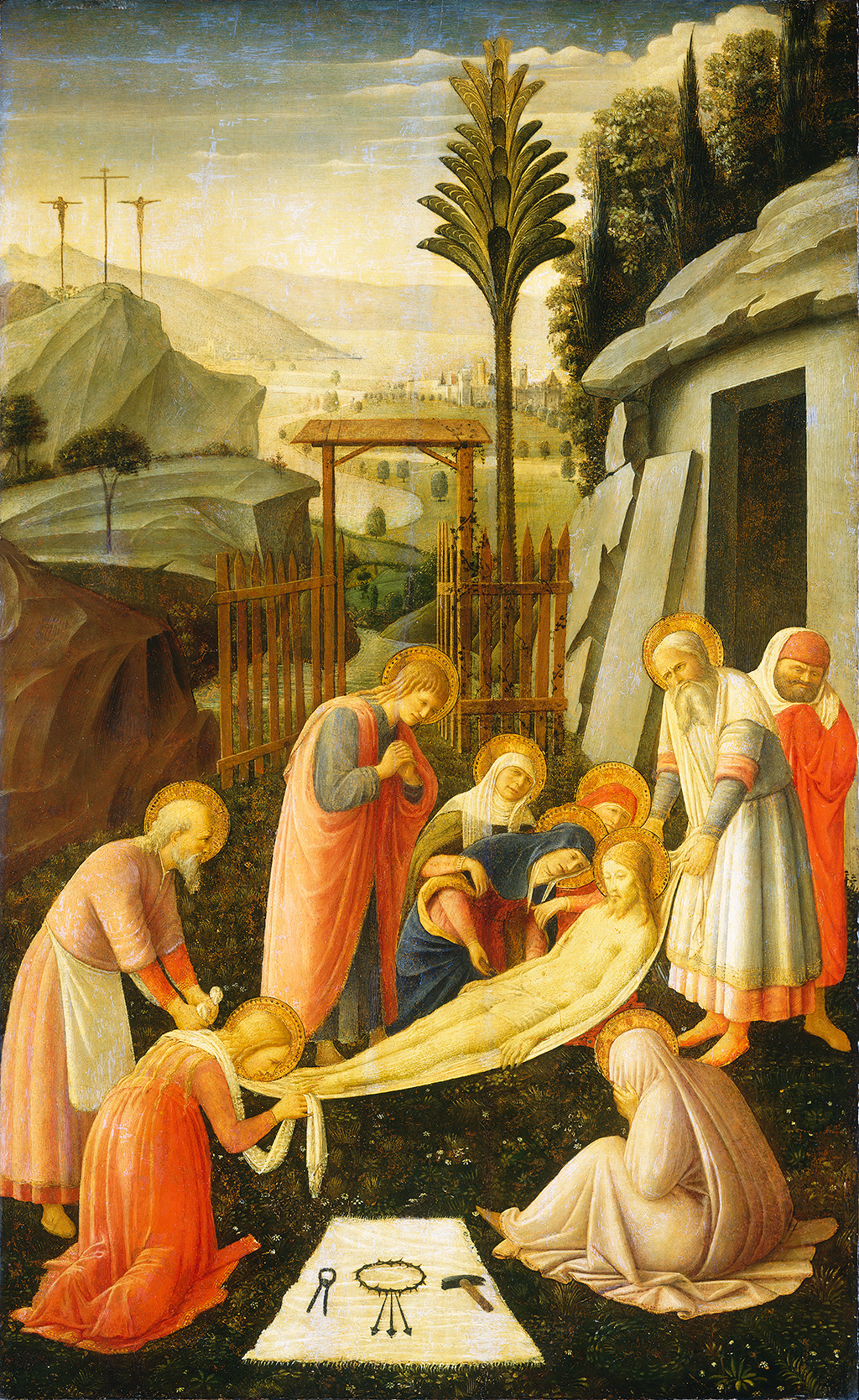
Two men carry Christ towards a dark doorway cut into stone. His head has almost reached it, but at the other end of the shroud a kneeling woman still bends over his feet. Behind them, an open gate looks out towards a city and three crosses on a hill. The central cross is already empty. In The Entombment of Christ, painted around 1450 and now in the National Gallery of Art in Washington, DC, the crosses and the tomb are separated by a few inches of painted landscape. All the time between them seems to pass in the foreground. [1]
At a Glance
- ArtistFra Angelico, as catalogued by the National Gallery of Art.
- TitleThe Entombment of Christ.
- Datec. 1450.
- MediumTempera on poplar panel.
- Dimensions88.9 × 54.9 cm overall (height × width).
- CollectionNational Gallery of Art, Washington, DC, Samuel H. Kress Collection.
- Accession number1939.1.260. [1]
Carrying Christ to the tomb
The burial comes immediately after the Crucifixion in the Gospel of John. Joseph of Arimathea obtains Pilate’s permission to take the body, and Nicodemus brings myrrh and aloes. They wrap Christ in linen and bury him in a new tomb in a garden near the place of execution. In Matthew, Joseph has the body laid in his own rock-cut tomb and rolls a stone across its entrance. Mary Magdalene and another Mary sit opposite the grave. Both accounts are brief. The painting dwells on the interval when the body is still in the mourners’ hands and the tomb is still open. [2] [3]
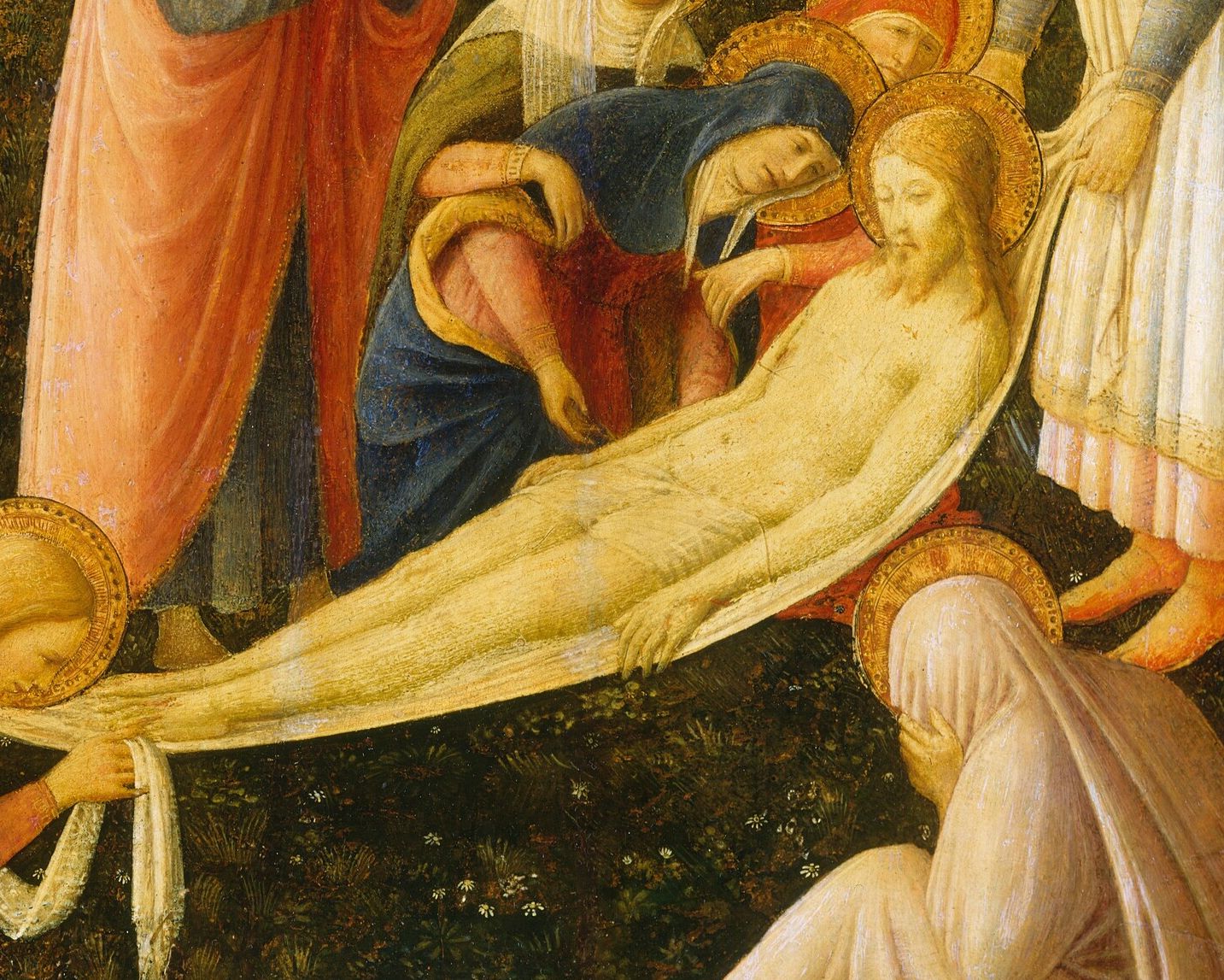
Christ’s feet are at the left, his head higher up at the right. The older man on the left bends and grips a gathered end of the cloth. The white-bearded man on the right holds it close to his waist, lifting Christ’s upper body towards the doorway. Between the two grips, the shroud dips under the weight. Christ’s nearer hand comes down almost to its edge, and small red wounds mark his hand, foot and side. The carriers stand on the same patch of ground yet have very different tasks. One gathers the slack near the feet, while the other takes the weight at the head and shoulders. [1]
Behind the shroud, the Virgin leans towards Christ’s face. One woman steadies her from behind and another bends in close. The young man in coral stands with his hands clasped, his head angled down towards the group. In front, the woman at Christ’s feet has a length of pale cloth in her hands. Across from her, a seated mourner draws her mantle over her head and presses her hands to her face. We see scarcely anything of her expression, but the weight of cloth piled around her on the ground makes her stillness palpable. These figures bring grief to the body in different ways. Some look, some touch, and one can hardly bear to look at all. [1]
The garden between cross and grave
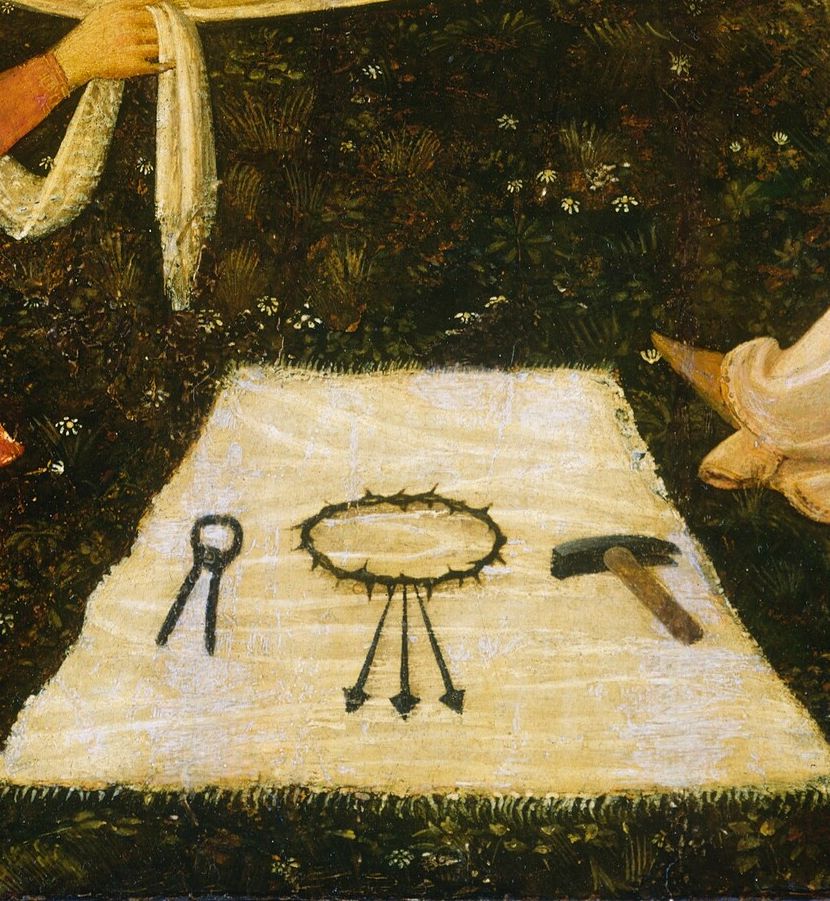
The dark turf beneath the mourners makes a shallow platform in the composition. Look down to the pale cloth spread flat on the grass. A pair of pincers, a crown of thorns and a hammer are laid out across it, with three long shafts below the crown. The cloth gives these small objects an expanse of their own. Its broad near edge brings them closer to us than any of the faces. The two cloths serve different purposes in the scene. One bears the body, and the other holds what remains from the Crucifixion. The hammer and pincers are set apart with a care that makes them easy to study. Their hard outlines give the violence a presence even here, where every gesture towards Christ is gentle. [1]
The upright rock face at the right gives the scene its destination. The rectangular opening is nearly black, and a broad slab leans against the rock beside it. The red-clad man nearest the entrance is the only mourner without a halo. He stands partly behind the man bearing Christ’s shoulders, where the pale stone and the shadow of the opening meet. Across the picture the rocky outcrop on the left crowds the other carrier. The mourners are held between these masses even as the gate behind them opens the view. [1]
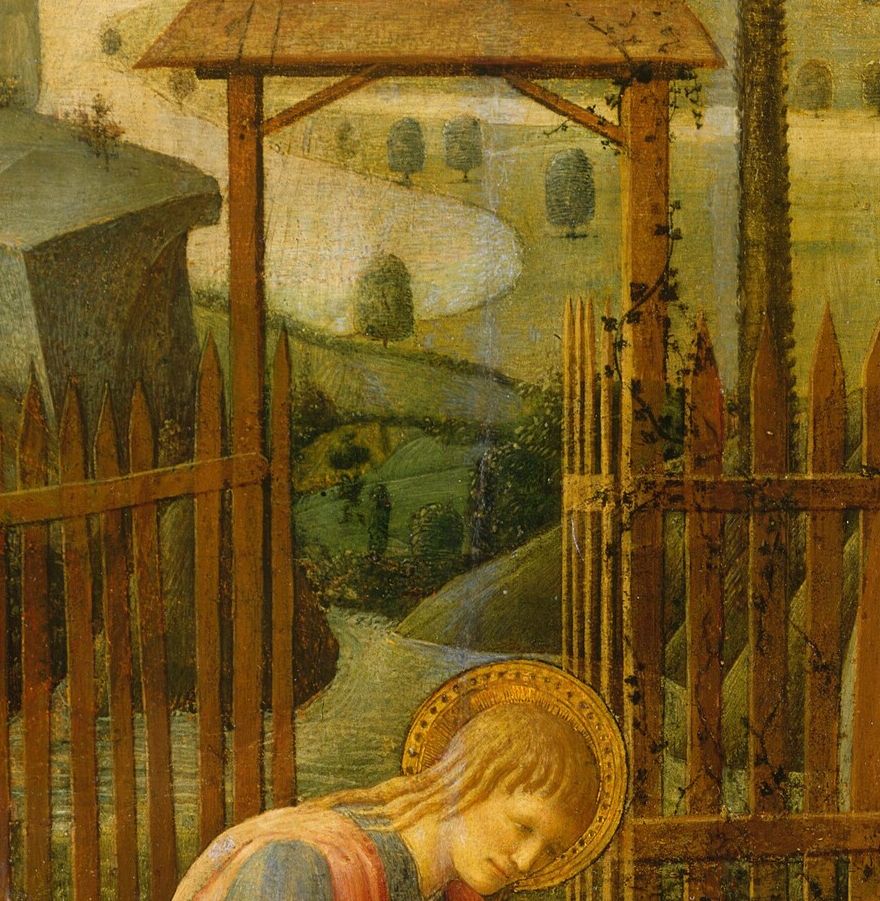
Through that gate the land drops away towards a winding river and a distant town. The gate’s roof and posts make a small frame within the tall panel, and the palm alongside rises almost to the top of the sky. On the left, the two other bodies still hang on their crosses. That detail fixes the scene in the immediate aftermath of the execution. The garden’s enclosure gives the mourners room to gather in relative seclusion while keeping the hill in sight. John’s account places the garden beside the place of Crucifixion. Here the painter makes the short distance legible through the gate, and the change in scale from the people on the grass to the figures on the hill. [1] [2]
Annotated Details from From the gate to the tomb
The numbered points identify visible features discussed in this article. Return from each detail to the numbered overview. The Washington Entombment of Christ, National Gallery of Art accession 1939.1.260. The open gate links the two halves of the picture. National Gallery of Art, Washington. Image source. CC0 / Public domain. Proportional web resize.
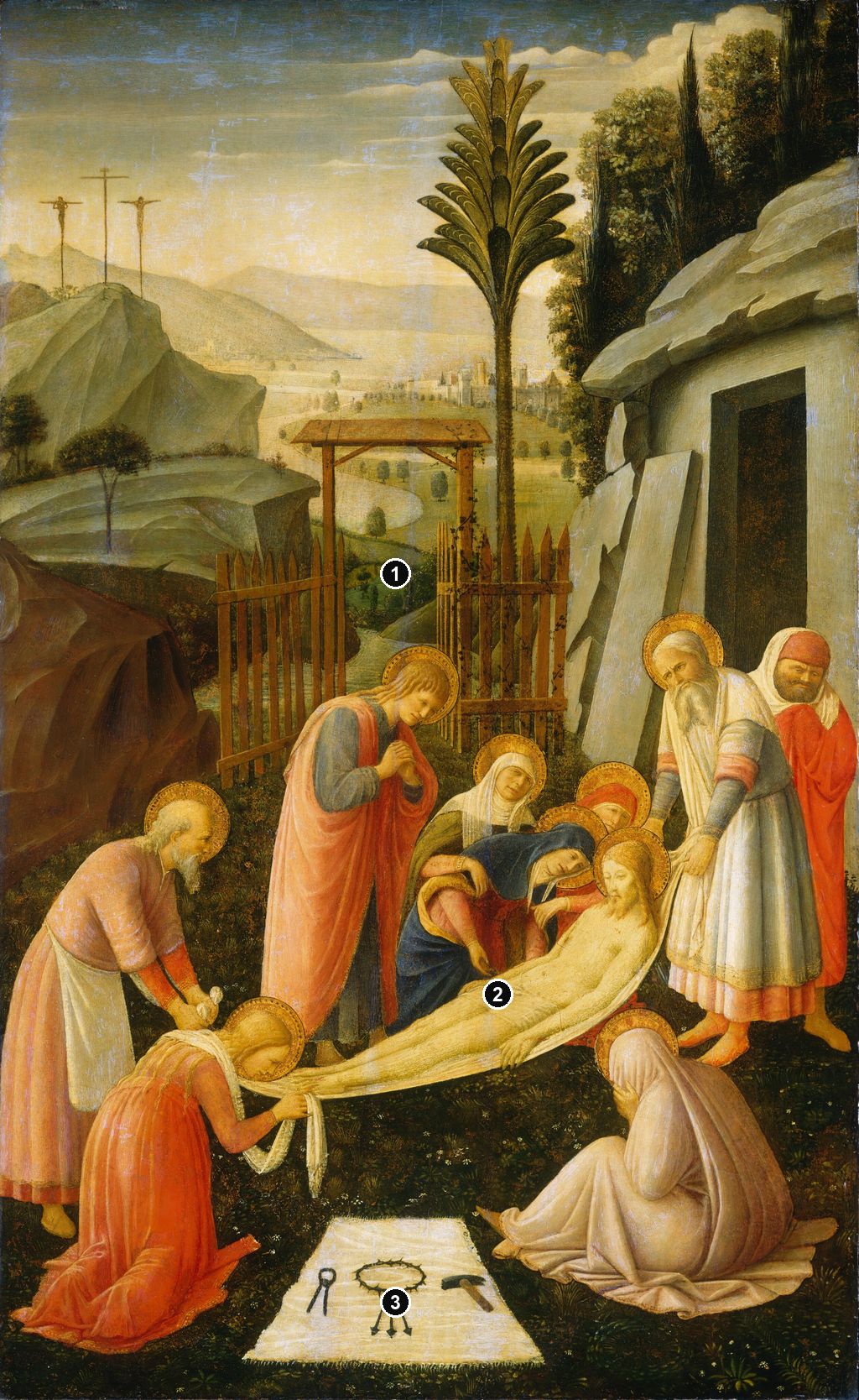
Details from FROM THE GATE TO THE TOMB
Compare the cropped details with the source images above. Notice how their colours, shapes and positions contribute to the larger compositions.
The gate beyond the mourners
The upright gate opens onto a road and a distant settlement. Its narrow opening carries the eye beyond the crowded foreground.
Hands carrying the body
Christ’s body rests on a cloth held at both ends. The cloth dips between the figures supporting it and directs the eye towards the tomb.
The objects on the cloth
The hammer, pincers and crown of thorns are set apart on a pale cloth beneath the mourners.
A Medici inventory and a disputed attribution
A possible early sighting comes from the inventory drawn up in 1492 after the death of Lorenzo de’ Medici. Under the heading for the antechamber to Lorenzo’s room, it lists a small panel by Fra Giovanni showing the dead Christ being carried to the tomb by saints. Frida Schottmüller proposed the identification with the Washington painting in 1924. The National Gallery of Art gives weight to the relatively unusual subject, and the entry’s emphasis on the procession fits what the panel shows especially well. The inventory gives no dimensions or distinctive detail such as the garden gate or the cloth of instruments. If the identification is right, it places the painting in a Medici household by 1492. Its original patron, intended setting and route out of the collection remain unknown. [1] [4] [5]
The National Gallery of Art currently names Fra Angelico as the artist. Earlier scholars differed over both design and execution. In her 1966 Kress catalogue, Fern Rusk Shapley singled out the two foreground mourners, especially the seated woman, as figures that had suggested the participation of Filippo Lippi. She also recorded extensive wear and repainting in the sky and landscape. Carlo Ludovico Ragghianti credited Angelico and Lippi in 1980, while the 1984 Museo Bardini catalogue listed Angelico and collaborators. In 1992 Nicoletta Pons proposed that Angelico began the panel and Jacopo del Sellaio finished it in Lippi’s workshop. A handwritten note by Federico Zeri on the back of a photograph names Angelico and Sellaio together. The debate continued around the Boston exhibition. Gerardo de Simone credited both men in 2017, and Laurence Kanter favoured Sellaio in his 2018 review. The foreground figures that drew Shapley’s eye still reward study, although the differences she observed leave room for several accounts of how the picture was made. [1] [5] [6]
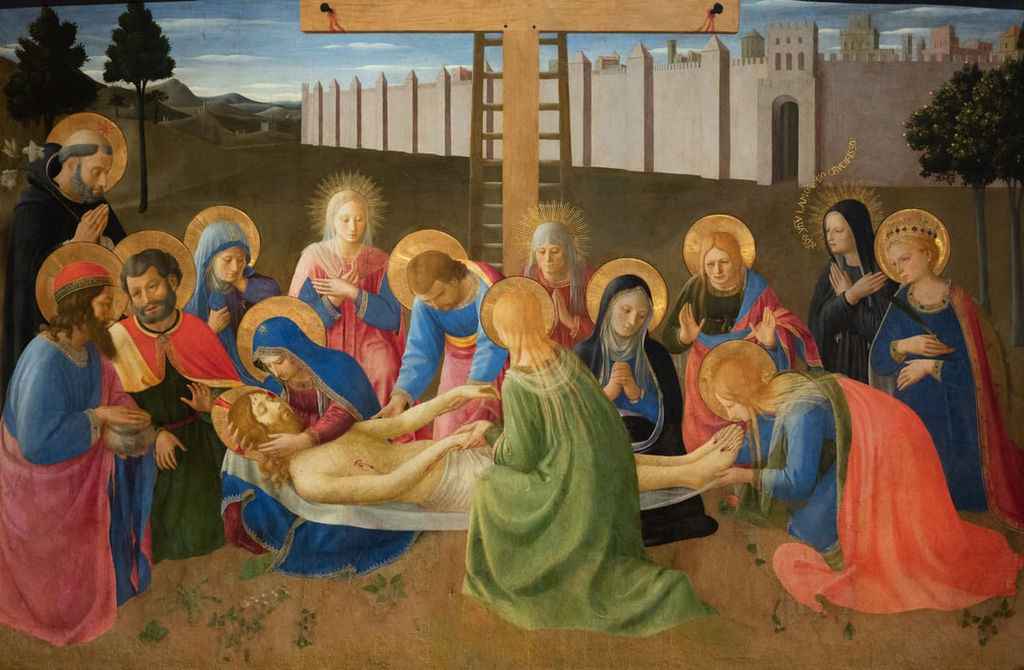
The Florentine Lamentation associated with Blessed Villana. The visible cross and ladders separate the gathering from the walled town. Image source. Public domain. Proportional web resize.
From Florence to Washington
The panel passed through Stefano Bardini and Luigi Grassi in Florence. Duveen Brothers bought it in January 1923 and shipped it to New York that spring. By February 1924 Bernard Berenson was congratulating the collector Henry Goldman on his acquisition, and later that year the painting appeared in a loan exhibition at Duveen under the title The Deposition. Duveen sold it in March 1937 to the Samuel H. Kress Foundation in a group of twenty-four paintings. It entered the National Gallery of Art as a gift in 1939. [1]
The Gallery completed a conservation treatment in 2018, when the panel went to Boston for Fra Angelico: Heaven on Earth. The Isabella Stewart Gardner Museum announced that the restored work would be publicly shown for the first time in more than forty years. The Gardner presented it as an altarpiece. The original setting remains unidentified, so the Boston installation belongs to the panel’s modern history. The Gallery’s annual report records completion of the treatment. Shapley’s description of the worn and repainted landscape gives a much earlier account of the surface. [5] [7] [8]
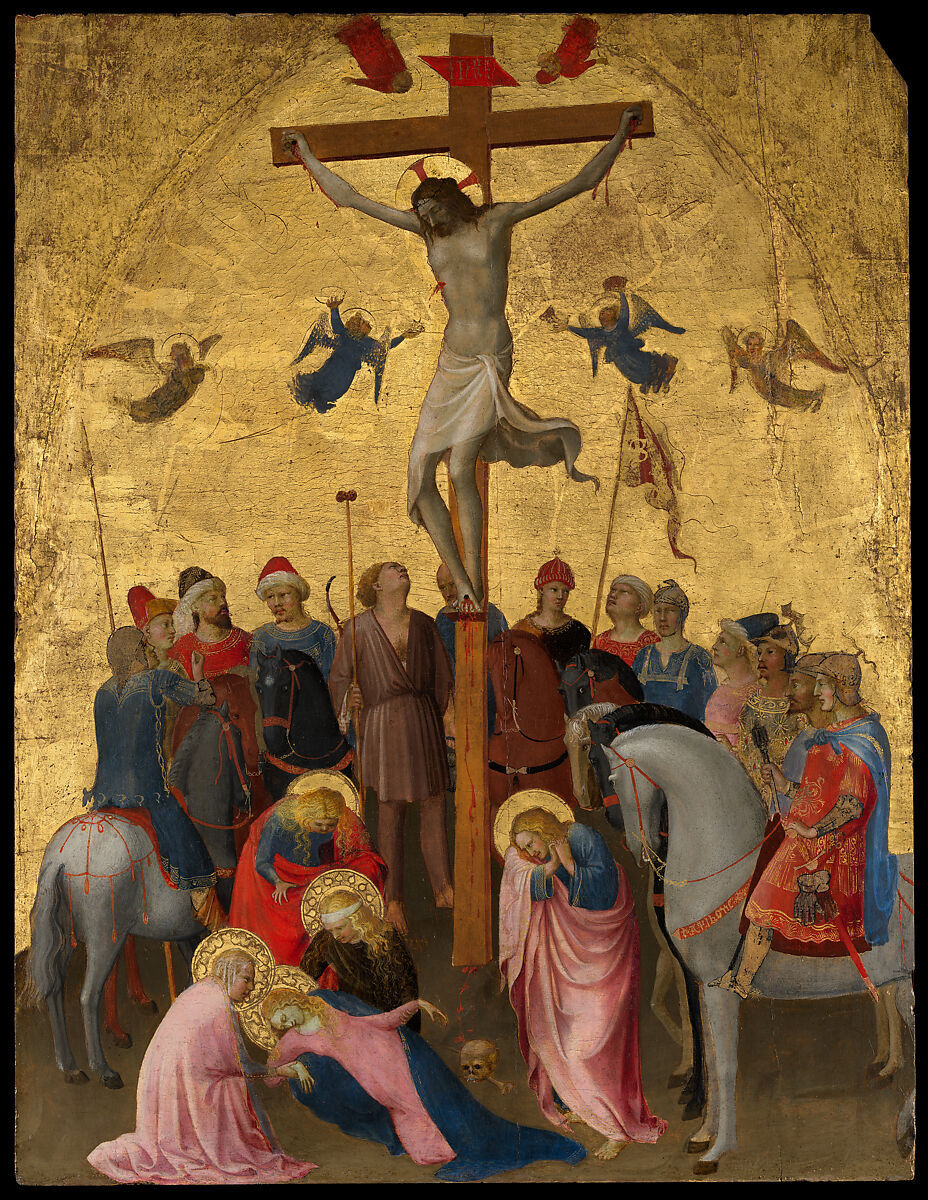
The Griggs Crucifixion, Metropolitan Museum of Art accession 43.98.5. The Virgin collapses as the soldiers and their horses form a group behind the cross. The Metropolitan Museum of Art. Image source. CC0 / Public domain. Proportional web resize.
Other treatments of the burial and mourning
The smaller, horizontal Entombment of Christ at the Alte Pinakothek in Munich dates from 1438–40. It occupied the centre of the San Marco Altarpiece predella, the painted strip below the main panel, where it divided scenes from the lives of Saints Cosmas and Damian. Its mourners gather close to the tomb and hold Christ’s torso upright. The Washington painting has a different emphasis. The men carry Christ in a broad sling and the upright format makes room for the route from the crosses to the garden. Palazzo Strozzi’s 2025 reconstruction of the altarpiece places the Munich scene between the companion panels, beneath the Madonna and saints. In that setting, Christ’s burial anchors a whole row of pictures about the sufferings of others. [1] [9] [10]
At the convent of San Marco, the fresco in cell 2 brings the mourners close to the rock and the open sarcophagus. It was painted on the wall of a friar’s cell. The Santa Trinita Deposition, an altarpiece for the Strozzi family chapel, stages the earlier moment of lowering Christ from the cross with ladders. The Croce al Tempio Lamentation is a large panel made for a Florentine confraternity whose members helped prepare condemned prisoners for death and burial. Its mourners gather around the body after the descent. Each work puts a different part of the story within reach of its viewers. In Washington, the action remains suspended between the woman at Christ’s feet and the man approaching the tomb. [1] [11] [12] [13] [14]
Fra Angelico artworks directory
Explore documented works and surviving parts of larger ensembles. Catalogue links identify individual records. Attribution and dating can vary across collections and publications. Search the Federico Zeri Photo Archive by artist.
| Name | Date | Medium and sources |
|---|---|---|
| Adoration of the Magi | About 1440–60, NGA catalogue | Painting Catalogue. |
| Adoration of the Magi (Armadio degli Argenti) | About 1450–53 | Tempera and gold on wood. Catalogue. |
| Agony in the Garden (Armadio degli Argenti) | About 1450–53 | Tempera and gilding on wood Catalogue. |
| Annalena Altarpiece / Pala di Annalena | commonly c. 1435 | Tempera on panel Catalogue. |
| Annunciation (Armadio degli Argenti) | About 1450–53 | Tempera and gilding on wood. Catalogue. |
| Annunciation (Cortona) | generally placed in the 1430s; exact dating remains debated | Tempera on panel Catalogue. |
| Annunciation (Prado) | 1425–26 | Tempera on poplar panel Catalogue. |
| Annunciation (San Marco upper corridor) | commonly c. 1442 | Fresco Catalogue. |
| Annunciation with Saint Peter Martyr | About 1439–43 | Fresco on plaster. Catalogue. |
| Annunciatory Angel | 1450–55, Detroit catalogue | Gold leaf and tempera on wood panel. Catalogue. |
| Armadio degli Argenti (Silver Treasury) | principally c. 1450–52 | Tempera on panel Catalogue. |
| Arrest of Christ (Armadio degli Argenti) | About 1450–53 | Tempera and gilding on wood Catalogue. |
| Ascension (Armadio degli Argenti) | About 1450–53 | Tempera and gilding on wood Catalogue. |
| Baptism of Christ (Armadio, Alesso Baldovinetti) | About 1452–53 | Tempera and gilding on wood Catalogue. |
| Beheading of Saints Cosmas and Damian (San Marco Altarpiece) | About 1438–42 | Painted panel Catalogue. |
| Betrayal of Christ (Armadio degli Argenti) | About 1450–53 | Tempera and gilding on wood Catalogue. |
| Blessed Dominican, Possibly Jordan of Saxony (San Marco Altarpiece) | About 1438–42 | Painted panel Catalogue. |
| Blessed Vincent Ferrer (San Marco Altarpiece) | About 1438–42 | Painted panel Catalogue. |
| Burial of Saints Cosmas and Damian (San Marco Altarpiece) | About 1438–42 | Painted panel Catalogue. |
| Bust of a Cleric and a Group of Figures (recto and verso) | 15th century | Pen and ink on paper Catalogue. |
| Christ among the Doctors (Armadio degli Argenti) | About 1450–53 | Tempera and gilding on wood Catalogue. |
| Christ before Caiaphas (Armadio degli Argenti) | About 1450–53 | Tempera and gilding on wood Catalogue. |
| Christ Glorified in the Court of Heaven | About 1423–24 | Egg tempera on wood, probably poplar, with gold and silver leaf Catalogue. |
| Christ Seated in Judgment | 1447 | Fresco and gilding on plaster. Catalogue. |
| Christ Stripped of His Garments (Armadio degli Argenti) | About 1450–53 | Tempera and gilding on wood Catalogue. |
| Christ Washes the Apostles’ Feet (Armadio degli Argenti) | About 1450–53 | Tempera and gilding on wood Catalogue. |
| Circumcision of Christ (Armadio degli Argenti) | About 1450–53 | Tempera and gilding on wood. Catalogue. |
| Communion of the Apostles (Armadio degli Argenti) | About 1450–53 | Tempera and gilding on wood Catalogue. |
| Coronation of the Virgin (Armadio degli Argenti) | About 1450–53 | Tempera and gilding on wood Catalogue. |
| Coronation of the Virgin (Louvre) | Louvre: second quarter of the fifteenth century, 1425–50; often dated more narrowly c. 1434–35 | Tempera and gold on panel Catalogue. |
| Coronation of the Virgin (Uffizi) | 1431–35 | Tempera on wood, gold ground Catalogue. |
| Cortona Triptych | About 1437 | Tempera and gold on panel. Catalogue. |
| Crucifixion (Armadio degli Argenti) | About 1450–53 | Tempera and gilding on wood Catalogue. |
| Crucifixion and Saints | 1441–42 | Fresco Catalogue. |
| Deposition from the Cross / Santa Trinita Deposition | commissioned 1429–32; completed by Angelico within this period | Tempera on panel Catalogue. |
| Descent into Limbo (Armadio degli Argenti) | About 1450–53 | Tempera and gilding on wood Catalogue. |
| Entombment of Christ (San Marco Altarpiece) | About 1438–42 | Painted panel Catalogue. |
| Entry into Jerusalem (Armadio degli Argenti) | About 1450–53 | Tempera and gilding on wood Catalogue. |
| Expulsion and the Stoning of Saint Stephen | 1448–49, Vatican Museums | Fresco. Catalogue. |
| Fiesole San Domenico Altarpiece | early 1420s; predella about 1423–24 | Tempera on panel Catalogue. |
| Flagellation (Armadio degli Argenti) | About 1450–53 | Tempera and gilding on wood Catalogue. |
| Flight into Egypt | About 1450–53 | Tempera and gilding on wood. Catalogue. |
| Guidalotti Polyptych | c. 1447–49 | Tempera and oil on panel Catalogue. |
| Healing of Palladia and Saint Damian Accepting Her Gift (San Marco Altarpiece) | About 1438–42 | Painted panel Catalogue. |
| Holy Pilgrim, Possibly Saint Roch (San Marco Altarpiece) | About 1438–42 | Painted panel Catalogue. |
| Holy Women at the Tomb (Armadio degli Argenti) | About 1450–53 | Tempera and gilding on wood Catalogue. |
| Judas Receives Payment (Armadio degli Argenti) | About 1450–53 | Tempera and gilding on wood Catalogue. |
| Lamentation over Christ (Armadio degli Argenti) | About 1450–53 | Tempera and gilding on wood Catalogue. |
| Lamentation over the Dead Christ (Croce al Tempio Lamentation) | 1436–41, Zeri catalogue | Tempera and gilding on wood panel. Catalogue. |
| Last Judgement (Armadio degli Argenti) | About 1450–53 | Tempera and gilding on wood Catalogue. |
| Last Judgement (San Marco) | c. 1425–28 | Tempera and gold on panel Catalogue. |
| Last Supper (Armadio degli Argenti) | About 1450–53 | Tempera and gilding on wood Catalogue. |
| Lex Amoris (Armadio degli Argenti) | About 1450–53 | Tempera and gilding on wood Catalogue. |
| Madonna and Child with Saint Dominic and Saint Thomas Aquinas | About 1430, Hermitage catalogue | Detached fresco. Catalogue. |
| Madonna and Child with Saints | About 1411–13 | Tempera on wood panel, with a gold ground. Catalogue. |
| Madonna of Humility | About 1425, Thyssen catalogue | Tempera and gold on wood. Catalogue. |
| Madonna of the Star | 1431–34, Zeri catalogue | Tempera with oil glazes and gold on wood panel, as catalogued by the Gardner for the 2018 exhibition. Catalogue. |
| Marriage at Cana (Armadio, Alesso Baldovinetti) | About 1452–53 | Tempera and gilding on wood Catalogue. |
| Massacre of the Innocents (Armadio degli Argenti) | About 1450–53 | Tempera and gilding on wood Catalogue. |
| Miracle of the Black Leg (San Marco Altarpiece) | About 1438–42 | Painted panel Catalogue. |
| Mocking of Christ (Armadio degli Argenti) | About 1450–53 | Tempera and gilding on wood Catalogue. |
| Mystic Wheel (The Vision of Ezekiel) | About 1450–52 | Tempera and gilding on wood. Catalogue. |
| Nativity (Armadio degli Argenti) | About 1450–53 | Tempera and gilding on wood. Catalogue. |
| Niccoline Chapel frescoes | principally 1448–50 | Fresco Catalogue. |
| Noli me Tangere | broadly within Angelico’s San Marco campaign, late 1430s–1440s | Fresco Catalogue. |
| Ordination of Saint Lawrence | 1448 | Fresco. Catalogue. |
| Pentecost (Armadio degli Argenti) | About 1450–53 | Tempera and gilding on wood Catalogue. |
| Presentation of Christ at the Temple (Armadio degli Argenti) | About 1450–53 | Tempera and gilding on wood. Catalogue. |
| Presentation of Jesus at the Temple | Early 1440s | Fresco on plaster. Catalogue. |
| Raising of Lazarus (Armadio degli Argenti) | About 1450–53 | Tempera and gilding on wood Catalogue. |
| Rescue of Saints Cosmas and Damian and Exorcism of Lysias (San Marco Altarpiece) | About 1438–42 | Painted panel Catalogue. |
| Road to Calvary (Armadio degli Argenti) | About 1450–53 | Tempera and gilding on wood Catalogue. |
| Saint Anthony Abbot (San Marco Altarpiece) | About 1438–42 | Painted panel Catalogue. |
| Saint Bernard of Clairvaux or Saint Benedict (San Marco Altarpiece) | About 1438–42 | Painted panel Catalogue. |
| Saint Damian Receives Money from Palladia | About 1425–49 | Tempera and gilding on wood. Catalogue. |
| Saint Francis and a Bishop Saint, Saint John the Baptist and Saint Dominic | Late 1420s, Getty catalogue | Tempera and gold leaf on panel. Catalogue. |
| Saint James the Greater Freeing the Magician Hermogenes | About 1426–29 | Tempera and gold on panel Catalogue. |
| Saint Jerome (San Marco Altarpiece) | About 1438–42 | Painted panel Catalogue. |
| Saint Lawrence Giving Alms | About 1448 | Wall fresco. Catalogue. |
| Saint Lawrence Receiving the Treasures of the Church from Pope Sixtus II | About 1448–49 | Fresco on plaster. Catalogue. |
| Saint Romuald (San Marco Altarpiece) | About 1438–42 | Painted panel Catalogue. |
| Saint Stephen Addressing the Council | 1448–49, Vatican Museums | Fresco. Catalogue. |
| Saint Stephen Preaching | 1448–49, Vatican Museums | Wall fresco. Catalogue. |
| Saint Thomas Aquinas (San Marco Altarpiece) | About 1438–42 | Painted panel Catalogue. |
| Saints Cosmas and Damian and Their Brothers Survive the Stake | Second quarter of the 15th century | Tempera and gilding on wood. Catalogue. |
| Saints Cosmas and Damian at the Stake (San Marco Altarpiece) | About 1438–42 | Painted panel Catalogue. |
| Saints Cosmas and Damian before Lysias (San Marco Altarpiece) | About 1438–42 | Painted panel Catalogue. |
| Saints Cosmas and Damian Rescued by an Angel | Second quarter of the 15th century | Tempera and gilding on wood. Catalogue. |
| Saints Cosmas and Damian with Their Brothers before Proconsul Lysias | Second quarter of the 15th century | Tempera and gilding on wood. Catalogue. |
| San Marco Altarpiece / Pala di San Marco | 1438–43 | Tempera on panel Catalogue. |
| San Pietro Martire Triptych | About 1422–23, Strozzi exhibition | Tempera and gold on panel. Catalogue. |
| Scenes from the Lives of the Desert Fathers (Thebaid) | About 1420, Uffizi catalogue | Tempera on wood. Catalogue. |
| Sixteen Prophets | 1447 | Fresco and gilding on plaster Catalogue. |
| Stoning and Shooting of the Brothers (San Marco Altarpiece) | About 1438–42 | Painted panel Catalogue. |
| Tabernacle of the Linaioli | 1433–35 | Tempera on panel Catalogue. |
| The Attempted Crucifixion and Stoning of Saints Cosmas and Damian | Second quarter of the 15th century | Tempera and gilding on wood. Catalogue. |
| The Crucifixion | About 1420–23, Met catalogue | Tempera on wood, gold ground. Catalogue. |
| The Death and the Assumption of the Virgin | 1424–34 | Tempera with oil glazes and gold on panel Catalogue. |
| The Dominican Blessed (left end) (Fiesole predella) | About 1423–24 | Egg tempera and gold on wood Catalogue. |
| The Dominican Blessed (right end) (Fiesole predella) | About 1423–24 | Egg tempera and gold on wood Catalogue. |
| The Entombment of Christ | About 1450 | Tempera on poplar panel. Catalogue. |
| The Forerunners of Christ with Saints and Martyrs | About 1423–24 | Egg tempera on wood (probably poplar), with gold and silver leaf. Catalogue. |
| The Funeral of Saint Anthony Abbot | About 1426–30 | Tempera on poplar panel. Catalogue. |
| The Martyrdom of Saints Cosmas and Damian | About 1425–49 | Tempera and gilding on wood. Catalogue. |
| The Mocking of Christ / Christ Mocked | within the San Marco dormitory campaign, broadly late 1430s–1440s | Fresco Catalogue. |
| The Nativity | About 1425, Minneapolis catalogue | Tempera on poplar panel. Catalogue. |
| The Nativity in Cell 5 at San Marco | About 1439–43 | Fresco on plaster. Catalogue. |
| The Penitent Saint Jerome | 1419–20 | Tempera on wood panel Catalogue. |
| The Virgin and Child by Fra Angelico (Fogg Museum) | About 1430, Harvard catalogue | Tempera originally on panel, subsequently transferred to Masonite. Catalogue. |
| The Virgin Mary with the Apostles and Other Saints (Fiesole predella) | About 1423–24 | Egg tempera and gold on wood Catalogue. |
| Transfiguration (Armadio, Alesso Baldovinetti) | About 1452–53 | Tempera and gilding on wood Catalogue. |
| Transfiguration (San Marco Cell 6) | within the San Marco dormitory campaign, broadly late 1430s–1440s | Fresco Catalogue. |
| Virgin Mary Annunciate | 1450–55, Detroit catalogue | Gold leaf and tempera on wood panel. Catalogue. |
| Virgin of the Pomegranate | About 1426 | Tempera on panel with gilding Catalogue. |
Frequently Asked Questions
The mourners are carrying Christ to the open tomb after the Crucifixion. The empty central cross on the distant hill and the doorway at the right mark the beginning and end of that short journey. [1]
Discussion
Use these prompts to look again or share an observation.
Reader Insights
Where does the weight of Christ’s body become visible in the way the people carrying him bend or look down?
How does the opening behind the figures organise the action in the narrow foreground of the small panel?
Join the Conversation
Share a detail or question about The Entombment of Christ.
References
- National Gallery of Art, The Entombment of Christ, object 401, accession 1939.1.260, artwork overview, provenance, exhibition history and bibliography. View source.
- United States Conference of Catholic Bishops, John 19:38–42, the burial of Jesus. View source.
- United States Conference of Catholic Bishops, Matthew 27:57–61, the burial of Jesus. View source.
- Eugène Müntz, Les collections des Médicis au XVe siècle (1888), p. 64, transcription of the 1492 inventory, fol. 16v. View source.
- Fern Rusk Shapley, Paintings from the Samuel H. Kress Collection: Italian Schools, XIII–XV Century (1966), pp. 97–98, K477. View source.
- Fondazione Federico Zeri, Deposizione di Cristo nel sepolcro, record 17738, attribution and photographic archive. View source.
- National Gallery of Art, 2018 Annual Report, painting conservation and loans. View source.
- Isabella Stewart Gardner Museum, Fra Angelico: Heaven on Earth, exhibition announcement. View source.
- Bayerische Staatsgemäldesammlungen, The Entombment of Christ, Alte Pinakothek, WAF 38 a. View source.
- Fondazione Palazzo Strozzi, La Pala di San Marco, reconstruction and component list. View source.
- Museo di San Marco, Il canone di Beato Angelico e le 4 eccezioni, comparison with the Lamentation in cell 2. View source.
- Carissa M. DiCindio, Fra Angelico’s Tempio Lamentation: A Consideration of Its Function and Meaning (2004), p. 19 and fig. 8. View source.
- Museo di San Marco, La Deposizione Strozzi di Beato Angelico torna al Museo di San Marco, commission and description. View source.
- Museo di San Marco, I “pietrini”: memorie cittadine nei sotterranei del Museo di San Marco, the Croce al Tempio confraternity and its Lamentation. View source.
.jpg)



 Fra Angelico.jpg)


