


 by Tom Gurney
Tom Gurney BSc (Hons) is an art history expert with over 20 years experience
Published on June 19, 2020 / Updated on November 29, 2026
Email: tomgurney1@gmail.com / Phone: +44 7429 011000
Introduction
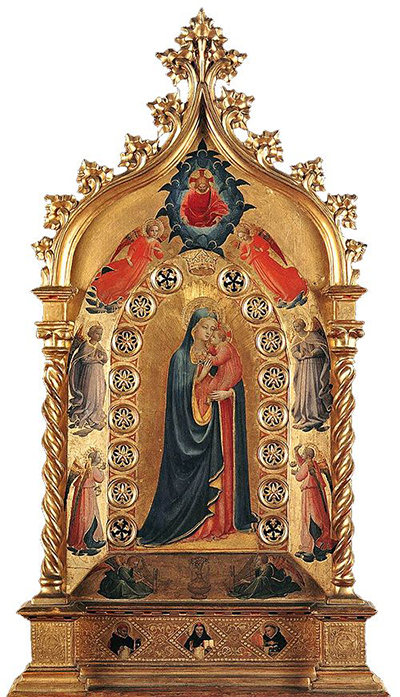
Mary holds the Christ Child close enough for their cheeks to touch. Around them a band of gilded roundels rises from the hem of her blue mantle to the crown above her head. The pair stand at the centre of Fra Angelico’s Madonna of the Star, a painted reliquary made for Santa Maria Novella in Florence. Now in the Museo di San Marco, it is one of four tabernacles in which Angelico brought scenes and images of the Virgin into the same space as relics. [1] [2]
At a Glance
- ArtistFra Angelico (Guido di Pietro). [1]
- Italian titleMadonna della Stella. [1]
- Date1431–34 in the Fondazione Federico Zeri catalogue. The Gardner’s 2018 exhibition used 1424–34. [1] [2]
- MediumTempera with oil glazes and gold on wood panel, as catalogued by the Gardner for the 2018 exhibition. [2]
- Dimensions84 × 51 cm in the Zeri record. The Gardner lists 87 × 51.8 cm. [1] [2]
- Original settingThe Dominican church of Santa Maria Novella, Florence. [1]
- CollectionMuseo di San Marco, Florence. [1]
Mary and the Child in the gold
The Child is set high against Mary’s left side. She turns towards him, her head inclined and one hand spread beneath him. His reddish garment picks up the warmer colours where her cloak opens, while her dark blue mantle joins the heads and hands to the long fall of fabric below. The curve of the cloak at the floor gives the standing figure a firm base. The art historian Giovanni Giura draws attention to the way Mary’s three-quarter turn gives the bodies room against the brilliant gold. The small overlap of the faces does as much to suggest depth as the modelling of the folds. [2] [3]
Fine gold rays extend outwards behind the pair. They belong to a larger field of radiance that reaches from Mary’s body to the crown and the figure in the apex. Alison Wright places the painting in a tradition of radiant images of the Virgin and reads the upper figure, looking down from among the cherubim, as Christ in heaven. The Zeri catalogue likewise identifies him as Christ the Redeemer. Giura’s text calls him God the Father. The figure’s position makes the relationship legible even across those different identifications. Follow his downward gaze past the crown and the splendour at the tip of the tabernacle centres on the closeness of mother and child. [1] [3] [4]
The eight larger angels change their poses as the space around Mary narrows. The pair in red near the crown tilt inwards, while the upright figures at the sides follow the verticals of the surround. In the shallow strip at Mary’s feet, two angels seen from behind attend to incense. Giura compares the variety of the angels’ poses with figures in Angelico’s Last Judgement at San Marco and points ahead to the angels of the Tabernacle of the Linaioli. Here, the two backs at the bottom help place the viewer among figures facing in towards the Virgin. [1] [3]
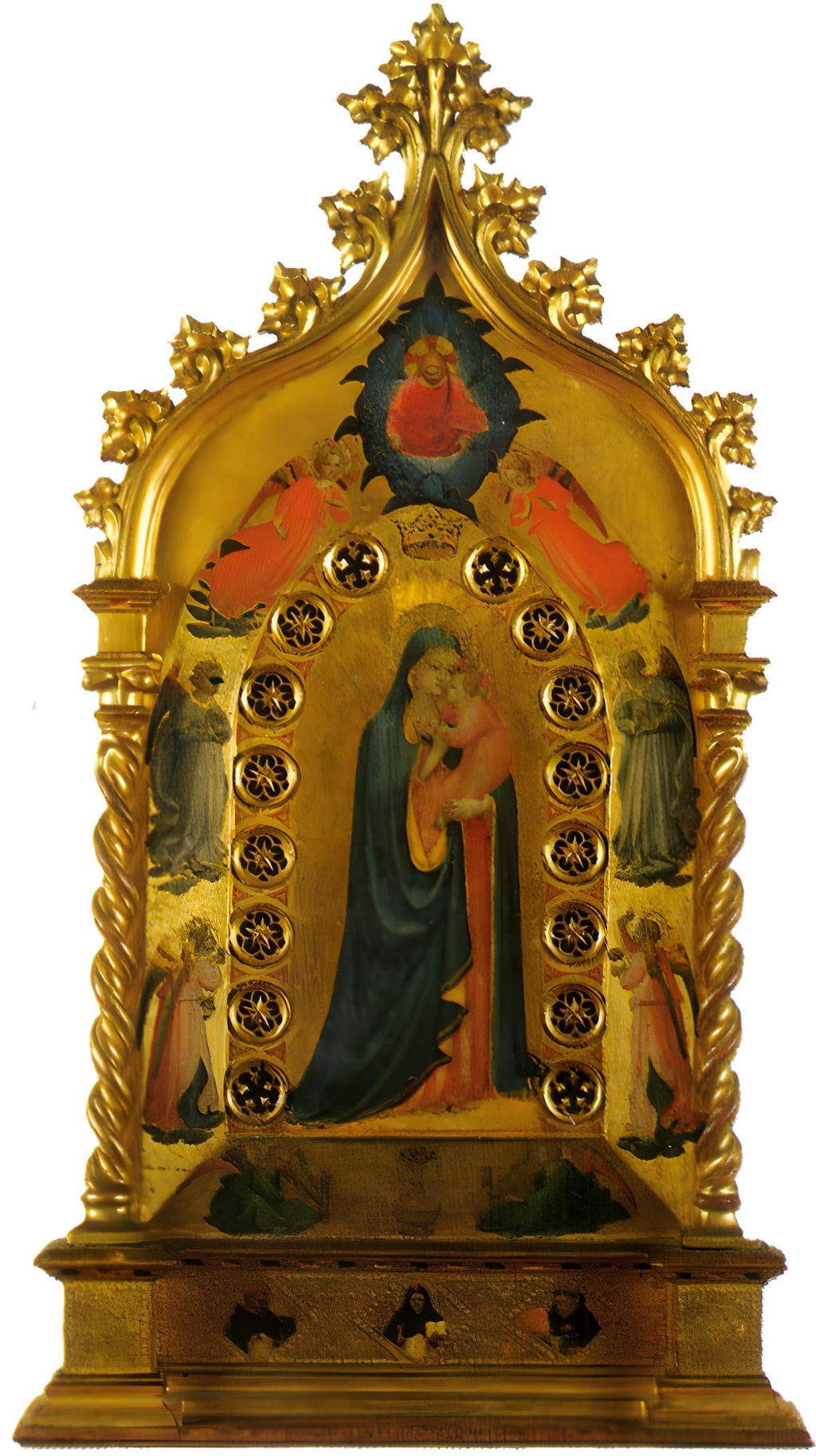
The Madonna of the Star on display with its architectural surround. Compare the central figures with the small images encircling them. Image source. Public domain. Proportional web resize.
The star-shaped apertures
The gold roundels invite a closer look. Giura connects the name Madonna della Stella with the gilded openwork around Mary. Some of the patterns resemble flowers at a distance. Seen more closely, the dark openings make the gold read as pierced work, distinct from the fine rays around Mary’s mantle. The eye moves from a painted effect of light to a series of small openings in the object itself. The band has no counterpart beneath Mary’s feet. There the floor of the central image meets the painted strip with the incense-bearing angels, setting a limit to the upright figure even as the gold carries the eye upwards. [3] [5]
Beth Williamson counts sixteen apertures and identifies them as possible remains of the original relic chambers. She suggests that the painted surfaces on either side helped preserve the apertures, since removing them would have cost part of the image of the angels. The elaborate pointed surround we see today, with its twisted columns and carved foliage, belongs to an assembly whose original outer frame is lost. The surviving band gives some idea of where relics could be seen in relation to the painting, although their precise arrangement and appearance remain uncertain. [5]
An earlier Sienese example shows what such a pairing of image and relic could achieve. Naddo Ceccarelli’s tabernacle in the Walters Art Museum sets a standing Virgin and Child within tiers of small glass windows. Relics survive in its frame, accompanied by slips identifying them. The windows occupy a place in the composition as deliberately as the painted figures do. Williamson relates Angelico’s work to this type of painted reliquary. The comparison brings out the importance of the starred band in the Florence object while leaving open how individual relics were covered or arranged there. [5] [6]
A reliquary for Santa Maria Novella
The narrow painted base, or predella, brings the commission into focus. It shows three Dominican saints in separate compartments: Dominic, Peter Martyr and Thomas Aquinas. Their scale and the geometry of their compartments give the base a steady horizontal rhythm beneath the tall arch. The order to which they belonged kept the tabernacle at Santa Maria Novella. Fra Giovanni di Zanobi Masi, the Dominican sacristan, commissioned the four reliquaries for the church’s sacristy. The Museo di San Marco notes that they were placed on the altar for solemn feasts. An object measured in centimetres could therefore have a ceremonial place in a large church. [1] [3] [7] [8]
Masi is documented as sacristan in 1424 and died in 1434. Those years frame the wider dating used by San Marco and the Gardner. The Zeri catalogue places this particular work towards the end of that span, in 1431–34, while Giura’s caption proposes 1425–30. The Palazzo Strozzi exhibition guide places the making of the group before Masi’s death. An Italian state catalogue entry for a companion tabernacle treats his death as a limit for the commission and leaves open the possibility that work continued afterwards. There is room within this evidence for the four objects to have been painted at different times. [1] [2] [3] [7] [8] [9]
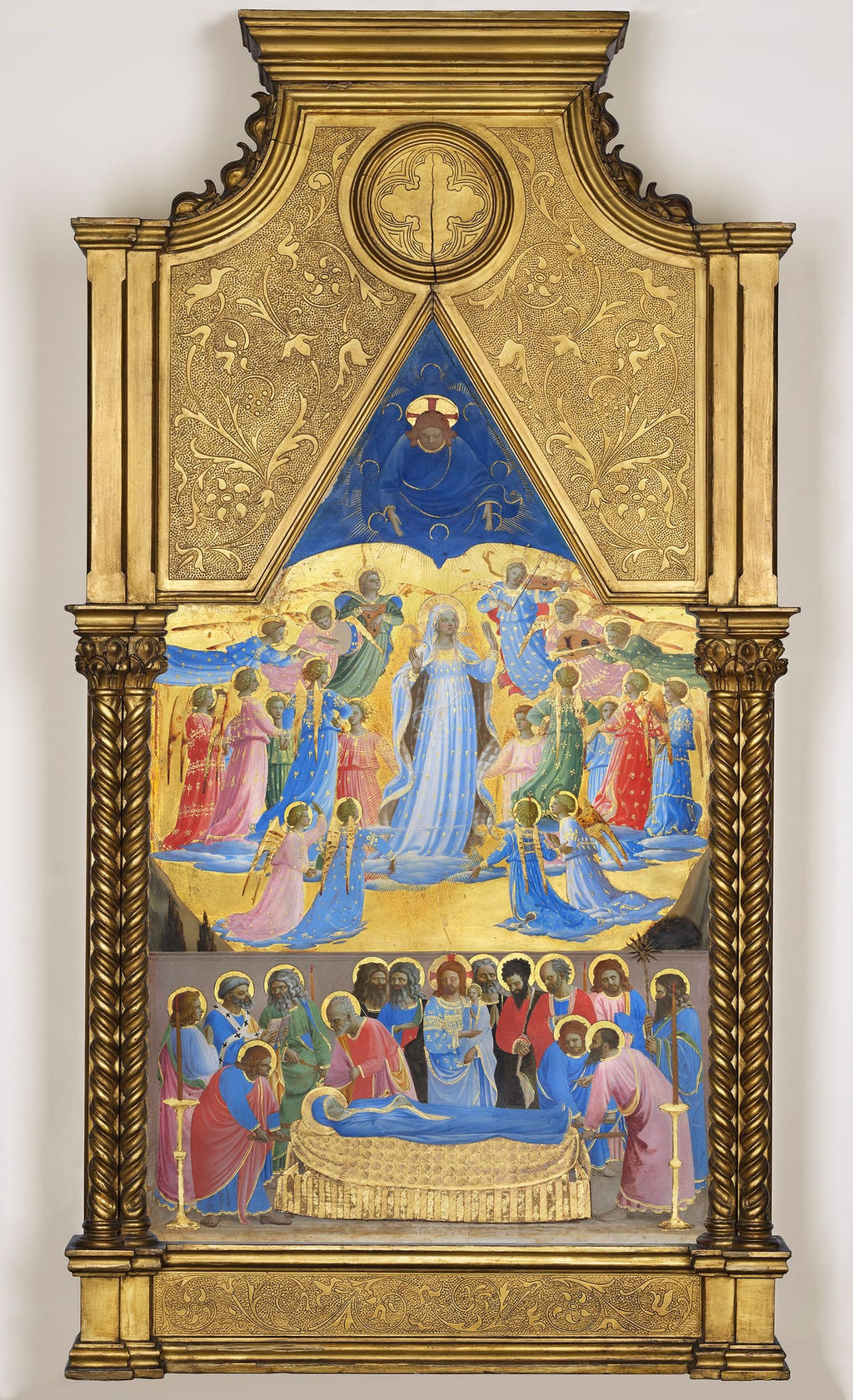
The Gardner reliquary in its architectural surround. The lower funeral and the upright Virgin above share the painted field. Image source. Public domain. Proportional web resize.
Four images of Mary
The two other reliquaries at San Marco are the Annunciation and Adoration of the Magi and the Coronation of the Virgin. The fourth, the Gardner’s Dormition and Assumption of the Virgin, shows Mary twice, stretched out on her bier below and rising upright above. In the Madonna of the Star, the embrace holds the centre from top to bottom. The crown overhead can bring Mary’s eventual glorification to mind while the Child still presses against her cheek. Seen together, the reliquaries give the same subject different kinds of time. The Boston painting takes the viewer from one event to the next. The Florence Madonna invites the eye to return to a single presence. [3] [4] [5] [7]
From the church to the museum
The three Florence reliquaries passed from Santa Maria Novella to San Marco in the nineteenth century. Writing about the 2018 reunion, art historian Xavier F. Salomon dates the transfer to 1868. San Marco formally opened as a museum the following year. [10] [11]
Archival photographs record the work under its familiar title at San Marco. The Musée d’Orsay holds an albumen print by Edizioni Brogi that names the museum and the Madonna della Stella in its title. The museum setting brought a different history. In November 1911 the tabernacle was stolen from cell 33 of the former dormitory and recovered within days. The Museo di San Marco’s account of its director Guido Carocci places the theft in the ensuing debate about how the collection was guarded. Nearly a century later the tabernacle travelled to the Musei Capitolini in Rome for the 2009 exhibition Beato Angelico. L’alba del Rinascimento. [1] [12] [13]
In 2018 the Gardner brought the four reliquaries together in Boston for Fra Angelico: Heaven on Earth, following restoration undertaken in collaboration with San Marco. In the latter museum’s rehung Sala del Beato Angelico, opened in 2021, the three Florence works were displayed in individual cases along the same wall. The four came together again at Palazzo Strozzi in the 2025–26 Fra Angelico exhibition. These groupings make it possible to compare works of different sizes and shapes. In the Madonna of the Star, the gold rays seem to widen the space around Mary, while the band of apertures gives that radiance a physical edge. Both effects depend on how close the viewer can come. [5] [8] [11] [14]
Fra Angelico artworks directory
Explore documented works and surviving parts of larger ensembles. Catalogue links identify individual records. Attribution and dating can vary across collections and publications. Search the Federico Zeri Photo Archive by artist.
| Name | Date | Medium and sources |
|---|---|---|
| Adoration of the Magi | About 1440–60, NGA catalogue | Painting Catalogue. |
| Adoration of the Magi (Armadio degli Argenti) | About 1450–53 | Tempera and gold on wood. Catalogue. |
| Agony in the Garden (Armadio degli Argenti) | About 1450–53 | Tempera and gilding on wood Catalogue. |
| Annalena Altarpiece / Pala di Annalena | commonly c. 1435 | Tempera on panel Catalogue. |
| Annunciation (Armadio degli Argenti) | About 1450–53 | Tempera and gilding on wood. Catalogue. |
| Annunciation (Cortona) | generally placed in the 1430s; exact dating remains debated | Tempera on panel Catalogue. |
| Annunciation (Prado) | 1425–26 | Tempera on poplar panel Catalogue. |
| Annunciation (San Marco upper corridor) | commonly c. 1442 | Fresco Catalogue. |
| Annunciation with Saint Peter Martyr | About 1439–43 | Fresco on plaster. Catalogue. |
| Annunciatory Angel | 1450–55, Detroit catalogue | Gold leaf and tempera on wood panel. Catalogue. |
| Armadio degli Argenti (Silver Treasury) | principally c. 1450–52 | Tempera on panel Catalogue. |
| Arrest of Christ (Armadio degli Argenti) | About 1450–53 | Tempera and gilding on wood Catalogue. |
| Ascension (Armadio degli Argenti) | About 1450–53 | Tempera and gilding on wood Catalogue. |
| Baptism of Christ (Armadio, Alesso Baldovinetti) | About 1452–53 | Tempera and gilding on wood Catalogue. |
| Beheading of Saints Cosmas and Damian (San Marco Altarpiece) | About 1438–42 | Painted panel Catalogue. |
| Betrayal of Christ (Armadio degli Argenti) | About 1450–53 | Tempera and gilding on wood Catalogue. |
| Blessed Dominican, Possibly Jordan of Saxony (San Marco Altarpiece) | About 1438–42 | Painted panel Catalogue. |
| Blessed Vincent Ferrer (San Marco Altarpiece) | About 1438–42 | Painted panel Catalogue. |
| Burial of Saints Cosmas and Damian (San Marco Altarpiece) | About 1438–42 | Painted panel Catalogue. |
| Bust of a Cleric and a Group of Figures (recto and verso) | 15th century | Pen and ink on paper Catalogue. |
| Christ among the Doctors (Armadio degli Argenti) | About 1450–53 | Tempera and gilding on wood Catalogue. |
| Christ before Caiaphas (Armadio degli Argenti) | About 1450–53 | Tempera and gilding on wood Catalogue. |
| Christ Glorified in the Court of Heaven | About 1423–24 | Egg tempera on wood, probably poplar, with gold and silver leaf Catalogue. |
| Christ Seated in Judgment | 1447 | Fresco and gilding on plaster. Catalogue. |
| Christ Stripped of His Garments (Armadio degli Argenti) | About 1450–53 | Tempera and gilding on wood Catalogue. |
| Christ Washes the Apostles’ Feet (Armadio degli Argenti) | About 1450–53 | Tempera and gilding on wood Catalogue. |
| Circumcision of Christ (Armadio degli Argenti) | About 1450–53 | Tempera and gilding on wood. Catalogue. |
| Communion of the Apostles (Armadio degli Argenti) | About 1450–53 | Tempera and gilding on wood Catalogue. |
| Coronation of the Virgin (Armadio degli Argenti) | About 1450–53 | Tempera and gilding on wood Catalogue. |
| Coronation of the Virgin (Louvre) | Louvre: second quarter of the fifteenth century, 1425–50; often dated more narrowly c. 1434–35 | Tempera and gold on panel Catalogue. |
| Coronation of the Virgin (Uffizi) | 1431–35 | Tempera on wood, gold ground Catalogue. |
| Cortona Triptych | About 1437 | Tempera and gold on panel. Catalogue. |
| Crucifixion (Armadio degli Argenti) | About 1450–53 | Tempera and gilding on wood Catalogue. |
| Crucifixion and Saints | 1441–42 | Fresco Catalogue. |
| Deposition from the Cross / Santa Trinita Deposition | commissioned 1429–32; completed by Angelico within this period | Tempera on panel Catalogue. |
| Descent into Limbo (Armadio degli Argenti) | About 1450–53 | Tempera and gilding on wood Catalogue. |
| Entombment of Christ (San Marco Altarpiece) | About 1438–42 | Painted panel Catalogue. |
| Entry into Jerusalem (Armadio degli Argenti) | About 1450–53 | Tempera and gilding on wood Catalogue. |
| Expulsion and the Stoning of Saint Stephen | 1448–49, Vatican Museums | Fresco. Catalogue. |
| Fiesole San Domenico Altarpiece | early 1420s; predella about 1423–24 | Tempera on panel Catalogue. |
| Flagellation (Armadio degli Argenti) | About 1450–53 | Tempera and gilding on wood Catalogue. |
| Flight into Egypt | About 1450–53 | Tempera and gilding on wood. Catalogue. |
| Guidalotti Polyptych | c. 1447–49 | Tempera and oil on panel Catalogue. |
| Healing of Palladia and Saint Damian Accepting Her Gift (San Marco Altarpiece) | About 1438–42 | Painted panel Catalogue. |
| Holy Pilgrim, Possibly Saint Roch (San Marco Altarpiece) | About 1438–42 | Painted panel Catalogue. |
| Holy Women at the Tomb (Armadio degli Argenti) | About 1450–53 | Tempera and gilding on wood Catalogue. |
| Judas Receives Payment (Armadio degli Argenti) | About 1450–53 | Tempera and gilding on wood Catalogue. |
| Lamentation over Christ (Armadio degli Argenti) | About 1450–53 | Tempera and gilding on wood Catalogue. |
| Lamentation over the Dead Christ (Croce al Tempio Lamentation) | 1436–41, Zeri catalogue | Tempera and gilding on wood panel. Catalogue. |
| Last Judgement (Armadio degli Argenti) | About 1450–53 | Tempera and gilding on wood Catalogue. |
| Last Judgement (San Marco) | c. 1425–28 | Tempera and gold on panel Catalogue. |
| Last Supper (Armadio degli Argenti) | About 1450–53 | Tempera and gilding on wood Catalogue. |
| Lex Amoris (Armadio degli Argenti) | About 1450–53 | Tempera and gilding on wood Catalogue. |
| Madonna and Child with Saint Dominic and Saint Thomas Aquinas | About 1430, Hermitage catalogue | Detached fresco. Catalogue. |
| Madonna and Child with Saints | About 1411–13 | Tempera on wood panel, with a gold ground. Catalogue. |
| Madonna of Humility | About 1425, Thyssen catalogue | Tempera and gold on wood. Catalogue. |
| Madonna of the Star | 1431–34, Zeri catalogue | Tempera with oil glazes and gold on wood panel, as catalogued by the Gardner for the 2018 exhibition. Catalogue. |
| Marriage at Cana (Armadio, Alesso Baldovinetti) | About 1452–53 | Tempera and gilding on wood Catalogue. |
| Massacre of the Innocents (Armadio degli Argenti) | About 1450–53 | Tempera and gilding on wood Catalogue. |
| Miracle of the Black Leg (San Marco Altarpiece) | About 1438–42 | Painted panel Catalogue. |
| Mocking of Christ (Armadio degli Argenti) | About 1450–53 | Tempera and gilding on wood Catalogue. |
| Mystic Wheel (The Vision of Ezekiel) | About 1450–52 | Tempera and gilding on wood. Catalogue. |
| Nativity (Armadio degli Argenti) | About 1450–53 | Tempera and gilding on wood. Catalogue. |
| Niccoline Chapel frescoes | principally 1448–50 | Fresco Catalogue. |
| Noli me Tangere | broadly within Angelico’s San Marco campaign, late 1430s–1440s | Fresco Catalogue. |
| Ordination of Saint Lawrence | 1448 | Fresco. Catalogue. |
| Pentecost (Armadio degli Argenti) | About 1450–53 | Tempera and gilding on wood Catalogue. |
| Presentation of Christ at the Temple (Armadio degli Argenti) | About 1450–53 | Tempera and gilding on wood. Catalogue. |
| Presentation of Jesus at the Temple | Early 1440s | Fresco on plaster. Catalogue. |
| Raising of Lazarus (Armadio degli Argenti) | About 1450–53 | Tempera and gilding on wood Catalogue. |
| Rescue of Saints Cosmas and Damian and Exorcism of Lysias (San Marco Altarpiece) | About 1438–42 | Painted panel Catalogue. |
| Road to Calvary (Armadio degli Argenti) | About 1450–53 | Tempera and gilding on wood Catalogue. |
| Saint Anthony Abbot (San Marco Altarpiece) | About 1438–42 | Painted panel Catalogue. |
| Saint Bernard of Clairvaux or Saint Benedict (San Marco Altarpiece) | About 1438–42 | Painted panel Catalogue. |
| Saint Damian Receives Money from Palladia | About 1425–49 | Tempera and gilding on wood. Catalogue. |
| Saint Francis and a Bishop Saint, Saint John the Baptist and Saint Dominic | Late 1420s, Getty catalogue | Tempera and gold leaf on panel. Catalogue. |
| Saint James the Greater Freeing the Magician Hermogenes | About 1426–29 | Tempera and gold on panel Catalogue. |
| Saint Jerome (San Marco Altarpiece) | About 1438–42 | Painted panel Catalogue. |
| Saint Lawrence Giving Alms | About 1448 | Wall fresco. Catalogue. |
| Saint Lawrence Receiving the Treasures of the Church from Pope Sixtus II | About 1448–49 | Fresco on plaster. Catalogue. |
| Saint Romuald (San Marco Altarpiece) | About 1438–42 | Painted panel Catalogue. |
| Saint Stephen Addressing the Council | 1448–49, Vatican Museums | Fresco. Catalogue. |
| Saint Stephen Preaching | 1448–49, Vatican Museums | Wall fresco. Catalogue. |
| Saint Thomas Aquinas (San Marco Altarpiece) | About 1438–42 | Painted panel Catalogue. |
| Saints Cosmas and Damian and Their Brothers Survive the Stake | Second quarter of the 15th century | Tempera and gilding on wood. Catalogue. |
| Saints Cosmas and Damian at the Stake (San Marco Altarpiece) | About 1438–42 | Painted panel Catalogue. |
| Saints Cosmas and Damian before Lysias (San Marco Altarpiece) | About 1438–42 | Painted panel Catalogue. |
| Saints Cosmas and Damian Rescued by an Angel | Second quarter of the 15th century | Tempera and gilding on wood. Catalogue. |
| Saints Cosmas and Damian with Their Brothers before Proconsul Lysias | Second quarter of the 15th century | Tempera and gilding on wood. Catalogue. |
| San Marco Altarpiece / Pala di San Marco | 1438–43 | Tempera on panel Catalogue. |
| San Pietro Martire Triptych | About 1422–23, Strozzi exhibition | Tempera and gold on panel. Catalogue. |
| Scenes from the Lives of the Desert Fathers (Thebaid) | About 1420, Uffizi catalogue | Tempera on wood. Catalogue. |
| Sixteen Prophets | 1447 | Fresco and gilding on plaster Catalogue. |
| Stoning and Shooting of the Brothers (San Marco Altarpiece) | About 1438–42 | Painted panel Catalogue. |
| Tabernacle of the Linaioli | 1433–35 | Tempera on panel Catalogue. |
| The Attempted Crucifixion and Stoning of Saints Cosmas and Damian | Second quarter of the 15th century | Tempera and gilding on wood. Catalogue. |
| The Crucifixion | About 1420–23, Met catalogue | Tempera on wood, gold ground. Catalogue. |
| The Death and the Assumption of the Virgin | 1424–34 | Tempera with oil glazes and gold on panel Catalogue. |
| The Dominican Blessed (left end) (Fiesole predella) | About 1423–24 | Egg tempera and gold on wood Catalogue. |
| The Dominican Blessed (right end) (Fiesole predella) | About 1423–24 | Egg tempera and gold on wood Catalogue. |
| The Entombment of Christ | About 1450 | Tempera on poplar panel. Catalogue. |
| The Forerunners of Christ with Saints and Martyrs | About 1423–24 | Egg tempera on wood (probably poplar), with gold and silver leaf. Catalogue. |
| The Funeral of Saint Anthony Abbot | About 1426–30 | Tempera on poplar panel. Catalogue. |
| The Martyrdom of Saints Cosmas and Damian | About 1425–49 | Tempera and gilding on wood. Catalogue. |
| The Mocking of Christ / Christ Mocked | within the San Marco dormitory campaign, broadly late 1430s–1440s | Fresco Catalogue. |
| The Nativity | About 1425, Minneapolis catalogue | Tempera on poplar panel. Catalogue. |
| The Nativity in Cell 5 at San Marco | About 1439–43 | Fresco on plaster. Catalogue. |
| The Penitent Saint Jerome | 1419–20 | Tempera on wood panel Catalogue. |
| The Virgin and Child by Fra Angelico (Fogg Museum) | About 1430, Harvard catalogue | Tempera originally on panel, subsequently transferred to Masonite. Catalogue. |
| The Virgin Mary with the Apostles and Other Saints (Fiesole predella) | About 1423–24 | Egg tempera and gold on wood Catalogue. |
| Transfiguration (Armadio, Alesso Baldovinetti) | About 1452–53 | Tempera and gilding on wood Catalogue. |
| Transfiguration (San Marco Cell 6) | within the San Marco dormitory campaign, broadly late 1430s–1440s | Fresco Catalogue. |
| Virgin Mary Annunciate | 1450–55, Detroit catalogue | Gold leaf and tempera on wood panel. Catalogue. |
| Virgin of the Pomegranate | About 1426 | Tempera on panel with gilding Catalogue. |
Frequently Asked Questions
Sixteen apertures survive around the main image and may preserve parts of the original relic compartments. Their original contents and the exact way they were displayed remain uncertain. [5]
Discussion
Use these prompts to look again or share an observation.
Reader Insights
How does the star’s small scale affect the way you notice it among the surrounding patterns and gilding?
What links the Madonna and child to the small figures below, and what keeps the two areas distinct?
Join the Conversation
Share a detail or question about Madonna of the Star.
References
- Fondazione Federico Zeri, Madonna della stella, work record 12946 (entry number 11652, in English and Italian). View source.
- Isabella Stewart Gardner Museum, Fra Angelico, 2018 exhibition, image caption for The Madonna della Stella. View source.
- Giovanni Giura, La seconda età della pittura in Santa Maria Novella, pp. 116–119, figs. 27–30 (in Italian). View source.
- Alison Wright, Compelling Radiance: Fra Angelico’s Shine, 2023, section on Marian radiance, pp. 19–20 in the accepted manuscript. View source.
- Beth Williamson, Fra Angelico and Siena: Contextualizing the Painted Reliquary, in Nathaniel Silver (ed.), Fra Angelico: Heaven on Earth, 2018, pp. 45–46. View source.
- The Walters Art Museum, Naddo Ceccarelli, Reliquary Tabernacle with the Virgin and Child, object 37.1159. View source.
- Museo di San Marco, Beato Angelico in mostra a Boston, 2017, on the four reliquaries and their use (in Italian). View source.
- Fondazione Palazzo Strozzi and Museo di San Marco, Fra Angelico: Fuorimostra, entry for the Basilica of Santa Maria Novella, 2025–26 (in Italian and English). View source.
- Catalogo Generale dei Beni Culturali, Incoronazione di Maria, catalogue no. 0900188382-1, historical commentary on Masi’s commission (in Italian). View source.
- Xavier F. Salomon, review of Fra Angelico: Heaven on Earth, Apollo, 10 May 2018. View source.
- Direzione regionale Musei nazionali Toscana, reopening of the Sala del Beato Angelico, 2021, including Angelo Tartuferi’s account of the display (in Italian). View source.
- Musée d’Orsay, Edizioni Brogi, Firenze – Museo di S. Marco, la Madonna della Stella (Fra Angelico), photograph record 32682. View source.
- Museo di San Marco, Guido Carocci a San Marco: un museo tra arte e storia, 2024, on the theft and recovery in 1911 (in Italian). View source.
- Isabella Stewart Gardner Museum, Fra Angelico: Heaven on Earth, 2018 exhibition announcement. View source.
.jpg)



 Fra Angelico.jpg)


