


 Fra Angelico.jpg)
 by Tom Gurney
Tom Gurney BSc (Hons) is an art history expert with over 20 years experience
Published on June 19, 2020 / Updated on November 29, 2026
Email: tomgurney1@gmail.com / Phone: +44 7429 011000
Introduction
Mary gathers the Christ Child into the curve of her dark mantle. One hand steadies him beneath the knees while the other comes forward through the folds of a transparent veil. He holds a pink flower and raises his right hand in blessing. Harvard Art Museums catalogues this small Florentine painting as Fra Angelico’s The Virgin and Child, made around 1430. The panel, Fogg Museum accession 1962.277, has also been attributed to Masolino and Zanobi Strozzi. Its delicate surfaces and the damage they have sustained help explain why the artist’s identity has been debated. [1] [2]
At a Glance
- ArtistFra Angelico in Harvard’s catalogue. Federico Zeri classified it as workshop of Fra Angelico. [1] [3]
- TitleThe Virgin and Child, also catalogued as Madonna and Child. [1]
- DateAbout 1430 according to Harvard. Laurence Kanter proposed about 1422–23. [1] [2]
- MediumTempera originally on panel, subsequently transferred to Masonite. [1] [2]
- Dimensions40.32 × 30.8 cm (height × width). [1]
- CollectionHarvard Art Museums/Fogg Museum, Cambridge, Massachusetts, accession 1962.277. Bequest of Lucy Wallace Porter. [1]
A child held close
The figures fill the narrow rectangle. Mary’s dark mantle sweeps down from the crown of her head and spreads towards the lower corners. Her head inclines towards the Child, whose face turns out towards the viewer. Follow the folds of his pink garment from shoulder to knee and you can see how he sits across her, torso upright and legs angled towards the middle of the picture. His bare foot drops almost to the bottom edge. The broad hand under his legs makes his weight felt. [1] [2]
The raised hand occupies a small patch of red on Mary’s chest, where its slender fingers are easy to follow. Lower down, his closed left hand holds the flower almost against her fingers. The pink of the bloom picks up the colour of his tunic, making it easy to miss until you trace the arms. The two gestures give the Child different relationships to those around him. The flower belongs to the intimate space between the figures. The blessing reaches out of it. His intent expression gives the gesture a gravity at odds with the bare foot and the folds bunched around his knees. [1] [2]
A fine white edge marks Mary’s veil as it passes under the dark hood and along her face. The cloth becomes harder to follow where it falls across her hand. Short pale strokes catch the light, and the red of the dress shows through between them. Compare these broken glints with the brighter scalloped edging on the Child’s pink tunic. His trim draws a firm boundary against Mary’s mantle. Her veil lets neighbouring colours run together, even as its highlights show where the cloth lies in front of her hand. [1] [2]
What the surface still tells us
The gold around the two figures is worked with a floral pattern. The design is particularly easy to follow in the open strip to the left of Mary’s head and shoulder. Closer to the faces, the circular haloes gather the pattern into two distinct areas, with darker rays marking the Child’s. The tooling gives the light something to catch on at the very places where the painted contours are most delicate. Laurence Kanter compared its elaborate foliage with the patterns on draperies in Angelico’s Pisa and Rotterdam Madonnas and with pen-and-ink ornament in a choir book he associated with the young artist. The comparisons pick up habits of drawing that carry across materials, from the gold to painted cloth and manuscript borders. [2]
Harvard gives the medium as tempera on panel. Kanter records that the painted surface was transferred from its wooden support to Masonite, a hardboard, and flattened in the process. He also describes damage to both figures’ draperies and finds that restoration accounts for much of the heaviness in their facial features. The highlights on the veil and the modelling of the hands still gave him grounds for arguing that the work was painted by Angelico himself. The contrast is visible even at a glance. The broad passages of damaged cloth can seem quite blunt, while a few surviving strokes place the thin veil precisely over a finger or against the dress. [1] [2]
Dating the Fogg painting
Kanter proposed about 1422–23, earlier than Harvard’s date of about 1430. He compared the panel with the San Pietro Martire Triptych in Florence, where Mary holds an upright, clothed Child at the centre of an altarpiece with saints. The figures in the Fogg picture have much the same slender proportions. In the small panel, the extended forearms do more of the work of establishing depth. Kanter also saw an early interest in the work of Masolino and the young Masaccio, before Angelico adopted more compact figures in the Last Judgement for Santa Maria degli Angeli and the scenes beneath the Annunciation now at the Prado. The 2025 Florence exhibition likewise dated the San Pietro Martire altarpiece to about 1422–23. Kanter’s earlier date for the Fogg picture rests on the sequence he proposed for these closely related works. [1] [2] [4]
The Städel Museum’s Madonna and Child Enthroned and Twelve Angels in Frankfurt (inv. 838) is only slightly smaller than the Fogg work. It fits a throne, a canopy and twelve attendants around the central pair, whereas the Fogg composition brings Mary and the Child right up to the edge of the picture. Kanter placed the Frankfurt painting a little earlier in Angelico’s career. Its format also helps explain why the dimensions alone tell us so little about the use of the Fogg picture. The two works offer very different experiences at much the same scale. [2] [5]
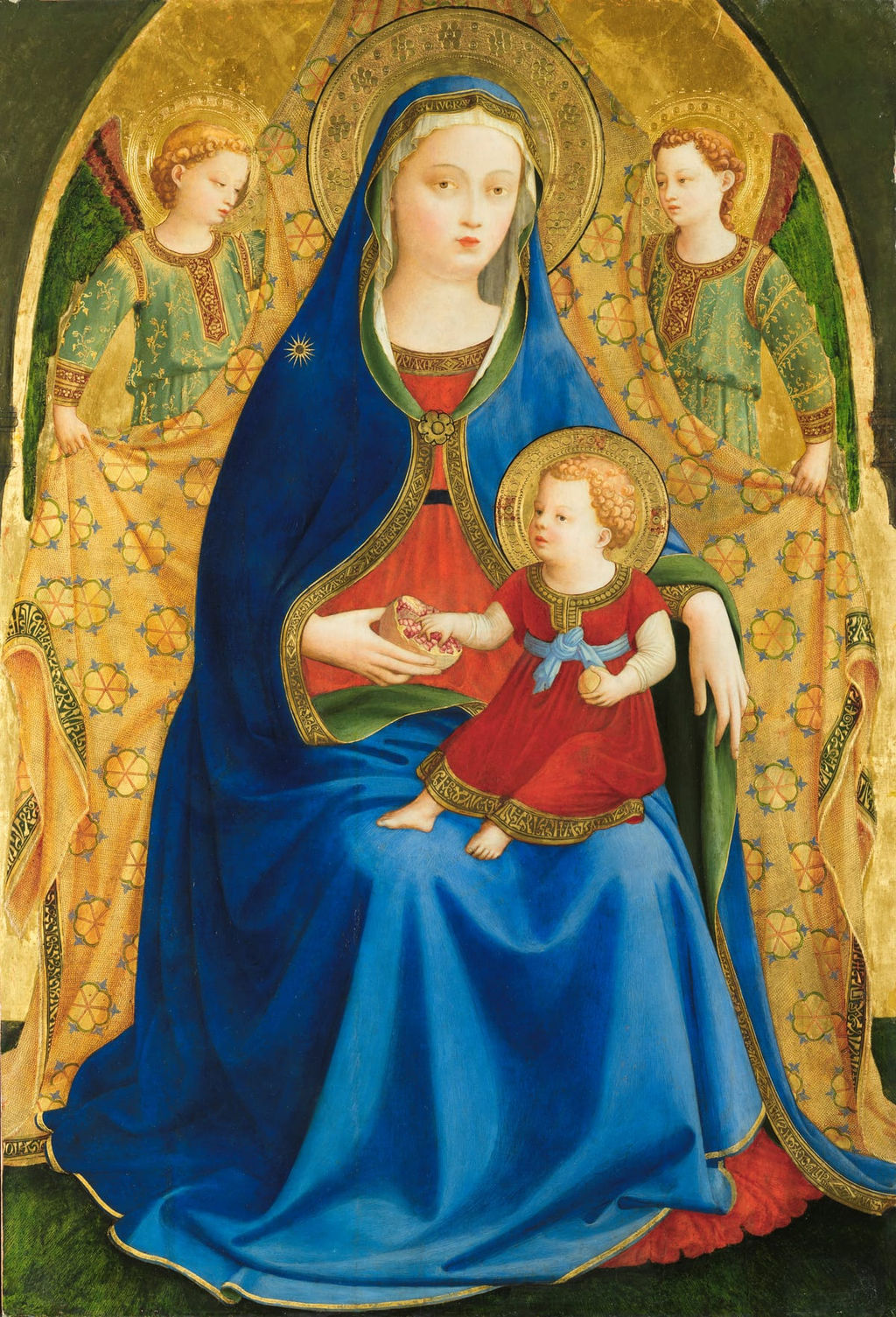
The Prado’s Virgin of the Pomegranate. The fruit, brought forward by two small gestures, sits against the red of the Virgin’s dress. Image source. Public domain. Proportional web resize.
A picture for close viewing
At just over forty centimetres high, the Fogg painting can be taken in from close enough to notice the flower, the fine folds of the veil and the way the Child’s fingers open in blessing. That scale suits personal devotion. Kanter compared the shape and half-length composition with the leaves of diptychs, two hinged panels that opened together. A second leaf could have faced these figures with another sacred image, changing the way a viewer read the Child’s gesture. The Fogg panel has no securely identified companion, and Kanter found no definite hinge evidence in the small group of related half-length paintings. Its first owner, setting and original arrangement remain unknown. [1] [2]
From Masolino to Angelico
The American Art Association offered the painting in New York on 27 November 1916 as the work of Masolino. Written lot 991 names Professor Venturi’s collection and Elia Volpi’s Villa Pia in Florence. The catalogue identifies the blessing and the flower and illustrates the same composition, although the description reverses the arm on which Mary carries the Child. Harvard notes that the reproduction was misnumbered 992. The written entry for 992 describes a separate, arched Madonna and Child, assigned at that sale to Gentile da Fabriano. In the digitised catalogue the photographs distinguish the two readily. The Fogg picture has a plain rectangular surround, while the other panel sits inside a tall architectural frame. Harvard traces lot 991 to Arthur Kingsley Porter, then by descent to Lucy Wallace Porter, who bequeathed it to the Fogg in 1962. [1] [6]
The name Masolino outlasted the sale in discussions of the painting. Bernard Berenson listed it as the work of an unnamed Florentine artist close to Masolino. Licia Collobi-Ragghianti proposed Zanobi Strozzi, an attribution Everett Fahy eventually took up after initially identifying the panel as an early Angelico. Federico Zeri’s photographic archive classifies the picture as workshop of Fra Angelico. Harvard lists Strozzi and Masolino as previous attributions and catalogues the work under Angelico’s name, in agreement with Kanter’s conclusion in the 2005 Metropolitan Museum of Art exhibition catalogue. The surviving modelling, veil and tooling show why Kanter gave particular weight to small passages in a painting whose larger surfaces have changed. [1] [2] [3]
Further reading
Explore a catalogue or scholarly study related to this article.
Fra Angelico. Laurence Kanter and Pia Palladino. Metropolitan Museum of Art, 2005.
Entry 14 sets out Kanter’s early dating and compares the Fogg painting with other small devotional works. Read or download the Met catalogue.
Fra Angelico artworks directory
Explore documented works and surviving parts of larger ensembles. Catalogue links identify individual records. Attribution and dating can vary across collections and publications. Search the Federico Zeri Photo Archive by artist.
| Name | Date | Medium and sources |
|---|---|---|
| Adoration of the Magi | About 1440–60, NGA catalogue | Painting Catalogue. |
| Adoration of the Magi (Armadio degli Argenti) | About 1450–53 | Tempera and gold on wood. Catalogue. |
| Agony in the Garden (Armadio degli Argenti) | About 1450–53 | Tempera and gilding on wood Catalogue. |
| Annalena Altarpiece / Pala di Annalena | commonly c. 1435 | Tempera on panel Catalogue. |
| Annunciation (Armadio degli Argenti) | About 1450–53 | Tempera and gilding on wood. Catalogue. |
| Annunciation (Cortona) | generally placed in the 1430s; exact dating remains debated | Tempera on panel Catalogue. |
| Annunciation (Prado) | 1425–26 | Tempera on poplar panel Catalogue. |
| Annunciation (San Marco upper corridor) | commonly c. 1442 | Fresco Catalogue. |
| Annunciation with Saint Peter Martyr | About 1439–43 | Fresco on plaster. Catalogue. |
| Annunciatory Angel | 1450–55, Detroit catalogue | Gold leaf and tempera on wood panel. Catalogue. |
| Armadio degli Argenti (Silver Treasury) | principally c. 1450–52 | Tempera on panel Catalogue. |
| Arrest of Christ (Armadio degli Argenti) | About 1450–53 | Tempera and gilding on wood Catalogue. |
| Ascension (Armadio degli Argenti) | About 1450–53 | Tempera and gilding on wood Catalogue. |
| Baptism of Christ (Armadio, Alesso Baldovinetti) | About 1452–53 | Tempera and gilding on wood Catalogue. |
| Beheading of Saints Cosmas and Damian (San Marco Altarpiece) | About 1438–42 | Painted panel Catalogue. |
| Betrayal of Christ (Armadio degli Argenti) | About 1450–53 | Tempera and gilding on wood Catalogue. |
| Blessed Dominican, Possibly Jordan of Saxony (San Marco Altarpiece) | About 1438–42 | Painted panel Catalogue. |
| Blessed Vincent Ferrer (San Marco Altarpiece) | About 1438–42 | Painted panel Catalogue. |
| Burial of Saints Cosmas and Damian (San Marco Altarpiece) | About 1438–42 | Painted panel Catalogue. |
| Bust of a Cleric and a Group of Figures (recto and verso) | 15th century | Pen and ink on paper Catalogue. |
| Christ among the Doctors (Armadio degli Argenti) | About 1450–53 | Tempera and gilding on wood Catalogue. |
| Christ before Caiaphas (Armadio degli Argenti) | About 1450–53 | Tempera and gilding on wood Catalogue. |
| Christ Glorified in the Court of Heaven | About 1423–24 | Egg tempera on wood, probably poplar, with gold and silver leaf Catalogue. |
| Christ Seated in Judgment | 1447 | Fresco and gilding on plaster. Catalogue. |
| Christ Stripped of His Garments (Armadio degli Argenti) | About 1450–53 | Tempera and gilding on wood Catalogue. |
| Christ Washes the Apostles’ Feet (Armadio degli Argenti) | About 1450–53 | Tempera and gilding on wood Catalogue. |
| Circumcision of Christ (Armadio degli Argenti) | About 1450–53 | Tempera and gilding on wood. Catalogue. |
| Communion of the Apostles (Armadio degli Argenti) | About 1450–53 | Tempera and gilding on wood Catalogue. |
| Coronation of the Virgin (Armadio degli Argenti) | About 1450–53 | Tempera and gilding on wood Catalogue. |
| Coronation of the Virgin (Louvre) | Louvre: second quarter of the fifteenth century, 1425–50; often dated more narrowly c. 1434–35 | Tempera and gold on panel Catalogue. |
| Coronation of the Virgin (Uffizi) | 1431–35 | Tempera on wood, gold ground Catalogue. |
| Cortona Triptych | About 1437 | Tempera and gold on panel. Catalogue. |
| Crucifixion (Armadio degli Argenti) | About 1450–53 | Tempera and gilding on wood Catalogue. |
| Crucifixion and Saints | 1441–42 | Fresco Catalogue. |
| Deposition from the Cross / Santa Trinita Deposition | commissioned 1429–32; completed by Angelico within this period | Tempera on panel Catalogue. |
| Descent into Limbo (Armadio degli Argenti) | About 1450–53 | Tempera and gilding on wood Catalogue. |
| Entombment of Christ (San Marco Altarpiece) | About 1438–42 | Painted panel Catalogue. |
| Entry into Jerusalem (Armadio degli Argenti) | About 1450–53 | Tempera and gilding on wood Catalogue. |
| Expulsion and the Stoning of Saint Stephen | 1448–49, Vatican Museums | Fresco. Catalogue. |
| Fiesole San Domenico Altarpiece | early 1420s; predella about 1423–24 | Tempera on panel Catalogue. |
| Flagellation (Armadio degli Argenti) | About 1450–53 | Tempera and gilding on wood Catalogue. |
| Flight into Egypt | About 1450–53 | Tempera and gilding on wood. Catalogue. |
| Guidalotti Polyptych | c. 1447–49 | Tempera and oil on panel Catalogue. |
| Healing of Palladia and Saint Damian Accepting Her Gift (San Marco Altarpiece) | About 1438–42 | Painted panel Catalogue. |
| Holy Pilgrim, Possibly Saint Roch (San Marco Altarpiece) | About 1438–42 | Painted panel Catalogue. |
| Holy Women at the Tomb (Armadio degli Argenti) | About 1450–53 | Tempera and gilding on wood Catalogue. |
| Judas Receives Payment (Armadio degli Argenti) | About 1450–53 | Tempera and gilding on wood Catalogue. |
| Lamentation over Christ (Armadio degli Argenti) | About 1450–53 | Tempera and gilding on wood Catalogue. |
| Lamentation over the Dead Christ (Croce al Tempio Lamentation) | 1436–41, Zeri catalogue | Tempera and gilding on wood panel. Catalogue. |
| Last Judgement (Armadio degli Argenti) | About 1450–53 | Tempera and gilding on wood Catalogue. |
| Last Judgement (San Marco) | c. 1425–28 | Tempera and gold on panel Catalogue. |
| Last Supper (Armadio degli Argenti) | About 1450–53 | Tempera and gilding on wood Catalogue. |
| Lex Amoris (Armadio degli Argenti) | About 1450–53 | Tempera and gilding on wood Catalogue. |
| Madonna and Child with Saint Dominic and Saint Thomas Aquinas | About 1430, Hermitage catalogue | Detached fresco. Catalogue. |
| Madonna and Child with Saints | About 1411–13 | Tempera on wood panel, with a gold ground. Catalogue. |
| Madonna of Humility | About 1425, Thyssen catalogue | Tempera and gold on wood. Catalogue. |
| Madonna of the Star | 1431–34, Zeri catalogue | Tempera with oil glazes and gold on wood panel, as catalogued by the Gardner for the 2018 exhibition. Catalogue. |
| Marriage at Cana (Armadio, Alesso Baldovinetti) | About 1452–53 | Tempera and gilding on wood Catalogue. |
| Massacre of the Innocents (Armadio degli Argenti) | About 1450–53 | Tempera and gilding on wood Catalogue. |
| Miracle of the Black Leg (San Marco Altarpiece) | About 1438–42 | Painted panel Catalogue. |
| Mocking of Christ (Armadio degli Argenti) | About 1450–53 | Tempera and gilding on wood Catalogue. |
| Mystic Wheel (The Vision of Ezekiel) | About 1450–52 | Tempera and gilding on wood. Catalogue. |
| Nativity (Armadio degli Argenti) | About 1450–53 | Tempera and gilding on wood. Catalogue. |
| Niccoline Chapel frescoes | principally 1448–50 | Fresco Catalogue. |
| Noli me Tangere | broadly within Angelico’s San Marco campaign, late 1430s–1440s | Fresco Catalogue. |
| Ordination of Saint Lawrence | 1448 | Fresco. Catalogue. |
| Pentecost (Armadio degli Argenti) | About 1450–53 | Tempera and gilding on wood Catalogue. |
| Presentation of Christ at the Temple (Armadio degli Argenti) | About 1450–53 | Tempera and gilding on wood. Catalogue. |
| Presentation of Jesus at the Temple | Early 1440s | Fresco on plaster. Catalogue. |
| Raising of Lazarus (Armadio degli Argenti) | About 1450–53 | Tempera and gilding on wood Catalogue. |
| Rescue of Saints Cosmas and Damian and Exorcism of Lysias (San Marco Altarpiece) | About 1438–42 | Painted panel Catalogue. |
| Road to Calvary (Armadio degli Argenti) | About 1450–53 | Tempera and gilding on wood Catalogue. |
| Saint Anthony Abbot (San Marco Altarpiece) | About 1438–42 | Painted panel Catalogue. |
| Saint Bernard of Clairvaux or Saint Benedict (San Marco Altarpiece) | About 1438–42 | Painted panel Catalogue. |
| Saint Damian Receives Money from Palladia | About 1425–49 | Tempera and gilding on wood. Catalogue. |
| Saint Francis and a Bishop Saint, Saint John the Baptist and Saint Dominic | Late 1420s, Getty catalogue | Tempera and gold leaf on panel. Catalogue. |
| Saint James the Greater Freeing the Magician Hermogenes | About 1426–29 | Tempera and gold on panel Catalogue. |
| Saint Jerome (San Marco Altarpiece) | About 1438–42 | Painted panel Catalogue. |
| Saint Lawrence Giving Alms | About 1448 | Wall fresco. Catalogue. |
| Saint Lawrence Receiving the Treasures of the Church from Pope Sixtus II | About 1448–49 | Fresco on plaster. Catalogue. |
| Saint Romuald (San Marco Altarpiece) | About 1438–42 | Painted panel Catalogue. |
| Saint Stephen Addressing the Council | 1448–49, Vatican Museums | Fresco. Catalogue. |
| Saint Stephen Preaching | 1448–49, Vatican Museums | Wall fresco. Catalogue. |
| Saint Thomas Aquinas (San Marco Altarpiece) | About 1438–42 | Painted panel Catalogue. |
| Saints Cosmas and Damian and Their Brothers Survive the Stake | Second quarter of the 15th century | Tempera and gilding on wood. Catalogue. |
| Saints Cosmas and Damian at the Stake (San Marco Altarpiece) | About 1438–42 | Painted panel Catalogue. |
| Saints Cosmas and Damian before Lysias (San Marco Altarpiece) | About 1438–42 | Painted panel Catalogue. |
| Saints Cosmas and Damian Rescued by an Angel | Second quarter of the 15th century | Tempera and gilding on wood. Catalogue. |
| Saints Cosmas and Damian with Their Brothers before Proconsul Lysias | Second quarter of the 15th century | Tempera and gilding on wood. Catalogue. |
| San Marco Altarpiece / Pala di San Marco | 1438–43 | Tempera on panel Catalogue. |
| San Pietro Martire Triptych | About 1422–23, Strozzi exhibition | Tempera and gold on panel. Catalogue. |
| Scenes from the Lives of the Desert Fathers (Thebaid) | About 1420, Uffizi catalogue | Tempera on wood. Catalogue. |
| Sixteen Prophets | 1447 | Fresco and gilding on plaster Catalogue. |
| Stoning and Shooting of the Brothers (San Marco Altarpiece) | About 1438–42 | Painted panel Catalogue. |
| Tabernacle of the Linaioli | 1433–35 | Tempera on panel Catalogue. |
| The Attempted Crucifixion and Stoning of Saints Cosmas and Damian | Second quarter of the 15th century | Tempera and gilding on wood. Catalogue. |
| The Crucifixion | About 1420–23, Met catalogue | Tempera on wood, gold ground. Catalogue. |
| The Death and the Assumption of the Virgin | 1424–34 | Tempera with oil glazes and gold on panel Catalogue. |
| The Dominican Blessed (left end) (Fiesole predella) | About 1423–24 | Egg tempera and gold on wood Catalogue. |
| The Dominican Blessed (right end) (Fiesole predella) | About 1423–24 | Egg tempera and gold on wood Catalogue. |
| The Entombment of Christ | About 1450 | Tempera on poplar panel. Catalogue. |
| The Forerunners of Christ with Saints and Martyrs | About 1423–24 | Egg tempera on wood (probably poplar), with gold and silver leaf. Catalogue. |
| The Funeral of Saint Anthony Abbot | About 1426–30 | Tempera on poplar panel. Catalogue. |
| The Martyrdom of Saints Cosmas and Damian | About 1425–49 | Tempera and gilding on wood. Catalogue. |
| The Mocking of Christ / Christ Mocked | within the San Marco dormitory campaign, broadly late 1430s–1440s | Fresco Catalogue. |
| The Nativity | About 1425, Minneapolis catalogue | Tempera on poplar panel. Catalogue. |
| The Nativity in Cell 5 at San Marco | About 1439–43 | Fresco on plaster. Catalogue. |
| The Penitent Saint Jerome | 1419–20 | Tempera on wood panel Catalogue. |
| The Virgin and Child by Fra Angelico (Fogg Museum) | About 1430, Harvard catalogue | Tempera originally on panel, subsequently transferred to Masonite. Catalogue. |
| The Virgin Mary with the Apostles and Other Saints (Fiesole predella) | About 1423–24 | Egg tempera and gold on wood Catalogue. |
| Transfiguration (Armadio, Alesso Baldovinetti) | About 1452–53 | Tempera and gilding on wood Catalogue. |
| Transfiguration (San Marco Cell 6) | within the San Marco dormitory campaign, broadly late 1430s–1440s | Fresco Catalogue. |
| Virgin Mary Annunciate | 1450–55, Detroit catalogue | Gold leaf and tempera on wood panel. Catalogue. |
| Virgin of the Pomegranate | About 1426 | Tempera on panel with gilding Catalogue. |
Frequently Asked Questions
It belongs to the Fogg Museum at Harvard Art Museums in Cambridge, Massachusetts. The accession number is 1962.277. [1]
That exhibition included the half-length Madonna and Child now at the Norton Simon Museum (F.1965.1.001.P), a separate painting with its own history of restoration and disputed attribution. Harvard’s panel is the one illustrated in Elia Volpi’s sale catalogue in 1916 and bequeathed to the Fogg in 1962. [1] [6] [7]
Discussion
Use these prompts to look again or share an observation.
Reader Insights
Trace the veil across Mary’s fingers. Which highlights let you see the cloth in front of the hand?
What can a surviving photograph establish about the 1916 sale when the picture number and written lot number differ?
Join the Conversation
Share a detail or question about The Virgin and Child by Fra Angelico (Fogg Museum).
References
- Harvard Art Museums, The Virgin and Child, Fogg Museum accession 1962.277. View source.
- Laurence Kanter, Virgin and Child, in Laurence Kanter and Pia Palladino, Fra Angelico, The Metropolitan Museum of Art, 2005, cat. 14, pp. 91–92. View source.
- Fondazione Federico Zeri, Madonna con Bambino, catalogue work 13550, entry 11762. View source.
- Fondazione Palazzo Strozzi and Museo di San Marco, Fra Angelico, 2025 exhibition press kit, selection of works, no. 25, San Pietro Martire Altarpiece. View source.
- Städel Museum, Madonna and Child Enthroned and Twelve Angels, inv. 838. View source.
- American Art Association, illustrated catalogue of the Elia Volpi sale, New York, 1916, Monday evening sale, lots 991–992. View source.
- Norton Simon Museum, Madonna and Child, F.1965.1.001.P. View source.
.jpg)



 Fra Angelico.jpg)


