 by Tom Gurney
Tom Gurney BSc (Hons) is an art history expert with over 20 years experience
Published on June 19, 2020 / Updated on November 29, 2026
Email: tomgurney1@gmail.com / Phone: +44 7429 011000
Introduction
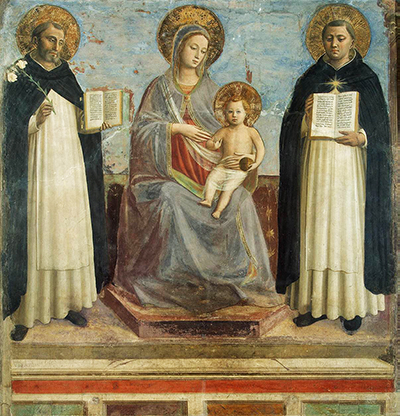
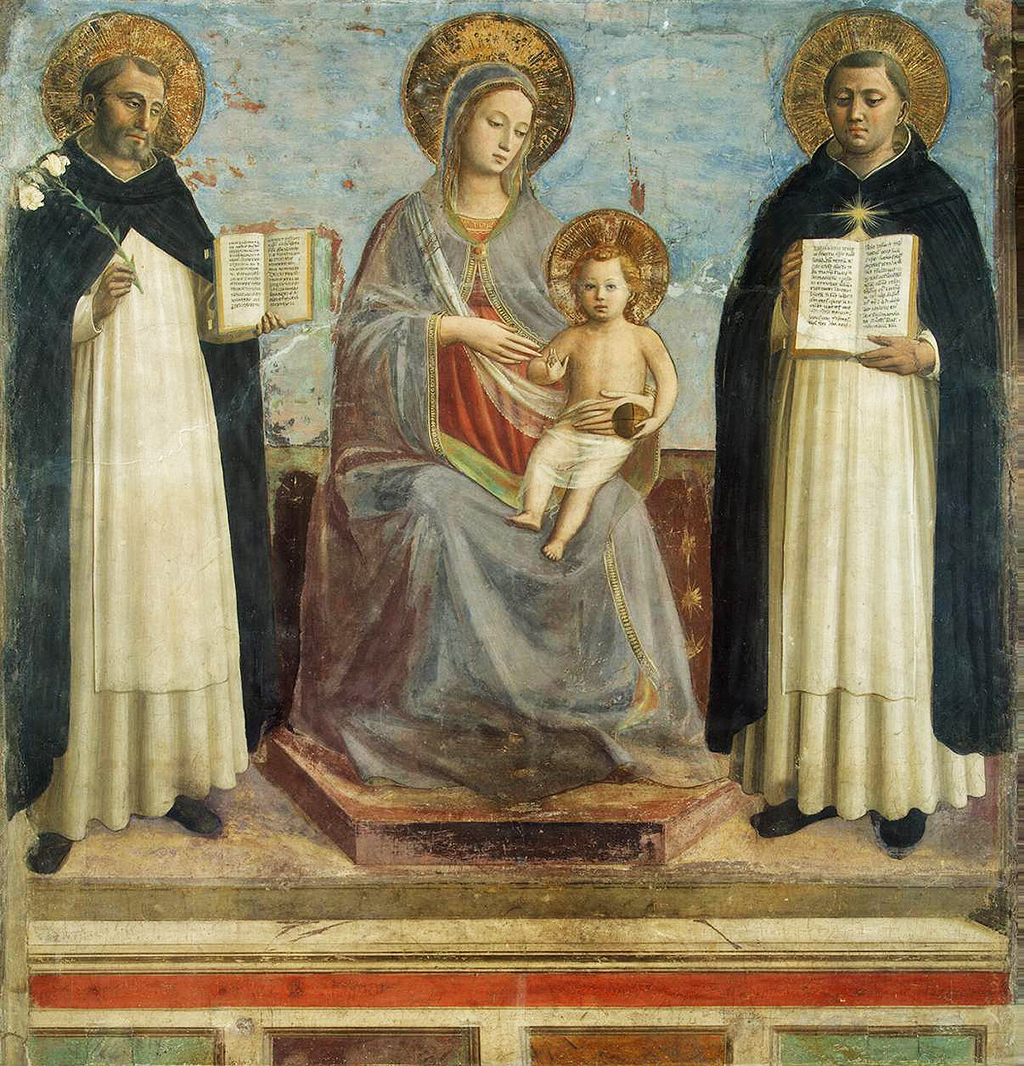
Two Dominican friars hold open books beside Mary and the Christ Child. The pages face out, towards anyone standing before the fresco. Saint Dominic holds a lily as well as his book. Across from him, Saint Thomas Aquinas presents a passage about the heavens declaring God's glory. Fra Angelico painted the group on a wall at San Domenico in Fiesole, near Florence. The detached fresco, now in the State Hermitage Museum in St Petersburg, is dated to around 1430 by the Hermitage. A comparison with another of Angelico's wall paintings has led to a later proposal. [1]
At a Glance
- ArtistFra Angelico
- TitleMadonna and Child with Saint Dominic and Saint Thomas Aquinas
- DateAround 1430, the Hermitage dating. Around 1445 has also been proposed. [1] [2]
- MediumDetached fresco. [1] [3]
- Dimensions196 × 187 cm. [1] [2]
- Original siteDominican convent of San Domenico, Fiesole. [1]
- CollectionState Hermitage Museum, St Petersburg, inv. ГЭ-253. [1] [2]
A throne between two friars
The saints are almost the same height and wear the same black and white habit, so their differences emerge gradually. Dominic, on the viewer's left, angles his head towards the centre. The line of his lily cuts across his dark cape, and the white flowers sit high against his shoulder. A bearded face and a slender stem give this side of the picture a different rhythm from the broad sweep of Aquinas's cloak and his composed, clean-shaven face. The starburst on Aquinas's chest sits just above his book, where it catches the eye before the little blocks of writing do. The lily traditionally signifies purity. [1] [2]
Angelico sets Mary above the saints' footing without raising her head above theirs. Her halo sits roughly level with theirs, but beneath her mantle a low, many-sided dais projects towards us. The friars' shoes occupy the narrow floor on either side of it. Their white habits drop in long, nearly parallel folds, while the fabric across Mary's knees spreads sideways and falls into shadow. Much of the throne is concealed by the seated figure. The small amount of visible architecture, especially the painted ledge below the group's feet, gives the bodies a place to stand or sit. [1]
The Child's legs break the line of Mary's mantle. One foot rests against the cloth higher than the other, and his white wrap gathers where the legs turn. His right hand rises beside Mary's extended fingers. With his left he holds a small orb against his body. Mary bends her head towards him, while he looks towards the viewer. Her hands make his position on her lap feel secure, leaving him free to face the person looking at the painting. At close range the fine borders of the cloth and the patterns in the haloes draw attention. From a distance it is the Child's face, set low between the larger heads, that draws the eye into the group. [1]
What the books say
The Hermitage catalogue identifies two passages in Aquinas's book. The longer one is Psalm 18:2–8 in the Vulgate. It begins with the heavens and the firmament bearing witness to God's handiwork, moves through the progress of the sun, and reaches the opening of a verse praising divine law. The catalogue also identifies Psalm 103:13, in which God waters the mountains from above and the earth is satisfied with the fruit of his works. In Bibles that follow the Hebrew numbering, those psalms are 19 and 104. The Hermitage describes the lettering in Dominic's book as illegible, with both Latin and Greek characters. [1] [4]
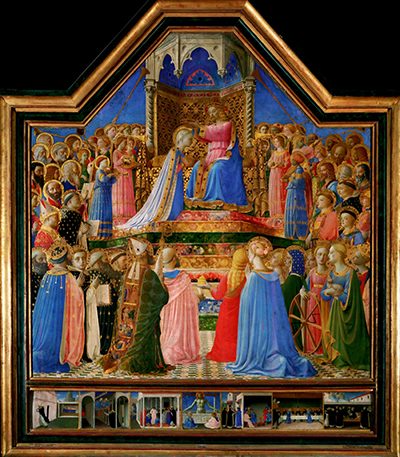
The choice of words for Aquinas has an unusually close parallel. In the painted predella, or lower tier, of the San Domenico high altarpiece, the National Gallery identifies an inscription derived from that same verse about the mountains and the earth. There the tiny Aquinas writes with a quill. In the mural the larger figure holds the book out with both hands. The altarpiece's main tier, made for the church at Fiesole, also places the Virgin and Child with Dominic and Aquinas, alongside angels and two more saints. The shared verse links the images more closely than their choice of saints alone. It gives a particular scriptural voice to the theologian in both settings. [1] [5]
The open book also affects how we read the central group. As the psalms move from the heavens and sun to the watered earth, the Child holds an orb small enough to fit in his hand. The juxtaposition allows a viewer to connect the world described in the text with the world evoked by the orb. The original background, which the Hermitage describes as red with gold stars, would have made the reference to the heavens easier to picture than it is against the blue now visible. [1]
Where the friars would have seen it
San Domenico at Fiesole is the secure point of origin. The precise wall is harder to establish. The Fondazione Federico Zeri records the chapter house, the room where the friars assembled. The Hermitage catalogue recounts that traditional placement and gives a different one proposed by Stefano Orlandi in 1964. Citing the historian of the convent, Lodovico Ferretti, Orlandi placed the fresco on the corridor wall above the landing of the stairs to the upper cells. Italy's cultural heritage catalogue places the original near the upper cells in its entry for the fresco copy Garibaldo Cepparelli painted in the early twentieth century. The chapter house at Fiesole also preserves a distinct Crucifixion, conserved in 2025. [1] [3] [6] [7]
The two proposed settings would have encouraged different ways of looking. A chapter house implies a room for assembling. At a landing the figures would have come into view as people climbed, with the painted floor and shoes above the approaching viewer. In either place the matching habits invited the friars to recognise their own order. The two saints stand close to the Virgin and Child at nearly the viewer's scale. If Orlandi's placement is right, the encounter belonged to a route the friars took in daily life, and its large forms could register before anyone was close enough to make out a line of script. [1] [3]
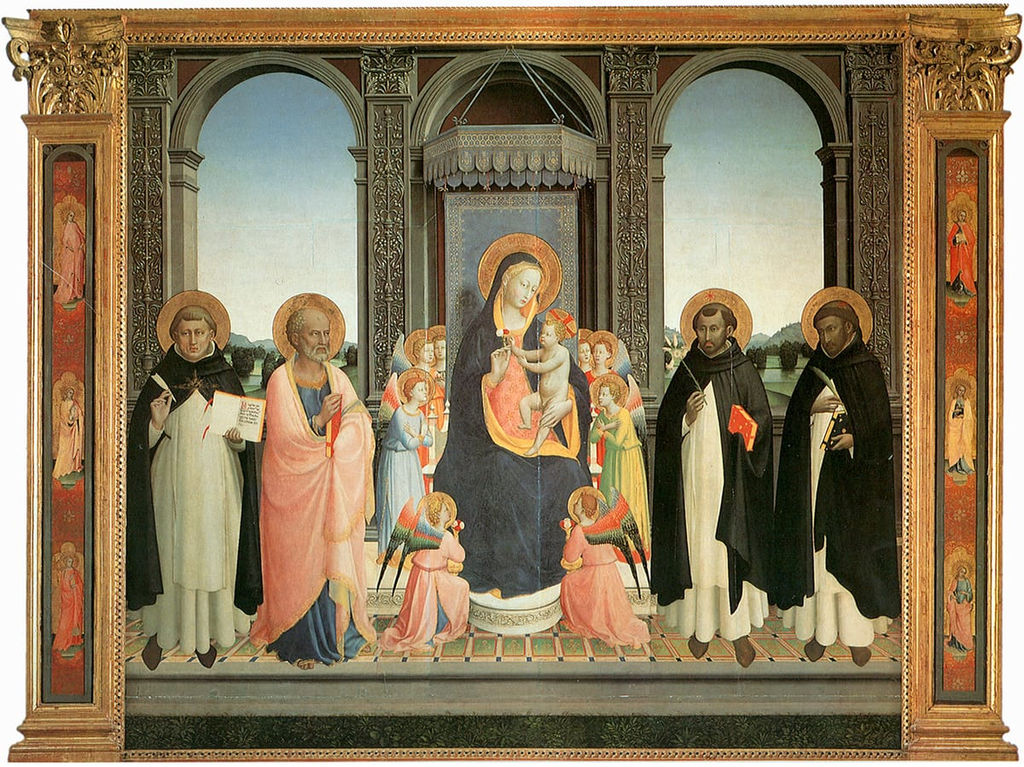
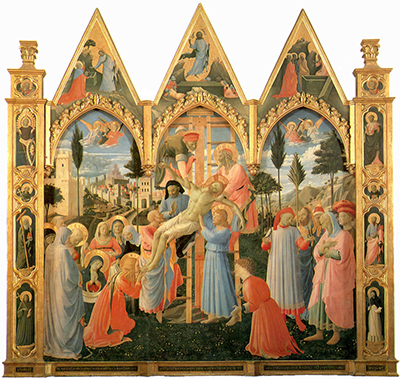
The main Fiesole altarpiece as it survives after Lorenzo di Credi’s alterations. Its detached predella is in London. Image source. Public domain. Proportional web resize.
From wall to frame
The Hermitage records the fresco at Fiesole until the convent's suppression in the 1870s. It entered the collection in 1883 following a purchase in Florence from Alessandro Mazzanti and Cosimo Conti, who ran an art gallery together in Via Panicale. The Italian entry for Cepparelli's copy gives an earlier date, 1879, in its account of the sale. The museum's catalogue is the direct record for the original's accession. It documents a gilded frame based on a design by Prince Grigory Gagarin in December 1883 and records that the frame and glass were ready in March 1884. Magnolia Scudieri identifies a second Angelico mural detached and sold from Fiesole in the nineteenth century. That was the refectory Calvary with Saint Dominic in Prayer, which the Louvre acquired in 1880. [1] [2] [6] [8] [9] [10]
Fresco bonds paint to plaster, so removing a mural means moving part of the painted wall surface. The Hermitage work has a mottled blue upper field, with patches of reddish colour showing through. The catalogue records that the background was repainted. Its description of red with gold stars changes the way one imagines the group, with warmer colour around the heads and gold repeated across the field beyond the haloes. The present image still preserves the friars' feet, the projecting dais and bands of painted decoration along the bottom. The surviving edges and worn passages give little basis for reconstructing the exact dimensions of the original wall painting. [1] [2]
A second Madonna in Florence
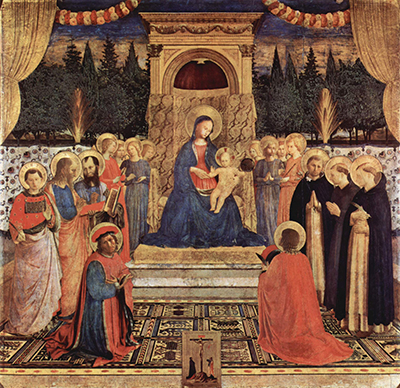
The Hermitage catalogue finds Umberto Baldini's date of around 1430 the most convincing. It also discusses Diane Cole Ahl's proposal of about 1445, soon after the Madonna delle Ombre at San Marco in Florence. She saw such a strong likeness in the two groups of Mary and the Child that she suggested Angelico could have used one cartoon, a full-size preparatory drawing, for both. The comparison is easiest to see in the inclination of Mary's head and the way the Child sits to one side of her. A shared design remains a hypothesis. [1]
At San Marco the company of saints extends much farther to either side, and painted architectural shadows respond to the real light in the corridor, as former museum director Giorgio Bonsanti explains. He also describes the use of fresco and other paint handling in different parts of that wall painting. The Hermitage mural brings its two attendants closer to the central pair and does so with very little architecture above their feet. The contrast helps explain why a similar pose for Mary and the Child changes character when the setting and the company around it change. Angelico used another related grouping over the doorway of San Domenico in Cortona, where a curved lunette frames the Virgin and Child with Dominic and Peter Martyr. The Italian catalogue records traces of the names Europe and Asia on the Child’s orb at Cortona, where the idea of Christ holding the world is quite literal. The lunette was detached in 1966, exposing the preparatory drawing underneath. [1] [11] [12]
Fra Angelico artworks directory
Explore documented works and surviving parts of larger ensembles. Catalogue links identify individual records. Attribution and dating can vary across collections and publications. Search the Federico Zeri Photo Archive by artist.
| Name | Date | Medium and sources |
|---|---|---|
| Adoration of the Magi | About 1440–60, NGA catalogue | Painting Catalogue. |
| Adoration of the Magi (Armadio degli Argenti) | About 1450–53 | Tempera and gold on wood. Catalogue. |
| Agony in the Garden (Armadio degli Argenti) | About 1450–53 | Tempera and gilding on wood Catalogue. |
| Annalena Altarpiece / Pala di Annalena | commonly c. 1435 | Tempera on panel Catalogue. |
| Annunciation (Armadio degli Argenti) | About 1450–53 | Tempera and gilding on wood. Catalogue. |
| Annunciation (Cortona) | generally placed in the 1430s; exact dating remains debated | Tempera on panel Catalogue. |
| Annunciation (Prado) | 1425–26 | Tempera on poplar panel Catalogue. |
| Annunciation (San Marco upper corridor) | commonly c. 1442 | Fresco Catalogue. |
| Annunciation with Saint Peter Martyr | About 1439–43 | Fresco on plaster. Catalogue. |
| Annunciatory Angel | 1450–55, Detroit catalogue | Gold leaf and tempera on wood panel. Catalogue. |
| Armadio degli Argenti (Silver Treasury) | principally c. 1450–52 | Tempera on panel Catalogue. |
| Arrest of Christ (Armadio degli Argenti) | About 1450–53 | Tempera and gilding on wood Catalogue. |
| Ascension (Armadio degli Argenti) | About 1450–53 | Tempera and gilding on wood Catalogue. |
| Baptism of Christ (Armadio, Alesso Baldovinetti) | About 1452–53 | Tempera and gilding on wood Catalogue. |
| Beheading of Saints Cosmas and Damian (San Marco Altarpiece) | About 1438–42 | Painted panel Catalogue. |
| Betrayal of Christ (Armadio degli Argenti) | About 1450–53 | Tempera and gilding on wood Catalogue. |
| Blessed Dominican, Possibly Jordan of Saxony (San Marco Altarpiece) | About 1438–42 | Painted panel Catalogue. |
| Blessed Vincent Ferrer (San Marco Altarpiece) | About 1438–42 | Painted panel Catalogue. |
| Burial of Saints Cosmas and Damian (San Marco Altarpiece) | About 1438–42 | Painted panel Catalogue. |
| Bust of a Cleric and a Group of Figures (recto and verso) | 15th century | Pen and ink on paper Catalogue. |
| Christ among the Doctors (Armadio degli Argenti) | About 1450–53 | Tempera and gilding on wood Catalogue. |
| Christ before Caiaphas (Armadio degli Argenti) | About 1450–53 | Tempera and gilding on wood Catalogue. |
| Christ Glorified in the Court of Heaven | About 1423–24 | Egg tempera on wood, probably poplar, with gold and silver leaf Catalogue. |
| Christ Seated in Judgment | 1447 | Fresco and gilding on plaster. Catalogue. |
| Christ Stripped of His Garments (Armadio degli Argenti) | About 1450–53 | Tempera and gilding on wood Catalogue. |
| Christ Washes the Apostles’ Feet (Armadio degli Argenti) | About 1450–53 | Tempera and gilding on wood Catalogue. |
| Circumcision of Christ (Armadio degli Argenti) | About 1450–53 | Tempera and gilding on wood. Catalogue. |
| Communion of the Apostles (Armadio degli Argenti) | About 1450–53 | Tempera and gilding on wood Catalogue. |
| Coronation of the Virgin (Armadio degli Argenti) | About 1450–53 | Tempera and gilding on wood Catalogue. |
| Coronation of the Virgin (Louvre) | Louvre: second quarter of the fifteenth century, 1425–50; often dated more narrowly c. 1434–35 | Tempera and gold on panel Catalogue. |
| Coronation of the Virgin (Uffizi) | 1431–35 | Tempera on wood, gold ground Catalogue. |
| Cortona Triptych | About 1437 | Tempera and gold on panel. Catalogue. |
| Crucifixion (Armadio degli Argenti) | About 1450–53 | Tempera and gilding on wood Catalogue. |
| Crucifixion and Saints | 1441–42 | Fresco Catalogue. |
| Deposition from the Cross / Santa Trinita Deposition | commissioned 1429–32; completed by Angelico within this period | Tempera on panel Catalogue. |
| Descent into Limbo (Armadio degli Argenti) | About 1450–53 | Tempera and gilding on wood Catalogue. |
| Entombment of Christ (San Marco Altarpiece) | About 1438–42 | Painted panel Catalogue. |
| Entry into Jerusalem (Armadio degli Argenti) | About 1450–53 | Tempera and gilding on wood Catalogue. |
| Expulsion and the Stoning of Saint Stephen | 1448–49, Vatican Museums | Fresco. Catalogue. |
| Fiesole San Domenico Altarpiece | early 1420s; predella about 1423–24 | Tempera on panel Catalogue. |
| Flagellation (Armadio degli Argenti) | About 1450–53 | Tempera and gilding on wood Catalogue. |
| Flight into Egypt | About 1450–53 | Tempera and gilding on wood. Catalogue. |
| Guidalotti Polyptych | c. 1447–49 | Tempera and oil on panel Catalogue. |
| Healing of Palladia and Saint Damian Accepting Her Gift (San Marco Altarpiece) | About 1438–42 | Painted panel Catalogue. |
| Holy Pilgrim, Possibly Saint Roch (San Marco Altarpiece) | About 1438–42 | Painted panel Catalogue. |
| Holy Women at the Tomb (Armadio degli Argenti) | About 1450–53 | Tempera and gilding on wood Catalogue. |
| Judas Receives Payment (Armadio degli Argenti) | About 1450–53 | Tempera and gilding on wood Catalogue. |
| Lamentation over Christ (Armadio degli Argenti) | About 1450–53 | Tempera and gilding on wood Catalogue. |
| Lamentation over the Dead Christ (Croce al Tempio Lamentation) | 1436–41, Zeri catalogue | Tempera and gilding on wood panel. Catalogue. |
| Last Judgement (Armadio degli Argenti) | About 1450–53 | Tempera and gilding on wood Catalogue. |
| Last Judgement (San Marco) | c. 1425–28 | Tempera and gold on panel Catalogue. |
| Last Supper (Armadio degli Argenti) | About 1450–53 | Tempera and gilding on wood Catalogue. |
| Lex Amoris (Armadio degli Argenti) | About 1450–53 | Tempera and gilding on wood Catalogue. |
| Madonna and Child with Saint Dominic and Saint Thomas Aquinas | About 1430, Hermitage catalogue | Detached fresco. Catalogue. |
| Madonna and Child with Saints | About 1411–13 | Tempera on wood panel, with a gold ground. Catalogue. |
| Madonna of Humility | About 1425, Thyssen catalogue | Tempera and gold on wood. Catalogue. |
| Madonna of the Star | 1431–34, Zeri catalogue | Tempera with oil glazes and gold on wood panel, as catalogued by the Gardner for the 2018 exhibition. Catalogue. |
| Marriage at Cana (Armadio, Alesso Baldovinetti) | About 1452–53 | Tempera and gilding on wood Catalogue. |
| Massacre of the Innocents (Armadio degli Argenti) | About 1450–53 | Tempera and gilding on wood Catalogue. |
| Miracle of the Black Leg (San Marco Altarpiece) | About 1438–42 | Painted panel Catalogue. |
| Mocking of Christ (Armadio degli Argenti) | About 1450–53 | Tempera and gilding on wood Catalogue. |
| Mystic Wheel (The Vision of Ezekiel) | About 1450–52 | Tempera and gilding on wood. Catalogue. |
| Nativity (Armadio degli Argenti) | About 1450–53 | Tempera and gilding on wood. Catalogue. |
| Niccoline Chapel frescoes | principally 1448–50 | Fresco Catalogue. |
| Noli me Tangere | broadly within Angelico’s San Marco campaign, late 1430s–1440s | Fresco Catalogue. |
| Ordination of Saint Lawrence | 1448 | Fresco. Catalogue. |
| Pentecost (Armadio degli Argenti) | About 1450–53 | Tempera and gilding on wood Catalogue. |
| Presentation of Christ at the Temple (Armadio degli Argenti) | About 1450–53 | Tempera and gilding on wood. Catalogue. |
| Presentation of Jesus at the Temple | Early 1440s | Fresco on plaster. Catalogue. |
| Raising of Lazarus (Armadio degli Argenti) | About 1450–53 | Tempera and gilding on wood Catalogue. |
| Rescue of Saints Cosmas and Damian and Exorcism of Lysias (San Marco Altarpiece) | About 1438–42 | Painted panel Catalogue. |
| Road to Calvary (Armadio degli Argenti) | About 1450–53 | Tempera and gilding on wood Catalogue. |
| Saint Anthony Abbot (San Marco Altarpiece) | About 1438–42 | Painted panel Catalogue. |
| Saint Bernard of Clairvaux or Saint Benedict (San Marco Altarpiece) | About 1438–42 | Painted panel Catalogue. |
| Saint Damian Receives Money from Palladia | About 1425–49 | Tempera and gilding on wood. Catalogue. |
| Saint Francis and a Bishop Saint, Saint John the Baptist and Saint Dominic | Late 1420s, Getty catalogue | Tempera and gold leaf on panel. Catalogue. |
| Saint James the Greater Freeing the Magician Hermogenes | About 1426–29 | Tempera and gold on panel Catalogue. |
| Saint Jerome (San Marco Altarpiece) | About 1438–42 | Painted panel Catalogue. |
| Saint Lawrence Giving Alms | About 1448 | Wall fresco. Catalogue. |
| Saint Lawrence Receiving the Treasures of the Church from Pope Sixtus II | About 1448–49 | Fresco on plaster. Catalogue. |
| Saint Romuald (San Marco Altarpiece) | About 1438–42 | Painted panel Catalogue. |
| Saint Stephen Addressing the Council | 1448–49, Vatican Museums | Fresco. Catalogue. |
| Saint Stephen Preaching | 1448–49, Vatican Museums | Wall fresco. Catalogue. |
| Saint Thomas Aquinas (San Marco Altarpiece) | About 1438–42 | Painted panel Catalogue. |
| Saints Cosmas and Damian and Their Brothers Survive the Stake | Second quarter of the 15th century | Tempera and gilding on wood. Catalogue. |
| Saints Cosmas and Damian at the Stake (San Marco Altarpiece) | About 1438–42 | Painted panel Catalogue. |
| Saints Cosmas and Damian before Lysias (San Marco Altarpiece) | About 1438–42 | Painted panel Catalogue. |
| Saints Cosmas and Damian Rescued by an Angel | Second quarter of the 15th century | Tempera and gilding on wood. Catalogue. |
| Saints Cosmas and Damian with Their Brothers before Proconsul Lysias | Second quarter of the 15th century | Tempera and gilding on wood. Catalogue. |
| San Marco Altarpiece / Pala di San Marco | 1438–43 | Tempera on panel Catalogue. |
| San Pietro Martire Triptych | About 1422–23, Strozzi exhibition | Tempera and gold on panel. Catalogue. |
| Scenes from the Lives of the Desert Fathers (Thebaid) | About 1420, Uffizi catalogue | Tempera on wood. Catalogue. |
| Sixteen Prophets | 1447 | Fresco and gilding on plaster Catalogue. |
| Stoning and Shooting of the Brothers (San Marco Altarpiece) | About 1438–42 | Painted panel Catalogue. |
| Tabernacle of the Linaioli | 1433–35 | Tempera on panel Catalogue. |
| The Attempted Crucifixion and Stoning of Saints Cosmas and Damian | Second quarter of the 15th century | Tempera and gilding on wood. Catalogue. |
| The Crucifixion | About 1420–23, Met catalogue | Tempera on wood, gold ground. Catalogue. |
| The Death and the Assumption of the Virgin | 1424–34 | Tempera with oil glazes and gold on panel Catalogue. |
| The Dominican Blessed (left end) (Fiesole predella) | About 1423–24 | Egg tempera and gold on wood Catalogue. |
| The Dominican Blessed (right end) (Fiesole predella) | About 1423–24 | Egg tempera and gold on wood Catalogue. |
| The Entombment of Christ | About 1450 | Tempera on poplar panel. Catalogue. |
| The Forerunners of Christ with Saints and Martyrs | About 1423–24 | Egg tempera on wood (probably poplar), with gold and silver leaf. Catalogue. |
| The Funeral of Saint Anthony Abbot | About 1426–30 | Tempera on poplar panel. Catalogue. |
| The Martyrdom of Saints Cosmas and Damian | About 1425–49 | Tempera and gilding on wood. Catalogue. |
| The Mocking of Christ / Christ Mocked | within the San Marco dormitory campaign, broadly late 1430s–1440s | Fresco Catalogue. |
| The Nativity | About 1425, Minneapolis catalogue | Tempera on poplar panel. Catalogue. |
| The Nativity in Cell 5 at San Marco | About 1439–43 | Fresco on plaster. Catalogue. |
| The Penitent Saint Jerome | 1419–20 | Tempera on wood panel Catalogue. |
| The Virgin and Child by Fra Angelico (Fogg Museum) | About 1430, Harvard catalogue | Tempera originally on panel, subsequently transferred to Masonite. Catalogue. |
| The Virgin Mary with the Apostles and Other Saints (Fiesole predella) | About 1423–24 | Egg tempera and gold on wood Catalogue. |
| Transfiguration (Armadio, Alesso Baldovinetti) | About 1452–53 | Tempera and gilding on wood Catalogue. |
| Transfiguration (San Marco Cell 6) | within the San Marco dormitory campaign, broadly late 1430s–1440s | Fresco Catalogue. |
| Virgin Mary Annunciate | 1450–55, Detroit catalogue | Gold leaf and tempera on wood panel. Catalogue. |
| Virgin of the Pomegranate | About 1426 | Tempera on panel with gilding Catalogue. |
Frequently Asked Questions
Dominic founded the Dominican Order, and Thomas Aquinas was a Dominican theologian. Their white habits and black cloaks identify what they share. The lily distinguishes Dominic, while the starburst above the open book helps distinguish Aquinas. [1] [2]
Discussion
Use these prompts to look again or share an observation.
Reader Insights
Look at the two kneeling friars in relation to the figures above. What does the difference of scale do to the composition?
Which parts of the original fresco could a museum viewer see differently from someone in its earlier architectural setting?
Join the Conversation
Share a detail or question about Madonna and Child with Saint Dominic and Saint Thomas Aquinas.
References
- Tatiana Kustodieva, State Hermitage Museum, Italian Painting, 13th–16th Centuries, 2011, entry 17, pp. 38–39 (in Russian). View source.
- State Hermitage Museum, The Virgin and Child with Sts Dominic and Thomas Aquinas, collection record ГЭ-253. View source.
- Fondazione Federico Zeri, Everett Fahy Photographic Archive, Madonna con Bambino tra san Domenico e san Tommaso d'Aquino, work record 107388 (in Italian). View source.
- Holy See, Nova Vulgata, Liber Psalmorum, Psalms 19 (18) and 104 (103) (in Latin). View source.
- Dillian Gordon, National Gallery, Fiesole San Domenico Altarpiece, collection catalogue, NG 663.2 and fig. 15. View source.
- Italian General Catalogue of Cultural Heritage, Madonna con Bambino tra San Domenico e San Tommaso d'Aquino, Garibaldo Cepparelli, record 0900118888 (in Italian). View source.
- Friends of Florence, Fra Angelico’s Crucifixion in the Convent of San Domenico in Fiesole Restored, 2025 conservation project report. View source.
- Magnolia Scudieri, Guido di Pietro, detto il Beato Angelico, Dizionario Biografico degli Italiani (in Italian). View source.
- Musée du Louvre, Le Calvaire avec saint Dominique en prière, collection record RF 265 (in French). View source.
- Maria Vittoria Thau, Gallerie degli Uffizi, “Alessandro Mazzanti, restauratore di ‘somma diligenza e rara perizia’”, Imagines 3, March 2020, pp. 176–77 and note 40 (in Italian). View source.
- Giorgio Bonsanti, Museo di San Marco, Fondare e restaurare, interview on conservation at San Marco, 2023 (in Italian). View source.
- Italian General Catalogue of Cultural Heritage, Madonna con Bambino tra i SS Domenico e Pietro martire, Cortona, record 0900198774 (in Italian). View source.
.jpg)
 Fra Angelico.jpg)