


 by Tom Gurney
Tom Gurney BSc (Hons) is an art history expert with over 20 years experience
Published on June 19, 2020 / Updated on November 29, 2026
Email: tomgurney1@gmail.com / Phone: +44 7429 011000
Introduction
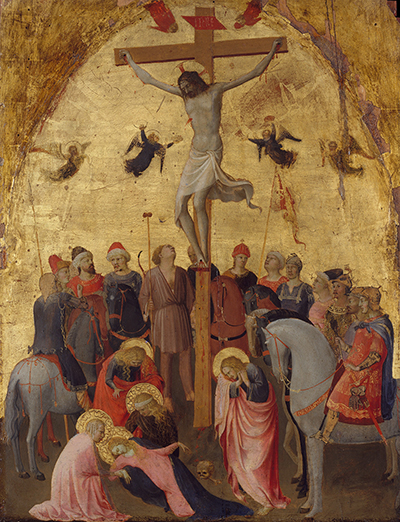
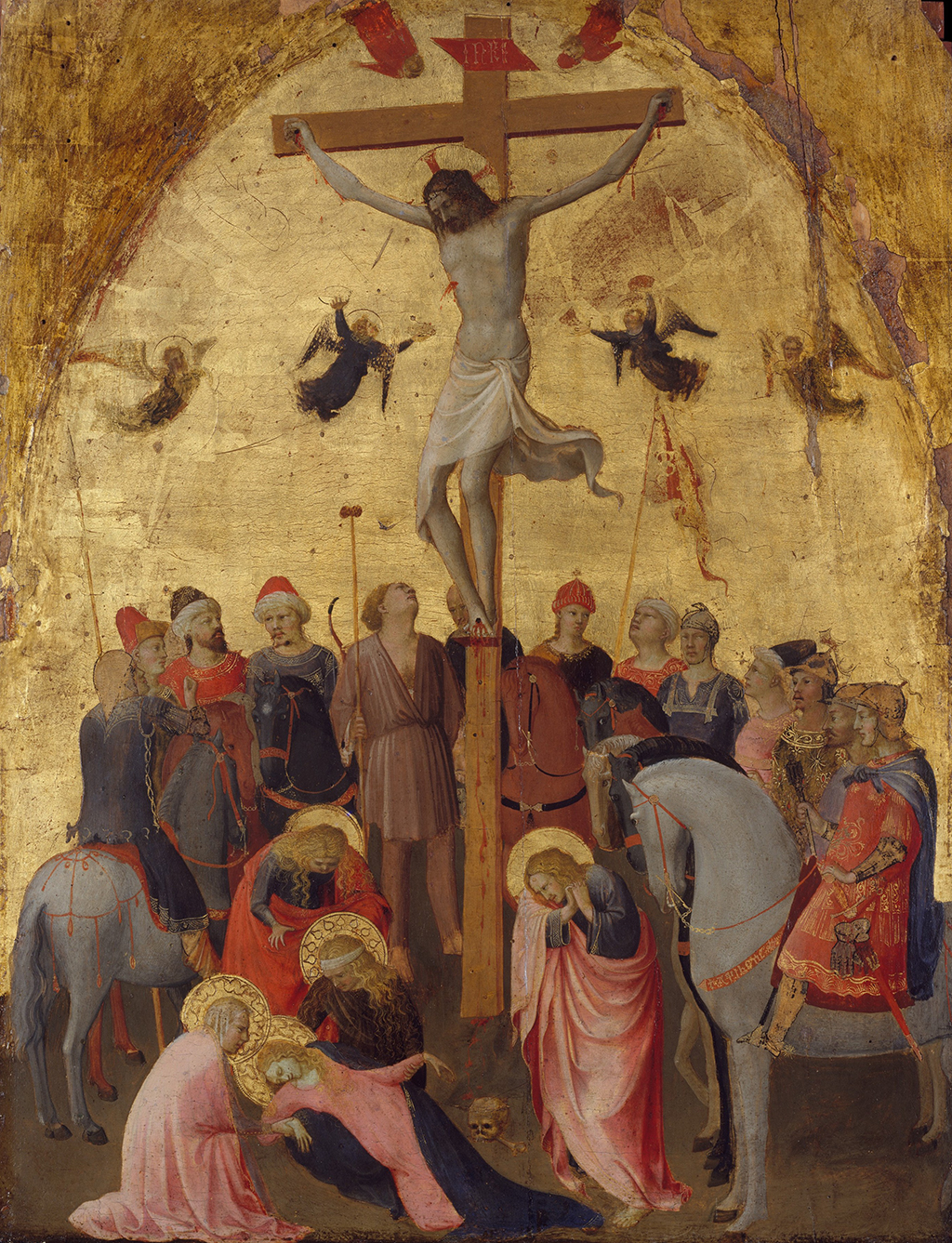
At the foot of the cross, the Virgin Mary has collapsed. The women supporting her bend so close that their gilded haloes overlap. Behind them, a horse turns its head inward, a man tilts his face towards Christ, and two onlookers turn towards one another. Fra Angelico's early Crucifixion at the Metropolitan Museum of Art in New York brings these separate reactions into a single scene. Painted in tempera on wood against a gold ground, the panel is small enough to study at close quarters. The Met dates it to about 1420–23 and suggests that it was made for private devotion. [1]
At a Glance
- TitleThe Crucifixion, also called the Griggs Crucifixion
- Artist and dateFra Angelico, about 1420–23, according to the Met. [1]
- MediumTempera on wood, gold ground. [1]
- Dimensions63.8 × 48.3 cm. [1]
- CollectionThe Metropolitan Museum of Art, New York, accession 43.98.5. Maitland F. Griggs Collection, Bequest of Maitland F. Griggs, 1943. [1]
Grief at the foot of the cross
The Virgin’s blue mantle spreads across the ground beneath the pink folds of her dress. Her eyelids are lowered and one hand hangs loosely. At the left a kneeling woman supports her, while another stoops over her shoulder. The Met identifies Mary of Cleofas among the mourners. The gathering takes its shape from the Virgin's weight. One figure has to get low enough to catch her, another bends sharply, and the patterned haloes behind their heads begin to overlap. Look for the pale hand against the dark fold of the Virgin's mantle. Its slackness conveys the collapse as readily as her face does. [1] [2]
Mary Magdalene, in red, leans forward behind the two women. Her posture can take a moment to read. Her bowed head, upper body and outstretched arm seem to occupy very little space on the surface, yet the bent form suggests her reaching towards the cross in depth. This is foreshortening, the apparent compression of a body or object seen when it points towards or away from the viewer. Jean Sorabella singles out the Magdalene in the Met's essay on Italian paintings of the Passion. The device gives the crowded group its urgency. The Magdalene pushes into the scene, while the Virgin's body sinks towards the bottom edge. [1] [2]
Across the cross stands Saint John the Evangelist. The fall of his pink mantle draws attention to the height he still occupies beside the collapsed figure. His head inclines and his hands draw together near his face. The small gap between him and the women gives the gesture room to register. Here are two ways of conveying grief within the same area of the painting. Mary can no longer hold herself up. John folds in on himself, his bowed head set against the round gold of his halo. [1] [2]
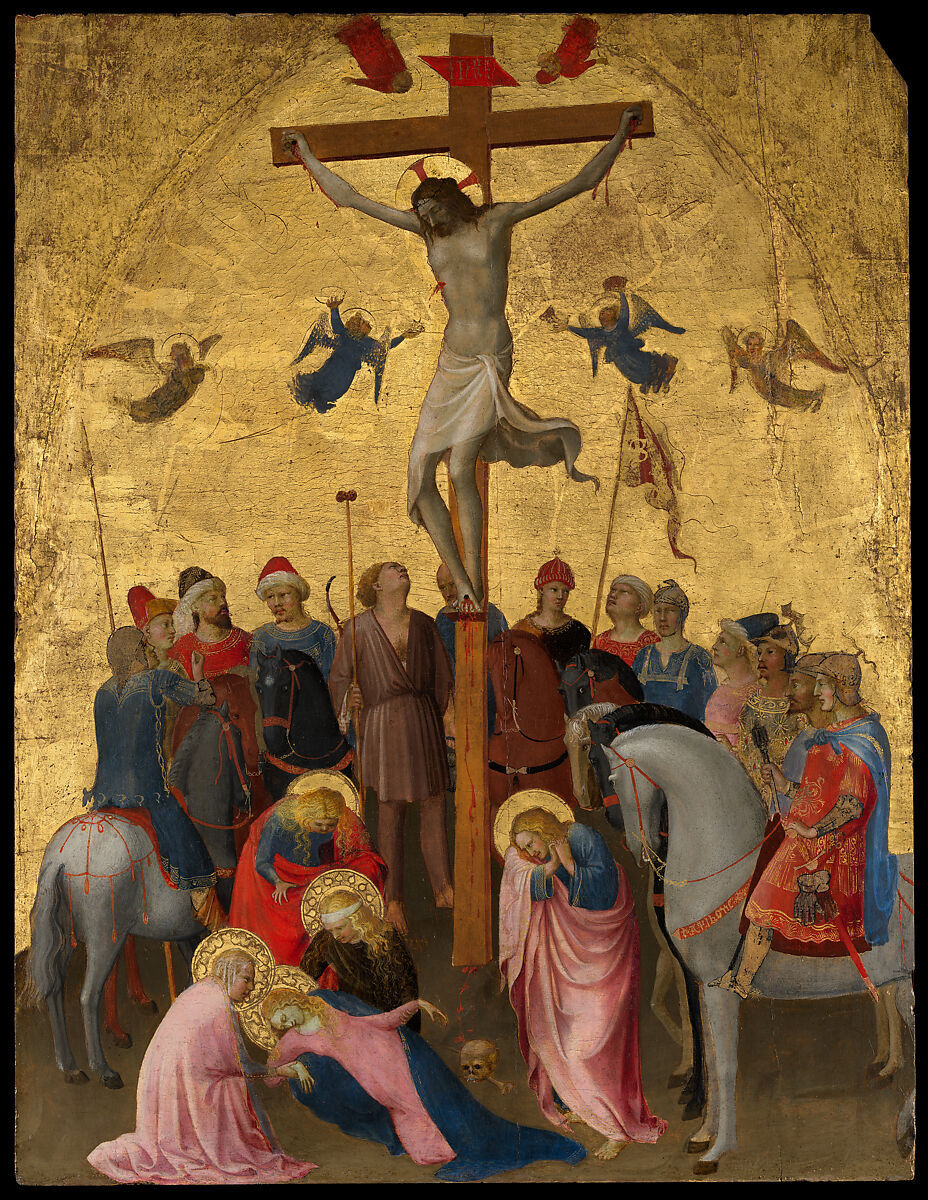
The Griggs Crucifixion, Metropolitan Museum of Art accession 43.98.5. The Virgin collapses as the soldiers and their horses form a group behind the cross. The Metropolitan Museum of Art. Image source. CC0 / Public domain. Proportional web resize.
How the crowd makes space
Fra Angelico gives the horses as much work to do as the riders. At the lower left, a grey horse shows its hindquarters, placing its rider with his back towards us. On the opposite side, another grey horse lowers its head and turns into the gathering. In between, heads, bridles and shoulders partly hide one another. These overlaps let the eye follow the bodies around the front and back of the cross. The brown earth is visible beneath the horses and mourners, and the nearer figures occupy the lower edge of the painted space. The overlaps and changes of angle give the group its depth in a setting with very little scenery. [1] [2]
Follow the faces across the middle of the panel. Near the central post, a man cranes his neck so far back that the underside of his chin catches the eye. A nearby soldier looks sideways. Others direct their attention across the group or towards Christ. The painter gives the standing man an upright reed, topped with the sponge of the Passion story. At the far right, the rider in red has gauntlets hanging from his sword belt, and the angle of his boot in the stirrup makes the foot look braced. Laurence Kanter draws attention to such particulars in the Met’s 2005 catalogue. They let us distinguish one rider from the next before we attend to the differences in their expressions. [1] [2] [3]
Kanter also points to a tension between two angles of view. We look down on the grieving figures in the foreground, especially the Magdalene. Further back, we look up towards the soldiers’ heads and towards Christ. Follow the long post from the Virgin’s side to the soles of Christ’s feet and the change becomes easier to see. The upright connects these viewpoints even though the transition between them is abrupt. We can see the mourners’ gestures clearly from above, while the upward view makes Christ seem all the more exposed. [2] [3]
Sorabella compares the arrangement with an earlier Crucifixion by the Sienese painter Pietro Lorenzetti, also at the Met. That work, dated to the 1340s, belonged to a portable altarpiece. It already brings the fainting Virgin together with an expressive crowd. Its three crosses divide the upper part of the composition among Christ and the two thieves. Fra Angelico's panel gives the upper field to one cross. Below it, the curve of the gathering allows the figures to stand at several distances from the same upright. The comparison shows how an artist could inherit established gestures and still change the experience of looking at the scene. [2] [4]
The Florentine bronze doors
The Met links the circular arrangement to Lorenzo Ghiberti's bronze doors for the Baptistery of Florence. The set now known as the North Door was made between 1403 and 1424. It includes a small Crucifixion among its reliefs of the life of Christ. In that particular relief, the Virgin and Saint John are grouped on either side of the tall cross. The painted Crucifixion surrounds the upright with a much fuller assembly. The comparison works at the level of how figures occupy a shallow space. An artist can use the angle of a shoulder, a turn of the head or one body partly hiding another to suggest depth within a remarkably narrow field. In bronze those effects are modelled in relief. Here they are made with the placement, outlines and shading of painted shapes. [1] [5] [6]
Ghiberti’s project overlapped the period in which the painting is usually dated. The Opera del Duomo’s catalogue records a proposed date for the bronze Crucifixion between 1407 and 1415, earlier than the probable dates of the painting. The Met draws a comparison between the artist’s arrangement of figures and the designs of the doors. The details of when or how the young painter might have seen work on them remain open. [1] [5] [6]
Gold, paint and an image for prayer
The ground beneath the mourners is a muted brown. Above the crowd, gold surrounds the angels’ dark wings and sets off Christ’s pale flesh. The haloes carry that gold down among the painted fabrics of the mourners. The figures get much of their solidity from turns of light and shade in the painted folds. Changing light on the gold itself is a different effect. It catches on the surface of the panel and keeps drawing the eye back towards the cross, even where the gold is worn. The soldiers have room to gather and the Virgin has ground to fall on, while Christ's body remains starkly exposed against gold. [1] [2]
At the top of the cross, the beam slants slightly. Christ's head drops towards one shoulder and his white loincloth lifts at one side. Thin marks of blood pick out the wounds and lead down the post. The angels near his body bend and spread their arms in the open space, with none of the horses or bodies that press around the mourners below. The distance from their movements to those at the Virgin's side is part of the painting's rhythm. The space around Christ gives time to look at his body before the scene brings the eye down to the people watching. [1] [2]
In Italian Passion painting, an image of the crucified Christ could help a viewer meditate on his suffering and sacrifice. At 63.8 by 48.3 centimetres, this panel has room for a crowded scene while keeping its details within easy reach of someone standing close. The grouping of the mourners at the near edge gives such a viewer a place to start. From there it is possible to follow the tilt of John's head, the gathering round the cross and the exchange of glances behind it. Private devotion is the Met’s interpretation, consistent with the picture’s scale and the attention it gives to individual reactions. [1] [2]
The panel itself preserves clues to a more complicated history. Kanter notes that the wood was thinned and cut down on all four sides. X-radiographs indicate that the painted area was always close to its present size and shape. Traces around the edges suggest elements of a former frame. Kanter sees these as clues that the picture may once have crowned an altarpiece. Carl Brandon Strehlke had argued for viewing at or near eye level, where the scale of the figures and the fine decorative details would make sense. Each proposal changes how we imagine a viewer meeting the painting. Close up, the harness and haloes reward scrutiny. Seen from below, a change in viewing angle might help explain how the painter joined the mourners to the men and horses further back. The original setting remains unsettled. [1] [3]
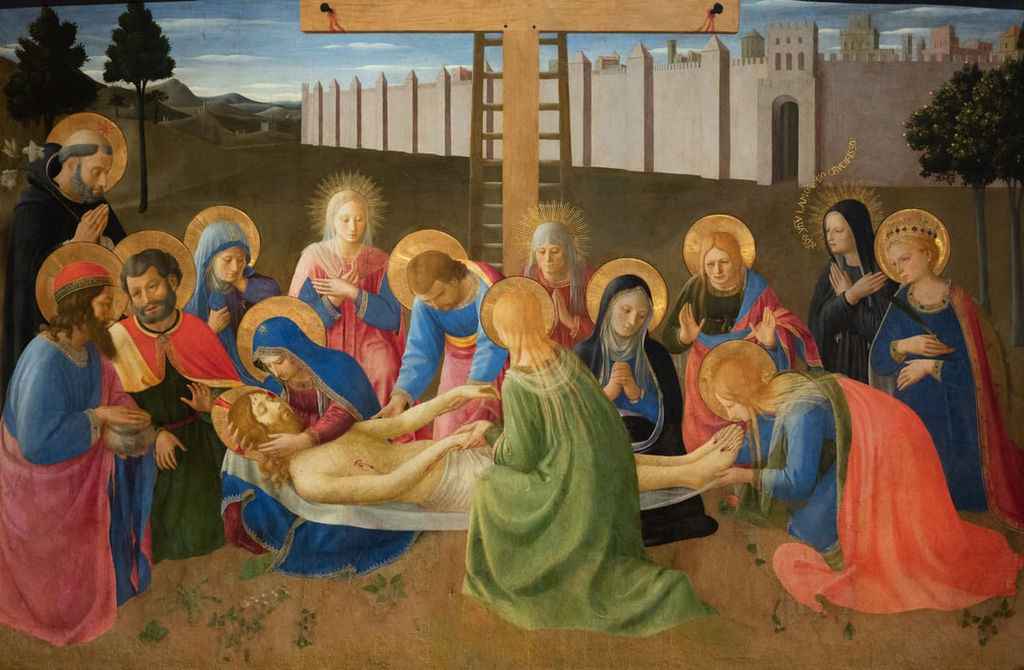
The Florentine Lamentation associated with Blessed Villana. The visible cross and ladders separate the gathering from the walled town. Image source. Public domain. Proportional web resize.
Why the date and attribution vary
The painting is sometimes called the Griggs Crucifixion, after Maitland F. Griggs, whose 1943 bequest brought it to the Met. That name mattered when there was much less agreement about who painted it. In 1971 the museum's Bulletin described how a number of other paintings had been grouped around the panel under the name “Master of the Griggs Crucifixion”. It identified that painter with Giovanni Toscani and reproduced the panel under his name. The old article singles out two of the same features that draw attention today, the semicircle of figures and the sweeping folds of the draperies. The visual observations endured when the attribution changed. Kanter’s catalogue discussion explains that Luciano Bellosi recognised some paintings grouped under that provisional name as parts of a documented altarpiece by Toscani. The Griggs panel was re-examined separately. Bellosi saw a likeness to the figures in Angelico’s predella, the painted strip below the main panel, at San Domenico in Fiesole. That comparison helped bring the work into accounts of Angelico’s early career. [1] [3] [7]
The Met's current collection record gives the panel to Fra Angelico and dates it to about 1420–23. The English checklist for the 2025–26 Fra Angelico exhibition in Florence lists the same object as “Fra Angelico and collaborator” and dates it about 1418–20. The Italian checklist likewise dates it to about 1418–20 and lists Beato Angelico alone. The object number, dimensions and Griggs credit identify one painting in all these records. The two date ranges touch around 1420, so they place it near the beginning of Angelico's career. The English exhibition checklist gives no name for the collaborator. The shift in viewpoint between the mourners and the crowd had already prompted suggestions that another hand might have painted the foreground, or that Angelico adapted it from a separate source. Kanter discusses both possibilities. The visible shift makes those proposals intelligible, while leaving the division of work open. [1] [3] [8] [9]
Look closely at the bridle of the horse at the far right. Kanter reads the tiny gilt letters there as a form of “Fra Giovanni”, the name Angelico used as a Dominican. If they are his signature, they would place the painting after he entered the order. The earliest surviving record to call him Fra Giovanni dates to 1423, but that gives a date at which the name was in use and leaves open when he took it. Kanter’s entry also records Strehlke’s suggestion that the letters could refer to the panel’s patron. A detail that might seem to settle who painted the panel or when it was made still depends on whose name the bridle carries. [3]
Other Crucifixions by Fra Angelico
The Ashmolean Museum in Oxford holds another panel from the early 1420s, The Crucifixion with the Virgin, Saint John the Evangelist and the Magdalen. Its original frame is still attached. The narrower composition brings three mourners close to the cross, with the Magdalene below and the Virgin and John to either side. A pelican above the cross feeds its young with its blood, a symbol of Christ’s sacrifice. At the Met, small angels occupy the gold around Christ and the horses and soldiers below give the onlookers’ responses as much room as the foreground grief. Both panels are thought likely to have been made for private devotion, a setting in which a concentrated image and a crowded narrative could each sustain prolonged attention. [1] [10]
The Met itself holds another work titled The Crucifixion, accession number 14.40.628, which its object record dates possibly to around 1440. The later picture is horizontal and shows saints including Dominic and Francis beside the cross. They lived centuries after the event, and the museum reads their presence as an expression of meditation. The Florence Crucifixion and Saints is a fresco made for the chapter house at San Marco, where the friars assembled. The Fogg’s Crucifixion, a late work associated with the Spanish cardinal Juan de Torquemada, shows the cardinal kneeling at the foot of the cross. The Griggs panel is the early gold-ground painting in which the cross rises over a company of soldiers, horses and grieving witnesses. [1] [3] [11] [12] [13]
Further reading
Explore a catalogue or scholarly study related to this article.
Fra Angelico. Laurence Kanter and Pia Palladino. Metropolitan Museum of Art, 2005.
The catalogue places the small Griggs panel among the early works associated with Angelico’s formation. Read or download the Met catalogue.
Fra Angelico artworks directory
Explore documented works and surviving parts of larger ensembles. Catalogue links identify individual records. Attribution and dating can vary across collections and publications. Search the Federico Zeri Photo Archive by artist.
| Name | Date | Medium and sources |
|---|---|---|
| Adoration of the Magi | About 1440–60, NGA catalogue | Painting Catalogue. |
| Adoration of the Magi (Armadio degli Argenti) | About 1450–53 | Tempera and gold on wood. Catalogue. |
| Agony in the Garden (Armadio degli Argenti) | About 1450–53 | Tempera and gilding on wood Catalogue. |
| Annalena Altarpiece / Pala di Annalena | commonly c. 1435 | Tempera on panel Catalogue. |
| Annunciation (Armadio degli Argenti) | About 1450–53 | Tempera and gilding on wood. Catalogue. |
| Annunciation (Cortona) | generally placed in the 1430s; exact dating remains debated | Tempera on panel Catalogue. |
| Annunciation (Prado) | 1425–26 | Tempera on poplar panel Catalogue. |
| Annunciation (San Marco upper corridor) | commonly c. 1442 | Fresco Catalogue. |
| Annunciation with Saint Peter Martyr | About 1439–43 | Fresco on plaster. Catalogue. |
| Annunciatory Angel | 1450–55, Detroit catalogue | Gold leaf and tempera on wood panel. Catalogue. |
| Armadio degli Argenti (Silver Treasury) | principally c. 1450–52 | Tempera on panel Catalogue. |
| Arrest of Christ (Armadio degli Argenti) | About 1450–53 | Tempera and gilding on wood Catalogue. |
| Ascension (Armadio degli Argenti) | About 1450–53 | Tempera and gilding on wood Catalogue. |
| Baptism of Christ (Armadio, Alesso Baldovinetti) | About 1452–53 | Tempera and gilding on wood Catalogue. |
| Beheading of Saints Cosmas and Damian (San Marco Altarpiece) | About 1438–42 | Painted panel Catalogue. |
| Betrayal of Christ (Armadio degli Argenti) | About 1450–53 | Tempera and gilding on wood Catalogue. |
| Blessed Dominican, Possibly Jordan of Saxony (San Marco Altarpiece) | About 1438–42 | Painted panel Catalogue. |
| Blessed Vincent Ferrer (San Marco Altarpiece) | About 1438–42 | Painted panel Catalogue. |
| Burial of Saints Cosmas and Damian (San Marco Altarpiece) | About 1438–42 | Painted panel Catalogue. |
| Bust of a Cleric and a Group of Figures (recto and verso) | 15th century | Pen and ink on paper Catalogue. |
| Christ among the Doctors (Armadio degli Argenti) | About 1450–53 | Tempera and gilding on wood Catalogue. |
| Christ before Caiaphas (Armadio degli Argenti) | About 1450–53 | Tempera and gilding on wood Catalogue. |
| Christ Glorified in the Court of Heaven | About 1423–24 | Egg tempera on wood, probably poplar, with gold and silver leaf Catalogue. |
| Christ Seated in Judgment | 1447 | Fresco and gilding on plaster. Catalogue. |
| Christ Stripped of His Garments (Armadio degli Argenti) | About 1450–53 | Tempera and gilding on wood Catalogue. |
| Christ Washes the Apostles’ Feet (Armadio degli Argenti) | About 1450–53 | Tempera and gilding on wood Catalogue. |
| Circumcision of Christ (Armadio degli Argenti) | About 1450–53 | Tempera and gilding on wood. Catalogue. |
| Communion of the Apostles (Armadio degli Argenti) | About 1450–53 | Tempera and gilding on wood Catalogue. |
| Coronation of the Virgin (Armadio degli Argenti) | About 1450–53 | Tempera and gilding on wood Catalogue. |
| Coronation of the Virgin (Louvre) | Louvre: second quarter of the fifteenth century, 1425–50; often dated more narrowly c. 1434–35 | Tempera and gold on panel Catalogue. |
| Coronation of the Virgin (Uffizi) | 1431–35 | Tempera on wood, gold ground Catalogue. |
| Cortona Triptych | About 1437 | Tempera and gold on panel. Catalogue. |
| Crucifixion (Armadio degli Argenti) | About 1450–53 | Tempera and gilding on wood Catalogue. |
| Crucifixion and Saints | 1441–42 | Fresco Catalogue. |
| Deposition from the Cross / Santa Trinita Deposition | commissioned 1429–32; completed by Angelico within this period | Tempera on panel Catalogue. |
| Descent into Limbo (Armadio degli Argenti) | About 1450–53 | Tempera and gilding on wood Catalogue. |
| Entombment of Christ (San Marco Altarpiece) | About 1438–42 | Painted panel Catalogue. |
| Entry into Jerusalem (Armadio degli Argenti) | About 1450–53 | Tempera and gilding on wood Catalogue. |
| Expulsion and the Stoning of Saint Stephen | 1448–49, Vatican Museums | Fresco. Catalogue. |
| Fiesole San Domenico Altarpiece | early 1420s; predella about 1423–24 | Tempera on panel Catalogue. |
| Flagellation (Armadio degli Argenti) | About 1450–53 | Tempera and gilding on wood Catalogue. |
| Flight into Egypt | About 1450–53 | Tempera and gilding on wood. Catalogue. |
| Guidalotti Polyptych | c. 1447–49 | Tempera and oil on panel Catalogue. |
| Healing of Palladia and Saint Damian Accepting Her Gift (San Marco Altarpiece) | About 1438–42 | Painted panel Catalogue. |
| Holy Pilgrim, Possibly Saint Roch (San Marco Altarpiece) | About 1438–42 | Painted panel Catalogue. |
| Holy Women at the Tomb (Armadio degli Argenti) | About 1450–53 | Tempera and gilding on wood Catalogue. |
| Judas Receives Payment (Armadio degli Argenti) | About 1450–53 | Tempera and gilding on wood Catalogue. |
| Lamentation over Christ (Armadio degli Argenti) | About 1450–53 | Tempera and gilding on wood Catalogue. |
| Lamentation over the Dead Christ (Croce al Tempio Lamentation) | 1436–41, Zeri catalogue | Tempera and gilding on wood panel. Catalogue. |
| Last Judgement (Armadio degli Argenti) | About 1450–53 | Tempera and gilding on wood Catalogue. |
| Last Judgement (San Marco) | c. 1425–28 | Tempera and gold on panel Catalogue. |
| Last Supper (Armadio degli Argenti) | About 1450–53 | Tempera and gilding on wood Catalogue. |
| Lex Amoris (Armadio degli Argenti) | About 1450–53 | Tempera and gilding on wood Catalogue. |
| Madonna and Child with Saint Dominic and Saint Thomas Aquinas | About 1430, Hermitage catalogue | Detached fresco. Catalogue. |
| Madonna and Child with Saints | About 1411–13 | Tempera on wood panel, with a gold ground. Catalogue. |
| Madonna of Humility | About 1425, Thyssen catalogue | Tempera and gold on wood. Catalogue. |
| Madonna of the Star | 1431–34, Zeri catalogue | Tempera with oil glazes and gold on wood panel, as catalogued by the Gardner for the 2018 exhibition. Catalogue. |
| Marriage at Cana (Armadio, Alesso Baldovinetti) | About 1452–53 | Tempera and gilding on wood Catalogue. |
| Massacre of the Innocents (Armadio degli Argenti) | About 1450–53 | Tempera and gilding on wood Catalogue. |
| Miracle of the Black Leg (San Marco Altarpiece) | About 1438–42 | Painted panel Catalogue. |
| Mocking of Christ (Armadio degli Argenti) | About 1450–53 | Tempera and gilding on wood Catalogue. |
| Mystic Wheel (The Vision of Ezekiel) | About 1450–52 | Tempera and gilding on wood. Catalogue. |
| Nativity (Armadio degli Argenti) | About 1450–53 | Tempera and gilding on wood. Catalogue. |
| Niccoline Chapel frescoes | principally 1448–50 | Fresco Catalogue. |
| Noli me Tangere | broadly within Angelico’s San Marco campaign, late 1430s–1440s | Fresco Catalogue. |
| Ordination of Saint Lawrence | 1448 | Fresco. Catalogue. |
| Pentecost (Armadio degli Argenti) | About 1450–53 | Tempera and gilding on wood Catalogue. |
| Presentation of Christ at the Temple (Armadio degli Argenti) | About 1450–53 | Tempera and gilding on wood. Catalogue. |
| Presentation of Jesus at the Temple | Early 1440s | Fresco on plaster. Catalogue. |
| Raising of Lazarus (Armadio degli Argenti) | About 1450–53 | Tempera and gilding on wood Catalogue. |
| Rescue of Saints Cosmas and Damian and Exorcism of Lysias (San Marco Altarpiece) | About 1438–42 | Painted panel Catalogue. |
| Road to Calvary (Armadio degli Argenti) | About 1450–53 | Tempera and gilding on wood Catalogue. |
| Saint Anthony Abbot (San Marco Altarpiece) | About 1438–42 | Painted panel Catalogue. |
| Saint Bernard of Clairvaux or Saint Benedict (San Marco Altarpiece) | About 1438–42 | Painted panel Catalogue. |
| Saint Damian Receives Money from Palladia | About 1425–49 | Tempera and gilding on wood. Catalogue. |
| Saint Francis and a Bishop Saint, Saint John the Baptist and Saint Dominic | Late 1420s, Getty catalogue | Tempera and gold leaf on panel. Catalogue. |
| Saint James the Greater Freeing the Magician Hermogenes | About 1426–29 | Tempera and gold on panel Catalogue. |
| Saint Jerome (San Marco Altarpiece) | About 1438–42 | Painted panel Catalogue. |
| Saint Lawrence Giving Alms | About 1448 | Wall fresco. Catalogue. |
| Saint Lawrence Receiving the Treasures of the Church from Pope Sixtus II | About 1448–49 | Fresco on plaster. Catalogue. |
| Saint Romuald (San Marco Altarpiece) | About 1438–42 | Painted panel Catalogue. |
| Saint Stephen Addressing the Council | 1448–49, Vatican Museums | Fresco. Catalogue. |
| Saint Stephen Preaching | 1448–49, Vatican Museums | Wall fresco. Catalogue. |
| Saint Thomas Aquinas (San Marco Altarpiece) | About 1438–42 | Painted panel Catalogue. |
| Saints Cosmas and Damian and Their Brothers Survive the Stake | Second quarter of the 15th century | Tempera and gilding on wood. Catalogue. |
| Saints Cosmas and Damian at the Stake (San Marco Altarpiece) | About 1438–42 | Painted panel Catalogue. |
| Saints Cosmas and Damian before Lysias (San Marco Altarpiece) | About 1438–42 | Painted panel Catalogue. |
| Saints Cosmas and Damian Rescued by an Angel | Second quarter of the 15th century | Tempera and gilding on wood. Catalogue. |
| Saints Cosmas and Damian with Their Brothers before Proconsul Lysias | Second quarter of the 15th century | Tempera and gilding on wood. Catalogue. |
| San Marco Altarpiece / Pala di San Marco | 1438–43 | Tempera on panel Catalogue. |
| San Pietro Martire Triptych | About 1422–23, Strozzi exhibition | Tempera and gold on panel. Catalogue. |
| Scenes from the Lives of the Desert Fathers (Thebaid) | About 1420, Uffizi catalogue | Tempera on wood. Catalogue. |
| Sixteen Prophets | 1447 | Fresco and gilding on plaster Catalogue. |
| Stoning and Shooting of the Brothers (San Marco Altarpiece) | About 1438–42 | Painted panel Catalogue. |
| Tabernacle of the Linaioli | 1433–35 | Tempera on panel Catalogue. |
| The Attempted Crucifixion and Stoning of Saints Cosmas and Damian | Second quarter of the 15th century | Tempera and gilding on wood. Catalogue. |
| The Crucifixion | About 1420–23, Met catalogue | Tempera on wood, gold ground. Catalogue. |
| The Death and the Assumption of the Virgin | 1424–34 | Tempera with oil glazes and gold on panel Catalogue. |
| The Dominican Blessed (left end) (Fiesole predella) | About 1423–24 | Egg tempera and gold on wood Catalogue. |
| The Dominican Blessed (right end) (Fiesole predella) | About 1423–24 | Egg tempera and gold on wood Catalogue. |
| The Entombment of Christ | About 1450 | Tempera on poplar panel. Catalogue. |
| The Forerunners of Christ with Saints and Martyrs | About 1423–24 | Egg tempera on wood (probably poplar), with gold and silver leaf. Catalogue. |
| The Funeral of Saint Anthony Abbot | About 1426–30 | Tempera on poplar panel. Catalogue. |
| The Martyrdom of Saints Cosmas and Damian | About 1425–49 | Tempera and gilding on wood. Catalogue. |
| The Mocking of Christ / Christ Mocked | within the San Marco dormitory campaign, broadly late 1430s–1440s | Fresco Catalogue. |
| The Nativity | About 1425, Minneapolis catalogue | Tempera on poplar panel. Catalogue. |
| The Nativity in Cell 5 at San Marco | About 1439–43 | Fresco on plaster. Catalogue. |
| The Penitent Saint Jerome | 1419–20 | Tempera on wood panel Catalogue. |
| The Virgin and Child by Fra Angelico (Fogg Museum) | About 1430, Harvard catalogue | Tempera originally on panel, subsequently transferred to Masonite. Catalogue. |
| The Virgin Mary with the Apostles and Other Saints (Fiesole predella) | About 1423–24 | Egg tempera and gold on wood Catalogue. |
| Transfiguration (Armadio, Alesso Baldovinetti) | About 1452–53 | Tempera and gilding on wood Catalogue. |
| Transfiguration (San Marco Cell 6) | within the San Marco dormitory campaign, broadly late 1430s–1440s | Fresco Catalogue. |
| Virgin Mary Annunciate | 1450–55, Detroit catalogue | Gold leaf and tempera on wood panel. Catalogue. |
| Virgin of the Pomegranate | About 1426 | Tempera on panel with gilding Catalogue. |
Frequently Asked Questions
Discussion
Use these prompts to look again or share an observation.
Reader Insights
Which gesture first tells you that the Virgin has lost her strength? Trace the hands of the women supporting her.
Follow the direction of the soldiers’ heads and the horses’ bodies. Where does the group draw attention back to the cross?
Join the Conversation
Share a detail or question about The Crucifixion.
References
- The Metropolitan Museum of Art. The Crucifixion, accession 43.98.5. Collection record. View source.
- Jean Sorabella. “The Crucifixion and Passion of Christ in Italian Painting”. Heilbrunn Timeline of Art History, The Metropolitan Museum of Art, June 2008. View source.
- Laurence Kanter. “The Crucifixion”, cat. 8. In Fra Angelico, by Laurence Kanter and Pia Palladino, The Metropolitan Museum of Art, 2005, pp. 52–54 (PDF pp. 65–67). For the Fogg panel, see cat. 39, pp. 223–25. View source.
- The Metropolitan Museum of Art. Pietro Lorenzetti, The Crucifixion, accession 2002.436. Collection record. View source.
- Opera di Santa Maria del Fiore. Lorenzo Ghiberti, North Gate of the Baptistery. View source.
- Opera di Santa Maria del Fiore. Crocifissione, Porta Nord del Battistero, inv. 931.18. Scientific catalogue (in Italian). View source.
- Everett Fahy. “Florentine Paintings in the Metropolitan Museum: An Exhibition and a Catalogue”. The Metropolitan Museum of Art Bulletin, vol. 29, no. 10, June 1971. Entry for accession 43.98.5. View source.
- Fondazione Palazzo Strozzi and Museo di San Marco. Fra Angelico, English exhibition press kit, Florence, 2025–26. Museo di San Marco checklist, no. 22. View source.
- Fondazione Palazzo Strozzi and Museo di San Marco. Beato Angelico, Italian exhibition press kit, Florence, 2025–26. Museo di San Marco checklist, no. 22 (in Italian). View source.
- Ashmolean Museum. The Crucifixion with the Virgin, Saint John the Evangelist and the Magdalen, accession WA2024.83. View source.
- The Metropolitan Museum of Art. The Crucifixion, accession 14.40.628. Collection record. View source.
- Ministero della Cultura. Crocifissione, Patriarchi, Santi, Beati, record 0900281120-0. Catalogo Generale dei Beni Culturali (in Italian). View source.
- The Metropolitan Museum of Art. Fra Angelico. Exhibition overview, 2005–06. View source.
.jpg)



 Fra Angelico.jpg)


