


 by Tom Gurney
Tom Gurney BSc (Hons) is an art history expert with over 20 years experience
Published on June 19, 2020 / Updated on November 29, 2026
Email: tomgurney1@gmail.com / Phone: +44 7429 011000
Introduction
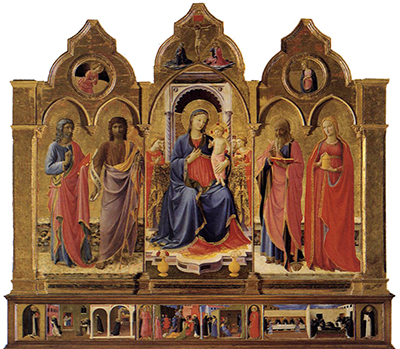
In Fra Angelico’s Cortona Triptych, the Virgin supports the Christ Child on her knee while four saints stand at either side. Look down from the gilded throne and the figures suddenly become small enough to gather round a dinner table or pass through a doorway. These are scenes from the life of Saint Dominic, painted along the foot of an altarpiece associated with the Dominican church of San Domenico in Cortona. The work is now in the Museo Diocesano del Capitolo. The checklist for the 2025 Palazzo Strozzi exhibition dates it to about 1437, within the broader 1430–40 range given by the Fondazione Federico Zeri. [1] [2]
At a Glance
- ArtistFra Angelico (Guido di Pietro). [1] [2]
- DateAbout 1437, according to the 2025 Palazzo Strozzi exhibition. [1]
- MediumTempera and gold on panel. [1]
- DimensionsMain section 187 × 240 cm. Predella 34.5 × 245.5 cm, as listed by Palazzo Strozzi. [1]
- CollectionMuseo Diocesano del Capitolo, Cortona, Italy. [1]
The Madonna and the four saints
The Virgin’s blue mantle sets her apart even before you make out the throne. It falls in broad folds across both knees, with flashes of red beneath and a gold border that dips towards the step. The Child stands on one knee, one of Mary’s hands steadying him at the hip and one bare foot tucked into a deep fold of her skirt. Small red blocks form a cross in his gold halo, and his raised hand makes a gesture of blessing. The two yellow vases at the foot of the throne almost match. Look closer and their flowers differ, dark red on the left and pale on the right. [1] [3]
The throne brings several kinds of ornament together in a remarkably small space. Its pale architectural frame, slender columns and scalloped recess enclose the Virgin’s large gold halo. Patterned cloth appears on either side of her mantle. The plinth below projects towards us and turns in and out in a series of curves and straight edges, picked out in bands of pink, white and green. Four angels attend the throne. They are so closely grouped around the chair that some of their wings disappear behind other figures or at the edges of the panel. The figures stand behind the level of the Child and above the vases, enough to suggest that there is room to approach the throne even within the narrow central bay. [1] [3]
The four standing saints are Matthew and John the Baptist, from the far left to the centre, and John the Evangelist and Mary Magdalene, from the centre to the far right. The Baptist’s rough garment, narrow staff and scroll give him a different silhouette from Matthew, who carries a red book. John the Evangelist bows his head over an open volume, a pen poised over the page, and the Magdalene carries the ointment vessel that identifies her. She and Matthew turn slightly inwards at the outer edges of the group. Their strong reds and blues recur in the clothes of the other saints and in the central panel, drawing the eye across the strips of the frame. [1] [2] [3]
Take a second look at the floor where it meets those strips. The bands behind the saints and the line of their footing are easier to follow across the two figures in each wing than across the whole altarpiece. The dark area in front of Mary’s throne, where the yellow vases stand, meets much paler flooring beneath the saints. A first view takes in a gathering united by gold, proportion and colour. Looking down at the figures’ feet brings you closer to the question of how these panels came together. [3] [4]
The Annunciation above the saints
Gabriel inclines towards Mary in a roundel over the left wing. She stands with her hands drawn across her breast in the roundel over the right. The gilded frame supplies a distance between the two figures. To follow their exchange you have to pass over the centre, where the Crucifixion rises above the enthroned Virgin and Child. The mourners flank the cross on patches of blue as it stands against gold, and the upper silhouette of the frame gives Christ’s extended arms room to spread. Across the top and down the middle, the triptych brings together the announcement of Christ’s birth, his appearance as a child and his death. [1] [2] [3]
Cortona also has Fra Angelico’s much larger Annunciation of Cortona, a separate altarpiece from the same church. In that work Gabriel and Mary occupy an architectural setting large enough for a perspective view of the portico. Adam and Eve appear in the garden beyond it, and the predella is chiefly about the life of the Virgin. Within the triptych, the entire Annunciation takes up two small circles at either side of the Crucifixion. The difference is immediately useful when identifying the works, and it also shows what the frame contributes. At the top of the triptych, the approach of the angel and the response of the Virgin take place across three bays of a gilded structure. [1] [3] [5]
Seven stories of Saint Dominic
A predella is the low strip of pictures at the foot of an altarpiece. Here seven incidents concerning Dominic, the founder of the Order of Preachers, share the strip with four standing saints. Peter Martyr opens the sequence. Michael the Archangel and Saint Vincent stand between groups of episodes, and Thomas Aquinas brings the sequence to a close. These four figures fill their narrow, gold-backed niches. In the adjoining scenes, smaller figures in recognisable buildings go about their business against blue skies or in darkened rooms. The switch in scale gives the eye a place to pause before the next group of events. [1] [2] [3]
At the left, the dream of Pope Innocent III spreads across the façade of a building. A red opening lets us see the sleeper while, just to its left, Dominic reaches upward to hold up a wall. The picture gives the man who is dreaming and what he dreams neighbouring places in the same building. Almost at the edge of the same building, Dominic and Francis meet and embrace. The distinct habits bring the two founders together in a single knot of brown, black and white just before the white columns of the next scene. In the vision of Peter and Paul that follows, Dominic first appears as a dark figure in one bay. In the adjoining bay he kneels, the apostles appearing above him. Columns divide that action into stages, as separate doorways might on a walk through a building. [1] [3]
The centre of the strip brings the saint into a more crowded setting. In the raising of Napoleone Orsini, bystanders gather in front of tall, brightly painted walls. The saint’s hands and the gestures of the people nearest the fallen figure draw attention back down to ground level. The next episode, the dispute with heretics and miracle of the book, carries the viewer from a group in front of buildings towards an interior where the little burst of fire is easy to miss. Moving from the crowd to the fire takes only a few inches of painted surface, but the change from open street to enclosed room makes the two moments legible. [1] [3]
In the last pair of scenes, the spaces are plainer. Dominican friars sit behind a long white cloth while two angels approach from either side to serve them. The cloth stretches out across the scene unbroken, holding the group together. In the death of Dominic the comparable horizontal is the saint’s bed, again surrounded by friars. The upright wall between the two interiors marks how far the story has moved, from a meal shared in life to the community gathered at one man’s death. Seen together, the episodes use two familiar arrangements of people in a room to make the friars recognisable as a community. [1] [3] [6]
Look back from the predella to the throne and the contrast in viewpoint is striking. The large figures are placed so that their haloes and gestures can be made out across a chapel. To follow the stories below, the eye has to move from one building to the next and catch much smaller gestures. The difference gave an altarpiece the capacity to offer both a focus for worship and episodes that rewarded slow attention. Here it also raises a historical question. Dominic’s story dominates the lower strip, while the large standing saints are names associated with a different dedication. [1] [3] [4]
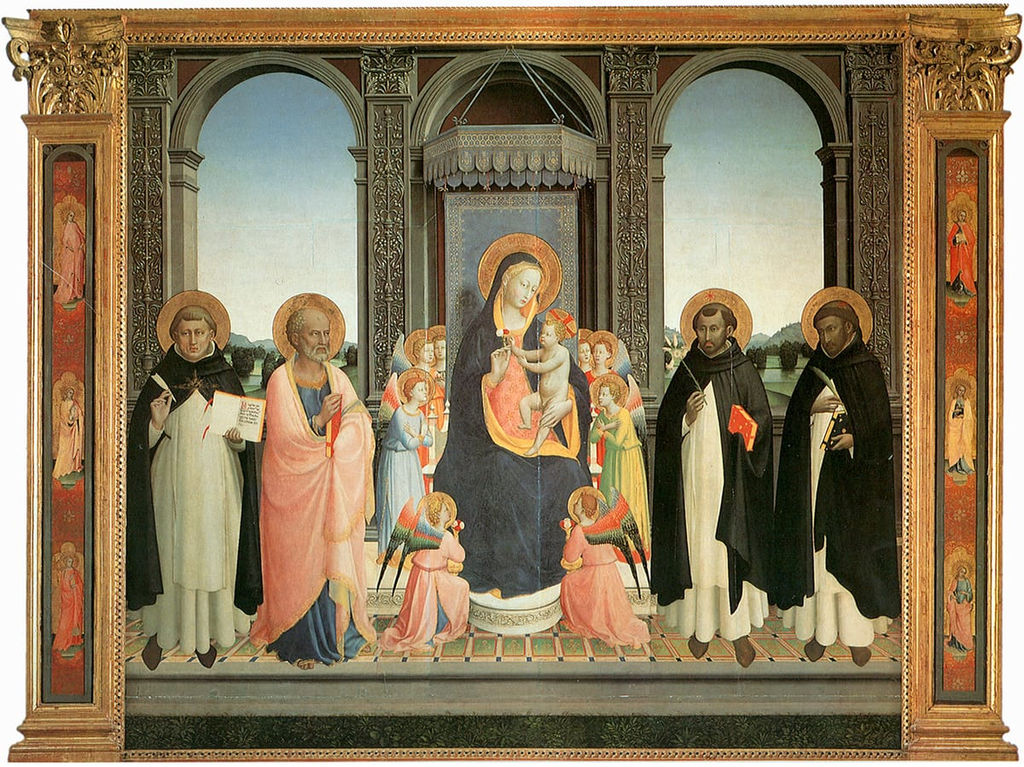
The main Fiesole altarpiece as it survives after Lorenzo di Credi’s alterations. Its detached predella is in London. Image source. Public domain. Proportional web resize.
A commission and a possible second altarpiece
Giovanni di Tommaso di ser Cecco, a wealthy Cortonese merchant, is documented as the patron of the chapel for which the wings are thought to have been made. Fra Angelico appears as a witness when Giovanni made his will at the convent in March 1438. The family chapel, to the right of the high altar at San Domenico, was dedicated to Saint John the Evangelist. Matthew and the Magdalene have been linked to the patron’s eldest son and his wife. Together the Evangelist and the Baptist could evoke the patron’s name, Giovanni. The Diocesan Museum’s guide also points to a civic reading for the Baptist. He was patron saint of Florence, which by then governed Cortona. Across the church, Sassetta’s Madonna of Humility occupied the chapel of the apothecary Niccolò di Angelo. The two works now share a museum, but their similar profiles once stood in chapels on opposite sides of the high altar. [4] [5] [7]
A will drawn up in 1437 records plans for another altarpiece in the church. Milana di Matteo, a lay member of the Dominican order, set aside money for a high altarpiece of the Virgin and Child with four saints, including Dominic. In 1440 a different high altarpiece, a Coronation of the Virgin by Lorenzo di Niccolò, came to San Domenico from Florence as a gift from Cosimo and Lorenzo de’ Medici. William Hood suggested that the throne panel and the Dominican predella may have belonged to an abandoned project for the high altar. Machtelt Brüggen Israëls connected those elements with Milana’s bequest and proposed that two completed altarpieces may have been combined later. A record of the predella apart from the triptych in 1770 gives the proposal particular weight, though the record alone leaves its original position open. [4]
This is an instance where the painted surfaces and the frame supply evidence alongside the documents. The mismatch in floor levels is visible today. Early photographs also show differences in the levels of the capitals that support the painted bays, and the lower edge of the central pinnacle was adjusted to fit. Brüggen Israëls saw such alterations as consistent with a later combination. Diane Cole Ahl proposed a different reading. She pointed to the way the narrative groups are matched to the three divisions of the frame and saw the uneven spaces as a deliberate response to Sassetta’s altarpiece across the church. The Diocesan Museum’s guide also allows for a reason to include the unrelated predella programme within a single commission. Giovanni belonged to the local confraternity of Saint Dominic, so showing the founder’s life below the family’s saints would honour both the church and the confraternity. [3] [4] [5] [7]
The wartime history of the panels complicates efforts to establish how the parts were joined. The painting was moved out of the chapel in 1940 for safekeeping, but the damp of its refuge did serious damage. Conservators detached the paint layers from their original supports, and the restored work went on display in the Diocesan Museum in 1950. The transfer saved the painting and took away evidence in the old wood that might have helped establish how the panels first fitted together. [4] [7]
The dating and attribution have also been debated. The Metropolitan Museum’s 2005 catalogue describes the triptych as the work of an assistant painting over Angelico’s design around 1440. The Diocesan Museum’s guide assigns it to Angelico with a date of 1438, and the 2025 Palazzo Strozzi checklist credits it to him and dates it around 1437. The estimates cluster within a few years of one another. The more consequential difference concerns whether Angelico himself painted the work. [1] [7] [8]
Two ways to compare Fra Angelico’s altarpieces
In the San Pietro Martire Triptych, now in Florence, the figures share a line of ground across the three bays. It was made for a community of Dominican nuns in Florence. There the figures of Gabriel and Mary also occupy small roundels at either side, but the central roundel shows God the Father sending the Holy Spirit. Look at the spaces between the arches for two small scenes of Peter Martyr preaching and being killed. Both works use the pointed frame to give the Annunciation room to unfold, while the spaces allotted to the saints’ stories differ. The Florentine triptych puts Peter Martyr’s episodes high up and at the edges. Cortona devotes a whole band below the standing saints to Dominic’s life. [1] [4] [9]
The Perugia Altarpiece is closer to Cortona in the arrangement of its central group. Angels attend an enthroned Virgin and Child in a gold-ground panel. At Perugia the wings of the attendants have more room to spread, a difference that Brüggen Israëls drew attention to when considering the tight fit of the throne group at Cortona. Perugia’s commission came from Elisabetta Guidalotti for her family altar in that city’s church of San Domenico, where the stories in the predella concern Saint Nicholas of Bari. The resemblance between throne groups is especially revealing beside the different saints and stories. A similar arrangement could serve a pair of Dominican churches while making room for each altar’s particular devotion. [4] [10]
Fra Angelico artworks directory
Explore documented works and surviving parts of larger ensembles. Catalogue links identify individual records. Attribution and dating can vary across collections and publications. Search the Federico Zeri Photo Archive by artist.
| Name | Date | Medium and sources |
|---|---|---|
| Adoration of the Magi | About 1440–60, NGA catalogue | Painting Catalogue. |
| Adoration of the Magi (Armadio degli Argenti) | About 1450–53 | Tempera and gold on wood. Catalogue. |
| Agony in the Garden (Armadio degli Argenti) | About 1450–53 | Tempera and gilding on wood Catalogue. |
| Annalena Altarpiece / Pala di Annalena | commonly c. 1435 | Tempera on panel Catalogue. |
| Annunciation (Armadio degli Argenti) | About 1450–53 | Tempera and gilding on wood. Catalogue. |
| Annunciation (Cortona) | generally placed in the 1430s; exact dating remains debated | Tempera on panel Catalogue. |
| Annunciation (Prado) | 1425–26 | Tempera on poplar panel Catalogue. |
| Annunciation (San Marco upper corridor) | commonly c. 1442 | Fresco Catalogue. |
| Annunciation with Saint Peter Martyr | About 1439–43 | Fresco on plaster. Catalogue. |
| Annunciatory Angel | 1450–55, Detroit catalogue | Gold leaf and tempera on wood panel. Catalogue. |
| Armadio degli Argenti (Silver Treasury) | principally c. 1450–52 | Tempera on panel Catalogue. |
| Arrest of Christ (Armadio degli Argenti) | About 1450–53 | Tempera and gilding on wood Catalogue. |
| Ascension (Armadio degli Argenti) | About 1450–53 | Tempera and gilding on wood Catalogue. |
| Baptism of Christ (Armadio, Alesso Baldovinetti) | About 1452–53 | Tempera and gilding on wood Catalogue. |
| Beheading of Saints Cosmas and Damian (San Marco Altarpiece) | About 1438–42 | Painted panel Catalogue. |
| Betrayal of Christ (Armadio degli Argenti) | About 1450–53 | Tempera and gilding on wood Catalogue. |
| Blessed Dominican, Possibly Jordan of Saxony (San Marco Altarpiece) | About 1438–42 | Painted panel Catalogue. |
| Blessed Vincent Ferrer (San Marco Altarpiece) | About 1438–42 | Painted panel Catalogue. |
| Burial of Saints Cosmas and Damian (San Marco Altarpiece) | About 1438–42 | Painted panel Catalogue. |
| Bust of a Cleric and a Group of Figures (recto and verso) | 15th century | Pen and ink on paper Catalogue. |
| Christ among the Doctors (Armadio degli Argenti) | About 1450–53 | Tempera and gilding on wood Catalogue. |
| Christ before Caiaphas (Armadio degli Argenti) | About 1450–53 | Tempera and gilding on wood Catalogue. |
| Christ Glorified in the Court of Heaven | About 1423–24 | Egg tempera on wood, probably poplar, with gold and silver leaf Catalogue. |
| Christ Seated in Judgment | 1447 | Fresco and gilding on plaster. Catalogue. |
| Christ Stripped of His Garments (Armadio degli Argenti) | About 1450–53 | Tempera and gilding on wood Catalogue. |
| Christ Washes the Apostles’ Feet (Armadio degli Argenti) | About 1450–53 | Tempera and gilding on wood Catalogue. |
| Circumcision of Christ (Armadio degli Argenti) | About 1450–53 | Tempera and gilding on wood. Catalogue. |
| Communion of the Apostles (Armadio degli Argenti) | About 1450–53 | Tempera and gilding on wood Catalogue. |
| Coronation of the Virgin (Armadio degli Argenti) | About 1450–53 | Tempera and gilding on wood Catalogue. |
| Coronation of the Virgin (Louvre) | Louvre: second quarter of the fifteenth century, 1425–50; often dated more narrowly c. 1434–35 | Tempera and gold on panel Catalogue. |
| Coronation of the Virgin (Uffizi) | 1431–35 | Tempera on wood, gold ground Catalogue. |
| Cortona Triptych | About 1437 | Tempera and gold on panel. Catalogue. |
| Crucifixion (Armadio degli Argenti) | About 1450–53 | Tempera and gilding on wood Catalogue. |
| Crucifixion and Saints | 1441–42 | Fresco Catalogue. |
| Deposition from the Cross / Santa Trinita Deposition | commissioned 1429–32; completed by Angelico within this period | Tempera on panel Catalogue. |
| Descent into Limbo (Armadio degli Argenti) | About 1450–53 | Tempera and gilding on wood Catalogue. |
| Entombment of Christ (San Marco Altarpiece) | About 1438–42 | Painted panel Catalogue. |
| Entry into Jerusalem (Armadio degli Argenti) | About 1450–53 | Tempera and gilding on wood Catalogue. |
| Expulsion and the Stoning of Saint Stephen | 1448–49, Vatican Museums | Fresco. Catalogue. |
| Fiesole San Domenico Altarpiece | early 1420s; predella about 1423–24 | Tempera on panel Catalogue. |
| Flagellation (Armadio degli Argenti) | About 1450–53 | Tempera and gilding on wood Catalogue. |
| Flight into Egypt | About 1450–53 | Tempera and gilding on wood. Catalogue. |
| Guidalotti Polyptych | c. 1447–49 | Tempera and oil on panel Catalogue. |
| Healing of Palladia and Saint Damian Accepting Her Gift (San Marco Altarpiece) | About 1438–42 | Painted panel Catalogue. |
| Holy Pilgrim, Possibly Saint Roch (San Marco Altarpiece) | About 1438–42 | Painted panel Catalogue. |
| Holy Women at the Tomb (Armadio degli Argenti) | About 1450–53 | Tempera and gilding on wood Catalogue. |
| Judas Receives Payment (Armadio degli Argenti) | About 1450–53 | Tempera and gilding on wood Catalogue. |
| Lamentation over Christ (Armadio degli Argenti) | About 1450–53 | Tempera and gilding on wood Catalogue. |
| Lamentation over the Dead Christ (Croce al Tempio Lamentation) | 1436–41, Zeri catalogue | Tempera and gilding on wood panel. Catalogue. |
| Last Judgement (Armadio degli Argenti) | About 1450–53 | Tempera and gilding on wood Catalogue. |
| Last Judgement (San Marco) | c. 1425–28 | Tempera and gold on panel Catalogue. |
| Last Supper (Armadio degli Argenti) | About 1450–53 | Tempera and gilding on wood Catalogue. |
| Lex Amoris (Armadio degli Argenti) | About 1450–53 | Tempera and gilding on wood Catalogue. |
| Madonna and Child with Saint Dominic and Saint Thomas Aquinas | About 1430, Hermitage catalogue | Detached fresco. Catalogue. |
| Madonna and Child with Saints | About 1411–13 | Tempera on wood panel, with a gold ground. Catalogue. |
| Madonna of Humility | About 1425, Thyssen catalogue | Tempera and gold on wood. Catalogue. |
| Madonna of the Star | 1431–34, Zeri catalogue | Tempera with oil glazes and gold on wood panel, as catalogued by the Gardner for the 2018 exhibition. Catalogue. |
| Marriage at Cana (Armadio, Alesso Baldovinetti) | About 1452–53 | Tempera and gilding on wood Catalogue. |
| Massacre of the Innocents (Armadio degli Argenti) | About 1450–53 | Tempera and gilding on wood Catalogue. |
| Miracle of the Black Leg (San Marco Altarpiece) | About 1438–42 | Painted panel Catalogue. |
| Mocking of Christ (Armadio degli Argenti) | About 1450–53 | Tempera and gilding on wood Catalogue. |
| Mystic Wheel (The Vision of Ezekiel) | About 1450–52 | Tempera and gilding on wood. Catalogue. |
| Nativity (Armadio degli Argenti) | About 1450–53 | Tempera and gilding on wood. Catalogue. |
| Niccoline Chapel frescoes | principally 1448–50 | Fresco Catalogue. |
| Noli me Tangere | broadly within Angelico’s San Marco campaign, late 1430s–1440s | Fresco Catalogue. |
| Ordination of Saint Lawrence | 1448 | Fresco. Catalogue. |
| Pentecost (Armadio degli Argenti) | About 1450–53 | Tempera and gilding on wood Catalogue. |
| Presentation of Christ at the Temple (Armadio degli Argenti) | About 1450–53 | Tempera and gilding on wood. Catalogue. |
| Presentation of Jesus at the Temple | Early 1440s | Fresco on plaster. Catalogue. |
| Raising of Lazarus (Armadio degli Argenti) | About 1450–53 | Tempera and gilding on wood Catalogue. |
| Rescue of Saints Cosmas and Damian and Exorcism of Lysias (San Marco Altarpiece) | About 1438–42 | Painted panel Catalogue. |
| Road to Calvary (Armadio degli Argenti) | About 1450–53 | Tempera and gilding on wood Catalogue. |
| Saint Anthony Abbot (San Marco Altarpiece) | About 1438–42 | Painted panel Catalogue. |
| Saint Bernard of Clairvaux or Saint Benedict (San Marco Altarpiece) | About 1438–42 | Painted panel Catalogue. |
| Saint Damian Receives Money from Palladia | About 1425–49 | Tempera and gilding on wood. Catalogue. |
| Saint Francis and a Bishop Saint, Saint John the Baptist and Saint Dominic | Late 1420s, Getty catalogue | Tempera and gold leaf on panel. Catalogue. |
| Saint James the Greater Freeing the Magician Hermogenes | About 1426–29 | Tempera and gold on panel Catalogue. |
| Saint Jerome (San Marco Altarpiece) | About 1438–42 | Painted panel Catalogue. |
| Saint Lawrence Giving Alms | About 1448 | Wall fresco. Catalogue. |
| Saint Lawrence Receiving the Treasures of the Church from Pope Sixtus II | About 1448–49 | Fresco on plaster. Catalogue. |
| Saint Romuald (San Marco Altarpiece) | About 1438–42 | Painted panel Catalogue. |
| Saint Stephen Addressing the Council | 1448–49, Vatican Museums | Fresco. Catalogue. |
| Saint Stephen Preaching | 1448–49, Vatican Museums | Wall fresco. Catalogue. |
| Saint Thomas Aquinas (San Marco Altarpiece) | About 1438–42 | Painted panel Catalogue. |
| Saints Cosmas and Damian and Their Brothers Survive the Stake | Second quarter of the 15th century | Tempera and gilding on wood. Catalogue. |
| Saints Cosmas and Damian at the Stake (San Marco Altarpiece) | About 1438–42 | Painted panel Catalogue. |
| Saints Cosmas and Damian before Lysias (San Marco Altarpiece) | About 1438–42 | Painted panel Catalogue. |
| Saints Cosmas and Damian Rescued by an Angel | Second quarter of the 15th century | Tempera and gilding on wood. Catalogue. |
| Saints Cosmas and Damian with Their Brothers before Proconsul Lysias | Second quarter of the 15th century | Tempera and gilding on wood. Catalogue. |
| San Marco Altarpiece / Pala di San Marco | 1438–43 | Tempera on panel Catalogue. |
| San Pietro Martire Triptych | About 1422–23, Strozzi exhibition | Tempera and gold on panel. Catalogue. |
| Scenes from the Lives of the Desert Fathers (Thebaid) | About 1420, Uffizi catalogue | Tempera on wood. Catalogue. |
| Sixteen Prophets | 1447 | Fresco and gilding on plaster Catalogue. |
| Stoning and Shooting of the Brothers (San Marco Altarpiece) | About 1438–42 | Painted panel Catalogue. |
| Tabernacle of the Linaioli | 1433–35 | Tempera on panel Catalogue. |
| The Attempted Crucifixion and Stoning of Saints Cosmas and Damian | Second quarter of the 15th century | Tempera and gilding on wood. Catalogue. |
| The Crucifixion | About 1420–23, Met catalogue | Tempera on wood, gold ground. Catalogue. |
| The Death and the Assumption of the Virgin | 1424–34 | Tempera with oil glazes and gold on panel Catalogue. |
| The Dominican Blessed (left end) (Fiesole predella) | About 1423–24 | Egg tempera and gold on wood Catalogue. |
| The Dominican Blessed (right end) (Fiesole predella) | About 1423–24 | Egg tempera and gold on wood Catalogue. |
| The Entombment of Christ | About 1450 | Tempera on poplar panel. Catalogue. |
| The Forerunners of Christ with Saints and Martyrs | About 1423–24 | Egg tempera on wood (probably poplar), with gold and silver leaf. Catalogue. |
| The Funeral of Saint Anthony Abbot | About 1426–30 | Tempera on poplar panel. Catalogue. |
| The Martyrdom of Saints Cosmas and Damian | About 1425–49 | Tempera and gilding on wood. Catalogue. |
| The Mocking of Christ / Christ Mocked | within the San Marco dormitory campaign, broadly late 1430s–1440s | Fresco Catalogue. |
| The Nativity | About 1425, Minneapolis catalogue | Tempera on poplar panel. Catalogue. |
| The Nativity in Cell 5 at San Marco | About 1439–43 | Fresco on plaster. Catalogue. |
| The Penitent Saint Jerome | 1419–20 | Tempera on wood panel Catalogue. |
| The Virgin and Child by Fra Angelico (Fogg Museum) | About 1430, Harvard catalogue | Tempera originally on panel, subsequently transferred to Masonite. Catalogue. |
| The Virgin Mary with the Apostles and Other Saints (Fiesole predella) | About 1423–24 | Egg tempera and gold on wood Catalogue. |
| Transfiguration (Armadio, Alesso Baldovinetti) | About 1452–53 | Tempera and gilding on wood Catalogue. |
| Transfiguration (San Marco Cell 6) | within the San Marco dormitory campaign, broadly late 1430s–1440s | Fresco Catalogue. |
| Virgin Mary Annunciate | 1450–55, Detroit catalogue | Gold leaf and tempera on wood panel. Catalogue. |
| Virgin of the Pomegranate | About 1426 | Tempera on panel with gilding Catalogue. |
Frequently Asked Questions
The triptych shows Gabriel and Mary in two small roundels in its upper corners. The separate Annunciation of Cortona makes their meeting the central subject of an altarpiece, with both figures under the same portico. Both works came from the church of San Domenico and belong to the Museo Diocesano del Capitolo. [1] [5]
Discussion
Use these prompts to look again or share an observation.
Reader Insights
How does the Madonna hold the centre while saints, inscriptions and small openings give the side panels their own focus?
When your eye moves from a large standing saint to a small scene below, what changes about the kind of story you can follow?
Join the Conversation
Share a detail or question about Cortona Triptych.
References
- Fondazione Palazzo Strozzi, Fra Angelico, 2025 exhibition checklist, items 19 and 25. View source.
- Fondazione Federico Zeri, Cortona Triptych, artwork record 13033 (in Italian). View source.
- Sailko, photograph of the assembled Cortona Triptych, Museo Diocesano, Cortona, 2020. View source.
- Machtelt Brüggen Israëls, “Sassetta, Fra Angelico and their Patrons at S. Domenico, Cortona”, The Burlington Magazine 145, no. 1208 (2003), pp. 760–76. View source.
- Liletta Fornasari and Paola Refice, eds., Rinascimento in terra d’Arezzo, pp. 36–38 and catalogue entry 4.1 (in Italian). View source.
- Istituto Nazionale di Studi sul Rinascimento, Trittico di Cortona, predella: San Domenico servito dagli angeli e Morte del Santo, photographic archive (in Italian). View source.
- Serena Nocentini, ed., Guida al Museo diocesano di Cortona (2012), entry 12, pp. 47–49 in Italian and pp. 185–86 in English. View source.
- Laurence Kanter and Pia Palladino, Fra Angelico, The Metropolitan Museum of Art (2005), p. 104. View source.
- Sistema Informativo Unificato per le Soprintendenze Archivistiche, Monastero di S. Piero Martire in S. Felice (in Italian). View source.
- Galleria Nazionale dell’Umbria, Guidalotti Polyptych, collection entry. View source.
.jpg)



 Fra Angelico.jpg)


