


 by Tom Gurney
Tom Gurney BSc (Hons) is an art history expert with over 20 years experience
Published on June 19, 2020 / Updated on November 29, 2026
Email: tomgurney1@gmail.com / Phone: +44 7429 011000
Introduction
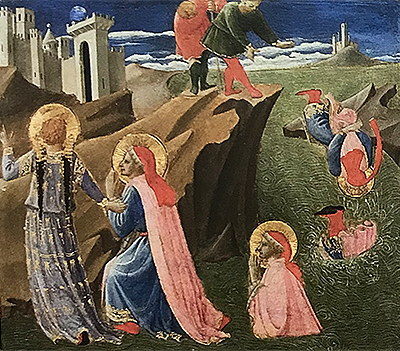
At the right of this small Florentine painting, two men tumble into a green sea. At the left, an angel steadies a man in a blue tunic and a long pink cloak. It takes a moment to recognise that the men at the water’s edge are the same two who have just been thrown from the cliff. This is the rescue of the brothers Cosmas and Damian in the predella of the Annalena Altarpiece, now in the Museo di San Marco in Florence. The whole episode fits into a painted compartment about twenty centimetres high. [1] [2]
At a Glance
- ArtistWorkshop of Fra Angelico, according to the Fondazione Federico Zeri. Zanobi Strozzi has been proposed. [1]
- DateSecond quarter of the fifteenth century, according to the Italian state catalogue. [2]
- MediumTempera and gilding on wood. [2]
- Dimensions20 × 22 cm for this compartment, as recorded by the Fondazione Federico Zeri. [1]
- CollectionMuseo di San Marco, Florence. Inventory 1890, no. 8486, for the predella. Italian state catalogue component 0900191243-4. [1] [2]
From the cliff to the water’s edge
The executioners occupy the highest point of the headland. One leans forward with both arms extended, his red-stockinged legs set wide apart. The saint nearest him has swung upside down, his bound hands across his body and the tail of his red cap curving towards the water. Below him, a shoe, a flash of blue and a fold of pink are almost all that can be seen of the second man. The tight curls in the green water crowd their bodies and make the lower figure’s disappearance especially vivid. [1] [2]
The same colours surface again at the foot of the cliff. One brother rises far enough out of the sea for his face and folded hands to come into view. The other has a foot down and a hand free to reach towards the angel. His cloak falls in a long sweep towards the lower edge of the picture. That sweep makes a striking change from the jumble of cloth and limbs above. The cap and tunic still identify him, but their folds now follow a body that has regained its balance. [1]
At the far left the angel turns partly away from us, raising one hand and extending the other to the saint. The fine gold pattern on the angel’s blue garment is most visible around the sleeve, close to the point where the two figures meet. The saints’ gold haloes are easier to pick out across the picture. One even hangs upside down with its wearer. Follow the haloes and the repeated red caps through the green and brown landscape and the action comes into focus. The panel gives the brothers two appearances each so that the eye can follow them from the fall to the rescue within one continuous place. [1]
The rock does much of the work usually done by a frame between episodes. Its steep dark face separates the falling bodies from the figures gathering to the left. Above it, the land still stretches between a pale fortified town and a tiny cluster of towers across the water. The dark opening in the town gate is only a short distance in the picture from the angel’s raised hand. The curve of the headland makes that passage look far enough away to belong to the world the saints have been taken out of. The painted walls and towers give the story a recognisable setting without fixing it to a particular city. [1] [2]
What the scene takes from the legend
In Jacobus de Voragine’s Golden Legend, Cosmas and Damian are Christian physicians who heal without taking payment. The proconsul Lysias summons them and their three brothers, and orders them to sacrifice to the gods. When they refuse, he has them bound and thrown into the sea. An angel delivers them and they return to face him. The painted rescue stops at the water’s edge and concentrates on Cosmas and Damian. Art historian Jillian Harrold points out that their three brothers, present in the literary episode, have been left out here. [3] [4]
That choice matters when the compartment is seen in sequence. It is the third from the left among the six Florentine scenes, at the right end of the first group of three. The preceding scene shows the brothers before Lysias. The next group begins with the ordeal by fire, where the other brothers are present again. Someone following the story across the predella can carry the judge’s sentence forward from the hearing. Within the narrow rescue scene there is room to give the two saints’ changing positions and the angel’s gesture the attention they need. [2] [3] [5]
Above these episodes, Cosmas and Damian stand close to the Virgin and Child on the main Annalena panel. Their fifteenth-century doctors’ dress includes the long caps and reddish cloaks that distinguish them in the smaller scenes. The predella, the low painted band beneath the main image, shows the same saints in danger and in need of help. Their robes make the connection legible even when the two men are falling headfirst or have water up to their shoulders. The pair’s prominence also suits a Medici commission. Cosmas was the name saint of Cosimo de’ Medici, and the two physicians recur in the family’s patronage. [3] [6]
How the Annalena panels came together
The name Annalena comes from the work’s former association with the Florentine convent of San Vincenzo d’Annalena. The curators of the 2025 Fra Angelico exhibition at Palazzo Strozzi and the Museo di San Marco identified a Medici commission and left the original site open. One proposal is the Medici chapel at San Lorenzo, which was dedicated to Cosmas and Damian. Their place beside the Virgin and the attention given to their story make sense for such a chapel. The main painting and the story scenes also spent time apart. In the nineteenth century the main panel was at the Accademia while the Florentine predella scenes were in the painters’ chapel at Santissima Annunziata. [1] [3] [5] [6]
The relationship between Annalena and the San Marco high altarpiece also affects how the rescue is dated. William Hood made the case for an Annalena altarpiece of the mid-1430s. Carl Brandon Strehlke placed it around 1442–45 in his 2021 study, pointing to a painting documented in 1445–47 by Mariotto di Cristofano that appears to borrow the design of the wall behind the saints on the Annalena main panel. That comparison concerns the main painting. The rescue has no comparably narrow date of its own. [2] [3] [7]
The six scenes in Florence are painted on two boards now joined. A separate panel at the Kunsthaus Zürich, Cosmas and Damian Heal the Deacon Justinian, has been associated with the same ensemble. Its painted field measures 19.5 × 22 cm, close to the scale of the rescue. The sizes help explain the association, while the complete original arrangement remains a matter of reconstruction. The rescue’s place among the surviving scenes can be seen today even though the full length and contents of the original predella are debated. [1] [2] [3] [8]
There is a similar distinction between identifying the painting and identifying its painter. The Italian state catalogue gives Fra Angelico as the principal attribution and records Zanobi Strozzi as an alternative. The Fondazione Federico Zeri catalogues the rescue as workshop of Fra Angelico. The Museo di San Marco has discussed Strozzi as a likely collaborator on the predella, and Strehlke attributed its execution to him. The exact division of work between Angelico and his assistants remains open. The museum records a further chapter in the object’s history after the main panel and predella were damaged in severe weather in September 2014. A restoration of the ensemble was presented in 2017. [1] [5] [7] [9] [10]
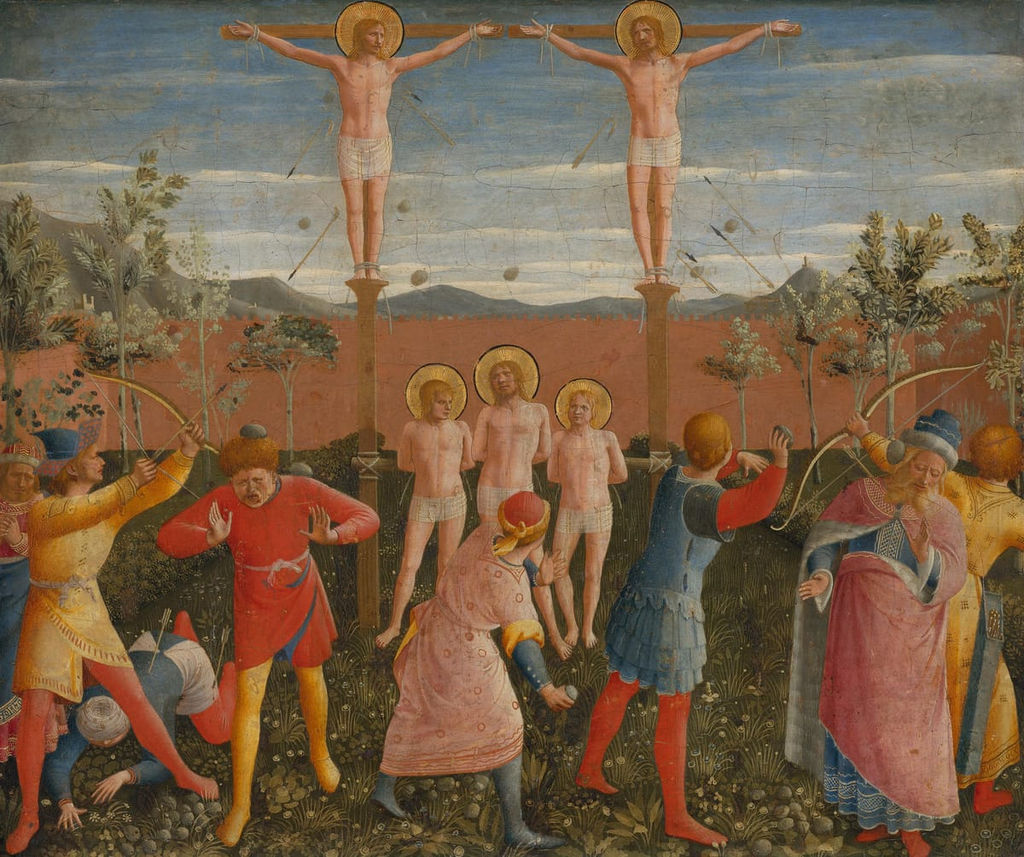
The separate San Marco high-altarpiece panel in Munich, WAF 38. The three standing men are flanked by the attackers. Image source. Public domain. Proportional web resize.
A second rescue in Munich
Fra Angelico’s version for the San Marco Altarpiece belongs to a different commission, for the high altar of the church of San Marco. It is now in the Alte Pinakothek in Munich, which dates it to about 1438–40 and gives its dimensions as 37.8 × 46.9 cm. On that larger panel the fall and rescue occupy the distance on the left. In the foreground all five brothers gather to the left of a decorated wall while demons attack Lysias to the right. The same saints must now act on behalf of the man who tried to have them drowned. [3] [4] [5] [11]
The Munich painting makes room for a reversal in which Lysias begs the men he condemned to pray for him. In Florence the story ends as the angel takes the rescued man by the arm. There is just enough space between his first appearance and his second to register what has happened to his body. The painter gives the fall the force of a body out of control and brings all that motion to a stop in the small space where the angel and the saint touch. [1] [4] [5] [11]
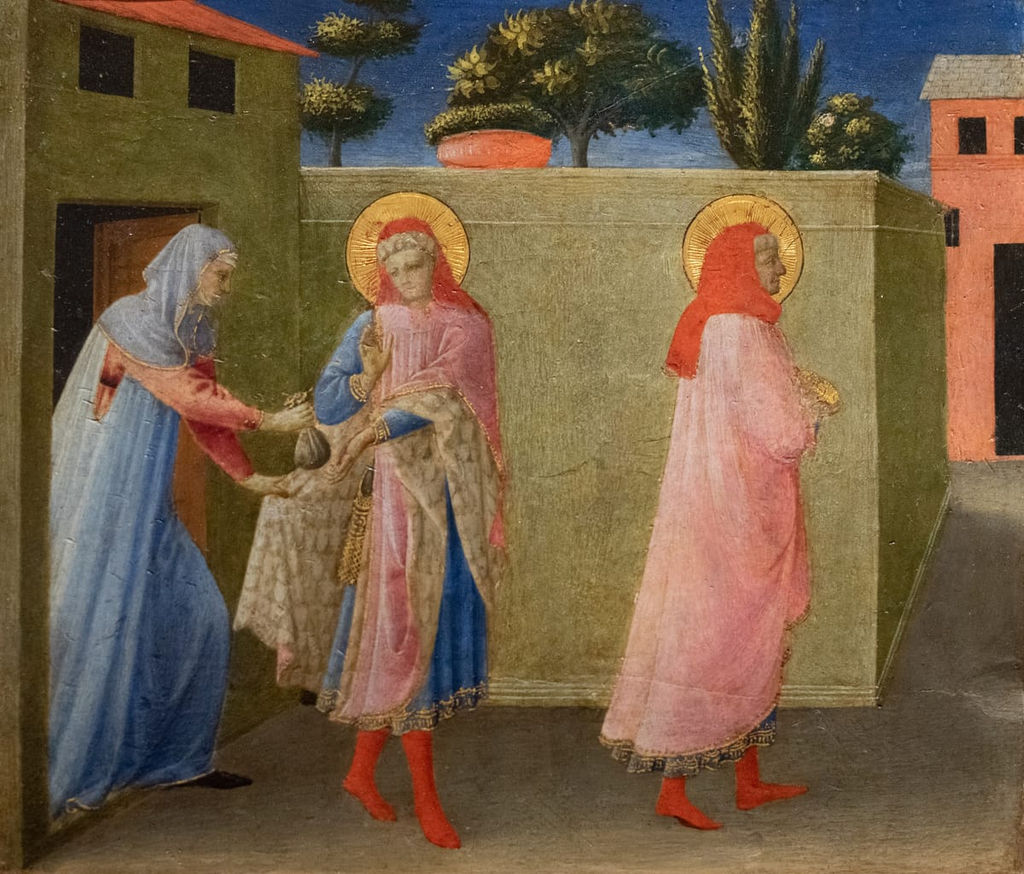
The smaller Florentine gift scene from the Annalena predella. At the right a second saint turns away from the exchange. Image source. Public domain. Proportional web resize.
Fra Angelico artworks directory
Explore documented works and surviving parts of larger ensembles. Catalogue links identify individual records. Attribution and dating can vary across collections and publications. Search the Federico Zeri Photo Archive by artist.
| Name | Date | Medium and sources |
|---|---|---|
| Adoration of the Magi | About 1440–60, NGA catalogue | Painting Catalogue. |
| Adoration of the Magi (Armadio degli Argenti) | About 1450–53 | Tempera and gold on wood. Catalogue. |
| Agony in the Garden (Armadio degli Argenti) | About 1450–53 | Tempera and gilding on wood Catalogue. |
| Annalena Altarpiece / Pala di Annalena | commonly c. 1435 | Tempera on panel Catalogue. |
| Annunciation (Armadio degli Argenti) | About 1450–53 | Tempera and gilding on wood. Catalogue. |
| Annunciation (Cortona) | generally placed in the 1430s; exact dating remains debated | Tempera on panel Catalogue. |
| Annunciation (Prado) | 1425–26 | Tempera on poplar panel Catalogue. |
| Annunciation (San Marco upper corridor) | commonly c. 1442 | Fresco Catalogue. |
| Annunciation with Saint Peter Martyr | About 1439–43 | Fresco on plaster. Catalogue. |
| Annunciatory Angel | 1450–55, Detroit catalogue | Gold leaf and tempera on wood panel. Catalogue. |
| Armadio degli Argenti (Silver Treasury) | principally c. 1450–52 | Tempera on panel Catalogue. |
| Arrest of Christ (Armadio degli Argenti) | About 1450–53 | Tempera and gilding on wood Catalogue. |
| Ascension (Armadio degli Argenti) | About 1450–53 | Tempera and gilding on wood Catalogue. |
| Baptism of Christ (Armadio, Alesso Baldovinetti) | About 1452–53 | Tempera and gilding on wood Catalogue. |
| Beheading of Saints Cosmas and Damian (San Marco Altarpiece) | About 1438–42 | Painted panel Catalogue. |
| Betrayal of Christ (Armadio degli Argenti) | About 1450–53 | Tempera and gilding on wood Catalogue. |
| Blessed Dominican, Possibly Jordan of Saxony (San Marco Altarpiece) | About 1438–42 | Painted panel Catalogue. |
| Blessed Vincent Ferrer (San Marco Altarpiece) | About 1438–42 | Painted panel Catalogue. |
| Burial of Saints Cosmas and Damian (San Marco Altarpiece) | About 1438–42 | Painted panel Catalogue. |
| Bust of a Cleric and a Group of Figures (recto and verso) | 15th century | Pen and ink on paper Catalogue. |
| Christ among the Doctors (Armadio degli Argenti) | About 1450–53 | Tempera and gilding on wood Catalogue. |
| Christ before Caiaphas (Armadio degli Argenti) | About 1450–53 | Tempera and gilding on wood Catalogue. |
| Christ Glorified in the Court of Heaven | About 1423–24 | Egg tempera on wood, probably poplar, with gold and silver leaf Catalogue. |
| Christ Seated in Judgment | 1447 | Fresco and gilding on plaster. Catalogue. |
| Christ Stripped of His Garments (Armadio degli Argenti) | About 1450–53 | Tempera and gilding on wood Catalogue. |
| Christ Washes the Apostles’ Feet (Armadio degli Argenti) | About 1450–53 | Tempera and gilding on wood Catalogue. |
| Circumcision of Christ (Armadio degli Argenti) | About 1450–53 | Tempera and gilding on wood. Catalogue. |
| Communion of the Apostles (Armadio degli Argenti) | About 1450–53 | Tempera and gilding on wood Catalogue. |
| Coronation of the Virgin (Armadio degli Argenti) | About 1450–53 | Tempera and gilding on wood Catalogue. |
| Coronation of the Virgin (Louvre) | Louvre: second quarter of the fifteenth century, 1425–50; often dated more narrowly c. 1434–35 | Tempera and gold on panel Catalogue. |
| Coronation of the Virgin (Uffizi) | 1431–35 | Tempera on wood, gold ground Catalogue. |
| Cortona Triptych | About 1437 | Tempera and gold on panel. Catalogue. |
| Crucifixion (Armadio degli Argenti) | About 1450–53 | Tempera and gilding on wood Catalogue. |
| Crucifixion and Saints | 1441–42 | Fresco Catalogue. |
| Deposition from the Cross / Santa Trinita Deposition | commissioned 1429–32; completed by Angelico within this period | Tempera on panel Catalogue. |
| Descent into Limbo (Armadio degli Argenti) | About 1450–53 | Tempera and gilding on wood Catalogue. |
| Entombment of Christ (San Marco Altarpiece) | About 1438–42 | Painted panel Catalogue. |
| Entry into Jerusalem (Armadio degli Argenti) | About 1450–53 | Tempera and gilding on wood Catalogue. |
| Expulsion and the Stoning of Saint Stephen | 1448–49, Vatican Museums | Fresco. Catalogue. |
| Fiesole San Domenico Altarpiece | early 1420s; predella about 1423–24 | Tempera on panel Catalogue. |
| Flagellation (Armadio degli Argenti) | About 1450–53 | Tempera and gilding on wood Catalogue. |
| Flight into Egypt | About 1450–53 | Tempera and gilding on wood. Catalogue. |
| Guidalotti Polyptych | c. 1447–49 | Tempera and oil on panel Catalogue. |
| Healing of Palladia and Saint Damian Accepting Her Gift (San Marco Altarpiece) | About 1438–42 | Painted panel Catalogue. |
| Holy Pilgrim, Possibly Saint Roch (San Marco Altarpiece) | About 1438–42 | Painted panel Catalogue. |
| Holy Women at the Tomb (Armadio degli Argenti) | About 1450–53 | Tempera and gilding on wood Catalogue. |
| Judas Receives Payment (Armadio degli Argenti) | About 1450–53 | Tempera and gilding on wood Catalogue. |
| Lamentation over Christ (Armadio degli Argenti) | About 1450–53 | Tempera and gilding on wood Catalogue. |
| Lamentation over the Dead Christ (Croce al Tempio Lamentation) | 1436–41, Zeri catalogue | Tempera and gilding on wood panel. Catalogue. |
| Last Judgement (Armadio degli Argenti) | About 1450–53 | Tempera and gilding on wood Catalogue. |
| Last Judgement (San Marco) | c. 1425–28 | Tempera and gold on panel Catalogue. |
| Last Supper (Armadio degli Argenti) | About 1450–53 | Tempera and gilding on wood Catalogue. |
| Lex Amoris (Armadio degli Argenti) | About 1450–53 | Tempera and gilding on wood Catalogue. |
| Madonna and Child with Saint Dominic and Saint Thomas Aquinas | About 1430, Hermitage catalogue | Detached fresco. Catalogue. |
| Madonna and Child with Saints | About 1411–13 | Tempera on wood panel, with a gold ground. Catalogue. |
| Madonna of Humility | About 1425, Thyssen catalogue | Tempera and gold on wood. Catalogue. |
| Madonna of the Star | 1431–34, Zeri catalogue | Tempera with oil glazes and gold on wood panel, as catalogued by the Gardner for the 2018 exhibition. Catalogue. |
| Marriage at Cana (Armadio, Alesso Baldovinetti) | About 1452–53 | Tempera and gilding on wood Catalogue. |
| Massacre of the Innocents (Armadio degli Argenti) | About 1450–53 | Tempera and gilding on wood Catalogue. |
| Miracle of the Black Leg (San Marco Altarpiece) | About 1438–42 | Painted panel Catalogue. |
| Mocking of Christ (Armadio degli Argenti) | About 1450–53 | Tempera and gilding on wood Catalogue. |
| Mystic Wheel (The Vision of Ezekiel) | About 1450–52 | Tempera and gilding on wood. Catalogue. |
| Nativity (Armadio degli Argenti) | About 1450–53 | Tempera and gilding on wood. Catalogue. |
| Niccoline Chapel frescoes | principally 1448–50 | Fresco Catalogue. |
| Noli me Tangere | broadly within Angelico’s San Marco campaign, late 1430s–1440s | Fresco Catalogue. |
| Ordination of Saint Lawrence | 1448 | Fresco. Catalogue. |
| Pentecost (Armadio degli Argenti) | About 1450–53 | Tempera and gilding on wood Catalogue. |
| Presentation of Christ at the Temple (Armadio degli Argenti) | About 1450–53 | Tempera and gilding on wood. Catalogue. |
| Presentation of Jesus at the Temple | Early 1440s | Fresco on plaster. Catalogue. |
| Raising of Lazarus (Armadio degli Argenti) | About 1450–53 | Tempera and gilding on wood Catalogue. |
| Rescue of Saints Cosmas and Damian and Exorcism of Lysias (San Marco Altarpiece) | About 1438–42 | Painted panel Catalogue. |
| Road to Calvary (Armadio degli Argenti) | About 1450–53 | Tempera and gilding on wood Catalogue. |
| Saint Anthony Abbot (San Marco Altarpiece) | About 1438–42 | Painted panel Catalogue. |
| Saint Bernard of Clairvaux or Saint Benedict (San Marco Altarpiece) | About 1438–42 | Painted panel Catalogue. |
| Saint Damian Receives Money from Palladia | About 1425–49 | Tempera and gilding on wood. Catalogue. |
| Saint Francis and a Bishop Saint, Saint John the Baptist and Saint Dominic | Late 1420s, Getty catalogue | Tempera and gold leaf on panel. Catalogue. |
| Saint James the Greater Freeing the Magician Hermogenes | About 1426–29 | Tempera and gold on panel Catalogue. |
| Saint Jerome (San Marco Altarpiece) | About 1438–42 | Painted panel Catalogue. |
| Saint Lawrence Giving Alms | About 1448 | Wall fresco. Catalogue. |
| Saint Lawrence Receiving the Treasures of the Church from Pope Sixtus II | About 1448–49 | Fresco on plaster. Catalogue. |
| Saint Romuald (San Marco Altarpiece) | About 1438–42 | Painted panel Catalogue. |
| Saint Stephen Addressing the Council | 1448–49, Vatican Museums | Fresco. Catalogue. |
| Saint Stephen Preaching | 1448–49, Vatican Museums | Wall fresco. Catalogue. |
| Saint Thomas Aquinas (San Marco Altarpiece) | About 1438–42 | Painted panel Catalogue. |
| Saints Cosmas and Damian and Their Brothers Survive the Stake | Second quarter of the 15th century | Tempera and gilding on wood. Catalogue. |
| Saints Cosmas and Damian at the Stake (San Marco Altarpiece) | About 1438–42 | Painted panel Catalogue. |
| Saints Cosmas and Damian before Lysias (San Marco Altarpiece) | About 1438–42 | Painted panel Catalogue. |
| Saints Cosmas and Damian Rescued by an Angel | Second quarter of the 15th century | Tempera and gilding on wood. Catalogue. |
| Saints Cosmas and Damian with Their Brothers before Proconsul Lysias | Second quarter of the 15th century | Tempera and gilding on wood. Catalogue. |
| San Marco Altarpiece / Pala di San Marco | 1438–43 | Tempera on panel Catalogue. |
| San Pietro Martire Triptych | About 1422–23, Strozzi exhibition | Tempera and gold on panel. Catalogue. |
| Scenes from the Lives of the Desert Fathers (Thebaid) | About 1420, Uffizi catalogue | Tempera on wood. Catalogue. |
| Sixteen Prophets | 1447 | Fresco and gilding on plaster Catalogue. |
| Stoning and Shooting of the Brothers (San Marco Altarpiece) | About 1438–42 | Painted panel Catalogue. |
| Tabernacle of the Linaioli | 1433–35 | Tempera on panel Catalogue. |
| The Attempted Crucifixion and Stoning of Saints Cosmas and Damian | Second quarter of the 15th century | Tempera and gilding on wood. Catalogue. |
| The Crucifixion | About 1420–23, Met catalogue | Tempera on wood, gold ground. Catalogue. |
| The Death and the Assumption of the Virgin | 1424–34 | Tempera with oil glazes and gold on panel Catalogue. |
| The Dominican Blessed (left end) (Fiesole predella) | About 1423–24 | Egg tempera and gold on wood Catalogue. |
| The Dominican Blessed (right end) (Fiesole predella) | About 1423–24 | Egg tempera and gold on wood Catalogue. |
| The Entombment of Christ | About 1450 | Tempera on poplar panel. Catalogue. |
| The Forerunners of Christ with Saints and Martyrs | About 1423–24 | Egg tempera on wood (probably poplar), with gold and silver leaf. Catalogue. |
| The Funeral of Saint Anthony Abbot | About 1426–30 | Tempera on poplar panel. Catalogue. |
| The Martyrdom of Saints Cosmas and Damian | About 1425–49 | Tempera and gilding on wood. Catalogue. |
| The Mocking of Christ / Christ Mocked | within the San Marco dormitory campaign, broadly late 1430s–1440s | Fresco Catalogue. |
| The Nativity | About 1425, Minneapolis catalogue | Tempera on poplar panel. Catalogue. |
| The Nativity in Cell 5 at San Marco | About 1439–43 | Fresco on plaster. Catalogue. |
| The Penitent Saint Jerome | 1419–20 | Tempera on wood panel Catalogue. |
| The Virgin and Child by Fra Angelico (Fogg Museum) | About 1430, Harvard catalogue | Tempera originally on panel, subsequently transferred to Masonite. Catalogue. |
| The Virgin Mary with the Apostles and Other Saints (Fiesole predella) | About 1423–24 | Egg tempera and gold on wood Catalogue. |
| Transfiguration (Armadio, Alesso Baldovinetti) | About 1452–53 | Tempera and gilding on wood Catalogue. |
| Transfiguration (San Marco Cell 6) | within the San Marco dormitory campaign, broadly late 1430s–1440s | Fresco Catalogue. |
| Virgin Mary Annunciate | 1450–55, Detroit catalogue | Gold leaf and tempera on wood panel. Catalogue. |
| Virgin of the Pomegranate | About 1426 | Tempera on panel with gilding Catalogue. |
Frequently Asked Questions
Discussion
Use these prompts to look again or share an observation.
Reader Insights
Locate the angel, the water and the witnesses. How does a single action give direction to several different figures?
Compare the little Florence rescue with the larger San Marco treatment. Where does each composition ask you to pause?
Join the Conversation
Share a detail or question about Saints Cosmas and Damian Rescued by an Angel.
References
- Fondazione Federico Zeri. San Cosma e san Damiano salvati dall’annegamento da un angelo, work 13473. Object entry and archival photographs (catalogue fields in English). View source.
- Italian Ministry of Culture, ArCo. San Cosma e San Damiano salvati dall’annegamento, component 0900191243-4 (in Italian). View source.
- Jillian Harrold. Saintly Doctors: The Early Iconography of SS. Cosmas and Damian in Italy. PhD thesis, University of Warwick, 2007, pp. 182–188, 192–197 and 210–212. View source.
- Jacobus de Voragine. The Golden Legend, “Of the Saints Cosmo and Damian”. William Caxton’s translation, Temple Classics edition, vol. 5, via Fordham University’s Internet Medieval Sourcebook. View source.
- Alessandro Santini, Museo di San Marco. L’Angelico a San Marco raccontato da Padre Marchese. Prima puntata: la Pala di San Marco, 2020 (in Italian). View source.
- Fondazione Palazzo Strozzi and Museo di San Marco. Fra Angelico exhibition press kit, 2025, room 3. View source.
- Carl Brandon Strehlke. “Fra Angelico: Domenican Painter or Medici Painter?” In Cecilia Frosinini (ed.), La Pala di San Marco del Beato Angelico: restauro e ricerche, Opificio delle Pietre Dure and Edifir, 2021, pp. 25–26, fig. 9. View source.
- Kunsthaus Zürich. Cosmas and Damian Heal the Deacon Justinian, KS 41. View source.
- Italian Ministry of Culture, Catalogo generale dei Beni Culturali. San Cosma e San Damiano salvati dall’annegamento, national catalogue entry (in Italian). View source.
- Direzione regionale Musei nazionali Toscana. Presentazione del restauro della Pala di Annalena del Beato Angelico, 2017 (in Italian). View source.
- Bayerische Staatsgemäldesammlungen, Alte Pinakothek. Die hll. Cosmas und Damian und ihre Brüder werden ins Meer gestürzt, von einem Engel errettet und befreien Lysias von Dämonen, WAF 37 (in German). View source.
.jpg)



 Fra Angelico.jpg)


