 by Tom Gurney
Tom Gurney BSc (Hons) is an art history expert with over 20 years experience
Published on June 19, 2020 / Updated on November 29, 2026
Email: tomgurney1@gmail.com / Phone: +44 7429 011000
Introduction
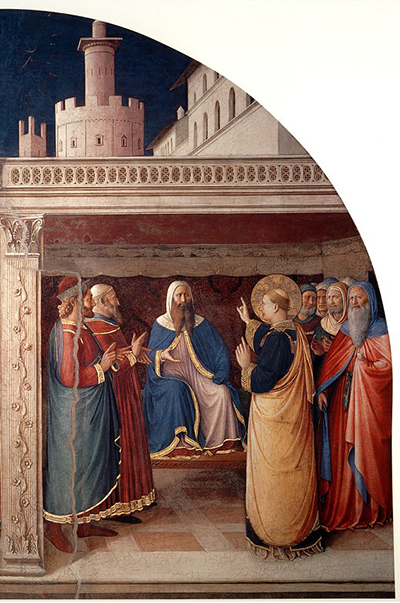
Saint Stephen stands before the high priest with one hand raised. His golden halo is almost level with the heads of the men behind him, but his face is turned towards the seated figure across the floor. Fra Angelico painted this encounter in the right half of an arched fresco high on the entrance wall of the Niccoline Chapel. On the left, Stephen has an audience gathered at his feet. Here, the same speaker must answer an accusation before the council of Jerusalem. The change of setting is as decisive as the change of audience. [1] [2]
At a Glance
- ArtistFra Angelico, working with assistants on the chapel cycle. [3] [4]
- DateLate 1440s. The Vatican Museums date the paired lunette to 1448–49. [1]
- MediumFresco. [2]
- Dimensions322 × 412 cm for the complete lunette, including the preaching scene. [2]
- LocationUpper register of the entrance wall, Niccoline Chapel, Apostolic Palace, Vatican City. [1] [3]
- PatronPope Nicholas V. [3]
What Stephen is asked to answer
The scene draws on chapters 6 and 7 of the Acts of the Apostles. Stephen is one of seven men chosen after a dispute over the daily distribution of aid in the Jerusalem community. Acts then describes opponents who cannot prevail against him in debate. He is brought before the Sanhedrin, the Jewish council in Jerusalem, where witnesses accuse him of speaking against the holy place and the Law. Acts calls them false witnesses. They claim he said that Jesus would destroy the place and change the customs handed down by Moses. As the council looks at him, Stephen’s face appears to them like that of an angel. [5]
When the high priest asks whether the charges are true, Stephen answers with a long account of the history he shares with his listeners. He begins with Abraham, goes on to Joseph and Moses, and traces the story of the sanctuary from the tent in the wilderness to the Temple built by Solomon. He argues that God’s presence cannot be confined to something made by human hands. The speech ends by accusing his hearers of resisting the Holy Spirit and betraying the one foretold by the prophets. Angelico gives the encounter a single sustained gesture. Stephen’s raised hand could belong to several moments in that speech, and there is no inscription to attach it to a particular verse. [1] [6]
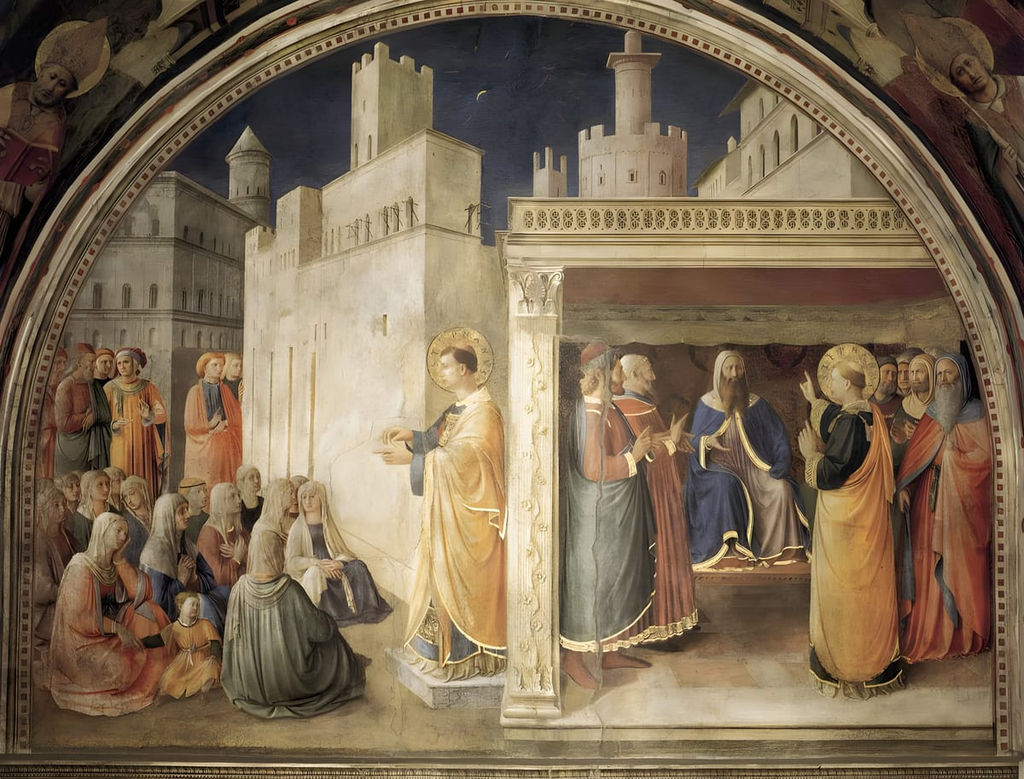
The paired Niccoline lunette. The architecture separates the preaching on the left from the council hearing on the right. Image source. Public domain. Proportional web resize.
How the chamber gives the argument shape
The high priest sits at the back, slightly above the men around him. His white head covering stands out against the dark patterned hanging, while the gold edging of his blue mantle traces its folds down to his feet. One hand comes forward, fingers open. To the left, a grey-bearded man in red opens a hand towards Stephen, with another man standing partly in front of him beside the pier. The responses on this side of the chamber are varied. Hands turn outwards or rise towards the speaker, while the partly obscured faces behind Stephen seem to watch from the narrow space between his halo and the curved edge of the fresco. [1] [2]
Stephen wears the same gold-coloured vestment with deep blue sleeves that marks him on the other side of the lunette. In the chamber his body is turned partly away from us, so the broad sweep of cloth draws the eye up his back to his face in profile. The pale floor slabs recede towards the rear of the chamber, giving the seated priest a place deep within the picture. Stephen stands much nearer the open front. The priest has the seat and the architectural setting of authority, while the standing figure commands the foreground. Both claims to attention are visible at once. [1] [2]
The opening is edged on the left by a pale pier, its fluted face interrupted by a climbing pattern of flowers. The capital carries a long horizontal entablature, with a row of small circular motifs picked out above it. Together they mark the edge of the hearing room. Higher up, a pink crenellated tower and a pale building with arched openings rise into the same dark blue sky that stretches over the public square. Art historian Livia Lupi draws attention to the way the city continues across the boundary between the two episodes. Jerusalem is recognisable through the story, while the mixture of fortress towers, classical ornament and Renaissance spatial construction makes it a city imagined for the chapel. [1] [7]
Two audiences beneath one arch
In Saint Stephen Preaching, the first Stephen stands on a step close to the dividing pier and turns towards the people gathered on the left. Cross the pier and the second Stephen turns left again, this time towards the high priest. The distance between two appearances of the same figure is remarkably short. Angelico uses the architecture to move the story forward without breaking up the mural with a separate frame. The difference in how people occupy the two spaces also changes the force of the speech. In the square the listeners have room to settle at Stephen’s feet. In the hearing room several men occupy the space at his back, and the tiled floor opens directly towards the people who will hear his answer. [1] [7]
Acts describes the anger that follows the speech, Stephen’s vision of Christ at God’s right hand and the rush to take him outside the city. The painted sequence gives the violence its own space in the next lunette, Expulsion and the Stoning of Saint Stephen. Lupi suggests that a bearded elder in a rose-coloured robe lined with blue may recur among the stone throwers. Read that way, clothing carries a second figure across the chapel as well as identifying the saint, although the resemblance leaves the man’s identity open. In the council scene, the opposing gestures still belong to a conversation. On the next wall, the hands that answer Stephen are raised to throw stones. [6] [7]
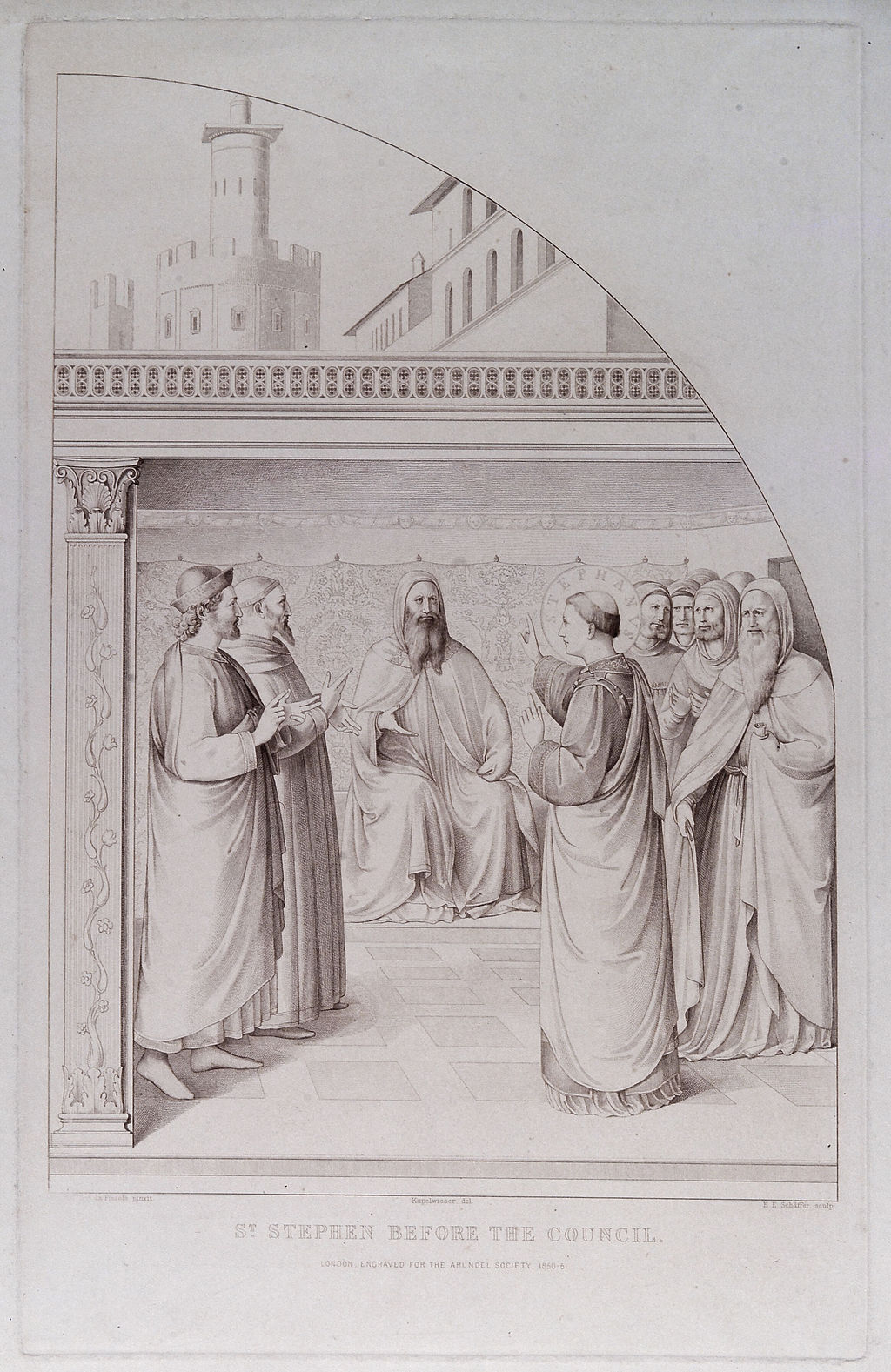
St Stephen before the Council, engraved by Eugen Eduard Schäffer after a drawing by Leopold Kupelwieser. Wellcome Collection 8695i. Wellcome Collection. Image source. Public domain. Proportional web resize.
The fresco in Nicholas V’s chapel
Two payments in February and March 1448 document Angelico’s work on the decoration for Nicholas V. One February payment was for ultramarine for the private chapel. It records a costly material supplied for the commission, while leaving open where that particular blue was used. The Museo Benozzo Gozzoli places Gozzoli’s contribution chiefly in the upper scenes of Stephen’s life, singling out his ordination. The surviving evidence supports a collaborative account of the cycle, while the division of work in this particular hearing remains uncertain. Directly below, Lawrence receives the Church’s treasures and gives alms. Lupi notes that the artists repeated details such as the flower ornament and the scrolls on the capitals across the two saints’ stories. The cities of Jerusalem and Rome retain their own settings, but similar architectural details invite the viewer to read the deeds of the two deacons together. The chapel is only about 4.2 metres wide, and the lunettes rise to about eight metres at their crowns. From the floor, the pier’s strong vertical and Stephen’s broad mantle can carry the scene at a distance that makes the smaller gestures harder to discern. [1] [3] [4] [7]
The Vatican Museums restored the chapel frescoes in 1995–96 and published the photograph of the full lunette after treatment. Anna Luce Sicurezza’s technical survey records fresco with additions made on dry plaster in the chapel, as well as construction lines made by snapping a cord against the surface. She illustrates those lines in the architecture of the Lawrence scene below. The survey shows how the workshop could lay out long, straight elements on a wall, though the example comes from the lower register and the published summary covers the cycle as a whole. [1] [8] [9]
The council episode also circulated on its own in the nineteenth century. In Antonio Schiassi’s engraving after Angelico, now in the Detroit Institute of Arts, the pier and curved outer edge enclose the encounter as a self-contained composition. Black ink translates the colours into tones and leaves the high priest’s chair, Stephen’s gesture and the framing architecture to carry the scene. The print makes the exchange easy to study at close range. In the chapel the painted pier has a further job, since it divides two moments in the saint’s story while leaving them under a single arch. [1] [10]
Inside the Niccoline Chapel
See the frescoes in the rooms where their painted stories meet.
Cappella Niccolina – Niccoline Chapel
See how the painted lives of Stephen and Lawrence occupy the two registers of the chapel.
Watch on YouTubeFra Angelico artworks directory
Explore documented works and surviving parts of larger ensembles. Catalogue links identify individual records. Attribution and dating can vary across collections and publications. Search the Federico Zeri Photo Archive by artist.
| Name | Date | Medium and sources |
|---|---|---|
| Adoration of the Magi | About 1440–60, NGA catalogue | Painting Catalogue. |
| Adoration of the Magi (Armadio degli Argenti) | About 1450–53 | Tempera and gold on wood. Catalogue. |
| Agony in the Garden (Armadio degli Argenti) | About 1450–53 | Tempera and gilding on wood Catalogue. |
| Annalena Altarpiece / Pala di Annalena | commonly c. 1435 | Tempera on panel Catalogue. |
| Annunciation (Armadio degli Argenti) | About 1450–53 | Tempera and gilding on wood. Catalogue. |
| Annunciation (Cortona) | generally placed in the 1430s; exact dating remains debated | Tempera on panel Catalogue. |
| Annunciation (Prado) | 1425–26 | Tempera on poplar panel Catalogue. |
| Annunciation (San Marco upper corridor) | commonly c. 1442 | Fresco Catalogue. |
| Annunciation with Saint Peter Martyr | About 1439–43 | Fresco on plaster. Catalogue. |
| Annunciatory Angel | 1450–55, Detroit catalogue | Gold leaf and tempera on wood panel. Catalogue. |
| Armadio degli Argenti (Silver Treasury) | principally c. 1450–52 | Tempera on panel Catalogue. |
| Arrest of Christ (Armadio degli Argenti) | About 1450–53 | Tempera and gilding on wood Catalogue. |
| Ascension (Armadio degli Argenti) | About 1450–53 | Tempera and gilding on wood Catalogue. |
| Baptism of Christ (Armadio, Alesso Baldovinetti) | About 1452–53 | Tempera and gilding on wood Catalogue. |
| Beheading of Saints Cosmas and Damian (San Marco Altarpiece) | About 1438–42 | Painted panel Catalogue. |
| Betrayal of Christ (Armadio degli Argenti) | About 1450–53 | Tempera and gilding on wood Catalogue. |
| Blessed Dominican, Possibly Jordan of Saxony (San Marco Altarpiece) | About 1438–42 | Painted panel Catalogue. |
| Blessed Vincent Ferrer (San Marco Altarpiece) | About 1438–42 | Painted panel Catalogue. |
| Burial of Saints Cosmas and Damian (San Marco Altarpiece) | About 1438–42 | Painted panel Catalogue. |
| Bust of a Cleric and a Group of Figures (recto and verso) | 15th century | Pen and ink on paper Catalogue. |
| Christ among the Doctors (Armadio degli Argenti) | About 1450–53 | Tempera and gilding on wood Catalogue. |
| Christ before Caiaphas (Armadio degli Argenti) | About 1450–53 | Tempera and gilding on wood Catalogue. |
| Christ Glorified in the Court of Heaven | About 1423–24 | Egg tempera on wood, probably poplar, with gold and silver leaf Catalogue. |
| Christ Seated in Judgment | 1447 | Fresco and gilding on plaster. Catalogue. |
| Christ Stripped of His Garments (Armadio degli Argenti) | About 1450–53 | Tempera and gilding on wood Catalogue. |
| Christ Washes the Apostles’ Feet (Armadio degli Argenti) | About 1450–53 | Tempera and gilding on wood Catalogue. |
| Circumcision of Christ (Armadio degli Argenti) | About 1450–53 | Tempera and gilding on wood. Catalogue. |
| Communion of the Apostles (Armadio degli Argenti) | About 1450–53 | Tempera and gilding on wood Catalogue. |
| Coronation of the Virgin (Armadio degli Argenti) | About 1450–53 | Tempera and gilding on wood Catalogue. |
| Coronation of the Virgin (Louvre) | Louvre: second quarter of the fifteenth century, 1425–50; often dated more narrowly c. 1434–35 | Tempera and gold on panel Catalogue. |
| Coronation of the Virgin (Uffizi) | 1431–35 | Tempera on wood, gold ground Catalogue. |
| Cortona Triptych | About 1437 | Tempera and gold on panel. Catalogue. |
| Crucifixion (Armadio degli Argenti) | About 1450–53 | Tempera and gilding on wood Catalogue. |
| Crucifixion and Saints | 1441–42 | Fresco Catalogue. |
| Deposition from the Cross / Santa Trinita Deposition | commissioned 1429–32; completed by Angelico within this period | Tempera on panel Catalogue. |
| Descent into Limbo (Armadio degli Argenti) | About 1450–53 | Tempera and gilding on wood Catalogue. |
| Entombment of Christ (San Marco Altarpiece) | About 1438–42 | Painted panel Catalogue. |
| Entry into Jerusalem (Armadio degli Argenti) | About 1450–53 | Tempera and gilding on wood Catalogue. |
| Expulsion and the Stoning of Saint Stephen | 1448–49, Vatican Museums | Fresco. Catalogue. |
| Fiesole San Domenico Altarpiece | early 1420s; predella about 1423–24 | Tempera on panel Catalogue. |
| Flagellation (Armadio degli Argenti) | About 1450–53 | Tempera and gilding on wood Catalogue. |
| Flight into Egypt | About 1450–53 | Tempera and gilding on wood. Catalogue. |
| Guidalotti Polyptych | c. 1447–49 | Tempera and oil on panel Catalogue. |
| Healing of Palladia and Saint Damian Accepting Her Gift (San Marco Altarpiece) | About 1438–42 | Painted panel Catalogue. |
| Holy Pilgrim, Possibly Saint Roch (San Marco Altarpiece) | About 1438–42 | Painted panel Catalogue. |
| Holy Women at the Tomb (Armadio degli Argenti) | About 1450–53 | Tempera and gilding on wood Catalogue. |
| Judas Receives Payment (Armadio degli Argenti) | About 1450–53 | Tempera and gilding on wood Catalogue. |
| Lamentation over Christ (Armadio degli Argenti) | About 1450–53 | Tempera and gilding on wood Catalogue. |
| Lamentation over the Dead Christ (Croce al Tempio Lamentation) | 1436–41, Zeri catalogue | Tempera and gilding on wood panel. Catalogue. |
| Last Judgement (Armadio degli Argenti) | About 1450–53 | Tempera and gilding on wood Catalogue. |
| Last Judgement (San Marco) | c. 1425–28 | Tempera and gold on panel Catalogue. |
| Last Supper (Armadio degli Argenti) | About 1450–53 | Tempera and gilding on wood Catalogue. |
| Lex Amoris (Armadio degli Argenti) | About 1450–53 | Tempera and gilding on wood Catalogue. |
| Madonna and Child with Saint Dominic and Saint Thomas Aquinas | About 1430, Hermitage catalogue | Detached fresco. Catalogue. |
| Madonna and Child with Saints | About 1411–13 | Tempera on wood panel, with a gold ground. Catalogue. |
| Madonna of Humility | About 1425, Thyssen catalogue | Tempera and gold on wood. Catalogue. |
| Madonna of the Star | 1431–34, Zeri catalogue | Tempera with oil glazes and gold on wood panel, as catalogued by the Gardner for the 2018 exhibition. Catalogue. |
| Marriage at Cana (Armadio, Alesso Baldovinetti) | About 1452–53 | Tempera and gilding on wood Catalogue. |
| Massacre of the Innocents (Armadio degli Argenti) | About 1450–53 | Tempera and gilding on wood Catalogue. |
| Miracle of the Black Leg (San Marco Altarpiece) | About 1438–42 | Painted panel Catalogue. |
| Mocking of Christ (Armadio degli Argenti) | About 1450–53 | Tempera and gilding on wood Catalogue. |
| Mystic Wheel (The Vision of Ezekiel) | About 1450–52 | Tempera and gilding on wood. Catalogue. |
| Nativity (Armadio degli Argenti) | About 1450–53 | Tempera and gilding on wood. Catalogue. |
| Niccoline Chapel frescoes | principally 1448–50 | Fresco Catalogue. |
| Noli me Tangere | broadly within Angelico’s San Marco campaign, late 1430s–1440s | Fresco Catalogue. |
| Ordination of Saint Lawrence | 1448 | Fresco. Catalogue. |
| Pentecost (Armadio degli Argenti) | About 1450–53 | Tempera and gilding on wood Catalogue. |
| Presentation of Christ at the Temple (Armadio degli Argenti) | About 1450–53 | Tempera and gilding on wood. Catalogue. |
| Presentation of Jesus at the Temple | Early 1440s | Fresco on plaster. Catalogue. |
| Raising of Lazarus (Armadio degli Argenti) | About 1450–53 | Tempera and gilding on wood Catalogue. |
| Rescue of Saints Cosmas and Damian and Exorcism of Lysias (San Marco Altarpiece) | About 1438–42 | Painted panel Catalogue. |
| Road to Calvary (Armadio degli Argenti) | About 1450–53 | Tempera and gilding on wood Catalogue. |
| Saint Anthony Abbot (San Marco Altarpiece) | About 1438–42 | Painted panel Catalogue. |
| Saint Bernard of Clairvaux or Saint Benedict (San Marco Altarpiece) | About 1438–42 | Painted panel Catalogue. |
| Saint Damian Receives Money from Palladia | About 1425–49 | Tempera and gilding on wood. Catalogue. |
| Saint Francis and a Bishop Saint, Saint John the Baptist and Saint Dominic | Late 1420s, Getty catalogue | Tempera and gold leaf on panel. Catalogue. |
| Saint James the Greater Freeing the Magician Hermogenes | About 1426–29 | Tempera and gold on panel Catalogue. |
| Saint Jerome (San Marco Altarpiece) | About 1438–42 | Painted panel Catalogue. |
| Saint Lawrence Giving Alms | About 1448 | Wall fresco. Catalogue. |
| Saint Lawrence Receiving the Treasures of the Church from Pope Sixtus II | About 1448–49 | Fresco on plaster. Catalogue. |
| Saint Romuald (San Marco Altarpiece) | About 1438–42 | Painted panel Catalogue. |
| Saint Stephen Addressing the Council | 1448–49, Vatican Museums | Fresco. Catalogue. |
| Saint Stephen Preaching | 1448–49, Vatican Museums | Wall fresco. Catalogue. |
| Saint Thomas Aquinas (San Marco Altarpiece) | About 1438–42 | Painted panel Catalogue. |
| Saints Cosmas and Damian and Their Brothers Survive the Stake | Second quarter of the 15th century | Tempera and gilding on wood. Catalogue. |
| Saints Cosmas and Damian at the Stake (San Marco Altarpiece) | About 1438–42 | Painted panel Catalogue. |
| Saints Cosmas and Damian before Lysias (San Marco Altarpiece) | About 1438–42 | Painted panel Catalogue. |
| Saints Cosmas and Damian Rescued by an Angel | Second quarter of the 15th century | Tempera and gilding on wood. Catalogue. |
| Saints Cosmas and Damian with Their Brothers before Proconsul Lysias | Second quarter of the 15th century | Tempera and gilding on wood. Catalogue. |
| San Marco Altarpiece / Pala di San Marco | 1438–43 | Tempera on panel Catalogue. |
| San Pietro Martire Triptych | About 1422–23, Strozzi exhibition | Tempera and gold on panel. Catalogue. |
| Scenes from the Lives of the Desert Fathers (Thebaid) | About 1420, Uffizi catalogue | Tempera on wood. Catalogue. |
| Sixteen Prophets | 1447 | Fresco and gilding on plaster Catalogue. |
| Stoning and Shooting of the Brothers (San Marco Altarpiece) | About 1438–42 | Painted panel Catalogue. |
| Tabernacle of the Linaioli | 1433–35 | Tempera on panel Catalogue. |
| The Attempted Crucifixion and Stoning of Saints Cosmas and Damian | Second quarter of the 15th century | Tempera and gilding on wood. Catalogue. |
| The Crucifixion | About 1420–23, Met catalogue | Tempera on wood, gold ground. Catalogue. |
| The Death and the Assumption of the Virgin | 1424–34 | Tempera with oil glazes and gold on panel Catalogue. |
| The Dominican Blessed (left end) (Fiesole predella) | About 1423–24 | Egg tempera and gold on wood Catalogue. |
| The Dominican Blessed (right end) (Fiesole predella) | About 1423–24 | Egg tempera and gold on wood Catalogue. |
| The Entombment of Christ | About 1450 | Tempera on poplar panel. Catalogue. |
| The Forerunners of Christ with Saints and Martyrs | About 1423–24 | Egg tempera on wood (probably poplar), with gold and silver leaf. Catalogue. |
| The Funeral of Saint Anthony Abbot | About 1426–30 | Tempera on poplar panel. Catalogue. |
| The Martyrdom of Saints Cosmas and Damian | About 1425–49 | Tempera and gilding on wood. Catalogue. |
| The Mocking of Christ / Christ Mocked | within the San Marco dormitory campaign, broadly late 1430s–1440s | Fresco Catalogue. |
| The Nativity | About 1425, Minneapolis catalogue | Tempera on poplar panel. Catalogue. |
| The Nativity in Cell 5 at San Marco | About 1439–43 | Fresco on plaster. Catalogue. |
| The Penitent Saint Jerome | 1419–20 | Tempera on wood panel Catalogue. |
| The Virgin and Child by Fra Angelico (Fogg Museum) | About 1430, Harvard catalogue | Tempera originally on panel, subsequently transferred to Masonite. Catalogue. |
| The Virgin Mary with the Apostles and Other Saints (Fiesole predella) | About 1423–24 | Egg tempera and gold on wood Catalogue. |
| Transfiguration (Armadio, Alesso Baldovinetti) | About 1452–53 | Tempera and gilding on wood Catalogue. |
| Transfiguration (San Marco Cell 6) | within the San Marco dormitory campaign, broadly late 1430s–1440s | Fresco Catalogue. |
| Virgin Mary Annunciate | 1450–55, Detroit catalogue | Gold leaf and tempera on wood panel. Catalogue. |
| Virgin of the Pomegranate | About 1426 | Tempera on panel with gilding Catalogue. |
Frequently Asked Questions
Discussion
Use these prompts to look again or share an observation.
Reader Insights
Compare the enclosure around Stephen with the open group in the neighbouring Preaching. How does the change of setting affect his address?
Which gaze or gesture makes the judgement of the council feel most apparent?
Join the Conversation
Share a detail or question about Saint Stephen Addressing the Council.
References
- Vatican Museums, Come, Let Us Worship #6, Vatican News, caption and post-restoration photograph of Preaching of St. Stephen and the Dispute in the Sanhedrin. View source.
- Fondazione Federico Zeri, Università di Bologna, Predica di santo Stefano, Disputa di santo Stefano nel Sinedrio, object catalogue (in Italian). View source.
- Vatican Museums, Cappella Niccolina (in Italian). View source.
- Museo Benozzo Gozzoli, Stories of Saint Stephen and Saint Lawrence – Niccoline Chapel. View source.
- United States Conference of Catholic Bishops, Acts of the Apostles, chapter 6. View source.
- United States Conference of Catholic Bishops, Acts of the Apostles, chapter 7. View source.
- Livia Lupi, Rhetoric of Pictorial Place, University of York PhD thesis, chapters 4–5, especially pp. 154–58, 170–72, 179–80 and fig. 147. View source.
- Francesco Buranelli (ed.), Il Beato Angelico e la Cappella Niccolina: storia e restauro, Vatican Museums publication record (in Italian). View source.
- Anna Luce Sicurezza, Procedure disegnative nella pittura murale di primo Quattrocento, in Materiali e tecniche nella pittura murale del Quattrocento, vol. I (in Italian). View source.
- Detroit Institute of Arts, Antonio Schiassi after Fra Angelico, Saint Stephen Before the High Priest, accession 09.1S1081. View source.
.jpg)
 Fra Angelico.jpg)