 by Tom Gurney
Tom Gurney BSc (Hons) is an art history expert with over 20 years experience
Published on June 19, 2020 / Updated on November 29, 2026
Email: tomgurney1@gmail.com / Phone: +44 7429 011000
Introduction
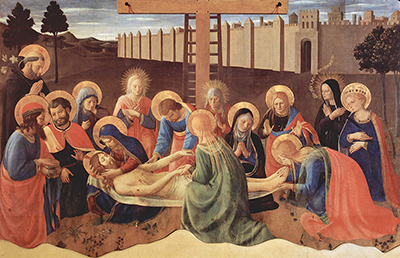
Fra Angelico’s Lamentation over the Dead Christ gathers its mourners beneath a cross that still bears the marks of the Crucifixion. Mary cradles her son’s head at the left, while Mary Magdalene bends to his feet at the right. Beyond them, a fortified city stretches almost the full width of the painted landscape. The panel was commissioned in 1436 for the Florentine confraternity of Santa Maria della Croce al Tempio. It is now in Florence’s Museo di San Marco. [1] [2]
At a Glance
- ArtistFra Angelico (Guido di Pietro). [1] [2]
- Date1436–41, the range used by the Fondazione Federico Zeri. The Italian state catalogue proposes completion in 1440. [1] [2]
- MediumTempera and gilding on wood panel. [1]
- Dimensions105 × 164 cm (height × width). [2]
- Original settingThe altar of Santa Maria della Croce al Tempio, Florence. [1] [2]
- CollectionMuseo di San Marco, Florence, inv. 1890, no. 8427. [1]
A commission for the Croce al Tempio
The first document is dated 13 April 1436. It survives in the Florentine state archive and is known through a transcription of the agreement and payment entries. Fra Sebastiano di Jacopo Benintendi, then a Benedictine, had arranged for the brotherhood’s panel. The prior was acquiring a missal from him, and seven ducats still owed on the book were to go towards the painting. A second entry, dated 2 December, records Fra Angelico’s receipt of sixty staia of wheat, a quantity measured by volume, as well as a cash payment. The frequently cited eighteen lire and eight soldi belong to the cash entry. The grain was also part of the transaction. [1] [3]
The receipt establishes that payment was under way in 1436. The state catalogue questions whether December’s instalment settled the commission and reads a date on the Virgin’s mantle as 1440. The Dizionario Biografico degli Italiani gives 1441 for the date it reports on the same garment. Both readings fit the Zeri catalogue’s broader span of 1436–41. A finished painting in December 1436 remains a possibility advanced in the scholarship, and the dates on the accounts leave room for work on the panel to have continued. [1] [2] [3] [4]
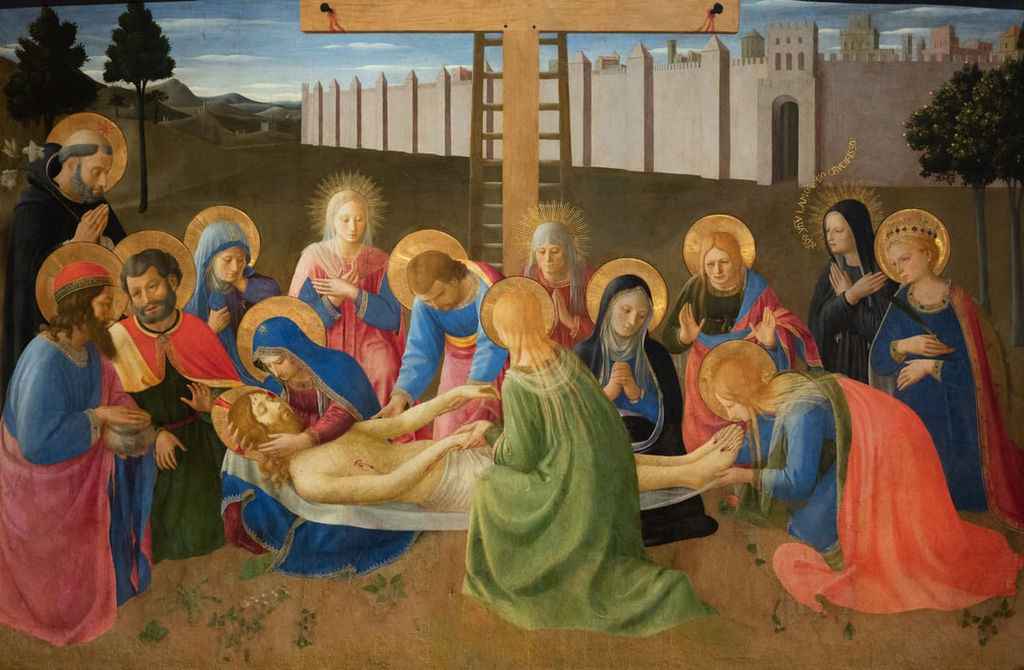
The Florentine Lamentation associated with Blessed Villana. The visible cross and ladders separate the gathering from the walled town. Image source. Public domain. Proportional web resize.
The chapel outside Florence’s walls
The brothers who attended the condemned were known as the Neri, after the black clothing they wore in that role. Their chapel, called Il Tempio, stood near the execution ground and a cemetery, outside the lost gate of San Francesco, also known as the Porta della Giustizia. The area around today’s Piazza Piave was then known as the Prati della Giustizia. In the Museo di San Marco’s presentation of the painting, Timothy Verdon links its altar to the final hours that condemned people spent in the chapel before being taken to the scaffold. [5] [6]
The painting’s unusual breadth has prompted a question about how it was seen there. The art historian Carl Brandon Strehlke proposed that it may have been an altar frontal, placed against the front of the altar table. Carissa DiCindio develops that suggestion in her study of the confraternity’s rituals. A person kneeling in front of the altar would have faced the body of Christ at close quarters, at roughly the level occupied by the mourners. The documents establish the connection to the altar, while the panel’s exact height and placement remain open. [1] [3]
DiCindio’s study also describes the small painted panels, or tavolette, that the brothers held before the condemned during their journey. The confraternity’s ritual instructions, preserved in a later compilation, direct the brothers to keep the image in view as long as possible. The large panel served at the altar, where the gaze could settle on one episode and stay there. The two uses help explain why what a prisoner could see mattered so much to the brothers’ work. [3]
The cross, the city and the hands
The upright of the cross divides the open landscape above the mourners. It meets the cluster of gold around their heads, with the ladder still in position behind it. Dark nails and small traces of red on the crossbeam draw the eye back to the violence that has just ended. Below, Christ’s body spans the composition almost horizontally. Its pale weight is carried by a sheet, and his chest turns far enough towards us to show the wound in his side. The muted ground beside him leaves the red, blue and green of the kneeling figures especially clear. [1] [3]
The hands give each mourner a different part in the scene. Mary supports the fallen head against her mantle. John the Evangelist bends over Christ to support one arm. A woman in a green cloak, with her back to us, takes his other hand. At his feet the Magdalene bows so far that her hair and red cloak fall forward with her. Just behind her, one woman brings her hands together in prayer and another lifts both palms. The art historian Christopher S. Wood draws attention to two subtler gestures farther back. A woman in red lets her crossed hands droop a little, while her neighbour in blue gathers a corner of cloth and brings it to her face. The group feels attentive to the smallest movement, even as the strongest lines of the picture hold it still. [3] [7]
Behind the figures the shaded ground sets off discs of gold and finer crowns of rays. Beyond it, towers and roofs rise above the city walls. The repeated buttresses shorten as the wall recedes to the left towards the hills, leaving the dark doorway at the right particularly distinct. The Museo di San Marco suggests that this Jerusalem recalls the walls and gate familiar to people approaching Il Tempio, and that the open ground beneath the cross may have evoked the local execution site. The resemblance works as an interpretation of the setting. For a Florentine viewer, the short distance between a city gate and the place of execution could have made the journey to Calvary feel close to home. [5]
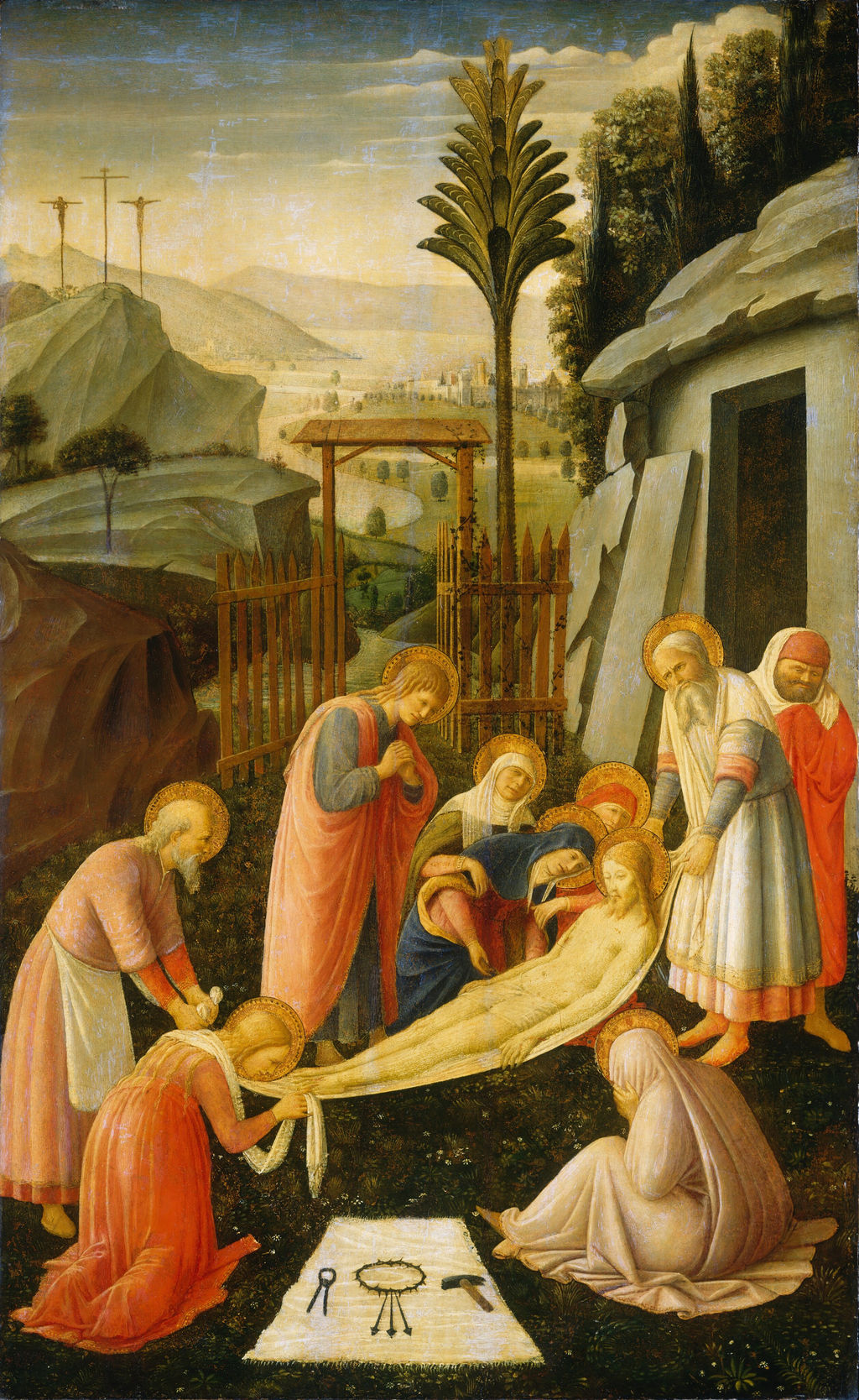
The Washington Entombment of Christ, National Gallery of Art accession 1939.1.260. The open gate links the two halves of the picture. National Gallery of Art, Washington. Image source. CC0 / Public domain. Proportional web resize.
Beata Villana among the mourners
The woman in black near the right edge is Beata Villana delle Botti, a fourteenth-century Florentine laywoman associated with the Dominicans and an ancestor of Benintendi. Gold rays surround her head, and words in gold curve from her mouth towards the open space above. Their sense is “Christ Jesus, my crucified love”. The crowned woman beside her, identified as Saint Catherine of Alexandria, holds the martyr’s palm, with a wheel behind her. At the far left Saint Dominic stands in prayer above the two men usually identified as Joseph of Arimathea and Nicodemus. The vessel held by one of them points to the preparation of the body for burial. The figures bring later forms of Christian devotion into the scene of Christ’s death. For a Florentine congregation, Villana also had a local presence through her relics at Santa Maria Novella, in which the brotherhood had recognised rights. [1] [3] [7]
The state catalogue records Stefano Orlandi’s suggestion that Benintendi may have been represented in the figure of Saint Dominic. It marks the identification of the praying woman near Christ’s feet as Catherine of Siena with a question mark. Villana’s inscription gives her a firmer identity. DiCindio reads the scene as a visual counterpart to Villana’s meditation on the Passion. Her place among the mourners gives that reading a particular force. A Florentine woman from more than a millennium after the event appears close enough to speak to Christ, as someone praying before the panel might also have hoped to do. [1] [3]
An earlier Florentine comparison is Giottino’s Lamentation from San Remigio. There, too, kneeling women are admitted into the company of Christ’s mourners. The Uffizi interprets them as probable patrons because their scale is smaller and they lack haloes. Angelico’s Villana belongs to the same space and scale as the other holy figures, and her rays and words make her role in the painting specific. The city and hills also give that shared space a reach beyond the immediate circle of mourners. [7] [8]
There is a different kind of urgency in Giotto’s Lamentation at Padua. A bare ridge descends towards Mary and Christ and the angels toss above them. In the Tempio panel the cross does much of the work of fixing the eye, while the wall and the stretches of open ground between the little groups give the viewer time to move from one response to another. Both painters place figures with their backs to us near the body, making the foreground feel occupied by fellow witnesses. [3]
A small drawing on parchment in Rotterdam shows how the arrangement could travel. Museum Boijmans Van Beuningen attributes the sheet to Zanobi Strozzi and sees in its group beneath the cross a loose borrowing from the Tempio panel. The drawing shrinks the scene to eight centimetres in height and turns it upright. What carries across is the gathering of figures around the body beneath the cross. [9]
From the oratory to the museum
When the old chapel was swallowed by the fortifications built during the siege of Florence in 1529–30, the brotherhood acquired an oratory in Borgo La Croce. The Museo di San Marco records that the panel was moved there and that the rites of consolation continued in front of it. After the confraternity’s suppression in 1785, the painting went to the Galleria dell’Accademia in 1786 and reached San Marco in 1919, according to the provenance assembled by DiCindio. It appeared in the 1955 exhibition commemorating five hundred years since Fra Angelico’s death. [2] [3] [5]
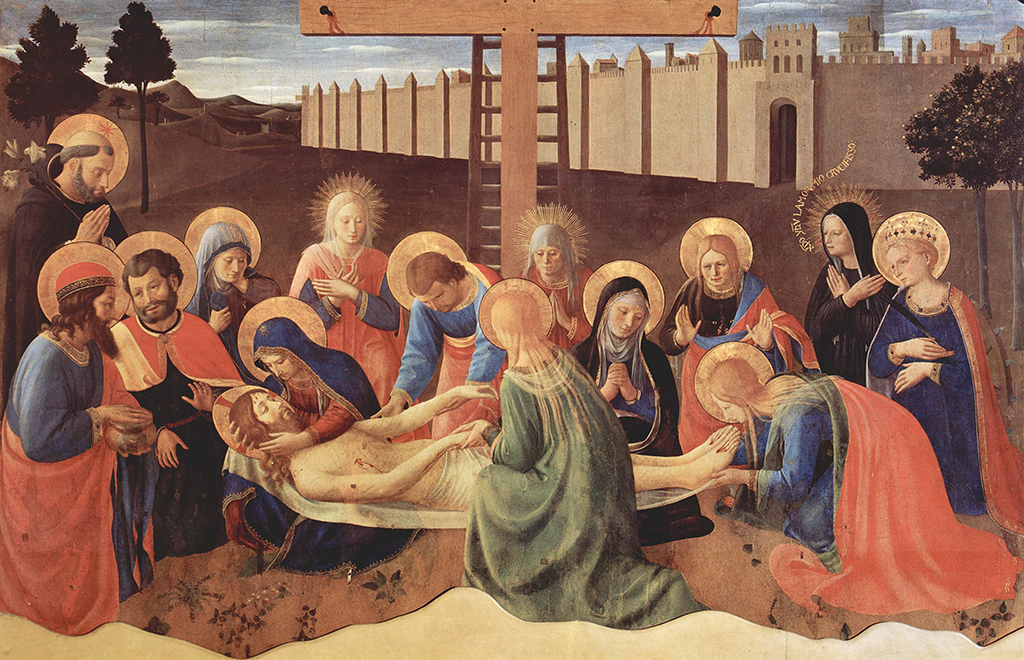
That same year, restorers at Rome’s Istituto Centrale del Restauro masked the badly damaged lower part of the panel with an undulating cover. The treatment predates Florence’s 1966 flood. [10]
The panel travelled to the Museo Diocesano in Turin in 2015 for an exhibition during the public display of the Shroud. The project’s sponsor records work on the wooden support and painted surface after rain spattered the painting during a severe storm in Florence the previous September. The exhibition gave the panel another setting in which visitors were invited to meditate on the Passion. [11] [12]
When the museum rearranged the Sala del Beato Angelico, it removed the cover so the panel could be seen at its full surviving height. Rossella Cavigli treated the exposed area with distinguishable, reversible additions. The difference matters when comparing older photographs with the painting in the gallery, especially along the ground below the mourners. [10]
The Italian state record lists historical proposals for participation by other hands under the names Master of the Castello Nativity and Master of Cell 2. The Zeri catalogue gives the panel to Fra Angelico. The records leave the allocation of individual passages open, including the landscape, whose light and recession are so important to the way the figures occupy the foreground. [1] [2]
Fra Angelico artworks directory
Explore documented works and surviving parts of larger ensembles. Catalogue links identify individual records. Attribution and dating can vary across collections and publications. Search the Federico Zeri Photo Archive by artist.
| Name | Date | Medium and sources |
|---|---|---|
| Adoration of the Magi | About 1440–60, NGA catalogue | Painting Catalogue. |
| Adoration of the Magi (Armadio degli Argenti) | About 1450–53 | Tempera and gold on wood. Catalogue. |
| Agony in the Garden (Armadio degli Argenti) | About 1450–53 | Tempera and gilding on wood Catalogue. |
| Annalena Altarpiece / Pala di Annalena | commonly c. 1435 | Tempera on panel Catalogue. |
| Annunciation (Armadio degli Argenti) | About 1450–53 | Tempera and gilding on wood. Catalogue. |
| Annunciation (Cortona) | generally placed in the 1430s; exact dating remains debated | Tempera on panel Catalogue. |
| Annunciation (Prado) | 1425–26 | Tempera on poplar panel Catalogue. |
| Annunciation (San Marco upper corridor) | commonly c. 1442 | Fresco Catalogue. |
| Annunciation with Saint Peter Martyr | About 1439–43 | Fresco on plaster. Catalogue. |
| Annunciatory Angel | 1450–55, Detroit catalogue | Gold leaf and tempera on wood panel. Catalogue. |
| Armadio degli Argenti (Silver Treasury) | principally c. 1450–52 | Tempera on panel Catalogue. |
| Arrest of Christ (Armadio degli Argenti) | About 1450–53 | Tempera and gilding on wood Catalogue. |
| Ascension (Armadio degli Argenti) | About 1450–53 | Tempera and gilding on wood Catalogue. |
| Baptism of Christ (Armadio, Alesso Baldovinetti) | About 1452–53 | Tempera and gilding on wood Catalogue. |
| Beheading of Saints Cosmas and Damian (San Marco Altarpiece) | About 1438–42 | Painted panel Catalogue. |
| Betrayal of Christ (Armadio degli Argenti) | About 1450–53 | Tempera and gilding on wood Catalogue. |
| Blessed Dominican, Possibly Jordan of Saxony (San Marco Altarpiece) | About 1438–42 | Painted panel Catalogue. |
| Blessed Vincent Ferrer (San Marco Altarpiece) | About 1438–42 | Painted panel Catalogue. |
| Burial of Saints Cosmas and Damian (San Marco Altarpiece) | About 1438–42 | Painted panel Catalogue. |
| Bust of a Cleric and a Group of Figures (recto and verso) | 15th century | Pen and ink on paper Catalogue. |
| Christ among the Doctors (Armadio degli Argenti) | About 1450–53 | Tempera and gilding on wood Catalogue. |
| Christ before Caiaphas (Armadio degli Argenti) | About 1450–53 | Tempera and gilding on wood Catalogue. |
| Christ Glorified in the Court of Heaven | About 1423–24 | Egg tempera on wood, probably poplar, with gold and silver leaf Catalogue. |
| Christ Seated in Judgment | 1447 | Fresco and gilding on plaster. Catalogue. |
| Christ Stripped of His Garments (Armadio degli Argenti) | About 1450–53 | Tempera and gilding on wood Catalogue. |
| Christ Washes the Apostles’ Feet (Armadio degli Argenti) | About 1450–53 | Tempera and gilding on wood Catalogue. |
| Circumcision of Christ (Armadio degli Argenti) | About 1450–53 | Tempera and gilding on wood. Catalogue. |
| Communion of the Apostles (Armadio degli Argenti) | About 1450–53 | Tempera and gilding on wood Catalogue. |
| Coronation of the Virgin (Armadio degli Argenti) | About 1450–53 | Tempera and gilding on wood Catalogue. |
| Coronation of the Virgin (Louvre) | Louvre: second quarter of the fifteenth century, 1425–50; often dated more narrowly c. 1434–35 | Tempera and gold on panel Catalogue. |
| Coronation of the Virgin (Uffizi) | 1431–35 | Tempera on wood, gold ground Catalogue. |
| Cortona Triptych | About 1437 | Tempera and gold on panel. Catalogue. |
| Crucifixion (Armadio degli Argenti) | About 1450–53 | Tempera and gilding on wood Catalogue. |
| Crucifixion and Saints | 1441–42 | Fresco Catalogue. |
| Deposition from the Cross / Santa Trinita Deposition | commissioned 1429–32; completed by Angelico within this period | Tempera on panel Catalogue. |
| Descent into Limbo (Armadio degli Argenti) | About 1450–53 | Tempera and gilding on wood Catalogue. |
| Entombment of Christ (San Marco Altarpiece) | About 1438–42 | Painted panel Catalogue. |
| Entry into Jerusalem (Armadio degli Argenti) | About 1450–53 | Tempera and gilding on wood Catalogue. |
| Expulsion and the Stoning of Saint Stephen | 1448–49, Vatican Museums | Fresco. Catalogue. |
| Fiesole San Domenico Altarpiece | early 1420s; predella about 1423–24 | Tempera on panel Catalogue. |
| Flagellation (Armadio degli Argenti) | About 1450–53 | Tempera and gilding on wood Catalogue. |
| Flight into Egypt | About 1450–53 | Tempera and gilding on wood. Catalogue. |
| Guidalotti Polyptych | c. 1447–49 | Tempera and oil on panel Catalogue. |
| Healing of Palladia and Saint Damian Accepting Her Gift (San Marco Altarpiece) | About 1438–42 | Painted panel Catalogue. |
| Holy Pilgrim, Possibly Saint Roch (San Marco Altarpiece) | About 1438–42 | Painted panel Catalogue. |
| Holy Women at the Tomb (Armadio degli Argenti) | About 1450–53 | Tempera and gilding on wood Catalogue. |
| Judas Receives Payment (Armadio degli Argenti) | About 1450–53 | Tempera and gilding on wood Catalogue. |
| Lamentation over Christ (Armadio degli Argenti) | About 1450–53 | Tempera and gilding on wood Catalogue. |
| Lamentation over the Dead Christ (Croce al Tempio Lamentation) | 1436–41, Zeri catalogue | Tempera and gilding on wood panel. Catalogue. |
| Last Judgement (Armadio degli Argenti) | About 1450–53 | Tempera and gilding on wood Catalogue. |
| Last Judgement (San Marco) | c. 1425–28 | Tempera and gold on panel Catalogue. |
| Last Supper (Armadio degli Argenti) | About 1450–53 | Tempera and gilding on wood Catalogue. |
| Lex Amoris (Armadio degli Argenti) | About 1450–53 | Tempera and gilding on wood Catalogue. |
| Madonna and Child with Saint Dominic and Saint Thomas Aquinas | About 1430, Hermitage catalogue | Detached fresco. Catalogue. |
| Madonna and Child with Saints | About 1411–13 | Tempera on wood panel, with a gold ground. Catalogue. |
| Madonna of Humility | About 1425, Thyssen catalogue | Tempera and gold on wood. Catalogue. |
| Madonna of the Star | 1431–34, Zeri catalogue | Tempera with oil glazes and gold on wood panel, as catalogued by the Gardner for the 2018 exhibition. Catalogue. |
| Marriage at Cana (Armadio, Alesso Baldovinetti) | About 1452–53 | Tempera and gilding on wood Catalogue. |
| Massacre of the Innocents (Armadio degli Argenti) | About 1450–53 | Tempera and gilding on wood Catalogue. |
| Miracle of the Black Leg (San Marco Altarpiece) | About 1438–42 | Painted panel Catalogue. |
| Mocking of Christ (Armadio degli Argenti) | About 1450–53 | Tempera and gilding on wood Catalogue. |
| Mystic Wheel (The Vision of Ezekiel) | About 1450–52 | Tempera and gilding on wood. Catalogue. |
| Nativity (Armadio degli Argenti) | About 1450–53 | Tempera and gilding on wood. Catalogue. |
| Niccoline Chapel frescoes | principally 1448–50 | Fresco Catalogue. |
| Noli me Tangere | broadly within Angelico’s San Marco campaign, late 1430s–1440s | Fresco Catalogue. |
| Ordination of Saint Lawrence | 1448 | Fresco. Catalogue. |
| Pentecost (Armadio degli Argenti) | About 1450–53 | Tempera and gilding on wood Catalogue. |
| Presentation of Christ at the Temple (Armadio degli Argenti) | About 1450–53 | Tempera and gilding on wood. Catalogue. |
| Presentation of Jesus at the Temple | Early 1440s | Fresco on plaster. Catalogue. |
| Raising of Lazarus (Armadio degli Argenti) | About 1450–53 | Tempera and gilding on wood Catalogue. |
| Rescue of Saints Cosmas and Damian and Exorcism of Lysias (San Marco Altarpiece) | About 1438–42 | Painted panel Catalogue. |
| Road to Calvary (Armadio degli Argenti) | About 1450–53 | Tempera and gilding on wood Catalogue. |
| Saint Anthony Abbot (San Marco Altarpiece) | About 1438–42 | Painted panel Catalogue. |
| Saint Bernard of Clairvaux or Saint Benedict (San Marco Altarpiece) | About 1438–42 | Painted panel Catalogue. |
| Saint Damian Receives Money from Palladia | About 1425–49 | Tempera and gilding on wood. Catalogue. |
| Saint Francis and a Bishop Saint, Saint John the Baptist and Saint Dominic | Late 1420s, Getty catalogue | Tempera and gold leaf on panel. Catalogue. |
| Saint James the Greater Freeing the Magician Hermogenes | About 1426–29 | Tempera and gold on panel Catalogue. |
| Saint Jerome (San Marco Altarpiece) | About 1438–42 | Painted panel Catalogue. |
| Saint Lawrence Giving Alms | About 1448 | Wall fresco. Catalogue. |
| Saint Lawrence Receiving the Treasures of the Church from Pope Sixtus II | About 1448–49 | Fresco on plaster. Catalogue. |
| Saint Romuald (San Marco Altarpiece) | About 1438–42 | Painted panel Catalogue. |
| Saint Stephen Addressing the Council | 1448–49, Vatican Museums | Fresco. Catalogue. |
| Saint Stephen Preaching | 1448–49, Vatican Museums | Wall fresco. Catalogue. |
| Saint Thomas Aquinas (San Marco Altarpiece) | About 1438–42 | Painted panel Catalogue. |
| Saints Cosmas and Damian and Their Brothers Survive the Stake | Second quarter of the 15th century | Tempera and gilding on wood. Catalogue. |
| Saints Cosmas and Damian at the Stake (San Marco Altarpiece) | About 1438–42 | Painted panel Catalogue. |
| Saints Cosmas and Damian before Lysias (San Marco Altarpiece) | About 1438–42 | Painted panel Catalogue. |
| Saints Cosmas and Damian Rescued by an Angel | Second quarter of the 15th century | Tempera and gilding on wood. Catalogue. |
| Saints Cosmas and Damian with Their Brothers before Proconsul Lysias | Second quarter of the 15th century | Tempera and gilding on wood. Catalogue. |
| San Marco Altarpiece / Pala di San Marco | 1438–43 | Tempera on panel Catalogue. |
| San Pietro Martire Triptych | About 1422–23, Strozzi exhibition | Tempera and gold on panel. Catalogue. |
| Scenes from the Lives of the Desert Fathers (Thebaid) | About 1420, Uffizi catalogue | Tempera on wood. Catalogue. |
| Sixteen Prophets | 1447 | Fresco and gilding on plaster Catalogue. |
| Stoning and Shooting of the Brothers (San Marco Altarpiece) | About 1438–42 | Painted panel Catalogue. |
| Tabernacle of the Linaioli | 1433–35 | Tempera on panel Catalogue. |
| The Attempted Crucifixion and Stoning of Saints Cosmas and Damian | Second quarter of the 15th century | Tempera and gilding on wood. Catalogue. |
| The Crucifixion | About 1420–23, Met catalogue | Tempera on wood, gold ground. Catalogue. |
| The Death and the Assumption of the Virgin | 1424–34 | Tempera with oil glazes and gold on panel Catalogue. |
| The Dominican Blessed (left end) (Fiesole predella) | About 1423–24 | Egg tempera and gold on wood Catalogue. |
| The Dominican Blessed (right end) (Fiesole predella) | About 1423–24 | Egg tempera and gold on wood Catalogue. |
| The Entombment of Christ | About 1450 | Tempera on poplar panel. Catalogue. |
| The Forerunners of Christ with Saints and Martyrs | About 1423–24 | Egg tempera on wood (probably poplar), with gold and silver leaf. Catalogue. |
| The Funeral of Saint Anthony Abbot | About 1426–30 | Tempera on poplar panel. Catalogue. |
| The Martyrdom of Saints Cosmas and Damian | About 1425–49 | Tempera and gilding on wood. Catalogue. |
| The Mocking of Christ / Christ Mocked | within the San Marco dormitory campaign, broadly late 1430s–1440s | Fresco Catalogue. |
| The Nativity | About 1425, Minneapolis catalogue | Tempera on poplar panel. Catalogue. |
| The Nativity in Cell 5 at San Marco | About 1439–43 | Fresco on plaster. Catalogue. |
| The Penitent Saint Jerome | 1419–20 | Tempera on wood panel Catalogue. |
| The Virgin and Child by Fra Angelico (Fogg Museum) | About 1430, Harvard catalogue | Tempera originally on panel, subsequently transferred to Masonite. Catalogue. |
| The Virgin Mary with the Apostles and Other Saints (Fiesole predella) | About 1423–24 | Egg tempera and gold on wood Catalogue. |
| Transfiguration (Armadio, Alesso Baldovinetti) | About 1452–53 | Tempera and gilding on wood Catalogue. |
| Transfiguration (San Marco Cell 6) | within the San Marco dormitory campaign, broadly late 1430s–1440s | Fresco Catalogue. |
| Virgin Mary Annunciate | 1450–55, Detroit catalogue | Gold leaf and tempera on wood panel. Catalogue. |
| Virgin of the Pomegranate | About 1426 | Tempera on panel with gilding Catalogue. |
Frequently Asked Questions
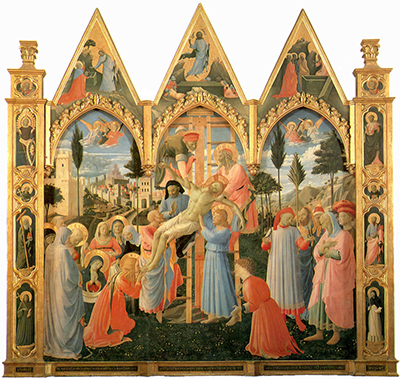
The Santa Trinita Deposition shows Christ being lowered from the cross. Lorenzo Monaco began that altarpiece for the Strozzi family’s setting at Santa Trinita, and Fra Angelico completed it. Both panels belong to the Museo di San Marco. The Croce al Tempio panel was painted for the brotherhood and shows the mourning after Christ’s body has been lowered. [1] [13]
The Entombment of Christ in the National Gallery of Art, Washington, is a narrower tempera painting on poplar, dated about 1450 and measuring 88.9 × 54.9 cm. Rock and the stone opening of the tomb frame the group as they carry Christ’s body. The Florence panel spreads the mourners across open ground beneath the cross. [1] [15]
Discussion
Use these prompts to look again or share an observation.
Reader Insights
Follow the line of Christ’s body across the figures gathered around him. Where do hands break or repeat that direction?
Find the open space at the edge of the crowd. What does it do to your sense of the group’s grief?
Join the Conversation
Share a detail or question about Lamentation over the Dead Christ (Croce al Tempio Lamentation).
References
- Ministero della Cultura, Compianto sul Cristo morto, national catalogue no. 0900196286, Museo di San Marco inv. 1890, no. 8427. View source.
- Fondazione Federico Zeri, Guido di Pietro, Compianto sul Cristo morto, online work record 12960. View source.
- Carissa M. DiCindio, Fra Angelico’s Tempio Lamentation: A Consideration of Its Function and Meaning, University of Georgia, 2004, chapters 1–4 and Appendix B. View source.
- Treccani, Guido di Pietro, detto il Beato Angelico, Dizionario Biografico degli Italiani, passage on the Tempio commission and mantle date. View source.
- Museo di San Marco, I “pietrini”: memorie cittadine nei sotterranei del Museo di San Marco, section on the Compagnia di Santa Maria della Croce al Tempio, 2025. View source.
- Timothy Verdon and the Museo di San Marco, Il Compianto sul Cristo morto visto da Timothy Verdon, museum presentation. View source.
- Christopher S. Wood, The Embedded Portrait: Giotto, Giottino, Angelico, Princeton University Press, 2023, chapter 7, pp. 272–74 and fig. 7.3. View source.
- Uffizi Galleries, Giottino, Lamentation over the Dead Christ, inv. 1890, no. 454. View source.
- Museum Boijmans Van Beuningen, The Lamentation, attributed to Zanobi Strozzi, I 239 (PK), catalogue discussion. View source.
- Angelo Tartuferi and the Museo di San Marco, Fare spazio a Beato Angelico, description of the redisplay and conservation, 2021. View source.
- Diocesi di Torino, Ostensione 2015: «Compianto sul Cristo morto» del Beato Angelico al Museo Diocesano, exhibition announcement. View source.
- Consulta di Torino, Esposizione del “Compianto sul Cristo morto” di Beato Angelico, exhibition and treatment account. View source.
- Museo di San Marco, La Deposizione Strozzi di Beato Angelico torna al Museo di San Marco, 2025. View source.
- Ministero della Cultura, Compianto sul Cristo morto, Cell 2 fresco, national catalogue no. 0900289160. View source.
- National Gallery of Art, Fra Angelico, The Entombment of Christ, accession 1939.1.260. View source.
.jpg)
 Fra Angelico.jpg)