 by Tom Gurney
Tom Gurney BSc (Hons) is an art history expert with over 20 years experience
Published on June 19, 2020 / Updated on November 20, 2026
Email: tomgurney1@gmail.com / Phone: +44 7429 011000
Introduction
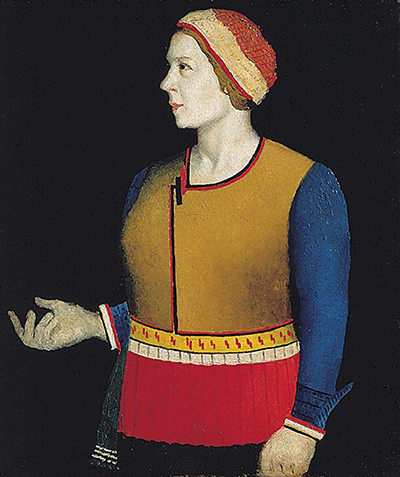
A woman stands against a nearly black ground, her body turned toward us but her face in profile. Her red-and-yellow head covering, ochre bodice, blue sleeves and open left hand make Kazimir Malevich's Portrait of the Artist’s Wife immediately recognizable. The saved image on this page matches the State Russian Museum's illustrated record for Жб-1572, catalogued as a 1933 oil painting. That accession is essential: the museum owns another portrait of his wife from 1934, with a similar title but a different composition. [1] [2]
The 1933 painting shows a real sitter through a deliberately constructed arrangement of colour and shape. Its figure is more legible than the geometric forms in Black Square, yet the broad, clear areas of red, blue and yellow make a purely descriptive reading incomplete. Malevich's late portraiture did not simply erase the questions about form that had occupied his abstract work. This article identifies the particular canvas, looks at its visual structure and explains why published museum pages give conflicting dates and measurements for its image. [1] [3] [4]
At a Glance
- ArtistKazimir Malevich
- Museum titlePortrait of the Artist’s Wife
- Date followed here1933, the date on the accession-bearing Russian Museum record
- MediumOil on canvas
- Dimensions67.5 × 56 cm on the accession-bearing record
- CollectionState Russian Museum, Saint Petersburg, Жб-1572
- SitterNatalia Andreyevna Manchenko (Malevich), identified by a second Russian Museum gallery entry
- Important distinctionA separate 1934 Portrait of Wife, Ж-9389, is 99.5 × 74.5 cm
Contents
- Which portrait is shown here?
- Looking closely: pose, colour and ground
- Who was the sitter?
- Where does it sit in Malevich's work?
- What does the museum record tell us about ownership?
- A profile and a differently posed portrait
Which portrait is shown here?
The owner museum's illustrated collection entry gives this work the title Portrait of the Artist’s Wife, the year 1933, oil on canvas, 67.5 × 56 cm, and inventory Жб-1572. It says the painting came from the artist in 1934. The local reproduction matches its pictured figure: the left-facing profile, close-fitting warm-coloured head covering, blue sleeves, horizontally banded red lower garment, open left hand and uninterrupted dark background. This match rests on the picture as well as the title. [1]
The museum also catalogues Portrait of Wife, 1934, oil on canvas, 99.5 × 74.5 cm, inventory Ж-9389. Its illustration shows a front-facing, more distant figure wearing a pale cap and a blue and red costume; both arms and much more of the body are visible. It is a separate canvas, not a larger print or another date for Жб-1572. A reader searching for “Malevich portrait of wife” can easily encounter both, so an accession number is more useful than the English title alone. [2]
There is a further complication. An illustrated Russian Museum gallery page reproduces the same profile composition as Жб-1572 but titles it Portrait of the Artist’s Wife. 1934 and gives 66 × 56 cm, without an accession number. Its text identifies the sitter as Natalia Andreyevna Manchenko (1902–1990), Malevich's third wife. The accession-bearing object entry and this gallery therefore disagree about the reproduced profile painting's date and height. The discrepancy is unresolved in the checked museum pages; the present article uses the accession-bearing 1933, 67.5 × 56 cm data and reports the alternative explicitly. [1] [3]
Looking closely: pose, colour and ground
The portrait is organized around a quiet profile and a series of emphatic colour blocks. The face turns left, while the torso offers a broader frontal view. A compact red and yellow covering encloses the hair. The light face and neck catch the eye before the blue sleeves and yellow-brown chest. Thin red and black lines around the neckline and down the bodice sharpen the boundaries between forms. At the waist, a pale patterned band separates the upper body from the large red zone beneath it. [1]
Her left arm bends outward. The palm is open, with fingers loosely separated, an unusually active shape in an otherwise still pose. Her other arm descends at the right. The outline of the clothing is crisp against the black, but the body is not a flat silhouette: changes of tone in the face, neck, shoulders and hands give the sitter volume. The image stages a tension between modeled human features and broad regions of almost independent colour. [1]
The ground supplies no furniture, horizon, room or landscape. It makes the sitter's posture and costume carry nearly all the visual information. The absence of a setting also means the picture does not document where she sat or what she was doing. A portrait can be attentive to a person without serving as a straightforward record of a particular domestic moment. The Russian Museum's interpretation of its late wife portrait emphasizes a static pose, an impenetrable dark backdrop and sculptural modeling; that is a useful comparison, but the essay on its 1934 accession belongs to the distinct Ж-9389 object and should not be silently transferred as documentation of this 1933 canvas. [1] [2] [3]
Who was the sitter?
The Russian Museum gallery that displays the matching profile picture names Natalia Andreyevna Manchenko, later Malevich, and calls her the artist's third wife. It gives her life dates as 1902–1990. The accession-bearing 1933 object record does not add a sitter biography beyond its title. Thus the name is supported by another owner page illustrating this composition, while the object date and dimensions come from the entry with Жб-1572. [1] [3]
The sitter's identity does not make every detail of the image biographical. The coloured costume, open hand and averted gaze are visible facts. A precise emotion, private conversation or reason for the gesture is not recorded in the checked object entry. The museum's separate interpretation of the 1934 portrait describes a pessimistic mood and an apathetic or weary expression; that is an attributed reading of a different accession, not evidence that Natalia felt those things while posing for the work shown here. [1] [2] [3]
Where does it sit in Malevich's work?
The 1933 museum date places Жб-1572 well after Malevich introduced Suprematism in 1915. In works such as Black Square he made the relation of coloured or dark shapes to a light field a subject in its own right. Here the person returns, but her clothing still organizes the canvas into strong planes: a blue sleeve at either side of the warm bodice, red below and a black field all around. This is a visual comparison, not a claim that the sitter was intended as a coded Suprematist symbol. [1] [4]
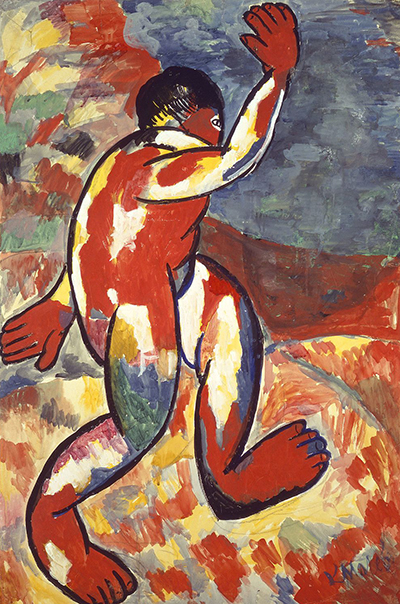
The contrast with an earlier figurative painting is also instructive. Bather dissolves a person into exaggerated rhythm and movement; this late portrait holds the figure steady. The dark background gives little spatial distraction, while the gaze leaves the frame to the left. The arrangement invites viewers to consider a represented person and an intentionally constructed painted surface at once. [1]
The museum's commentary on the separate 1934 wife portrait cautions against explaining Malevich's last figurative work solely as compliance with Socialist Realism. It describes his engagement with classical art and his continued formal experimentation. That published interpretation provides context for his late portraits as a group; it cannot by itself establish why he made this particular 1933 canvas or exactly how it was painted. [2]
What does the museum record tell us about ownership?
The Russian Museum says it received Жб-1572 from the artist in 1934, a year after the painting's listed date. Its Russian wording describes acquisition from him. This identifies an early collection transfer, but the short catalogue line does not provide a complete history of where the canvas was painted, exhibited or stored before entering the museum. Those questions require additional archival evidence. [1] [5]
The separate Ж-9389 entered in 1935 from the First Exhibition of Leningrad Artists, according to its own museum page. The different acquisition lines reinforce that the museum treats the two portraits as separate works with separate histories. They should not be used to fill gaps in one another's records. [1] [2]
A profile and a differently posed portrait
The profile directs attention to the boundary between the face and the ground. A viewer can follow that edge down towards the neck and clothing, then return to the painted head. This sequence helps the pose remain legible even where individual details are understated. The larger Portrait of Wife has another arrangement, with the head and body presented differently within a taller format. The two illustrated museum items let a reader judge the difference in pose directly. They also keep the 1934 acquisition of the profile from being confused with the 1934 date assigned to the separate work. [1] [2] [5]
This is one reason to keep the dating discrepancy visible even in a short caption. The Russian Museum’s accession-bearing record for the profile and its other presentation of that image give different numbers. The profile itself is recognizable across them. With the differently posed later canvas, the difference is in the pictured object as well as in the dates and measurements. Starting with the outline of the head is therefore a practical way to decide which catalogue details to consult. [1] [2] [3]
Frequently Asked Questions
Is the painting dated 1933 or 1934?
The Russian Museum entry for the matching, accessioned painting Жб-1572 says 1933. A second illustrated museum gallery shows the same profile image but says 1934. The article follows the object record's 1933 date and flags the unresolved disagreement. The museum additionally owns a genuinely distinct 1934 wife portrait, Ж-9389. [1] [2] [3]
How large is the painting?
Is the sitter identified?
Yes. The museum gallery illustrating the profile image identifies her as Natalia Andreyevna Manchenko (Malevich), Malevich's third wife. [3]
Is this the same portrait as the museum's 1934 Portrait of Wife?
No. The 1934 canvas is accession Ж-9389, shows a front-facing figure in a different costume and measures 99.5 × 74.5 cm in its own catalogue entry. [2]
Discussion
How does the dark background change your attention to Natalia’s face, hand and costume?
Which colour boundaries feel most important to the portrait’s structure?
Reader Insights
Compare the turned profile with the frontal position of the torso. What kind of stillness does this create?
Look at the open left hand. How does its small gesture work against the broad areas of colour?
The museum owns two different wife portraits. Which visual details identify the 1933 canvas shown here?
Join the Conversation
Share a close observation or a source-backed detail about Russian Museum Жб-1572.
References
- State Russian Museum, Portrait of the Artist’s Wife, Жб-1572: accession-bearing illustrated owner record; 1933, oil on canvas, 67.5 × 56 cm, received from the artist in 1934. View source.
- State Russian Museum, Портрет жены (Portrait of Wife), Ж-9389: illustrated record for the distinct 1934 canvas, 99.5 × 74.5 cm, with its 1935 acquisition note and published interpretation. View source.
- Russian Museum gallery, Portrait of the Artist’s Wife. 1934: same profile composition as Жб-1572, but a conflicting 1934 date and 66 × 56 cm measurement; names Natalia Andreyevna Manchenko as sitter. View source.
- Smarthistory, Charles Cramer and Kim Grant, “Suprematism, Part I: Kazimir Malevich”: scholarly account of Malevich's 1915 abstraction, used for historical comparison rather than object metadata. View source.
- State Russian Museum, Russian-language Портрет жены художника, Жб-1572: owner wording for the 1934 acquisition from the artist. View source.