

 Buy Art Prints Now
from Amazon
Leonardo da Vinci Inventions
Leonardo's invention designs survive above all through drawings, notes and later interpretations. They include studies of flight, descent, underwater work, artillery and mechanical force, but they should not be treated as proof that Leonardo built modern machines.
This guide separates Leonardo's folios and designs from later reconstructions and modern labels. It introduces the famous invention subjects without claiming that Leonardo flew, tested, deployed or proved the machines.
At a Glance
- Page titleLeonardo da Vinci Inventions
- CategoryLeonardo invention designs and mechanical studies
- Main evidencedrawings, notebook folios, later museum models and institutional interpretation
- Evidence basisspecific folios and museum records rather than a single broad invention myth
- Core topicsflight, descent, underwater work, military engineering, models and modern interpretation
- Key subjectsFlying Machine, Ornithopter, Helicopter, Parachute, Diving Suit, Crossbow and Machine Gun
- Evidence cautiondrawings, folios, designs and later models are related but not interchangeable
- Avoid claimingthat Leonardo built, flew, tested, proved or deployed these machines
- Image evidencereproductions and model photographs document later visibility, not proof that Leonardo built working machines
Contents
- Drawings Before Machines
- Flight: Flying Machine and Ornithopter
- The Aerial Screw and the Modern Helicopter Label
- Parachute: Descent, Folio and Later Models
- Diving Suit: Work Below the Surface
- Giant Crossbow
- Machine Gun and Multi-Barrel Artillery
- Later Models and Public Imagination
- What Not to Overclaim
- Why Leonardo's Inventions Still Matter
Explore Leonardo da Vinci Inventions
Use these cards as a guide through folios, models and later interpretation. They do not claim that Leonardo built, tested or proved modern working machines.
Flying Machine
A folio and model subject separating manuscript evidence from later reconstruction.
Ornithopter
A wing-design subject that keeps several folios and model traditions distinct.
Helicopter / Aerial Screw
A popular-title bridge for the aerial screw, not a modern helicopter claim.
Parachute
A Codex Atlanticus folio subject with later model and test evidence carefully bounded.
Diving Suit
An underwater-design subject separating folio, later model and modern interpretation.
Crossbow
A large-weapon design subject with folio and model evidence held apart.
Machine Gun
A popular-title bridge for repeating artillery, not a modern firearm claim.
Triple Barrel Cannon
A caution-led artillery subject, treated separately from the Machine Gun page.
Drawings Before Machines
The strongest evidence-led version of Leonardo's inventions begins with paper. His designs survive primarily as studies, notes and drawings, not as a workshop full of finished machines. Later museum models can be extremely useful, because they translate drawings into objects that visitors can understand. But a model is not the same kind of evidence as Leonardo's own folio.
This matters because Leonardo invention pages are especially vulnerable to myth. A photograph of a model can look like a surviving Renaissance machine. A modern title can make a Renaissance design sound like a direct ancestor of modern technology. A single dramatic label, such as helicopter or machine gun, can compress several centuries of engineering history into one misleading phrase.
The strongest evidence begins with named drawings and museum records. The Flying Machine is anchored to a Museo Leonardiano model and its relationship to Manuscript B [1]. Ornithopter evidence keeps Science Museum Group model material distinct from Codex Atlanticus and Codex on the Flight of Birds material [3] [4]. Helicopter uses a familiar modern title, but the subject is the Aerial Screw and Manuscript B f. 83v [6]. Parachute and Diving Suit are tied to specific Codex Atlanticus folios [8] [10]. Crossbow and Machine Gun belong to military engineering, with reference drawings and later museum models held apart [12] [14].
Leonardo was not a magician who secretly completed modern technology. He was a designer whose notebooks show sustained experiments in imagining machines.
Flight: Flying Machine and Ornithopter
Leonardo's flight studies are among the most famous of his inventions because they touch an ancient human desire: to leave the ground. The Flying Machine subject is supported by Museo Leonardiano's Flying machine page, which records a model related to Leonardo's Manuscript B, f. 74v [1]. That source supports a page about a flapping-wing design, a pilot platform, cords, pulleys, stirrups and mechanical interpretation. It does not support a claim that Leonardo built a successful aircraft.
Museo Leonardiano's broader Flight studies context frames Leonardo's interest in birds, wings, gliding, soaring and the limits of human-powered flight [2]. His flight designs were not isolated fantasies; they grew from observation of natural motion and questions about artificial imitation.
The Ornithopter belongs to the same larger question, but its evidence is separate. Science Museum Group records a model of Leonardo da Vinci’s ornithopter wing, connected with a boat-shaped ornithopter scheme in Codex Atlanticus, folio 313 recto-a.[3] Museo Leonardiano’s Detail of a mechanical wing belongs to another source context, connected with the Codex on the Flight of Birds f. 11v.[4] They are related flight-study records, not one generic machine.
Museo Leonardiano’s Study of a beating wing adds another useful distinction.[5] It belongs to a related wing-study tradition rather than to the exact same object as the Ornithopter or Flying Machine pages. Leonardo returned to wings again and again, but the studies remain separate pieces of evidence.
That separation is the lesson. Leonardo studied flight repeatedly, but the evidence is a set of drawings, studies and model interpretations, not a single completed machine. Leonardo explored flapping wings, articulated wings and the dream of human flight. That is not the same as saying he flew.
The Aerial Screw and the Modern Helicopter Label
Helicopter is the familiar modern title, but the historical subject is Leonardo's Aerial Screw. Museo Nazionale Scienza e Tecnologia Leonardo da Vinci anchors the design in Manuscript B f. 83v [6]. The source supports discussion of the screw-like form, model tradition and famous drawing, not a claim that Leonardo invented the modern helicopter.
Google Arts and Culture / Museo Leonardiano and Museums Victoria can support model context and public interpretation [7]. Those sources help explain why the design looks so striking to modern readers. They do not override the governing Aerial Screw terminology.
Leonardo’s Aerial Screw belongs to a manuscript and model tradition. It was not a working rotorcraft: there was no modern engine, no tested helicopter and no evidence that Leonardo proved vertical flight.
The design remains fascinating because it imagines lift through spiral motion and treats air as a mechanical medium. Its boldness does not require a false origin story for aviation.
Parachute: Descent, Folio and Later Models
The Parachute page is anchored by Codex Atlanticus f. 1058 verso. The Google Arts and Culture / Veneranda Biblioteca Ambrosiana record supplies the folio evidence for the design, while Museo Scienza, Science Museum Group and Museums Victoria document later model and interpretation traditions.[8] [9]
The important distinction is between the fifteenth-century design and later testing or model history. Leonardo drew a parachute design. Later institutions built models or discussed its feasibility. The cited source material does not support a claim that Leonardo built, tested, proved or flew the parachute.
The Parachute broadens the flight theme from ascent to controlled descent. It shows Leonardo thinking not only about how a body might rise, but how it might survive falling.
Even here, modern vocabulary needs caution. A modern parachute is a developed technology with fabrics, cords, packing methods, training and testing cultures. Leonardo's design belongs to a manuscript and model tradition. It is an extraordinary idea, not proof of modern aviation.
Diving Suit: Work Below the Surface
The Diving Suit shifts from air to water. Its central evidence is Codex Atlanticus folio 909v, presented through Google Arts and Culture with the Veneranda Biblioteca Ambrosiana [10]. The source material also uses Lombardia Beni Culturali's Scafandro per palombaro record for the later model evidence connected with the Museo Nazionale della Scienza e della Tecnologia in Milan [11].
The Diving Suit is easy to picture: clothing, breathing tubes, a mask, glass eye pieces, ballast and tools. The evidence is narrower. Leonardo drew and described underwater equipment in a naval and military-engineering context. Later models make the design visible, but they do not prove that he built, tested or used a functioning diving suit.
Underwater work is a difficult design problem. A person below the surface needs air, vision, weight, movement, signalling and escape. Leonardo's design brings those problems into one imaginative technical system.
The diving suit is separate from related underwater-breathing and diving-bell material. The central evidence remains folio 909v and the later model record, while the dedicated Diving Suit page gives the fuller account.[10] [11]
Giant Crossbow
Leonardo's Crossbow belongs to the military-engineering side of his invention studies. Museo Scienza's Giant Crossbow material connects the design to Codex Atlanticus f. 149b r [12]. Later models help convey the scale and strangeness of the design, but they must not be mistaken for surviving Leonardo objects.
The Crossbow is a good example of Leonardo's mixture of practical engineering and theatrical scale. It imagines power, intimidation and mechanism. It also reveals the courtly and military context in which technical drawings could operate: as proposals, demonstrations of ingenuity, or conceptual solutions to the problems of force and warfare.
Leonardo did not invent the crossbow; crossbows existed long before him. The giant crossbow is best described as a design system rather than as a weapon known to have been built or used in battle.[12] Codex Atlanticus gives the design its manuscript footing, while the model tradition helps explain scale and mechanism.[13]
The Crossbow also balances the flight material. Leonardo's inventions were not all dreams of escape into the air. Many were tied to war, pressure, motion, force and the power to damage.
Machine Gun and Multi-Barrel Artillery
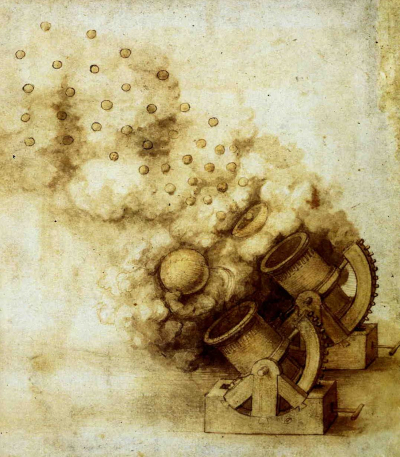
The Machine Gun title is another modern label that needs qualification. It does not mean that Leonardo invented a modern automatic weapon. The historical subject is multi-barrel artillery connected with Codex Atlanticus f. 157r and later museum models [14] [15].
Museo Leonardiano's Mitragliera a tre file di canne and Museo Scienza's Mitragliera a trentatré canne support the page's central design lane: multiple small barrels arranged in rows so firing, reloading and cooling could be managed in sequence [14] [15]. That is a strong engineering idea. It is not the same as automatic fire.
The design can be described as an attempt to increase the rhythm and volume of fire before modern ammunition systems existed. Leonardo was thinking about arrangement and sequence: a problem of time addressed by multiplying barrels and organizing their use.
Triple Barrel Cannon is a related caution case rather than a settled synonym for the Machine Gun page. Its warning alert keeps the attribution and object-status questions separate.
Later Models and Public Imagination
Leonardo invention subjects often depend on later models. A model can clarify scale, arrangement and mechanical intention; the problem comes only when a twentieth-century museum model is treated as if it were an object Leonardo built.
The same distinction recurs across the invention subjects. Parachute and Diving Suit distinguish Codex Atlanticus folios from later model records [8] [9] [10] [11]. Crossbow and Machine Gun separate reference drawings from Museo Scienza or Museo Leonardiano models [12] [14] [15]. Helicopter uses Aerial Screw source language while retaining the familiar modern title [6].
Leonardo's invention reputation was built from several layers: his notebooks, later institutions that reconstructed and displayed the designs, and modern popular names that made the ideas easier to remember.
The subject can be treated with enthusiasm while still distinguishing evidence from legend.
Museum models are acts of interpretation. They choose a scale, a material, a finishing logic and sometimes a modern title. Described clearly, a model helps explain the drawing; presented without context, it can imply that Leonardo left behind a completed object.
The clearest rhythm is simple: name the design, name the manuscript or folio where the source allows it, identify later models as later interpretations, and state what is not known. That lets the excitement of Leonardo's imagination stand on evidence rather than inherited myth.
What Not to Overclaim
Leonardo did not build a documented flying machine, fly an ornithopter, invent the modern helicopter, prove a parachute, invent modern scuba, build a giant crossbow or invent the modern machine gun. Later museum models are not Renaissance objects, and modern titles are not always Leonardo’s own titles.
A subtler overclaim is also worth avoiding: that Leonardo's designs directly caused modern technologies. Some designs feel predictive, and some address problems later solved by modern engineering, but influence, invention and resemblance are different things. A drawing can resemble a later technology without being its practical origin.
The stronger public claim is that Leonardo investigated a remarkable range of mechanical problems. He drew with unusual clarity. He imagined devices with a designer's eye for bodies, forces, materials and motion. That is enough. It is also more durable history.
Why Leonardo's Inventions Still Matter
Leonardo's inventions matter because they show thought in motion. They reveal him asking how wings might move, how air might lift, how a body might descend safely, how a person might work underwater, how force might be stored and released, and how weapons might multiply their power.
They also reveal the limits of invention as a historical category. An invention is not only a final working object. It can be a drawing, a proposal, a model, an experiment in imagination or a later reconstruction of an idea. Leonardo's inventions live across all of those forms.
Handled carefully, Leonardo's invention designs become more impressive, not less. They can be admired without turning Leonardo into a modern engineer in Renaissance clothing.
The result is both exciting and exact. Leonardo’s drawings do not need to be inflated into completed machines; they already show a mind repeatedly trying to convert observation into mechanism.
Frequently Asked Questions
Discussion
Which Leonardo invention is easiest to misunderstand: the Aerial Screw, the Machine Gun, the Diving Suit, the Parachute or the Flying Machine?
Reader Insights
How can Leonardo’s notebooks be separated from later museum models?
When does a title like Helicopter or Machine Gun help readers, and when does it mislead?
What would a source need to show before a built, tested or proven claim belonged here?
Join the Conversation
Share your reading of Leonardo's invention drawings below.
References
- Museo Leonardiano di Vinci, Flying machine, accessed 30 July 2026.
- Museo Leonardiano di Vinci, Flight studies, accessed 30 July 2026.
- Science Museum Group Collection, Model of Leonardo da Vinci Ornithopter wing, accessed 30 July 2026.
- Museo Leonardiano di Vinci, Detail of a mechanical wing, accessed 30 July 2026.
- Museo Leonardiano di Vinci, Study of a beating wing, accessed 30 July 2026.
- Museo Nazionale Scienza e Tecnologia Leonardo da Vinci, Aerial screw, accessed 30 July 2026.
- Museums Victoria Collections, Helicopter Model - Leonardo da Vinci, 'Aerial Screw' Design, Italy, 1483-1485, accessed 30 July 2026.
- Google Arts and Culture / Veneranda Biblioteca Ambrosiana, Atlantic Codex (Codex Atlanticus), f. 1058 verso, accessed 30 July 2026.
- Museo Nazionale Scienza e Tecnologia Leonardo da Vinci, Parachute, accessed 30 July 2026.
- Google Arts and Culture / Veneranda Biblioteca Ambrosiana, Codex Atlanticus, folio 909 v, accessed 30 July 2026.
- Lombardia Beni Culturali, Scafandro per palombaro, Luigi Tursini, accessed 30 July 2026.
- Museo Nazionale Scienza e Tecnologia Leonardo da Vinci, Giant crossbow, accessed 30 July 2026.
- Google Arts and Culture / Veneranda Biblioteca Ambrosiana, Codex Atlanticus, folio 149 b recto, accessed 30 July 2026.
- Museo Leonardiano di Vinci, Mitragliera a tre file di canne, accessed 30 July 2026.
- Museo Scienza online collection, Mitragliera a trentatré canne, accessed 30 July 2026.