

 by Tom Gurney
Tom Gurney BSc (Hons) is an art history expert with over 20 years experience
Published on June 19, 2020 / Updated on August 2, 2026
Email: tomgurney1@gmail.com / Phone: +44 7429 011000
Virgin of the Rocks by Leonardo da Vinci
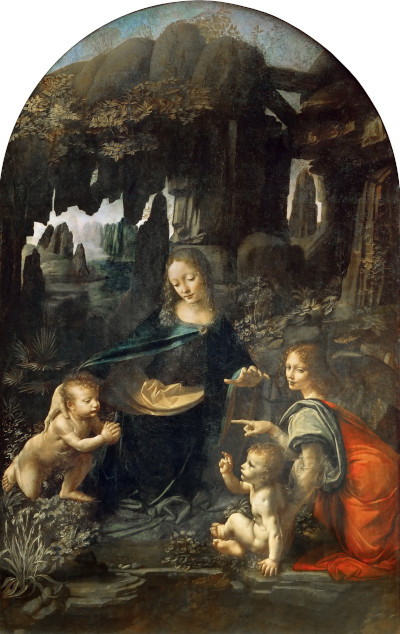
Leonardo da Vinci’s Virgin of the Rocks survives in two closely related paintings with separate histories. The earlier version is in the Louvre, Paris, where it is catalogued as La Vierge, l'Enfant Jésus, saint Jean Baptiste et un ange, dit La Vierge aux rochers, inventory INV 777; MR 320.[1] The later version is in the National Gallery, London, under the title The Virgin with the Infant Saint John the Baptist adoring the Christ Child accompanied by an Angel ('The Virgin of the Rocks'), inventory NG1093.[2]
Both paintings place the Virgin Mary, the infant Christ, the infant Saint John the Baptist and an angel inside a rocky grotto dense with plants, shadow and distant blue landscape. The London painting belonged to the altarpiece made for the chapel of the Confraternity of the Immaculate Conception in San Francesco Grande, Milan.[2] The Louvre record connects the Paris version to the same Milanese commission while stressing that its early history remains difficult to reconstruct fully.[1]
The two works should be read together but not collapsed into one object. Their shared invention, different supports, documentary histories and conservation records make the comparison central to understanding how Leonardo’s Milanese design developed.
At a Glance
- ArtistLeonardo da Vinci
- Page subjectTwo related paintings known as Virgin of the Rocks
- Paris versionLouvre, INV 777 ; MR 320, dated 1483 / 1494 [1]
- Paris mediumOil on canvas after transfer from wood to canvas [1]
- Paris dimensions1.995 m × 1.22 m [1]
- London versionNational Gallery, NG1093, about 1491/2–9 and 1506–8 [2]
- London mediumOil on wood, poplar identified [2]
- London dimensions189.5 × 120 cm [2]
- Original contextSan Francesco Grande / Confraternity of the Immaculate Conception, Milan [1] [2]
- Key comparisonAngel gesture, chronology, support and conservation history
Contents
- Introduction
- At a Glance
- Annotated Comparison
- Two Paintings, One Problem
- The Milan Commission
- The Paris Version
- The London Version and Its Phases
- Meaning and Iconography
- Paris and London Compared
- Conservation, Display and Reception
- Why the Two Versions Matter
Annotated Comparison: Louvre and London Versions
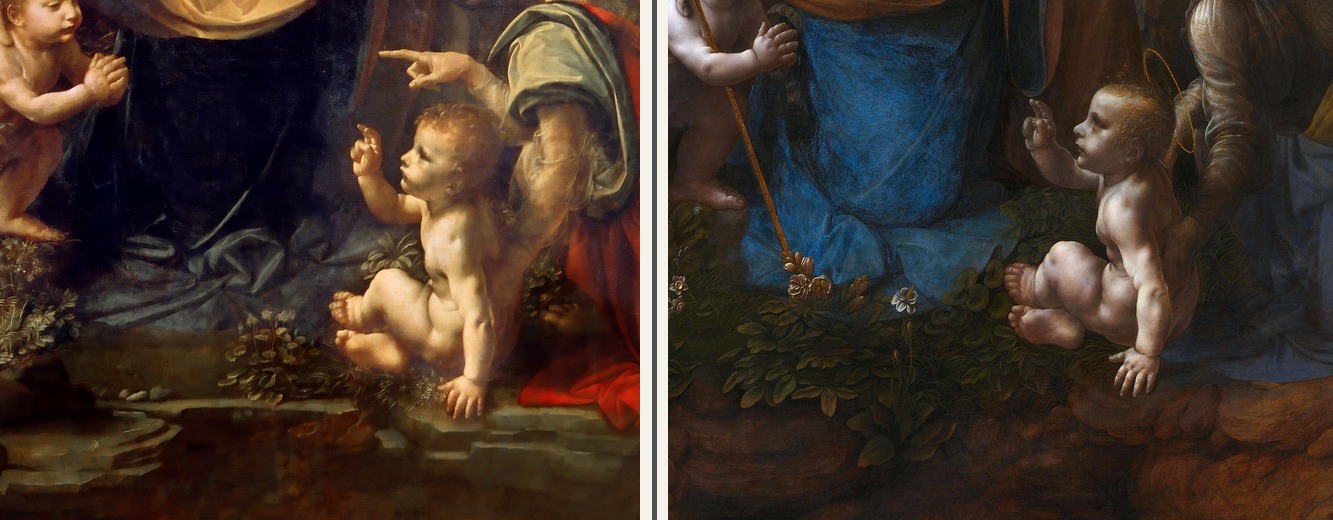
The Louvre version is shown on the left and the National Gallery version on the right. The paired markers identify four differences that matter for reading the two paintings together: the angel’s gesture and gaze, the devotional attributes, the blessing group and the handling of the grotto foreground.[6] [7]
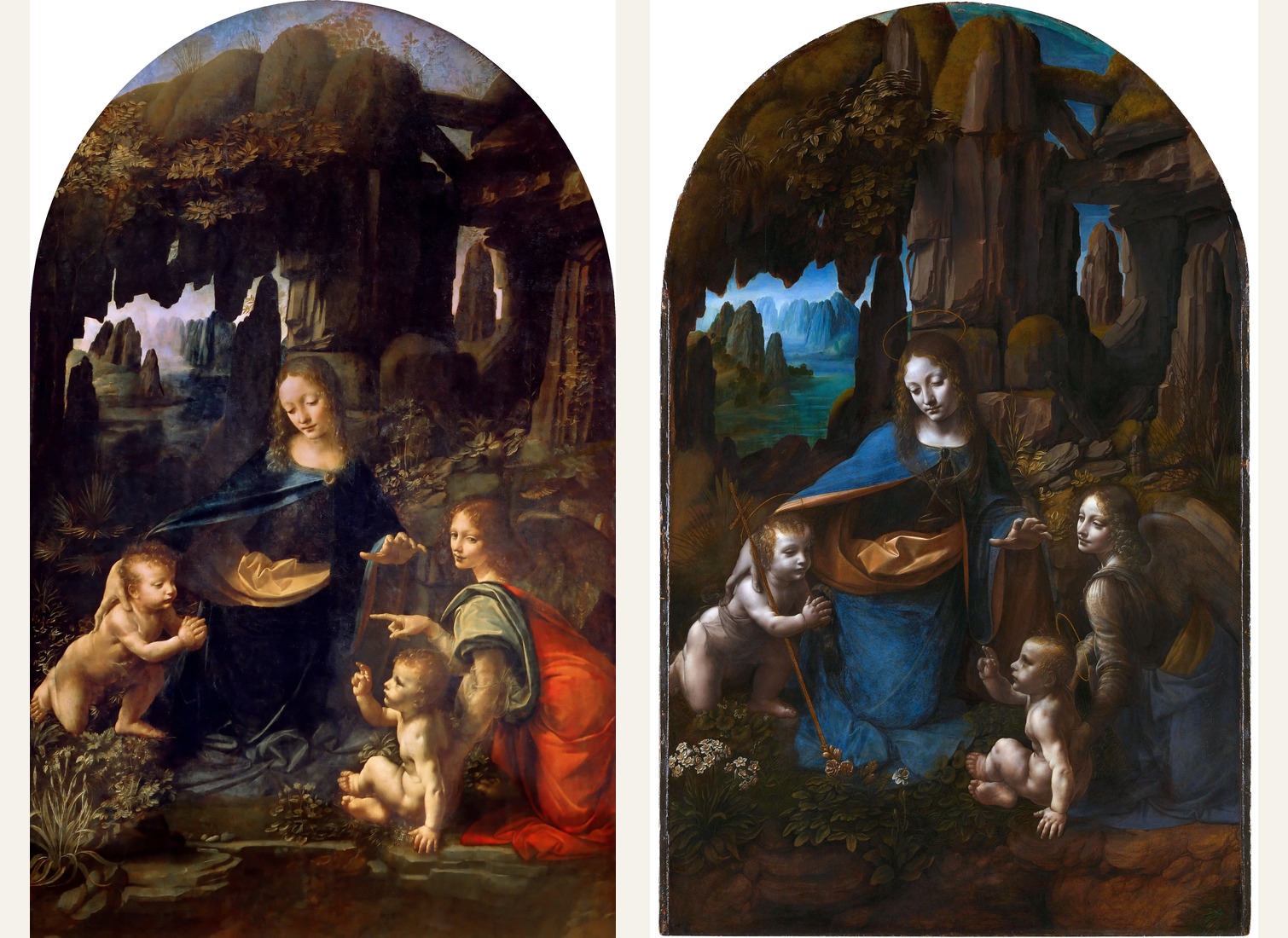
Details from VIRGIN OF THE ROCKS
These details compare the Louvre and London paintings without treating them as a single object.
Angel’s gesture and gaze
The Louvre angel turns outward and points across the group. In the London painting, that outward address is reduced, changing how the viewer enters the sacred conversation.
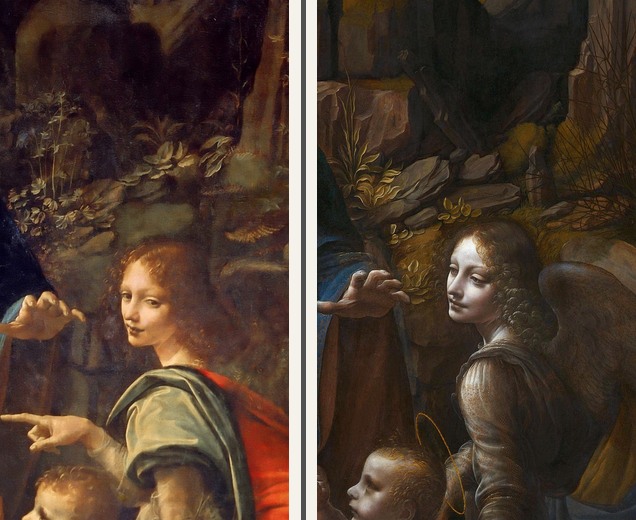
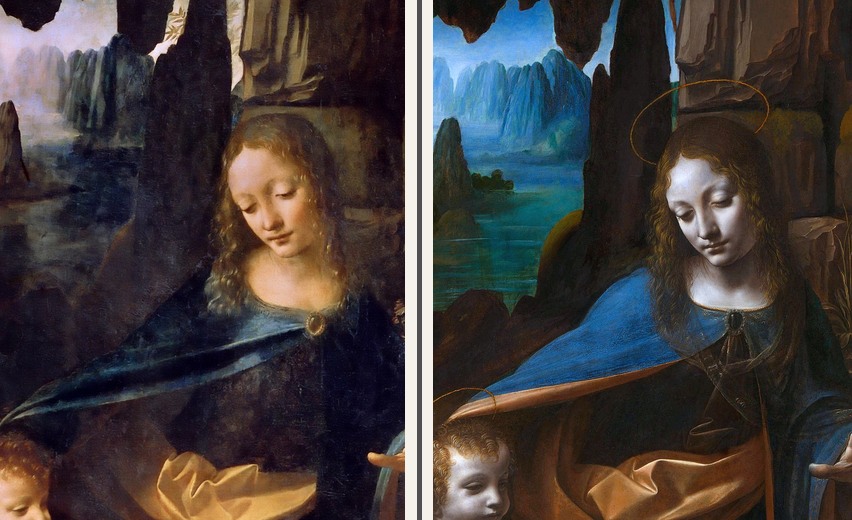
Halos and reed cross
The London version clarifies the devotional reading with visible halos and Saint John’s reed cross. The Louvre version is less explicit, leaving more of the relationship to gesture and pose.
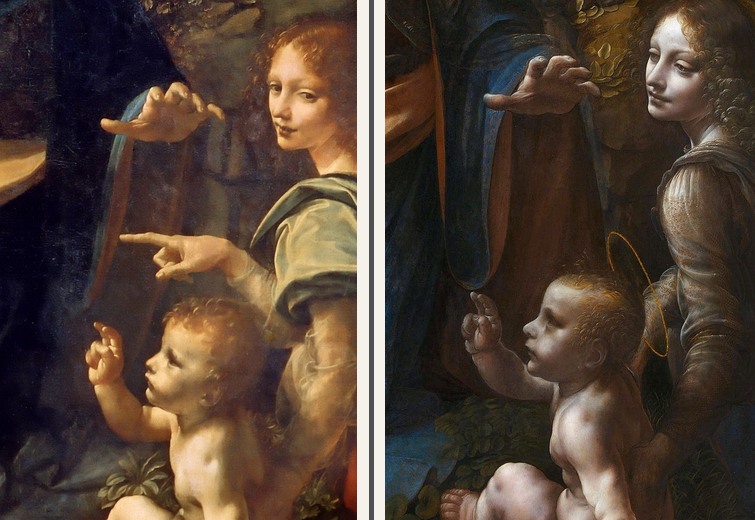
Christ Child and blessing
The blessing group keeps the same basic structure, but small changes in hands, spacing and emphasis affect how the two children and the Virgin’s sheltering gesture are read.
Grotto, plants and foreground
The rocky setting and botanical foreground are central to the image’s atmosphere. Comparing the two versions shows how the grotto was sharpened, adjusted and rebalanced across the later work.
Two Paintings, One Problem
The Louvre version is the earlier painting. The Louvre dates it 1483/1494, identifies Leonardo as the artist, records the main inventory number as INV 777, and gives its measurements as 1.995 m high by 1.22 m wide [1]. The record notes that it was formerly arched and that it is now oil on canvas after transfer from wood to canvas [1]. It is visible in the Louvre’s Denon wing, Salle 710 [1].
The London version is later and belongs to the National Gallery. The National Gallery dates it about 1491/2–9 and 1506–8, records the medium as oil on poplar, and gives the dimensions as 189.5 by 120 cm [2]. The painting was bought by the National Gallery in 1880 and is displayed in Room 51 [2]. It is part of the National Gallery’s group of surviving panels from the San Francesco altarpiece, alongside two angel-musician panels [2].
The National Gallery describes its version as a replacement for an earlier similar picture, now in the Louvre [2]. The Louvre, more cautiously, explains that many documents survive but that the precise chain of events behind the two paintings cannot be reconstructed definitively [1]. That difference in tone is useful. The two-version story has a strong documentary frame, but not every detail is settled.
The subject is best approached comparatively. The Louvre painting preserves the earlier invention; the National Gallery painting preserves the later replacement accepted for the Milanese altarpiece. Together they show how one Leonardo design generated two major surviving objects, each with its own date, support, provenance and conservation history.
The Milan Commission
The commission began in Milan. The Louvre record states that on 25 April 1483 Leonardo signed a contract with the brothers Ambrogio and Evangelista de Predis for the gilding and painting of the altarpiece in the chapel of the Confraternity of the Immaculate Conception at San Francesco Grande [1]. The National Gallery gives the same basic structure: Leonardo and the de Predis brothers were commissioned to provide paintings for a large carved altarpiece already made by Giacomo del Maino [2].
The chapel’s dedication matters. The Immaculate Conception was still a debated doctrine, especially important to the Franciscans, and the altarpiece was designed to celebrate Mary’s preservation from original sin [2]. The Louvre explains that the sculpted upper register centred on the Virgin, while the lower register included a large central painting with the Virgin, the Christ Child, angels and prophets according to the contract [1]. Leonardo’s final pictorial solution differed from that written description. Instead of prophets David and Isaiah, the surviving compositions centre on the Virgin, Christ, Saint John the Baptist and an angel.
The National Gallery’s account stresses that the subject was relatively new and that there was no single standard formula for it [2]. That freedom helps explain why Leonardo’s solution is so strange and memorable. Rather than placing Mary in a conventional architectural setting, he creates a shaded grotto, alive with rocks, plants and water-like atmosphere. The rocky landscape is not merely picturesque. It helps express the mystery of Mary’s role within the Incarnation and the Franciscan devotion behind the commission.
The original altarpiece was not a single picture hanging alone. It was a mixed structure of sculpture, gilding and painted panels. The National Gallery explains that the central painting belonged beneath a sculpted Virgin and was flanked by two angels playing musical instruments [2]. The sculpted structure itself is lost, but the surviving National Gallery group preserves the central painting and the two angel panels associated with it [2]. This matters because modern museum display can make the central panel seem self-contained. In Milan, it belonged to a devotional machine of wood, gilding, sculpture, music-making angels and Marian theology.
The contract also helps explain why the paintings look both original and constrained. Leonardo could invent the grotto, atmosphere and figure relationships, but he was not simply painting whatever he liked. The altarpiece had a required function, a chapel, a confraternity and a payment structure. The Louvre record notes that the contract expected a central subject involving the Virgin, Christ, angels and prophets, while the final image transformed that written programme into a more compact sacred encounter [1]. Leonardo’s genius here lies partly in negotiation: he turns documentary requirements into an image that feels timeless, but the image was born from a specific commission.
The Paris Version
The Louvre painting is the first version. The Louvre dates it to about 1483–1494 and records it as Leonardo’s work [1]. It is tall, formerly arched and now transferred to canvas [1]. Its early French provenance is uncertain. The Louvre says the painting is first mentioned in 1625 at Fontainebleau and may have entered French royal collections earlier, perhaps under Louis XII between 1499 and 1512 or later under Francis I, but no hypothesis is demonstrable [1].
Stylistically, the Louvre record places the Paris version before the London one. It notes that historians agree the Louvre painting is earlier on stylistic grounds, citing affinities with the Adoration of the Magi, the Benois Madonna and Saint Jerome [1]. The figures are described as more graceful and Florentine in type, with slim faces, long fingers and more abundant, broken drapery [1].
The Paris version is also the more disruptive composition. The angel looks outward and points toward Saint John the Baptist, interrupting the closed devotional circuit between Mary, Christ and John. The National Gallery uses this as the chief compositional distinction between the two versions: in the Paris painting the angel points, while in the London version that gesture is removed [2]. The angel’s outward gaze makes the viewer part of the sacred encounter. It is a bold device, and one that the later London version softens.
The Louvre record also offers important caution. The painting’s page to France is uncertain, and there are two principal hypotheses, neither proven [1]. That uncertainty should not be smoothed away. The Paris picture is earlier and autograph in the Louvre’s catalogue, but its early collection history is not fully documented.
The Louvre’s account of those hypotheses is worth keeping in view. The painting is first documented at Fontainebleau in 1625, but it may have entered France earlier [1]. One possibility is that it entered through dynastic or royal collecting connected with marriages between the Valois and Habsburgs. Another is that it entered the collection of Louis XII during the French occupation of Milan, either through acquisition or seizure from the collections of Ludovico Sforza [1]. The Louvre explicitly states that neither page can be demonstrated [1]. That is why the Paris version should be described as securely in the Louvre now, and as earlier on stylistic grounds, but not as having a fully known early provenance.
The painting’s physical support also separates it from the London work. The Louvre records that it is now oil on canvas after transposition from wood to canvas [1]. That means the object visible today has a support history different from the one Leonardo originally worked on. A viewer comparing the two versions should therefore avoid treating differences in surface, colour and condition as if they were only differences in Leonardo’s hand. Supports, restorations and centuries of collection history all affect how each version now appears.
The London Version and Its Phases
The London painting is the version made for, or at least preserved from, the San Francesco Grande altarpiece. The National Gallery states that it replaced a similar picture Leonardo made earlier, now in the Louvre [2]. It was begun about a decade later than the first version and worked on in more than one campaign [2].
Technical examination is especially important here. The National Gallery object record says recent conservation work revealed that Leonardo painted the London version in three phases [2]. He probably began in the early 1490s, working on details such as the angel’s gauze sleeve; a few years later he changed the position of Christ’s head, turning it from a three-quarter view to profile; after leaving Milan in 1499, he returned in 1506 and added ultramarine to the sky, a costly blue pigment specifically mentioned in the original contract [2].
The Technical Bulletin gives the deeper conservation frame. Before cleaning in 2008–9, research had been carried out for several years to assess whether treatment was feasible and safe [3]. The painting had become increasingly difficult to read because an oil-and-mastic varnish applied in 1949 had degraded severely [3]. During and before treatment, analysis of layers, materials and surface condition enlarged knowledge of Leonardo’s practice [3].
This evidence changes how the London version should be described. It is not simply a darker copy of the Louvre painting. It is a late, phased, technically complex version in which Leonardo adjusted design, simplified colour and worked toward a different visual effect. Some areas appear unfinished at close range, but the National Gallery suggests that this may have been deliberate, allowing attention to focus on the most important features [2].
The National Gallery’s dating is deliberately split: about 1491/2–9 and 1506–8 [2]. That split is not an inconvenience; it is one of the keys to the painting. It tells the reader that the London version is not a single sitting, a single year or even a single continuous campaign. Leonardo began, left, returned and completed. The painting therefore carries time in its surface. Early work, later changes and final adjustments coexist within one object.
This is also why the London version is central to technical art history. The Technical Bulletin describes analysis before and during treatment using methods such as X-radiography, infrared reflectography, pigment analysis, cross-sections and medium analysis [3]. Those tools do not merely confirm that a famous painting was cleaned. They reveal how the painting was made: where the structure changed, how surface layers behaved, what materials were present and how restoration could proceed without damaging Leonardo’s surviving work.
Meaning and Iconography
Both paintings place four figures in a rocky shelter. Mary is the largest and highest figure. The infant John the Baptist kneels before the Christ Child. Christ blesses him. An angel supports or accompanies the group. The National Gallery describes all four as kneeling to adore the infant Christ, who raises his hand in blessing [2]. The figures communicate silently within a shaded, fertile grotto [2].
The subject connects the Immaculate Conception with the Incarnation. The Louvre record explains that, in the chapel setting, a viewer could understand the divine plan from top to bottom: the upper imagery expressed God’s preservation of Mary from original sin, while the lower painting showed the Incarnation through Christ’s childhood [1]. In other words, Leonardo’s grotto scene was not an isolated poetic fantasy. It belonged to an altarpiece programme about Mary’s role in salvation history.
The infant John the Baptist complicates the scene. He is not part of a straightforward Nativity. His presence points forward to Christ’s public mission and Passion. The Louvre explains that the contract had asked for prophets, but Leonardo reduced this to one angel and Saint John, the last prophet announcing the coming of the Messiah [1]. The image therefore gathers several times at once: Christ’s childhood, John’s future role, Mary’s election and the Incarnation.
The power of the composition comes from the way those meanings are held without explanatory clutter. There are no written labels, no architectural frame inside the picture, and no hard separation between holy figures and landscape. Mary’s hand, Christ’s blessing, John’s kneeling body and the angel’s presence create the theology through gesture. The grotto encloses the group but does not trap it. Openings in the rocks lead to water, blue distance and a world beyond the sacred shelter.
Leonardo also shifts the emotional tone away from ceremony toward encounter. The figures are close to one another, almost pressed into a family group. Yet the scene is not domestic in an ordinary sense. The blessing of John and the angel’s role give it prophetic depth. The image feels quiet because the figures communicate by gesture and gaze, but that quietness carries large theological pressure.
Paris and London Compared
The two paintings are close enough to invite comparison and different enough to make comparison necessary. The most obvious difference is the angel. In the Louvre version, the angel looks outward and points toward John. In the London version, the angel’s gesture is changed, and the inward relationship among the figures becomes quieter [2].
The paintings also differ in style and handling. The Louvre record says the Paris version has affinities with Leonardo’s earlier Florentine work: elongated faces, slender fingers and more broken drapery [1]. The London painting, by contrast, has rounder forms, stronger contrasts of light and dark and a more metallic colour tonality [1]. The National Gallery also notes that the London version uses fewer colours, mainly blue, yellow and brown, and that Leonardo changed the angel’s robes from red to blue, probably to simplify the picture and focus attention on the Virgin’s yellow draperies [2].
Condition and conservation complicate visual comparison. The two paintings have lived different material lives. The Louvre painting has been transferred from wood to canvas [1]. The London painting remained on poplar and underwent major modern cleaning after varnish degradation made it hard to read [3]. Differences visible today may therefore reflect both Leonardo’s choices and later histories of support, varnish, cleaning and display.
This is why the two versions should be compared in layers. First, compare the iconography: both show Mary, Christ, John and an angel in a rocky setting. Second, compare the composition: the Paris angel points and meets the viewer, while the London angel no longer interrupts the group in the same way [2]. Third, compare chronology and style: the Louvre version belongs earlier, while the London version was worked across the 1490s and 1506–8 [1] [2]. Fourth, compare material histories: one has been transferred to canvas; the other was cleaned, technically studied and reframed in the National Gallery [1] [3] [4].
That layered comparison protects the reader from a common mistake. The question is not simply which version is “better” or “original.” The real art-historical interest lies in why Leonardo and his patrons arrived at two surviving versions and how each object preserves a different stage of invention, dispute, completion and afterlife.
It also protects the paintings from being treated as duplicates for illustration. In a book or web page, the two images can look like alternate crops of the same idea. In object terms, they are not interchangeable. The Louvre painting is a transferred former panel with a cautious early provenance and the more outward-facing angel [1]. The London painting is a poplar panel tied to the surviving San Francesco altarpiece group and to a technical record of phased work [2] [3]. Their similarity is the reason comparison begins; their difference is the reason comparison matters.
Grotto, Geology, Plants and Sacred Meaning
The rocky setting is one of Leonardo’s great inventions. The National Gallery describes the figures as crowded in a grotto overhung with rocks and dense vegetation [2]. It notes the vividness of the landscape: foliage around John’s knees, plants sprouting from rocks, textured stone, distant blue mountains and effects of aerial perspective [2].
The grotto is not just a stage set. It gives the painting its title and its atmosphere. The Louvre record explains that this “fascinating décor,” a symbol of the Immaculate Conception, generated the name Virgin of the Rocks from the early nineteenth century onward [1]. The rocky shelter can evoke protection, mystery, hidden fertility and divine election. Leonardo turns theology into an environment.
The plants are equally important. The National Gallery notes that the flowers do not simply correspond to real botanical specimens; they can appear as hybrids of different plants [2]. This is typical of Leonardo’s way of combining close observation with imaginative construction. The landscape feels convincing not because every plant is a botanical label, but because the whole world seems alive, damp, shaded and fertile.
Sfumato, Underdrawing and Technique
The London painting is one of the major documents for Leonardo’s mature painting technique. The National Gallery explains that he blurred the edges of forms to suggest the shadows surrounding them, a technique later called sfumato [2]. The faces emerge softly from the darkness, and the transitions between light and shade are subtle rather than sharply outlined [2].
The underdrawing is especially revealing. The National Gallery says the preliminary drawing shows that Leonardo first attempted a different design and then changed his mind so that the London version became almost identical to the Louvre composition [2]. That means the London painting does not begin as a simple copy. Its buried drawing preserves an alternate possibility, later brought back toward the earlier scheme.
The Technical Bulletin records the technical methods used to examine the picture: X-radiography, infrared reflectography, pigment analysis, cross-sections, medium analysis and other laboratory tools [3]. This evidence clarified layer structure, materials and condition before and during cleaning [3]. It also revealed the complexity of Leonardo’s practice in Milan, including phased work, expensive materials and a highly controlled tonal structure.
The use of ultramarine is one of the most concrete contract-linked details. The National Gallery states that Leonardo added ultramarine to the sky in 1506, and that this expensive blue pigment was specifically mentioned in the original contract [2]. A pigment detail like that helps bridge archive and object. The contract’s material expectations can still be connected to the painted surface.
The underdrawing evidence is equally important for understanding Leonardo’s decisions. The National Gallery says the London underdrawing shows that he first tried a different design and later changed it so the painting became almost identical to the Louvre version [2]. That detail is a beautiful puzzle. It suggests that even when Leonardo was making a replacement version, he did not simply trace or repeat the earlier painting. He explored another arrangement and then returned to the established composition. The finished similarity therefore hides a history of experiment.
Sfumato and aerial perspective complete the technical picture. The National Gallery explains that Leonardo softened edges around forms, especially in faces, and used blue distant mountains to suggest recession [2]. These effects were tied to his study of vision: how distance changes colour, how shadow makes form emerge, and how atmosphere affects perception. In Virgin of the Rocks, optical observation becomes devotional atmosphere.
Payment Dispute and Completion
The two-version history is also tied to payment. The National Gallery says documents from the early 1490s show Leonardo and Ambrogio de Predis disputing the agreed price with the confraternity, arguing that materials had cost more than expected.[2] The Louvre record gives the same economic frame in more detail, noting that the artists sought at least 100 additional ducats for the large oil painting defined as a “Notre Dame,” while the confraternity offered far less.[1]
The National Gallery suggests that Leonardo probably sold the first version elsewhere when the confraternity would not pay the extra amount [2]. The Louvre is more cautious, stressing that many documents survive but the precise events remain impossible to reconstruct completely [1]. A responsible account should keep both points together: the dispute was economic and documentary, but it does not resolve every question about why two paintings exist.
The later documentary sequence is clearer. The National Gallery states that the London version was probably begun in the early 1490s, left unfinished when Leonardo departed Milan in 1499, and completed after he was summoned back in 1506; final payment came in 1508 [2]. The Louvre record also notes a 1506 agreement and 1508 documents confirming completion [1]. The London version therefore belongs to a long, interrupted process rather than a single compact campaign.
The payment dispute also helps remove some of the false mystery from the two-version story. The existence of two paintings does not require a secret symbolic programme or a dramatic legend. The sources point first to practical pressures: contract terms, costs, valuation, additional payment, patron dissatisfaction and delayed completion [1] [2]. The mystery that remains is historical, not sensational. We have enough documents to understand the economic conflict, but not enough to reconstruct every decision that moved one painting toward France and another into the Milanese altarpiece.
For that reason, public wording should be firm where the sources are firm and cautious where they are cautious. The Paris painting is earlier. The London painting is later and connected to the National Gallery’s surviving San Francesco altarpiece panels. The artists disputed payment with the confraternity. The London version was finished by 1508. The exact page by which the Paris version entered France remains unproven [1].
Conservation, Display and Reception
The National Gallery’s conservation work has become part of the painting’s modern history. The Technical Bulletin explains that the 2008–9 cleaning and restoration followed years of research and was undertaken primarily for aesthetic reasons, because degraded varnish made the painting difficult to read [3]. Treatment involved not only cleaning but analysis that enlarged understanding of materials, layer structure and Leonardo’s technique [3].
The painting was also reframed and redisplayed. A National Gallery in-depth restoration page explains that the new frame, purchased in 2009, was designed to suit the original setting and incorporated pilasters and a cornice of a north Italian frame around 1500 [4]. This matters because the painting had originally belonged within a sculpted altarpiece. Modern display cannot reconstruct San Francesco Grande, but framing can help viewers experience something closer to the object’s altarpiece function.
The two versions were famously brought together in London for the 2011–12 exhibition Leonardo da Vinci: Painter at the Court of Milan. A National Gallery press release described this as the first time the two paintings had been shown together [5]. That event made clear what reproductions often blur: the two pictures are not interchangeable. Their differences in gesture, chronology, colour, support, conservation and provenance are central to their meaning.
The restoration also changed the London painting’s readability. The National Gallery Technical Bulletin says the degraded 1949 varnish had made the picture increasingly difficult to understand visually [3]. Cleaning did not simply make the painting brighter; it made the relationships among figures, rocks, colour and depth more legible. It also allowed the Gallery to present the painting in a frame that better evoked its original altarpiece context [4].
Modern reception of Virgin of the Rocks therefore depends on conservation as well as fame. What visitors see in London today is not just “Leonardo untouched.” It is Leonardo after centuries of ownership, varnish, study, cleaning, reframing and redisplay. What visitors see in Paris is also shaped by history, including transfer from wood to canvas and an early provenance that remains uncertain before its documented presence at Fontainebleau [1]. The two paintings teach the same lesson in different ways: a Renaissance masterpiece is always both an image and an object with a material biography.
Why the Two Versions Matter
Virgin of the Rocks matters because it is both an image and a problem. As an image, it is one of Leonardo’s most haunting inventions: sacred figures emerging from a shadowed natural world, joined by gesture, blessing and atmosphere. As a problem, it asks the viewer to think through documents, patronage, payment, replacement, technical evidence and two object histories.
It is also a key work for Leonardo’s Milanese period. The commission came soon after he entered the orbit of the Sforza court, and it shows him adapting Florentine figure invention to a new institutional and devotional setting. The grotto is not just background; it is an environment of sacred meaning. The bodies are not isolated devotional types; they are connected by touch, gaze and blessing. The painting transforms an altarpiece contract into a meditation on vision, nature and incarnation.
The two versions also show Leonardo’s willingness to rethink a successful idea. The Paris painting is earlier, more startling in the angel’s outward address and gesture. The London painting is later, technically layered and more inward. The change is not a simple improvement or decline. It is a reconsideration. Leonardo returns to the same sacred group and finds a different balance of mystery, focus and pictorial unity.
For readers moving across Leonardo’s wider work, the page belongs beside the Adoration of the Magi, Saint Jerome in the Wilderness, the Burlington House Cartoon, the Louvre Saint Anne, the National Gallery cartoon and The Last Supper. These works share problems of sacred grouping, atmosphere, unfinished or revised process, and the relationship between drawing and painting. Virgin of the Rocks stands near the centre of that network because it survives in two major versions, each preserving a different moment in Leonardo’s thinking.
There is no single “the” Virgin of the Rocks unless the object is identified. The Louvre painting and the National Gallery painting are related works, not duplicates. Their shared composition begins the story; their differences give the story its historical shape.
Keeping both versions distinct keeps Leonardo’s invention, the Milanese commission and the paintings’ later lives in proper focus.
Frequently Asked Questions
Discussion
Use this space to discuss Virgin of the Rocks by Leonardo da Vinci, its source evidence and how it fits into Leonardo da Vinci's wider cluster.
Keep comments focused on close looking, attribution language, object evidence and page-specific caveats.
Reader Insights
Which detail on this page most changes how you read the work?
How does this page connect to Leonardo's paintings, drawings, inventions or workshop context?
Where should the wording stay cautious because the source evidence is qualified?
Join the Conversation
Share your reading of Virgin of the Rocks by Leonardo da Vinci below.
References
- Musée du Louvre, “La Vierge, l'Enfant Jésus, saint Jean Baptiste et un ange, dit La Vierge aux rochers, INV 777; MR 320”, accessed 28 July 2026.
- National Gallery, London, “Leonardo da Vinci, The Virgin of the Rocks, NG1093”, accessed 28 July 2026.
- National Gallery Technical Bulletin, Keith, Roy, Morrison and Schade, “Leonardo da Vinci’s Virgin of the Rocks: Treatment, Technique and Display”, accessed 28 July 2026.
- National Gallery, London, “Restoring Leonardo: The new frame”, accessed 28 July 2026.
- National Gallery, London, “Leonardo’s Virgin of the Rocks paintings united”, accessed 28 July 2026.
- Wikimedia Commons, “Virgin of the Rocks (Louvre).jpg”, public-domain reproduction record, accessed 2 August 2026.
- Wikimedia Commons, “Leonardo da Vinci Virgin of the Rocks (National Gallery London).jpg”, public-domain reproduction record, accessed 2 August 2026.