

 by Tom Gurney
Tom Gurney BSc (Hons) is an art history expert with over 20 years experience
Published on June 19, 2020 / Updated on August 2, 2026
Email: tomgurney1@gmail.com / Phone: +44 7429 011000
Vitruvian Man by Leonardo da Vinci
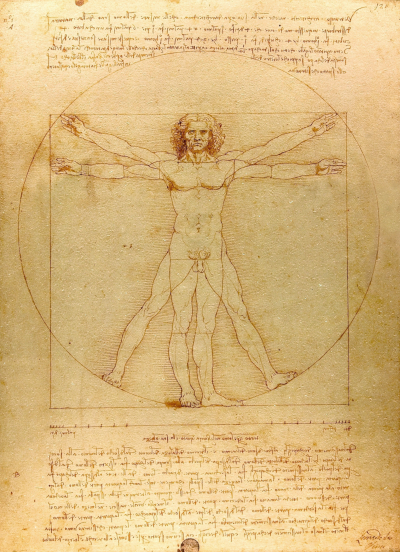
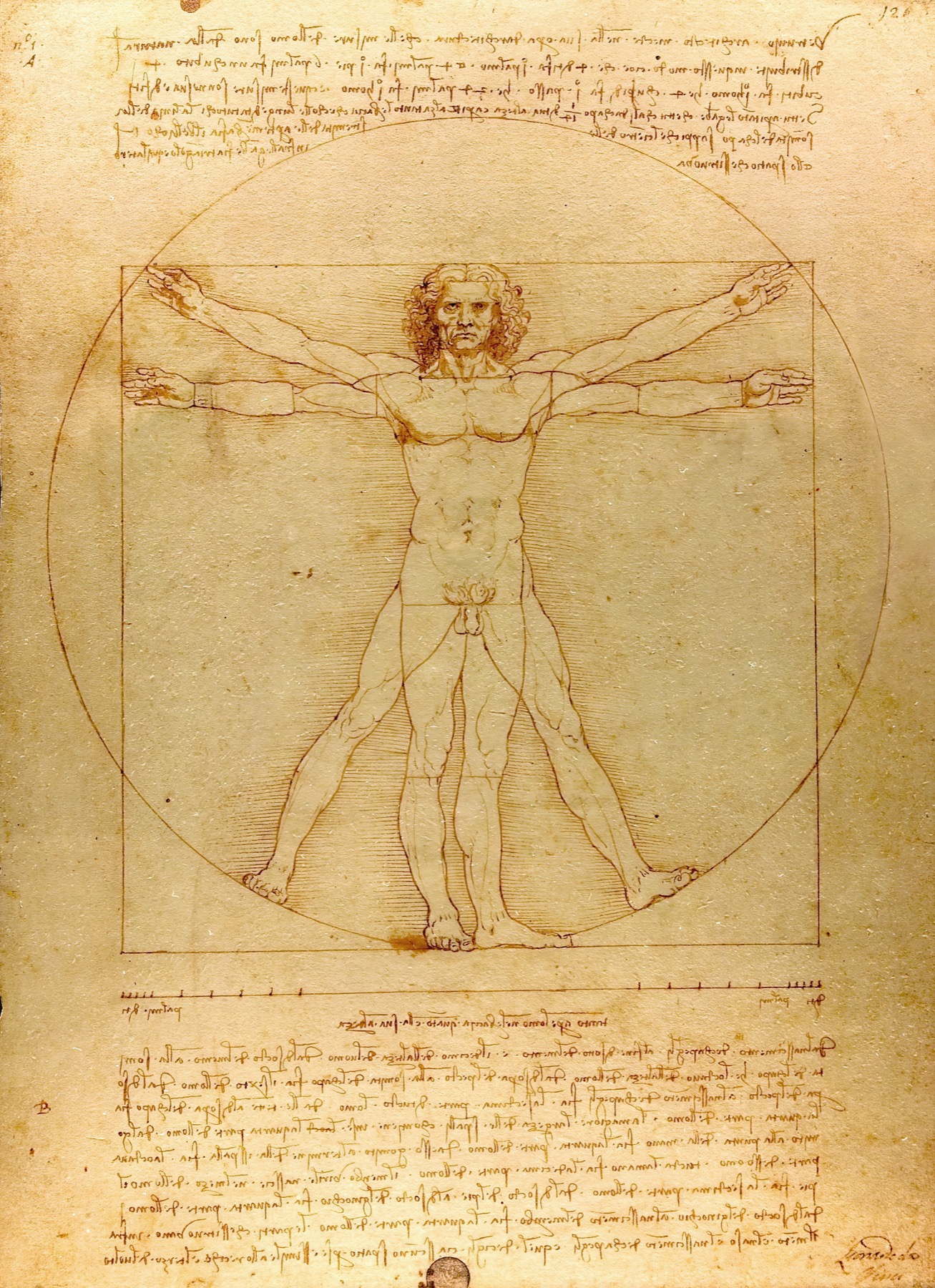
Vitruvian Man is a study of proportion, geometry and the human body rather than a general emblem of “Renaissance genius.” Leonardo places a nude male figure inside a circle and a square, with arms and legs shown in two positions and notes written above and below the image.
The Gallerie dell'Accademia in Venice identifies the sheet as Studio di proporzioni del corpo noto come Uomo vitruviano, a study of body proportions known as the Vitruvian Man. It is a drawing on paper, catalogued as number 228, made with metalpoint, pen and ink, and touches of watercolor on white paper.[1]
Leonardo’s subject is measurement. The drawing tests how the body can be described through ratios, how a figure can be fitted into geometrical forms, and how ancient architectural theory might be checked against observation. The sheet is therefore a diagram, a notebook page, a drawing of a body and an argument about the relation between human form and mathematical order.
At a Glance
- ArtistLeonardo da Vinci
- TitleStudio di proporzioni del corpo noto come Uomo vitruviano [1]
- Common titleVitruvian Man
- DateGenerally associated with Leonardo’s Milanese years, around 1490; exact dating remains cautious [1] [2]
- MediumMetalpoint, pen and ink, touches of watercolor on white paper [1]
- Dimensions345 × 246 mm in the Accademia’s 2025 exhibition caption [2]
- Catalogue / inventoryCatalogue 228; inv. 228r in recent display material [1] [2]
- CollectionGallerie dell’Accademia, Venice [1]
- Object typeDrawing / annotated proportion study
- Display statusNot permanently displayed; conservation-sensitive work on paper [1]
Contents
- Introduction
- At a Glance
- What the Sheet Shows
- The Problem Leonardo Took from Vitruvius
- Vitruvius, Alberti and Euclid
- The Two Positions of the Body
- Circle, Square and Centers
- The Writing Around the Figure
- Measurement and Anatomy
- A Drawing on Fragile Paper
- Annotated Details
Annotated Details from Vitruvian Man
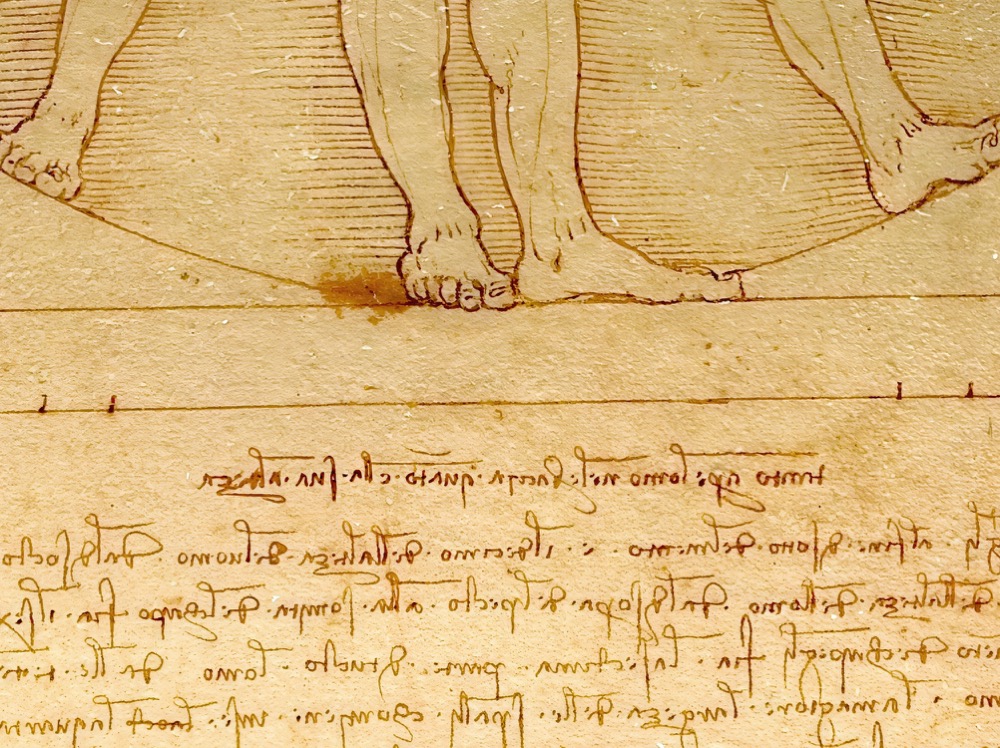
The annotated image separates the figure's head, hands, torso and feet so the page can read the sheet as a proportional study rather than a generic emblem.
Details from VITRUVIAN MAN
Close looking highlights the details that structure this Leonardo page while keeping object and image-source caveats separate.
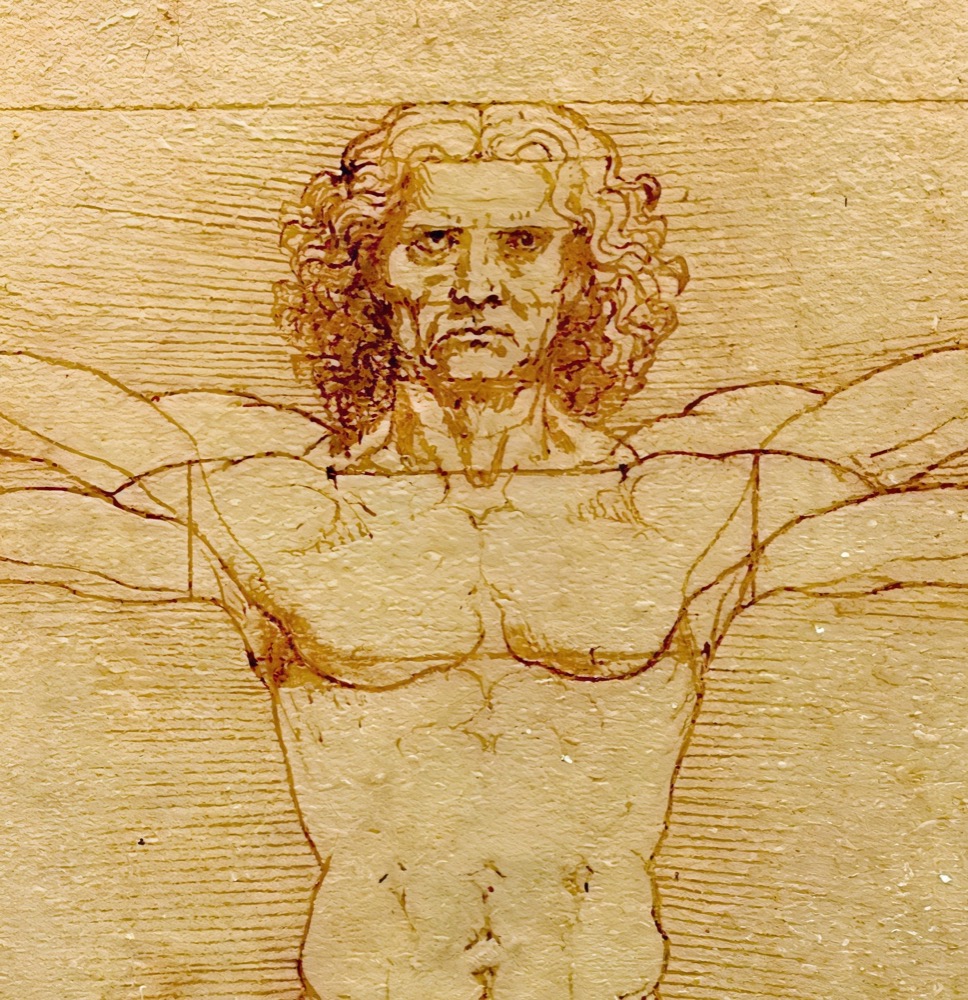
Head and upper measure
The head sits inside a written and geometric system rather than as a portrait likeness.
Extended hands
The outstretched hand tests the body's reach across the square and circle.
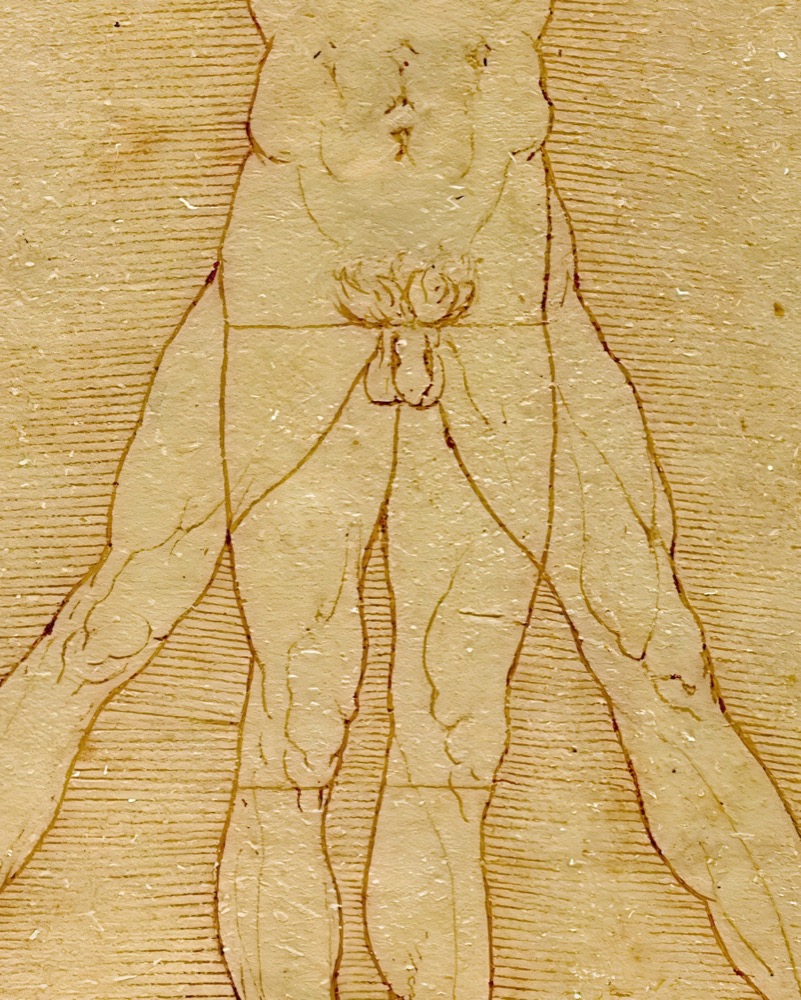
Torso and navel
The torso turns anatomical observation into a measured proportional centre.
Feet and lower geometry
The lower legs and feet show the double stance used to reconcile body and geometry.
What the Sheet Shows
The drawing presents a frontal male nude. One body occupies the page, but the arms and legs are doubled. One set of legs stands closer together; the other opens outward. One set of arms extends horizontally; the other rises diagonally. The body therefore appears still and moving at the same time.
The geometry is equally direct. A square touches the figure's head, feet and horizontally stretched hands. A circle, centered around the navel, touches the more widely spread limbs. The circle and square do not merely decorate the body. They are the test conditions of the drawing.
Leonardo adds written notes above and below the figure. They are part of the work, not a caption added later. The sheet asks to be read and measured as well as viewed. Its visual power comes from the fact that the body, lines and writing all work together.
This is why the drawing can be misunderstood when it is reproduced without scale or text. Online, on posters, coins or book covers, it often becomes a universal symbol of balance. On the original paper, it is a working study: small, fragile, annotated and tied to a precise problem inherited from architectural theory.
The Problem Leonardo Took from Vitruvius
The Roman author Vitruvius wrote De architectura, a treatise on architecture. In Book III, he argued that temple design depends on symmetry and proportion. He used the well-shaped human body as an analogy for architectural harmony.[4]
Vitruvius described the body through measurable parts. The face, hand, head, foot, forearm and chest all correspond to fractions of total height. He then made the claim that became essential for Leonardo: if a man lies with hands and feet extended, a circle centered on the navel can touch his fingers and toes; the same body can also produce a square when height and arm span are compared.[4]
Leonardo's drawing turns that written passage into a visible solution. But it is not a passive illustration. Vitruvius wrote about a body placed on its back as a demonstration of symmetry. Leonardo draws a standing figure, gives it two sets of limbs, and makes the paper itself a field where text, geometry and anatomy meet.
The difference matters. Vitruvius is interested in architecture. Leonardo is interested in the body as measured form. The ancient text supplies a problem; Leonardo makes the problem visual and tests its limits.
Body as Architecture
Vitruvius' argument begins with temples, not with portraiture. He describes proportion as a relation among parts and between each part and the whole. A building is well ordered when its elements correspond according to a measured system. The human body enters the discussion because it offers a natural model of such correspondence.[4]
Leonardo takes this architectural analogy seriously, but he does not draw a temple. He draws the body as if it were an architectural plan. The square and circle act like construction lines. The horizontal and vertical measures organize the figure. The written proportions turn limbs and features into modules.
This is why the drawing feels both human and abstract. The man has hair, muscles, knees, feet and a face. At the same time, he is being used as a measured structure. The sheet asks whether a living body can be understood with the same discipline used for buildings.
The analogy also helps explain the drawing's restraint. Leonardo does not add a setting, narrative, landscape or emotional drama. Such details would distract from the body as a system. The page is not trying to show a particular man in a particular place. It is trying to show a body as an ordered relation of parts.
That architectural frame is also a useful guard against over-romantic readings. The drawing is not simply saying that man is divine, central or perfect. It is asking how claims about human measure might be made visible and testable.
Vitruvius, Alberti and Euclid
The Gallerie dell'Accademia warns against treating the sheet as a simple application of Vitruvius. For a long time, the drawing was read that way: Leonardo had supposedly taken the Roman architect's theory and drawn it. Recent studies, summarised by the museum, complicate that account.[1]
The Accademia states that the drawing also reflects Leonardo's engagement with Leon Battista Alberti and Euclidean thought. The proportions used in the sheet do not simply reproduce Vitruvius' text. According to the museum's account, they correspond in important ways to measurements analysed in Alberti's De statua, while the overall geometrical ambition also belongs to a Euclidean way of thinking about form.[1]
This correction does not make Vitruvius irrelevant. Leonardo cites Vitruvius in the writing around the figure, and the circle-square problem comes from the architectural tradition attached to him. But the drawing is more than a classical quotation. It is a Renaissance act of comparison, revision and synthesis.
That makes the sheet more Leonardo-like, not less. He was rarely content to copy authority. The Royal Collection's account of his anatomical work describes how, around 1490, he searched for ideal bodily proportions but then found that measurement of living models produced awkward fractions and contradictions. Theory and observation did not always agree.[3]
The Vitruvian Man sits at that tension point. It shows a body made to satisfy a geometrical idea, while also belonging to Leonardo's wider habit of testing inherited knowledge against measurement.
The Accademia's distinction also changes the tone of the drawing. A simple Vitruvian illustration would mainly honour antiquity. Leonardo's sheet does something more restless. It places an ancient architectural claim beside newer Renaissance proportion theory and the discipline of geometry, then lets the body become the testing ground. The figure is idealised, but the method is investigative.[1]
Reading the Proportions Without Loose Quotation
The sheet's inscription includes a series of proportional statements. Some belong to the Vitruvian tradition: the span of the arms equals the height of the body; the navel can serve as the center of a circle; parts such as the hand, foot, head and face correspond to fractions of the full figure.[4]
Leonardo's writing makes these claims practical. They are not abstract numbers floating away from the image. The viewer can test them against the drawn body. The line from the soles to the top of the head, the stretch of the arms, the position of the navel and the reach of fingers and toes all become visible checks on the text.
Leonardo’s inscription should be read for its function rather than treated as a detachable quotation. Different translations vary in wording and emphasis, but the text links Vitruvian proportion theory with Leonardo’s drawing and turns the sheet into a measured visual argument.
The same caution applies to modern diagrams that mark every possible ratio on the image. The original sheet already contains a disciplined set of measures. Adding later numerical overlays can be useful in a classroom, but it can also make Leonardo's working drawing look like a solved modern infographic. The historical point is subtler: Leonardo is thinking through inherited ratios, not merely displaying a final chart.
The Two Positions of the Body
The doubled limbs are the drawing's great practical invention. A single naturalistic pose could not easily satisfy both the square and the circle. Leonardo therefore shows two positions on one body.
The horizontal arms and closer legs belong to the square. The raised arms and opened legs belong to the circle. By overlaying both positions, Leonardo avoids drawing two separate figures and turns the sheet into a compact demonstration. The body becomes a measuring instrument.
This is not a study of motion in the later sense of sequential movement. The limbs do not show a man walking, exercising or changing pose over time. They show two proportional states at once. The figure is doubled because the geometry requires it.
Yet the visual effect is lively. The body seems to expand from a stable center. The arms and legs create a rhythm that makes the still drawing feel activated. This is one reason the image has survived so powerfully in modern culture: it is not just a diagram of proportion, but a human figure caught between two systems.
The two-position solution also separates Leonardo from a purely verbal reading of Vitruvius. The ancient passage could be understood as one body able to yield both circle and square. On paper, however, the problem becomes more demanding. To touch the square and circle convincingly, the body has to change its limbs. Leonardo's drawing is therefore a solution to a visual and geometric problem created by turning text into image.[4] [5]
That solution is elegant because it preserves unity. Leonardo does not place two men side by side. He does not make one figure transparent or schematic. He gives one body two possible reaches, allowing the viewer to understand both systems at once.
Circle, Square and Centers
The circle and square are not the same operation. The circle is related to the navel, which Vitruvius names as the body's central point for a compass. The square depends on the equivalence of the body's height and the span of the outstretched arms.[4]
Leonardo's drawing makes the distinction visible. The center of the circle and the center of the square do not simply collapse into one easy point. The body must be adjusted to satisfy both. That slight displacement is one of the sheet's quiet intellectual achievements.
Medieval and Renaissance readers often associated the circle and square with larger symbolic meanings: heaven and earth, perfection and material order, macrocosm and microcosm. The Accademia notes that the two shapes had long been used in such symbolic ways and that the human figure inside them could illustrate correspondences between the larger universe and the human being.[1]
Those meanings should not erase the measuring problem. Leonardo is not only drawing a spiritual emblem. He is also drawing a body whose measurable parts must meet exact lines. The power of the sheet comes from the union of symbol and calculation.
The centers are especially important. If the circle is centered on the navel, the body answers one ideal. If the square is governed by height and arm span, the body answers another. The drawing does not pretend that all centers are the same. It lets the viewer see that proportion can depend on which measurement is chosen as the controlling term.
This makes the sheet feel more experimental than a logo. A logo tends to simplify. Leonardo's drawing clarifies without erasing the difficulty. The square, circle and body cooperate, but they do not collapse into a single effortless sign.
The Writing Around the Figure
The inscription is essential because it keeps the drawing tied to a textual tradition. Leonardo is not presenting a silent nude. He surrounds the body with written proportional statements, translating and adapting an intellectual problem into his own working language.
The writing also changes the viewer's pace. The eye first grasps the figure, circle and square, then slows down over the notes. The sheet moves between instant visual recognition and patient study. That rhythm is close to Leonardo's notebooks generally, where image and text often build knowledge together.
Because the inscription matters so much, it should not be loosely quoted without a verified transcription and translation. A careful account can still explain the function of the notes: they record and test bodily proportions in relation to Vitruvian theory.
The notes also guard against a purely aesthetic reading. The drawing is beautiful, but beauty is not its only aim. The written material shows that Leonardo is thinking in ratios, divisions and correspondences.
There is a visual difference between the writing above and below the body. The upper text follows the curve of the circle more loosely, while the lower writing is more orderly beneath the figure. That contrast reinforces the sheet's hybrid character. It is not a polished emblem made for display. It is a working page where image and note remain visibly interdependent.
The writing also reminds us that Leonardo's knowledge was often made in fragments. He did not publish a finished treatise on human proportion. He left notes, sheets, studies and projects that later viewers had to piece together. The Vitruvian Man feels complete because the image is so resolved, but it still belongs to the notebook world of experiment and comparison.
Measurement and Anatomy
The Vitruvian Man belongs near Leonardo's anatomical studies, but it is not the same kind of object as his later dissected bodies. Around 1490, according to the Royal Collection, Leonardo made a detailed study of human proportion while searching for an ideal body whose parts could be expressed as simple fractions of the whole.[3]
The same account explains why that search became difficult. When Leonardo measured living models, reality did not always produce tidy ratios. He had to express proportions in more complicated fractions and even correct observations to match theory. Faced with the gap between ideal proportion and observed bodies, he eventually moved away from this line of proportion study.[3]
This gives the Vitruvian Man a sharper historical place. It is not the final solution to the human body. It is a high point in a particular phase of inquiry, when Leonardo was asking whether the body could be made into a harmonious, visible and repeatable system of measures.
Later anatomical drawings became more empirical, mechanical and investigative. Leonardo studied bones, muscles, organs and movement with increasing intensity. The Vitruvian Man looks cleaner than that later work because it belongs to the problem of ideal proportion rather than dissection.
The Royal Collection's account helps prevent a common mistake: reading the Vitruvian Man as the culmination of all Leonardo's anatomy. It is better understood as part of an early proportion phase. Leonardo's later anatomical sheets are more concerned with structure, function, dissection and movement. The Vitruvian Man is concerned with the measurable outward body and its relation to ideal geometry.[3]
That outward focus explains the sheet's clarity. Leonardo is not opening the body, as he would later do in anatomical studies. He is measuring the visible body's envelope: height, span, limbs, centers and proportional parts. The body is treated as a complete visible system before it becomes an internal mechanical one.[3]
That does not make it superficial. To measure the visible body carefully is already a serious anatomical act. Artists needed to understand how figures were built, how limbs related to torsos, and how bodies occupied space. But Leonardo's later work would press beyond external proportion into bones, muscles, organs and mechanical function.
The drawing therefore belongs to a turning point. It shows Leonardo still attracted to harmonious ratios, while the larger arc of his research would reveal that living bodies resist simple perfection. This tension gives the sheet much of its human interest. It is an ideal, but it was made by an artist who increasingly distrusted easy ideals.
Drawing Method and Materials
The Accademia identifies the sheet as made with metalpoint, pen and ink, and touches of watercolor on white paper.[1] That combination is significant. Metalpoint requires discipline because it is difficult to erase. Pen and ink can clarify, strengthen and articulate forms. Light washes can give selective modelling.
The drawing's crisp geometry depends on preparation. The square and circle are clean, and the body is placed with great control. The figure is not a rapid life sketch. It is a planned construction in which the paper had to carry both diagram and figure.
At the same time, the sheet is not mechanically cold. The head has shading; the torso has modelling; the hair and muscles have visual character. Leonardo lets the body remain sensuous enough to be read as human, even while it is held inside a measuring system.
The material fragility matters here too. A drawing on paper records thought directly, but paper is vulnerable. The very medium that makes the sheet feel intimate and immediate also makes it difficult to display safely for repeated public viewing. The object we know through endless reproductions survives because access to the original is restricted.
Not a Golden-Ratio Shortcut
Popular accounts often connect the Vitruvian Man with the golden ratio. The claim is attractive because the drawing already seems to join mathematics and beauty. But the source path followed here does not need the golden ratio to explain the work.
The Accademia's account points instead to Vitruvius, Alberti and Euclidean thought. The Royal Collection frames the drawing within Leonardo's search for simple proportional fractions and his later difficulty when living measurement complicated the theory.[1] [3] Vitruvius' own passage concerns symmetry, body parts, circle, square, navel, height and arm span, not a golden rectangle.[4]
That does not mean later viewers cannot impose golden-ratio diagrams on reproductions. It means such diagrams should not be presented as Leonardo's governing method unless specific evidence proves the claim. A famous image attracts famous myths. The clearest reading keeps close to the evidence that the drawing itself and the museum record can support.
The more interesting point is already there. Leonardo did not need a modern golden-ratio story to join mathematics and the body. He was working with older and richer problems: how architecture borrows from human measure, how geometry can describe living form, and how observation revises inherited theory.
The golden-ratio myth also narrows Leonardo's achievement. If the drawing is reduced to one hidden formula, viewers may stop looking at the actual relations on the sheet. The circle and square, the doubled limbs, the written notes, the body-part ratios and the tension between Vitruvius and Alberti all become secondary to a modern treasure hunt.
A better reading keeps the mathematics visible but plural. Leonardo is not decorating a body with numbers. He is negotiating among textual authority, geometrical form and observed measurement. That is richer than a single ratio and closer to the way his mind seems to work across the notebooks.
A Drawing on Fragile Paper
The Vitruvian Man is not permanently displayed. The Accademia states clearly that the work is not on view for reasons of protection and conservation. Like the museum's other Leonardo sheets, it must be preserved away from harmful light and under controlled microclimatic conditions. Drawings and prints are therefore not displayed permanently.[1]
This fact belongs near the center of the story, not in a footnote for visitors only. Works on paper are vulnerable in ways that panel paintings and sculptures are not. Light can damage paper and media; humidity and temperature must be controlled; repeated display carries risk.
The 2025 Accademia exhibition Corpi moderni temporarily made the sheet visible again. The museum's exhibition text warned that viewing was timed for conservation reasons: the drawing was visible for 20 minutes, followed by 20 minutes of darkness behind a lowered curtain.[2] That display pattern dramatizes the object's fragility. Even when the drawing is shown, it is shown under restraint.
This is a useful correction to the modern image's ubiquity. The Vitruvian Man appears everywhere as a reproduction, but the original is a small, light-sensitive sheet kept mostly out of sight. Its fame has expanded; its physical presence remains delicate.
The display rule also changes how we think about looking. A painting in a gallery can become part of a regular visit. The Vitruvian Man usually cannot. Encountering the original means entering a conservation compromise: the public sees it only under conditions designed to limit harm.
This is not a frustrating technicality. It is part of the object's meaning now. The sheet survives because generations of collectors, museums and conservators treated it as a vulnerable work on paper. Its modern fame depends on reproduction, but its future depends on restraint.
Provenance: From Milanese Collecting to Venice
The Accademia connects the sheet to the graphic collection of Giuseppe Bossi, the Milanese painter, writer and collector. Bossi's diary records that in 1807 he acquired an important group of Leonardo drawings from the De Pagave family.[1]
The De Pagave group had earlier come from Countess Anna Luisa Monti, heir of Cardinal Cesare Monti. In 1784, while the drawings were still owned by the De Pagave family, Carlo Giuseppe Gerli engraved and published several of them, including the study now known as the Vitruvian Man.[1]
That history matters because it shows the drawing's modern survival inside collections of Leonardo sheets, not as a continuously public masterpiece. Its later fame should not be projected back onto every stage of its life. For long periods, the sheet belonged to specialist graphic collections and printed knowledge rather than mass visual culture.
The Accademia's record does not turn this provenance into a complete chain back to Leonardo's workshop. It gives a documented modern path through Monti, De Pagave and Bossi. That difference between known collecting history and unknown earliest ownership is worth preserving.
The Gerli publication of 1784 is another important step. It means the sheet entered printed knowledge before becoming the global modern icon we know today. Engraving and publication helped move Leonardo's drawings from private or specialist collections into a wider learned culture.[1]
Bossi's role is also fitting. He was not merely a buyer of curiosities. He belonged to the modern rediscovery of Leonardo's graphic work, when drawings, notebooks and studies increasingly shaped the understanding of Leonardo beyond the surviving paintings. The Vitruvian Man became famous in a world newly prepared to value Leonardo's thinking on paper.
Why the Image Became an Icon
The Vitruvian Man became famous because it condenses several powerful ideas into one clear image. It shows a human body, but not as a portrait. It shows geometry, but not as an abstract diagram. It shows ancient learning, but through Leonardo's hand. It suggests that the body can be understood through measure while still remaining visually compelling.
Modern culture often uses the drawing as a symbol of Leonardo's range. That is understandable, but it can flatten the sheet. The drawing is not a general advertisement for curiosity. It is a precise answer to a historical problem about proportion.
Smarthistory's teaching account makes this useful distinction by describing the sheet as a modest drawing that has come to signify much larger ideas than it originally did. It emphasizes the three basic elements of the image: one male figure, one circle and one square. That clarity helps explain why the drawing travels so easily across modern media.[5]
Its afterlife also depends on reproducibility. The design reads instantly at small scale. The doubled limbs make the geometry legible. The circle and square provide a ready frame. Even viewers who cannot read Leonardo's writing can understand that the body is being measured.
The danger of this afterlife is that the image becomes too smooth. It can be made to stand for humanism, science, design, medicine, technology or creativity without any one of those uses being tied to the sheet's historical problem. The drawing is generous enough to carry many meanings, but the article's job is to bring the reader back to the object.
That return makes the image stranger again. It is not a corporate symbol, a poster of balance or an all-purpose Renaissance badge. It is a small drawing in Venice, not normally on display, made by an artist thinking through how a body might fit inherited measures and ideal shapes.
The modern icon and the historical sheet can coexist. The fame is real; so is the fragility. The symbolic reach is real; so is the specific Accademia catalogue record. The best reading keeps both in view.
Artist Up Close
Begin with the navel. It anchors the circle and recalls the Vitruvian compass point. Then look lower and notice that the square obeys another logic. The body is not simply centered once; it is made to answer two geometric systems.[4]
Next, follow the limbs. The horizontal arms and closer legs answer one shape; the raised arms and spread legs answer another. Leonardo's solution is economical because one figure performs both demonstrations.
Finally, look at the head and torso. The body is diagrammatic, but the head is shaded and particular. The face, hair, chest and muscles keep the figure from becoming pure geometry. Leonardo lets the human form serve measurement without disappearing into it.
Frequently Asked Questions
Discussion
Use this space to discuss Vitruvian Man by Leonardo da Vinci, its source evidence and how it fits into Leonardo da Vinci's wider cluster.
Keep comments focused on close looking, attribution language, object evidence and page-specific caveats.
Reader Insights
Which detail on this page most changes how you read the work?
How does this page connect to Leonardo's paintings, drawings, inventions or workshop context?
Where should the wording stay cautious because the source evidence is qualified?
Join the Conversation
Share your reading of Vitruvian Man by Leonardo da Vinci below.
References
- Gallerie dell'Accademia di Venezia, “Studio di proporzioni del corpo noto come Uomo vitruviano”, accessed 28 July 2026.
- Gallerie dell'Accademia di Venezia, “Corpi moderni. La costruzione del corpo nella Venezia del Rinascimento. Leonardo, Michelangelo, Dürer, Giorgione”, accessed 28 July 2026.
- Royal Collection Trust, Martin Clayton, “Leonardo's Study of Anatomy”, accessed 28 July 2026.
- Vitruvius, The Ten Books on Architecture, Book III, Chapter I, translated by Morris Hicky Morgan, Perseus Digital Library, accessed 28 July 2026.
- Smarthistory / Khan Academy, Dr. Letha Ch'ien, “Leonardo da Vinci, 'Vitruvian Man'”, accessed 28 July 2026.