

 by Tom Gurney
Tom Gurney BSc (Hons) is an art history expert with over 20 years experience
Published on June 19, 2020 / Updated on August 2, 2026
Email: tomgurney1@gmail.com / Phone: +44 7429 011000
Ornithopter
Leonardo da Vinci's Ornithopter is best understood as a group of flapping-wing flight ideas rather than as a surviving aircraft. The word ornithopter describes a machine that imitates the wingbeat of birds, and it gives modern readers a useful way into Leonardo's designs. It does not mean that Leonardo built or flew a working machine.
The strongest page-title source is the Science Museum Group's record for a Model of Leonardo da Vinci Ornithopter wing, object number 1992-731 [1]. That record describes a later model based on a boat-shaped ornithopter scheme, c. 1487, tied to the Codex Atlanticus, folio 313, recto-a [1]. It also explains the basic category: ornithopters are flapping-wing machines [1]. The page therefore has a clear public spine, but it is not a simple one-object story.
Several nearby source contexts need to stay separate. Museo Leonardiano's Detail of a mechanical wing is a 1929 model related to the Codex on the Flight of Birds, f. 11 v [2]. The Smithsonian National Air and Space Museum's Leonardo da Vinci Ornithopter Model is a full-size model based on Manuscript B, folio 74, and it includes the essential caution that Leonardo likely never constructed any of his flying-machine designs [3]. Museo Leonardiano's Study of a beating wing is another 1929 model, but its source relationship is Codex Atlanticus, f. 747 r [5]. These are related, but not interchangeable.
Leonardo's flight studies are spectacular enough without turning them into legend. The ornithopter matters because it shows him trying to translate the movement of birds into mechanical terms: wings, levers, cords, joints, membranes, air and human effort. Its value is not that it succeeded as aviation, but that it records an exceptionally serious attempt to study flight as a physical problem.
At a Glance
- Familiar titleOrnithopter
- CategoryFlight-design and model interpretation page
- Primary source contextScience Museum Group, Model of Leonardo da Vinci Ornithopter wing
- Object number1992-731
- Primary folio evidenceCodex Atlanticus, folio 313, recto-a
- Mechanical-wing laneMuseo Leonardiano, Detail of a mechanical wing
- Mechanical-wing sourceCodex on the Flight of Birds, f. 11 v
- Manuscript B supportSmithsonian/NASM model based on Manuscript B, folio 74
- Feasibility cautionNo working-flight or Leonardo-built-machine claim
- Imageexplanatory image use; not evidence of a Leonardo-built or flown machine
Contents
- What an Ornithopter Is
- The Science Museum Group Lane
- Codex Atlanticus 313 Recto-A
- The Mechanical Wing at Museo Leonardiano
- Manuscript B and the Smithsonian Model
- Flight Studies and the Power Problem
- Study of a Beating Wing
- Evidence Limits
- Why the Ornithopter Matters
What an Ornithopter Is
An ornithopter is a flying machine that seeks lift or propulsion through flapping wings. In Leonardo's world, the most obvious model for flight was the bird. Birds did not move through air by spinning propellers or by fixed wings attached to engines. They beat, curved, opened, closed and adjusted their wings. Leonardo's early flight studies tried to ask whether that living motion could be translated into a machine.
The subject is not one neat artifact. It is a family of designs, notes, later models and modern labels. Some sources use the word ornithopter directly. Others describe a mechanical wing, a beating wing, a flying machine or a flight study. The simple title is helpful, but the evidence has to be kept in separate lanes.
The Science Museum Group record provides the clearest title bridge. Its object is explicitly called a Model of Leonardo da Vinci Ornithopter wing, and it describes the model as based on a boat-shaped ornithopter scheme from the Codex Atlanticus, folio 313, recto-a [1]. The model is a later museum object based on a Leonardo design source, not a Renaissance aircraft.
That difference matters. Leonardo left drawings and notes. Later institutions, educators and model-makers created objects to help viewers understand them. Those objects are useful, but they are interpretations. They are not proof that Leonardo built a machine, and they are not original aircraft.
The Science Museum Group Lane
The Science Museum Group record anchors the public title because it names the subject plainly: Model of Leonardo da Vinci Ornithopter wing [1]. It gives the object number as 1992-731, places it in the category of aeronautics, and identifies it as a model [1]. It also gives the key source relationship: the model is based on a boat-shaped ornithopter scheme from about 1487 in the Codex Atlanticus, folio 313, recto-a [1].
That record supports a careful account of Leonardo's flapping-wing designs and of the later model evidence that helps modern viewers visualize them [1]. It connects the page title to a specific object record while keeping the object itself in the category of model interpretation.
The record also carries a useful caution. The Science Museum Group notes that its records are constantly being enhanced and improved and that it cannot guarantee the accuracy of every detail shown on the site [1]. That does not invalidate the record, but it reinforces the need to keep claims close to the cited evidence.
The Science Museum Group lane is the title and object-model spine, not the whole story. It identifies one ornithopter-wing model and one source folio. Other institutional sources widen the context by connecting Leonardo's flapping-wing studies to mechanical wings, Manuscript B and the Codex on the Flight of Birds.
Codex Atlanticus 313 Recto-A
The Science Museum Group record ties its ornithopter-wing model to Codex Atlanticus, folio 313, recto-a [1]. That detail matters. A general reference to Leonardo's notebooks would be too vague; the folio reference gives the model a specific manuscript context.
The same folio reference has limits. It identifies the source context for the Science Museum Group ornithopter-wing model, but it does not make Codex Atlanticus 313 recto-a the only flight design Leonardo made. It also remains separate from other flight-study folios, even when they belong to Leonardo's aviation interests.
That separation gives the subject its credibility. Leonardo's technical manuscripts are scattered across many codices, folios and later arrangements. Each source context has to show what it actually supports.
For the Ornithopter page, Codex Atlanticus 313 recto-a belongs to the boat-shaped ornithopter scheme lane [1]. Nearby sources widen the picture without erasing that starting point.
The Mechanical Wing at Museo Leonardiano
Museo Leonardiano's Detail of a mechanical wing gives the page a second important lane [2]. This is a 1929 model made by the Istituto Tecnico Professionale, or Industriale, Leonardo da Vinci of Florence and donated to the Museo Leonardiano in 1938 [2]. It represents a mechanical wing formed by articulated segments linked by control lines [2]. The model belongs to the museum's Flight studies collection and is displayed at the Museo Leonardiano in the Counts Guidi's castle [2].
The record gives material and inventory details that can later support an At a Glance section: the model is carved and partially painted walnut wood, leather, cotton rope and iron; it is 40 centimetres high; and it carries inventory record OA: 00000022 [2]. Most importantly for this page, the record gives its source relationship as Leonardo da Vinci, Codex on the Flight of Birds, f. 11 v [2].
This lane explains the wing problem in physical terms. The model shows a mechanical wing made of several articulated sections. Museo Leonardiano describes the lower control lines as flexing or closing the wing, while upper lines extend or open it [2]. It also connects the design to Leonardo's observation of bird wings and flight technique [2].
This source shows that ornithopter design was not just a fantasy of attaching wings to a body. Leonardo was interested in wing structure, movement, flexion and recovery. A wing had to change shape and meet air differently at different moments. The mechanical-wing model helps make that problem visible.
The lane remains distinct. Codex on the Flight of Birds, f. 11 v is not the same as Codex Atlanticus 313 recto-a. The model is not the Science Museum Group object or the Smithsonian Manuscript B model. It is related support, not a replacement for the page's primary source spine.
Manuscript B and the Smithsonian Model
The Smithsonian National Air and Space Museum adds another useful but separate lane. Its Leonardo da Vinci Ornithopter Model page describes a full-size model based on a drawing in Manuscript B, folio 74, held by the Institut de France in Paris [3]. The model was built by Opera Laboratori Fiorentini—Civita Group in 2006 and lent by Finmeccanica North America [3].
This source is valuable for two reasons. First, it shows that Manuscript B has its own ornithopter model tradition. Second, it states the main caution plainly: Leonardo likely never actually constructed any of his flying-machine designs [3].
The Smithsonian lane is evidence and rights context, not a broad image permission for this site. Its usage information points users to the Smithsonian for rights questions [3]. The model also cannot stand in for the Science Museum Group object or the Museo Leonardiano mechanical wing.
The Smithsonian record adds another institutional model tradition connected to Manuscript B folio 74 [3]. It widens the flight-design context without pretending that every model comes from the same folio.
This also clarifies the relation to Flying Machine. That page is tied to a Museo Leonardiano model sourced to Manuscript B (France), f. 74 v. Ornithopter remains the broader flapping-wing design page, with the Science Museum Group object as its clearest title spine.
Flight Studies and the Power Problem
Museo Leonardiano's Flight studies page gives the broad interpretive frame [4]. It describes Leonardo's fascination with flight as a lifelong concern, evidenced by designs for flying machines and reflections on the flight of birds in his manuscripts [4]. It also places his early Milan work in a specific phase: he designed flapping-wing machines capable of imitating the structure and propulsive movement of bird wings [4].
The same source supplies the most important feasibility caveat. Humans cannot generate enough energy to move wings mechanically, so flapping-wing flight was not feasible [4]. This prevents the subject from becoming a heroic but inaccurate story of a lost aircraft.
The design does not become trivial because it could not fly. Leonardo was working on a difficult physical problem with the knowledge and materials available to him. His questions were serious: how birds move, how wings flex, how surfaces interact with air, how a pilot's body might supply motion, and how a machine might repeat a wingbeat. The failure of human-powered flapping flight does not erase the sophistication of those questions.
Museo Leonardiano also notes that Leonardo later turned toward gliding or soaring flight, where propulsion depends on air currents [4]. This matters because it shows movement in his thinking. He did not simply cling to one design. He observed, revised and shifted from one model of flight to another as the limits became clearer.
Leonardo's ornithopter belongs to an early flapping-wing phase. It is part of the history of studying flight, not the beginning of modern powered aviation in a direct mechanical line.
Study of a Beating Wing
Museo Leonardiano's Study of a beating wing record is related support only [5]. It describes another 1929 model from the Flight studies collection, also made by the Istituto Tecnico Professionale or Industriale Leonardo da Vinci of Florence [5]. The model imitates the anatomy and operation of bird wings, using articulated sections, flat springs, control lines and a crankshaft system [5]. Its source relationship, however, is Codex Atlanticus, f. 747 r [5].
That source is useful because it explains Leonardo's interest in wing articulation, but it remains separate from the Science Museum Group model based on Codex Atlanticus 313 recto-a [1] [5]. It also stays distinct from the Museo Leonardiano mechanical-wing detail sourced to the Codex on the Flight of Birds, f. 11 v [2].
The support value is real. The beating-wing model shows how Leonardo's flight studies repeatedly returned to the structure of wings. It helps readers understand that the ornithopter was not only about a pilot and a platform. It was about the behavior of the wing itself: segments, joints, coverings, springs and control. In Leonardo's imagination, a machine for flight needed to imitate motion, not just shape.
The limitation is equally real. This source is not the governing object for the page. It is a related example in the mechanical-wing studies, with its own folio evidence.
Evidence Limits
The topic invites inflated language, so the limits matter. The evidence does not show that Leonardo built the ornithopter, flew it, or produced a functioning aircraft. The later museum models are interpretive objects, not Renaissance machines.
A softer overclaim comes from flattening the evidence. A sentence saying only that "Leonardo's ornithopter comes from the Codex Atlanticus" is not precise enough. The reader needs to know which folio, which model and which object record is being discussed: the Science Museum Group ornithopter-wing model, the Museo Leonardiano mechanical-wing detail, the Smithsonian full-size model, or a related beating-wing study.
The title Ornithopter is simple; the source trail is layered. The page gathers a family of related evidence, and its clarity depends on keeping those strands visible without overloading every sentence.
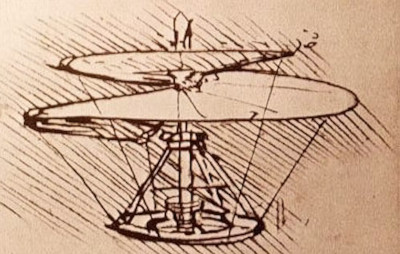
The same caution applies to images. Illustration can explain the flapping-wing idea, but it is not proof that Leonardo built or tested a working ornithopter.
What to Notice First
Begin with the wing. In the ornithopter idea, the wing is not a fixed surface. It is supposed to move, flex and act against air. That is why the mechanical-wing sources matter. Leonardo was interested in the anatomy and operation of bird wings, and later models try to show how articulated segments, control lines and springs could translate that interest into mechanism [2] [5].
Then notice the human body. Many of Leonardo's early flight ideas depend on the assumption that a human pilot might provide enough force to move the wings. The problem is that human muscle power was not sufficient for mechanically driven flapping flight [4]. The machine asks too much of the body.
Next, notice the difference between drawing and model. Leonardo's manuscripts contain the design thinking. The Science Museum Group, Museo Leonardiano and Smithsonian objects are later models or reconstructions built to interpret that thinking [1] [2] [3]. They are not Leonardo's own aircraft. They are ways of making manuscript problems visible.
Finally, notice its place inside Leonardo's broader flight family. Flying Machine, Ornithopter, Helicopter, Parachute and other invention pages are related because they all sit near the dream of flight. Ornithopter is the flapping-wing design page, not a container for every airborne idea in Leonardo's notebooks.
Why the Ornithopter Matters
The Ornithopter matters because it shows Leonardo thinking by analogy. Birds fly. Their wings move. Their bodies balance. Their surfaces interact with air. Leonardo did not simply admire that fact; he tried to break it down into parts that a machine might imitate.
That effort is both brilliant and limited. It is brilliant because it treats flight as a mechanical problem rather than a miracle. It is limited because the human-powered flapping mechanism could not solve the problem of lift, power and control [4]. The design sits precisely at that intersection: astonishing observation, ambitious translation and physical constraint.
It also matters because it shows how later institutions interpret Leonardo. The Science Museum Group model, Museo Leonardiano models and Smithsonian model all help modern audiences picture designs that might otherwise remain hard to parse on a manuscript page [1] [2] [3] [5]. A reconstruction gives shape to evidence, but it does not turn a design into a tested historical machine.
Leonardo did not invent a working airplane. He did help create a rich body of flight studies in which observation, anatomy, engineering and imagination press against one another. The ornithopter is one of the clearest forms of that pressure.
The ornithopter records one of Leonardo's largest questions: what would it take for a human-made thing to move through air like a bird? The answer was not a working aircraft, but the drawings and later models still preserve the seriousness of the question.
Frequently Asked Questions
Discussion
Use this space to discuss Leonardo's ornithopter designs, their source evidence and their place within his wider flight studies.
Keep comments focused on the drawings, models, folios and evidence limits behind the flapping-wing idea.
Reader Insights
Which source detail most changes how you read Leonardo's flapping-wing designs?
How does the ornithopter connect to Leonardo's wider studies of birds, anatomy and mechanical motion?
Where do the later models help, and where do they risk making the evidence look more certain than it is?
Join the Conversation
Share your reading of Leonardo's ornithopter studies below.
References
- Science Museum Group Collection, Model of Leonardo da Vinci Ornithopter wing, object record 1992-731, accessed 30 July 2026.
- Museo Leonardiano di Vinci, Detail of a mechanical wing, model record, accessed 30 July 2026.
- Smithsonian National Air and Space Museum, Leonardo da Vinci Ornithopter Model, accessed 30 July 2026.
- Museo Leonardiano di Vinci, Flight studies, collection record, accessed 30 July 2026.
- Museo Leonardiano di Vinci, Study of a beating wing, model record, accessed 30 July 2026.