

 by Tom Gurney
Tom Gurney BSc (Hons) is an art history expert with over 20 years experience
Published on June 19, 2020 / Updated on July 5, 2026
Email: tomgurney1@gmail.com / Phone: +44 7429 011000
Les Amants by Rene Magritte: The Kiss That Cannot Arrive
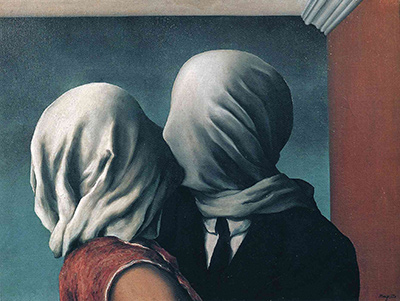
Les Amants, usually known in English as The Lovers, is one of Rene Magritte's most unsettling images of intimacy. Painted in Paris in 1928, it shows two lovers kissing while both heads are covered by white cloth. The Museum of Modern Art records the work as oil on canvas, measuring 54 x 73.4 cm, and holds it as a gift of Richard S. Zeisler. [1]
The image is simple enough to remember in seconds: two bodies lean together, the kiss is unmistakable, and yet the faces are hidden exactly where intimacy should become most direct. The cloth does not only block the viewer. It blocks the lovers from each other. That is why the painting feels more disturbing than a scene of separation. The lovers are close, but their closeness has been made unreachable. [1]
Magritte's power here lies in restraint. He does not need a monstrous figure, a theatrical dreamscape or a complicated symbolic code. He takes a recognisable human gesture and inserts one impossible condition. The result is a painting about desire, obstruction, identity and the limits of knowing another person. [3]
At a Glance
- Artist: Rene Magritte
- Title: The Lovers / Les Amants
- Date: Paris, 1928
- Medium: Oil on canvas
- Dimensions: 54 x 73.4 cm
- Collection: Museum of Modern Art, New York
- Object Number: 530.1998
Contents
- Why This Painting Matters
- Museum Perspective
- Historical Background
- Visual Description
- Looking Carefully
- Meaning and Interpretation
- Provenance
- Comparison Works
Why This Painting Matters
Les Amants matters because it turns one of art's oldest subjects, the kiss, into a problem. Lovers usually promise access: to feeling, to identity, to touch, to mutual recognition. Magritte keeps the pose of intimacy but removes the face, the mouth, the gaze and the expression. The painting therefore preserves the outward form of love while making love visually impossible. [1]
This makes the work more than an image of romance. It is an image of frustrated recognition. The viewer cannot read the lovers' faces, and the lovers cannot meet each other without the fabric intervening. The cloth becomes a barrier, but not a wall. It is thin, close to the skin and almost tender in its modelling. That ambiguity gives the painting its emotional force. [6]
The painting is also crucial within Magritte's wider career because it belongs to the late 1920s, when his mature Surrealist language was forming. During these years, he repeatedly used ordinary objects, clear settings and simple contradictions to make reality feel unreliable. MoMA's artist page places The Lovers among his key works from the period, alongside The Menaced Assassin and The False Mirror. [2]
Museum Perspective
MoMA's presentation of the painting is especially useful because it does not treat the covered heads as a single solved symbol. Its gallery label describes the fabric as a barrier that changes passion into isolation and frustration, but it also notes that the biographical explanation involving Magritte's mother remains speculative. [1]
That caution matters. Many older accounts connect the veiled faces to the death of Magritte's mother, who died by suicide when he was young. The story is powerful, and it has often shaped readings of the covered face motif. But a responsible reading should not reduce Les Amants to a childhood trauma. MoMA itself frames the story as speculation, and Magritte resisted the idea that his paintings could be decoded so directly. [1]
The museum also gives the work a concrete institutional history. The Lovers is not only a famous image online. It is a specific painting with a documented medium, size, object number, exhibition history and provenance. That factual grounding helps keep interpretation from floating away from the object. [1]
Historical Background
Magritte painted The Lovers in 1928, soon after moving near Paris and entering closer contact with the Surrealist group. The date is important because it places the work in the same intense period that produced several of his most enduring visual problems: hidden faces, ordinary objects made strange, and images that refuse to explain themselves. [3]
Surrealism was often interested in desire, the unconscious and the disruption of ordinary logic. Magritte's version, however, is unusually calm. He does not dissolve the lovers into dreamlike distortion. He paints them clearly enough that the viewer immediately understands the situation, then lets the obstruction do the work. [6]
The 1928 date also connects Les Amants to a broader group of paintings involving covered or withheld faces. These works are sometimes discussed together, but the exact relationships among versions and titles must be handled carefully. The MoMA work is the best-known painting at the /les-amants/ target URL, while the live cluster also has a separate /les-amants-i/ page for a closely related version. [4]
Visual Description
The painting shows two figures pressed together in a kiss. Their bodies occupy the foreground, close to the picture plane. One figure wears a dark jacket; the other appears in red. Both heads are wrapped in pale cloth, which covers the faces completely and gathers around the contours of the nose, mouth and skull. [1]
The background is compact and architectural rather than expansive. A red wall and cooler blue-grey area hold the figures in a shallow space. This setting is not busy. It does not tell a story about where the lovers are or what happened before the image. It functions more like a stage on which the contradiction can be seen clearly. [6]
The cloth is the key visual event. It is not painted as a flat sign. It folds, stretches and catches light. That physicality is important because the obstruction feels real. The lovers are not separated by an abstract idea; they are separated by something soft, close and suffocatingly intimate. [1]
Looking Carefully
The first thing to notice is that the kiss still happens. Magritte does not show two people turned away from each other. He shows contact, pressure and closeness. This makes the obstruction more painful. The painting is not about the absence of desire; it is about desire reaching a barrier at the exact point where it expects fulfilment. [1]
The second thing to notice is that the viewer is also implicated. A normal portrait or romantic scene allows the viewer to read faces. Here the viewer's curiosity is blocked. We are put into the same condition as the lovers: near enough to understand the scene, but unable to possess it fully. [7]
The third thing to notice is the painting's refusal of melodrama. There is no visible struggle. The lovers do not tear at the cloth. They do not collapse. The image is controlled, almost formal. That calmness is what makes it so disturbing. Magritte's Surrealism often works by making impossibility look composed. [6]
Things You Might Miss
The cloth does not simply hide identity; it also removes breath, speech and expression. A kiss usually involves lips, breath and facial contact. Magritte leaves the bodily arrangement of the kiss intact while withdrawing the very features that would make it humanly legible. [7]
The title also matters. Les Amants promises lovers, not strangers or ghosts. The title asks the viewer to accept the relationship, while the image denies access to the signs by which that relationship would normally be confirmed. This is a classic Magritte problem: title and image cooperate while also making each other more uncertain. [5]
The painting's popularity can make it look like a simple emblem of doomed romance. It is stronger than that. The image does not say only that love is impossible. It says that intimacy itself can contain distance, that seeing another person is never total, and that desire may be intensified by what it cannot reach. [7]
Technique and Composition
Magritte's technique in Les Amants is deliberately legible. The forms are clear, the figures are readable, and the setting is controlled. He does not use thick painterly texture to make the scene expressive. Instead, he uses clarity to make the contradiction sharper. [6]
Compositionally, the work is built around the joined heads. The faces should be the emotional centre of the painting, but the white cloth turns that centre into an obstruction. The lovers' bodies create a diagonal pressure toward the kiss, while the fabric prevents the viewer from arriving at the expected point of recognition. [1]
The colour contrast helps. The pale cloth stands out against darker clothing and background tones. The red area behind the figures gives the image heat, but the covered faces cool that heat into unease. The painting is sensual and airless at the same time. [6]
Meaning and Interpretation
The most common interpretation of Les Amants is that it represents desire blocked by separation. That is a useful starting point, but it should not become a fixed answer. The painting is effective because it allows several related experiences to happen at once: love and distance, contact and blindness, desire and frustration, closeness and unknowability. [1]
The biographical interpretation should be handled with care. The story of Magritte's mother's death has been repeated often in relation to covered faces, but MoMA presents it as speculation, and modern scholarship is cautious about turning it into a master key. The painting may resonate with trauma, but it cannot responsibly be reduced to trauma. [1]
mystery means nothing either, it is unknowable.
Rene Magritte [1]
Magritte's own attitude supports that caution. The sentence above is a useful guardrail for this painting. Les Amants does not ask the viewer to find one hidden explanation. It asks the viewer to experience a visible contradiction that remains unresolved. [1]
Title Analysis
The French title Les Amants means The Lovers. It is direct, almost ordinary. That directness matters because the image is not ordinary at all. The title identifies the figures by relationship, while the painting hides the signs that would let us recognise them as individuals. [5]
The title also keeps the painting from becoming merely horrific. If the work were called The Veiled Figures or The Suffocation, the emotional direction would be narrower. The Lovers preserves tenderness inside the obstruction. The figures are not just trapped or masked; they are lovers whose intimacy has become unreadable. [7]
Provenance
MoMA's provenance research gives the work a documented ownership history. The painting was with Jean Bastien in Brussels by 1953, passed through figures including E. L. T. Mesens, Fernand Graindorge, Hecker Jensen and Richard L. Feigen Gallery, and was sold to Richard S. Zeisler in New York in September 1958. MoMA acquired it in 1998 as Zeisler's bequest. [1]
This provenance is valuable because it connects the painting to both Belgian Surrealist networks and later American collecting. The work's modern fame can make it feel placeless, but its history runs through Brussels, Liege, Basel, Chicago and New York before entering MoMA's collection. [1]
Exhibition History
MoMA identifies the painting in installation views from several exhibitions, including Dada, Surrealism and Their Heritage in 1968, Painting & Sculpture II in 2004-2005, and Magritte: The Mystery of the Ordinary, 1926-1938 in 2013-2014. [1]
The 2013-2014 exhibition context is especially important because it placed the work inside the key years when Magritte transformed ordinary objects and familiar scenes into philosophical traps. That exhibition's title, The Mystery of the Ordinary, is almost a concise description of what Les Amants does. [3]
Comparison Works
The most immediate comparison is the related Les Amants I page. Both works use covered heads, but the emotional arrangement differs: one emphasises a kiss, the other a posed pairing. Together they show that Magritte was not simply repeating an image. He was testing how the covered face changes different kinds of human relation. [4]
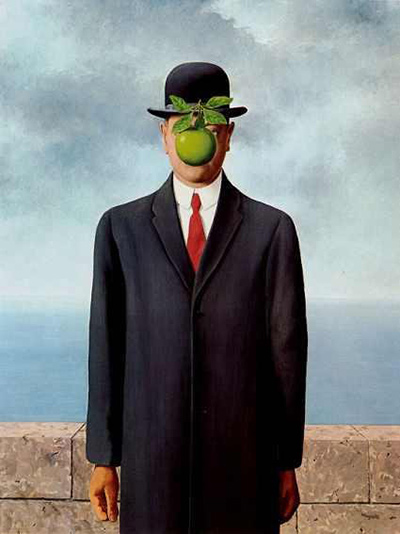
The Son of Man is another essential comparison. In that painting, an apple blocks the face of a solitary bowler-hatted man. In Les Amants, cloth blocks two faces at once. One image frustrates portraiture; the other frustrates intimacy. Both show Magritte's interest in concealment as an active visual force. [5]
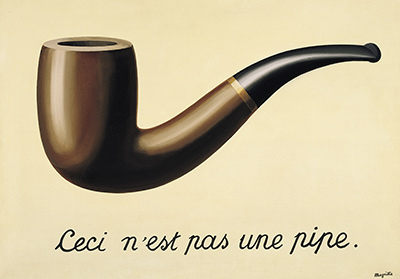
The Treachery of Images offers a different but related problem. There, the viewer recognises a pipe and is told that it is not a pipe. In Les Amants, the viewer recognises a kiss but cannot access the faces that would complete it. Both works make recognition stumble. [3]
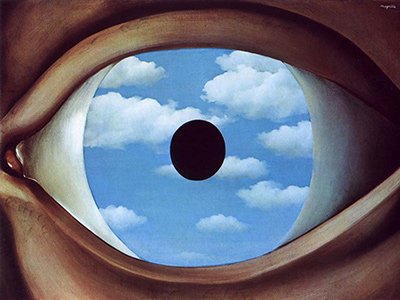
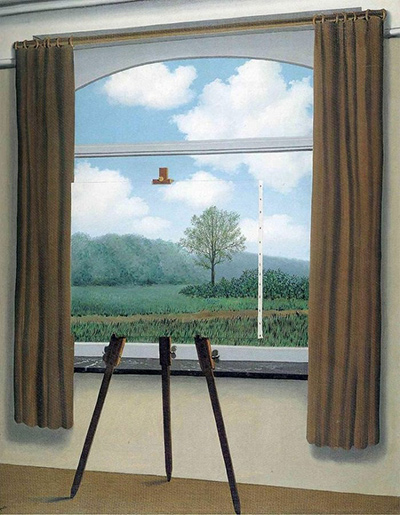
The painting also connects to The False Mirror, The Human Condition and Not to Be Reproduced. Those works explore eyes, surfaces, pictures, mirrors and the refusal of expected visual access. Les Amants belongs in that same family of Magritte images where seeing is made unreliable. [7]
Reception and Influence
The painting's influence has been unusually broad because the image is so immediately legible. Two covered heads kissing can be understood without a caption, which has made the work especially powerful in reproduction, design and popular visual culture. [2]
But that recognisability can flatten the painting if it is treated only as an image of tragic romance. The stronger reading is more precise: Magritte shows a scene in which intimacy is present and obstructed at the same time. That contradiction is why the work continues to feel modern. [7]
Timeline
- 1898 - Rene Magritte is born in Lessines, Belgium. [2]
- 1927 - Magritte moves near Paris and enters closer contact with the Surrealist circle. [3]
- 1928 - Magritte paints The Lovers in Paris. [1]
- 1958 - Richard S. Zeisler acquires the painting in New York. [1]
- 1998 - MoMA acquires the painting as a bequest from Zeisler. [1]
- 2013-2014 - The painting appears in MoMA's Magritte: The Mystery of the Ordinary, 1926-1938. [1]
FAQs
Les Amants is usually read as an image of intimacy blocked by separation, but it should not be reduced to one fixed meaning. The covered faces create a contradiction between closeness and inaccessibility. [1]
The covered faces may suggest frustration, unknowability, secrecy or blocked desire. Some writers connect the motif to the death of Magritte's mother, but MoMA presents that connection as speculation rather than fact. [1]
The best-known Les Amants / The Lovers painting is in the Museum of Modern Art, New York. MoMA records it as object number 530.1998 and a gift of Richard S. Zeisler. [1]
The titles and versions are often confusing. The live site has separate pages for Les Amants and Les Amants I. This page focuses on the MoMA painting of two lovers kissing through cloth-covered faces. [1]
Magritte generally resisted fixed explanations of his paintings. MoMA quotes him on mystery as something unknowable rather than a hidden meaning waiting to be translated. [1]
References
- MoMA, "Rene Magritte. The Lovers. Paris 1928", View source.
- MoMA, "Rene Magritte", View source.
- Anne Umland, ed., Magritte: The Mystery of the Ordinary, 1926-1938, Museum of Modern Art, 2013.
- David Sylvester and Sarah Whitfield, eds., Rene Magritte: Catalogue Raisonne, Volume I: Oil Paintings 1916-1930, Menil Foundation / Philip Wilson, 1992.
- Harry Torczyner, Magritte: Ideas and Images, New York: Harry N. Abrams, 1977.
- Suzi Gablik, Magritte, London: Thames & Hudson, 1970.
- Patricia Allmer, Rene Magritte: Beyond Painting, Manchester University Press, 2009.
- Royal Museums of Fine Arts of Belgium, "Magritte Museum", View source.