


 by Tom Gurney
Tom Gurney BSc (Hons) is an art history expert with over 20 years experience
Page created on / Page updated on
Email: tomgurney1@gmail.com / Phone: +44 7429 011000
Not to Be Reproduced by Rene Magritte
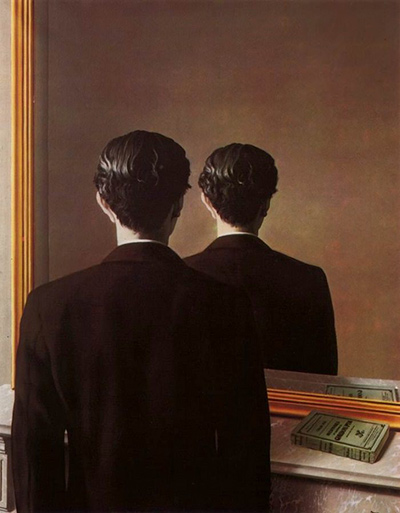
Not to Be Reproduced is one of Rene Magritte's sharpest mirror paintings. A man stands before a mirror. We expect the mirror to reveal his face. Instead, it gives us the back of his head again. [3]
The painting is usually identified as a 1937 oil portrait of Edward James, the British Surrealist patron who commissioned several works from Magritte. It is held by Museum Boijmans Van Beuningen in Rotterdam. [1] [4]
The shock is precise. The book on the mantelpiece reflects normally, but the man does not. Magritte changes only the rule he needs to change, which makes the impossible event feel colder and more exact. [6]
At a Glance
- Artist: Rene Magritte [7]
- Title: Not to Be Reproduced
- French title: La reproduction interdite [3]
- Date: 1937 [3]
- Medium: oil on canvas [3]
- Collection: Museum Boijmans Van Beuningen, Rotterdam [1]
- Subject: Edward James [4]
- Key object: Poe's The Narrative of Arthur Gordon Pym of Nantucket in French edition [4]
Contents
- Why this painting matters
- Museum and collection context
- Historical background
- Visual description
- Looking carefully
- Meaning and interpretation
- Comparison works
Why This Painting Matters
Not to Be Reproduced matters because it turns the mirror, a device of recognition, into a device of refusal. Mirrors usually promise access to the self. Here, the mirror repeats concealment. [6]
The painting is also central to the Edward James group. Alongside The Pleasure Principle and Time Transfixed, it shows Magritte working inside a patron's world of interiors, portraits and staged paradoxes. [4]
Museum and Collection Context
The painting is associated with Museum Boijmans Van Beuningen in Rotterdam, one of the major European collections holding Magritte's work. The official object reference was not fully retrievable in this environment, so this page treats the Boijmans collection fact together with the catalogue raisonne and other scholarly references. [1] [3]
That caution matters because the painting is often reproduced and discussed online. The strongest reading should not depend on internet folklore. It should begin with what the image visibly does: the mirror disobeys only for the human figure. [6]
Museum Moment
Seen as a museum object, the painting depends on a very controlled delay. The viewer first recognises a conventional portrait arrangement: figure, mantel, mirror, book and interior. Only after that recognition does the mirror's refusal become clear. Magritte needs the room to look credible before the impossible rule can register. [6]
This delay is one reason the painting should not be reduced to a spooky effect. Its force is intellectual and visual at once. The mirror behaves correctly for the book, so the viewer cannot dismiss the scene as a simple fantasy. The contradiction is targeted, and that makes it more exacting. [4]
Video Guide
This selected video from Shawn Grenier | The Canvas offers useful visual context before the detailed analysis continues.
Historical Background
Magritte painted Not to Be Reproduced in 1937, during his connection with Edward James. James was not merely a collector but an active Surrealist patron whose domestic spaces became settings for impossible images. [4]
This portrait is strange because it withholds the face of its subject. A portrait normally promises recognition. Magritte gives the patron's body, clothes and position, but removes the identifying frontal view that a mirror should provide. [6]
Visual Description
The painting shows a man in a dark jacket standing before a mantel and mirror. He is seen from behind. His hair, shoulders and collar are carefully described. The space is quiet and controlled. [3]
In the mirror, the viewer expects to see his face. Instead, the reflection shows the same back view. The mirror repeats the refusal. On the mantel, however, a book is reflected correctly. This detail proves that the mirror is not generally broken; it fails only at the human figure. [4]
Looking Carefully
Begin with the book. It is easy to miss because the human anomaly dominates the painting, but the book is crucial. Its correct reflection shows that Magritte is not simply painting a fantasy mirror. He is changing one relationship within an otherwise orderly scene. [4]
Then look at the posture. Edward James stands calmly, as if nothing unusual has happened. The painting's uncanniness comes from that calm. The figure does not react to his own missing face. [6]
Finally, notice the frame of the mirror. It acts like a second painting inside the painting. What should reveal identity becomes a picture of concealment. [5]
Things You Might Miss
- The title does not simply describe reproduction in the mechanical sense. It also points to failure: the mirror is forbidden to reproduce the sitter as expected. [5]
- The painting is not faceless because the head is absent. The head is present twice, but only from behind. [6]
- The Poe book is not decorative trivia. Poe's fiction often plays with unreliable narration, enclosed spaces and uncertain identity. [4]
Poe and the Book
The book on the mantel is usually identified as a French edition of Edgar Allan Poe's The Narrative of Arthur Gordon Pym of Nantucket. That detail is more than a literary Easter egg. Poe's novel is itself bound up with narration, identity, uncertainty and the unstable border between fact and fiction. [4]
In the painting, the book is also the control case. It reflects normally. The viewer therefore has two systems in one image: a book that obeys reflection and a human figure who does not. Magritte makes the inanimate object more reliable than the portrait subject. [6]
Technique and Composition
The technique is controlled and sober. The jacket, hair, mirror and mantel are painted in a realist manner. This realism is what makes the mirror anomaly so effective. [3]
The composition is almost symmetrical, but not comforting. The viewer, the sitter and the mirror create a closed circuit. We look at a man looking at an image that refuses to look back. [6]
Meaning and Interpretation
The strongest interpretation is about identity and representation. The mirror should offer self-knowledge. Instead, it reproduces the same unknowability already visible to the viewer. [5]
The painting also asks what a portrait can do. A portrait without a face should fail, yet this one succeeds precisely because it makes absence its subject. Edward James is represented through the impossibility of seeing him. [4]
It is tempting to call the painting sinister or frightening, but those are responses rather than evidence. The firmer point is that Magritte turns recognition into repetition and reflection into concealment. [6]
Title Analysis
La reproduction interdite means reproduction forbidden or not to be reproduced. The title is wonderfully double. It refers to an image that refuses normal reflection, but also to the reproduction of identity in art. [5]
The title also suits Magritte's broader suspicion of images. A picture is never the thing itself. Here, even a mirror, the most automatic of images, fails to deliver the expected truth. [5]
Provenance and Patron Context
Edward James is central to the painting's meaning. He commissioned and collected major Surrealist works, and Magritte produced several important paintings connected to him. [4]
Time Transfixed, completed the following year, belongs to the same world of refined interiors and impossible events. In one painting, the fireplace admits a train. In Not to Be Reproduced, the mirror refuses a face. [2]
The Edward James context sharpens the portrait problem. James wanted and supported Surrealist art that altered domestic experience. Yet Magritte's portrait refuses the usual reward of patronage: the sitter's recognisable face. The painting gives James a place in the image while denying the frontal identity that portraiture conventionally supplies. [4]
Comparison Works
The False Mirror is the closest conceptual comparison because both paintings make sight unreliable. In The False Mirror, the eye becomes sky. In Not to Be Reproduced, the mirror becomes a machine of concealment. [6]
Time Transfixed is important because of Edward James and domestic space. The Human Condition is useful because it also tests what an image does inside a room. [3]
The Son of Man provides a later echo. There, an apple hides the face from outside. In Not to Be Reproduced, the mirror itself withholds the face. [6]
Reception and Influence
The painting has had a strong afterlife because its central device is instantly understandable. Anyone knows what a mirror should do, so anyone can feel the disturbance when it refuses. [6]
Later visual culture often uses the repeated back-view as a shorthand for split identity or alienation. But Magritte's painting is more precise than a generic identity crisis. It gives the viewer a rule and then violates it in one exact place. [5]
Timeline
- 1937 - Magritte paints Not to Be Reproduced. [3]
- 1937 - The work belongs to Magritte's Edward James portrait context. [4]
- 1938 - Magritte completes Time Transfixed, another major Edward James-related interior. [2]
Magritte artworks directory
| Name | Date | Medium |
|---|---|---|
| Memory of a Voyage | 1963 | Oil on canvas |
| The Blood of the World | 1927; also catalogued as 1926–27 | Oil on canvas |
| The Hunters at the Edge of Night | Paris, 1928 | Oil on canvas |
| The Empty Picture Frame (La saignée) | 1938–39 | Gouache on paper |
| The Glass House | 1939 | Gouache on paper |
| Oasis | 1926 in the illustrated Christie’s catalogue | Oil on canvas |
| Natural Encounters | 1945 | Oil on canvas |
| Attempting the Impossible | 1928 | Oil on canvas |
| On the Threshold of Liberty | 1930 | Oil on canvas |
| The Titanic Days | 1928 | Oil on canvas |
| The Voice of Space | 1931 | Oil on canvas |
| Unexpected Answer | 1932 in the museum catalogue, 1933 on the reverse | Oil on canvas |
| Elective Affinities | 1932 in MoMA’s checklist, also published as 1933 | Oil on canvas |
| The Human Condition II | 1935 | Oil on canvas |
| The Six Elements | 1929 | Oil on canvas |
| The Happy Donor | 1966 | Oil on canvas |
| Clairvoyance (Self Portrait) | Brussels, 1936 | Oil on canvas |
| Philosopher’s Lamp | 1936 | Oil on canvas |
| The Annunciation | Paris, 1930 | Oil on canvas |
| The Lost Jockey | Circa 1942 in the illustrated lot catalogue | Gouache on paper laid down on canvas |
| Homage to Mack Sennett | 1936 in the Thyssen catalogue | Oil on canvas |
| Discovery | 1927 | Oil on canvas |
| Collective Invention | 1935 in the later catalogue index | Oil on canvas |
| The Wonders of Nature | 1953 | Oil on canvas |
| The Balcony | Circa 1950, with 1950 inscribed on the reverse | Oil on canvas |
| The Pilgrim | 1966 | Oil on canvas |
| The Invention of Life | 1928 | Oil on canvas |
| The Therapist | 1941 | Gouache on paper |
| The Gradation of Fire | 1938 or 1939 in the catalogue index | Gouache on paper |
| A Friend of Order | 1964 | Oil on canvas |
| The Poetic World | 1939 in Hammacher’s illustrated monograph | Gouache |
| The Muscles of the Sky | Paris, 1927 | Oil on canvas |
| The Battle of the Argonne | 1959 | Oil on canvas |
| Meditation | 1936 | Oil on canvas |
| The Domain of Arnheim | 1962 | Oil on canvas |
| This Is Not an Apple | 1964 | Oil on Unilite |
| The Meaning of Night | Brussels, 1927 | Oil on canvas |
| The Pleasure Principle (Portrait of Edward James) | 1937 | Oil on canvas |
| Ready Made Bouquet | 1957 | Oil on canvas |
| Popular Panorama | 1926 | Oil on canvas |
| Memory of a Journey | 1955 in the Thyssen catalogue. Tentatively 1958 in the catalogue index. | Gouache on paper, as exhibited at the Thyssen |
| Sheherazade | 1947 | Gouache on paper |
| The Difficult Crossing | 1926 | Oil on canvas |
| The Fair Captive | 1948 in the catalogue raisonné | Oil on canvas |
| The Birth of the Idol | 1926 | Oil on canvas |
| Hegel’s Holiday | 1958 | Oil on canvas |
| Homesickness | 1941 | Oil on canvas |
| The Rape (Le Viol) | 1934 | Oil on canvas |
| The Art of Living | 1967 | Oil on canvas |
| Secret Life IV | 1928 | Oil on canvas |
| The Tomb of the Wrestlers | 1960 | Oil on canvas |
| Young Girl Eating a Bird (The Pleasure) | 1927 | Oil on canvas |
| The Central Story | 1928 | Oil on canvas |
| The Seducer | 1953 | Oil on canvas |
| The Telescope | 1963 | Oil on canvas |
| The Banquet | 1958 | Oil on canvas |
| The Empty Mask | 1928 | Oil on canvas |
| The Cultivation of Ideas | 1927 | Oil on canvas |
| The Enchanted Pose | 1927 | Oil on canvas |
| The Future of Statues | 1937 | Oil on plaster |
| The Return of the Flame | 1943 | Oil on canvas |
| The White Page | 1967 | Oil on canvas |
| The Large Family | 1963 | Oil on canvas |
| Black Magic | 1945 | Oil on canvas |
| Les Amants I | 1928 | Oil on canvas |
| Man in a Bowler Hat | 1964 | Oil on canvas |
| The Portrait | 1935 | Oil on canvas |
| The Sixteenth of September | 1956 | Oil on canvas |
| Heartstrings | 1960 | Oil on canvas |
| The Present | 1939; also dated 1938 or 1939 | Gouache on paper |
| Act of Violence | 1932 | Oil on canvas |
| Fashionable People | 1950, in the 2016 thesis caption | Medium unconfirmed · Attribution follows the published caption |
| The Representation | 1962 | Oil on canvas |
| Memory | 1948 | Gouache on paper |
| The Mysteries of the Horizon | 1955 | Oil on canvas |
| Portrait of Stephy Langui | 1961 | Oil on canvas |
| The Double Secret | 1927 | Oil on canvas |
| Every Day | 1966 | Oil on canvas |
| The Invisible World | 1954 | Oil on canvas |
| Dawn of Cayenne | 1926 | Oil painting |
| Clear Ideas | 1955 (inscribed); possible 1958 execution | Oil on canvas |
| The Face of Genius | 1926 / 1927 | Oil on canvas |
| Good Faith | 1965; earlier record 1964–65 | Oil on canvas |
| The Flash | 1959 | Gouache and pencil on paper |
| Perpetual Motion | 1935; earlier catalogue 1934 | Oil on canvas |
| Personal Values | 1952 | Oil on canvas |
| Not to Be Reproduced | 1937 | Oil on canvas |
| The Red Model | 1935 | Oil on canvas |
| The Menaced Assassin | 1927 | Oil on canvas |
| The Castle of the Pyrenees | 1959 | Oil on canvas |
| The Blank Signature | 1965 | Oil on canvas |
| The Listening Room | 1952 | Oil on canvas |
| Golconde | 1953 | Oil on canvas |
| Time Transfixed | 1938 | Oil on canvas |
| The Treachery of Images | 1929 | Oil on canvas |
| The False Mirror | 1929 | Oil on canvas |
| The Empire of Light | 1953–54 | Oil on canvas |
| The Human Condition | 1933 | Oil on canvas |
| Les Amants | 1928 | Oil on canvas |
| The Son of Man | 1964 | Oil on canvas |
FAQs
It is held by Museum Boijmans Van Beuningen in Rotterdam. [1]
The figure is generally identified as Edward James, Magritte's British Surrealist patron. [4]
Magritte makes the mirror fail only for the human figure, turning reflection into concealment. [6]
The book is a French edition of Edgar Allan Poe's The Narrative of Arthur Gordon Pym of Nantucket. [4]
Both works are linked to Edward James and both introduce an impossible event into a controlled interior. [2]
Discussion
Which detail or comparison most changes how you read Magritte’s work? Share your observations below.
References
- Museum Boijmans Van Beuningen, Rene Magritte object/artist reference for La reproduction interdite / Not to Be Reproduced, current/archived object reference identified but not fetchable in this environment.
- Art Institute of Chicago API/object record, "La duree poignardee (Time Transfixed)," accessed July 4, 2026, https://api.artic.edu/api/v1/artworks/34181.
- David Sylvester and Sarah Whitfield, eds., Rene Magritte: Catalogue Raisonne, Houston and London: Menil Foundation / Philip Wilson, 1993.
- Richard Calvocoressi, Magritte, London: Phaidon, 1984.
- Harry Torczyner, Magritte: Ideas and Images, New York: Harry N. Abrams, 1977.
- Patricia Allmer, Rene Magritte: Beyond Painting, Manchester: Manchester University Press, 2009.
- Museum of Modern Art, "Rene Magritte," artist record, accessed July 4, 2026, https://www.moma.org/artists/3692-rene-magritte.







