


 by Tom Gurney
Tom Gurney BSc (Hons) is an art history expert with over 20 years experience
Page created on / Page updated on
Email: tomgurney1@gmail.com / Phone: +44 7429 011000
The Birth of the Idol
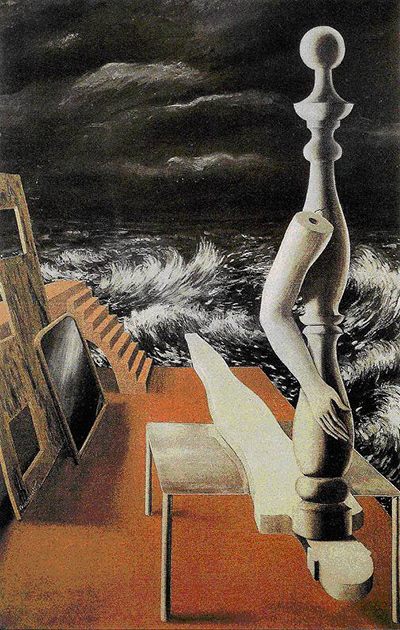
A tall white form stands above a table in René Magritte’s The Birth of the Idol. Its rounded top and narrow stem resemble a piece of turned wood, but a human arm bends across the front. Below it a pale cutout lies across the tabletop and projects over the near edge. Beside this arrangement, an orange floor and a flight of steps give way to a sea of breaking waves. The painted wood, arm and foam all catch the light, making it possible to follow the most unlikely parts of the scene quite clearly.
Magritte painted La Naissance de l’idole in 1926. The catalogue raisonné index records an oil on canvas measuring 120 by 80 centimetres, number 89 in volume I. Its inventory of motifs includes a frame or mirror, stairs, a table, breaking waves and a form related to the bilboquet, a cup-and-ball toy. The illustrated work matches the upright composition with the arm against the turned figure, the cutout on the table and the dark sea. [1] [2]
At a Glance
- Original titleLa Naissance de l’idole
- Date1926
- MediumOil on canvas
- Size120 × 80 cm
- Catalogue numberSylvester I 89
Selected works
Contents
The figure above the table
The sphere at the top is nearly circular. A narrow neck joins it to a broad, shallow curve beneath. Lower down, the turned form alternately narrows and widens. The large curves have only a few changes of tone, so the silhouette does much of the work of making the object legible. The sea behind it has far more internal detail. White foam breaks across the dark water in short strokes, while the outer edge of the upright figure remains continuous almost the whole way from its head to its base. The dark side of its sphere nearly disappears into the clouds, while the light around its rim preserves the circle.
The arm changes how we look at that outline. At the top of the arm a flat end, with a small dark mark, is visible where a shoulder would normally continue into the body. The elbow bends out to the left, and the forearm crosses back in towards the upright form. Long fingers rest against its rounded lower section. The arm has the curve and proportion we might recognise from a mannequin or a cast. Its position also gives the turned shape a gesture whose ease seems incongruous amid the breaking waves.
Christie’s discussion of Magritte’s later Le Temps jadis identifies the bilboquet as a form he used in several roles. In work such as The Lost Jockey it could take on features associated with trees. In The Birth of the Idol it borrows an arm. Its summit has no features to suggest the direction of a gaze. The arm supplies the strongest indication of a front, even though the vertical form itself could be imagined turning on an axis. [3]
The pale shape and the orange floor
The pale shape across the table is easiest to follow from its narrow far end. It swells towards the foreground and continues beyond the table’s near edge, where a rounded piece turns down towards the lower right. In places a narrow shaded edge makes it look cut from a thick sheet. Part of its outline suggests a body seen flat. The figure above it has depth, a steady upright axis and an articulated arm. The pale shape gives a very different account of how a body might occupy the same small area.
Watch: Understanding Magritte
Three complementary films introduce the artist, explore words and images, and examine a painting’s materials. These are broader Magritte comparisons, alongside the work discussed here.
René Magritte: Great Art Explained
An introduction to Magritte’s life, characteristic images and visual puzzles.
Watch on YouTubeThe table is seen from high enough to make its top a broad plane. Its straight sides and thin legs give some sense of where it stands on the orange surface. The cutout crosses that geometry on a diagonal. Its light colour briefly makes it look as if it were made of the same substance as the turned figure and arm. Following the edge where it extends beyond the table makes its thickness easier to see. The projection also brings it closer to us than the foot of the vertical form, even though the two can seem almost joined at first.
On the other side of the painting, a dark framed object leans at an angle near an upright board with rectangular openings. The catalogue index identifies a mirror among the objects here. Its muted surface gives very little back to the eye. Behind it, the orange steps offer a succession of narrow, regular edges. Following those edges takes us towards the water, where the profile of the foam keeps changing and the nearest wave rises close to the top of the steps. [1]
The sea at the edge of the floor
Dark sky takes up much of the upper part of the canvas. A few streaks of light separate the low clouds. Below, the water is easier to read through its crests than through the distance to the horizon. One of the brightest waves bends across the middle behind the table and figure. A second rises at the right edge. The upright form seems almost still because its pale outline cuts through both. Its arm makes the contrast particularly legible. The fingers curve gently towards the wood, close to a passage where the water breaks into irregular white marks.
In the 1926 The Difficult Crossing, Magritte also put a turned form near a storm. There the storm fills a rectangle at the far end of a room and the turned object has an eye. The Thyssen catalogue asks whether that sea is a view through a window or an image on the wall. In The Birth of the Idol, the orange steps give the sea a more direct relation to the foreground. The arm gives the biggest object the suggestion of a body, leaving us to decide how the pale cutout at its feet belongs to the scene. [4]
The title invites us to look for the moment when an object becomes a figure. The narrow joints and rounded top make the upright shape easy to imagine as something made on a lathe. Coming back to the hand changes its presence. The fingers touch the smooth curve just above the base, where the figure’s volume is especially clear. Magritte places that quiet gesture close to the most agitated part of the sea. The waves make the stillness of the hand and the weight of the turned object easier to see.
Magritte artworks directory
| Name | Date | Medium |
|---|---|---|
| Memory of a Voyage | 1963 | Oil on canvas |
| The Blood of the World | 1927; also catalogued as 1926–27 | Oil on canvas |
| The Hunters at the Edge of Night | Paris, 1928 | Oil on canvas |
| The Empty Picture Frame (La saignée) | 1938–39 | Gouache on paper |
| The Glass House | 1939 | Gouache on paper |
| Oasis | 1926 in the illustrated Christie’s catalogue | Oil on canvas |
| Natural Encounters | 1945 | Oil on canvas |
| Attempting the Impossible | 1928 | Oil on canvas |
| On the Threshold of Liberty | 1930 | Oil on canvas |
| The Titanic Days | 1928 | Oil on canvas |
| The Voice of Space | 1931 | Oil on canvas |
| Unexpected Answer | 1932 in the museum catalogue, 1933 on the reverse | Oil on canvas |
| Elective Affinities | 1932 in MoMA’s checklist, also published as 1933 | Oil on canvas |
| The Human Condition II | 1935 | Oil on canvas |
| The Six Elements | 1929 | Oil on canvas |
| The Happy Donor | 1966 | Oil on canvas |
| Clairvoyance (Self Portrait) | Brussels, 1936 | Oil on canvas |
| Philosopher’s Lamp | 1936 | Oil on canvas |
| The Annunciation | Paris, 1930 | Oil on canvas |
| The Lost Jockey | Circa 1942 in the illustrated lot catalogue | Gouache on paper laid down on canvas |
| Homage to Mack Sennett | 1936 in the Thyssen catalogue | Oil on canvas |
| Discovery | 1927 | Oil on canvas |
| Collective Invention | 1935 in the later catalogue index | Oil on canvas |
| The Wonders of Nature | 1953 | Oil on canvas |
| The Balcony | Circa 1950, with 1950 inscribed on the reverse | Oil on canvas |
| The Pilgrim | 1966 | Oil on canvas |
| The Invention of Life | 1928 | Oil on canvas |
| The Therapist | 1941 | Gouache on paper |
| The Gradation of Fire | 1938 or 1939 in the catalogue index | Gouache on paper |
| A Friend of Order | 1964 | Oil on canvas |
| The Poetic World | 1939 in Hammacher’s illustrated monograph | Gouache |
| The Muscles of the Sky | Paris, 1927 | Oil on canvas |
| The Battle of the Argonne | 1959 | Oil on canvas |
| Meditation | 1936 | Oil on canvas |
| The Domain of Arnheim | 1962 | Oil on canvas |
| This Is Not an Apple | 1964 | Oil on Unilite |
| The Meaning of Night | Brussels, 1927 | Oil on canvas |
| The Pleasure Principle (Portrait of Edward James) | 1937 | Oil on canvas |
| Ready Made Bouquet | 1957 | Oil on canvas |
| Popular Panorama | 1926 | Oil on canvas |
| Memory of a Journey | 1955 in the Thyssen catalogue. Tentatively 1958 in the catalogue index. | Gouache on paper, as exhibited at the Thyssen |
| Sheherazade | 1947 | Gouache on paper |
| The Difficult Crossing | 1926 | Oil on canvas |
| The Fair Captive | 1948 in the catalogue raisonné | Oil on canvas |
| The Birth of the Idol | 1926 | Oil on canvas |
| Hegel’s Holiday | 1958 | Oil on canvas |
| Homesickness | 1941 | Oil on canvas |
| The Rape (Le Viol) | 1934 | Oil on canvas |
| The Art of Living | 1967 | Oil on canvas |
| Secret Life IV | 1928 | Oil on canvas |
| The Tomb of the Wrestlers | 1960 | Oil on canvas |
| Young Girl Eating a Bird (The Pleasure) | 1927 | Oil on canvas |
| The Central Story | 1928 | Oil on canvas |
| The Seducer | 1953 | Oil on canvas |
| The Telescope | 1963 | Oil on canvas |
| The Banquet | 1958 | Oil on canvas |
| The Empty Mask | 1928 | Oil on canvas |
| The Cultivation of Ideas | 1927 | Oil on canvas |
| The Enchanted Pose | 1927 | Oil on canvas |
| The Future of Statues | 1937 | Oil on plaster |
| The Return of the Flame | 1943 | Oil on canvas |
| The White Page | 1967 | Oil on canvas |
| The Large Family | 1963 | Oil on canvas |
| Black Magic | 1945 | Oil on canvas |
| Les Amants I | 1928 | Oil on canvas |
| Man in a Bowler Hat | 1964 | Oil on canvas |
| The Portrait | 1935 | Oil on canvas |
| The Sixteenth of September | 1956 | Oil on canvas |
| Heartstrings | 1960 | Oil on canvas |
| The Present | 1939; also dated 1938 or 1939 | Gouache on paper |
| Act of Violence | 1932 | Oil on canvas |
| Fashionable People | 1950, in the 2016 thesis caption | Medium unconfirmed · Attribution follows the published caption |
| The Representation | 1962 | Oil on canvas |
| Memory | 1948 | Gouache on paper |
| The Mysteries of the Horizon | 1955 | Oil on canvas |
| Portrait of Stephy Langui | 1961 | Oil on canvas |
| The Double Secret | 1927 | Oil on canvas |
| Every Day | 1966 | Oil on canvas |
| The Invisible World | 1954 | Oil on canvas |
| Dawn of Cayenne | 1926 | Oil painting |
| Clear Ideas | 1955 (inscribed); possible 1958 execution | Oil on canvas |
| The Face of Genius | 1926 / 1927 | Oil on canvas |
| Good Faith | 1965; earlier record 1964–65 | Oil on canvas |
| The Flash | 1959 | Gouache and pencil on paper |
| Perpetual Motion | 1935; earlier catalogue 1934 | Oil on canvas |
| Personal Values | 1952 | Oil on canvas |
| Not to Be Reproduced | 1937 | Oil on canvas |
| The Red Model | 1935 | Oil on canvas |
| The Menaced Assassin | 1927 | Oil on canvas |
| The Castle of the Pyrenees | 1959 | Oil on canvas |
| The Blank Signature | 1965 | Oil on canvas |
| The Listening Room | 1952 | Oil on canvas |
| Golconde | 1953 | Oil on canvas |
| Time Transfixed | 1938 | Oil on canvas |
| The Treachery of Images | 1929 | Oil on canvas |
| The False Mirror | 1929 | Oil on canvas |
| The Empire of Light | 1953–54 | Oil on canvas |
| The Human Condition | 1933 | Oil on canvas |
| Les Amants | 1928 | Oil on canvas |
| The Son of Man | 1964 | Oil on canvas |
Frequently Asked Questions
A turned form resembling a cup-and-ball toy has a human arm set against it.
Discussion
Look closely and compare your reading with others.
Reader Insights
How does the placement of the arm change the way you read the upright form?
Which edge of the pale cutout best suggests its thickness?
Where do the steps and the surf seem closest together?
Join the Conversation
Share a detail, comparison or question about The Birth of the Idol below.
References
- Magritte. Toutes les œuvres, tous les thèmes. Catalogue raisonné and motif index, vol. I, p. 175, no. 89. View source.
- Bridgeman Images. La naissance de l’idole, 1926. Illustrated artwork record, 987449. View source.
- Christie’s. Le temps jadis. Illustrated lot record, no. 6010052, with discussion of Magritte’s early bilboquets. View source.
- Museo Nacional Thyssen-Bornemisza. La máquina Magritte. Exhibition catalogue, 2021, cat. 34 and essay on the picture and the window. View source.







