




The Flash
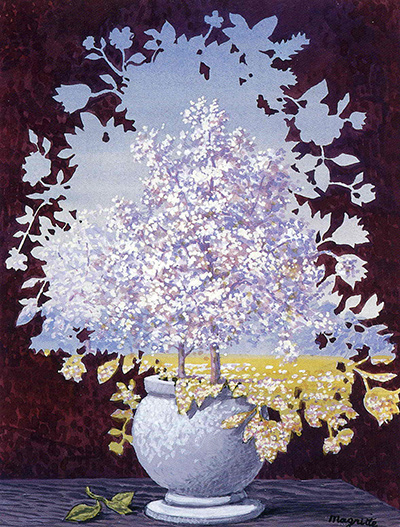
A pale vase stands on a patterned tabletop beside a loose green leaf. Above it, the outline of a bouquet encloses a bright landscape: flowering trees, a yellow-green field and blue sky. We can recognise the shape of an indoor flower arrangement while looking through that shape into a scene that seems to belong outdoors.
René Magritte made The Flash, or L'éclair, in 1959. This version is gouache and pencil on paper, 25.1 × 19.7 centimetres, catalogued as Sylvester IV 1464. Christie's offered it from a private collection in 2003. [1]
At a Glance
Date of this work
The Flash — this gouache
1959 [1]Contents
A bouquet made into a boundary
The outer contour is immediately important. Flowers, leaves and small stems create a recognisable floral silhouette against the dark red surroundings. Its numerous projections give the upper group an irregular edge, quite different from a simple rectangular opening.
Inside that edge, however, the image does not supply a conventional collection of cut flowers. A landscape continues across the area the bouquet occupies. The eye can follow a blue sky above trees whose trunks extend towards the field below.
This creates two overlapping ways of reading the same space. From a distance, vase and floral outline establish a familiar still life. Closer attention makes the landscape more insistent. The bouquet remains legible as a boundary even as its contents frustrate the expectation that the outline has established.
The flowering trees within
The trees supply a particularly effective connection between the two readings. Their blossoms belong naturally to a landscape, yet their pale colours also suit the impression of a large arrangement of flowers. The image uses that resemblance while keeping the trunks visible enough to identify something more substantial than cut stems.
Look down through the blossom towards the lower branches. Their structure gives the pale mass an internal organisation. The trees occupy a space extending beyond the scale implied by the vase, even though their upper forms help fill its bouquet-like silhouette.
The pale field beneath them extends horizontally. Small bright marks scatter across it, adding detail without becoming separate large objects. This band gives the trees a place to stand and provides a visual distance that an ordinary bouquet would not require.
Sky shaped by flowers
The sky is contained by the irregular outer contour. It fills areas that can also be understood as leaves or petals in silhouette, making the edge alternate between a floral shape and the boundary of a view. The same pale blue can therefore participate in more than one recognition.
This effect becomes especially clear near the outer projections. A shape that initially seems to be an individual flower can become a small extension of sky, joined to the larger opening behind the trees. The boundaries remain precise, but what they appear to bound keeps changing.
The dark red background strengthens the distinction. It gives the lighter silhouette a consistent surrounding field, so the opening is easy to trace. The uncertainty lies within a readable structure: we can follow the edge clearly while remaining unsure how to understand the space on either side of it.
The vase as a familiar support
The vase gives the arrangement an ordinary beginning. Its rounded body, narrow upper opening and small supporting base make it recognisable as a container placed on a table. Shading suggests a curved, pale surface with a definite front and sides.
That solidity contrasts with the bouquet above. The vase seems to occupy a manageable domestic space, while the trees and field imply something much larger. Their meeting at the opening concentrates the discrepancy between the two scales.
Watch: Understanding Magritte
Three complementary films introduce the artist, explore words and images, and examine a painting’s materials. These are broader Magritte comparisons, alongside the work discussed here.
René Magritte: Great Art Explained
An introduction to Magritte’s life, characteristic images and visual puzzles.
Watch on YouTubeNotice how the vessel partly interrupts the lower landscape. Its pale body remains in front as an object, rather than dissolving completely into the scene above it. The painting preserves enough of a conventional vase arrangement to keep the landscape's appearance inside the bouquet surprising.
A leaf on the tabletop
The loose leaf at the lower left supplies another small point of comparison. Unlike the leaves suggested by the bouquet's outline, this one has its own green surface and a visible place on the table. It can be examined as a separate object rather than as the boundary of another view.
Its proximity to the vase helps establish a near foreground. The eye can move between the fallen leaf, the vessel and the tabletop's repeated marks before returning to the larger floral shape. These quieter passages give the composition a physical setting around its principal impossibility.
The leaf may invite thoughts about a flower arrangement's temporary life, but the image does not establish that it has just withered or fallen. Its visual role is already substantial: it distinguishes a leaf represented as a thing from leaf-like shapes that contain sky and landscape.
Transparency or an image within an image?
One possible reading is that the bouquet has become transparent, allowing a landscape to appear through it. Another is that a separate scene has been fitted into a flower-shaped area. Both descriptions account for parts of what we see, and neither fully explains the relationship between the vase and the distant trees.
The painting does not show a complete room with a window behind the arrangement. Nor does it provide a clearly described picture frame around the landscape. The floral contour has to perform the work of a boundary without becoming an ordinary architectural opening.
This is why the image can remain unsettled after its main device has been noticed. Recognising the landscape does not make the bouquet disappear, and recognising the bouquet does not reduce the trees to ordinary cut flowers. The two readings continue to depend on one another.
A particular work on paper
Christie's identifies this as the first of two gouaches following Magritte's earlier oil composition Le plagiat, painted in 1940. The related subject does not make those objects interchangeable: the 1959 paper work has its own medium, dimensions and catalogue entry. [1]
The catalogue records the work through Eleanor Cramer Hodes and Galerie Natalie Seroussi, and lists its appearance in Chicago in 1961. These details belong to the history of this gouache, rather than to every reproduction or later treatment of a transparent bouquet. [1]
The relatively small sheet also concentrates the encounter. Its elaborate contour and many small marks of blossom can be held within a compact field of vision. The image's reach into landscape is therefore especially striking beside the physical intimacy of a work on paper.
Looking between the two spaces
Begin with the leaf and vase, then follow the opening upwards through the trunks and blossom into the sky. This route starts in a comparatively familiar still life and arrives in a space whose scale no longer fits that starting point.
Moving back towards the outer edge reverses the experience. The landscape is gathered into the silhouette of flowers once more, and the vase seems ready to support a bouquet. The drawing remains clear enough for this shift to happen repeatedly without one reading becoming permanently dominant.
The Flash rewards that movement of attention. Its strangeness is held within a recognisable domestic arrangement, and its landscape remains inseparable from the floral outline carrying it. The result makes a familiar object feel newly expansive without giving up the precise boundaries that first allowed us to recognise it.
Magritte artworks directory
| Name | Date | Medium |
|---|---|---|
| Memory of a Voyage | 1963 | Oil on canvas |
| The Blood of the World | 1927; also catalogued as 1926–27 | Oil on canvas |
| The Hunters at the Edge of Night | Paris, 1928 | Oil on canvas |
| The Empty Picture Frame (La saignée) | 1938–39 | Gouache on paper |
| The Glass House | 1939 | Gouache on paper |
| Oasis | 1926 in the illustrated Christie’s catalogue | Oil on canvas |
| Natural Encounters | 1945 | Oil on canvas |
| Attempting the Impossible | 1928 | Oil on canvas |
| On the Threshold of Liberty | 1930 | Oil on canvas |
| The Titanic Days | 1928 | Oil on canvas |
| The Voice of Space | 1931 | Oil on canvas |
| Unexpected Answer | 1932 in the museum catalogue, 1933 on the reverse | Oil on canvas |
| Elective Affinities | 1932 in MoMA’s checklist, also published as 1933 | Oil on canvas |
| The Human Condition II | 1935 | Oil on canvas |
| The Six Elements | 1929 | Oil on canvas |
| The Happy Donor | 1966 | Oil on canvas |
| Clairvoyance (Self Portrait) | Brussels, 1936 | Oil on canvas |
| Philosopher’s Lamp | 1936 | Oil on canvas |
| The Annunciation | Paris, 1930 | Oil on canvas |
| The Lost Jockey | Circa 1942 in the illustrated lot catalogue | Gouache on paper laid down on canvas |
| Homage to Mack Sennett | 1936 in the Thyssen catalogue | Oil on canvas |
| Discovery | 1927 | Oil on canvas |
| Collective Invention | 1935 in the later catalogue index | Oil on canvas |
| The Wonders of Nature | 1953 | Oil on canvas |
| The Balcony | Circa 1950, with 1950 inscribed on the reverse | Oil on canvas |
| The Pilgrim | 1966 | Oil on canvas |
| The Invention of Life | 1928 | Oil on canvas |
| The Therapist | 1941 | Gouache on paper |
| The Gradation of Fire | 1938 or 1939 in the catalogue index | Gouache on paper |
| A Friend of Order | 1964 | Oil on canvas |
| The Poetic World | 1939 in Hammacher’s illustrated monograph | Gouache |
| The Muscles of the Sky | Paris, 1927 | Oil on canvas |
| The Battle of the Argonne | 1959 | Oil on canvas |
| Meditation | 1936 | Oil on canvas |
| The Domain of Arnheim | 1962 | Oil on canvas |
| This Is Not an Apple | 1964 | Oil on Unilite |
| The Meaning of Night | Brussels, 1927 | Oil on canvas |
| The Pleasure Principle (Portrait of Edward James) | 1937 | Oil on canvas |
| Ready Made Bouquet | 1957 | Oil on canvas |
| Popular Panorama | 1926 | Oil on canvas |
| Memory of a Journey | 1955 in the Thyssen catalogue. Tentatively 1958 in the catalogue index. | Gouache on paper, as exhibited at the Thyssen |
| Sheherazade | 1947 | Gouache on paper |
| The Difficult Crossing | 1926 | Oil on canvas |
| The Fair Captive | 1948 in the catalogue raisonné | Oil on canvas |
| The Birth of the Idol | 1926 | Oil on canvas |
| Hegel’s Holiday | 1958 | Oil on canvas |
| Homesickness | 1941 | Oil on canvas |
| The Rape (Le Viol) | 1934 | Oil on canvas |
| The Art of Living | 1967 | Oil on canvas |
| Secret Life IV | 1928 | Oil on canvas |
| The Tomb of the Wrestlers | 1960 | Oil on canvas |
| Young Girl Eating a Bird (The Pleasure) | 1927 | Oil on canvas |
| The Central Story | 1928 | Oil on canvas |
| The Seducer | 1953 | Oil on canvas |
| The Telescope | 1963 | Oil on canvas |
| The Banquet | 1958 | Oil on canvas |
| The Empty Mask | 1928 | Oil on canvas |
| The Cultivation of Ideas | 1927 | Oil on canvas |
| The Enchanted Pose | 1927 | Oil on canvas |
| The Future of Statues | 1937 | Oil on plaster |
| The Return of the Flame | 1943 | Oil on canvas |
| The White Page | 1967 | Oil on canvas |
| The Large Family | 1963 | Oil on canvas |
| Black Magic | 1945 | Oil on canvas |
| Les Amants I | 1928 | Oil on canvas |
| Man in a Bowler Hat | 1964 | Oil on canvas |
| The Portrait | 1935 | Oil on canvas |
| The Sixteenth of September | 1956 | Oil on canvas |
| Heartstrings | 1960 | Oil on canvas |
| The Present | 1939; also dated 1938 or 1939 | Gouache on paper |
| Act of Violence | 1932 | Oil on canvas |
| Fashionable People | 1950, in the 2016 thesis caption | Medium unconfirmed · Attribution follows the published caption |
| The Representation | 1962 | Oil on canvas |
| Memory | 1948 | Gouache on paper |
| The Mysteries of the Horizon | 1955 | Oil on canvas |
| Portrait of Stephy Langui | 1961 | Oil on canvas |
| The Double Secret | 1927 | Oil on canvas |
| Every Day | 1966 | Oil on canvas |
| The Invisible World | 1954 | Oil on canvas |
| Dawn of Cayenne | 1926 | Oil painting |
| Clear Ideas | 1955 (inscribed); possible 1958 execution | Oil on canvas |
| The Face of Genius | 1926 / 1927 | Oil on canvas |
| Good Faith | 1965; earlier record 1964–65 | Oil on canvas |
| The Flash | 1959 | Gouache and pencil on paper |
| Perpetual Motion | 1935; earlier catalogue 1934 | Oil on canvas |
| Personal Values | 1952 | Oil on canvas |
| Not to Be Reproduced | 1937 | Oil on canvas |
| The Red Model | 1935 | Oil on canvas |
| The Menaced Assassin | 1927 | Oil on canvas |
| The Castle of the Pyrenees | 1959 | Oil on canvas |
| The Blank Signature | 1965 | Oil on canvas |
| The Listening Room | 1952 | Oil on canvas |
| Golconde | 1953 | Oil on canvas |
| Time Transfixed | 1938 | Oil on canvas |
| The Treachery of Images | 1929 | Oil on canvas |
| The False Mirror | 1929 | Oil on canvas |
| The Empire of Light | 1953–54 | Oil on canvas |
| The Human Condition | 1933 | Oil on canvas |
| Les Amants | 1928 | Oil on canvas |
| The Son of Man | 1964 | Oil on canvas |
Frequently Asked Questions
They appear as trees within a landscape, while the outer boundary retains the silhouette of a bouquet. The image keeps both scales in play.
This 1959 version is gouache and pencil on paper. The related earlier Le plagiat was an oil composition. [1]
Discussion
Compare the familiar objects with the spaces they appear to occupy.
Reader Insights
Where does the floral outline most clearly become a boundary around sky?
How does the loose leaf differ from the leaf shapes above the vase?
Which detail makes the landscape feel larger than the still life containing it?
Join the Conversation
Share a detail, comparison or question about The Flash below.
References
- Christie's, René Magritte, L'éclair, 2003, lot 152: object record, provenance, exhibition history and related compositions. View source.Splash image: The Flash, 1959. Gouache and pencil on paper, 25.1 × 19.7 cm. Sylvester IV 1464; private collection as recorded in the 2003 catalogue.







