


 by Tom Gurney
Tom Gurney BSc (Hons) is an art history expert with over 20 years experience
Page created on / Page updated on
Email: tomgurney1@gmail.com / Phone: +44 7429 011000
Man in a Bowler Hat
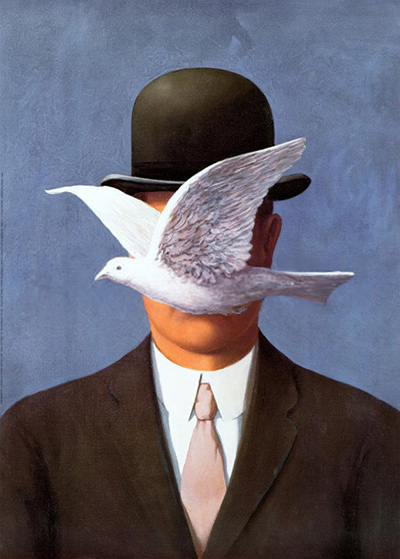
A white bird flies across a man’s face in René Magritte’s Man in a Bowler Hat. The shoulders and the front of the jacket are square to us, and the hat sits almost at the centre of the canvas. The bird moves to the left. Its nearer wing rises through the space where we would expect to see the man’s eyes, and its body crosses the lower part of his face. The picture is still enough to resemble a formal portrait, with a single movement passing across it at the point where a viewer might ordinarily meet the sitter’s gaze.
The composition shown here is L’Homme au chapeau melon, a 1964 oil on canvas listed as 65 by 50 centimetres and number 1002 in volume III of the catalogue raisonné. The French index records the work under that title, and the Magritte estate booklet illustrates the bird crossing the face. The Christie’s catalogue for Le Lieu commun identifies it as one of four major oils from 1964 that take up the bowler-hatted figure. [1] [2] [3]
At a Glance
- Original titleL’Homme au chapeau melon
- Date1964
- MediumOil on canvas
- Catalogue numberSylvester III 1002
- Size65 × 50 cm (catalogue index)
Selected works
The shape of a portrait
A softly mottled blue field surrounds the man. There is no clear line to set apart a wall, a horizon or a floor. The blue is lighter in some areas and darker in others, giving the background some variation without drawing attention away from the figure. Against that field, the jacket spreads across the bottom of the picture and rises to either side of the pale shirt. The outer line of the shoulders makes the figure look broad and stable. It also leaves two wedges of open blue through which the wings can spread visually.
The crown of the bowler is dark, with enough light along its upper left to describe the curve. The hatband makes a narrow division before the brim extends to either side. A small area of the man’s forehead appears just below it on the left, between the hat and the pale wing. On the right, the side of the head and the ear can be picked out along the edge of the bird. These fragments make the position of the head clear. They also guide the eye in towards the place where the face should be most legible.
The shirt and tie supply a line down the middle of the body. The pointed ends of the collar open towards the knot, and the tie widens as it approaches the lower edge. The collar, jaw and hat are aligned closely enough to make the pose feel deliberate. Little in the suit suggests an abrupt turn or step. That steadiness gives the bird room to look like something passing through a composition that could have held the same outline a moment before or a moment after.
The bird’s path across the face
The bird’s head reaches farther left than the edge of the man’s face. Its dark eye is a tiny, sharply placed point, separated from the tip of the beak by a short stretch of pale paint. The body broadens below the raised wing and then narrows towards the tail at the right. It is close to horizontal across the figure. The tail projects into the open blue, which makes the direction along the length of the bird particularly easy to follow.
Watch: Understanding Magritte
Three complementary films introduce the artist, explore words and images, and examine a painting’s materials. These are broader Magritte comparisons, alongside the work discussed here.
René Magritte: Great Art Explained
An introduction to Magritte’s life, characteristic images and visual puzzles.
Watch on YouTubeOne wing rises in front of the hat. Its individual feathers are visible as overlapping strokes, with cooler grey and lilac in the shadows. The other wing sweeps back towards the left in a much lighter shape. Part of its edge can be followed from the tip to the angle where it meets the body. The different tones make it possible to see the wings in relation to one another, and the steep diagonals give the bird a sense of movement that the man’s upright posture helps bring out.
The head, wing and body cover different parts of the man. The eye can follow an edge of the bird and then find a strip of warm colour where the man reappears below it. There is a quiet line along the bottom of his jaw, directly above the crisp white collar. Most of the areas that would show his expression are absent from view. The only eye we can see clearly is the bird’s, which is directed along its own path across the canvas.
The bowler and what it leaves visible
The bowler recurs in the 1964 group that Christie’s discusses in its notes on Le Lieu commun. The Fondation Magritte also points to the man in the dark coat and bowler as a recurring character and identifies the apple that covers his face in The Son of Man. The apple occupies a more compact area. Here the bird’s elongated body crosses the face and its wings extend across the brim. The particular shape of what intervenes determines which parts of the person we can still see. [3] [4]
The title directs us first to the man and his hat. We can recognise the clothing and the pose readily, and both stay visible long enough for us to register how little they tell us about the individual. The bird has a much more clearly defined action. That difference matters because the painting could have used the face to hold the eye in the centre. Instead the visible head of the bird takes attention sideways, towards the blue at the left, with the white of the wing drawing it back across the man.
The colour separates the objects even where their outlines are crowded. The brighter wing stands out against the crown of the hat. Lower down, the white of the bird is close to the white of the shirt, with the strip of skin between them helping us distinguish the light on feathers from the light falling on fabric.
It is possible to imagine that the bird would pass beyond the shoulders in the next moment. The pose of the man supplies no comparable indication of what he will do. For the duration of the picture, the two are held in precise alignment. The suit still looks like the beginning of a formal portrait, and the one visible eye belongs to the moving shape crossing it.
Magritte artworks directory
| Name | Date | Medium |
|---|---|---|
| Memory of a Voyage | 1963 | Oil on canvas |
| The Blood of the World | 1927; also catalogued as 1926–27 | Oil on canvas |
| The Hunters at the Edge of Night | Paris, 1928 | Oil on canvas |
| The Empty Picture Frame (La saignée) | 1938–39 | Gouache on paper |
| The Glass House | 1939 | Gouache on paper |
| Oasis | 1926 in the illustrated Christie’s catalogue | Oil on canvas |
| Natural Encounters | 1945 | Oil on canvas |
| Attempting the Impossible | 1928 | Oil on canvas |
| On the Threshold of Liberty | 1930 | Oil on canvas |
| The Titanic Days | 1928 | Oil on canvas |
| The Voice of Space | 1931 | Oil on canvas |
| Unexpected Answer | 1932 in the museum catalogue, 1933 on the reverse | Oil on canvas |
| Elective Affinities | 1932 in MoMA’s checklist, also published as 1933 | Oil on canvas |
| The Human Condition II | 1935 | Oil on canvas |
| The Six Elements | 1929 | Oil on canvas |
| The Happy Donor | 1966 | Oil on canvas |
| Clairvoyance (Self Portrait) | Brussels, 1936 | Oil on canvas |
| Philosopher’s Lamp | 1936 | Oil on canvas |
| The Annunciation | Paris, 1930 | Oil on canvas |
| The Lost Jockey | Circa 1942 in the illustrated lot catalogue | Gouache on paper laid down on canvas |
| Homage to Mack Sennett | 1936 in the Thyssen catalogue | Oil on canvas |
| Discovery | 1927 | Oil on canvas |
| Collective Invention | 1935 in the later catalogue index | Oil on canvas |
| The Wonders of Nature | 1953 | Oil on canvas |
| The Balcony | Circa 1950, with 1950 inscribed on the reverse | Oil on canvas |
| The Pilgrim | 1966 | Oil on canvas |
| The Invention of Life | 1928 | Oil on canvas |
| The Therapist | 1941 | Gouache on paper |
| The Gradation of Fire | 1938 or 1939 in the catalogue index | Gouache on paper |
| A Friend of Order | 1964 | Oil on canvas |
| The Poetic World | 1939 in Hammacher’s illustrated monograph | Gouache |
| The Muscles of the Sky | Paris, 1927 | Oil on canvas |
| The Battle of the Argonne | 1959 | Oil on canvas |
| Meditation | 1936 | Oil on canvas |
| The Domain of Arnheim | 1962 | Oil on canvas |
| This Is Not an Apple | 1964 | Oil on Unilite |
| The Meaning of Night | Brussels, 1927 | Oil on canvas |
| The Pleasure Principle (Portrait of Edward James) | 1937 | Oil on canvas |
| Ready Made Bouquet | 1957 | Oil on canvas |
| Popular Panorama | 1926 | Oil on canvas |
| Memory of a Journey | 1955 in the Thyssen catalogue. Tentatively 1958 in the catalogue index. | Gouache on paper, as exhibited at the Thyssen |
| Sheherazade | 1947 | Gouache on paper |
| The Difficult Crossing | 1926 | Oil on canvas |
| The Fair Captive | 1948 in the catalogue raisonné | Oil on canvas |
| The Birth of the Idol | 1926 | Oil on canvas |
| Hegel’s Holiday | 1958 | Oil on canvas |
| Homesickness | 1941 | Oil on canvas |
| The Rape (Le Viol) | 1934 | Oil on canvas |
| The Art of Living | 1967 | Oil on canvas |
| Secret Life IV | 1928 | Oil on canvas |
| The Tomb of the Wrestlers | 1960 | Oil on canvas |
| Young Girl Eating a Bird (The Pleasure) | 1927 | Oil on canvas |
| The Central Story | 1928 | Oil on canvas |
| The Seducer | 1953 | Oil on canvas |
| The Telescope | 1963 | Oil on canvas |
| The Banquet | 1958 | Oil on canvas |
| The Empty Mask | 1928 | Oil on canvas |
| The Cultivation of Ideas | 1927 | Oil on canvas |
| The Enchanted Pose | 1927 | Oil on canvas |
| The Future of Statues | 1937 | Oil on plaster |
| The Return of the Flame | 1943 | Oil on canvas |
| The White Page | 1967 | Oil on canvas |
| The Large Family | 1963 | Oil on canvas |
| Black Magic | 1945 | Oil on canvas |
| Les Amants I | 1928 | Oil on canvas |
| Man in a Bowler Hat | 1964 | Oil on canvas |
| The Portrait | 1935 | Oil on canvas |
| The Sixteenth of September | 1956 | Oil on canvas |
| Heartstrings | 1960 | Oil on canvas |
| The Present | 1939; also dated 1938 or 1939 | Gouache on paper |
| Act of Violence | 1932 | Oil on canvas |
| Fashionable People | 1950, in the 2016 thesis caption | Medium unconfirmed · Attribution follows the published caption |
| The Representation | 1962 | Oil on canvas |
| Memory | 1948 | Gouache on paper |
| The Mysteries of the Horizon | 1955 | Oil on canvas |
| Portrait of Stephy Langui | 1961 | Oil on canvas |
| The Double Secret | 1927 | Oil on canvas |
| Every Day | 1966 | Oil on canvas |
| The Invisible World | 1954 | Oil on canvas |
| Dawn of Cayenne | 1926 | Oil painting |
| Clear Ideas | 1955 (inscribed); possible 1958 execution | Oil on canvas |
| The Face of Genius | 1926 / 1927 | Oil on canvas |
| Good Faith | 1965; earlier record 1964–65 | Oil on canvas |
| The Flash | 1959 | Gouache and pencil on paper |
| Perpetual Motion | 1935; earlier catalogue 1934 | Oil on canvas |
| Personal Values | 1952 | Oil on canvas |
| Not to Be Reproduced | 1937 | Oil on canvas |
| The Red Model | 1935 | Oil on canvas |
| The Menaced Assassin | 1927 | Oil on canvas |
| The Castle of the Pyrenees | 1959 | Oil on canvas |
| The Blank Signature | 1965 | Oil on canvas |
| The Listening Room | 1952 | Oil on canvas |
| Golconde | 1953 | Oil on canvas |
| Time Transfixed | 1938 | Oil on canvas |
| The Treachery of Images | 1929 | Oil on canvas |
| The False Mirror | 1929 | Oil on canvas |
| The Empire of Light | 1953–54 | Oil on canvas |
| The Human Condition | 1933 | Oil on canvas |
| Les Amants | 1928 | Oil on canvas |
| The Son of Man | 1964 | Oil on canvas |
Frequently Asked Questions
A white bird flies from right to left across the man’s face.
Discussion
Look closely and compare your reading with others.
Reader Insights
What makes the man’s pose feel steady while the bird seems to move?
Which fragments of the head tell you where the face is?
How does the bird’s visible eye affect where you look next?
Join the Conversation
Share a detail, comparison or question about Man in a Bowler Hat below.
References
- Magritte. Toutes les œuvres, tous les thèmes. French catalogue raisonné index, vol. III, p. 403, no. 1002. View source.
- Magritte estate. Ceci est un jeu de l’oie, illustrated booklet, entry for L’Homme au chapeau melon. View source.
- Christie’s. Le lieu commun, catalogue notes on the four 1964 bowler-hat paintings. View source.
- Fondation Magritte. Notes on Le Fils de l’homme and the bowler-hatted figure. View source.







