




Perpetual Motion
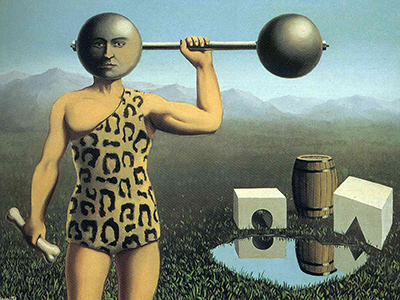
A strongman holds a barbell beside his head, but the left-hand weight has his face. His raised hand supports the bar that also seems to pass through the place where his head belongs. At the right, a barrel and two white solids stand beside a little pool, their reflections neatly inverted in the water. The impossible body shares its setting with an unusually orderly demonstration of reflected shapes.
René Magritte's Perpetual Motion, or Le Mouvement perpétuel, is an oil on canvas measuring 54 × 73 centimetres. The later catalogue record dates it to 1935, Sylvester II 361. MoMA's 1965 exhibition catalogue reproduced the same composition with the date 1934. [1] [2]
At a Glance
Contents
Where the head becomes a weight
The barbell is immediately recognisable: a straight bar connects two rounded masses. Its right-hand end looks like a smooth dark sphere, while the left end carries a pair of eyes, a nose and a mouth. The face remains readable even as the enclosing form takes on the shape of exercise equipment.
The two ends are closely related in size. That similarity encourages us to regard them as equivalent weights, although one also occupies the human figure's head position. A familiar arrangement of facial features has been fitted into an object whose function seems incompatible with a living person.
Look along the bar from one sphere to the other. It links the objects convincingly enough for us to understand what the raised hand is gripping. Then return to the neck below the face. The figure belongs to the load he appears to support. The disturbance lies in that relationship, rather than in any difficulty recognising the separate parts.
The pose and the suggestion of effort
The raised arm bends at the elbow, with the hand wrapped around the horizontal bar. The other arm drops beside the body and holds a white bone. These unequal actions give the figure a clear silhouette: one side reaches towards the weight, while the other extends downwards with a much smaller object.
His leopard-patterned outfit leaves the shoulders and much of the chest exposed. Its single diagonal strap and repeated dark markings make the costume conspicuous against the green landscape. It suggests a theatrical strongman, though the painting supplies no individual identity or named performance.
The body does not swing or stagger under the weight. Its upright bearing makes the situation seem established, almost routine. That composure sharpens the problem: we recognise a pose of physical strength, but the figure's own head has become part of the apparatus through which strength would normally be demonstrated.
A bone in the lowered hand
The bone is easy to overlook beside the larger barbell. Its pale surface stands out against the grass, and its expanded ends make it recognisable despite the relatively simple modelling. It is held as an object, separate from the visible body.
Its shape offers another comparison with the barbell. Both have a connecting length and enlarged ends, although their scales, materials and associations differ. The eye can move between them without requiring either to stand for a fixed idea. The painting sets up a visible resemblance that is suggestive before it becomes explanatory.
The bone also makes the lowered hand purposeful. This arm is not simply resting while the other works. Each hand is occupied, but the objects create different relationships with the body: the bone remains outside it, whereas the barbell has absorbed the place of the head. The distinction makes the figure's construction stranger on a second look.
Watch: Understanding Magritte
Three complementary films introduce the artist, explore words and images, and examine a painting’s materials. These are broader Magritte comparisons, alongside the work discussed here.
René Magritte: Great Art Explained
An introduction to Magritte’s life, characteristic images and visual puzzles.
Watch on YouTubeThe pool and its precise inversions
At the right, the water forms a small, irregular patch in the grass. Three objects stand along its far edge: a white block pierced by a rounded opening, an upright barrel and another white solid with an angular cut-out. Their lower images appear within the pool.
The reflections establish an intelligible relation between object and surface. The barrel's vertical shape continues downwards in reverse, while the openings in the white forms return beneath them. We can follow each reflected counterpart without having to invent a second set of objects underground.
This local clarity matters beside the figure. The water presents an unusual group of things according to a familiar visual rule. The strongman's head, by contrast, cannot be made ordinary merely by looking more carefully. The composition places a dependable relationship and a contradictory one close together, inviting us to compare how readily we accept each.
Solids, holes and painted volume
The white objects are distinct from the rounded weights. Their broad faces and sharp edges give them a geometric simplicity, while the barrel introduces curved wooden sides and dark horizontal bands. These differences allow the small group to read as several materials and constructions rather than one undifferentiated cluster.
The openings make empty space part of the arrangement. The rounded hole and angular notch are shaped absences, yet their reflections give them the same compositional importance as the solid surfaces around them. Looking at the pool involves comparing gaps as well as objects.
Across the whole painting, curved forms recur in different roles: a face, a weight, a barrel, the ends of a bone. Their similarities create links, but those links do not erase differences of function. Magritte's scene remains unsettling because things stay recognisable while entering relationships that ordinary recognition cannot comfortably explain.
A calm landscape around the contradiction
Grass spreads behind the figure and the pool, with blue-grey mountains rising further away. The sky offers an open, comparatively pale backdrop. There is no dense crowd or elaborate interior to distract from the two principal groups.
The horizontal landscape also gives the strongman's upright body a stable setting. The barbell extends across the upper part of the figure, while the small group at the right sits lower and further back. Those different heights lead the eye through the composition without making it feel chaotic.
The setting's calm makes the impossible arrangement more conspicuous. There is no visible catastrophe that would explain the transformed head as a fleeting event. Instead, the scene asks us to spend time with a condition already in place. Its convincing grass, distance and reflected light make the bodily contradiction harder to dismiss as a simple failure of description.
The title's promise of movement
Perpetual Motion names something the still image cannot literally perform. The raised weight suggests effort that might continue, while the figure's impassive pose gives no clear beginning or ending to that action. One possible reading is that the title prolongs the suspended situation in our imagination.
The small pool introduces a different kind of persistence. Its reflections repeat the objects immediately above them, making a stable visual relation rather than showing a sequence of movement. The title does not turn that arrangement into a mechanical explanation; it opens another question about how still forms can suggest continuing activity.
The older MoMA catalogue listed the canvas with Grosvenor Gallery, London, at the time of its 1965 exhibition. That is a historical location, not a statement of present ownership. [1] To return to the painting itself, compare the two ends of the barbell, then the objects and their reflections. Each comparison is easy to begin and difficult to finish without reconsidering what counts as a body, a weight or a convincing picture.
Magritte artworks directory
| Name | Date | Medium |
|---|---|---|
| Memory of a Voyage | 1963 | Oil on canvas |
| The Blood of the World | 1927; also catalogued as 1926–27 | Oil on canvas |
| The Hunters at the Edge of Night | Paris, 1928 | Oil on canvas |
| The Empty Picture Frame (La saignée) | 1938–39 | Gouache on paper |
| The Glass House | 1939 | Gouache on paper |
| Oasis | 1926 in the illustrated Christie’s catalogue | Oil on canvas |
| Natural Encounters | 1945 | Oil on canvas |
| Attempting the Impossible | 1928 | Oil on canvas |
| On the Threshold of Liberty | 1930 | Oil on canvas |
| The Titanic Days | 1928 | Oil on canvas |
| The Voice of Space | 1931 | Oil on canvas |
| Unexpected Answer | 1932 in the museum catalogue, 1933 on the reverse | Oil on canvas |
| Elective Affinities | 1932 in MoMA’s checklist, also published as 1933 | Oil on canvas |
| The Human Condition II | 1935 | Oil on canvas |
| The Six Elements | 1929 | Oil on canvas |
| The Happy Donor | 1966 | Oil on canvas |
| Clairvoyance (Self Portrait) | Brussels, 1936 | Oil on canvas |
| Philosopher’s Lamp | 1936 | Oil on canvas |
| The Annunciation | Paris, 1930 | Oil on canvas |
| The Lost Jockey | Circa 1942 in the illustrated lot catalogue | Gouache on paper laid down on canvas |
| Homage to Mack Sennett | 1936 in the Thyssen catalogue | Oil on canvas |
| Discovery | 1927 | Oil on canvas |
| Collective Invention | 1935 in the later catalogue index | Oil on canvas |
| The Wonders of Nature | 1953 | Oil on canvas |
| The Balcony | Circa 1950, with 1950 inscribed on the reverse | Oil on canvas |
| The Pilgrim | 1966 | Oil on canvas |
| The Invention of Life | 1928 | Oil on canvas |
| The Therapist | 1941 | Gouache on paper |
| The Gradation of Fire | 1938 or 1939 in the catalogue index | Gouache on paper |
| A Friend of Order | 1964 | Oil on canvas |
| The Poetic World | 1939 in Hammacher’s illustrated monograph | Gouache |
| The Muscles of the Sky | Paris, 1927 | Oil on canvas |
| The Battle of the Argonne | 1959 | Oil on canvas |
| Meditation | 1936 | Oil on canvas |
| The Domain of Arnheim | 1962 | Oil on canvas |
| This Is Not an Apple | 1964 | Oil on Unilite |
| The Meaning of Night | Brussels, 1927 | Oil on canvas |
| The Pleasure Principle (Portrait of Edward James) | 1937 | Oil on canvas |
| Ready Made Bouquet | 1957 | Oil on canvas |
| Popular Panorama | 1926 | Oil on canvas |
| Memory of a Journey | 1955 in the Thyssen catalogue. Tentatively 1958 in the catalogue index. | Gouache on paper, as exhibited at the Thyssen |
| Sheherazade | 1947 | Gouache on paper |
| The Difficult Crossing | 1926 | Oil on canvas |
| The Fair Captive | 1948 in the catalogue raisonné | Oil on canvas |
| The Birth of the Idol | 1926 | Oil on canvas |
| Hegel’s Holiday | 1958 | Oil on canvas |
| Homesickness | 1941 | Oil on canvas |
| The Rape (Le Viol) | 1934 | Oil on canvas |
| The Art of Living | 1967 | Oil on canvas |
| Secret Life IV | 1928 | Oil on canvas |
| The Tomb of the Wrestlers | 1960 | Oil on canvas |
| Young Girl Eating a Bird (The Pleasure) | 1927 | Oil on canvas |
| The Central Story | 1928 | Oil on canvas |
| The Seducer | 1953 | Oil on canvas |
| The Telescope | 1963 | Oil on canvas |
| The Banquet | 1958 | Oil on canvas |
| The Empty Mask | 1928 | Oil on canvas |
| The Cultivation of Ideas | 1927 | Oil on canvas |
| The Enchanted Pose | 1927 | Oil on canvas |
| The Future of Statues | 1937 | Oil on plaster |
| The Return of the Flame | 1943 | Oil on canvas |
| The White Page | 1967 | Oil on canvas |
| The Large Family | 1963 | Oil on canvas |
| Black Magic | 1945 | Oil on canvas |
| Les Amants I | 1928 | Oil on canvas |
| Man in a Bowler Hat | 1964 | Oil on canvas |
| The Portrait | 1935 | Oil on canvas |
| The Sixteenth of September | 1956 | Oil on canvas |
| Heartstrings | 1960 | Oil on canvas |
| The Present | 1939; also dated 1938 or 1939 | Gouache on paper |
| Act of Violence | 1932 | Oil on canvas |
| Fashionable People | 1950, in the 2016 thesis caption | Medium unconfirmed · Attribution follows the published caption |
| The Representation | 1962 | Oil on canvas |
| Memory | 1948 | Gouache on paper |
| The Mysteries of the Horizon | 1955 | Oil on canvas |
| Portrait of Stephy Langui | 1961 | Oil on canvas |
| The Double Secret | 1927 | Oil on canvas |
| Every Day | 1966 | Oil on canvas |
| The Invisible World | 1954 | Oil on canvas |
| Dawn of Cayenne | 1926 | Oil painting |
| Clear Ideas | 1955 (inscribed); possible 1958 execution | Oil on canvas |
| The Face of Genius | 1926 / 1927 | Oil on canvas |
| Good Faith | 1965; earlier record 1964–65 | Oil on canvas |
| The Flash | 1959 | Gouache and pencil on paper |
| Perpetual Motion | 1935; earlier catalogue 1934 | Oil on canvas |
| Personal Values | 1952 | Oil on canvas |
| Not to Be Reproduced | 1937 | Oil on canvas |
| The Red Model | 1935 | Oil on canvas |
| The Menaced Assassin | 1927 | Oil on canvas |
| The Castle of the Pyrenees | 1959 | Oil on canvas |
| The Blank Signature | 1965 | Oil on canvas |
| The Listening Room | 1952 | Oil on canvas |
| Golconde | 1953 | Oil on canvas |
| Time Transfixed | 1938 | Oil on canvas |
| The Treachery of Images | 1929 | Oil on canvas |
| The False Mirror | 1929 | Oil on canvas |
| The Empire of Light | 1953–54 | Oil on canvas |
| The Human Condition | 1933 | Oil on canvas |
| Les Amants | 1928 | Oil on canvas |
| The Son of Man | 1964 | Oil on canvas |
Frequently Asked Questions
Discussion
Compare the familiar objects with the spaces they appear to occupy.
Reader Insights
At what point does the figure's head stop looking separate from the barbell?
What visual relationship do you notice between the bone and the exercise weight?
Does the orderly reflection make the rest of the scene feel more believable or more strange?
Join the Conversation
Share a detail, comparison or question about Perpetual Motion below.
References
- James Thrall Soby, René Magritte, Museum of Modern Art (1965). Colour plate, printed p.31; caption p.30 and exhibition checklist p.79. The exact reproduced composition is dated 1934 in this earlier catalogue. View source.Splash image: Perpetual Motion, 1935 in the later catalogue; dated 1934 in MoMA’s 1965 catalogue. Oil on canvas, 54 × 73 cm. Sylvester II 361.
- Magritte. Toutes les œuvres, tous les thèmes, catalogue transcription, page 9. Entry423, catalogue361, volumeII p.193: 1935, oil on canvas,54×73cm. The database identifies the Sylvester catalogue raisonné as its descriptive source. View source.







