



The Present
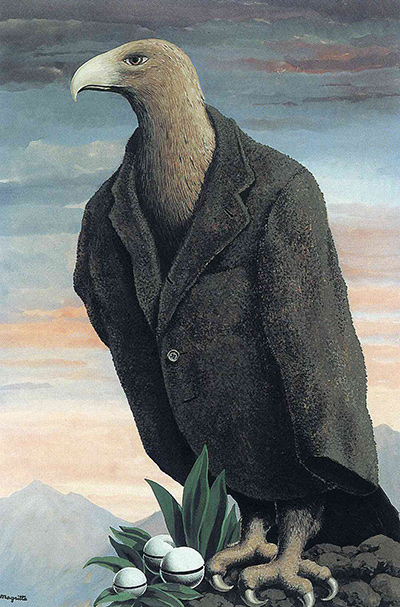
An eagle's head rises from the collar of a dark jacket. Below the garment, large talons grip the rocky ground beside green leaves and three pale, spherical bells. A cloudy sky opens behind the figure, whose upright bearing recalls a formal portrait even though its head and feet remain unmistakably those of a bird.
René Magritte's The Present, or Le Présent, is a gouache on paper. The Musée d'Orsay and Musée de l'Orangerie's educational brochure reproduces it with the date 1939 and a private-collection caption. Museum Boijmans Van Beuningen's research gives the broader dating 1938 or 1939. [1] [2]
At a Glance
Contents
A jacket that changes the bird
The jacket is the composition's largest dark form. Its lapels, button and folded edges make it recognisable as clothing rather than plumage. The garment gives the central figure a human outline without turning the exposed head into a human face.
Its shoulders create a broad silhouette that narrows towards the feet. Within that silhouette, much of the bird's body becomes unavailable to view. We understand the jacket through its familiar construction, while the concealed anatomy remains unresolved.
The effect is more specific than an animal simply standing beside a human object. The clothing occupies the place of the bird's body and appears fitted around it. That relationship makes us reconsider the jacket as well as the eagle: an ordinary garment begins to look like a structure capable of giving a nonhuman creature a recognisably social posture.
The head above the collar
The curved beak and round eye remain clear against the sky. The head turns towards the left, giving the figure a direction of attention. Its profile differs from the jacket's more frontal presentation, creating a small but significant tension within the apparently composed pose.
The neck carries fine changes of colour and texture, unlike the broad passages of dark fabric below. This distinction keeps the animal visible as an animal. Magritte has not smoothed every part into a single fantasy material; the mismatch depends on the two surfaces retaining different identities.
Follow the collar around the base of the neck. The join is presented without a dramatic seam or an explanatory mechanism. The bird simply occupies the garment. The clarity of that contact makes the whole arrangement easy to recognise and difficult to accept as an ordinary dressed body.
Talons and the missing wings
At the bottom, the bird's feet emerge beneath the jacket. Their curved claws and articulated toes provide a second clear statement of animal anatomy. They also establish a contact with the rough ground that gives the figure apparent weight.
Between head and feet, the clothing hides the body. We do not see outstretched wings or a convincing human pair of hands. The jacket offers expectations about limbs that the image does not fulfil.
That absence changes the figure's possible actions. A bird might ordinarily fly, perch or spread its wings; a person wearing a jacket might gesture with an arm. Here, the garment's closed outline suspends those familiar possibilities. The figure remains upright and imposing, but its capacity for movement is harder to imagine than its physical presence.
The pale bells among the leaves
Three pale spheres occupy the lower-left area near the feet. Dark slits identify them as bells rather than eggs. Their smooth, rounded forms contrast with the sharp beak, irregular claws and uneven stones.
Watch: Understanding Magritte
Three complementary films introduce the artist, explore words and images, and examine a painting’s materials. These are broader Magritte comparisons, alongside the work discussed here.
René Magritte: Great Art Explained
An introduction to Magritte’s life, characteristic images and visual puzzles.
Watch on YouTubeGreen leaves gather around and behind them. Their pointed outlines give the small group a different rhythm from the jacket's broad lapels. The combination of foliage and bells looks carefully arranged, though the painting does not supply a practical reason for it.
Compare the dark marks on the bells with the darker gaps between the leaves. Both make small interruptions within otherwise clear shapes. At this scale, the image asks for a different kind of attention from the imposing central figure: the viewer can inspect particular edges and surfaces rather than immediately reading the group as a portrait-like whole.
Ground, sky and the upright figure
The rocky foreground supports the eagle and its surrounding objects. Its irregularity is visible around the talons, where the distinction between a gripping foot and the surface beneath it becomes especially clear. This local detail helps the unusual figure feel physically situated.
Behind it, bands of cloud and lighter sky create an open distance. The darker upper area and warmer light near the horizon set off the head and jacket without enclosing them in a room. The figure is dressed as though for a human setting, but the landscape remains exposed.
The vertical format intensifies its presence. The head rises into the upper area, the jacket occupies the middle, and the feet and bells gather below. The composition has the organisation of a standing figure even while the details resist a straightforward account of what kind of figure it is.
An association described in correspondence
Museum Boijmans Van Beuningen discusses Le Présent in a scholarly entry about another Magritte gouache, La saignée. The entry relates Magritte's need for fresh associations of images in a letter to Marcel Mariën and connects the combination of an eagle and jacket with this work. [2]
That documented connection helps explain the composition as a deliberate conjunction of recognisable things. It does not establish a single symbolic translation for the bird, the garment or the bells. The image can produce several associations without each becoming a recorded intention.
The distinction is useful when looking at the figure's authority. Its upright stance and dark clothing may feel formal or imposing, but those responses arise from the visible arrangement. Naming a particular political person or treating the bells as a coded family story would require evidence beyond what the composition alone can provide.
Date, medium and the appearance of certainty
The matched museum reproduction is captioned 1939, while the broader 1938-or-1939 dating remains in the Boijmans research. Both refer to the gouache subject. The difference should remain visible rather than being concealed behind a falsely exact chronology. [1] [2]
The medium also distinguishes the work from Magritte's oil paintings. A gouache is not made into an oil simply because its modelling looks controlled and substantial. Here, the jacket's volume and the bird's textured neck make recognisable forms convincing without making their combination ordinary.
Look again from the beak to the lapels, then down towards the feet. Each transition crosses a boundary between familiar kinds of things. The landscape and the small group of bells give the figure a setting, but they do not explain it away. The Present holds its viewer through the precise visibility of a conjunction whose meaning remains open to examination.
Magritte artworks directory
| Name | Date | Medium |
|---|---|---|
| Memory of a Voyage | 1963 | Oil on canvas |
| The Blood of the World | 1927; also catalogued as 1926–27 | Oil on canvas |
| The Hunters at the Edge of Night | Paris, 1928 | Oil on canvas |
| The Empty Picture Frame (La saignée) | 1938–39 | Gouache on paper |
| The Glass House | 1939 | Gouache on paper |
| Oasis | 1926 in the illustrated Christie’s catalogue | Oil on canvas |
| Natural Encounters | 1945 | Oil on canvas |
| Attempting the Impossible | 1928 | Oil on canvas |
| On the Threshold of Liberty | 1930 | Oil on canvas |
| The Titanic Days | 1928 | Oil on canvas |
| The Voice of Space | 1931 | Oil on canvas |
| Unexpected Answer | 1932 in the museum catalogue, 1933 on the reverse | Oil on canvas |
| Elective Affinities | 1932 in MoMA’s checklist, also published as 1933 | Oil on canvas |
| The Human Condition II | 1935 | Oil on canvas |
| The Six Elements | 1929 | Oil on canvas |
| The Happy Donor | 1966 | Oil on canvas |
| Clairvoyance (Self Portrait) | Brussels, 1936 | Oil on canvas |
| Philosopher’s Lamp | 1936 | Oil on canvas |
| The Annunciation | Paris, 1930 | Oil on canvas |
| The Lost Jockey | Circa 1942 in the illustrated lot catalogue | Gouache on paper laid down on canvas |
| Homage to Mack Sennett | 1936 in the Thyssen catalogue | Oil on canvas |
| Discovery | 1927 | Oil on canvas |
| Collective Invention | 1935 in the later catalogue index | Oil on canvas |
| The Wonders of Nature | 1953 | Oil on canvas |
| The Balcony | Circa 1950, with 1950 inscribed on the reverse | Oil on canvas |
| The Pilgrim | 1966 | Oil on canvas |
| The Invention of Life | 1928 | Oil on canvas |
| The Therapist | 1941 | Gouache on paper |
| The Gradation of Fire | 1938 or 1939 in the catalogue index | Gouache on paper |
| A Friend of Order | 1964 | Oil on canvas |
| The Poetic World | 1939 in Hammacher’s illustrated monograph | Gouache |
| The Muscles of the Sky | Paris, 1927 | Oil on canvas |
| The Battle of the Argonne | 1959 | Oil on canvas |
| Meditation | 1936 | Oil on canvas |
| The Domain of Arnheim | 1962 | Oil on canvas |
| This Is Not an Apple | 1964 | Oil on Unilite |
| The Meaning of Night | Brussels, 1927 | Oil on canvas |
| The Pleasure Principle (Portrait of Edward James) | 1937 | Oil on canvas |
| Ready Made Bouquet | 1957 | Oil on canvas |
| Popular Panorama | 1926 | Oil on canvas |
| Memory of a Journey | 1955 in the Thyssen catalogue. Tentatively 1958 in the catalogue index. | Gouache on paper, as exhibited at the Thyssen |
| Sheherazade | 1947 | Gouache on paper |
| The Difficult Crossing | 1926 | Oil on canvas |
| The Fair Captive | 1948 in the catalogue raisonné | Oil on canvas |
| The Birth of the Idol | 1926 | Oil on canvas |
| Hegel’s Holiday | 1958 | Oil on canvas |
| Homesickness | 1941 | Oil on canvas |
| The Rape (Le Viol) | 1934 | Oil on canvas |
| The Art of Living | 1967 | Oil on canvas |
| Secret Life IV | 1928 | Oil on canvas |
| The Tomb of the Wrestlers | 1960 | Oil on canvas |
| Young Girl Eating a Bird (The Pleasure) | 1927 | Oil on canvas |
| The Central Story | 1928 | Oil on canvas |
| The Seducer | 1953 | Oil on canvas |
| The Telescope | 1963 | Oil on canvas |
| The Banquet | 1958 | Oil on canvas |
| The Empty Mask | 1928 | Oil on canvas |
| The Cultivation of Ideas | 1927 | Oil on canvas |
| The Enchanted Pose | 1927 | Oil on canvas |
| The Future of Statues | 1937 | Oil on plaster |
| The Return of the Flame | 1943 | Oil on canvas |
| The White Page | 1967 | Oil on canvas |
| The Large Family | 1963 | Oil on canvas |
| Black Magic | 1945 | Oil on canvas |
| Les Amants I | 1928 | Oil on canvas |
| Man in a Bowler Hat | 1964 | Oil on canvas |
| The Portrait | 1935 | Oil on canvas |
| The Sixteenth of September | 1956 | Oil on canvas |
| Heartstrings | 1960 | Oil on canvas |
| The Present | 1939; also dated 1938 or 1939 | Gouache on paper |
| Act of Violence | 1932 | Oil on canvas |
| Fashionable People | 1950, in the 2016 thesis caption | Medium unconfirmed · Attribution follows the published caption |
| The Representation | 1962 | Oil on canvas |
| Memory | 1948 | Gouache on paper |
| The Mysteries of the Horizon | 1955 | Oil on canvas |
| Portrait of Stephy Langui | 1961 | Oil on canvas |
| The Double Secret | 1927 | Oil on canvas |
| Every Day | 1966 | Oil on canvas |
| The Invisible World | 1954 | Oil on canvas |
| Dawn of Cayenne | 1926 | Oil painting |
| Clear Ideas | 1955 (inscribed); possible 1958 execution | Oil on canvas |
| The Face of Genius | 1926 / 1927 | Oil on canvas |
| Good Faith | 1965; earlier record 1964–65 | Oil on canvas |
| The Flash | 1959 | Gouache and pencil on paper |
| Perpetual Motion | 1935; earlier catalogue 1934 | Oil on canvas |
| Personal Values | 1952 | Oil on canvas |
| Not to Be Reproduced | 1937 | Oil on canvas |
| The Red Model | 1935 | Oil on canvas |
| The Menaced Assassin | 1927 | Oil on canvas |
| The Castle of the Pyrenees | 1959 | Oil on canvas |
| The Blank Signature | 1965 | Oil on canvas |
| The Listening Room | 1952 | Oil on canvas |
| Golconde | 1953 | Oil on canvas |
| Time Transfixed | 1938 | Oil on canvas |
| The Treachery of Images | 1929 | Oil on canvas |
| The False Mirror | 1929 | Oil on canvas |
| The Empire of Light | 1953–54 | Oil on canvas |
| The Human Condition | 1933 | Oil on canvas |
| Les Amants | 1928 | Oil on canvas |
| The Son of Man | 1964 | Oil on canvas |
Frequently Asked Questions
Discussion
Compare the familiar objects with the spaces they appear to occupy.
Reader Insights
How does the jacket affect your sense of the eagle's posture?
Which detail most clearly distinguishes the pale spheres from eggs?
What changes when you imagine the wings concealed beneath the clothing?
Join the Conversation
Share a detail, comparison or question about The Present below.
References
- Musée d'Orsay and Musée de l'Orangerie, Activités éducatives 2020–2021, p. 25: reproduction of Le Présent, dated 1939 and captioned private collection. View source.Splash image: The Present, gouache on paper. Dated 1939 in the Orsay/Orangerie brochure and 1938 or 1939 in Boijmans research; private collection in the 2021 brochure.
- Museum Boijmans Van Beuningen, Marijke Peyser, research entry for La saignée, in A Dream Collection: passage on Magritte's letter to Marcel Mariën and the gouache Le présent, dated 1938 or 1939. View source.







