


 by Tom Gurney
Tom Gurney BSc (Hons) is an art history expert with over 20 years experience
Page created on / Page updated on
Email: tomgurney1@gmail.com / Phone: +44 7429 011000
The Hunters at the Edge of Night
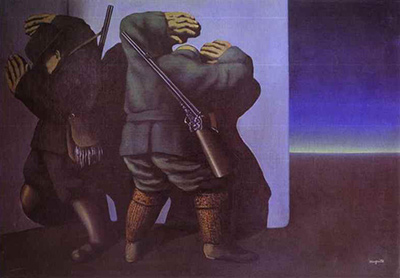
Two hunters lift their hands as if to ward something off. One is close to the left edge of the picture. The other turns his back to us beside the sharply lit end of a wall. Both carry guns, yet neither seems ready to use one. Beyond the wall, an open stretch of ground meets a thin line of light. What has startled the hunters is difficult to place in that space. Their alarm is much clearer than its cause.
René Magritte painted Les Chasseurs au bord de la nuit in Paris in 1928. The oil on canvas is approximately 81 × 116 centimetres and is number 228 in the first volume of the catalogue raisonné. The Museum of Modern Art included it in the New York presentation of Magritte: The Mystery of the Ordinary, 1926–1938 and gives the lender as a private collection. [1]
At a Glance
- Original titleLes Chasseurs au bord de la nuit
- Date and placeParis, 1928
- MediumOil on canvas
- SizeApproximately 81 × 116 cm
- Catalogue numberSylvester I 228
Selected works
The Blood of the World
1927; also catalogued as 1926–27Contents
Hands, rifles and the edge of the wall
The two men occupy most of the left side. On the far left, a hat casts the upper part of a face into shadow. One hand opens beside it, with the fingers spread. The other hunter wears a thick green coat and turns his back towards us. His arms reach upwards. His rifle lies diagonally across the coat, and the metal and wooden parts of the gun make a crisp interruption in the fabric. The orange-brown leggings and heavy shoes at the bottom give him weight, even though the position of his upper body is hard to make sense of.
These details tell us something about what the men can do. They look equipped to follow an animal or wait for it to appear. In this moment, the raised hands are doing something more immediate than handling the weapons. The figure nearest the wall seems to withdraw into his shoulders, while the open hand at the left pulls our attention towards the edge of the picture. We can recognise the equipment and still have trouble imagining what the next movement would be.
The wall gives that trouble a visible shape. Its broad pale plane is easy to follow above the men and where it ends at the right. At the hunters’ heads and shoulders, its relationship to them is less certain. One man’s hat and hands are visible without giving us a full view of his head. The other man’s lifted arms and bent posture make it difficult to locate precisely where he ends and the plane behind him begins. The Christie’s catalogue discusses the impression that their bodies are becoming caught in the wall. That reading explains why a surface that seems simple at the right becomes so hard to read nearer the centre. [2]
The line where night begins
To the right of the wall there is a clear view of the horizon. A thread of light separates the flat brown ground from the dark blue above it. The strip is narrow enough to seem very far away. The left-hand side, by contrast, is so crowded with fabric, limbs and weapons that it brings us immediately back to the foreground. The wall is where those two experiences meet. Move your eye across it and a picture that feels hemmed in by bodies suddenly opens up.
The title gives the light a temporal meaning. Au bord de la nuit suggests being at the edge of night, a point at which the light can still be seen and darkness already occupies much of the view. A dawn or evening reading is possible. The picture gives us little to settle which way the light is changing. What we can see clearly is the division it makes between ground and sky. Reading the title draws our attention to that border, then sends us back to the other borders we have trouble following.
Watch: Understanding Magritte
Three complementary films introduce the artist, explore words and images, and examine a painting’s materials. These are broader Magritte comparisons, alongside the work discussed here.
René Magritte: Great Art Explained
An introduction to Magritte’s life, characteristic images and visual puzzles.
Watch on YouTubeThe title also lets the idea of an edge travel through the picture. There is the edge of the wall, the line between the sky and land, and the interrupted contour of each hunter. The wall seems firm where it divides near space from distant space. Near the men, where it might have furnished a familiar spatial reference, it contributes to our uncertainty. The two effects happen within a short distance of one another.
A figure that cannot be untangled
In The Titanic Days, another work dated 1928, Magritte compresses two figures into an outline that is difficult to prise apart. The version in the Kunstsammlung Nordrhein-Westfalen is a vertical canvas and carries the title with a second-version indication on its reverse. In it, the dark figure overlaps the lighter body so closely that tracing one against the other becomes part of seeing the scene. An exhibition in Düsseldorf in 1996–97 brought The Hunters at the Edge of Night into the company of that work. [3] [4]
The comparison clarifies what the wall contributes to the hunters’ predicament. In The Titanic Days, the contour of one body determines how much can be seen of another. In The Hunters at the Edge of Night, a flat architectural surface is drawn into a similar visual relationship. We can see why a viewer might say the men are being absorbed by it. A description such as that is most convincing when it remains tied to specific passages, where a contour ends, a hand appears without the expected view of a face, or a garment carries on past the point where we can imagine the body beneath it.
The Menaced Assassin also sets armed figures around a boundary. The 1927 painting puts two men at the sides of a doorway. MoMA relates their positions to the Fantômas serial, which helps account for some of the painting’s staging. We can use the comparison to notice how differently the two pictures direct attention. The doorway in The Menaced Assassin gives a view into a furnished room. At the right of the wall in The Hunters at the Edge of Night, the view offers the ground and sky, leaving the reason for the alarm elusive. [5]
From Paris to Brussels and beyond
Magritte was living in the Paris area when he painted the work, but its early history ran through Brussels. The auction literature records an August 1928 postcard from him to E. L. T. Mesens and lists an illustration in the November 1928 issue of Variétés. Paul-Gustave van Hecke had founded that Brussels journal earlier in the year. An image as deeply concerned with partial views and the position of figures was already reaching readers who could see it on a printed page far from the canvas. [4] [6]
The early provenance runs from Galerie L’Époque to Galerie Le Centaure, and then through Mesens and Claude Spaak. The painting was recorded at the Salle Giso in Brussels in 1931, in the Minotaure exhibition in Brussels in 1934 and at the Julien Levy Gallery in New York in 1938. It appeared in the Belgian pavilion at Venice in 1954. Later records trace it through William and Noma Copley and Alfred Neven DuMont, followed by the London Christie’s sale of 2014. These are documented stages in the life of the canvas. The exhibition records tell us where people could see it at particular dates, while the provenance follows the people and galleries through whose hands it passed. [2] [4]
A useful way to return to the painting is to begin at the far right, with the light on the horizon, and work back towards the hunters. Following that direction, we pass from the picture’s clearest boundary to the places where the bodies and wall are least easy to separate. The weapons may be the first thing we recognise, but the angles of the hands and the space they seem to push against are what leave the encounter suspended.
Magritte artworks directory
| Name | Date | Medium |
|---|---|---|
| Memory of a Voyage | 1963 | Oil on canvas |
| The Blood of the World | 1927; also catalogued as 1926–27 | Oil on canvas |
| The Hunters at the Edge of Night | Paris, 1928 | Oil on canvas |
| The Empty Picture Frame (La saignée) | 1938–39 | Gouache on paper |
| The Glass House | 1939 | Gouache on paper |
| Oasis | 1926 in the illustrated Christie’s catalogue | Oil on canvas |
| Natural Encounters | 1945 | Oil on canvas |
| Attempting the Impossible | 1928 | Oil on canvas |
| On the Threshold of Liberty | 1930 | Oil on canvas |
| The Titanic Days | 1928 | Oil on canvas |
| The Voice of Space | 1931 | Oil on canvas |
| Unexpected Answer | 1932 in the museum catalogue, 1933 on the reverse | Oil on canvas |
| Elective Affinities | 1932 in MoMA’s checklist, also published as 1933 | Oil on canvas |
| The Human Condition II | 1935 | Oil on canvas |
| The Six Elements | 1929 | Oil on canvas |
| The Happy Donor | 1966 | Oil on canvas |
| Clairvoyance (Self Portrait) | Brussels, 1936 | Oil on canvas |
| Philosopher’s Lamp | 1936 | Oil on canvas |
| The Annunciation | Paris, 1930 | Oil on canvas |
| The Lost Jockey | Circa 1942 in the illustrated lot catalogue | Gouache on paper laid down on canvas |
| Homage to Mack Sennett | 1936 in the Thyssen catalogue | Oil on canvas |
| Discovery | 1927 | Oil on canvas |
| Collective Invention | 1935 in the later catalogue index | Oil on canvas |
| The Wonders of Nature | 1953 | Oil on canvas |
| The Balcony | Circa 1950, with 1950 inscribed on the reverse | Oil on canvas |
| The Pilgrim | 1966 | Oil on canvas |
| The Invention of Life | 1928 | Oil on canvas |
| The Therapist | 1941 | Gouache on paper |
| The Gradation of Fire | 1938 or 1939 in the catalogue index | Gouache on paper |
| A Friend of Order | 1964 | Oil on canvas |
| The Poetic World | 1939 in Hammacher’s illustrated monograph | Gouache |
| The Muscles of the Sky | Paris, 1927 | Oil on canvas |
| The Battle of the Argonne | 1959 | Oil on canvas |
| Meditation | 1936 | Oil on canvas |
| The Domain of Arnheim | 1962 | Oil on canvas |
| This Is Not an Apple | 1964 | Oil on Unilite |
| The Meaning of Night | Brussels, 1927 | Oil on canvas |
| The Pleasure Principle (Portrait of Edward James) | 1937 | Oil on canvas |
| Ready Made Bouquet | 1957 | Oil on canvas |
| Popular Panorama | 1926 | Oil on canvas |
| Memory of a Journey | 1955 in the Thyssen catalogue. Tentatively 1958 in the catalogue index. | Gouache on paper, as exhibited at the Thyssen |
| Sheherazade | 1947 | Gouache on paper |
| The Difficult Crossing | 1926 | Oil on canvas |
| The Fair Captive | 1948 in the catalogue raisonné | Oil on canvas |
| The Birth of the Idol | 1926 | Oil on canvas |
| Hegel’s Holiday | 1958 | Oil on canvas |
| Homesickness | 1941 | Oil on canvas |
| The Rape (Le Viol) | 1934 | Oil on canvas |
| The Art of Living | 1967 | Oil on canvas |
| Secret Life IV | 1928 | Oil on canvas |
| The Tomb of the Wrestlers | 1960 | Oil on canvas |
| Young Girl Eating a Bird (The Pleasure) | 1927 | Oil on canvas |
| The Central Story | 1928 | Oil on canvas |
| The Seducer | 1953 | Oil on canvas |
| The Telescope | 1963 | Oil on canvas |
| The Banquet | 1958 | Oil on canvas |
| The Empty Mask | 1928 | Oil on canvas |
| The Cultivation of Ideas | 1927 | Oil on canvas |
| The Enchanted Pose | 1927 | Oil on canvas |
| The Future of Statues | 1937 | Oil on plaster |
| The Return of the Flame | 1943 | Oil on canvas |
| The White Page | 1967 | Oil on canvas |
| The Large Family | 1963 | Oil on canvas |
| Black Magic | 1945 | Oil on canvas |
| Les Amants I | 1928 | Oil on canvas |
| Man in a Bowler Hat | 1964 | Oil on canvas |
| The Portrait | 1935 | Oil on canvas |
| The Sixteenth of September | 1956 | Oil on canvas |
| Heartstrings | 1960 | Oil on canvas |
| The Present | 1939; also dated 1938 or 1939 | Gouache on paper |
| Act of Violence | 1932 | Oil on canvas |
| Fashionable People | 1950, in the 2016 thesis caption | Medium unconfirmed · Attribution follows the published caption |
| The Representation | 1962 | Oil on canvas |
| Memory | 1948 | Gouache on paper |
| The Mysteries of the Horizon | 1955 | Oil on canvas |
| Portrait of Stephy Langui | 1961 | Oil on canvas |
| The Double Secret | 1927 | Oil on canvas |
| Every Day | 1966 | Oil on canvas |
| The Invisible World | 1954 | Oil on canvas |
| Dawn of Cayenne | 1926 | Oil painting |
| Clear Ideas | 1955 (inscribed); possible 1958 execution | Oil on canvas |
| The Face of Genius | 1926 / 1927 | Oil on canvas |
| Good Faith | 1965; earlier record 1964–65 | Oil on canvas |
| The Flash | 1959 | Gouache and pencil on paper |
| Perpetual Motion | 1935; earlier catalogue 1934 | Oil on canvas |
| Personal Values | 1952 | Oil on canvas |
| Not to Be Reproduced | 1937 | Oil on canvas |
| The Red Model | 1935 | Oil on canvas |
| The Menaced Assassin | 1927 | Oil on canvas |
| The Castle of the Pyrenees | 1959 | Oil on canvas |
| The Blank Signature | 1965 | Oil on canvas |
| The Listening Room | 1952 | Oil on canvas |
| Golconde | 1953 | Oil on canvas |
| Time Transfixed | 1938 | Oil on canvas |
| The Treachery of Images | 1929 | Oil on canvas |
| The False Mirror | 1929 | Oil on canvas |
| The Empire of Light | 1953–54 | Oil on canvas |
| The Human Condition | 1933 | Oil on canvas |
| Les Amants | 1928 | Oil on canvas |
| The Son of Man | 1964 | Oil on canvas |
Frequently Asked Questions
The Museum of Modern Art exhibition checklist records Paris, 1928, and identifies the oil as catalogue raisonné number 228.
Their raised hands suggest alarm. The ground and sky to the right offer no visible cause for their reaction.
Discussion
Look closely and compare your reading with others.
Reader Insights
Where does the wall first seem to interfere with the shape of a hunter?
What does the strip of light tell you about the space beyond the wall?
How does your reading change if you follow one of the rifles before looking at the hands?
Join the Conversation
Share a detail, comparison or question about The Hunters at the Edge of Night below.
References
- The Museum of Modern Art, Magritte: The Mystery of the Ordinary, 1926–1938, exhibition checklist, p. 7, Sylvester no. 228 and New York venue. View source.
- Christie’s, Les chasseurs au bord de la nuit, London, 2014, lot 5766448, illustrated composition, provenance and commentary. View source.
- Kunstsammlung Nordrhein-Westfalen, Les jours gigantesques, 1928, inventory 0275, illustrated collection record. View source.
- Christie’s, Les chasseurs au bord de la nuit, lot 6509413, catalogued literature, correspondence, provenance and exhibitions. View source.
- The Museum of Modern Art, The Menaced Assassin, 1927, object 247.1966, collection record and gallery label. View source.
- Art Institute of Chicago, Ryerson and Burnham Libraries, “Case 6: Variétés,” exhibition of Belgian Surrealist publications. View source.







