


 by Tom Gurney
Tom Gurney BSc (Hons) is an art history expert with over 20 years experience
Page created on / Page updated on
Email: tomgurney1@gmail.com / Phone: +44 7429 011000
The Lost Jockey
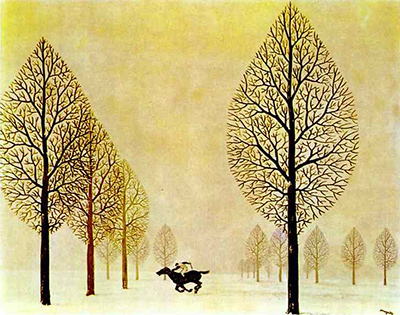
A dark horse gallops across a pale clearing in René Magritte’s The Lost Jockey. Its rider leans low over its neck. On both sides, rows of bare trees recede into the distance, and two large crowns rise like leaves against the sky. The rider is travelling quickly enough for the horse’s legs to gather and stretch beneath it, yet it is difficult to tell where the opening between the trees leads. The nearest trunks give the scene a strong sense of depth. They also make the horse and rider look very small.
Magritte used the French title Le Jockey perdu for several different compositions. The clearing shown here, with two large leaf-shaped crowns and a small rider near the lower edge, matches the gouache catalogued by Sotheby’s as circa 1942 and as number 1178 in volume IV of the catalogue raisonné. It measures 50.7 by 65.2 centimetres and is painted on paper laid down on canvas. A thesis in the São Paulo State University repository reproduces the yellow-toned image with a 1948 caption. The circa 1942 date follows the illustrated lot record for the identifiable object. [1] [2]
At a Glance
- Original titleLe Jockey perdu
- DateCirca 1942 in the illustrated lot catalogue
- MediumGouache on paper laid down on canvas
- Size50.7 × 65.2 cm
- Catalogue numberSylvester IV 1178
Selected works
Discovery
1927Collective Invention
1935 in the later catalogue indexHomage to Mack Sennett
1936 in the Thyssen catalogueThe Lost Jockey
Circa 1942 in the illustrated lot catalogueContents
The trees lead back into the clearing
The foremost tree on the right rises almost to the top of the picture. The crown widens from the tip, then curves inward towards the trunk. This outline is made up of the ends of the branches. Look closer and the edge unravels into a multitude of small forks, each leaving a patch of lighter sky between its points. The shape reads as a large leaf from a distance. Close up, it is made of the visible parts of a leafless tree.
The central trunk works much like the vein of a leaf. Its darker line runs up through the crown, and the branches divide on either side before they reach the perimeter. At the bottom, that same line continues out of the crown and meets the pale ground. The trunk belongs to both readings. It gives the crown a central axis and puts the whole form at a particular place in the landscape. The tree at the left repeats the arrangement on a smaller scale. Its top begins lower in the sky and some of its branches reach the edge of the picture.
The smaller trees help make the scene more legible. Behind the foremost trunks, progressively thinner ones meet the ground higher in the field of view. Their branches are less distinct and their colours grow paler. We can follow the left row towards a clearing near the middle. On the right, some of the nearest tree’s branches interrupt the view of the smaller crowns. These are familiar ways to paint depth. Magritte uses them to make the repeated shapes look increasingly distant even as their pointed outlines make them look like variations on the same leaf.
Watch: Understanding Magritte
Three complementary films introduce the artist, explore words and images, and examine a painting’s materials. These are broader Magritte comparisons, alongside the work discussed here.
René Magritte: Great Art Explained
An introduction to Magritte’s life, characteristic images and visual puzzles.
Watch on YouTubeThe pale clearing has few markings at ground level. Its surface looks snow-like in the existing reproduction. Small changes of colour are easier to see than any track, fence or boundary. The meeting points of the trunks and ground therefore do much of the work of placing the trees. If we look away from those points and let the pale sky and ground come together, the smaller trees begin to look suspended within the same light. Returning to the dark bases of the foreground trunks gives the clearing its depth again.
A gallop beneath the branches
The horse and rider are easiest to find by scanning the open space near the bottom. The horse’s head projects to the left and its tail to the right. The rider forms a small pale patch above the dark body. The angled legs and forward lean imply haste, but the ground offers no visible rail or track for their movement. Following their direction takes the eye across the foreground. Following the rows of trees takes it back into the distance. The two directions barely meet.
The clearing around the horse gives it an uninterrupted outline. That makes the action clear even at a fraction of the size of the trees. It also lets us imagine the rider passing behind a trunk only a moment later, where the same shape might disappear. The title gives a possible account of that movement. A jockey who has lost the way can still be racing, and the trees can mark out a route without pointing to a destination. The picture makes the motion easy to recognise and gives us very little evidence of where it will end.
The strongest dark accents belong to the horse and the stems of the nearest trees. That resemblance in tone helps keep the small figure from getting lost in the pale ground. The difference is in the direction of the marks. The trunks rise almost straight, and their branching is repeated on both sides of the clearing. The horse compresses its dark shape into a short horizontal passage. Even on a small reproduction, it breaks the rhythm set by the trees.
Other versions of the lost jockey
MoMA’s exhibition documents a 1926 Lost Jockey made with cut-and-pasted sheet music, watercolour, pencil and ink. Magritte also made an oil version that year. The early works place the rider among forms that can resemble turned wooden objects as well as trees. The theme returned in a 1942 oil, documented separately in the Sotheby’s catalogue. A later gouache, dated to late 1947 or early 1948 in its illustrated lot entry, brings back tall trees and adds framing curtains. That work is catalogue raisonné number 1253. Its setting and lower-left signature distinguish it from the gouache with the pale clearing. [3] [4] [5]
The lot record for the pictured gouache lists it in the 1999 exhibition Surrealism: Two Private Eyes at the Solomon R. Guggenheim Museum and in Magritte: The Use of Painting at the Jeu de Paume in 2003. Its catalogue history helps separate this composition from other works with the same title. Within the image, the most recognisable difference is the form of the nearest trees. Follow the bare branches up each trunk and the impression of a leaf gradually appears. Follow the horse across the clearing and the same trees again become the large, upright things it is passing. [1]
Magritte artworks directory
| Name | Date | Medium |
|---|---|---|
| Memory of a Voyage | 1963 | Oil on canvas |
| The Blood of the World | 1927; also catalogued as 1926–27 | Oil on canvas |
| The Hunters at the Edge of Night | Paris, 1928 | Oil on canvas |
| The Empty Picture Frame (La saignée) | 1938–39 | Gouache on paper |
| The Glass House | 1939 | Gouache on paper |
| Oasis | 1926 in the illustrated Christie’s catalogue | Oil on canvas |
| Natural Encounters | 1945 | Oil on canvas |
| Attempting the Impossible | 1928 | Oil on canvas |
| On the Threshold of Liberty | 1930 | Oil on canvas |
| The Titanic Days | 1928 | Oil on canvas |
| The Voice of Space | 1931 | Oil on canvas |
| Unexpected Answer | 1932 in the museum catalogue, 1933 on the reverse | Oil on canvas |
| Elective Affinities | 1932 in MoMA’s checklist, also published as 1933 | Oil on canvas |
| The Human Condition II | 1935 | Oil on canvas |
| The Six Elements | 1929 | Oil on canvas |
| The Happy Donor | 1966 | Oil on canvas |
| Clairvoyance (Self Portrait) | Brussels, 1936 | Oil on canvas |
| Philosopher’s Lamp | 1936 | Oil on canvas |
| The Annunciation | Paris, 1930 | Oil on canvas |
| The Lost Jockey | Circa 1942 in the illustrated lot catalogue | Gouache on paper laid down on canvas |
| Homage to Mack Sennett | 1936 in the Thyssen catalogue | Oil on canvas |
| Discovery | 1927 | Oil on canvas |
| Collective Invention | 1935 in the later catalogue index | Oil on canvas |
| The Wonders of Nature | 1953 | Oil on canvas |
| The Balcony | Circa 1950, with 1950 inscribed on the reverse | Oil on canvas |
| The Pilgrim | 1966 | Oil on canvas |
| The Invention of Life | 1928 | Oil on canvas |
| The Therapist | 1941 | Gouache on paper |
| The Gradation of Fire | 1938 or 1939 in the catalogue index | Gouache on paper |
| A Friend of Order | 1964 | Oil on canvas |
| The Poetic World | 1939 in Hammacher’s illustrated monograph | Gouache |
| The Muscles of the Sky | Paris, 1927 | Oil on canvas |
| The Battle of the Argonne | 1959 | Oil on canvas |
| Meditation | 1936 | Oil on canvas |
| The Domain of Arnheim | 1962 | Oil on canvas |
| This Is Not an Apple | 1964 | Oil on Unilite |
| The Meaning of Night | Brussels, 1927 | Oil on canvas |
| The Pleasure Principle (Portrait of Edward James) | 1937 | Oil on canvas |
| Ready Made Bouquet | 1957 | Oil on canvas |
| Popular Panorama | 1926 | Oil on canvas |
| Memory of a Journey | 1955 in the Thyssen catalogue. Tentatively 1958 in the catalogue index. | Gouache on paper, as exhibited at the Thyssen |
| Sheherazade | 1947 | Gouache on paper |
| The Difficult Crossing | 1926 | Oil on canvas |
| The Fair Captive | 1948 in the catalogue raisonné | Oil on canvas |
| The Birth of the Idol | 1926 | Oil on canvas |
| Hegel’s Holiday | 1958 | Oil on canvas |
| Homesickness | 1941 | Oil on canvas |
| The Rape (Le Viol) | 1934 | Oil on canvas |
| The Art of Living | 1967 | Oil on canvas |
| Secret Life IV | 1928 | Oil on canvas |
| The Tomb of the Wrestlers | 1960 | Oil on canvas |
| Young Girl Eating a Bird (The Pleasure) | 1927 | Oil on canvas |
| The Central Story | 1928 | Oil on canvas |
| The Seducer | 1953 | Oil on canvas |
| The Telescope | 1963 | Oil on canvas |
| The Banquet | 1958 | Oil on canvas |
| The Empty Mask | 1928 | Oil on canvas |
| The Cultivation of Ideas | 1927 | Oil on canvas |
| The Enchanted Pose | 1927 | Oil on canvas |
| The Future of Statues | 1937 | Oil on plaster |
| The Return of the Flame | 1943 | Oil on canvas |
| The White Page | 1967 | Oil on canvas |
| The Large Family | 1963 | Oil on canvas |
| Black Magic | 1945 | Oil on canvas |
| Les Amants I | 1928 | Oil on canvas |
| Man in a Bowler Hat | 1964 | Oil on canvas |
| The Portrait | 1935 | Oil on canvas |
| The Sixteenth of September | 1956 | Oil on canvas |
| Heartstrings | 1960 | Oil on canvas |
| The Present | 1939; also dated 1938 or 1939 | Gouache on paper |
| Act of Violence | 1932 | Oil on canvas |
| Fashionable People | 1950, in the 2016 thesis caption | Medium unconfirmed · Attribution follows the published caption |
| The Representation | 1962 | Oil on canvas |
| Memory | 1948 | Gouache on paper |
| The Mysteries of the Horizon | 1955 | Oil on canvas |
| Portrait of Stephy Langui | 1961 | Oil on canvas |
| The Double Secret | 1927 | Oil on canvas |
| Every Day | 1966 | Oil on canvas |
| The Invisible World | 1954 | Oil on canvas |
| Dawn of Cayenne | 1926 | Oil painting |
| Clear Ideas | 1955 (inscribed); possible 1958 execution | Oil on canvas |
| The Face of Genius | 1926 / 1927 | Oil on canvas |
| Good Faith | 1965; earlier record 1964–65 | Oil on canvas |
| The Flash | 1959 | Gouache and pencil on paper |
| Perpetual Motion | 1935; earlier catalogue 1934 | Oil on canvas |
| Personal Values | 1952 | Oil on canvas |
| Not to Be Reproduced | 1937 | Oil on canvas |
| The Red Model | 1935 | Oil on canvas |
| The Menaced Assassin | 1927 | Oil on canvas |
| The Castle of the Pyrenees | 1959 | Oil on canvas |
| The Blank Signature | 1965 | Oil on canvas |
| The Listening Room | 1952 | Oil on canvas |
| Golconde | 1953 | Oil on canvas |
| Time Transfixed | 1938 | Oil on canvas |
| The Treachery of Images | 1929 | Oil on canvas |
| The False Mirror | 1929 | Oil on canvas |
| The Empire of Light | 1953–54 | Oil on canvas |
| The Human Condition | 1933 | Oil on canvas |
| Les Amants | 1928 | Oil on canvas |
| The Son of Man | 1964 | Oil on canvas |
Frequently Asked Questions
The pale clearing with leaf-shaped trees and a small rider matches the gouache listed as Sylvester IV 1178, dated circa 1942 in its illustrated lot record.
Yes. The title also appears on works including a 1926 collage, oils from 1926 and 1942, and a separate later gouache with framing curtains.
Discussion
Look closely and compare your reading with others.
Reader Insights
Which tree or group of trees best establishes the depth of the clearing?
At what distance do the branches begin to read as the outline of a leaf?
How do the direction of the gallop and the direction of the rows affect your reading of the title?
Join the Conversation
Share a detail, comparison or question about The Lost Jockey below.
References
- Sotheby’s. Le Jockey perdu. Illustrated lot 24, Exquisite Corpus, 2025, citing Sylvester IV 1178. View source.
- Universidade Estadual Paulista institutional repository. Illustrated thesis, p. 111, Le jockey perdu captioned 1948. View source.
- Museum of Modern Art. Magritte: The Mystery of the Ordinary, 1926–1938. Online exhibition, The Lost Jockey. View source.
- Sotheby’s. Le Jockey perdu. Illustrated lot entry for the 1942 oil, Modern Evening Auction, 2025. View source.
- Sotheby’s. Le jockey perdu. Illustrated lot 41, 2018, citing Sylvester IV 1253. View source.







