


 by Tom Gurney
Tom Gurney BSc (Hons) is an art history expert with over 20 years experience
Page created on / Page updated on
Email: tomgurney1@gmail.com / Phone: +44 7429 011000
Homage to Mack Sennett
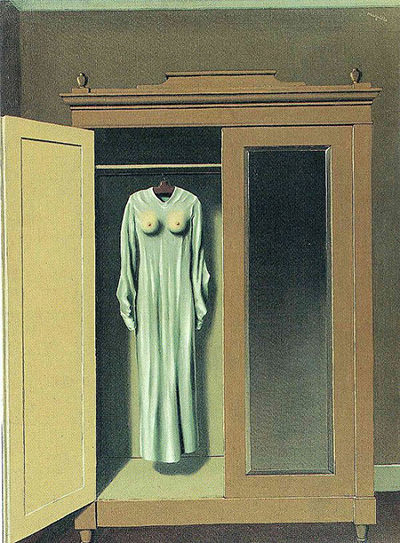
A long pale dress hangs in an open wardrobe in René Magritte’s Homage to Mack Sennett. It has a collar, sleeves and folds that fall towards the hem. At the chest, two breasts project from the garment. There is a hanger at the neck, and the ends of the sleeves hang down either side. The wardrobe makes the dress appear to have been put away. The way the fabric takes on the form of a body makes it harder to imagine what putting it on would mean.
The illustrated catalogue for the Thyssen-Bornemisza exhibition The Magritte Machine records this composition as In memoriam Mack Sennett, an oil on canvas dated 1936, with dimensions of 73 by 55 centimetres. It gives the owner as the City of La Louvière, inventory LL P 0220/1937, and identifies it as catalogue raisonné number 420. The same composition circulates under the English title Homage to Mack Sennett with a 1934 date in an image agency record. The date used here follows the illustrated exhibition catalogue and the corresponding loan list. [1] [2] [3]
At a Glance
- Catalogue titleIn memoriam Mack Sennett
- Date1936 in the Thyssen catalogue
- MediumOil on canvas
- Size73 × 55 cm
- CollectionCity of La Louvière, LL P 0220/1937
- Catalogue numberSylvester II 420
Selected works
Discovery
1927Collective Invention
1935 in the later catalogue indexHomage to Mack Sennett
1936 in the Thyssen catalogueThe Lost Jockey
Circa 1942 in the illustrated lot catalogueWhat the wardrobe reveals
The open door at the left juts towards us. Its light inset panel is visible almost from top to bottom, and the angle of its edge makes the recess behind it look deeper. Across from it, the right door stays flush with the front of the wardrobe. Its tall dark panel repeats the proportions of the opening, but it gives us very little to see. The two sides occupy almost the same height. Opening one of them has created two different surfaces for the eye, a lit space we can look into and a dark rectangle that keeps its contents out of view.
The upper rail helps place the dress inside that recess. It runs above the hanger, across a narrow stretch of dark background. The hanger is just visible above the collar. That ordinary means of support accounts for the height and angle of the garment with very little explanation. Lower down, the bright hem stops just above the wardrobe floor and casts a small shadow. The floor catches the light at the bottom left where the door has opened, then darkens again as it goes back beneath the dress. Together those details make a plausible space for a garment hanging at rest.
The wardrobe also takes up almost the whole painted room. We see a little wall over its carved top and a strip of floor under its feet. There is no furniture nearby to offer another point of attention. Even the dark right panel keeps sending us back to the brighter compartment. The picture makes the act of looking into the wardrobe easy to understand. The longer we look there, the more difficult its single visible object becomes.
There is a small but distinct change of direction at the wardrobe’s cornice. The long horizontal moulding gives way to a raised section above the middle, while small finials mark either end. The cabinet appears deliberately made and complete. The open door interrupts that symmetry below, shifting the visual weight towards the left. The garment hangs between the projecting door and the right panel, close to the middle of the picture but visibly off centre within the cabinet.
Watch: Understanding Magritte
Three complementary films introduce the artist, explore words and images, and examine a painting’s materials. These are broader Magritte comparisons, alongside the work discussed here.
René Magritte: Great Art Explained
An introduction to Magritte’s life, characteristic images and visual puzzles.
Watch on YouTubeWhere fabric takes on the body
The neckline and sleeves establish the dress from the top down. The fabric turns over at the neck and falls in pale ridges along both arms. At the chest, the two rounded forms catch the light, with smaller points of colour near their centres. The paint gives those forms volume. It also carries the pale surface of the cloth across and around them. The Thyssen catalogue discusses the work as a fusion of body and dress, an effect we can follow through the way the shadows at the chest enter the longer folds below. [1]
Look at the sleeve ends, then return to the chest. The sleeves get narrower and terminate like empty folds. The two rounded forms, by comparison, have a shape that seems to give the fabric something to cover. The image offers no visible hands or head to complete that impression. The shape of a person is most specific in the one area where the dress and the body are hardest to tell apart. The rest of the dress remains legible as something suspended from a hanger.
The folds below the chest carry the ambiguity down the picture. The fabric falls almost vertically, with long bands of light and shade. We can imagine how the folds might settle under their own weight. Near the shoulders, their direction changes with the hanger. Between those two areas, the shape of the torso interrupts the downward lines. It is possible to follow the light from shoulder to hem and see the whole surface as cloth. The small projecting forms still give the same passage the appearance of flesh.
A title drawn from the cinema
Mack Sennett was a filmmaker whose contribution to screen comedy received a special Academy Award in 1938. The name in Magritte’s title brings a connection with cinema to a painting whose action is unusually still. A door has been opened and something surprising is on view, an arrangement that can recall the timing of a screen reveal. The painting holds us at the moment after the opening. Looking from the door to the hanger and then to the dress gives us a sequence of discoveries within a single image. That reading follows the composition and the association suggested by the title. [4]
A different encounter between a person and a familiar object takes place in Attempting the Impossible. In the 1928 painting, a brush approaches an incomplete shoulder, and the figure seems to be taking shape in the same room as the painter. Here the hanger and the open door keep the setting quiet. The garment has taken on something of the person who could wear it, and the viewer has to decide when that transformation becomes visible. It can happen quickly at the chest. The steady lines of the wardrobe and the empty sleeves keep drawing the eye back to the things that made the scene look ordinary at first. [5]
Magritte artworks directory
| Name | Date | Medium |
|---|---|---|
| Memory of a Voyage | 1963 | Oil on canvas |
| The Blood of the World | 1927; also catalogued as 1926–27 | Oil on canvas |
| The Hunters at the Edge of Night | Paris, 1928 | Oil on canvas |
| The Empty Picture Frame (La saignée) | 1938–39 | Gouache on paper |
| The Glass House | 1939 | Gouache on paper |
| Oasis | 1926 in the illustrated Christie’s catalogue | Oil on canvas |
| Natural Encounters | 1945 | Oil on canvas |
| Attempting the Impossible | 1928 | Oil on canvas |
| On the Threshold of Liberty | 1930 | Oil on canvas |
| The Titanic Days | 1928 | Oil on canvas |
| The Voice of Space | 1931 | Oil on canvas |
| Unexpected Answer | 1932 in the museum catalogue, 1933 on the reverse | Oil on canvas |
| Elective Affinities | 1932 in MoMA’s checklist, also published as 1933 | Oil on canvas |
| The Human Condition II | 1935 | Oil on canvas |
| The Six Elements | 1929 | Oil on canvas |
| The Happy Donor | 1966 | Oil on canvas |
| Clairvoyance (Self Portrait) | Brussels, 1936 | Oil on canvas |
| Philosopher’s Lamp | 1936 | Oil on canvas |
| The Annunciation | Paris, 1930 | Oil on canvas |
| The Lost Jockey | Circa 1942 in the illustrated lot catalogue | Gouache on paper laid down on canvas |
| Homage to Mack Sennett | 1936 in the Thyssen catalogue | Oil on canvas |
| Discovery | 1927 | Oil on canvas |
| Collective Invention | 1935 in the later catalogue index | Oil on canvas |
| The Wonders of Nature | 1953 | Oil on canvas |
| The Balcony | Circa 1950, with 1950 inscribed on the reverse | Oil on canvas |
| The Pilgrim | 1966 | Oil on canvas |
| The Invention of Life | 1928 | Oil on canvas |
| The Therapist | 1941 | Gouache on paper |
| The Gradation of Fire | 1938 or 1939 in the catalogue index | Gouache on paper |
| A Friend of Order | 1964 | Oil on canvas |
| The Poetic World | 1939 in Hammacher’s illustrated monograph | Gouache |
| The Muscles of the Sky | Paris, 1927 | Oil on canvas |
| The Battle of the Argonne | 1959 | Oil on canvas |
| Meditation | 1936 | Oil on canvas |
| The Domain of Arnheim | 1962 | Oil on canvas |
| This Is Not an Apple | 1964 | Oil on Unilite |
| The Meaning of Night | Brussels, 1927 | Oil on canvas |
| The Pleasure Principle (Portrait of Edward James) | 1937 | Oil on canvas |
| Ready Made Bouquet | 1957 | Oil on canvas |
| Popular Panorama | 1926 | Oil on canvas |
| Memory of a Journey | 1955 in the Thyssen catalogue. Tentatively 1958 in the catalogue index. | Gouache on paper, as exhibited at the Thyssen |
| Sheherazade | 1947 | Gouache on paper |
| The Difficult Crossing | 1926 | Oil on canvas |
| The Fair Captive | 1948 in the catalogue raisonné | Oil on canvas |
| The Birth of the Idol | 1926 | Oil on canvas |
| Hegel’s Holiday | 1958 | Oil on canvas |
| Homesickness | 1941 | Oil on canvas |
| The Rape (Le Viol) | 1934 | Oil on canvas |
| The Art of Living | 1967 | Oil on canvas |
| Secret Life IV | 1928 | Oil on canvas |
| The Tomb of the Wrestlers | 1960 | Oil on canvas |
| Young Girl Eating a Bird (The Pleasure) | 1927 | Oil on canvas |
| The Central Story | 1928 | Oil on canvas |
| The Seducer | 1953 | Oil on canvas |
| The Telescope | 1963 | Oil on canvas |
| The Banquet | 1958 | Oil on canvas |
| The Empty Mask | 1928 | Oil on canvas |
| The Cultivation of Ideas | 1927 | Oil on canvas |
| The Enchanted Pose | 1927 | Oil on canvas |
| The Future of Statues | 1937 | Oil on plaster |
| The Return of the Flame | 1943 | Oil on canvas |
| The White Page | 1967 | Oil on canvas |
| The Large Family | 1963 | Oil on canvas |
| Black Magic | 1945 | Oil on canvas |
| Les Amants I | 1928 | Oil on canvas |
| Man in a Bowler Hat | 1964 | Oil on canvas |
| The Portrait | 1935 | Oil on canvas |
| The Sixteenth of September | 1956 | Oil on canvas |
| Heartstrings | 1960 | Oil on canvas |
| The Present | 1939; also dated 1938 or 1939 | Gouache on paper |
| Act of Violence | 1932 | Oil on canvas |
| Fashionable People | 1950, in the 2016 thesis caption | Medium unconfirmed · Attribution follows the published caption |
| The Representation | 1962 | Oil on canvas |
| Memory | 1948 | Gouache on paper |
| The Mysteries of the Horizon | 1955 | Oil on canvas |
| Portrait of Stephy Langui | 1961 | Oil on canvas |
| The Double Secret | 1927 | Oil on canvas |
| Every Day | 1966 | Oil on canvas |
| The Invisible World | 1954 | Oil on canvas |
| Dawn of Cayenne | 1926 | Oil painting |
| Clear Ideas | 1955 (inscribed); possible 1958 execution | Oil on canvas |
| The Face of Genius | 1926 / 1927 | Oil on canvas |
| Good Faith | 1965; earlier record 1964–65 | Oil on canvas |
| The Flash | 1959 | Gouache and pencil on paper |
| Perpetual Motion | 1935; earlier catalogue 1934 | Oil on canvas |
| Personal Values | 1952 | Oil on canvas |
| Not to Be Reproduced | 1937 | Oil on canvas |
| The Red Model | 1935 | Oil on canvas |
| The Menaced Assassin | 1927 | Oil on canvas |
| The Castle of the Pyrenees | 1959 | Oil on canvas |
| The Blank Signature | 1965 | Oil on canvas |
| The Listening Room | 1952 | Oil on canvas |
| Golconde | 1953 | Oil on canvas |
| Time Transfixed | 1938 | Oil on canvas |
| The Treachery of Images | 1929 | Oil on canvas |
| The False Mirror | 1929 | Oil on canvas |
| The Empire of Light | 1953–54 | Oil on canvas |
| The Human Condition | 1933 | Oil on canvas |
| Les Amants | 1928 | Oil on canvas |
| The Son of Man | 1964 | Oil on canvas |
Frequently Asked Questions
The illustrated Thyssen catalogue and its official loan list date the object to 1936. An image agency caption gives 1934.
Sennett was a filmmaker who received a special Academy Award in 1938 for his contribution to screen comedy.
Discussion
Look closely and compare your reading with others.
Reader Insights
How does the open door direct your eye towards the dress?
Which fold makes the garment read most clearly as fabric?
What does the name in the title lead you to notice about the timing of the reveal?
Join the Conversation
Share a detail, comparison or question about Homage to Mack Sennett below.
References
- Museo Nacional Thyssen-Bornemisza. La máquina Magritte. Illustrated exhibition catalogue, p. 124, entry 56, CR 420. View source.
- Boletín Oficial del Estado. Exhibition loan list for La Máquina Magritte, entry 6. View source.
- Bridgeman Images. Homage to Mack Sennett, asset 5337349. View source.
- Academy of Motion Picture Arts and Sciences. The 10th Academy Awards, special awards. View source.
- Museum of Modern Art. Tentative de l’impossible. Exhibition audio guide. View source.







