




Fashionable People
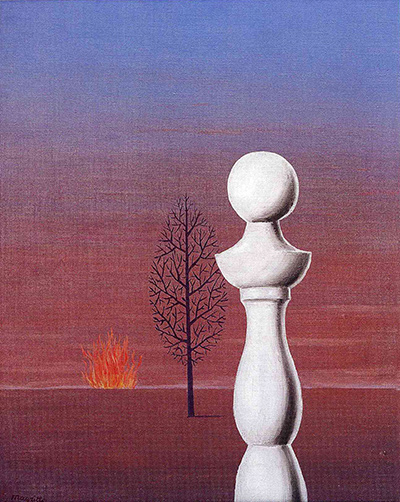
A large white form stands before a bare tree and a small fire. Its rounded head and narrowing body resemble a figure, but its smooth, turned contours suggest a manufactured object. Pink and blue bands stretch across the sky, while the ground remains almost empty. A few clearly separated things are enough to make the landscape feel inhabited and strangely still.
The composition is reproduced as Fashionable People, attributed to René Magritte and dated 1950, in Walmira Sodré Austríaco Moraes's 2016 doctoral thesis at UNESP. The illustrated example appears on printed page 458. That published caption supplies the title and date used here; it does not establish a French title, dimensions or present collection. [1]
At a Glance
Date of this work
Date in the published caption
1950 [1]Contents
A figure without a face
The white form occupies much of the right side. A rounded upper section rests above a narrow neck, a projecting shoulder-like curve and a longer body. Those relationships make it easy to imagine a person, even though there are no eyes, mouth or separate arms.
Its smooth surface encourages a different reading at the same time. The repeated swelling and narrowing could belong to an object shaped on a lathe. Rather than reproducing human anatomy, it offers a simplified sequence of curves that happens to suggest the proportions of a standing figure.
Look from the spherical top towards the broader middle section. Recognition develops through the relation between the parts, not through a single identifying feature. The form can seem human for a moment, then become an object again when attention returns to its polished outline and lack of expression.
Turned curves and the suggestion of a bilboquet
The form recalls a baluster or the turned components of a cup-and-ball toy, often called a bilboquet. That resemblance is more precise than simply calling it a mysterious statue: the narrow necks and rounded masses suggest a familiar kind of worked object.
Moraes discusses the pictured example among recurring bilboquet-like forms in Magritte's imagery. [1] The comparison helps describe what is visible without requiring us to identify the painted object as a functioning toy. No attached cord or complete game is shown.
The lower part continues beyond the bottom edge. This cropping matters because it withholds a complete base. A fully displayed pedestal might establish the object as a sculpture standing in a particular place. Here, the edge makes it feel close to us while leaving its full height and support partly outside the picture.
The tree's open structure
Behind the white form, a dark tree divides into many slender branches. Its bare silhouette is almost the opposite of the solid figure-like shape. We can see sky between the branches, whereas the white surface blocks what lies behind it.
The tree's vertical trunk creates a second upright presence. It is narrower and less massive, but its branching pattern gives it a distinct outline. The two forms therefore share a direction while differing in texture, density and apparent construction.
Try looking at the spaces within the tree rather than at its dark branches. The sky remains visible through its open network. Then compare the white object's uninterrupted body. The painting creates a strong relationship between a form built from lines and one presented as a continuous volume, without needing a crowded setting to make that difference clear.
Watch: Understanding Magritte
Three complementary films introduce the artist, explore words and images, and examine a painting’s materials. These are broader Magritte comparisons, alongside the work discussed here.
René Magritte: Great Art Explained
An introduction to Magritte’s life, characteristic images and visual puzzles.
Watch on YouTubeA small fire near the horizon
At the left, pale orange and yellow flames rise from a low patch. They introduce a flickering shape into a scene otherwise dominated by stable contours. The flame tips are less regular than either the turned object or the tree's branching structure.
The fire also adds a concentrated warm accent. Its light colour links it loosely with the sky's pinker passages, but its sharply upward movement distinguishes it from the horizontal bands behind. It is small in area and still difficult to ignore.
There is no visible person tending the fire and no obvious building around it. The image does not explain what burns or why. That lack of narrative leaves the fire available as a visual event: a changing, luminous form set apart from the white object's composed stillness. A fixed symbolic meaning would go beyond what the scene itself establishes.
Sky and ground arranged in bands
The sky moves from cooler blue above towards pink and mauve nearer the horizon. Thin horizontal passages stretch across its lower area. These bands give the background an expansive rhythm that contrasts with the upright forms in front of it.
The ground is comparatively plain. Its muted colour supports the white figure and the tree without surrounding them with many identifying details. There are few clues to a specific location, and the scene's effect does not depend on recognising one.
The horizon sits low enough for the tree and white form to appear clearly against the sky. Their outlines can be compared across a broad, simple field. This arrangement makes the relations between objects more important than a detailed account of the terrain they occupy.
Light, shade and apparent material
Shading along the white form gives its curves a sense of volume. The darkened side makes the spherical top and projecting middle look rounded rather than flat. Light appears to move across a continuous, smooth surface.
That modelling contributes to the object's credibility without identifying its material conclusively. It could suggest painted wood, plaster or another pale worked substance, but the reproduction alone does not establish a technical description of what the imagined object is made from.
The tree and fire offer different kinds of visibility. The dark branches read through their outline; the flames through their brightness and irregular edges. Against them, the white form is understood through shaded volume. The composition brings together three distinct ways of making a thing recognisable within a painted landscape.
The plural title and the empty setting
Fashionable People introduces people in the plural, yet the image contains no ordinary group of human figures. The white form may suggest one standing presence, while the tree offers another upright silhouette. Their relation can feel social without becoming an identifiable meeting.
That is a possible response to the title, rather than a documented explanation from Magritte. The English caption gives us a prompt, but it does not settle whether the scene is comic, solemn or faintly threatening. The forms remain too spare to support a complete story about their identities.
The most productive way back into the picture is to compare its contrasts: smooth volume and open branches, pale solidity and small flames, upright shapes and horizontal sky. The published title and date identify the reproduction being discussed, while those visible relationships explain why it rewards attention. Its peculiar presence comes from how a few familiar kinds of form stand together in an otherwise quiet landscape.
Magritte artworks directory
| Name | Date | Medium |
|---|---|---|
| Memory of a Voyage | 1963 | Oil on canvas |
| The Blood of the World | 1927; also catalogued as 1926–27 | Oil on canvas |
| The Hunters at the Edge of Night | Paris, 1928 | Oil on canvas |
| The Empty Picture Frame (La saignée) | 1938–39 | Gouache on paper |
| The Glass House | 1939 | Gouache on paper |
| Oasis | 1926 in the illustrated Christie’s catalogue | Oil on canvas |
| Natural Encounters | 1945 | Oil on canvas |
| Attempting the Impossible | 1928 | Oil on canvas |
| On the Threshold of Liberty | 1930 | Oil on canvas |
| The Titanic Days | 1928 | Oil on canvas |
| The Voice of Space | 1931 | Oil on canvas |
| Unexpected Answer | 1932 in the museum catalogue, 1933 on the reverse | Oil on canvas |
| Elective Affinities | 1932 in MoMA’s checklist, also published as 1933 | Oil on canvas |
| The Human Condition II | 1935 | Oil on canvas |
| The Six Elements | 1929 | Oil on canvas |
| The Happy Donor | 1966 | Oil on canvas |
| Clairvoyance (Self Portrait) | Brussels, 1936 | Oil on canvas |
| Philosopher’s Lamp | 1936 | Oil on canvas |
| The Annunciation | Paris, 1930 | Oil on canvas |
| The Lost Jockey | Circa 1942 in the illustrated lot catalogue | Gouache on paper laid down on canvas |
| Homage to Mack Sennett | 1936 in the Thyssen catalogue | Oil on canvas |
| Discovery | 1927 | Oil on canvas |
| Collective Invention | 1935 in the later catalogue index | Oil on canvas |
| The Wonders of Nature | 1953 | Oil on canvas |
| The Balcony | Circa 1950, with 1950 inscribed on the reverse | Oil on canvas |
| The Pilgrim | 1966 | Oil on canvas |
| The Invention of Life | 1928 | Oil on canvas |
| The Therapist | 1941 | Gouache on paper |
| The Gradation of Fire | 1938 or 1939 in the catalogue index | Gouache on paper |
| A Friend of Order | 1964 | Oil on canvas |
| The Poetic World | 1939 in Hammacher’s illustrated monograph | Gouache |
| The Muscles of the Sky | Paris, 1927 | Oil on canvas |
| The Battle of the Argonne | 1959 | Oil on canvas |
| Meditation | 1936 | Oil on canvas |
| The Domain of Arnheim | 1962 | Oil on canvas |
| This Is Not an Apple | 1964 | Oil on Unilite |
| The Meaning of Night | Brussels, 1927 | Oil on canvas |
| The Pleasure Principle (Portrait of Edward James) | 1937 | Oil on canvas |
| Ready Made Bouquet | 1957 | Oil on canvas |
| Popular Panorama | 1926 | Oil on canvas |
| Memory of a Journey | 1955 in the Thyssen catalogue. Tentatively 1958 in the catalogue index. | Gouache on paper, as exhibited at the Thyssen |
| Sheherazade | 1947 | Gouache on paper |
| The Difficult Crossing | 1926 | Oil on canvas |
| The Fair Captive | 1948 in the catalogue raisonné | Oil on canvas |
| The Birth of the Idol | 1926 | Oil on canvas |
| Hegel’s Holiday | 1958 | Oil on canvas |
| Homesickness | 1941 | Oil on canvas |
| The Rape (Le Viol) | 1934 | Oil on canvas |
| The Art of Living | 1967 | Oil on canvas |
| Secret Life IV | 1928 | Oil on canvas |
| The Tomb of the Wrestlers | 1960 | Oil on canvas |
| Young Girl Eating a Bird (The Pleasure) | 1927 | Oil on canvas |
| The Central Story | 1928 | Oil on canvas |
| The Seducer | 1953 | Oil on canvas |
| The Telescope | 1963 | Oil on canvas |
| The Banquet | 1958 | Oil on canvas |
| The Empty Mask | 1928 | Oil on canvas |
| The Cultivation of Ideas | 1927 | Oil on canvas |
| The Enchanted Pose | 1927 | Oil on canvas |
| The Future of Statues | 1937 | Oil on plaster |
| The Return of the Flame | 1943 | Oil on canvas |
| The White Page | 1967 | Oil on canvas |
| The Large Family | 1963 | Oil on canvas |
| Black Magic | 1945 | Oil on canvas |
| Les Amants I | 1928 | Oil on canvas |
| Man in a Bowler Hat | 1964 | Oil on canvas |
| The Portrait | 1935 | Oil on canvas |
| The Sixteenth of September | 1956 | Oil on canvas |
| Heartstrings | 1960 | Oil on canvas |
| The Present | 1939; also dated 1938 or 1939 | Gouache on paper |
| Act of Violence | 1932 | Oil on canvas |
| Fashionable People | 1950, in the 2016 thesis caption | Medium unconfirmed · Attribution follows the published caption |
| The Representation | 1962 | Oil on canvas |
| Memory | 1948 | Gouache on paper |
| The Mysteries of the Horizon | 1955 | Oil on canvas |
| Portrait of Stephy Langui | 1961 | Oil on canvas |
| The Double Secret | 1927 | Oil on canvas |
| Every Day | 1966 | Oil on canvas |
| The Invisible World | 1954 | Oil on canvas |
| Dawn of Cayenne | 1926 | Oil painting |
| Clear Ideas | 1955 (inscribed); possible 1958 execution | Oil on canvas |
| The Face of Genius | 1926 / 1927 | Oil on canvas |
| Good Faith | 1965; earlier record 1964–65 | Oil on canvas |
| The Flash | 1959 | Gouache and pencil on paper |
| Perpetual Motion | 1935; earlier catalogue 1934 | Oil on canvas |
| Personal Values | 1952 | Oil on canvas |
| Not to Be Reproduced | 1937 | Oil on canvas |
| The Red Model | 1935 | Oil on canvas |
| The Menaced Assassin | 1927 | Oil on canvas |
| The Castle of the Pyrenees | 1959 | Oil on canvas |
| The Blank Signature | 1965 | Oil on canvas |
| The Listening Room | 1952 | Oil on canvas |
| Golconde | 1953 | Oil on canvas |
| Time Transfixed | 1938 | Oil on canvas |
| The Treachery of Images | 1929 | Oil on canvas |
| The False Mirror | 1929 | Oil on canvas |
| The Empire of Light | 1953–54 | Oil on canvas |
| The Human Condition | 1933 | Oil on canvas |
| Les Amants | 1928 | Oil on canvas |
| The Son of Man | 1964 | Oil on canvas |
Frequently Asked Questions
Fashionable People [1]
1950, in the 2016 thesis caption [1]
René Magritte, in that caption [1]
Discussion
Compare the familiar objects with the spaces they appear to occupy.
Reader Insights
Which curve first makes the white object resemble a person?
How does the bare tree differ from the solid form beside it?
What does the small fire contribute to the scene's stillness?
Join the Conversation
Share a detail, comparison or question about Fashionable People below.
References
- Walmira Sodré Austríaco Moraes, Sob o domínio da metáfora: transposição de imagens poéticas (em) entre Edgar Allan Poe e René Magritte, doctoral thesis, UNESP/IBILCE (2016), pp. 156 and458: discussion of recurring forms and the illustrated composition captioned Fashionable People, René Magritte, 1950. View source.Splash image: Composition reproduced as Fashionable People, René Magritte, 1950, in Moraes’s 2016 UNESP thesis, p.458. The caption does not establish dimensions or a collection.







