


 by Tom Gurney
Tom Gurney BSc (Hons) is an art history expert with over 20 years experience
Page created on / Page updated on
Email: tomgurney1@gmail.com / Phone: +44 7429 011000
Ready Made Bouquet
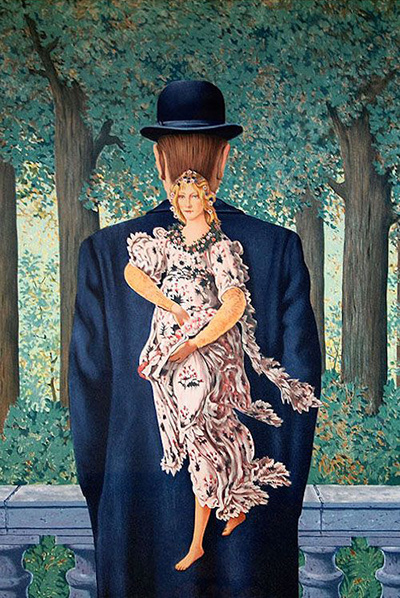
A man in a dark coat and bowler hat stands with his back to us before a wooded landscape. Over the middle of his coat is a woman in a light dress strewn with flowers. She faces us, and the folds of her dress sweep to one side as though she were moving. The figure is Flora from Botticelli’s Primavera. Magritte makes the man and the trees large enough to establish a world of their own, then gives part of that world to a figure whose posture, dress and scale belong to a different picture. [1] [2]
The version reproduced here is the 1957 oil on canvas in the Nakanoshima Museum of Art, Osaka. The museum records Le Bouquet Tout Fait as 163 centimetres high by 130.5 wide and lists it as work 000147. The catalogue raisonné index identifies the large 1957 oil as number 859. Magritte also painted a smaller oil with the same title in 1956. Its foliage is markedly warmer in the reproduction published by the Royal Museums of Fine Arts of Belgium, and the Osaka canvas has a stone balustrade across the lower part of the scene. [1] [3] [4]
At a Glance
- Original titleLe Bouquet Tout Fait
- Date1957
- MediumOil on canvas
- Size163 × 130.5 cm
- CollectionNakanoshima Museum of Art, Osaka, 000147
- Catalogue numberSylvester III 859
Selected works
The man at the balustrade
The balustrade gives the man a place to stand. Its top edge runs behind his body and reappears on each side. The repeated shapes below that edge make the stonework easy to distinguish from the loose clusters of leaves. Beyond it, trunks are visible on either side of the coat and continue upwards into a canopy. Gaps between them admit light from further back. The man faces this view in much the same direction we do. His figure occupies the part of the landscape we would otherwise look straight into.
The bowler hat rises against the foliage, with a curved brim that stands out clearly above the man’s hair. The shoulders widen below it and settle into long, comparatively quiet stretches of dark cloth. Magritte gives us enough light and shade to follow the turn of the hat and the slope of the shoulders. Those details make the man’s body easy to place in the scene, although the coat fills the centre so thoroughly that we cannot see what lies directly ahead of him.
The first place where the second figure interrupts this outline is at the back of his neck. Flora’s head rises towards his hair, and her shoulders lie well inside the width of his. The right edge of her dress comes close to the outer edge of his sleeve. Her bare foot ends lower down, still against a field of dark material. Following these points gives us a way to see how closely the two silhouettes have been fitted together. Almost every part of the smaller figure has the coat behind it.
Flora in Botticelli’s grove
In the Uffizi’s account of Primavera, Flora represents Chloris after her transformation. The two appear in the same painting near its right edge. Zephyrus reaches for Chloris, while Flora appears further in, dressed in flowers. Botticelli sets these figures among other figures from mythology and backs the whole scene with orange and laurel trees. The painted lawn and the vegetation help carry the eye across a wide horizontal panel. [2]
Watch: Understanding Magritte
Three complementary films introduce the artist, explore words and images, and examine a painting’s materials. These are broader Magritte comparisons, alongside the work discussed here.
René Magritte: Great Art Explained
An introduction to Magritte’s life, characteristic images and visual puzzles.
Watch on YouTubeMagritte takes the figure who wears and carries flowers and gives her a new set of surroundings. In his painting the flowering dress can be studied closely because the coat behind it is so dark. Flora inclines her head slightly, and her hands gather folds and flowers near her waist. Lower down, the pattern changes direction with the folds. Some of the material trails away to the side. Her posture brings a sense of motion to the middle of the painting, where the man’s straight back might otherwise have kept the eye moving upwards towards the hat.
There are trees in both paintings, but their relation to Flora changes. Botticelli’s figure takes her place among other bodies of comparable scale. Magritte’s Flora fits within the space defined by a single coat and appears in front of a woodland she cannot visibly reach. We can see a foot, the movement of the dress and the turn of the head clearly enough to imagine a body with weight. At the same time, the part of the scene where her foot comes down contains nothing we could take for a surface she might stand on. The balustrade establishes a clear edge for the larger figure and leaves her position unresolved.
How the figures share the picture
The Royal Museums of Fine Arts of Belgium discuss the pairing in their account of the 1956 canvas. Their exhibition text describes the figures as coming together like thin images placed back to back. That description sends the eye to the point where Flora’s contours meet the man’s coat. In the Osaka painting, the border of her dress has so much incident that it is easy to follow it independently of the broad folds beneath it. The silhouette of the man then comes into focus again around her. At a distance he sets the scale of the picture. Looking more closely brings out the smaller figure’s flowers, fingers and feet. [1] [4]
A turned figure also matters in Not to Be Reproduced. There, a mirror offers a second view of a man’s back where we ordinarily expect to see his face. Here the figure facing us is Flora, and the man remains turned towards the trees. The two pictures give us different reasons to search for a face. In Ready Made Bouquet, the face we can see belongs to a figure lifted from a much older painting. [2] [5]
The title can direct attention first to the flowers Flora carries and wears. It can also suggest that Magritte found his bouquet already assembled in Botticelli’s picture. The woman is visibly intact as a figure, down to the bare foot beneath the hem. Yet the new position of her body makes it difficult to imagine her walking through the landscape we see. The forest supplies a setting for the man in the bowler hat, and his back supplies the dark space in which the pattern of flowers becomes most legible.
Magritte artworks directory
| Name | Date | Medium |
|---|---|---|
| Memory of a Voyage | 1963 | Oil on canvas |
| The Blood of the World | 1927; also catalogued as 1926–27 | Oil on canvas |
| The Hunters at the Edge of Night | Paris, 1928 | Oil on canvas |
| The Empty Picture Frame (La saignée) | 1938–39 | Gouache on paper |
| The Glass House | 1939 | Gouache on paper |
| Oasis | 1926 in the illustrated Christie’s catalogue | Oil on canvas |
| Natural Encounters | 1945 | Oil on canvas |
| Attempting the Impossible | 1928 | Oil on canvas |
| On the Threshold of Liberty | 1930 | Oil on canvas |
| The Titanic Days | 1928 | Oil on canvas |
| The Voice of Space | 1931 | Oil on canvas |
| Unexpected Answer | 1932 in the museum catalogue, 1933 on the reverse | Oil on canvas |
| Elective Affinities | 1932 in MoMA’s checklist, also published as 1933 | Oil on canvas |
| The Human Condition II | 1935 | Oil on canvas |
| The Six Elements | 1929 | Oil on canvas |
| The Happy Donor | 1966 | Oil on canvas |
| Clairvoyance (Self Portrait) | Brussels, 1936 | Oil on canvas |
| Philosopher’s Lamp | 1936 | Oil on canvas |
| The Annunciation | Paris, 1930 | Oil on canvas |
| The Lost Jockey | Circa 1942 in the illustrated lot catalogue | Gouache on paper laid down on canvas |
| Homage to Mack Sennett | 1936 in the Thyssen catalogue | Oil on canvas |
| Discovery | 1927 | Oil on canvas |
| Collective Invention | 1935 in the later catalogue index | Oil on canvas |
| The Wonders of Nature | 1953 | Oil on canvas |
| The Balcony | Circa 1950, with 1950 inscribed on the reverse | Oil on canvas |
| The Pilgrim | 1966 | Oil on canvas |
| The Invention of Life | 1928 | Oil on canvas |
| The Therapist | 1941 | Gouache on paper |
| The Gradation of Fire | 1938 or 1939 in the catalogue index | Gouache on paper |
| A Friend of Order | 1964 | Oil on canvas |
| The Poetic World | 1939 in Hammacher’s illustrated monograph | Gouache |
| The Muscles of the Sky | Paris, 1927 | Oil on canvas |
| The Battle of the Argonne | 1959 | Oil on canvas |
| Meditation | 1936 | Oil on canvas |
| The Domain of Arnheim | 1962 | Oil on canvas |
| This Is Not an Apple | 1964 | Oil on Unilite |
| The Meaning of Night | Brussels, 1927 | Oil on canvas |
| The Pleasure Principle (Portrait of Edward James) | 1937 | Oil on canvas |
| Ready Made Bouquet | 1957 | Oil on canvas |
| Popular Panorama | 1926 | Oil on canvas |
| Memory of a Journey | 1955 in the Thyssen catalogue. Tentatively 1958 in the catalogue index. | Gouache on paper, as exhibited at the Thyssen |
| Sheherazade | 1947 | Gouache on paper |
| The Difficult Crossing | 1926 | Oil on canvas |
| The Fair Captive | 1948 in the catalogue raisonné | Oil on canvas |
| The Birth of the Idol | 1926 | Oil on canvas |
| Hegel’s Holiday | 1958 | Oil on canvas |
| Homesickness | 1941 | Oil on canvas |
| The Rape (Le Viol) | 1934 | Oil on canvas |
| The Art of Living | 1967 | Oil on canvas |
| Secret Life IV | 1928 | Oil on canvas |
| The Tomb of the Wrestlers | 1960 | Oil on canvas |
| Young Girl Eating a Bird (The Pleasure) | 1927 | Oil on canvas |
| The Central Story | 1928 | Oil on canvas |
| The Seducer | 1953 | Oil on canvas |
| The Telescope | 1963 | Oil on canvas |
| The Banquet | 1958 | Oil on canvas |
| The Empty Mask | 1928 | Oil on canvas |
| The Cultivation of Ideas | 1927 | Oil on canvas |
| The Enchanted Pose | 1927 | Oil on canvas |
| The Future of Statues | 1937 | Oil on plaster |
| The Return of the Flame | 1943 | Oil on canvas |
| The White Page | 1967 | Oil on canvas |
| The Large Family | 1963 | Oil on canvas |
| Black Magic | 1945 | Oil on canvas |
| Les Amants I | 1928 | Oil on canvas |
| Man in a Bowler Hat | 1964 | Oil on canvas |
| The Portrait | 1935 | Oil on canvas |
| The Sixteenth of September | 1956 | Oil on canvas |
| Heartstrings | 1960 | Oil on canvas |
| The Present | 1939; also dated 1938 or 1939 | Gouache on paper |
| Act of Violence | 1932 | Oil on canvas |
| Fashionable People | 1950, in the 2016 thesis caption | Medium unconfirmed · Attribution follows the published caption |
| The Representation | 1962 | Oil on canvas |
| Memory | 1948 | Gouache on paper |
| The Mysteries of the Horizon | 1955 | Oil on canvas |
| Portrait of Stephy Langui | 1961 | Oil on canvas |
| The Double Secret | 1927 | Oil on canvas |
| Every Day | 1966 | Oil on canvas |
| The Invisible World | 1954 | Oil on canvas |
| Dawn of Cayenne | 1926 | Oil painting |
| Clear Ideas | 1955 (inscribed); possible 1958 execution | Oil on canvas |
| The Face of Genius | 1926 / 1927 | Oil on canvas |
| Good Faith | 1965; earlier record 1964–65 | Oil on canvas |
| The Flash | 1959 | Gouache and pencil on paper |
| Perpetual Motion | 1935; earlier catalogue 1934 | Oil on canvas |
| Personal Values | 1952 | Oil on canvas |
| Not to Be Reproduced | 1937 | Oil on canvas |
| The Red Model | 1935 | Oil on canvas |
| The Menaced Assassin | 1927 | Oil on canvas |
| The Castle of the Pyrenees | 1959 | Oil on canvas |
| The Blank Signature | 1965 | Oil on canvas |
| The Listening Room | 1952 | Oil on canvas |
| Golconde | 1953 | Oil on canvas |
| Time Transfixed | 1938 | Oil on canvas |
| The Treachery of Images | 1929 | Oil on canvas |
| The False Mirror | 1929 | Oil on canvas |
| The Empire of Light | 1953–54 | Oil on canvas |
| The Human Condition | 1933 | Oil on canvas |
| Les Amants | 1928 | Oil on canvas |
| The Son of Man | 1964 | Oil on canvas |
Frequently Asked Questions
She is Flora, the goddess of spring, taken from Sandro Botticelli’s Primavera.
The green woodland and stone balustrade identify the 1957 canvas in Osaka.
Discussion
Look closely and compare your reading with others.
Reader Insights
Where does the stone balustrade help you judge the man’s distance from the trees?
Which detail in Flora’s dress gives the strongest sense of movement?
How does Flora’s position change when you look at Botticelli’s whole painting?
Join the Conversation
Share a detail, comparison or question about Ready Made Bouquet below.
References
- Nakanoshima Museum of Art, Osaka. The Ready-made Bouquet, 1957. Collection record 000147. View source.
- Daniela Parenti. Spring. Uffizi Galleries collection record, inv. 1890 no. 8360. View source.
- Magritte. Toutes les œuvres, tous les thèmes. Catalogue raisonné index, vol. III, pp. 258 and 274, nos. 837 and 859. View source.
- Royal Museums of Fine Arts of Belgium. Magritte, Broodthaers & Contemporary Art. Exhibition dossier, 2017, discussion and 1956 reproduction. View source.
- Museum Boijmans Van Beuningen. La reproduction interdite. Collection record and catalogue entry. View source.







