


 by Tom Gurney
Tom Gurney BSc (Hons) is an art history expert with over 20 years experience
Page created on / Page updated on
Email: tomgurney1@gmail.com / Phone: +44 7429 011000
The Banquet
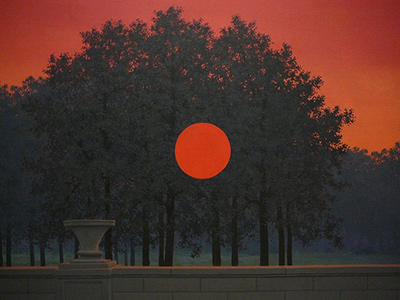
An orange-red sun hangs in front of a stand of dark trees in René Magritte’s The Banquet. Behind the trees, a sunset fills the upper part of the canvas with a related colour. At the bottom, a stone parapet and a single urn suggest a terrace from which we might watch the light fade. The trees and terrace make a plausible setting for that moment. Then the clean outline of the sun draws our attention to the place it occupies. Wherever its colour meets the leaves, the sun interrupts them.
The painting shown here is the 1958 oil on canvas in the Art Institute of Chicago, which measures 97.3 by 130.3 centimetres. The French index to the catalogue raisonné lists it as Le Banquet, volume III, number 868, with dimensions rounded to 97 by 130 centimetres. It is the largest and last of four oils bearing the title. The 1965 MoMA retrospective catalogue reproduces this composition, including the low terrace wall, the urn at the left and the sun against the trees. [1] [2] [3]
At a Glance
- Original titleLe Banquet
- Date1958
- MediumOil on canvas
- Size97.3 × 130.3 cm
- Catalogue numberSylvester III 868
- CollectionArt Institute of Chicago
Selected works
The view from the terrace
The parapet is the closest thing to us in the picture. Its lower face is in shadow. A thin warm line picks out the top towards the right, where small changes in colour give the surface a little depth. A row of masonry joints is visible below it. The parapet crosses the entire canvas, giving us a position from which to look out over what at first seems to be a park. It also establishes a steady horizontal that makes the irregularities of the woodland more visible.
The urn stands off to the left. Its lip is broad and level, and the body narrows towards a squared support. There is enough light on its edges to show how the shape turns. The soft, cool darkness just behind it belongs to the landscape. In front of that darkness, the urn is distinct even though it occupies relatively little of the picture. Its position on the terrace gives the left foreground a clear point of reference, which helps the eye judge how much farther away the trees appear.
The trees rise in a nearly continuous mass. At their feet, though, there are intervals between trunks through which we can see cooler colours, a softly lit patch of ground and suggestions of more trees. Towards the top of the canvas, leaves and smaller branches break into the open sky. Those small marks give the trees a fringe through which traces of the sunset are visible. The branches at the top and the spaces near the ground let us look through the woodland at different heights.
The sun in front of the leaves
The disc is almost at the centre of the canvas. The colour across it changes very little and its edge stays sharp where it meets the foliage. The leaves near the skyline appear as dark marks against the light. Around the disc we see the reverse relation, as a continuous area of strong colour cuts off the pattern of the leaves. Magritte needs little modelling to make the sun appear to sit in front. The simple fact that its outline continues uninterrupted through the canopy is enough.
Watch: Understanding Magritte
Three complementary films introduce the artist, explore words and images, and examine a painting’s materials. These are broader Magritte comparisons, alongside the work discussed here.
René Magritte: Great Art Explained
An introduction to Magritte’s life, characteristic images and visual puzzles.
Watch on YouTubeThe orange sky gives the disc somewhere to belong. It suggests the kind of light in which we might expect to see the sun setting behind a dark stand of trees. Some of that warmth also reaches the narrow top of the wall. Because the foreground and sky share the light, we can read them as parts of one evening scene. The sun itself calls the arrangement into question. If we follow the shapes that overlap, it comes in front of the trees. If we follow the light into the distance, we are led to expect it much farther away.
In a 1964 letter to André Bosmans, quoted by Dawn Ades in the Art Institute’s catalogue, Magritte used The Banquet to discuss objects that are visible in principle but hidden from view. His account of the painting treats the trees as a screen behind which we would expect to find the sun. By giving the disc a complete outline across the screen, he reveals what the trees would conceal and covers a patch of the very foliage that would conceal it. We can see the two results at once. [1]
Variations on the sunset
The idea predates this canvas. The Art Institute traces it to a sketch in a letter Magritte sent to Mirabelle Dors and Maurice Rapin in November 1956 and to a gouache he made that year. The sketch already set the sun in front of trees. The first oil put those trees in a clearing scattered with large stones. A later 1957 oil established the parapet that also appears here. The changes affect how we approach the scene. Where a clearing might allow an open view from the ground, the wall places us at a specific edge and makes the space beyond it feel measured. [1] [2]
Ades relates the motif to Magritte’s experiments with overlapping images in The Place in the Sun and to his placement of a crescent against a tree in The Sixteenth of September. The orange disc plays a particular role in the 1958 canvas. It is larger in relation to the trees than in the other oils, which makes it appear nearer. Its roundness is also especially legible against the broad canopy and the firm horizontal of the terrace. For a moment we can see the disc as a circle suspended over a dark field before the sunset colours draw it back into the landscape. [1]
The painting makes it possible to linger over the sunset and to feel how much the setting depends on an ordinary expectation about which things should cover others. The urn stays firmly above the parapet, and the gaps between the trunks continue to suggest the ground beyond. The horizon also stays low enough that the sky can colour the picture from above the canopy. In that carefully placed world, the sun has moved to the one place where its whole outline can stay visible.
Magritte artworks directory
| Name | Date | Medium |
|---|---|---|
| Memory of a Voyage | 1963 | Oil on canvas |
| The Blood of the World | 1927; also catalogued as 1926–27 | Oil on canvas |
| The Hunters at the Edge of Night | Paris, 1928 | Oil on canvas |
| The Empty Picture Frame (La saignée) | 1938–39 | Gouache on paper |
| The Glass House | 1939 | Gouache on paper |
| Oasis | 1926 in the illustrated Christie’s catalogue | Oil on canvas |
| Natural Encounters | 1945 | Oil on canvas |
| Attempting the Impossible | 1928 | Oil on canvas |
| On the Threshold of Liberty | 1930 | Oil on canvas |
| The Titanic Days | 1928 | Oil on canvas |
| The Voice of Space | 1931 | Oil on canvas |
| Unexpected Answer | 1932 in the museum catalogue, 1933 on the reverse | Oil on canvas |
| Elective Affinities | 1932 in MoMA’s checklist, also published as 1933 | Oil on canvas |
| The Human Condition II | 1935 | Oil on canvas |
| The Six Elements | 1929 | Oil on canvas |
| The Happy Donor | 1966 | Oil on canvas |
| Clairvoyance (Self Portrait) | Brussels, 1936 | Oil on canvas |
| Philosopher’s Lamp | 1936 | Oil on canvas |
| The Annunciation | Paris, 1930 | Oil on canvas |
| The Lost Jockey | Circa 1942 in the illustrated lot catalogue | Gouache on paper laid down on canvas |
| Homage to Mack Sennett | 1936 in the Thyssen catalogue | Oil on canvas |
| Discovery | 1927 | Oil on canvas |
| Collective Invention | 1935 in the later catalogue index | Oil on canvas |
| The Wonders of Nature | 1953 | Oil on canvas |
| The Balcony | Circa 1950, with 1950 inscribed on the reverse | Oil on canvas |
| The Pilgrim | 1966 | Oil on canvas |
| The Invention of Life | 1928 | Oil on canvas |
| The Therapist | 1941 | Gouache on paper |
| The Gradation of Fire | 1938 or 1939 in the catalogue index | Gouache on paper |
| A Friend of Order | 1964 | Oil on canvas |
| The Poetic World | 1939 in Hammacher’s illustrated monograph | Gouache |
| The Muscles of the Sky | Paris, 1927 | Oil on canvas |
| The Battle of the Argonne | 1959 | Oil on canvas |
| Meditation | 1936 | Oil on canvas |
| The Domain of Arnheim | 1962 | Oil on canvas |
| This Is Not an Apple | 1964 | Oil on Unilite |
| The Meaning of Night | Brussels, 1927 | Oil on canvas |
| The Pleasure Principle (Portrait of Edward James) | 1937 | Oil on canvas |
| Ready Made Bouquet | 1957 | Oil on canvas |
| Popular Panorama | 1926 | Oil on canvas |
| Memory of a Journey | 1955 in the Thyssen catalogue. Tentatively 1958 in the catalogue index. | Gouache on paper, as exhibited at the Thyssen |
| Sheherazade | 1947 | Gouache on paper |
| The Difficult Crossing | 1926 | Oil on canvas |
| The Fair Captive | 1948 in the catalogue raisonné | Oil on canvas |
| The Birth of the Idol | 1926 | Oil on canvas |
| Hegel’s Holiday | 1958 | Oil on canvas |
| Homesickness | 1941 | Oil on canvas |
| The Rape (Le Viol) | 1934 | Oil on canvas |
| The Art of Living | 1967 | Oil on canvas |
| Secret Life IV | 1928 | Oil on canvas |
| The Tomb of the Wrestlers | 1960 | Oil on canvas |
| Young Girl Eating a Bird (The Pleasure) | 1927 | Oil on canvas |
| The Central Story | 1928 | Oil on canvas |
| The Seducer | 1953 | Oil on canvas |
| The Telescope | 1963 | Oil on canvas |
| The Banquet | 1958 | Oil on canvas |
| The Empty Mask | 1928 | Oil on canvas |
| The Cultivation of Ideas | 1927 | Oil on canvas |
| The Enchanted Pose | 1927 | Oil on canvas |
| The Future of Statues | 1937 | Oil on plaster |
| The Return of the Flame | 1943 | Oil on canvas |
| The White Page | 1967 | Oil on canvas |
| The Large Family | 1963 | Oil on canvas |
| Black Magic | 1945 | Oil on canvas |
| Les Amants I | 1928 | Oil on canvas |
| Man in a Bowler Hat | 1964 | Oil on canvas |
| The Portrait | 1935 | Oil on canvas |
| The Sixteenth of September | 1956 | Oil on canvas |
| Heartstrings | 1960 | Oil on canvas |
| The Present | 1939; also dated 1938 or 1939 | Gouache on paper |
| Act of Violence | 1932 | Oil on canvas |
| Fashionable People | 1950, in the 2016 thesis caption | Medium unconfirmed · Attribution follows the published caption |
| The Representation | 1962 | Oil on canvas |
| Memory | 1948 | Gouache on paper |
| The Mysteries of the Horizon | 1955 | Oil on canvas |
| Portrait of Stephy Langui | 1961 | Oil on canvas |
| The Double Secret | 1927 | Oil on canvas |
| Every Day | 1966 | Oil on canvas |
| The Invisible World | 1954 | Oil on canvas |
| Dawn of Cayenne | 1926 | Oil painting |
| Clear Ideas | 1955 (inscribed); possible 1958 execution | Oil on canvas |
| The Face of Genius | 1926 / 1927 | Oil on canvas |
| Good Faith | 1965; earlier record 1964–65 | Oil on canvas |
| The Flash | 1959 | Gouache and pencil on paper |
| Perpetual Motion | 1935; earlier catalogue 1934 | Oil on canvas |
| Personal Values | 1952 | Oil on canvas |
| Not to Be Reproduced | 1937 | Oil on canvas |
| The Red Model | 1935 | Oil on canvas |
| The Menaced Assassin | 1927 | Oil on canvas |
| The Castle of the Pyrenees | 1959 | Oil on canvas |
| The Blank Signature | 1965 | Oil on canvas |
| The Listening Room | 1952 | Oil on canvas |
| Golconde | 1953 | Oil on canvas |
| Time Transfixed | 1938 | Oil on canvas |
| The Treachery of Images | 1929 | Oil on canvas |
| The False Mirror | 1929 | Oil on canvas |
| The Empire of Light | 1953–54 | Oil on canvas |
| The Human Condition | 1933 | Oil on canvas |
| Les Amants | 1928 | Oil on canvas |
| The Son of Man | 1964 | Oil on canvas |
Frequently Asked Questions
The 1958 oil with the stone parapet and urn in the foreground.
Discussion
Look closely and compare your reading with others.
Reader Insights
Where does the painting first establish how far away the trees are?
How does the colour of the sky affect where you expect to find the sun?
What changes when you follow the sun’s outline instead of looking at the whole landscape?
Join the Conversation
Share a detail, comparison or question about The Banquet below.
References
- Art Institute of Chicago. The Banquet, collection record 118718, including Dawn Ades’s catalogue entry for the Lindy and Edwin Bergman Collection. View source.
- Magritte. Toutes les œuvres, tous les thèmes. French catalogue raisonné index, vol. III, pp. 267–72 and p. 283, nos. 851, 852, 857 and 868. View source.
- James Thrall Soby. René Magritte. Museum of Modern Art retrospective catalogue, 1965. View source.







