


 by Tom Gurney
Tom Gurney BSc (Hons) is an art history expert with over 20 years experience
Page created on / Page updated on
Email: tomgurney1@gmail.com / Phone: +44 7429 011000
The Enchanted Pose
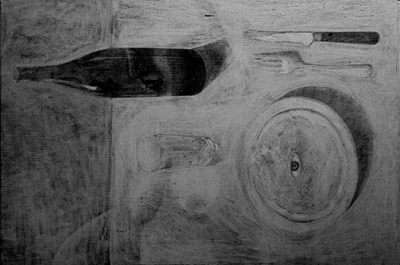
René Magritte’s The Enchanted Pose survives beneath four paintings. A photograph of the original 1927 oil shows two standing women beside fluted columns. The image on this page records one of the discoveries that established what happened to the canvas. It is a sideways X-ray of The Portrait, where the bottle, plate and cutlery of the 1935 still life are visible alongside traces of the earlier figure. The two arrangements occupy the same piece of cloth. Turning the radiograph makes it easier to follow the woman’s profile and to compare it with the photograph of The Enchanted Pose. [1] [2]
The French catalogue index records the work as La Pose enchantée, number 163 in volume I. A reviewer saw the painting at Galerie L’Époque in Brussels in 1927. In 1932, the Palais des Beaux-Arts asked Magritte to collect it after it was passed over for a group exhibition. For decades, the photograph was the principal evidence of the composition. Conservation work has since established that Magritte cut the canvas into sections and used them for new paintings. The four sections are still held within those later works. [1] [2] [3]
At a Glance
- Original titleLa Pose enchantée
- Date1927
- MediumOil on canvas
- Catalogue numberSylvester I 163
- StatusFour sections survive as supports for later paintings
- Image shownRotated X-ray of The Portrait (1935), revealing the upper-left fragment
Selected works
Contents
Two figures in the photograph
The two women stand close together at nearly the same height. Both are shown in profile, with similar faces and a repeated posture. Each leans against a column, with her arm meeting its flat top. The grooves of the columns continue down towards the floor. Their vertical lines are easier to follow than the outlines of the bodies, which turn through shoulders, backs, hips and legs. The repetition makes it possible to look from one figure to the other and find corresponding curves at almost the same level.
Behind the figures, the junctions between floor, wall and sky leave wide areas of comparatively little incident. The space is spare enough that a rising line in the background or the edge of a column can become an important landmark. Those edges help viewers place the figures, and they also helped researchers locate the painted fragments. A part of a profile might fit either woman if seen by itself. The corresponding lines of the body, background and column give a researcher several features to match at once. [2] [3]
The published photograph records where the forms stood in relation to one another. It also gives an impression of light and shade across the figures. Because the photograph is monochrome, evidence of colour comes from examining the fragments themselves. This is one reason the discovery mattered beyond finding the cloth. Paint left along a turned-over edge can add information about a part of the composition whose colour was previously known only indirectly. [2] [3]
The figure beneath the still life
While examining The Portrait for a Magritte exhibition, MoMA conservators noticed blue and ochre paint along edges that were usually left bare in his work. Under ultraviolet light they saw shapes they could not account for in the still life. An X-ray then showed an underlying form. Once the radiograph was turned sideways, the profile and upper body of a woman became legible. Brad Epley of the Menil Collection recognised a possible connection with the photographed painting. The conservators laid the image of the radiograph over a scan of the upper left of the photograph and found that the contours matched. [2]
Watch: Understanding Magritte
Three complementary films introduce the artist, explore words and images, and examine a painting’s materials. These are broader Magritte comparisons, alongside the work discussed here.
René Magritte: Great Art Explained
An introduction to Magritte’s life, characteristic images and visual puzzles.
Watch on YouTubeSome of that early paint was also visible at the surface under close examination. MoMA’s conservators reported pink in an area of the painted glass and blue near the knife. In the radiograph, the objects of the still life remain prominent. They are useful for recognising whose canvas is being examined, even when they appear to lie on their sides. Once the orientation is understood, the large dark bottle can be read as one part of the later painting while the faint contours of the figure are followed on their own. [2]
A second fragment was identified beneath Stockholm’s The Red Model. Its radiograph showed the lower part of a woman and a column. Placed alongside the part found at MoMA, it accounted for the lower left of the original. The two images together show what a single fragment cannot establish by itself. They put the upper and lower parts of one standing figure back into a relationship visible in the early photograph. [2]
Finding the two remaining sections
The third section is beneath the 1935 The Human Condition at Norwich Castle Museum & Art Gallery. Its conservators used X-rays and mapped elements present in the paint with macro X-ray fluorescence. Such maps can help locate residues of a particular paint across an area of canvas. They provide a different kind of evidence from a radiograph, which brings several layers together in a single image. In Norwich, the findings could be compared with traces on the folded edges and with the early photograph. [4]
The Royal Museums of Fine Arts of Belgium and the University of Liège identified the final section beneath God Is Not a Saint, painted in 1935–36 and held in Brussels. The study brought together imaging and close analysis of the paints. Its comparison of all four radiographs with the photograph shows which sections are present and how each has been turned or cropped to suit its later composition. The museums’ French announcement presented a reconstruction made with the four discoveries. The reconstruction is an image assembled from the evidence, while the four pieces of cloth remain supports for the paintings Magritte made over them. [3] [5]
The dates of the later pictures place the reuse within a relatively short period. They also explain why the rest of the search focused on paintings from around the time of the MoMA still life. Size and date helped narrow that search, while the lines beneath the visible compositions supplied the evidence for each identification. [2] [5]
The exact reason for cutting up the original remains open. The material evidence lets us say more about what Magritte did. He gave the separate pieces new orientations and new images, while leaving traces of the old composition in the paint and at the edges. Seen in that light, the sideways still life on this page records a stage in the painting’s history, when one familiar picture gave conservators a way to locate part of another.
Magritte artworks directory
| Name | Date | Medium |
|---|---|---|
| Memory of a Voyage | 1963 | Oil on canvas |
| The Blood of the World | 1927; also catalogued as 1926–27 | Oil on canvas |
| The Hunters at the Edge of Night | Paris, 1928 | Oil on canvas |
| The Empty Picture Frame (La saignée) | 1938–39 | Gouache on paper |
| The Glass House | 1939 | Gouache on paper |
| Oasis | 1926 in the illustrated Christie’s catalogue | Oil on canvas |
| Natural Encounters | 1945 | Oil on canvas |
| Attempting the Impossible | 1928 | Oil on canvas |
| On the Threshold of Liberty | 1930 | Oil on canvas |
| The Titanic Days | 1928 | Oil on canvas |
| The Voice of Space | 1931 | Oil on canvas |
| Unexpected Answer | 1932 in the museum catalogue, 1933 on the reverse | Oil on canvas |
| Elective Affinities | 1932 in MoMA’s checklist, also published as 1933 | Oil on canvas |
| The Human Condition II | 1935 | Oil on canvas |
| The Six Elements | 1929 | Oil on canvas |
| The Happy Donor | 1966 | Oil on canvas |
| Clairvoyance (Self Portrait) | Brussels, 1936 | Oil on canvas |
| Philosopher’s Lamp | 1936 | Oil on canvas |
| The Annunciation | Paris, 1930 | Oil on canvas |
| The Lost Jockey | Circa 1942 in the illustrated lot catalogue | Gouache on paper laid down on canvas |
| Homage to Mack Sennett | 1936 in the Thyssen catalogue | Oil on canvas |
| Discovery | 1927 | Oil on canvas |
| Collective Invention | 1935 in the later catalogue index | Oil on canvas |
| The Wonders of Nature | 1953 | Oil on canvas |
| The Balcony | Circa 1950, with 1950 inscribed on the reverse | Oil on canvas |
| The Pilgrim | 1966 | Oil on canvas |
| The Invention of Life | 1928 | Oil on canvas |
| The Therapist | 1941 | Gouache on paper |
| The Gradation of Fire | 1938 or 1939 in the catalogue index | Gouache on paper |
| A Friend of Order | 1964 | Oil on canvas |
| The Poetic World | 1939 in Hammacher’s illustrated monograph | Gouache |
| The Muscles of the Sky | Paris, 1927 | Oil on canvas |
| The Battle of the Argonne | 1959 | Oil on canvas |
| Meditation | 1936 | Oil on canvas |
| The Domain of Arnheim | 1962 | Oil on canvas |
| This Is Not an Apple | 1964 | Oil on Unilite |
| The Meaning of Night | Brussels, 1927 | Oil on canvas |
| The Pleasure Principle (Portrait of Edward James) | 1937 | Oil on canvas |
| Ready Made Bouquet | 1957 | Oil on canvas |
| Popular Panorama | 1926 | Oil on canvas |
| Memory of a Journey | 1955 in the Thyssen catalogue. Tentatively 1958 in the catalogue index. | Gouache on paper, as exhibited at the Thyssen |
| Sheherazade | 1947 | Gouache on paper |
| The Difficult Crossing | 1926 | Oil on canvas |
| The Fair Captive | 1948 in the catalogue raisonné | Oil on canvas |
| The Birth of the Idol | 1926 | Oil on canvas |
| Hegel’s Holiday | 1958 | Oil on canvas |
| Homesickness | 1941 | Oil on canvas |
| The Rape (Le Viol) | 1934 | Oil on canvas |
| The Art of Living | 1967 | Oil on canvas |
| Secret Life IV | 1928 | Oil on canvas |
| The Tomb of the Wrestlers | 1960 | Oil on canvas |
| Young Girl Eating a Bird (The Pleasure) | 1927 | Oil on canvas |
| The Central Story | 1928 | Oil on canvas |
| The Seducer | 1953 | Oil on canvas |
| The Telescope | 1963 | Oil on canvas |
| The Banquet | 1958 | Oil on canvas |
| The Empty Mask | 1928 | Oil on canvas |
| The Cultivation of Ideas | 1927 | Oil on canvas |
| The Enchanted Pose | 1927 | Oil on canvas |
| The Future of Statues | 1937 | Oil on plaster |
| The Return of the Flame | 1943 | Oil on canvas |
| The White Page | 1967 | Oil on canvas |
| The Large Family | 1963 | Oil on canvas |
| Black Magic | 1945 | Oil on canvas |
| Les Amants I | 1928 | Oil on canvas |
| Man in a Bowler Hat | 1964 | Oil on canvas |
| The Portrait | 1935 | Oil on canvas |
| The Sixteenth of September | 1956 | Oil on canvas |
| Heartstrings | 1960 | Oil on canvas |
| The Present | 1939; also dated 1938 or 1939 | Gouache on paper |
| Act of Violence | 1932 | Oil on canvas |
| Fashionable People | 1950, in the 2016 thesis caption | Medium unconfirmed · Attribution follows the published caption |
| The Representation | 1962 | Oil on canvas |
| Memory | 1948 | Gouache on paper |
| The Mysteries of the Horizon | 1955 | Oil on canvas |
| Portrait of Stephy Langui | 1961 | Oil on canvas |
| The Double Secret | 1927 | Oil on canvas |
| Every Day | 1966 | Oil on canvas |
| The Invisible World | 1954 | Oil on canvas |
| Dawn of Cayenne | 1926 | Oil painting |
| Clear Ideas | 1955 (inscribed); possible 1958 execution | Oil on canvas |
| The Face of Genius | 1926 / 1927 | Oil on canvas |
| Good Faith | 1965; earlier record 1964–65 | Oil on canvas |
| The Flash | 1959 | Gouache and pencil on paper |
| Perpetual Motion | 1935; earlier catalogue 1934 | Oil on canvas |
| Personal Values | 1952 | Oil on canvas |
| Not to Be Reproduced | 1937 | Oil on canvas |
| The Red Model | 1935 | Oil on canvas |
| The Menaced Assassin | 1927 | Oil on canvas |
| The Castle of the Pyrenees | 1959 | Oil on canvas |
| The Blank Signature | 1965 | Oil on canvas |
| The Listening Room | 1952 | Oil on canvas |
| Golconde | 1953 | Oil on canvas |
| Time Transfixed | 1938 | Oil on canvas |
| The Treachery of Images | 1929 | Oil on canvas |
| The False Mirror | 1929 | Oil on canvas |
| The Empire of Light | 1953–54 | Oil on canvas |
| The Human Condition | 1933 | Oil on canvas |
| Les Amants | 1928 | Oil on canvas |
| The Son of Man | 1964 | Oil on canvas |
Frequently Asked Questions
A rotated X-ray of The Portrait revealing the upper-left fragment.
Discussion
Look closely and compare your reading with others.
Reader Insights
Which parts of the sideways radiograph belong to the later still life?
What could the photograph establish about the original before the canvas fragments were found?
How does seeing the radiograph change what you notice about The Portrait?
Join the Conversation
Share a detail, comparison or question about The Enchanted Pose below.
References
- Magritte. Toutes les œuvres, tous les thèmes. French catalogue raisonné and motif index, vol. I, p. 232, no. 163. View source.
- Michael Duffy and Cindy Albertson. The Discovery of Magritte’s The Enchanted Pose. Museum of Modern Art, 2013. View source.
- Royal Museums of Fine Arts of Belgium. La pose enchantée, French press dossier, 2017. View source.
- MA-XRF imaging on René Magritte’s La condition humaine. Heritage Science, 2017. View source.
- Discovery and multi-analytical study of the last missing quarter from René Magritte’s La pose enchantée. Heritage Science, 2018. View source.







