


 by Tom Gurney
Tom Gurney BSc (Hons) is an art history expert with over 20 years experience
Page created on / Page updated on
Email: tomgurney1@gmail.com / Phone: +44 7429 011000
Popular Panorama
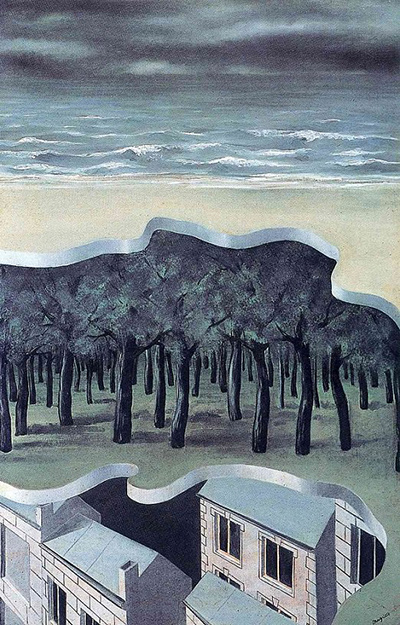
A rough sea breaks on a strip of pale beach in René Magritte’s Popular Panorama. Below the beach, the ground appears to have been cut away to disclose a stand of dark trees. At the foot of the trees another cut reveals the roofs and upper floors of a town. Each part has details that would make sense in a landscape of its own. In this narrow upright canvas, the curved edges bring those landscapes into contact. Following an edge takes us from the apparent depth of one place to the beginning of another.
Magritte painted Panorama populaire in 1926. The Kunstsammlung Nordrhein-Westfalen in Düsseldorf records it as an oil on canvas measuring 120.5 centimetres high by 80.2 wide. The museum notes the signature at the lower right and the title and artist’s name on the stretcher. It identifies the picture as catalogue raisonné number 122 and lists it under inventory number 0393. The same work appeared in the figure-and-ground section of the Thyssen-Bornemisza exhibition La máquina Magritte. [1] [2]
At a Glance
- Original titlePanorama populaire
- Date1926
- MediumOil on canvas
- Size120.5 × 80.2 cm
- CollectionKunstsammlung Nordrhein-Westfalen, 0393
- Catalogue numberSylvester I 122
Selected works
Popular Panorama
1926Sheherazade
1947The Fair Captive
1948 in the catalogue raisonnéFrom the sea to the trees
The top part of the picture establishes a horizon through horizontal changes in colour. Dark cloud stretches across the sky, and the sea below is broken by pale lines of foam. The breakers become easier to distinguish as the water comes forward. By the time the eye reaches the beach, the dark water and cloud have given way to a broad expanse of light sand. Its surface looks open enough to continue indefinitely to either side. Along its lower boundary it behaves like a layer with a thickness of its own.
The line there is easy to follow. Towards the centre it rises abruptly, and there is a sloping section before it bends again at the right. A narrow blue-grey band separates the sand from the dark shape underneath. Light and shade play along that band as if it were the wall of a cut through a solid material. Yet what we see below extends backwards among trees. Magritte gives us both the narrow thickness at the cut and the suggestion of open ground beyond it.
The forest contains a succession of almost upright trunks. The nearer ones are heavier and darker, and smaller trunks remain visible between them. Some stand against muted patches of green ground. Their spacing allows the eye to imagine walking further into the woods, in a direction that leads away from the surface of the canvas. The frame made by the beach above and the cut below does something different. It holds the trees together as a broad band across the width of the painting. One set of cues pulls the eye into the woods, and the other keeps bringing it back to the shape of their border.
Roofs under the woodland
The greenish ground under the trees meets an even paler rim. This second cut bends into a much tighter curve than the first. It comes down between two stretches of woodland and looks thickest where the border turns. Beneath it, the straight edges of walls, windows and roofs introduce a sudden change in direction. We see the buildings from sufficiently high up to look onto their roofs and still make out the façades. The bottom of the canvas interrupts this view. The street, if there is one, lies beyond the available picture.
Watch: Understanding Magritte
Three complementary films introduce the artist, explore words and images, and examine a painting’s materials. These are broader Magritte comparisons, alongside the work discussed here.
René Magritte: Great Art Explained
An introduction to Magritte’s life, characteristic images and visual puzzles.
Watch on YouTubeAt the left the roofs recede along diagonals. A building near the middle shows tall dark windows under a blue-grey roof, and there is a much darker interval between the structures. Those shadowed spaces give the buildings their own depth, just as the changes in the size of the trunks do for the forest above. The cliffs or slopes we might look for to connect the different elevations never appear. The two curved rims do most of the work of joining the scenes, and they seem to belong to the very surfaces they interrupt.
The colours also carry across the boundaries. The blue-grey of the rooftops recalls the water near the horizon, while the light faces of the buildings pick up the sand’s paler tones. The repetition lets the top and bottom answer one another across the darkest part of the forest.
A landscape seen in section
The Thyssen-Bornemisza catalogue discusses the painting in relation to cutaway diagrams. Illustrated magazines used such views to make enclosed or buried structures visible. The catalogue proposes a diagram of the Paris Métro beneath the Place de l’Opéra, published in Popular Mechanics in 1910, as a possible source. The suggestion helps explain the peculiar directness of the view. Magritte lets us see three settings together as if an obstruction had been removed. The picture offers too little information to determine how any one of those settings could lie under another. [2]
A detail worth comparing is the edge of the canvas in The Human Condition. There, in the 1933 painting now in Washington, a landscape shown on an easel aligns with one visible beyond the window. The painted canvas has a narrow edge that helps distinguish the two surfaces even where the scenery appears continuous. In Popular Panorama the thin edges also tell us that there is more than one surface to account for. As we cross them, the surf, forest and rooftops remain distinct places, each with its own signs of distance. [3]
The Düsseldorf museum traces Popular Panorama to Paul-Gustave Van Hecke’s Galerie L’Époque in Brussels and then through the gallery network that included Le Centaure and Walter Schwarzenberg. E. L. T. Mesens acquired the painting in 1932. The museum documents it in his collection through at least 1957 and acquired it from Galerie Brusberg in 2002. The collection record gives firmer dates for some parts of that history than for others. [1]
On a first look, the title might lead us to start with the open horizon. The tall format soon encourages a second kind of looking, down through the picture, past the grey rim and into the woods. From there we come to rooftops so close that individual windows can be picked out. At every step Magritte gives us something recognisable to establish our position. The difficulty begins when we try to carry that position across the next edge.
Magritte artworks directory
| Name | Date | Medium |
|---|---|---|
| Memory of a Voyage | 1963 | Oil on canvas |
| The Blood of the World | 1927; also catalogued as 1926–27 | Oil on canvas |
| The Hunters at the Edge of Night | Paris, 1928 | Oil on canvas |
| The Empty Picture Frame (La saignée) | 1938–39 | Gouache on paper |
| The Glass House | 1939 | Gouache on paper |
| Oasis | 1926 in the illustrated Christie’s catalogue | Oil on canvas |
| Natural Encounters | 1945 | Oil on canvas |
| Attempting the Impossible | 1928 | Oil on canvas |
| On the Threshold of Liberty | 1930 | Oil on canvas |
| The Titanic Days | 1928 | Oil on canvas |
| The Voice of Space | 1931 | Oil on canvas |
| Unexpected Answer | 1932 in the museum catalogue, 1933 on the reverse | Oil on canvas |
| Elective Affinities | 1932 in MoMA’s checklist, also published as 1933 | Oil on canvas |
| The Human Condition II | 1935 | Oil on canvas |
| The Six Elements | 1929 | Oil on canvas |
| The Happy Donor | 1966 | Oil on canvas |
| Clairvoyance (Self Portrait) | Brussels, 1936 | Oil on canvas |
| Philosopher’s Lamp | 1936 | Oil on canvas |
| The Annunciation | Paris, 1930 | Oil on canvas |
| The Lost Jockey | Circa 1942 in the illustrated lot catalogue | Gouache on paper laid down on canvas |
| Homage to Mack Sennett | 1936 in the Thyssen catalogue | Oil on canvas |
| Discovery | 1927 | Oil on canvas |
| Collective Invention | 1935 in the later catalogue index | Oil on canvas |
| The Wonders of Nature | 1953 | Oil on canvas |
| The Balcony | Circa 1950, with 1950 inscribed on the reverse | Oil on canvas |
| The Pilgrim | 1966 | Oil on canvas |
| The Invention of Life | 1928 | Oil on canvas |
| The Therapist | 1941 | Gouache on paper |
| The Gradation of Fire | 1938 or 1939 in the catalogue index | Gouache on paper |
| A Friend of Order | 1964 | Oil on canvas |
| The Poetic World | 1939 in Hammacher’s illustrated monograph | Gouache |
| The Muscles of the Sky | Paris, 1927 | Oil on canvas |
| The Battle of the Argonne | 1959 | Oil on canvas |
| Meditation | 1936 | Oil on canvas |
| The Domain of Arnheim | 1962 | Oil on canvas |
| This Is Not an Apple | 1964 | Oil on Unilite |
| The Meaning of Night | Brussels, 1927 | Oil on canvas |
| The Pleasure Principle (Portrait of Edward James) | 1937 | Oil on canvas |
| Ready Made Bouquet | 1957 | Oil on canvas |
| Popular Panorama | 1926 | Oil on canvas |
| Memory of a Journey | 1955 in the Thyssen catalogue. Tentatively 1958 in the catalogue index. | Gouache on paper, as exhibited at the Thyssen |
| Sheherazade | 1947 | Gouache on paper |
| The Difficult Crossing | 1926 | Oil on canvas |
| The Fair Captive | 1948 in the catalogue raisonné | Oil on canvas |
| The Birth of the Idol | 1926 | Oil on canvas |
| Hegel’s Holiday | 1958 | Oil on canvas |
| Homesickness | 1941 | Oil on canvas |
| The Rape (Le Viol) | 1934 | Oil on canvas |
| The Art of Living | 1967 | Oil on canvas |
| Secret Life IV | 1928 | Oil on canvas |
| The Tomb of the Wrestlers | 1960 | Oil on canvas |
| Young Girl Eating a Bird (The Pleasure) | 1927 | Oil on canvas |
| The Central Story | 1928 | Oil on canvas |
| The Seducer | 1953 | Oil on canvas |
| The Telescope | 1963 | Oil on canvas |
| The Banquet | 1958 | Oil on canvas |
| The Empty Mask | 1928 | Oil on canvas |
| The Cultivation of Ideas | 1927 | Oil on canvas |
| The Enchanted Pose | 1927 | Oil on canvas |
| The Future of Statues | 1937 | Oil on plaster |
| The Return of the Flame | 1943 | Oil on canvas |
| The White Page | 1967 | Oil on canvas |
| The Large Family | 1963 | Oil on canvas |
| Black Magic | 1945 | Oil on canvas |
| Les Amants I | 1928 | Oil on canvas |
| Man in a Bowler Hat | 1964 | Oil on canvas |
| The Portrait | 1935 | Oil on canvas |
| The Sixteenth of September | 1956 | Oil on canvas |
| Heartstrings | 1960 | Oil on canvas |
| The Present | 1939; also dated 1938 or 1939 | Gouache on paper |
| Act of Violence | 1932 | Oil on canvas |
| Fashionable People | 1950, in the 2016 thesis caption | Medium unconfirmed · Attribution follows the published caption |
| The Representation | 1962 | Oil on canvas |
| Memory | 1948 | Gouache on paper |
| The Mysteries of the Horizon | 1955 | Oil on canvas |
| Portrait of Stephy Langui | 1961 | Oil on canvas |
| The Double Secret | 1927 | Oil on canvas |
| Every Day | 1966 | Oil on canvas |
| The Invisible World | 1954 | Oil on canvas |
| Dawn of Cayenne | 1926 | Oil painting |
| Clear Ideas | 1955 (inscribed); possible 1958 execution | Oil on canvas |
| The Face of Genius | 1926 / 1927 | Oil on canvas |
| Good Faith | 1965; earlier record 1964–65 | Oil on canvas |
| The Flash | 1959 | Gouache and pencil on paper |
| Perpetual Motion | 1935; earlier catalogue 1934 | Oil on canvas |
| Personal Values | 1952 | Oil on canvas |
| Not to Be Reproduced | 1937 | Oil on canvas |
| The Red Model | 1935 | Oil on canvas |
| The Menaced Assassin | 1927 | Oil on canvas |
| The Castle of the Pyrenees | 1959 | Oil on canvas |
| The Blank Signature | 1965 | Oil on canvas |
| The Listening Room | 1952 | Oil on canvas |
| Golconde | 1953 | Oil on canvas |
| Time Transfixed | 1938 | Oil on canvas |
| The Treachery of Images | 1929 | Oil on canvas |
| The False Mirror | 1929 | Oil on canvas |
| The Empire of Light | 1953–54 | Oil on canvas |
| The Human Condition | 1933 | Oil on canvas |
| Les Amants | 1928 | Oil on canvas |
| The Son of Man | 1964 | Oil on canvas |
Frequently Asked Questions
A beach, a woodland and town roofs appear in three layers.
Discussion
Look closely and compare your reading with others.
Reader Insights
Which details make the forest seem to extend behind the edge of the beach?
How does the viewpoint change when you reach the roofs?
What does the suggestion of a cutaway diagram help you notice in the painting?
Join the Conversation
Share a detail, comparison or question about Popular Panorama below.
References
- Kunstsammlung Nordrhein-Westfalen. Panorama populaire, 1926. Collection and provenance record, inv. 0393. View source.
- Museo Nacional Thyssen-Bornemisza. La máquina Magritte. Exhibition catalogue, 2021, Figure and Ground, cat. 17. View source.
- National Gallery of Art. The Human Condition, 1933. Collection record, 1987.55.1. View source.







