


 by Tom Gurney
Tom Gurney BSc (Hons) is an art history expert with over 20 years experience
Page created on / Page updated on
Email: tomgurney1@gmail.com / Phone: +44 7429 011000
The Future of Statues
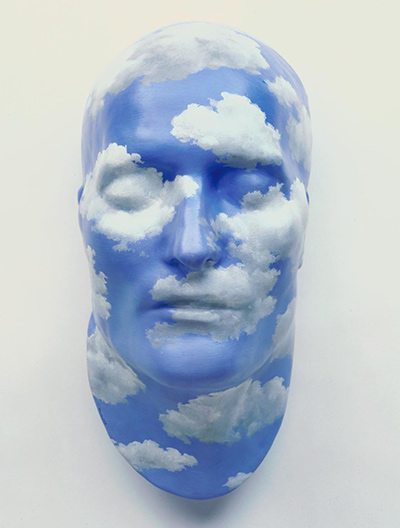
White clouds cross the closed eyes, cheeks and forehead of a blue plaster head in René Magritte’s The Future of Statues. There is a cloud just above one eyebrow and another across the mouth. The shadows around the nose and beneath the chin belong to the shape of the cast, while the lighter patches belong to the painted sky. A cloud can therefore seem to hang in open air and at the same time pass over a raised part of the face. The two kinds of light are visible together.
The cast pictured here is Tate’s 1937 L’Avenir des statues, accession T03258, number 687 in volume II of the catalogue raisonné. The Museo Nacional Thyssen-Bornemisza lists it as oil on plaster and gives its dimensions as 33 by 16.5 by 20.3 centimetres. Its catalogue reproduces the Tate cast alongside another example, now in Duisburg. The distribution of clouds across the eyes, upper lip and lower end in the existing image matches the Tate example. [1] [2]
At a Glance
- Original titleL’Avenir des statues
- Date1937
- MediumOil on plaster
- Catalogue numberSylvester II 687
- Size33 × 16.5 × 20.3 cm (Thyssen catalogue)
- CollectionTate, T03258
Selected works
Clouds on a curved surface
The forehead occupies a broad arc above the eyes. Across the upper part of the forehead, the blue gives way to a pale bank of cloud. A further patch sits to the right of centre in the photograph. It follows the area where the forehead starts to curve away, so the cloud is legible both as an irregular white shape and as paint on something round. Between these patches, there is enough uninterrupted blue to give the impression of open sky.
Below the forehead the forms are closer together. One cloud curves around an eyelid and spreads onto the cheek. The nose remains prominent because its bridge catches light and its sides fall away into shadow. Below it, the white paint around the mouth crosses the shallow relief of the upper lip. Small grey passages in the clouds suggest shaded vapour, while the hollow beside the nose has a shadow appropriate to solid plaster. The treatment gives the eye two reasons for seeing light and shade across nearly the same place.
There is no horizon across the surface. Blue continues around the chin and down the long lower portion of the cast. Clouds there have a little more space between them. The absence of a ground line allows the eye to carry the impression of sky around the whole head. The edge of the object then brings us back to the plaster. In the photograph, at the bottom and to one side, a faint shadow falls outside the outline. That shadow helps locate the cast in the space in front of the camera, even while the painted surface suggests much greater distances.
From a death mask to a sky
Magritte worked on a commercial plaster copy of Napoleon’s death mask. Elke Schneider, writing for the Fondation Napoléon about the Duisburg example, points out that the model had already been adapted for reproduction. The familiar form of the head therefore came to Magritte through a series of decisions about how the face would be represented and circulated. The closed eyes and the contours of the mouth belong to that existing likeness. Magritte added a painted surface that makes those particular features harder to read at a glance. [2] [3]
Watch: Understanding Magritte
Three complementary films introduce the artist, explore words and images, and examine a painting’s materials. These are broader Magritte comparisons, alongside the work discussed here.
René Magritte: Great Art Explained
An introduction to Magritte’s life, characteristic images and visual puzzles.
Watch on YouTubeThe knowledge that it is a death mask changes how the eyelids appear. They give the cast a stillness that is easy to recognise before we can name whose face it is. The painted clouds suggest shapes that could change or drift with the weather. In the object they are fixed where Magritte placed them. It is possible to imagine the time implied by those forms, from the brief duration of a cloud to the much longer life of a likeness reproduced in plaster. The work holds both at the scale of a single face.
A photograph fixes one viewpoint. In front of a cast, a viewer could shift position and see the nose interrupt one part of the image while revealing more along the cheek. The amount of cloud visible around the curved side would change with the angle. A painted sky on a canvas appears to unfold into depth from a broadly flat surface. Here some of the changes a viewer sees are caused by the actual depth of the support. That allows the painted pattern to keep changing in small ways as the viewer moves around it.
Four versions of the object
The title refers to four painted casts catalogued under different numbers. Christie’s identifies them as 674, 675, 676 and 687 in volume II. Its record documents no. 675, while the Thyssen catalogue illustrates the two museum examples numbered 674 and 687. The Thyssen dates the Duisburg cast to 1932 and the Tate cast to 1937. The two illustrations show why the cloud shapes matter when identifying an individual object. The faces have a similar outline, and the paint follows a different course across the forehead, cheeks and lower part of each. [1] [4]
In the Thyssen’s photographs, the cloud around the eye on the viewer’s left spreads farther down the cheek on the Tate cast. The Duisburg example has a longer stretch of blue under its chin. Details like these remain legible even when the photographs have different backgrounds. [1]
The title directs attention towards the idea of a statue even though the support is a cast of a face. It invites us to look at the object as a thing with a history before the sky was painted over it. Repeating the work on several casts gave Magritte several opportunities to place the same kind of sky across nearly the same forms. A slight shift of a cloud can uncover an eyelid or bring a patch of white onto the nose. The arrangement of the foreground features stays familiar while the painted sky gives each example its own pattern.
In the Tate cast, one can follow the blue from above the forehead to below the chin, briefly losing sight of parts of the face among the clouds. Turning attention back to the nose, mouth or eyelids restores the sense of a single, solid shape. The work allows that passage from sky to face to happen repeatedly within the limits of one small object.
Magritte artworks directory
| Name | Date | Medium |
|---|---|---|
| Memory of a Voyage | 1963 | Oil on canvas |
| The Blood of the World | 1927; also catalogued as 1926–27 | Oil on canvas |
| The Hunters at the Edge of Night | Paris, 1928 | Oil on canvas |
| The Empty Picture Frame (La saignée) | 1938–39 | Gouache on paper |
| The Glass House | 1939 | Gouache on paper |
| Oasis | 1926 in the illustrated Christie’s catalogue | Oil on canvas |
| Natural Encounters | 1945 | Oil on canvas |
| Attempting the Impossible | 1928 | Oil on canvas |
| On the Threshold of Liberty | 1930 | Oil on canvas |
| The Titanic Days | 1928 | Oil on canvas |
| The Voice of Space | 1931 | Oil on canvas |
| Unexpected Answer | 1932 in the museum catalogue, 1933 on the reverse | Oil on canvas |
| Elective Affinities | 1932 in MoMA’s checklist, also published as 1933 | Oil on canvas |
| The Human Condition II | 1935 | Oil on canvas |
| The Six Elements | 1929 | Oil on canvas |
| The Happy Donor | 1966 | Oil on canvas |
| Clairvoyance (Self Portrait) | Brussels, 1936 | Oil on canvas |
| Philosopher’s Lamp | 1936 | Oil on canvas |
| The Annunciation | Paris, 1930 | Oil on canvas |
| The Lost Jockey | Circa 1942 in the illustrated lot catalogue | Gouache on paper laid down on canvas |
| Homage to Mack Sennett | 1936 in the Thyssen catalogue | Oil on canvas |
| Discovery | 1927 | Oil on canvas |
| Collective Invention | 1935 in the later catalogue index | Oil on canvas |
| The Wonders of Nature | 1953 | Oil on canvas |
| The Balcony | Circa 1950, with 1950 inscribed on the reverse | Oil on canvas |
| The Pilgrim | 1966 | Oil on canvas |
| The Invention of Life | 1928 | Oil on canvas |
| The Therapist | 1941 | Gouache on paper |
| The Gradation of Fire | 1938 or 1939 in the catalogue index | Gouache on paper |
| A Friend of Order | 1964 | Oil on canvas |
| The Poetic World | 1939 in Hammacher’s illustrated monograph | Gouache |
| The Muscles of the Sky | Paris, 1927 | Oil on canvas |
| The Battle of the Argonne | 1959 | Oil on canvas |
| Meditation | 1936 | Oil on canvas |
| The Domain of Arnheim | 1962 | Oil on canvas |
| This Is Not an Apple | 1964 | Oil on Unilite |
| The Meaning of Night | Brussels, 1927 | Oil on canvas |
| The Pleasure Principle (Portrait of Edward James) | 1937 | Oil on canvas |
| Ready Made Bouquet | 1957 | Oil on canvas |
| Popular Panorama | 1926 | Oil on canvas |
| Memory of a Journey | 1955 in the Thyssen catalogue. Tentatively 1958 in the catalogue index. | Gouache on paper, as exhibited at the Thyssen |
| Sheherazade | 1947 | Gouache on paper |
| The Difficult Crossing | 1926 | Oil on canvas |
| The Fair Captive | 1948 in the catalogue raisonné | Oil on canvas |
| The Birth of the Idol | 1926 | Oil on canvas |
| Hegel’s Holiday | 1958 | Oil on canvas |
| Homesickness | 1941 | Oil on canvas |
| The Rape (Le Viol) | 1934 | Oil on canvas |
| The Art of Living | 1967 | Oil on canvas |
| Secret Life IV | 1928 | Oil on canvas |
| The Tomb of the Wrestlers | 1960 | Oil on canvas |
| Young Girl Eating a Bird (The Pleasure) | 1927 | Oil on canvas |
| The Central Story | 1928 | Oil on canvas |
| The Seducer | 1953 | Oil on canvas |
| The Telescope | 1963 | Oil on canvas |
| The Banquet | 1958 | Oil on canvas |
| The Empty Mask | 1928 | Oil on canvas |
| The Cultivation of Ideas | 1927 | Oil on canvas |
| The Enchanted Pose | 1927 | Oil on canvas |
| The Future of Statues | 1937 | Oil on plaster |
| The Return of the Flame | 1943 | Oil on canvas |
| The White Page | 1967 | Oil on canvas |
| The Large Family | 1963 | Oil on canvas |
| Black Magic | 1945 | Oil on canvas |
| Les Amants I | 1928 | Oil on canvas |
| Man in a Bowler Hat | 1964 | Oil on canvas |
| The Portrait | 1935 | Oil on canvas |
| The Sixteenth of September | 1956 | Oil on canvas |
| Heartstrings | 1960 | Oil on canvas |
| The Present | 1939; also dated 1938 or 1939 | Gouache on paper |
| Act of Violence | 1932 | Oil on canvas |
| Fashionable People | 1950, in the 2016 thesis caption | Medium unconfirmed · Attribution follows the published caption |
| The Representation | 1962 | Oil on canvas |
| Memory | 1948 | Gouache on paper |
| The Mysteries of the Horizon | 1955 | Oil on canvas |
| Portrait of Stephy Langui | 1961 | Oil on canvas |
| The Double Secret | 1927 | Oil on canvas |
| Every Day | 1966 | Oil on canvas |
| The Invisible World | 1954 | Oil on canvas |
| Dawn of Cayenne | 1926 | Oil painting |
| Clear Ideas | 1955 (inscribed); possible 1958 execution | Oil on canvas |
| The Face of Genius | 1926 / 1927 | Oil on canvas |
| Good Faith | 1965; earlier record 1964–65 | Oil on canvas |
| The Flash | 1959 | Gouache and pencil on paper |
| Perpetual Motion | 1935; earlier catalogue 1934 | Oil on canvas |
| Personal Values | 1952 | Oil on canvas |
| Not to Be Reproduced | 1937 | Oil on canvas |
| The Red Model | 1935 | Oil on canvas |
| The Menaced Assassin | 1927 | Oil on canvas |
| The Castle of the Pyrenees | 1959 | Oil on canvas |
| The Blank Signature | 1965 | Oil on canvas |
| The Listening Room | 1952 | Oil on canvas |
| Golconde | 1953 | Oil on canvas |
| Time Transfixed | 1938 | Oil on canvas |
| The Treachery of Images | 1929 | Oil on canvas |
| The False Mirror | 1929 | Oil on canvas |
| The Empire of Light | 1953–54 | Oil on canvas |
| The Human Condition | 1933 | Oil on canvas |
| Les Amants | 1928 | Oil on canvas |
| The Son of Man | 1964 | Oil on canvas |
Frequently Asked Questions
The 1937 Tate cast with clouds across the closed eye, cheek and upper lip.
Discussion
Look closely and compare your reading with others.
Reader Insights
Where do the painted clouds most clearly follow the curve of the plaster?
Which shadows help you distinguish the face from the painted sky?
How might the work change as you move from a front view to a side view?
Join the Conversation
Share a detail, comparison or question about The Future of Statues below.
References
- Museo Nacional Thyssen-Bornemisza. La máquina Magritte, exhibition catalogue, p. 135, nos. 64–65. View source.
- Magritte. Toutes les œuvres, tous les thèmes. French catalogue raisonné title index, vol. II, p. 434, no. 687. View source.
- Elke Schneider. L’Avenir des statues. Fondation Napoléon, on the Lehmbruck Museum cast and its plaster model. View source.
- Christie’s. L’avenir des statues, catalogue raisonné no. 675 and related casts. View source.







