


 by Tom Gurney
Tom Gurney BSc (Hons) is an art history expert with over 20 years experience
Page created on / Page updated on
Email: tomgurney1@gmail.com / Phone: +44 7429 011000
Oasis
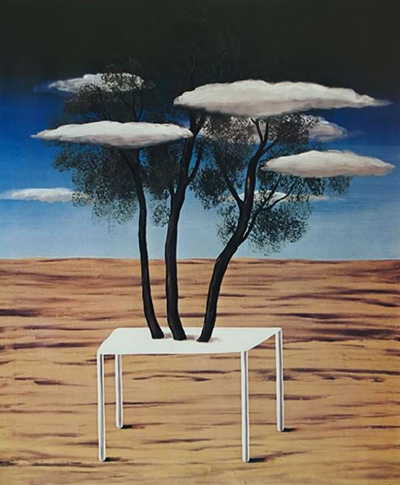
In René Magritte’s Oasis, three trees rise through a tabletop in the middle of an open desert. Clouds gather among their trunks and branches, low enough to brush the furniture. The table is the most orderly thing in the landscape. Its straight edges and slender legs give us familiar shapes from which to judge the distance between the trees and the ground. Then its proportions complicate that judgment. The tabletop widens towards the back, where we would usually expect it to narrow.
The oil on canvas is 75 centimetres high by 65 wide. The illustrated Christie’s catalogue identifies it as L’oasis, dates it to 1926 and gives its number as 95 in the first volume of the catalogue raisonné edited by David Sylvester. The work had already appeared in print by March 1927 and was shown at the Galerie Le Centaure that spring. [1]
At a Glance
- Original titleL’oasis
- Date1926 in the illustrated Christie’s catalogue
- MediumOil on canvas
- Size75 × 65 cm
- Catalogue numberSylvester I 95
Selected works
Contents
How the table sits in the desert
The tabletop is the first place to test the picture’s depth. Follow either side edge from the near end towards the trees and it moves away from the centre. The front edge looks shorter than the edge behind it. At the same time we see the legs below the top and the trunks rising from above it. The painting gives us enough information to recognise the piece of furniture and to place it on the ground. The shape of its upper surface then makes that seemingly straightforward position difficult to reconstruct.
That geometry affects the space available to the trees. The wider part of the tabletop lies beneath the clustered trunks, almost as though the surface were opening out to receive them. The three trees stand far enough apart to show individual stretches of trunk. Higher up, their foliage pulls them into a single group. The cloud at their side interrupts the dark shape, and the pale passages lower down make it harder to trace an uninterrupted line from the ground through the furniture to the branches. The grove looks settled in its place even as the eye struggles to explain how it got there.
A second system of depth operates in the desert. Alternating bands of light and shade lie across the ground. The darker edges give small rises the appearance of casting shadows. As the marks recede, they become part of a broader rhythm that carries the eye across the empty land. The table stands out because the ground around it gives us so many gradual changes while the furniture gives us abrupt corners. The same contrast lets us see immediately that the table belongs to a much smaller scale than the stretch of land behind it.
Look at the open spaces beneath the table. They belong to the same desert as the ground on either side, so the eye can pass between the legs and continue into the distance. Above the top, the dense foliage interrupts that passage. The piece of furniture divides the vertical picture into a region of comparatively open ground and a region where trees and clouds occupy much of the same space. That division gives the three trees an unusual weight. A landscape feature that might normally sit low in the distance is brought forward and raised into the centre of the picture.
Watch: Understanding Magritte
Three complementary films introduce the artist, explore words and images, and examine a painting’s materials. These are broader Magritte comparisons, alongside the work discussed here.
René Magritte: Great Art Explained
An introduction to Magritte’s life, characteristic images and visual puzzles.
Watch on YouTubeTrees and clouds at the same height
An oasis in a dry landscape suggests a place where vegetation has access to water. The green group answers the title at once. Its placement adds a question. What there is of the grove seems concentrated on a flat raised surface whose edge can be followed with the eye. The ground below is dry and open. We can recognise the vegetation as a sign of growth without being able to trace that growth beneath the trees. The title therefore helps identify the larger setting while making the odd position of the trunks harder to ignore.
The clouds make that position harder to measure. A cloud in a painted sky can ordinarily serve as a distant form. Here its overlap with the foliage gives it a place among the trees. Even the lower patches belong to the immediate cluster around the table. The clouds have soft contours compared with the sharply defined furniture, but the recognisable forms nearby make their position unusually specific. There is a sense that they could drift while the trees and table stay where they are. In the painting, their placement is as decisive as the placement of a leg or trunk.
Clouds also occupy unexpectedly close quarters in À la Suite de l’eau, les nuages, another 1926 oil, held by the Kunsthaus Zürich. There, pale bands cross in front of vertical architectural forms, beyond a shallow pool and a large plant-like shape. The clouds interrupt our view across a space whose floor and upright forms suggest a built setting. In Oasis, the interruption takes place out in the open, and the clouds gather around a group small enough to fit on a table. Both paintings give a tangible setting to something whose edges keep changing. Their settings make us notice different things about that effect. [2]
A later example, Les marches de l’été, places clouds near blocks of pale blue suspended over a coast. Centre Pompidou dates its canvas to 1938. There the sky seems to have acquired some of the blunt edges of the hovering blocks. In Oasis, the tabletop has the clearest edges, and the clouds seem to evade its geometry even as they make the group around it feel more compact. Seen together, the works show how Magritte could use clouds to draw attention to the difference between a shape with a measurable edge and one that seems to change as we look. [3]
The painting’s early record
Christie’s lists the canvas as number 17 in the April to May 1927 Galerie Le Centaure exhibition in Brussels. Its bibliography also records P.-G. Van Hecke’s discussion in the March 1927 issue of Sélection. The two entries establish how early the picture circulated, first in print and then in the gallery’s exhibition record. The same catalogue documents differences in later dating. Louis Scutenaire’s 1947 book gave 1925, while several exhibitions in the 1960s printed 1927. The date 1926 follows the illustrated lot entry. The history of the alternatives helps explain why the same arrangement of table, clouds and trunks may turn up under another year. [1]
The painting was exhibited again in Rotterdam and Stockholm in 1967. By then a gallery audience could see it against decades of Magritte’s experiments with the placement of ordinary objects. The picture itself still asks for close attention to a small number of things. One way back into it is to start in the distance, follow the pale ground towards the nearest leg, and then look for the place where a trunk meets the table. The journey seems perfectly possible until we have to decide how far away the back edge is. The trees have a place we can point to before they have a place we can make sense of. [1]
Magritte artworks directory
| Name | Date | Medium |
|---|---|---|
| Memory of a Voyage | 1963 | Oil on canvas |
| The Blood of the World | 1927; also catalogued as 1926–27 | Oil on canvas |
| The Hunters at the Edge of Night | Paris, 1928 | Oil on canvas |
| The Empty Picture Frame (La saignée) | 1938–39 | Gouache on paper |
| The Glass House | 1939 | Gouache on paper |
| Oasis | 1926 in the illustrated Christie’s catalogue | Oil on canvas |
| Natural Encounters | 1945 | Oil on canvas |
| Attempting the Impossible | 1928 | Oil on canvas |
| On the Threshold of Liberty | 1930 | Oil on canvas |
| The Titanic Days | 1928 | Oil on canvas |
| The Voice of Space | 1931 | Oil on canvas |
| Unexpected Answer | 1932 in the museum catalogue, 1933 on the reverse | Oil on canvas |
| Elective Affinities | 1932 in MoMA’s checklist, also published as 1933 | Oil on canvas |
| The Human Condition II | 1935 | Oil on canvas |
| The Six Elements | 1929 | Oil on canvas |
| The Happy Donor | 1966 | Oil on canvas |
| Clairvoyance (Self Portrait) | Brussels, 1936 | Oil on canvas |
| Philosopher’s Lamp | 1936 | Oil on canvas |
| The Annunciation | Paris, 1930 | Oil on canvas |
| The Lost Jockey | Circa 1942 in the illustrated lot catalogue | Gouache on paper laid down on canvas |
| Homage to Mack Sennett | 1936 in the Thyssen catalogue | Oil on canvas |
| Discovery | 1927 | Oil on canvas |
| Collective Invention | 1935 in the later catalogue index | Oil on canvas |
| The Wonders of Nature | 1953 | Oil on canvas |
| The Balcony | Circa 1950, with 1950 inscribed on the reverse | Oil on canvas |
| The Pilgrim | 1966 | Oil on canvas |
| The Invention of Life | 1928 | Oil on canvas |
| The Therapist | 1941 | Gouache on paper |
| The Gradation of Fire | 1938 or 1939 in the catalogue index | Gouache on paper |
| A Friend of Order | 1964 | Oil on canvas |
| The Poetic World | 1939 in Hammacher’s illustrated monograph | Gouache |
| The Muscles of the Sky | Paris, 1927 | Oil on canvas |
| The Battle of the Argonne | 1959 | Oil on canvas |
| Meditation | 1936 | Oil on canvas |
| The Domain of Arnheim | 1962 | Oil on canvas |
| This Is Not an Apple | 1964 | Oil on Unilite |
| The Meaning of Night | Brussels, 1927 | Oil on canvas |
| The Pleasure Principle (Portrait of Edward James) | 1937 | Oil on canvas |
| Ready Made Bouquet | 1957 | Oil on canvas |
| Popular Panorama | 1926 | Oil on canvas |
| Memory of a Journey | 1955 in the Thyssen catalogue. Tentatively 1958 in the catalogue index. | Gouache on paper, as exhibited at the Thyssen |
| Sheherazade | 1947 | Gouache on paper |
| The Difficult Crossing | 1926 | Oil on canvas |
| The Fair Captive | 1948 in the catalogue raisonné | Oil on canvas |
| The Birth of the Idol | 1926 | Oil on canvas |
| Hegel’s Holiday | 1958 | Oil on canvas |
| Homesickness | 1941 | Oil on canvas |
| The Rape (Le Viol) | 1934 | Oil on canvas |
| The Art of Living | 1967 | Oil on canvas |
| Secret Life IV | 1928 | Oil on canvas |
| The Tomb of the Wrestlers | 1960 | Oil on canvas |
| Young Girl Eating a Bird (The Pleasure) | 1927 | Oil on canvas |
| The Central Story | 1928 | Oil on canvas |
| The Seducer | 1953 | Oil on canvas |
| The Telescope | 1963 | Oil on canvas |
| The Banquet | 1958 | Oil on canvas |
| The Empty Mask | 1928 | Oil on canvas |
| The Cultivation of Ideas | 1927 | Oil on canvas |
| The Enchanted Pose | 1927 | Oil on canvas |
| The Future of Statues | 1937 | Oil on plaster |
| The Return of the Flame | 1943 | Oil on canvas |
| The White Page | 1967 | Oil on canvas |
| The Large Family | 1963 | Oil on canvas |
| Black Magic | 1945 | Oil on canvas |
| Les Amants I | 1928 | Oil on canvas |
| Man in a Bowler Hat | 1964 | Oil on canvas |
| The Portrait | 1935 | Oil on canvas |
| The Sixteenth of September | 1956 | Oil on canvas |
| Heartstrings | 1960 | Oil on canvas |
| The Present | 1939; also dated 1938 or 1939 | Gouache on paper |
| Act of Violence | 1932 | Oil on canvas |
| Fashionable People | 1950, in the 2016 thesis caption | Medium unconfirmed · Attribution follows the published caption |
| The Representation | 1962 | Oil on canvas |
| Memory | 1948 | Gouache on paper |
| The Mysteries of the Horizon | 1955 | Oil on canvas |
| Portrait of Stephy Langui | 1961 | Oil on canvas |
| The Double Secret | 1927 | Oil on canvas |
| Every Day | 1966 | Oil on canvas |
| The Invisible World | 1954 | Oil on canvas |
| Dawn of Cayenne | 1926 | Oil painting |
| Clear Ideas | 1955 (inscribed); possible 1958 execution | Oil on canvas |
| The Face of Genius | 1926 / 1927 | Oil on canvas |
| Good Faith | 1965; earlier record 1964–65 | Oil on canvas |
| The Flash | 1959 | Gouache and pencil on paper |
| Perpetual Motion | 1935; earlier catalogue 1934 | Oil on canvas |
| Personal Values | 1952 | Oil on canvas |
| Not to Be Reproduced | 1937 | Oil on canvas |
| The Red Model | 1935 | Oil on canvas |
| The Menaced Assassin | 1927 | Oil on canvas |
| The Castle of the Pyrenees | 1959 | Oil on canvas |
| The Blank Signature | 1965 | Oil on canvas |
| The Listening Room | 1952 | Oil on canvas |
| Golconde | 1953 | Oil on canvas |
| Time Transfixed | 1938 | Oil on canvas |
| The Treachery of Images | 1929 | Oil on canvas |
| The False Mirror | 1929 | Oil on canvas |
| The Empire of Light | 1953–54 | Oil on canvas |
| The Human Condition | 1933 | Oil on canvas |
| Les Amants | 1928 | Oil on canvas |
| The Son of Man | 1964 | Oil on canvas |
Frequently Asked Questions
The illustrated Christie’s entry dates this oil to 1926. It also records historical publications and exhibitions that gave 1925 or 1927.
Its upper surface widens towards the far edge and appears to support three growing trees.
Discussion
Look closely and compare your reading with others.
Reader Insights
Which edge of the table most affects your sense of where it stands?
How does the oasis change if you look first at the clouds and then at the trunks?
What do the uninterrupted desert bands contribute to the small group at the centre?
Join the Conversation
Share a detail, comparison or question about Oasis below.
References
- Christie’s. René Magritte, L’oasis. Illustrated lot catalogue, lot 6127877. View source.
- Kunsthaus Zürich. À la Suite de l’eau, les nuages. Collection record, 1980/0013. View source.
- Centre Pompidou. Les marches de l’été. Collection record, AM 1991-138. View source.







