


 by Tom Gurney
Tom Gurney BSc (Hons) is an art history expert with over 20 years experience
Page created on / Page updated on
Email: tomgurney1@gmail.com / Phone: +44 7429 011000
The Annunciation
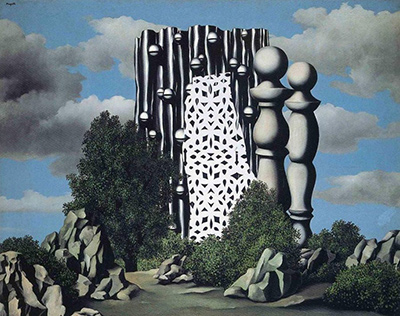
A sheet of white cut paper rises among rocks and bushes in René Magritte’s The Annunciation. Behind it stands a dark, gleaming surface studded with round bells. Two shapes like turned wooden posts rise on the right. Their rounded tops are set against a sky crowded with clouds. The paper, bells and turned shapes have familiar counterparts at much smaller scales. Here the vegetation gathers around their bases, and the objects rise above it like a building or a monument.
Magritte painted L’Annonciation in Paris in 1930. The oil on canvas belongs to Tate, inventory T04367. The Menil Collection gives the canvas measurements as 113.7 by 145.9 centimetres and records Tate’s purchase in 1986 with assistance from the Friends of the Tate Gallery. MoMA’s exhibition checklist identifies the painting as catalogue raisonné number 330. [1] [2] [3]
At a Glance
- Original titleL’Annonciation
- Date and placeParis, 1930
- MediumOil on canvas
- Size113.7 × 145.9 cm
- CollectionTate, T04367
- Catalogue numberSylvester I 330
Selected works
Contents
Rocks, bushes and upright objects
The foreground gives us a low path between rocks. Larger stones stand to the sides, and shorter clusters rise closer to the centre. Their uneven faces catch light on one side and drop into shadow on the other. As the path leads in, a dense patch of foliage cuts across the lower part of the white paper. On the left, a taller tree hides much of the dark surface behind it. The plants help place the strange objects within the terrain. We see the lower edges of the objects vanish at different points, as they would if something large stood among the trees.
The two upright forms on the right have a narrower waist between rounded sections. The tops are nearly spherical and pick up the light differently from the rocks far below them. Their resemblance makes it tempting to read them as a matched pair. They are set at slightly different heights, and a gap near the top briefly gives the sky a place between them. Lower down the pair is interrupted by greenery. The eye can follow the separate outlines near the top more readily than it can determine how each shape meets the earth.
The Menil Collection describes them as bilboquets, a term connected to wooden cup-and-ball toys that recur in Magritte’s painting. Seen at the scale of the rocky landscape, the turned shapes can also recall balusters. Both associations are available through the rounded ends and the narrow sections between them. The location gives those recognisable forms a different presence. Above the trees, they have the height of something we might approach from below and have to look up at. [2]
Paper and metal at the scale of a monument
The white cutout has a dense pattern of dark openings. At the sides, its outer edge changes direction and occasionally disappears behind the shrubs. Inside, the smaller openings divide it into thin bridges and thicker patches. These shapes look as though they have been cut out of a sheet. They also invite us to try to see through them, much as we can look through the spaces between branches. The white is so strong against the darker object behind it that the eye alternates between the cut points and the continuous sheet they belong to.
Watch: Understanding Magritte
Three complementary films introduce the artist, explore words and images, and examine a painting’s materials. These are broader Magritte comparisons, alongside the work discussed here.
René Magritte: Great Art Explained
An introduction to Magritte’s life, characteristic images and visual puzzles.
Watch on YouTubeThe dark surface rises all the way into the sky. Narrow highlights run down it, giving it the appearance of a curtain with a metallic sheen. The round bells sit among those vertical bands and catch similar flecks of light. The Menil account identifies them as sleigh bells. Their placement makes it hard to imagine how any individual bell would move, even though its shape is familiar. A bell has a very different size and position in The Happy Donor, where a single round form sits on a low wall. Here the repeated forms help give the surface the scale of a backdrop that could screen an entire view. [2] [4]
The sky is visible along both sides of the screen and above its uneven top. Patches of cloud range from pale to almost as dark as the upper rocks. That variation makes the plane of the objects especially clear wherever a bright edge meets a shaded cloud. It also leaves open how much terrain continues behind them. We can see the direction in which the path leads, but the view it might reach is almost entirely taken up by the two posts, the white cutout and the bells.
Look at the dark little shapes inside the cut paper and then at the dark marks in the rock faces. The paper’s shapes repeat at close intervals and tend to have crisp edges. In the rocks, the dark areas spread across irregular faces and suggest different angles to the light. The contrast helps us read the paper as a surface even though we see the scene around it recede into depth. Near the bottom of the sheet, the foliage breaks up its outline in a third way. The limits of the paper shift from clear cuts in the middle to an edge that the eye has to reconstruct behind the plants.
The title and a later exhibition proposal
The traditional subject of the Annunciation gives the title a sense of an event or message. Here there is no visible speaker or listener. The upright forms occupy the place where we might expect figures in a scene, and the path draws us towards them. Once we arrive there with our eyes, the painting offers the contours of objects and their relations to the landscape. The title can make that arrival feel like an encounter, even as the things we encounter are difficult to place in a story.
The Menil Drawing Institute found The Annunciation in Dominique de Menil’s notes for a proposed exhibition called Dream Monuments. The show she and John de Menil began planning in the late 1960s was never realised. The notes became a point of departure for a later exhibition in 2021. Her interest in the painting offers one documented way of seeing the assembled forms as monumental. They lift a group of ordinarily small objects high enough to alter the horizon. Following the path from the bottom of the picture lets us see how Magritte gives those objects an imposing presence before we have decided what they might commemorate or announce. [2]
Magritte artworks directory
| Name | Date | Medium |
|---|---|---|
| Memory of a Voyage | 1963 | Oil on canvas |
| The Blood of the World | 1927; also catalogued as 1926–27 | Oil on canvas |
| The Hunters at the Edge of Night | Paris, 1928 | Oil on canvas |
| The Empty Picture Frame (La saignée) | 1938–39 | Gouache on paper |
| The Glass House | 1939 | Gouache on paper |
| Oasis | 1926 in the illustrated Christie’s catalogue | Oil on canvas |
| Natural Encounters | 1945 | Oil on canvas |
| Attempting the Impossible | 1928 | Oil on canvas |
| On the Threshold of Liberty | 1930 | Oil on canvas |
| The Titanic Days | 1928 | Oil on canvas |
| The Voice of Space | 1931 | Oil on canvas |
| Unexpected Answer | 1932 in the museum catalogue, 1933 on the reverse | Oil on canvas |
| Elective Affinities | 1932 in MoMA’s checklist, also published as 1933 | Oil on canvas |
| The Human Condition II | 1935 | Oil on canvas |
| The Six Elements | 1929 | Oil on canvas |
| The Happy Donor | 1966 | Oil on canvas |
| Clairvoyance (Self Portrait) | Brussels, 1936 | Oil on canvas |
| Philosopher’s Lamp | 1936 | Oil on canvas |
| The Annunciation | Paris, 1930 | Oil on canvas |
| The Lost Jockey | Circa 1942 in the illustrated lot catalogue | Gouache on paper laid down on canvas |
| Homage to Mack Sennett | 1936 in the Thyssen catalogue | Oil on canvas |
| Discovery | 1927 | Oil on canvas |
| Collective Invention | 1935 in the later catalogue index | Oil on canvas |
| The Wonders of Nature | 1953 | Oil on canvas |
| The Balcony | Circa 1950, with 1950 inscribed on the reverse | Oil on canvas |
| The Pilgrim | 1966 | Oil on canvas |
| The Invention of Life | 1928 | Oil on canvas |
| The Therapist | 1941 | Gouache on paper |
| The Gradation of Fire | 1938 or 1939 in the catalogue index | Gouache on paper |
| A Friend of Order | 1964 | Oil on canvas |
| The Poetic World | 1939 in Hammacher’s illustrated monograph | Gouache |
| The Muscles of the Sky | Paris, 1927 | Oil on canvas |
| The Battle of the Argonne | 1959 | Oil on canvas |
| Meditation | 1936 | Oil on canvas |
| The Domain of Arnheim | 1962 | Oil on canvas |
| This Is Not an Apple | 1964 | Oil on Unilite |
| The Meaning of Night | Brussels, 1927 | Oil on canvas |
| The Pleasure Principle (Portrait of Edward James) | 1937 | Oil on canvas |
| Ready Made Bouquet | 1957 | Oil on canvas |
| Popular Panorama | 1926 | Oil on canvas |
| Memory of a Journey | 1955 in the Thyssen catalogue. Tentatively 1958 in the catalogue index. | Gouache on paper, as exhibited at the Thyssen |
| Sheherazade | 1947 | Gouache on paper |
| The Difficult Crossing | 1926 | Oil on canvas |
| The Fair Captive | 1948 in the catalogue raisonné | Oil on canvas |
| The Birth of the Idol | 1926 | Oil on canvas |
| Hegel’s Holiday | 1958 | Oil on canvas |
| Homesickness | 1941 | Oil on canvas |
| The Rape (Le Viol) | 1934 | Oil on canvas |
| The Art of Living | 1967 | Oil on canvas |
| Secret Life IV | 1928 | Oil on canvas |
| The Tomb of the Wrestlers | 1960 | Oil on canvas |
| Young Girl Eating a Bird (The Pleasure) | 1927 | Oil on canvas |
| The Central Story | 1928 | Oil on canvas |
| The Seducer | 1953 | Oil on canvas |
| The Telescope | 1963 | Oil on canvas |
| The Banquet | 1958 | Oil on canvas |
| The Empty Mask | 1928 | Oil on canvas |
| The Cultivation of Ideas | 1927 | Oil on canvas |
| The Enchanted Pose | 1927 | Oil on canvas |
| The Future of Statues | 1937 | Oil on plaster |
| The Return of the Flame | 1943 | Oil on canvas |
| The White Page | 1967 | Oil on canvas |
| The Large Family | 1963 | Oil on canvas |
| Black Magic | 1945 | Oil on canvas |
| Les Amants I | 1928 | Oil on canvas |
| Man in a Bowler Hat | 1964 | Oil on canvas |
| The Portrait | 1935 | Oil on canvas |
| The Sixteenth of September | 1956 | Oil on canvas |
| Heartstrings | 1960 | Oil on canvas |
| The Present | 1939; also dated 1938 or 1939 | Gouache on paper |
| Act of Violence | 1932 | Oil on canvas |
| Fashionable People | 1950, in the 2016 thesis caption | Medium unconfirmed · Attribution follows the published caption |
| The Representation | 1962 | Oil on canvas |
| Memory | 1948 | Gouache on paper |
| The Mysteries of the Horizon | 1955 | Oil on canvas |
| Portrait of Stephy Langui | 1961 | Oil on canvas |
| The Double Secret | 1927 | Oil on canvas |
| Every Day | 1966 | Oil on canvas |
| The Invisible World | 1954 | Oil on canvas |
| Dawn of Cayenne | 1926 | Oil painting |
| Clear Ideas | 1955 (inscribed); possible 1958 execution | Oil on canvas |
| The Face of Genius | 1926 / 1927 | Oil on canvas |
| Good Faith | 1965; earlier record 1964–65 | Oil on canvas |
| The Flash | 1959 | Gouache and pencil on paper |
| Perpetual Motion | 1935; earlier catalogue 1934 | Oil on canvas |
| Personal Values | 1952 | Oil on canvas |
| Not to Be Reproduced | 1937 | Oil on canvas |
| The Red Model | 1935 | Oil on canvas |
| The Menaced Assassin | 1927 | Oil on canvas |
| The Castle of the Pyrenees | 1959 | Oil on canvas |
| The Blank Signature | 1965 | Oil on canvas |
| The Listening Room | 1952 | Oil on canvas |
| Golconde | 1953 | Oil on canvas |
| Time Transfixed | 1938 | Oil on canvas |
| The Treachery of Images | 1929 | Oil on canvas |
| The False Mirror | 1929 | Oil on canvas |
| The Empire of Light | 1953–54 | Oil on canvas |
| The Human Condition | 1933 | Oil on canvas |
| Les Amants | 1928 | Oil on canvas |
| The Son of Man | 1964 | Oil on canvas |
Frequently Asked Questions
Tate holds the 1930 oil on canvas under inventory T04367.
The Menil identifies the paired turned forms as bilboquets and describes cut paper in front of a bell-studded metallic surface.
Discussion
Look closely and compare your reading with others.
Reader Insights
Which rock or tree gives you the strongest sense of the objects’ scale?
Where does the white cutout seem to stand in relation to the dark screen?
What does the title lead you to expect when you follow the path towards the centre?
Join the Conversation
Share a detail, comparison or question about The Annunciation below.
References
- Museum of Modern Art. Magritte: The Mystery of the Ordinary, 1926–1938. Exhibition checklist, p. 13, catalogue raisonné entry 330. View source.
- Menil Collection. “Pictures for Dreaming: Surrealism in the Dream Monuments Archive.” Figure 1 and notes 4–5. View source.
- Museo Nacional Thyssen-Bornemisza. The Magritte Machine. Exhibition list of works, Tate T04367. View source.
- Musée d’Ixelles. L’heureux donateur. Collection entry. View source.







