


 by Tom Gurney
Tom Gurney BSc (Hons) is an art history expert with over 20 years experience
Page created on / Page updated on
Email: tomgurney1@gmail.com / Phone: +44 7429 011000
On the Threshold of Liberty
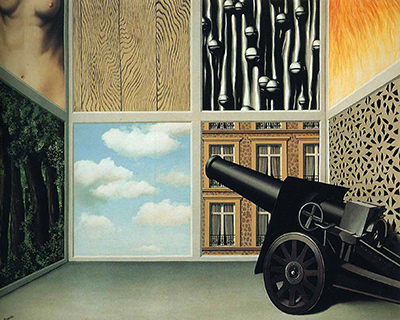
A cannon stands in a room whose walls contain a blue sky, the front of a building, a dark wood and a patch of fire. In René Magritte’s On the Threshold of Liberty, each view has straight borders and a place in the architecture. The cannon sits on the floor in front of them, its barrel pointing across the room towards the panels. It is easy to see where the cannon stands. It is much harder to decide what lies in front of it, since every panel seems to open onto a world with a different depth and scale.
The picture shown here is the wide canvas held by Museum Boijmans Van Beuningen in Rotterdam. The museum dates it to 1930 and records it as an oil on canvas measuring 114 by 146 centimetres, inventory 2709 (MK). A larger, upright version was made in 1937 for Edward James and is now at the Art Institute of Chicago. The two pictures share their French title, Au seuil de la liberté. [1] [2]
At a Glance
- Original titleAu seuil de la liberté
- Date1930
- MediumOil on canvas
- Size114 × 146 cm
- CollectionMuseum Boijmans Van Beuningen, 2709 (MK)
Selected works
A room made of views
The floor gives us a place from which to look. It extends across the foreground and meets the panels along the back of the room. At either side, the junction between the walls and the floor angles towards us. Those edges are enough to suggest that we could stand in the room. They make sense of the space around the cannon’s wheels and the part of the carriage cut off at the right edge.
The lower panels directly ahead present two very different kinds of distance. On the left, broad clouds fill a patch of sky. On the right, rows of windows run across the façade of a building. The sky has depth without much indication of scale. The façade provides plenty of clues to scale, from window openings to decorative divisions. The two panels meet along a single straight border, so the eye can cross directly from an open stretch of air to a wall dense with detail.
Higher up, the grain of wood runs through broad pale strips. Alongside it, a dark panel contains closely spaced upright shapes with small rounded forms. At either side, the panels turn with the room. Part of a torso occupies the upper left above a dark woodland view. The orange flames at the right sit above a light panel filled with repeating dark openings. The borders hold all eight sections in place, even when the subject of one panel seems to belong at an entirely different distance from the viewer.
It is worth following those borders around the corners. Within a panel, the view can have its own direction. The trees rise into depth, the façade faces outward and the pattern at the right keeps drawing attention back to the wall. Along a border, we recover the angle of the room. That movement from subject to edge can make the panels look like painted decorations on one pass and openings to different places on the next. Magritte keeps the lower edges of the walls visible so that both readings have something to depend on.
The cannon in the foreground
The wheel is one of the clearest shapes in the foreground. Its outer edge sits where the carriage bears on the floor, and the lighter details around the hub stand out from the deep brown and black. Above the wheel, the long barrel projects towards the centre of the room. It overlaps the façade and approaches the division between building and sky. The cannon’s strong diagonal pulls the eye away from the vertical and horizontal divisions that otherwise organise the wall.
Watch: Understanding Magritte
Three complementary films introduce the artist, explore words and images, and examine a painting’s materials. These are broader Magritte comparisons, alongside the work discussed here.
René Magritte: Great Art Explained
An introduction to Magritte’s life, characteristic images and visual puzzles.
Watch on YouTubeBoijmans quotes a letter Magritte sent to the dealer E.L.T. Mesens on 10 June 1930. In it he listed such subjects as sky, fire, a cut-paper shape, a house façade, a woman’s breasts, a forest and planks. He described the cannon on the floor as pointing at the things that made up the walls. The list is useful because it treats those things as parts of the room even when they have the appearance of pictures or views. When we follow the line of the barrel, its destination remains difficult to imagine. It seems to point towards both a wall and the things pictured there. [1]
The title suggests that we are at the point of passing into somewhere else. There is no obvious doorway along the floor. It is the separate panels, with their trees and windows and sky, that offer possible ways out. The cannon changes the feeling of that possibility. Boijmans proposes a source in the French translation of John Buchan’s novel Prester John, where the narrator speaks of being close to freedom. The possible literary source supplies a way to hear the title. The composition leaves open what crossing the threshold would involve. [1]
From a grid to a room
A year earlier, Magritte had arranged six separate views in The Six Elements, now in Philadelphia. Its panels meet like the cells of a grid across a horizontal canvas. Motifs such as the sky, the façade and the woodland anticipate parts of the Rotterdam picture. Boijmans describes the earlier work as a precursor. An important change takes place in the way the sections meet. In The Six Elements, their borders divide the flat field of the canvas. In On the Threshold of Liberty, the sections bend around a space with its own floor. We can imagine standing in front of them with the cannon beside us. [1] [3]
Boijmans records that Magritte prepared the 1930 work for a solo exhibition at Galerie Goemans in Paris that was cancelled after the gallery closed. The canvas was later shown at the 1936 International Surrealist Exhibition in London. The following year, James commissioned three large paintings for his London home, including the upright version of On the Threshold of Liberty. In the later work, the taller walls give the upper panels a stronger presence above the floor and cannon. The scale of the commission also made the invented room a prominent part of a real interior. MoMA’s audio guide describes how James used lighting to reveal paintings from the commission behind two-way mirrors. [1] [2]
A photograph Magritte took in 1937 shows James with his back to the camera in front of the upright canvas. The Metropolitan Museum of Art holds the gelatin silver print. James’s position makes the painted floor and walls seem closer to the space in which he stands. It is a way to see how the composition might behave when it fills much of a person’s field of view. In the Rotterdam painting, the wheel and open floor still make a similar invitation. The closer we come to taking up that position, the more pressing the question of what sort of wall is in front of us becomes. [4]
Magritte artworks directory
| Name | Date | Medium |
|---|---|---|
| Memory of a Voyage | 1963 | Oil on canvas |
| The Blood of the World | 1927; also catalogued as 1926–27 | Oil on canvas |
| The Hunters at the Edge of Night | Paris, 1928 | Oil on canvas |
| The Empty Picture Frame (La saignée) | 1938–39 | Gouache on paper |
| The Glass House | 1939 | Gouache on paper |
| Oasis | 1926 in the illustrated Christie’s catalogue | Oil on canvas |
| Natural Encounters | 1945 | Oil on canvas |
| Attempting the Impossible | 1928 | Oil on canvas |
| On the Threshold of Liberty | 1930 | Oil on canvas |
| The Titanic Days | 1928 | Oil on canvas |
| The Voice of Space | 1931 | Oil on canvas |
| Unexpected Answer | 1932 in the museum catalogue, 1933 on the reverse | Oil on canvas |
| Elective Affinities | 1932 in MoMA’s checklist, also published as 1933 | Oil on canvas |
| The Human Condition II | 1935 | Oil on canvas |
| The Six Elements | 1929 | Oil on canvas |
| The Happy Donor | 1966 | Oil on canvas |
| Clairvoyance (Self Portrait) | Brussels, 1936 | Oil on canvas |
| Philosopher’s Lamp | 1936 | Oil on canvas |
| The Annunciation | Paris, 1930 | Oil on canvas |
| The Lost Jockey | Circa 1942 in the illustrated lot catalogue | Gouache on paper laid down on canvas |
| Homage to Mack Sennett | 1936 in the Thyssen catalogue | Oil on canvas |
| Discovery | 1927 | Oil on canvas |
| Collective Invention | 1935 in the later catalogue index | Oil on canvas |
| The Wonders of Nature | 1953 | Oil on canvas |
| The Balcony | Circa 1950, with 1950 inscribed on the reverse | Oil on canvas |
| The Pilgrim | 1966 | Oil on canvas |
| The Invention of Life | 1928 | Oil on canvas |
| The Therapist | 1941 | Gouache on paper |
| The Gradation of Fire | 1938 or 1939 in the catalogue index | Gouache on paper |
| A Friend of Order | 1964 | Oil on canvas |
| The Poetic World | 1939 in Hammacher’s illustrated monograph | Gouache |
| The Muscles of the Sky | Paris, 1927 | Oil on canvas |
| The Battle of the Argonne | 1959 | Oil on canvas |
| Meditation | 1936 | Oil on canvas |
| The Domain of Arnheim | 1962 | Oil on canvas |
| This Is Not an Apple | 1964 | Oil on Unilite |
| The Meaning of Night | Brussels, 1927 | Oil on canvas |
| The Pleasure Principle (Portrait of Edward James) | 1937 | Oil on canvas |
| Ready Made Bouquet | 1957 | Oil on canvas |
| Popular Panorama | 1926 | Oil on canvas |
| Memory of a Journey | 1955 in the Thyssen catalogue. Tentatively 1958 in the catalogue index. | Gouache on paper, as exhibited at the Thyssen |
| Sheherazade | 1947 | Gouache on paper |
| The Difficult Crossing | 1926 | Oil on canvas |
| The Fair Captive | 1948 in the catalogue raisonné | Oil on canvas |
| The Birth of the Idol | 1926 | Oil on canvas |
| Hegel’s Holiday | 1958 | Oil on canvas |
| Homesickness | 1941 | Oil on canvas |
| The Rape (Le Viol) | 1934 | Oil on canvas |
| The Art of Living | 1967 | Oil on canvas |
| Secret Life IV | 1928 | Oil on canvas |
| The Tomb of the Wrestlers | 1960 | Oil on canvas |
| Young Girl Eating a Bird (The Pleasure) | 1927 | Oil on canvas |
| The Central Story | 1928 | Oil on canvas |
| The Seducer | 1953 | Oil on canvas |
| The Telescope | 1963 | Oil on canvas |
| The Banquet | 1958 | Oil on canvas |
| The Empty Mask | 1928 | Oil on canvas |
| The Cultivation of Ideas | 1927 | Oil on canvas |
| The Enchanted Pose | 1927 | Oil on canvas |
| The Future of Statues | 1937 | Oil on plaster |
| The Return of the Flame | 1943 | Oil on canvas |
| The White Page | 1967 | Oil on canvas |
| The Large Family | 1963 | Oil on canvas |
| Black Magic | 1945 | Oil on canvas |
| Les Amants I | 1928 | Oil on canvas |
| Man in a Bowler Hat | 1964 | Oil on canvas |
| The Portrait | 1935 | Oil on canvas |
| The Sixteenth of September | 1956 | Oil on canvas |
| Heartstrings | 1960 | Oil on canvas |
| The Present | 1939; also dated 1938 or 1939 | Gouache on paper |
| Act of Violence | 1932 | Oil on canvas |
| Fashionable People | 1950, in the 2016 thesis caption | Medium unconfirmed · Attribution follows the published caption |
| The Representation | 1962 | Oil on canvas |
| Memory | 1948 | Gouache on paper |
| The Mysteries of the Horizon | 1955 | Oil on canvas |
| Portrait of Stephy Langui | 1961 | Oil on canvas |
| The Double Secret | 1927 | Oil on canvas |
| Every Day | 1966 | Oil on canvas |
| The Invisible World | 1954 | Oil on canvas |
| Dawn of Cayenne | 1926 | Oil painting |
| Clear Ideas | 1955 (inscribed); possible 1958 execution | Oil on canvas |
| The Face of Genius | 1926 / 1927 | Oil on canvas |
| Good Faith | 1965; earlier record 1964–65 | Oil on canvas |
| The Flash | 1959 | Gouache and pencil on paper |
| Perpetual Motion | 1935; earlier catalogue 1934 | Oil on canvas |
| Personal Values | 1952 | Oil on canvas |
| Not to Be Reproduced | 1937 | Oil on canvas |
| The Red Model | 1935 | Oil on canvas |
| The Menaced Assassin | 1927 | Oil on canvas |
| The Castle of the Pyrenees | 1959 | Oil on canvas |
| The Blank Signature | 1965 | Oil on canvas |
| The Listening Room | 1952 | Oil on canvas |
| Golconde | 1953 | Oil on canvas |
| Time Transfixed | 1938 | Oil on canvas |
| The Treachery of Images | 1929 | Oil on canvas |
| The False Mirror | 1929 | Oil on canvas |
| The Empire of Light | 1953–54 | Oil on canvas |
| The Human Condition | 1933 | Oil on canvas |
| Les Amants | 1928 | Oil on canvas |
| The Son of Man | 1964 | Oil on canvas |
Frequently Asked Questions
This is the wide 1930 canvas held by Museum Boijmans Van Beuningen in Rotterdam.
The larger, upright canvas commissioned by Edward James belongs to the Art Institute of Chicago.
Discussion
Look closely and compare your reading with others.
Reader Insights
Which wall panel first reads as a view into another space?
Where does your eye go if you follow the direction of the cannon’s barrel?
What changes when the grid of separate images becomes part of a room?
Join the Conversation
Share a detail, comparison or question about On the Threshold of Liberty below.
References
- Museum Boijmans Van Beuningen. Au seuil de la liberté. Collection record, 2709 (MK), and research notes. View source.
- Museum of Modern Art. Au seuil de la liberté (On the Threshold of Liberty), 1937. Exhibition audio guide, with Stephanie D’Alessandro of the Art Institute of Chicago. View source.
- Philadelphia Museum of Art. The Six Elements. Collection record, 1950-134-127. View source.
- Metropolitan Museum of Art. Edward James in front of “On the Threshold of Liberty”. Photograph collection record, 1987.1100.157. View source.







