




The Invisible World
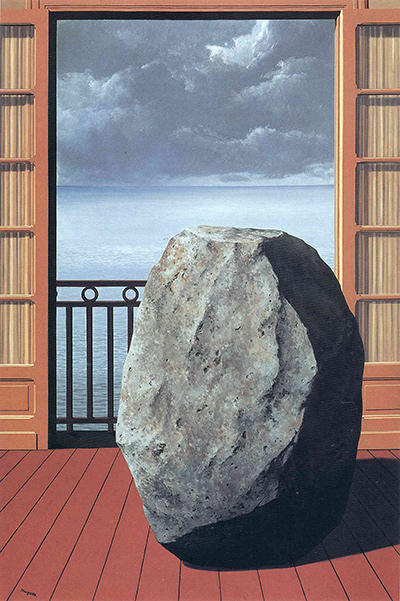
A large boulder stands on red floorboards before an open pair of glass doors. Beyond the balcony railing lie a pale sea and a grey, clouded sky. Everything is recognisable, but the stone occupies a place where its size, weight and proximity feel difficult to accommodate. The view is open, and our access to it is obstructed at the same time.
René Magritte painted The Invisible World, or Le monde invisible, in 1954. The Menil Collection's canvas, inventory V 615, measures 195.6 × 131.1 centimetres. Its identity and dimensions are recorded in the Art Gallery of New South Wales's 2024 exhibition resource. The tall format gives the boulder an almost bodily presence within the room. [1]
At a Glance
A stone on the floor and a stone in the air
Contents
A stone inside a room
The stone dominates the foreground without filling the entire canvas. Its broad pale face turns towards the viewer, while a darker side curves away to the right. A smaller upper plane completes the impression of a solid, irregular object. We can understand its volume even though its situation remains strange.
Small marks across the surface suggest mottling and roughness. These details distinguish the boulder from the smoother architecture around it. The rock belongs to another kind of environment, yet Magritte describes it with enough care to make it feel insistently present on the floor.
Its placement also creates an encounter at close range. We do not look down upon it from a remote viewpoint. It rises into the doorway and interrupts the view beyond, making the room's foreground a place that has to be negotiated by the eye.
The doors and the balcony
The paired doors supply a measured architectural frame. Their straight edges and repeated glass divisions contrast with the stone's uneven contour. The open centre promises a route towards the balcony and the sea, while the rock makes that route appear restricted.
The railing provides another set of repeated shapes. Its vertical bars and circular ornaments establish a regular pattern behind the stone. Where that pattern disappears, the boulder's silhouette becomes particularly clear. We can infer the continuation of the railing without seeing it all.
This relationship gives the rock a convincing position in space. It stands in front of the balcony, within the room, and in contact with the floor. The picture does not make every spatial rule uncertain. It establishes enough ordinary relationships for the extraordinary occupation of the foreground to become unavoidable.
Floorboards and shadow
The floorboards lead towards the opening. Their narrow divisions create directions through the room, but the stone interrupts their continuity. We see the boards around its base and imagine them continuing beneath it. The support that the boulder seems to receive is part of its apparent weight.
A dark shadow spreads towards the right. It helps separate the stone from the floor and makes the meeting between them more emphatic. The lighter front of the boulder and its darker side create a further turn between what faces us and what recedes.
These painted relationships can suggest a particular light, but they do not establish an unseen door or the route by which the rock entered. The image supplies an arrangement to examine, not a sequence of practical events. Its stillness leaves the circumstances of arrival unresolved.
A distant sea
Behind the confined foreground, the sea offers a broad horizontal opening. Its pale surface is comparatively quiet, especially beside the more sharply defined architecture and mottled stone. The horizon gives that distance a clear boundary without furnishing a specific, identifiable coastal location.
Watch: Understanding Magritte
Three complementary films introduce the artist, explore words and images, and examine a painting’s materials. These are broader Magritte comparisons, alongside the work discussed here.
René Magritte: Great Art Explained
An introduction to Magritte’s life, characteristic images and visual puzzles.
Watch on YouTubeThe clouds gather more heavily in the sky above. Their changing light and dark forms provide a different kind of mass from the boulder's compact solidity. Both sky and stone occupy substantial areas of the picture, but their apparent materials invite different expectations.
The distant view remains attractive even while it is partly blocked. We can look around the stone towards the water and then return to the object nearest us. Magritte makes the boulder a conspicuous obstruction without allowing it to erase the landscape completely.
Why scale matters
The picture's effect depends on the relation between the rock and the room. A pebble on the floor would be easy to overlook. This boulder reaches far into the opening and seems difficult to move, making the architecture look less accommodating than it first appears.
At the same time, the doors remain ordinary in their proportions. Magritte does not need to turn them into fantastic architecture. Their familiarity gives us a basis for judging the stone's inconvenient scale and the way it changes the use of the surrounding space.
The tall canvas strengthens that presence. The stone rises from near the bottom towards the middle of the view, while the open doorway carries the eye upwards into the sky. We experience a conflict between the heavy foreground and the more expansive space above and beyond it.
Stones and the later paintings
The Menil Collection's 2014 gallery guide describes stones as a recurring concern in Magritte's late work. It places The Invisible World among images in which large rocks occupy improbable situations, alongside paintings that transform familiar objects and entire scenes into stone. [2]
Those approaches are related, but their effects differ. A familiar object represented as petrified changes its apparent substance. The boulder here remains recognisably a boulder; the disturbance lies in where it stands and how it relates to the room and view around it.
This distinction makes the picture more specific than a general example of something strange. Its material is ordinary, its volume legible and much of its space coherent. The problem emerges from the combination. The painting allows a familiar thing to become unfamiliar without dissolving its recognisable identity.
What is invisible?
The title poses a question beside a scene filled with visible things. Stone, doors, floor, railing, water and clouds can all be named. Naming them, however, does not explain the relation that makes their coexistence so unsettling.
It is tempting to give the boulder a fixed hidden meaning: an obstacle, a private burden or something concealed in the mind. Such readings may describe a viewer's response, but the picture does not identify one personal story as its solution. Its visible construction gives the question a more sustained life.
The AGNSW resource places this work beside Magritte's reflections on painting as a means of creating poetic images from recognisable things. That context encourages attention to relationships within the image rather than treating each object as a substitute for a single explanatory word. [1]
The boulder remains a powerful final point of return. It both belongs to the space through its painted weight and disrupts that space through its placement. Beyond it, the sea continues. The Invisible World holds these experiences together, making an open view feel newly difficult to enter.
Magritte artworks directory
| Name | Date | Medium |
|---|---|---|
| Memory of a Voyage | 1963 | Oil on canvas |
| The Blood of the World | 1927; also catalogued as 1926–27 | Oil on canvas |
| The Hunters at the Edge of Night | Paris, 1928 | Oil on canvas |
| The Empty Picture Frame (La saignée) | 1938–39 | Gouache on paper |
| The Glass House | 1939 | Gouache on paper |
| Oasis | 1926 in the illustrated Christie’s catalogue | Oil on canvas |
| Natural Encounters | 1945 | Oil on canvas |
| Attempting the Impossible | 1928 | Oil on canvas |
| On the Threshold of Liberty | 1930 | Oil on canvas |
| The Titanic Days | 1928 | Oil on canvas |
| The Voice of Space | 1931 | Oil on canvas |
| Unexpected Answer | 1932 in the museum catalogue, 1933 on the reverse | Oil on canvas |
| Elective Affinities | 1932 in MoMA’s checklist, also published as 1933 | Oil on canvas |
| The Human Condition II | 1935 | Oil on canvas |
| The Six Elements | 1929 | Oil on canvas |
| The Happy Donor | 1966 | Oil on canvas |
| Clairvoyance (Self Portrait) | Brussels, 1936 | Oil on canvas |
| Philosopher’s Lamp | 1936 | Oil on canvas |
| The Annunciation | Paris, 1930 | Oil on canvas |
| The Lost Jockey | Circa 1942 in the illustrated lot catalogue | Gouache on paper laid down on canvas |
| Homage to Mack Sennett | 1936 in the Thyssen catalogue | Oil on canvas |
| Discovery | 1927 | Oil on canvas |
| Collective Invention | 1935 in the later catalogue index | Oil on canvas |
| The Wonders of Nature | 1953 | Oil on canvas |
| The Balcony | Circa 1950, with 1950 inscribed on the reverse | Oil on canvas |
| The Pilgrim | 1966 | Oil on canvas |
| The Invention of Life | 1928 | Oil on canvas |
| The Therapist | 1941 | Gouache on paper |
| The Gradation of Fire | 1938 or 1939 in the catalogue index | Gouache on paper |
| A Friend of Order | 1964 | Oil on canvas |
| The Poetic World | 1939 in Hammacher’s illustrated monograph | Gouache |
| The Muscles of the Sky | Paris, 1927 | Oil on canvas |
| The Battle of the Argonne | 1959 | Oil on canvas |
| Meditation | 1936 | Oil on canvas |
| The Domain of Arnheim | 1962 | Oil on canvas |
| This Is Not an Apple | 1964 | Oil on Unilite |
| The Meaning of Night | Brussels, 1927 | Oil on canvas |
| The Pleasure Principle (Portrait of Edward James) | 1937 | Oil on canvas |
| Ready Made Bouquet | 1957 | Oil on canvas |
| Popular Panorama | 1926 | Oil on canvas |
| Memory of a Journey | 1955 in the Thyssen catalogue. Tentatively 1958 in the catalogue index. | Gouache on paper, as exhibited at the Thyssen |
| Sheherazade | 1947 | Gouache on paper |
| The Difficult Crossing | 1926 | Oil on canvas |
| The Fair Captive | 1948 in the catalogue raisonné | Oil on canvas |
| The Birth of the Idol | 1926 | Oil on canvas |
| Hegel’s Holiday | 1958 | Oil on canvas |
| Homesickness | 1941 | Oil on canvas |
| The Rape (Le Viol) | 1934 | Oil on canvas |
| The Art of Living | 1967 | Oil on canvas |
| Secret Life IV | 1928 | Oil on canvas |
| The Tomb of the Wrestlers | 1960 | Oil on canvas |
| Young Girl Eating a Bird (The Pleasure) | 1927 | Oil on canvas |
| The Central Story | 1928 | Oil on canvas |
| The Seducer | 1953 | Oil on canvas |
| The Telescope | 1963 | Oil on canvas |
| The Banquet | 1958 | Oil on canvas |
| The Empty Mask | 1928 | Oil on canvas |
| The Cultivation of Ideas | 1927 | Oil on canvas |
| The Enchanted Pose | 1927 | Oil on canvas |
| The Future of Statues | 1937 | Oil on plaster |
| The Return of the Flame | 1943 | Oil on canvas |
| The White Page | 1967 | Oil on canvas |
| The Large Family | 1963 | Oil on canvas |
| Black Magic | 1945 | Oil on canvas |
| Les Amants I | 1928 | Oil on canvas |
| Man in a Bowler Hat | 1964 | Oil on canvas |
| The Portrait | 1935 | Oil on canvas |
| The Sixteenth of September | 1956 | Oil on canvas |
| Heartstrings | 1960 | Oil on canvas |
| The Present | 1939; also dated 1938 or 1939 | Gouache on paper |
| Act of Violence | 1932 | Oil on canvas |
| Fashionable People | 1950, in the 2016 thesis caption | Medium unconfirmed · Attribution follows the published caption |
| The Representation | 1962 | Oil on canvas |
| Memory | 1948 | Gouache on paper |
| The Mysteries of the Horizon | 1955 | Oil on canvas |
| Portrait of Stephy Langui | 1961 | Oil on canvas |
| The Double Secret | 1927 | Oil on canvas |
| Every Day | 1966 | Oil on canvas |
| The Invisible World | 1954 | Oil on canvas |
| Dawn of Cayenne | 1926 | Oil painting |
| Clear Ideas | 1955 (inscribed); possible 1958 execution | Oil on canvas |
| The Face of Genius | 1926 / 1927 | Oil on canvas |
| Good Faith | 1965; earlier record 1964–65 | Oil on canvas |
| The Flash | 1959 | Gouache and pencil on paper |
| Perpetual Motion | 1935; earlier catalogue 1934 | Oil on canvas |
| Personal Values | 1952 | Oil on canvas |
| Not to Be Reproduced | 1937 | Oil on canvas |
| The Red Model | 1935 | Oil on canvas |
| The Menaced Assassin | 1927 | Oil on canvas |
| The Castle of the Pyrenees | 1959 | Oil on canvas |
| The Blank Signature | 1965 | Oil on canvas |
| The Listening Room | 1952 | Oil on canvas |
| Golconde | 1953 | Oil on canvas |
| Time Transfixed | 1938 | Oil on canvas |
| The Treachery of Images | 1929 | Oil on canvas |
| The False Mirror | 1929 | Oil on canvas |
| The Empire of Light | 1953–54 | Oil on canvas |
| The Human Condition | 1933 | Oil on canvas |
| Les Amants | 1928 | Oil on canvas |
| The Son of Man | 1964 | Oil on canvas |
Frequently Asked Questions
The canvas belongs to The Menil Collection in Houston, inventory V 615. [1]
In this composition the boulder meets the floor and casts a shadow. Its improbable placement within the room is central to the effect.
Discussion
Follow the rock’s relation to the doorway, floor and distant horizon.
Reader Insights
Which architectural details make the stone's scale most apparent?
How does the boulder change your experience of the distant sea?
Where does the painting make an impossible situation look convincing?
Join the Conversation
Share a detail, comparison or question about The Invisible World below.
References
- Art Gallery of New South Wales, Magritte: Learning resource, 2024, p. 24. Reproduction, title, 1954 date, medium, dimensions and Menil inventory V 615; accompanying artist statement. View source.Splash image: The Invisible World, 1954. Oil on canvas, 195.6 × 131.1 cm. The Menil Collection, Houston; V 615.
- The Menil Collection, Memories of a Voyage: The Late Work of René Magritte, 2014 gallery guide. Stones, improbable placement and petrification in the late work. View source.
- Christie’s, René Magritte, Les idées claires, 2006 sale catalogue. Separate dated-1955 painting and qualified later-execution proposal. View source.







