

 by Tom Gurney
Tom Gurney BSc (Hons) is an art history expert with over 20 years experience
Published on June 19, 2020June 19, 2020 / Updated on July 6, 2026
Email: tomgurney1@gmail.com / Phone: +44 7429 011000
The Son of Man: Why Magritte's Apple Still Hides More Than It Reveals
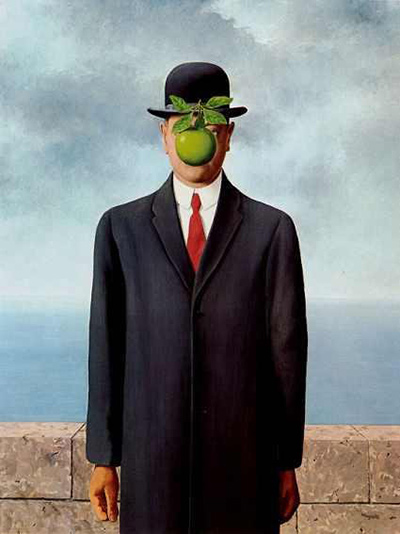
The Son of Man is the Rene Magritte painting almost everyone recognises before they know its title. A man in a dark coat and bowler hat stands against a low wall, with the sea and a pale cloudy sky behind him. His posture is formal, his clothing ordinary, and the composition is calm. Then the image refuses the one thing a portrait normally promises: the face. A large green apple floats directly in front of the man's head, hiding most of his features while allowing a single eye to remain partly visible at the edge. [7] [1]
Painted in 1964, The Son of Man belongs to Magritte's late career, when his visual language had become exceptionally clear and instantly memorable. The objects are not exotic. A hat, an apple, a coat, a wall, a horizon: all are familiar things. The strangeness comes from their arrangement and from the precision with which Magritte stages a small impossibility. The apple does not burst, melt, glow or transform. It simply occupies the wrong place, and by doing so it turns the whole painting into a problem of looking. [7] [2]
That problem is why the work has lasted so powerfully in popular memory. The painting is often described as a self-portrait, and that description is useful, but it is also incomplete. If this is Magritte presenting himself, he does so by withholding himself. The bowler-hatted figure resembles the anonymous middle-class men who recur throughout his work, while the obscured face makes individuality both present and unavailable. The painting gives the viewer a person, then blocks the ordinary route by which a viewer would identify him. [7]
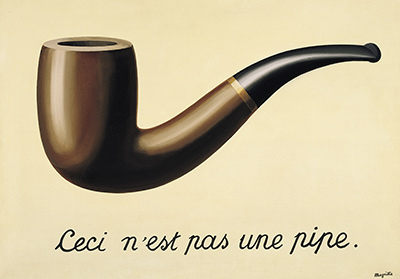
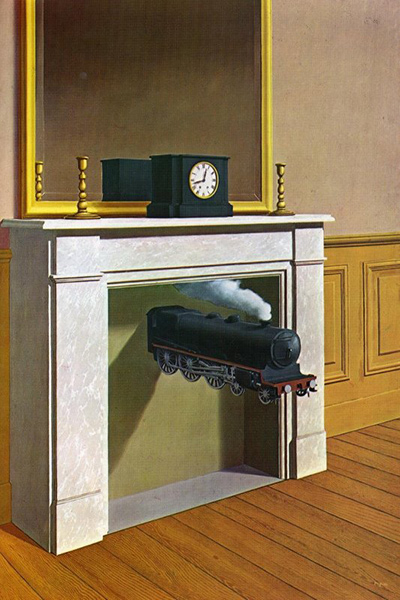
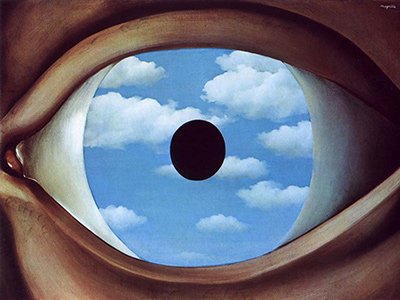
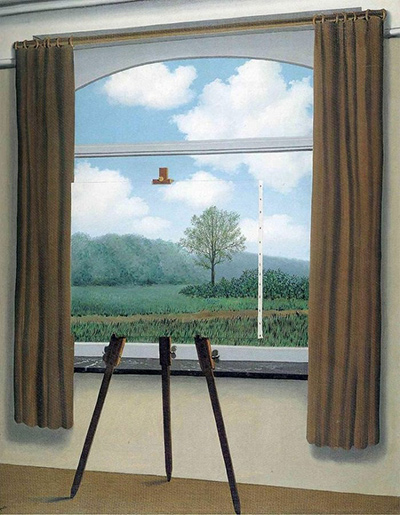
The Son of Man is also a compact introduction to Magritte's wider artistic intelligence. Like The Treachery of Images, it asks viewers to notice the gap between an image and what they expect an image to do. Like The Human Condition, it turns concealment into an active force rather than a mere absence. Like The Listening Room and This is Not an Apple, it uses the apple as an ordinary object made philosophically awkward. The result is not a puzzle with a single solution, but a picture that makes the viewer feel the pressure of wanting one. [7]
Today the painting is privately owned and is rarely seen in public, yet its image circulates everywhere: in art books, posters, design references, films, music videos and parodies. That wide recognition can make the work seem more familiar than it really is. Look at it carefully, and the famous green apple becomes only the beginning. The odd anatomy of the arm, the deadpan horizon, the formal dress, the uncertain title and the blocked face all contribute to a painting that is simple in outline but deeply resistant to being explained away. [7]
Contents
- At a Glance
- Why This Painting Matters
- Timeline
- Historical Background
- Commission and Patron
- Provenance
- Visual Analysis
- Looking Carefully
- Things You Might Miss
- Technique and Composition
At a Glance
- Artist: Rene Magritte
- Title: The Son of Man
- Original title: Le fils de l'homme
- Date: 1964
- Medium: Oil on canvas
- Dimensions: 116 x 89 cm
- Current location: Private collection
- Movement: Surrealism
- Subject: A formally dressed man in a bowler hat whose face is hidden by a floating green apple, standing before a low wall with the sea and cloudy sky behind him.
- Best known for: Its unforgettable image of a green apple obscuring a man's face, a visual device that turns a portrait into a meditation on concealment, identity and the desire to see what is hidden.
- Related Magritte themes: Bowler-hatted men, apples, blocked faces, ordinary objects in impossible positions, and the unstable relationship between visible things and unseen meaning.
- Useful comparisons: The Treachery of Images, The Human Condition, The Listening Room, This is Not an Apple and Man in a Bowler Hat.
Why This Painting Matters
The Son of Man matters because it condenses much of Magritte's art into one instantly legible image. It does not require specialist knowledge to feel its force. A viewer understands the situation in seconds: this is a portrait-like image, and the face has been blocked. But the painting keeps unfolding after that first recognition. The apple is not merely a joke or a visual trick. It creates a conflict between what the eye receives and what the mind expects. [6]
That conflict is central to Magritte's importance. Many Surrealist artists used dream imagery, distorted bodies or theatrical fantasy to disrupt ordinary reality. Magritte often worked more quietly. His pictures tend to be crisp, controlled and almost plain in their presentation. The disturbance comes from the exact placement of familiar things. In The Son of Man, the apple is painted as an apple, the man as a man, the sky as a sky. Nothing is visibly chaotic. Yet the painting is impossible because an ordinary object has been moved into a position that ordinary reality cannot explain. [6]
The painting also matters because it changes the function of portraiture. A portrait traditionally offers access: to likeness, status, character, memory or identity. The Son of Man offers all the visual signals of a portrait and then denies the expected revelation. The man stands still, centred and frontal. His clothing is formal enough to suggest social identity, yet generic enough to resist individuality. The viewer is given a sitter without a face, a person without full personhood, a self-portrait that refuses self-disclosure. [6]
This is why the painting's popularity should not be mistaken for simplicity. The image is popular because it is clear, but it is durable because it is unresolved. The green apple is easy to remember, easy to reproduce and easy to parody, which has helped the work circulate far beyond museum culture. But repetition has not exhausted it. Each reproduction still depends on the same small frustration: the viewer wants the apple to move. The painting makes that desire visible. [6]
The Son of Man also sits at the meeting point of several recurring Magritte motifs. The bowler-hatted man connects it to his repeated images of anonymous bourgeois figures. The apple links it to works in which fruit becomes strange through scale, placement or naming. The hidden face recalls Magritte's broader interest in veiling, blocking and displacement. The sea and sky connect the figure to one of his favourite settings: a clear horizon that appears open while the central subject remains inaccessible. [6]
For a general audience, the painting is often an entry point into Magritte's art. It introduces the way he turns the ordinary against itself. For art historians, it shows the late Magritte at his most economical: a small set of motifs arranged with such precision that the painting becomes both image and argument. It asks what it means to see a person, what it means to hide in plain sight, and why an image can become more compelling when it withholds the thing we most expect it to show. [6]
Timeline
- 1898 — Rene Magritte is born in Lessines, Belgium. He would become one of the most distinctive painters associated with Surrealism, though his mature work often differs from the more dreamlike or biomorphic imagery of many Paris Surrealists. [7]
- 1922 — Magritte marries Georgette Berger. Around the same period, he encounters the work of Giorgio de Chirico, whose uncanny arrangements of ordinary things help shape Magritte's own sense that painting can make thought visible without abandoning recognisable objects. [7]
- 1926 — Magritte paints The Lost Jockey, often cited as an important early Surrealist work. This period begins his long exploration of displacement, contradiction and visual poetry. [7]
- 1927-1930 — Magritte lives near Paris and comes into closer contact with the Surrealist circle. The move helps place him within the wider European avant-garde, but his later reputation would rest on a particularly Belgian, deadpan and philosophical version of Surrealism. [7]
- 1929 — Magritte paints The Treachery of Images, the famous pipe painting with the inscription declaring that the painted pipe is not a pipe. This work becomes one of the clearest statements of his interest in the difference between objects, images and language. [7]
- 1930s — Magritte develops many of the devices that would define his mature work: veiled or obscured faces, interiors that open onto impossible spaces, paintings within paintings, floating objects, and precise scenes that resist ordinary logic. [7]
- 1950s — The bowler-hatted man becomes one of Magritte's most recognisable recurring figures. The motif gives him a way to combine self-image, anonymity and bourgeois ordinariness in a single visual type. [7]
- 1964 — Magritte paints The Son of Man. The work brings together the bowler hat, the hidden face, the apple and the seascape into one of his most memorable late images. [7]
- 1964 — Magritte also produces related works that explore similar problems of concealment and identity, including Man in a Bowler Hat and The Great War on Facades. These paintings show that The Son of Man was part of a broader late-career meditation on faces, figures and blocked visibility. [7]
- 1967 — Magritte dies in Brussels. In the years after his death, his clean, enigmatic imagery becomes increasingly influential across art, advertising, design, film and popular culture. [7]
- Late 20th century — The Son of Man becomes one of Magritte's most widely reproduced images. Its fame grows partly because the composition is easy to recognise at a glance, but also because it lends itself to quotation and parody without losing its underlying mystery. [7]
- 1999 — The painting gains renewed popular visibility through The Thomas Crown Affair, in which the bowler-hatted, Magritte-like figure becomes part of the film's art-heist language of disguise and misdirection. [7]
- Today — The Son of Man remains in private ownership and is rarely available for public viewing. Its public life therefore depends heavily on reproduction, discussion and cultural reference, making it both elusive as an object and unusually familiar as an image. [7]
Video Guide
This selected video from Shawn Grenier | The Canvas offers useful visual context before the detailed analysis continues.
Historical Background
The Son of Man was painted near the end of Magritte's career, long after Surrealism had first emerged as an avant-garde movement in the 1920s. By 1964, Magritte was not a young rebel trying to shock Paris. He was an established Belgian artist with a fully formed visual language, a language built from ordinary objects, crisp realism, blocked meanings and titles that often deepen rather than solve the mystery of the image. [7]
This late date matters. The painting belongs to a period when Magritte's art had become more public, more reproducible and more immediately recognisable. Earlier works such as The Treachery of Images had already shown his interest in the instability of representation: a painted pipe is visible, but it is not the usable object it depicts. The Human Condition had explored how a painting can hide and reveal at the same time. By the 1960s, Magritte could rely on a vocabulary of motifs that viewers increasingly associated with him: apples, bowler hats, curtains, skies, stones, pipes, windows, mirrors and faceless figures. [7]
The historical background is also a history of restraint. Magritte's version of Surrealism is often quieter than the theatrical fantasy associated with artists such as Salvador Dali. He rarely needs melting forms or feverish detail. Instead, he borrows the cool descriptive surface of realist painting and uses it against ordinary expectation. His pictures can look almost polite at first: tidy rooms, neat suits, clean horizons, carefully painted objects. The disturbance comes afterward, when the viewer realises that the familiar world has been reorganised according to a logic that cannot be comfortably explained. [7]
In The Son of Man, that method is especially concentrated. The scene is not overloaded. A man stands before a wall. Behind him are sea and sky. The palette is controlled; the pose is formal; the apple is clear. The setting is not dreamlike in the usual sense. It is not vague or misty. It is precise enough to make the impossible placement of the apple more forceful. Magritte's historical importance lies partly in that precision: he found a way to make philosophical doubt look clean, bright and almost matter-of-fact. [7]
The painting also reflects the changing cultural position of Magritte in the 1960s. His imagery was increasingly admired not only within Surrealist circles but also by younger artists, designers and viewers interested in the power of signs. At a moment when Pop Art and conceptual art were becoming more visible, Magritte's art looked newly relevant. His paintings were not Pop in the strict sense, but their clarity, repeatable motifs and interest in the status of images made them unusually adaptable to the visual culture of the later 20th century. [7]
The bowler-hatted man is central to that shift. In earlier modern culture, the bowler could suggest a middle-class type: respectable, urban, conventional and anonymous. Magritte turned that conventional figure into a site of uncertainty. The man in The Son of Man is not heroic, romantic or expressive. He is almost aggressively ordinary. Yet because his face is hidden, that ordinariness becomes strange. The painting suggests that anonymity is not empty; it is a mask with its own power. [7]
The apple, too, draws on a long history of symbolic association while resisting a single settled meaning. Western viewers may think of Eden, temptation, knowledge or the fall, especially because of the title. But Magritte's art rarely rewards one-to-one decoding. The apple matters because it is both specific and ordinary. It is not an emblem placed in a textbook allegory. It is a visible object that blocks another visible object. In that sense, the historical background of The Son of Man is not only Surrealism, but also the longer history of painting as a medium that promises vision while constantly shaping, limiting and interrupting what can be seen. [7]
Commission and Patron
The Son of Man is commonly discussed as a commissioned self-portrait connected with Harry Torczyner, the Belgian-born lawyer, collector, writer and friend of Magritte. That background is important because the painting does not behave like a conventional self-portrait. It does not offer an intimate likeness of the artist's face. Instead, it turns the problem of self-representation into the subject of the work. [7]
The commission reportedly began with the idea of Magritte painting himself. For many artists, a self-portrait is a chance to present a visible identity: the face, the studio, the tools, the gaze, the outward signs of temperament. Magritte approached the task differently. The resulting painting shows a figure who can be read as the artist, but only through disguise, type and obstruction. The bowler hat recalls the public image Magritte cultivated in photographs and in his repeated painted figures. The apple, however, prevents the portrait from becoming simple recognition. [7]
That tension makes the patronage story more than a biographical footnote. If Torczyner asked for an image of Magritte, Magritte answered with an image about the impossibility or refusal of direct access. The picture gives the patron a self-portrait that almost cancels itself. It says: here is the artist, and here is the object that prevents you from seeing him. It is a witty solution, but also a serious one, because it turns a private commission into a broader statement about identity and visibility. [7]
The relationship between Magritte and Torczyner also matters because Torczyner became one of the important interpreters of Magritte's ideas for an English-speaking readership. His later writing helped preserve comments, correspondence and conversations that shaped how many readers understand works such as The Son of Man. The often-cited discussion of visible and hidden things, associated with Magritte's 1965 radio interview with Jean Neyens and cited through Torczyner, is central to the way the painting is usually explained. [7]
Even so, the painting should not be reduced to a single anecdote about a commission. The story helps explain why the work can be called a self-portrait, but the image itself is larger than that category. The Son of Man is not only Magritte hiding from a patron's request. It is Magritte transforming that request into a philosophical problem. The patron asks for the artist; the artist supplies a figure whose very visibility depends on concealment. [7]
Provenance
The provenance of The Son of Man is less publicly visible than that of many famous modern paintings because the work is privately owned. That private status is part of the painting's modern story. It is one of Magritte's best-known images, but the original canvas is not a regular feature of a museum collection where visitors can reliably see it. Most people know it through reproduction rather than direct encounter. [7]
The widely repeated account places the painting first with Harry Torczyner, the collector and writer associated with its commission. Magritte completed the canvas in 1964, and Torczyner is generally identified as its early owner. This is consistent with the painting's origin as a commissioned self-portrait and with Torczyner's broader relationship to Magritte's work and ideas. [7]
After Torczyner, the painting passed into later private ownership. Published accounts of the work's market history commonly refer to a Christie's sale in 1998, after which the painting remained in a private collection. Because privately held works can move through collections without the same public documentation as museum objects, the article should avoid implying more certainty than the public record allows. What can be said plainly is that The Son of Man is not currently housed in a public museum collection. [7]
That matters for how the painting is experienced. A museum-owned masterpiece often develops its reputation through repeated public viewing: school groups, scholars, tourists, postcards, catalogues and installation histories. The Son of Man has had a different kind of fame. It is visually ubiquitous, yet physically elusive. The image is everywhere, while the object itself appears only occasionally when loaned. [7]
This unusual public-private status intensifies one of the painting's own themes. The work is about visibility and concealment, and its provenance gives that theme an accidental afterlife. The face is hidden by an apple; the painting itself is largely hidden from routine public view. In both cases, absence does not weaken fascination. It sharpens it. [7]
Visual Analysis
The Son of Man is built on a strikingly simple arrangement. A man stands in the centre of a vertical canvas. He faces forward, close enough to dominate the picture but not so close that the setting disappears. Behind him is a low wall, and beyond the wall a strip of sea and a cloudy sky. The setting is open, yet the figure feels sealed off. The horizon suggests distance, while the frontality of the man pulls everything back to the blocked face. [6]
The figure's clothing is essential to the painting's effect. He wears a dark coat or suit, a white shirt, a red tie and a bowler hat. These are not theatrical garments. They suggest public respectability, urban formality and middle-class anonymity. The outfit makes the man legible as a social type before he is legible as an individual. In a normal portrait, clothing might support identity. Here it partly replaces identity, because the face cannot complete the usual act of recognition. [6]
The bowler hat is more than an accessory. In Magritte's work, the bowler-hatted man became a recurring type, sometimes read as a stand-in for the artist, sometimes as a symbol of the ordinary bourgeois male, and often as both at once. The hat gives the figure a silhouette that is immediately memorable. It also makes him strangely impersonal. He looks dressed for public life, but the painting denies the private face that would distinguish him from any other man in similar clothes. [6]
The apple is the visual centre of the painting, but it is important that it does not behave dramatically. It floats where the man's face should be, yet Magritte paints it with plain clarity. It is green, rounded and ordinary, with leaves attached. It is not monstrous, luminous or symbolic in an obvious emblematic way. Its power comes from placement. Because it is in front of the face, it becomes both object and obstruction. [6]
That obstruction is not total. A sliver of the man's eye appears near the apple's edge. This detail changes the psychological temperature of the work. If the apple covered everything, the image might feel like pure erasure. Because the eye remains partly visible, the viewer senses the presence of a hidden person behind the object. The painting therefore holds two kinds of visibility in tension: the apple we can see clearly, and the face we know must be there but cannot properly see. [6]
The background intensifies the stillness. The wall is low and horizontal; the sea and sky are calm; the clouds are pale and evenly spread. There is no storm, no obvious narrative event, no theatrical lighting. Magritte gives the impossible central image a sober environment. This restraint is one reason the painting is so effective. The apple is not explained by the world around it, but neither is the world distorted to accommodate it. The scene remains matter-of-fact, which makes the impossibility harder to dismiss as fantasy. [6]
The figure's posture is also unusually rigid. He stands with his arms at his sides, like someone posing formally for a photograph. Yet one arm appears subtly wrong, with the elbow seeming to bend in an unnatural direction. This anatomical oddity is easy to miss because the apple commands so much attention. Once noticed, it deepens the painting's unease. The face is not the only thing that resists ordinary reading; the body, too, has been quietly disturbed. [6]
Compositionally, the painting depends on balance. The man is central, the apple is central, and the horizon runs behind him with quiet order. The symmetry makes the image memorable and poster-like, but it also creates pressure. Everything seems arranged to present the figure clearly, yet the most important part of the figure is blocked. Magritte turns clarity against itself. The painting is easy to see and difficult to complete. [6]
Looking Carefully
Begin with the apple, because Magritte expects you to. It is the most conspicuous element in the painting and the thing that makes the image unforgettable. But after noticing it, ask what kind of object it is. It is not painted as a magical symbol. It is a familiar piece of fruit rendered with enough clarity to be immediately recognisable. Its strangeness comes almost entirely from its position. [6]
Then look at the edge of the apple. The face is not completely removed. Part of an eye remains visible, which means the painting does not simply replace a head with fruit. It stages a partial concealment. The viewer can sense the hidden face without being allowed to possess it. That tiny visible eye is one of the details that makes the work feel alive rather than merely clever. [6]
Next, follow the line of the hat and shoulders. The figure is stiff, centred and upright. There is no expressive gesture to interpret. He does not reach for the apple or react to it. He behaves as if the impossible object in front of his face were perfectly ordinary. This calmness is crucial. Magritte rarely asks the figure to be surprised on the viewer's behalf. The scene remains composed, leaving the disturbance to happen in the viewer's mind. [6]
Now compare the figure with the background. The low wall forms a horizontal barrier across the painting, and the sea beyond it creates a second kind of distance. The man is both outdoors and strangely closed in. The open horizon does not make the picture feel free; it makes the blocked face feel more pointed. There is space behind him, but not access to him. [6]
Finally, notice how little the painting explains. There is no narrative clue, no visible source of the apple's suspension, no dramatic weather and no inscription. Magritte gives enough information for recognition and withholds enough to prevent resolution. Looking carefully at The Son of Man means accepting that the painting is not hiding a simple answer behind the apple. The hiddenness itself is the subject. [6]
Things You Might Miss
The visible eye is easy to underestimate. The apple attracts attention so strongly that the remaining eye can seem like a minor detail, but it is crucial to the painting's tension. It confirms that there is a face behind the fruit and that the viewer is not simply looking at a man whose head has been replaced. The painting is about obstruction, not substitution. [6]
The figure's left arm is another subtle disturbance. It appears to bend in a way that does not quite match normal anatomy. Because the painting is so famous for the apple, this bodily oddity is often overlooked. It suggests that the picture's strangeness is not confined to the face. Magritte has made the whole body slightly unreliable. [6]
The wall behind the figure is also important. It divides the picture into near and far, public figure and open distance. The sea beyond the wall might normally suggest freedom, travel or horizon, but here it works more like a backdrop. The man does not move toward it. He stands still, fixed before it, as though the world behind him is available to the eye but irrelevant to action. [6]
The red tie deserves attention because it is one of the few warm accents in a largely cool, restrained image. It helps hold the viewer's eye on the body after the apple has claimed the face. It also reinforces the figure's formality: this is not a casual passer-by but a man presented in public costume. [6]
Finally, the apple's leaves matter because they make the object more specific. This is not a generic green circle or abstract barrier. It is recognisably fruit, complete with natural detail, placed in a position where nature makes no sense. That is Magritte's precision at work: the more ordinary the object appears, the stranger its placement becomes. [6]
Technique and Composition
The Son of Man is an oil painting on canvas, and its technique belongs to Magritte's familiar mode of clear, controlled representation. The brushwork is not the subject. Magritte does not invite the viewer to dwell on expressive paint handling or visible painterly drama. Instead, he uses a relatively smooth surface to make each object legible. This clarity is part of the painting's intellectual force. [7]
The composition is vertical and frontal. The figure is placed in the centre, with the apple aligned over the face and the bowler hat crowning the silhouette. This centrality gives the painting the immediate force of an icon. It can be recognised from a distance and remembered after a brief glance. But the same central order also heightens the frustration of the hidden face. Everything in the picture seems to prepare us to look at the man directly, and then the apple blocks the encounter. [7]
Magritte's handling of space is deliberately shallow. The wall, sea and sky create recession, but the painting does not draw the viewer into deep narrative space. The figure remains close to the picture plane, almost like a cut-out placed before a calm backdrop. The apple floats even closer, asserting itself as the foremost object. The result is a layered arrangement: viewer, apple, hidden face, figure, wall, sea, sky. Each layer is visible except the one the viewer most wants to see. [7]
The work's compositional restraint is also its discipline. Magritte does not clutter the scene with secondary symbols. He uses a small number of elements and gives each one a role. The hat establishes type, the coat establishes social formality, the apple creates obstruction, the wall creates division, and the horizon creates distance. The painting's mystery does not come from abundance. It comes from exact placement. [7]
Colour, Light and Materials
The colour structure of The Son of Man is restrained, which makes the green apple even more commanding. Much of the painting is built from cool greys, muted blues and dark clothing. The sea and sky sit behind the figure in subdued tones, while the wall provides a pale horizontal support. Against that controlled field, the apple becomes the most vivid element in the picture. [7]
The red tie is the other major colour accent. It is smaller than the apple but important because it anchors the body below the blocked face. The red and green do not create a decorative flourish so much as a visual tension: the apple claims the head, the tie marks the social body. Between them sits the white shirt, a conventional sign of formality that helps the figure read as respectable and ordinary. [7]
The light is even and cool. There is no dramatic spotlight, no theatrical shadow and no obvious emotional weather. This neutrality matters because Magritte's impossible image is not presented as a hallucination. It is presented as something calmly visible. The painting's light behaves as if the scene were perfectly normal, even while the arrangement of objects insists that it is not. [7]
Because the painting is in a private collection, detailed public technical information is limited. What matters for most viewers is the way Magritte uses oil paint to suppress expressive handling in favour of lucid description. The surfaces appear controlled enough that the image can operate almost like a thought experiment. The material painting becomes a means of making an impossible visual proposition feel plainly seen. [7]
Meaning and Interpretation
The most persuasive interpretation of The Son of Man begins with concealment. The apple hides the face, but it also makes the viewer more aware of the face than an ordinary visible portrait might. We do not simply see an apple. We see an apple in the way. The painting turns obstruction into attention. [5]
Magritte's own comments about hidden and visible things are often used to explain the work, and rightly so. The painting stages the human desire to see what is withheld. It is not enough for the viewer to accept the apple as the visible object. The mind immediately imagines the face behind it. That mental act is part of the artwork. Magritte makes the viewer participate in the construction of the unseen. [5]
The painting can also be read as an anti-portrait. If it is a self-portrait, it presents selfhood as something indirect. The artist appears as a type, not as an exposed individual. The bowler hat and formal coat produce an image of social identity, while the apple blocks personal identity. The result is not absence, but doubleness: Magritte is both present and withheld. [5]
Religious interpretation is tempting because of the title and the apple. The phrase "son of man" has biblical resonance, and the apple can recall Eden, temptation and knowledge. But the painting resists becoming a simple Christian allegory. Magritte's apple is not held, bitten or offered. It does not appear within a narrative of sin or fall. It functions first as a visible object that interrupts another visible object. [5]
The painting is also about modern anonymity. The man is dressed with public respectability but without individuality. He could be Magritte, a businessman, a clerk, a commuter, a generic man of the city. The apple prevents the viewer from turning him into a psychological character. Instead, he becomes a figure for the way modern identity can be both highly visible and strangely impersonal. [5]
Ultimately, The Son of Man does not ask to be solved. Its meaning lies in the unresolved relation between seeing and wanting to see more. The painting is powerful because it makes that desire feel immediate. It shows that mystery does not require darkness or obscurity. Sometimes mystery can be bright, frontal, ordinary and perfectly clear. [5]
Title Analysis
The title The Son of Man gives the painting much of its interpretive charge. In English, the phrase carries biblical echoes, especially because of the apple's possible association with Eden. It can suggest humanity, inheritance, temptation and the condition of being descended from Adam. Those associations are useful, but they should be handled carefully. [5]
The title can also be read more plainly. A "son of man" is a human being, an ordinary man, one figure among many. That reading fits the anonymous bowler-hatted figure. He is not presented as a named individual or heroic subject. He is a man made generic by costume and made unknowable by concealment. [5]
Magritte's titles often do not explain his paintings in a straightforward way. They open another field of association. The Son of Man does exactly that. The title encourages symbolic thought, while the image frustrates any simple symbolic conclusion. It gives the viewer just enough language to begin interpreting, but not enough to finish. [5]
Reception
The reception of The Son of Man is unusual because its fame has been shaped less by continuous museum display than by reproduction. Many famous paintings become familiar because millions of visitors encounter them in a public collection. The Son of Man became familiar even though the original is rarely accessible. Its image travelled through books, posters, film, design and popular culture. [7]
That circulation has made it one of Magritte's most recognisable works, but recognisability can be double-edged. The painting is sometimes treated as a clever poster image: man, bowler hat, apple. Yet its deeper reception depends on viewers realising that the image is not only memorable but structurally exact. It takes only a moment to recognise, but much longer to exhaust. [7]
In art-historical terms, the painting has become a key example of late Magritte: lucid, economical, enigmatic and unusually suited to modern visual culture. It helped confirm the artist's reputation as a painter whose images can be immediately popular without becoming intellectually shallow. [7]
Influence
The influence of The Son of Man lies in the portability of its idea. A face blocked by an ordinary object can be understood instantly, adapted easily and repeated in countless visual contexts. That repeatability has helped the painting become one of the modern period's most recognisable images. [3]
Its deeper influence is not only iconographic. The painting shows how a simple visual interruption can produce philosophical complexity. Later artists, designers and filmmakers have repeatedly drawn on that lesson: concealment can be more compelling than revelation, and an image can become stronger by refusing to give the viewer complete access. [3]
The work also helped define the public idea of Magritte himself. The bowler hat, the apple and the calm impossibility have become shorthand for his broader art. Even viewers who know little about Surrealism often understand that this image belongs to a world where ordinary things have been rearranged with exact, unsettling intelligence. [3]
Popular Culture
The Son of Man has had a long life in popular culture because its image is so immediately adaptable. A bowler hat, a formal coat and a face-blocking apple are enough to evoke Magritte even when the original painting is not shown directly. [4]
The best-known film reference is The Thomas Crown Affair, where Magritte's bowler-hatted anonymity becomes part of a visual game of disguise and misdirection. The painting's logic fits the heist genre perfectly: identity is visible, concealed and multiplied at the same time. [4]
Norman Rockwell's Mr. Apple is another important homage. Rockwell changes the tone, but the debt to Magritte is clear. The tribute shows how quickly The Son of Man became a modern image that other artists could quote, parody and transform. [4]
The painting has also been echoed in music videos, advertising, television, graphic design and internet imagery. These references vary widely in seriousness, but they all depend on the same fact: Magritte created an image that can be reduced almost to a visual formula without losing its recognisable charge. [4]
FAQs
The Son of Man is a 1964 oil painting by Rene Magritte. It shows a formally dressed man in a bowler hat standing before a wall, sea and cloudy sky, with a green apple floating in front of his face. [7]
The apple hides the face and makes the viewer aware of wanting to see what is hidden. It is one of Magritte's clearest images of the tension between visible things and concealed things. [7]
It is commonly described as a self-portrait, but it is an unusual one. Magritte presents himself through a generic bowler-hatted figure and then blocks the face, turning self-portraiture into a problem of concealment. [7]
The painting is privately owned. Because it is not part of a regular public museum display, most viewers know it through reproductions rather than direct viewing. [7]
The painting belongs to Surrealism, but it shows Magritte's especially controlled version of the movement. The scene is painted clearly and calmly, while the arrangement of objects creates the impossibility. [7]
The painting does not have one fixed meaning. It is most often understood as a meditation on identity, hiddenness, desire and the gap between what we see and what we want to see. [7]
It is famous because the image is simple, memorable and unresolved. The green apple in front of the face can be recognised instantly, but the painting continues to provoke questions about portraiture, identity and visibility. [7]
Yes. The 1999 film The Thomas Crown Affair makes memorable use of Magritte-like bowler-hatted figures, drawing on the painting's themes of disguise, anonymity and visual misdirection. [7]
References
- MoMA, René Magritte artist page, View source.
- Magritte Museum / Royal Museums of Fine Arts of Belgium, Magritte Museum, View source.
- Karen Chernick, Why Magritte Was Fascinated with Bowler Hats, Artsy, 2018, View source.
- Vogue, A Tip of the Bowler Hat to Magritte, 2016, View source.
- Harry Torczyner, Magritte: Ideas and Images, New York: Harry N. Abrams, 1977.
- David Sylvester, Magritte: The Silence of the World, Menil Foundation, 1992.
- David Sylvester, Sarah Whitfield and Michael Raeburn, Rene Magritte: Catalogue Raisonne, Menil Foundation / Philip Wilson Publishers.